Opinion Learning from Medical Forums
Tanveer Ali
University of Ottawa [email protected]
Marina Sokolova
University of Ottawa & CHEO [email protected]
David Schramm
University of Ottawa & CHEO [email protected]
Diana Inkpen
University of Ottawa [email protected]
Abstract
Our study focuses on opinion mining of several medi-cal forums dedicated to Hearing Loss (HL). Surgeries related to HL are the most common surgeries in North America; thus, they affect many patients and their families. We have extracted the opinions of people from these forums related to stigma of HL, conse-quences of HL surgeries, living with HL, failures of HL loss treatments, etc. We performed a manual an-notation first with two annotators and have 93% over-all agreement with kappa 0.78 and then applied Ma-chine Learning methods to classify the data into opin-ionated and non-opinopin-ionated messages. Using our feature set, we achieved best F-score 0.577 and 0.585 with SVM and logistic-R classifier respectively.
1
Introduction
The development of the Internet and of the user-friendly Web technologies profoundly changed the ways the general public can express their opinions on a multitude of topics. In order to make informed decisions, there is a necessity to develop methods that adequately – efficiently and effectively – extract new knowledge from the online messages (Bobicev et al., 2012). Opin-ions depend on individual's personality, culture and expectations of the society. Thus, opinions are challenging for independent external evalua-tion and categorizaevalua-tion.
Natural language statements can be divided into two categories: facts and opinions. Facts can be expressed with topic keywords, while opin-ions are more difficult to express with a few keywords. They are the words of mouth on the web, e.g.,
Factual Sentence:
Most things come in somewhere between 40 and 105, depending on the frequency.
Opinionated Sentence:
I don't think you will find anyone who this level of amplification is undamaging, but the option is to not hear.
In this work, we have performed opinion mining of message posted on medical forums dedicated to Hearing Loss. Surgeries related to HL are the most common surgeries in North America; thus, they affect many patients and their families. Our current work aims to provide a tool that can extract opinions expressed by the general public. Understanding of what people think about the surgeries and their consequences helps health care providers to develop better health care poli-cies and the general public outreach.
We collected data from web forums and we invited two annotators to manually annotate texts gathered from medical forums. We obtained the overall agreement of 93% and kappa was 0.78. Then we used a subjectivity lexicon and machine learning algorithms to automatically classify the posts. Our experiments with different combina-tions of features using different classifiers, i.e., Naïve Bayes, SVM and Logistics-R have shown significant improvement in F-score performance (55.7%, 56.8% and 57.8%, respectively) over the majority class baseline, which was 47.6%.
2
Related Work
A very limited work has been done on opinion mining on health related forums. Sokolova and Bobicev (2011) analyzed opinions posted on a general medical forum (i.e., the forum where the users discussed different health problems). The messages discussed health-related topics: medi-cations, treatment, illness and cure, etc. The au-thors constructed a set of sentences manually labeled as positive, negative and neutral opin-ions. Among the three opinion categories, better results were obtained for the negative category (kappa = 0.365). For external evaluation of the labeling results, Machine Learning methods were applied on the annotated data. The best F-score = 0.839 was achieved by SVM. However, the au-thors used a small and imbalanced dataset, i.e., 169 positive and 74 negative sentences. Thus, the data had an inheritably high major class baseline of Accuracy = 70% and F-score = 57%. In our case, we used a considerably bigger and com-pletely balanced data set having 93% overall
agreement and 0.78 kappa between two annota-tors, with the majority class baseline of accuracy = 50% and F-score = 47.6%.
In (Goeuriotet al., 2012), the authors have built a medical domain lexicon in order to per-form classification on a dataset that they collect-ed from a website callcollect-ed Drug Expert. The da-taset contains user reviews on drugs with ratings from 0 to 10 (negative to positive). The authors have performed the polarity detection on this dataset which already contains subjective infor-mation (opinions) about users’ experience with particular drugs. However, in our case, we have extracted messages from health forums which publish both opinionated and non-opinionated posts.
3
Building the Dataset
We wanted our data be specific to the problem at hand. This is why we concentrated only a few health forums dedicated to Hearing Loss (HL). Although the very specific topic prevented us to have access to a high volume of data, at the same time, focusing on relevant forums only helped us to reduce the volume of unrelated messages. Al-so, we wanted to analyze the forum discussions, i.e., threads, which consist of more opinionated messages rather than questions and answers about the medical problems.
For the opinion mining, we have chosen a critical domain of HL problems: opinions about Hearing Aids. To the best of our knowledge, no relevant previous work was done in this area. For our dataset; we have collected individual posts from 26 different threads on three health fo-rums1.
3.1 Data Description
The initial collection of data contains about 893 individual posts from 34 threads. They were ex-tracted using the XPath query by using the Google Chrome extension “XPathHelper”.
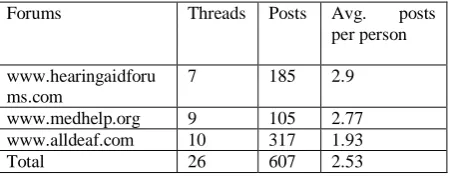
This data was filtered and reduced to 26 threads by removing the threads in which people did not discuss Hearing Aids. The threads con-tained 607 posts in them. Table 1 lists the forum web sites, the number of threads collected from each forum, the number of posts gathered from each forum, and an average number of posts written by each author.
1
http://www.medhelp.org, http://www.alldeaf.com, http://www.hearingaidforums.com
Forums Threads Posts Avg. posts
per person
www.hearingaidforu ms.com
7 185 2.9
www.medhelp.org 9 105 2.77 www.alldeaf.com 10 317 1.93
Total 26 607 2.53
Table 1. Filtered dataset collection statistics
We split the data from individual threads into sentences using our version of a regular expres-sion based sentence splitter. We partly removed noise from the text by removing sentences con-taining very few words (4 in our case) as they did not convey well-formed opinions, for example:
Sentence: No, educate me. Sentence: Max AVERAGE SPL. Sentence: Am I right ?
Sentence: It is permanent.
The remaining sentences from the 26 threads were manually annotated by two inde-pendent annotators into two classes (opinionated and non-opinionated). There were several cate-gories of opinionated and non-opinionated sen-tences. We provide the examples below.
Non-opinionated about Hearing Aids: Factual on Hearing Aids:
So a doubling of 'power' equates to a 3dB rise in measured output.
Not relevant to Hearing Aids:
Lots of jobs in that field and I was pleased that I have met all of the qualifications.
Opinionated about Hearing Aids: Positive
The aids you see discussed on this forum are designed with limiting factors intended to keep sound from being amplified to damaging levels.
Neutral/Unknown
I have yet to see an ENT indicate that properly adjusted hearing aids will either cause or not cause ear damage.
Negative
"I was referring to perception and in my understanding, even a duration of a few minutes can damage the ears."
5 Experiments
5.1 Manual Annotation
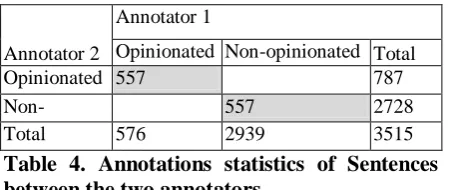
The dataset of 3515 sentences from 26 threads were manually annotated by two annotators. The annotators were asked to tag a sentence as opin-ionated if it conveys positive, negative or mixed opinions on hearing aids. All the sentences which do not contain any opinions are left blank and they are considered as non-opinionated. Accord-ing to Table 4, annotator1 and annotator 2 did not put the opinionated label a large number of sentences, i.e., 2939 and 2728 respectively. We further considered them as non-opinionated.
Annotator 2
Annotator 1
Opinionated Non-opinionated Total
Opinionated 557 787
Non-opinionated
557 2728
Total 576
218 128
2939 3515
Table 4. Annotations statistics of Sentences between the two annotators
To evaluate the annotator agreement, we calcu-lated kappa as in(Sokolova & Bobicev, 2011):
The overall percentage agreement between the annotators for the dataset was 93% and kappa was 0.78. This indicates a substantial agreement between the taggers in both the cases.
5.2 Dataset preprocessing
Due to the large number of irrelevant sentences, the dataset is very much imbalanced. A balanced dataset is necessary for accurate classification, as in the case of imbalanced dataset as this, if all sentences are considered as non-opinionated, the accuracy of the system is very high (83%), as the non-opinionated class dominates the opinionated class in the dataset. To be exact, there are 557 opinionated sentences and 2728 non-opinionated sentences. For this purpose, we reduce the non-opinionated sentences by applying a version of
the under-sampling technique (Barandela et al., 2004).
In contrast with a commonly applied ran-dom under-sampling, our under-sampling meth-od selects only certain sentences to keep them in the data set. For each occurrence of an opinion-ated sentence, the next non-opinionopinion-ated sentence is chosen to be kept, and the rest are discarded. The final dataset contains 1152 total sentences with 576 opinionated and non-opinionated sen-tences each.
5.3 Classification results
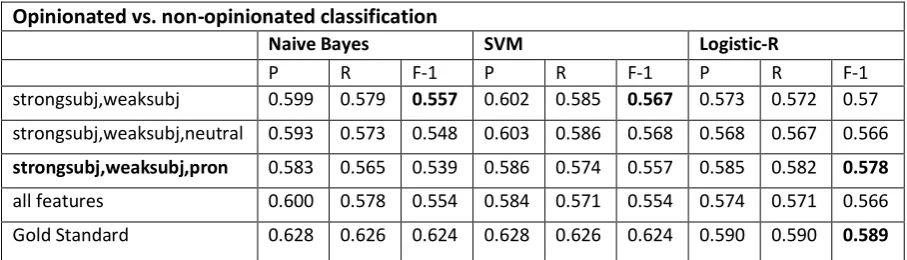
The output files generated by the system for both the datasets are classified using the WEKA (Hall et al., 2009). For our evaluation, we used 10-fold cross validation which is a standard clas-sifier selection for classification purpose. Exper-iments were performed using three different clas-sifiers: Naïve Bayes, support vector machine (SVM) and logistic regression (logistic-R). Per-formance was evaluated using the F1-measure between the three classifiers on the given da-tasets. The best performance for Naïve Bayes and support vector machine were 55.7% and 56.7% respectively with (strongsubj, weaksubj) feature. With Logistics-R the best performance was 57.8% with (strongsubj, weaksubj, pronoun) feature. It was found that the performance of lo-gistic regression was the best on the features se-lected for our evaluation.
Opinionated vs. non-opinionated classification
Naive Bayes SVM Logistic-R
P R F-1 P R F-1 P R F-1
strongsubj,weaksubj 0.599 0.579 0.557 0.602 0.585 0.567 0.573 0.572 0.57
strongsubj,weaksubj,neutral 0.593 0.573 0.548 0.603 0.586 0.568 0.568 0.567 0.566
strongsubj,weaksubj,pron 0.583 0.565 0.539 0.586 0.574 0.557 0.585 0.582 0.578
all features 0.600 0.578 0.554 0.584 0.571 0.554 0.574 0.571 0.566
Gold Standard 0.628 0.626 0.624 0.628 0.626 0.624 0.590 0.590 0.589
Table 5. Comparison of performance between different features among three classifiers
Table 5 shows that the improvement was 8.1% for Naïve Bayes, 9.2% for SVM and 10.2% for logistic-R. We evaluated different sets of fea-tures for the classification performance. Table 5 shows that the best performance of all classifiers was with different feature sets, as for Naïve Bayes it was with (strongsubj, weaksubj) at 55.7%, for SVM it was with (strongsubj, weak-subj, neutral) at 56.8% and for logistic-R it was with (strongsubj, weaksubj, pron) at 57.8%. It
was assumed that neutral word clues should indi-cate non-subjectivity, as they are neutral in polar-ity; however, the results did not show improve-ment with neutral features. This may be due to very limited neutral words in the lexicon, i.e., only 7.18%. The best classifier was logistic re-gression with the feature set (strongsubj, weak-subj, pron) with F1-measure 57.8%, which is slightly lower than the gold standard of 58.9% with logistic-R.
Opinionated vs. non-opinionated classification with lemmatization
Naive Bayes SVM Logistic-R
P R F-1 P Re F-1 P R F-1
Strongsubj,weaksubj,prp_phrase 0.596 0.58 0.562 0.604 0.591 0.577 0.586 0.58 3
0.57 9
strongsubj,weaksubj 0.604 0.58 0.554 0.605 0.591 0.576 0.584 0.58 0.57
5
strongsubj,weaksubj,neutral 0.600 0.582 0.562 0.597 0.583 0.568 0.584 0.58
3
0.58
strongsubj,weaksubj,pron 0.602 0.578 0.552 0.586 0.575 0.561 0.592 0.58
9
0.58 5
all features 0.602 0.58 0.556 0.593 0.582 0.569 0.582 0.57
9
0.57 5
Gold standard 0.628 0.626 0.624 0.628 0.626 0.624 0.590 0.59
0
0.58 9
Table 6. Comparison of performance with lemmatization between different features among three classifiers
As most opinions are expressed with the use of personal pronouns, we extracted the phrases that contain pronouns within sentences, e.g., I would assume, I feel as, I could sympathize. We consider the number of such phrases within sen-tences and evaluated the performance using combinations with other features. Also, to in-crease the number of matched words in the lexi-con, all the nouns and verbs were lemmatized to see if the classification performance increases. The classification results show improvement for all the classifiers. It is interesting to note that Na-ïve Bayes and SVM both have shown their best performance with the feature combining subjec-tivity clues and phrases with pronouns, which indicate the significance of pronouns for subjec-tivity; however logistics-R performed best with
subjectivity and phrases with pronoun features, but in this case pronoun phrase features show the 2nd best performance.
6
Analysis
The results from the experiments have provided various insights about opinion mining in health-related forums. For classification, the bag-of-words representation provided higher results than the other feature sets. We interpret this result an indication of the importance of the word mean-ing. The words were more important than their semantic orientation or polarity. We noticed that the subjectivity clues such as strong subjective or weak subjective labels from the lexicon have not increased the performance for identifying opin-ionated and non-opinopin-ionated sentences; they per-formed equivalently to the gold standard (i.e., bag-of-words). Also note that the bag-of-word representation (BOW) is a high gold standard that is hard to beat in many texts classification problems. In our case, a simple baseline of clas-sifying every sentence into the most frequent class is outperformed by the BOW representation by 13.6% on average among all the three classi-fiers. This difference indicates how difficult the opinion mining task is. The personal pronouns such as I, me, ours, yours, etc. also play an im-portant role, as these are commonly found in subjective sentences and the results have shown some improvement for features with pronouns. However, subjective clues and phrases that con-tain pronouns can lead to false prediction, e.g.:
Sentence 1:
I can understand that once the lost gain has been reapplied, techniques such as compression can reduce the additional amount of SPL DB that is required.
Sentence 2:
I understand you will have to practice for some time with any type of hearing aid.
Sentence 1 from our data is labeled by both
annotators as non-opinionated but it contains understand which is strong subjective in lexicon; also I can understand contains a pronoun. At the same time, Sentence 2 contains the same strong subjective word and the same pronoun, but it is labeled by both annotators as opinionated in the data. It has been noted that understand has oc-curred more in non-opinionated sentences, which in part provides the reason for the high perfor-mance of the baseline.
Our results are comparative to other related studies. We achieved Precision = 0.604, Recall = 0.591 and F-score = 0.577 with (
strong-subj,weaksubj,prp_phrase) feature set using the support vector machine classifier.
In general, for consumer reviews, opinion-bearing text segments are classified into positive and negative with Precision 56%−72% (Hu & Liu 2004). For online debates, the complete texts (i.e. posts) were classified as positive or negative stance with F-score 39%−67% (Somasundaran & Wiebe, 2009); when those posts were enriched with preferences learned from the Web, F-score increased to 53%−75%.
7
Conclusion and Future Work
In this work, we performed opinion mining of online messages related to Hearing Loss. We used several lexicon-based features together with the rule based features like pronoun phrases clas-sification of opinionated and non-opinionated sentences. As categories, we considered sentenc-es being opinionated if they contained opinions about Hearing Aids. Other sentences were con-sidered as non-opinionated. Evaluations have been made using three different classifiers and it is shown that our proposed features outper-formed the baseline classifier which uses only bag-of-word features.
In future work, we could use structural tures, dialogue act features, and sentiment fea-tures (Biyani & Bhatia, 2012) for the subjectivity classification of sentences. The lexicon could be improved, as the domain lexicon created in (Goeuriot et al., 2012) has shown better results over other dictionaries for polarity detection.
Acknowledgements
This work was supported by NSERC and by the CHEO Department of Surgery Research. We thank Brian Dewar for his assistance in finding medical forums.
References
Baccianella, S., Esuli, A., &Sebastiani, F. (2010, May).Sentiwordnet 3.0: An enhanced lexical re-source for sentiment analysis and opinion min-ing.In Proceedings of the 7th conference on Inter-national Language Resources and Evaluation (LREC’10), Valletta, Malta, May.
Barandela, R., Valdovinos, R. M., Sánchez, J. S., & Ferri, F. J. (2004). The imbalanced training sample
problem: Under or over sampling?. In Structural,
Biyani, P., Caragea, S. B. C., & Mitra, P. (2012) Thread specific features are helpful for identifying
subjectivity orientation of online forum
threads.COLING.
Bobicev, V., Sokolova, M., Jafer, Y., & Schramm, D. (2012).Learning sentiments from tweets with
per-sonal health information.In Advances in Artificial
Intelligence (pp. 37-48).Springer Berlin Heidel-berg.
Eysenbach, G. (2009). Infodemiology and infoveil-lance: framework for an emerging set of public health informatics methods to analyze search, communication and publication behavior on the
In-ternet. Journal of medical Internet research, 11(1).
Gillick, D. (2009, May). Sentence boundary detection
and the problem with the US. In Proceedings of
Human Language Technologies: The 2009 Annual Conference of the North American Chapter of the Association for Computational Linguistics, Com-panion Volume: Short Papers (pp. 241-244). Asso-ciation for Computational Linguistics.
Goeuriot, L., Na, J. C., Min Kyaing, W. Y., Khoo, C., Chang, Y. K., Theng, Y. L., & Kim, J. J. (2012, January). Sentiment lexicons for health-related
opinion mining.In Proceedings of the 2nd ACM
SIGHIT International Health Informatics Symposi-um (pp. 219-226).ACM.
Hall, M., Frank, E., Holmes, G., Pfahringer, B., Reutemann, P., & Witten, I. H. (2009).The WEKA
data mining software: an update. ACM SIGKDD
Explorations Newsletter, 11(1), 10-18.
Hu, M., & Liu, B. (2004, August).Mining and
sum-marizing customer reviews.In Proceedings of the
tenth ACM SIGKDD international conference on Knowledge discovery and data mining (pp. 168-177).ACM.
Kennedy, A., & Inkpen, D. (2006).Sentiment classifi-cation of movie reviews using contextual valence
shifters. Computational Intelligence, 22(2),
110-125.
Newman, M. L., Pennebaker, J. W., Berry, D. S., & Richards, J. M. (2003).Lying words: Predicting
de-ception from linguistic styles. Personality and
So-cial Psychology Bulletin, 29(5), 665-675.
Rhodewalt, F., & Zone, J. B. (1989). Appraisal of life change, depression, and illness in hardy and
non-hardy women. Journal of Personality and Social
Psychology, 56(1), 81.
Sokolova, M., &Bobicev, V. (2011).Sentiments and
Opinions in Health-related Web
messag-es.In Recent Advances in Natural Language Pro-cessing (pp. 132-139).
Somasundaran, S., &Wiebe, J. (2009, Au-gust).Recognizing stances in online debates. In Proceedings of the Joint Conference of the 47th
Annual Meeting of the ACL and the 4th Interna-tional Joint Conference on Natural Language Pro-cessing of the AFNLP: Volume 1-Volume 1 (pp. 226-234). Association for Computational Linguis-tics.
Taboada, M., Brooke, J., Tofiloski, M., Voll, K., &Stede, M. (2011).Lexicon-based methods for
sen-timent analysis. Computational linguistics, 37(2),
267-307.
Wilson, T., Wiebe, J., & Hoffmann, P. (2005, Octo-ber).Recognizing contextual polarity in
phrase-level sentiment analysis.In Proceedings of the
con-ference on Human Language Technology and Em-pirical Methods in Natural Language Pro-cessing (pp. 347-354).Association for Computa-tional Linguistics.
Yi, J., Nasukawa, T., Bunescu, R., &Niblack, W. (2003, November). Sentiment analyzer: Extracting sentiments about a given topic using natural
lan-guage processing techniques. In Data Mining,
2003.ICDM 2003. Third IEEE International