Knowledge-Poor Approach to Shallow Parsing:
Contribution of Unsupervised Part-of-Speech Induction
Marie Guégan
Syllabs
15, rue Jean-Baptiste Berlier
75013 Paris, France
[email protected]
Claude de Loupy
Syllabs
15, rue Jean-Baptiste Berlier
75013 Paris, France
[email protected]
Abstract
Natural language processing tasks often rely on part-of-speech (POS) tagging as a prepro-cessing step. However it is not clear how the absence of any part-of-speech tagger should hamper the development of other natural lan-guage processing tools. In this paper we in-vestigate the contribution of fully unsuper-vised part-of-speech induction to a common natural language processing task. We focus on the supervised English shallow parsing task and compare systems relying either on POS induction, on POS tagging, or on lexical features only as a baseline. Our experiments on the English CoNLL'2000 dataset show a significant benefit from POS induction over the baseline, with performances close to those obtained with a traditional POS tagger. Re-sults demonstrate a great potential of POS in-duction for shallow parsing which could be applied to resource-scarce languages.
1
Introduction
Shallow parsing is a specific type of phrase chunking which is often used for different Natu-ral Language Processing (NLP) tasks like text mining or question answering. The goal of the task is to divide a text into syntactically related non-overlapping groups of words (Tjong Kim Sang and Buchholz, 2000). These include noun, verb, or adjective phrases. It usually requires a part-of-speech (POS) tagger and a training cor-pus annotated with shallow parsing tags.
Unfortunately, one is often constrained by the lack of resources, tools or language experts, for instance when dealing with resource-scarce lan-guages. In particular, the elaboration of a POS tagger is a delicate issue. Without any linguistic expert, the only possible approaches are statistic-al. Training POS taggers requires the manual
constitution of either a large annotated corpus or a large morphosyntactic lexicon. These resources are very costly, both in time and in terms of lin-guistic knowledge required from the annotator.
By contrast, we notice that the concept of shal-low parsing is relatively easily understandable by native speakers, even if they are not linguists. Relative to POS tagging, its annotation does not require a prohibitive amount of time and effort1. This is especially the case when the full shallow parsing task is reduced to a certain chunk type, as noun phrases for instance. Hence we think the most difficult requirement for the task is the POS tagging preprocessing step.
This observation drew our attention to the fol-lowing question: is the POS tagging step neces-sary to shallow parsing? In this paper we intend to show how shallow parsing may benefit from fully unsupervised POS induction methods, as an alternative to accurate POS tagging. Section 2 introduces related work. Despite the popularity of shallow parsing and POS induction, we found only one paper related to POS induction for shal-low parsing. Section 3 describes the models, tools and corpora we used: an existing POS in-duction tool (Clark, 2003), an implementation of Conditional Random Fields (CRF++) and the CoNLL’2000 dataset. Experiments and results are presented in Section 4. POS induction greatly improves the baseline, with performances close to supervised POS tagging.
2
Related Work
Shallow parsing has become a common task in NLP. The originality of our method is to rely on part-of-speech induction rather than accurate POS tagging.
1
The standard English shallow parsing corpus contains around 50 distinct POS tags and only 10 chunk types.
2.1 Shallow Parsing
Traditional approaches rely on preprocessing by an accurate POS tagger. Most work on shallow parsing is based on the English CoNLL’2000 shared task, which provided reference datasets for training and testing. The CoNLL dataset ac-tually contains POS tags assigned by the Brill (1995) tagger. A number of approaches have been evaluated on these datasets, for general shallow parsing as well as for the simpler noun phrase chunking task: support vector machines (SVM) with polynomial kernels (Kudo and Mat-sumoto, 2001; Goldberg and Elhadad, 2009) and linear kernels (Lee and Wu, 2007), conditional random fields (Sha and Pereira, 2003), maximum likelihood trigram models (Shen and Sarkar, 2005), probabilistic finite-state automata (Araujo and Serrano, 2008), transformation-based learn-ing or memory-based learnlearn-ing (Tjong Kim Sang, 2000). So far, SVM have achieved the best state-of-the-art performances.
To our knowledge, little work has considered other languages. Chunking corpora have been derived from the Arabic Treebank (Diab et al., 2004) and the UPENN Chinese Treebank-4 (Chen et al., 2006). Goldberg et al. (2006) showed that the traditional definition of base noun phrases as non-recursive noun phrases does not apply in Hebrew, and proposed an alternate definition. Nguyen et al. (2009) discuss on how to build annotated data for Vietnamese text chunking and how to apply discriminative se-quence learning to Vietnamese text chunking. The lack of tools and annotated corpora in non-English languages is clearly an issue.
Following this observation and contrary to the approaches cited above, we make the assumption that no POS tagger is available. To compare our work with previous approaches and to allow ex-tensive experiments, we evaluated our method on English using the standard CoNLL’2000 dataset. The lack of similar annotated corpora in other languages unfortunately constrained the scope of this article to English.
2.2 Part-of-Speech Induction
Unlike van den Bosch and Buchholz (2002) who studied shallow parsing on the basis of lexical features only, we choose to incorporate features related to the traditional notion of part of speech. In this work we apply part-of-speech induction techniques to acquire additional features. This task differs from semi-supervised part-of-speech tagging, where the tagger is trained on an
un-tagged corpus but uses a morphosyntactic lex-icon giving possible tags for each word (e.g. (Merialdo, 1994)). Part-of-speech induction is the task of clustering words into word classes (or pseudo-POS) in a completely unsupervised set-ting. No prior knowledge such as a morphosyn-tactic lexicon is required. The only resource needed is a relatively large training text corpus.
Christodoulopoulos et al. (2010) and (Bi-emann, 2010) compiled helpful surveys of the domain. Christodoulopoulos et al. (2010) eva-luated seven POS induction systems spanning nearly 20 years of work: class-based n-grams (Brown et al., 1992), class-based n-grams with morphology (Clark, 2003), Chinese Whispers graph clustering (Biemann, 2006), Bayesian HMM with Gibbs sampling (Goldwater and Grif-fiths, 2007), Bayesian HMM with variational Bayes (Johnson, 2007), sparsity posterior-regularization HMM (Graça et al., 2009), and feature-based HMM (Berg-Kirkpatrick et al., 2010). The performance measures were mainly based on mapping accuracies (with respect to a gold standard) and entropy coefficients.
Biemann et al. (2007) and Biemann (2010) succinctly tested their Chinese Whispers algo-rithm on the shallow parsing task with the Eng-lish CoNLL’2000 dataset. They showed a signif-icant improvement of the use of unsupervised pseudo part-of-speech tags over the baseline that discarded any POS information. However, their experiments covered several tasks and were not focused on shallow parsing. By contrast, in this article we use an alternate POS induction algo-rithm and propose a more in-depth evaluation of shallow parsing with POS induction.
3
Resources, Models and Tools
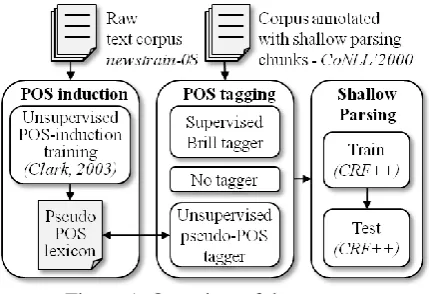
This section describes the tools and resources used in this work. Figure 1 depicts the global organization of our modules.
3.2 CRFs for Shallow Parsing
Model and Tool
We follow Sha and Pereira (2003), who achieved near state-of-the-art results on the English shal-low parsing task using Conditional Random Fields (CRFs) (Lafferty et al., 2003). CRFs allow us to incorporate a large number of features in a flexible way. We used the CRF++ implementa-tion5, distributed under the GNU Lesser General Public License and new BSD License.
Our feature set is defined as follows. On a 5-token window centered on the current 5-token to be classified, we included all lowercased form token unigrams and bigrams, as well as (pseudo) POS tag unigrams, bigrams and trigrams. We also in-corporated phrase chunk label bigrams. These features are commonly used for shallow parsing. Finally, we added on the same 5-token window a feature indicating whether the forms begin with a capital, as well as features accounting for the form ending (3 characters) on a window of 3 to-kens. The purpose of these features is to facilitate the classification of unknown words by incorpo-rating morphological information into the model. In some experiments (see Section 4.4), we tried several feature frequency cutoff values, va-rying from 1 occurrence in the training set to at least 100. The default is set to 1.
Corpus
The standard reference corpus for English shal-low parsing is the CoNLL’2000 shared task data-set. The CoNLL dataset6 was automatically de-rived from a subset of the Wall Street Journal (WSJ) portion of the Penn Treebank. It consists of partitions of the WSJ: sections 15-18 as train-ing data (8936 sentences) and section 20 as test data (2012 sentences). It contains phrase bounda-ries in the IOB representation, as well as part-of-speech tags assigned by the Brill tagger7. The corpus contains 48 Brill tags.
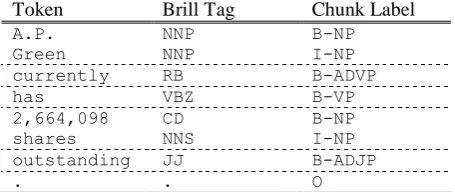
A sentence extracted from the CoNLL training corpus is shown in Table 2. Here, chunk phrases are separated with horizontal dashed lines. Each chunk type has 2 types of chunk labels: prefix B indicates the beginning of the chunk phrase, and prefix I stands for inside the chunk phrase. Label O represents tokens that do not belong to any phrase.
5
Available at http://crfpp.sourceforge.net/
6
See http://www.clips.ua.ac.be/conll2000/chunking/
7
The original manually annotated tags from WSJ were dis-carded in order to make the CoNLL task more realistic.
Token Brill Tag Chunk Label
A.P. NNP B-NP
Green NNP I-NP
currently RB B-ADVP
has VBZ B-VP
2,664,098 CD B-NP
shares NNS I-NP
outstanding JJ B-ADJP
. . O
Table 2. Example sentence from the CoNLL'2000 training corpus
In some experiments, we discarded all Brill tags. In our POS-induction-based experiments, we replaced them with pseudo-POS tags.
4
Experiments and Results
Our experiments have 4 goals: (i) estimate the gain of POS induction over a system that does not rely on any part-of-speech information; (ii) estimate performance variation depending on the size of the shallow parsing training corpus; (iii) study the influence of the number of pseudo-POS clusters; (iv) observe the system behavior with CRF feature pruning. Our results were evaluated using the Perl script provided by CoNLL8.
4.1 The CoNLL Shallow Parsing Task
We first evaluated our system in the traditional setting. Our objective is to estimate the potential of POS induction for shallow parsing in the case where no POS tagger is available.
We conducted three runs using the same CRF feature template (Section 3.2), depending on whether the POS tags are the original Brill tags from the corpus (Brill), our pseudo-POS tags (P50), or no tag at all as a baseline (NoPOS). For this experiment, we used the CoNLL datasets for training and testing. The pseudo-POS tagger was learnt on the full newstrain-08 corpus. We set the number of pseudo-POS tags to 50, which is comparable to the number of Brill tags.
Detailed results are presented in Table 3. It shows precision, recall and F-measure for each chunk category. Precision is the percentage of correct phrases over the total number of phrases annotated by the system. Recall is the percen-tage of correct phrases over the total number of true phrases in the reference. The F-measure is defined as the harmonic mean of precision and recall9.
8http://www.cnts.ua.ac.be/conll2000/chunking/conlleval.txt 9
Baseline: NoPOS Unsupervised: P50 Supervised: Brill
Chunk types found found found
ADJP 80.00 59.36 68.15 325 79.05 68.04 73.13 377 81.27 76.26 78.68 411
ADVP 84.21 75.75 79.76 779 82.94 80.25 81.57 838 84.24 80.83 82.50 831
CONJP 38.46 55.56 45.45 13 55.56 55.56 55.56 9 50.00 55.56 52.63 10
INTJ 100 100 100 2 100 50.00 66.67 1 100 50.00 66.67 1
LST 0 0 0 0 0 0 0 0 0 0 0 0
NP 91.38 91.01 91.19 12372 94.09 93.87 93.98 12393 94.44 94.13 94.29 12381
PP 96.71 97.15 96.93 4833 96.47 98.17 97.31 4896 96.84 98.03 97.43 4870
PRT 76.79 81.13 78.9 112 77.68 82.08 79.82 112 78.85 77.36 78.10 104
SBAR 85.82 83.74 84.77 522 89.49 85.98 87.70 514 88.10 85.79 86.93 521
VP 91.64 90.58 91.10 4604 93.33 93.09 93.21 4646 93.78 94.18 93.98 4678
All 91.91 90.79 91.34 23562 93.61 93.35 93.48 23786 93.99 93.82 93.90 23807
Accuracy 94.61 95.84 96.12
Table 3. Detailed chunking results for the English shallow parsing task
Column found inTable 3 gives the total num-ber of phrases annotated by the system (correct or incorrect). Accuracy is the percentage of cor-rect guesses at the token level.
First, we recall that the state-of-the art system of Lee and Wu (2007) reached a 94.22% F-measure using Brill part-of-speech tags. Compa-rably, our system performs reasonably well when using the same tags (Brill: F-measure 93.90%), considering that it was not subject to any refine-ments. Without any POS information, the system already achieves a high F-measure (91.34%).
We observe a 2% overall gain of P50 (F-measure 93.48%) over NoPOS, and a drop from Brill inferior to 0.5%. P50 beats Brill on a few categories, although not substantially: conjunc-tions, particles, and subordinating conjunctions. Its performances are very close to Brill on the 4 most frequent chunk types: adverb phrases, noun phrases, prepositional phrases, and verb phrases. These results incidentally suggest a great poten-tial of the approach for noun phrase chunking, for which state-of-the-art systems reach about 96.8% F-measure (Araujo and Serrano, 2008).
The category of adjective phrases is the most difficult. Although significantly improving the recall of NoPOS, the F-measure for P50 lies ex-actly between NoPOS and Brill.
Looking into the test corpus
We examined the output test corpus to explain the differences between the unsupervised ap-proach (P50) and the supervised apap-proach (Brill). The accuracies tell us that on 47,377 tokens, Brill correctly tagged 130 tokens more than P50. Looking specifically at the 2,808 tokens that were unknown to the pseudo-POS tagger, Brill correctly tagged 16 tokens more than P50.
Un-known words thus only account for 12% of the 130-token advantage.
The major sources of disagreement on chunks are shown in Table 4. These account for more than half the 130-token difference. It shows for instance that in cases where Brill chose B-NP and P50 chose I-NP, Brill was correct for 15 to-kens more than P50. We observe that P50 tends to annotate too long noun and verb phrases (P50: incorrect I-NP and I-VP). It also shows more difficulties finding the beginning of verb and adjective phrases (Brill: B-VP and B-ADJP).
Finally, we examined the Brill parts of speech of misclassified chunks on which Brill and P50 disagreed (see Table 5). P50 mostly fails on ad-jectives and adverbs. Yet it better classifies IN tokens (preposition, subordinating conjunction).
Brill P50 Brill correct P50 correct Diff B-NP I-NP 79 64 15 B-VP B-PP 21 9 12 B-ADJP B-ADVP 17 6 11 B-ADJP B-VP 11 0 11 B-ADVP I-NP 11 2 9 B-VP B-NP 26 17 9 B-VP I-VP 20 11 9
Table 4. Disagreement between Brill and P50 on a few chunks
Brill POS Brill correct P50 correct Diff
JJ 87 49 38
RB 74 46 28
TO 34 21 13
VBG 37 26 11
VB 22 13 9
CC 56 49 7
IN 39 53 -14
4.2 Training Corpus Size
Corpora such as the CoNLL’2000 dataset are expensive to produce and not yet available for many languages. Therefore we were interested in the evolution of performances with the size of the training corpus. We repeated the experiments from previous section on corpus sizes ranging from 1% (approximately 90 sentences) to 100% (approximately 9000 sentences). All systems were tested on the CoNLL test set. Each experi-ment was run on 20 different splits of the train-ing corpus (except for the full corpus).
In addition, we wanted to take into account the difficulty of compiling large monolingual corpo-ra in some languages. We therefore also tested the method using a much smaller corpus for POS induction training. It contains a subset of 1 mil-lion words from the newstrain-08 corpus, as op-posed to 500 million for the full corpus (see Sec-tion 3.1). In this experiment we also set the num-ber of pseudo-POS clusters to 50.
Figure 2 shows the F-measures for varying sizes of the training corpus on the abscissa on a logarithmic scale. The four curves correspond to the following taggers: Brill, pseudo POS tagger trained on the full newstrain-08 corpus (P50), pseudo POS tagger trained on the smaller new-strain corpus (P50m), and no tagger (NoPOS). Each point denotes the mean of the 20 runs. To give an insight of the variation in F-measure across all runs, we added box plots on the P50 curve. Each box is centered on the median of the runs. Half the points lie between its lower and upper sides. The whiskers extend to the most extreme data point which is no more than 1.5 times the height of the box away from the box.
We observe a significant improvement of our POS-induction-based systems over the baseline (NoPOS), especially for smaller training corpora. For a 1% sample of the CoNLL corpus, the F-measures are approximately 65% only for the baseline (NoPOS), 78% for the unsupervised systems (P50 and P50m) and 83.5% in the su-pervised setting (Brill).
A 90% F-measure is achieved starting from 10% of the training corpus by Brill, and starting from 20% by P50. More generally, the unsuper-vised system needs a little more than twice as much annotated data as the supervised system to achieve a similar F-measure.
With less than 200 sentences (2% sample), the unsupervised system almost achieves 83% F-measure, which is only achieved by the baseline starting from 900 sentences (10% sample).
Figure 2. F-measure depending on the training corpus sample size and on the POS tagger
Finally, we notice that P50 and P50m get very close results, despite the fact that their pseudo POS taggers have been trained on 500M tokens and 1M tokens respectively. This result validates the approach for the case where only relatively small raw text corpora are available for training the pseudo POS tagger. This finding could be highly valuable for resource-scarce languages.
4.3 Number of pseudo-POS clusters
Some POS induction algorithms have the advan-tage over supervised POS tagging to easily adapt the number of word classes to the task.
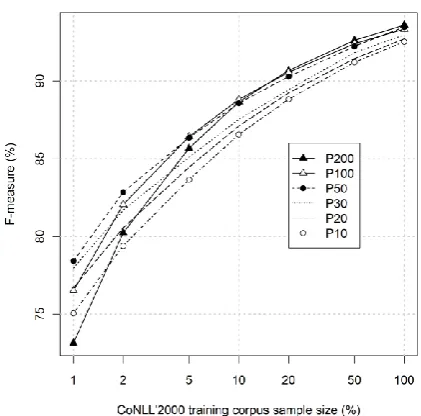
Biemann (2010) conjectures for the same chunking task that results could be significantly improved with a smaller cluster number. To veri-fy this hypothesis, we trained several pseudo-POS taggers with a cluster number between 10 and 200. Similarly to the experiments reported in the previous section, we evaluate the systems on varying sizes of the CoNLL training corpus10.
Results are presented in Figure 3. From 10 to 50 clusters, performances increase with the num-ber of clusters for all sizes of the training corpus. By contrast, P100 and P200 only improve over P50 for corpus sizes superior to 10%, which represents about 900 sentences. This can be attri-buted to the sparseness of pseudo POS tags in small training sets. We conclude that for small training corpus sizes, the number of pseudo-POS tags should be chosen carefully. On the whole, the F-measures vary in a 5.3% interval for a 1% sample, and in a 1.1% interval for the full corpus.
10
Figure 3. F-measure depending on the CoNLL’2000 training corpus sample size for a varying number of pseudo-POS clusters
The F-measures obtained using the full train-ing dataset are: 93.6 (P200), 93.34 (P100), 93.48 (P50), 92.97 (P30), 92.72 (P20), and 92.53 (P10). They were 91.34 for the baseline and 93.9 for Brill (see Table 3): even 10 pseudo-POS clusters are sufficient to beat the baseline, and this is va-lid for all sizes of the training corpus.
4.4 CRF Feature Selection
In the last experiment we tested CRF feature pruning. The idea is to select the features appear-ing at least times in the training corpus. This was motivated by Goldberg and Elhadad (2009), who explored the importance of lexical features in shallow parsing and other sequence labeling tasks. The performance of their anchored SVM system only decreased from 93.69% to 93.12% with heavy pruning ( ), while the base-line dropped from 93.73% to 91.83%. In addi-tion, they showed comparable performances be-tween heavily pruned models and full models when tested on out-of-domain data.
As in Goldberg and Elhadad (2009), we set the feature frequency threshold to values ranging from 1 to 100. Each experiment was run only once using the whole CoNLL training corpus.
Figure 4 shows that the supervised part-of-speech tagging system is the most robust to fea-ture pruning. It loses less than 1% for . In comparison, the baseline NoPOS loses 4.3%. This indicates a strong dependency to the domain of the training corpus.
Figure 4. F-measure for various CRF feature pruning thresholds
The unsupervised systems resist quite well to feature pruning for , losing 1.1% and 1.6% F-measure for 200 and 50 clusters. P50 models have around 350,000 features for
and 5,100 features only for , while the baseline keeps from 270,000 to 2,200 features.
As in Goldberg and Elhadad (2009), it will be interesting to test the pruned models on out-of-domain corpora, and see how POS induction-based systems behave in comparison to systems relying on accurate part-of-speech information.
5
Conclusion and Future Work
In this paper, we study the contribution of part-of-speech induction to shallow parsing. The gen-eral context of our work is the automatic treat-ment of minority languages for which few lin-guistic resources are available, though we expe-rimented on English only. Our constraint is the lack of any POS tagger. The experiments were carried out on the standard English CoNLL’2000 dataset, which allowed extensive experiments and explicit comparison to related work. We used Clark (2003)’s tool for the POS induction step and CRF++ for the shallow parsing train and test steps. Results show a significant advantage of POS-induction-based systems over a baseline which uses lexical features only.
lan-guages, it could be a very interesting point to manage NLP for resource-scarce languages.
Acknowledgments
The research leading to these results has received funding from the European Community’s Se-venth Framework Programme (FP7/2007-2013) under Grant Agreement n° 24800511.
References
Araujo, L., & Serrano, J. I. (2008). Highly accurate error-driven method for noun phrase detection.
Pattern Recognition Letters, 29(4), 547-557. Berg-Kirkpatrick, T., Bouchard-Côté, A., DeNero, J.,
& Klein, D. (2010). Painless unsupervised learning with features. Proceedings of HLT-NAACL 2010
(pp. 582-590).
Biemann, C. (2006). Unsupervised Part-of-Speech Tagging Employing Efficient Graph Clustering.
Proceedings of ACL-CoLing 2006 - Student Re-search Workshop (pp. 7-12).
Biemann, C. (2010). Unsupervised Part-of-Speech Tagging in the Large. Research on Language and Computation, 7(2-4), 101-135.
Biemann, C., Giuliano, C., & Gliozzo, A. (2007). Un-supervised Part of Speech Tagging Supporting Su-pervised Methods. Proceedings of RANLP-07. van den Bosch, A., & Buchholz, S. (2001). Shallow
parsing on the basis of words only. Proceedings of ACLʼ02 (p. 433).
Brill, E. (1995). Transformation-based error-driven learning and natural language processing: a case study in part-of-speech tagging. Computational Linguistics, 21(4), 543-565.
Brown, P. F., DeSouza, P. V., Mercer, R. L., Pietra, V. J. D., & Lai, J. C. (1992). Class-Based n-gram Models of Natural Language. Computational Lin-guistics, 18(4), 467-479.
Chen, W., Zhang, Y., & Isahara, H. (2006). An Em-pirical Study of Chinese Chunking. Proceedings of COLING/ACL 2006 Poster Sessions (pp. 97-104). Christodoulopoulos, C., Goldwater, S., & Steedman,
M. (2010). Two decades of unsupervised POS in-duction: how far have we come? Proceedings of EMNLP 2010 (pp. 575-584).
Clark, A. (2003). Combining distributional and mor-phological information for part of speech induc-tion. Proceedings of EACL 2003 (pp. 59-66). Diab, M., Hacioglu, K., & Jurafsky, D. (2004).
Auto-matic Tagging of Arabic Text: From Raw Text to
11
http://www.ttc-project.eu
Base Phrase Chunks. Proceedings of HLT-NAACL 2004: Short Papers (p. 149–152).
Goldberg, Y., Adler, M., & Elhadad, M. (2006). Noun phrase chunking in Hebrew: influence of lexical and morphological features. Proceedings of ACL-CoLing 2006 (pp. 689-696).
Goldberg, Y., & Elhadad, M. (2009). On the role of lexical features in sequence labeling. Proceedings of EMNLP 2009 (pp. 1142-1151).
Goldwater, S., & Griffiths, T. L. (2007). A fully Bayesian approach to unsupervised part-of-speech tagging. Proceedings of ACLʼ07 (pp. 744-751). Graça, J., Ganchev, K., Taskar, B., & Pereira, F.
(2009). Posterior vs. Parameter Sparsity in Latent Variable Models. Proc. of NIPS (p. 664–672). Johnson, M. (2007). Why Doesnʼt EM Find Good
HMM POS-Taggers? Proceedings of EMNLP-CoNLL 2007.
Kudo, T., & Matsumoto, Y. (2001). Chunking with support vector machines. Proceedings of NAACL 2001 (pp. 1-8).
Lafferty, J., McCallum, A., & Pereira, F. (2001). Conditional random fields: Probabilistic models for segmenting and labeling sequence data. Proceed-ings of ICMLʼ01 (pp. 282–289)
Lee, Y.-S., & Wu, Y.-C. (2007). A robust multilin-gual portable phrase chunking system. Expert Sys-tems with Applications, 33(3), 590-599.
Merialdo, B. (1994). Tagging English text with a probabilistic model. Computational Linguistics,
20(2), 155--171. MIT Press.
Ney, H., Essen, U., & Kneser, R. (1994). On structur-ing probabilistic dependencies in stochastic lan-guage modelling. Computer Speech and Language,
8(1), 1-38.
Nguyen, L. M., Nguyen, H. T., Nguyen, P. T., Ho, T. B., & Shimazu, A. (2009). An empirical study of Vietnamese noun phrase chunking with discrimina-tive sequence models. Proc. of the 7th Workshop on Asian Language Resources (pp. 9-16).
Sha, F., & Pereira, F. (2003). Shallow parsing with conditional random fields. Proceedings of NAACL 2003 (pp. 134-141).
Shen, H., & Sarkar, A. (2005). Voting Between Mul-tiple Data Representations for Text Chunking. In
Advances in Artificial Intelligence (Vol. 3501, pp. 389-400). Springer Berlin / Heidelberg.
Tjong Kim Sang, E. F. (2000). Noun Phrase Recogni-tion by System CombinaRecogni-tion. Proceedings of NAACL 2000 (p. 6).