Implementation of Itree-MAC Protocol for Effective Energy Consumption in
Wireless Sensor Networks
K. S. Ananda Kumar1, R. Balakrishna2
1Research Scholar (CSE) & Asst. Professor, Department of ISE, Raja Rajeswari College of Engineering,
Bangalore, Karnataka, India
2Principal & Professor, Raja Rajeswari College of Engineering, Bangalore, Karnataka, India
ABSTRACT
Recent day’s wireless sensor networks, obtain a lot of importance to researchers. Energy efficiency is playing a key role in ensuring a secure, consistent and sustainable scheme for the future. Reliable data communication and energy consumption are the mainly significant parameters that are required in wireless sensor networks. Here, the author focuses on the following parametric measures like - energy consumption and packet delivery ratio. Many number of sensor nodes are spread that can communicate with all other nodes in the network. Different MAC protocols have been planned to improve the efficiency more by enhancing the packet delivery ratio, reliability and less energy consumption. In this paper the author proposes a new scheme based on Itree-MAC protocol, NS2 is used for implementation of this protocol.Itree-Itree-MAC provides a high packet delivery ratio and less energy consumption. The results show that energy consumption is very less in Itree-MAC compared to other protocols like IRC-MAC and RC MAC protocols.
Keywords : Energy Consumption; Itree MAC, Medium Access Control, RC-MAC, Wireless Sensor Networks
I.
INTRODUCTIONA wireless sensor network consists of a group of small, normally battery-powered devices and wireless infrastructure that record conditions in different environments like hospital, industry, wild. The sensor network connects to the net, an enterprise network, or a industrial network so that the collected information can be transferred to repository systems for different analysis purpose and used in various applications.
Wireless MAC protocols are divided into two types, distributed and centralized. In distributed, random access is one type, again centralized MAC protocols have divided into three categories, i) random access ii) guaranteed access iii) hybrid access. Wireless medium makes the MAC layer design have important issues
are a) half duplex operation b) errors in burst channel iii) time varying channels[5].
In wireless sensor networks, the amount of information moved from source node to a destination node in a certain time period in transmission channel, this means that the total number of packets received at destination node are called throughput. At base station throughput value is more when packet size increases, after some point of time it is not capable of carrying the load, during that time its value decreases. Here necessity for characterization of throughput for enhancing in wireless sensor networks [6, 9].
section 4, the conclusion of the paper explained in section 5.
II.
LITERATURE REVIEWKyunghee Sun et. al proposes a MAC scheme for energy efficiency in wireless sensor networks. In proposed scheme, it includes communication and information technologies such as Internet o Things, Big data analytics, cloud and fog computing, these are highly suitable for smart sensor devices in networking atmosphere. In smart sensor nodes, to improve network lifetime using longer distances from sink nodes [01].
Pijus Kumar Pal et al, proposes a means have used in the development of WSN which is in advance reputation gradually and is used in broad range of applications. Here they conclude that, consider the both positive and negative points, for future research distributed standard MAC protocols are used for Energy efficient purposes in wireless sensor network [02].
Vinicius Galvao et al proposes, WSN in automated atmosphere based on TDMA and S-MAC protocol, maintaining a less energy consumption and high throughput. Considering both TDMA & CSMA proposing a new protocol it contain low energy consumption comparing with S-MAC [03].
Hesham Sh. Elhelw et. al, proposes a novel MAC protocol E2MAC, mainly concentrated on packet delivery, delay and low consumption of energy, they conclude that, E2MAC is mainly used for high level sensor networks [04].
Xiaoli Zhou et. Al, they analyzed the two mac protocols related to throughput, end to end delay, energy consumption for different environments for queueing theory. Results showed that design
the throughput, end to end delay, consumption of energy for various environments [7].
Rachid et al, proposes the energy consumption is a main resource that can be used for minimize the transmissions in network. Less average throughput and energy consumption are noticed in IEEE 802.11. Analyze the DCF using a access point and various mobile devices in markov model [8].
III.
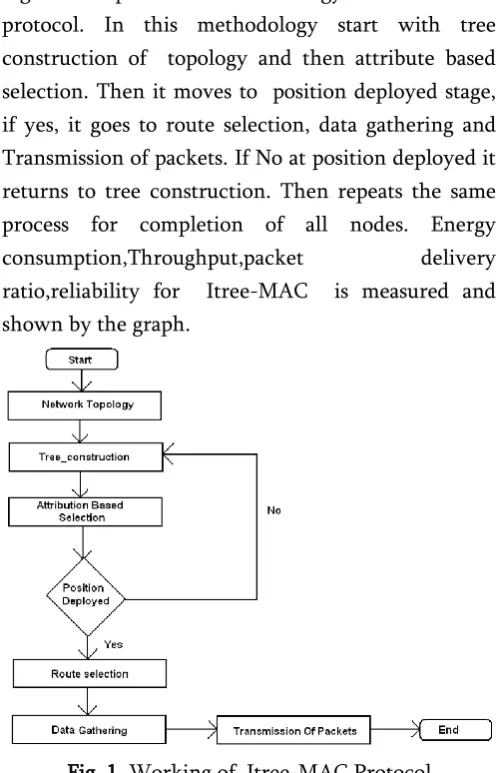
PROPOSED METHODOLOGYFigure 1 explains the methodology for Itree MAC protocol. In this methodology start with tree construction of topology and then attribute based selection. Then it moves to position deployed stage, if yes, it goes to route selection, data gathering and Transmission of packets. If No at position deployed it returns to tree construction. Then repeats the same process for completion of all nodes. Energy consumption,Throughput,packet delivery ratio,reliability for Itree-MAC is measured and shown by the graph.
Fig. 1. Working of Itree-MAC Protocol
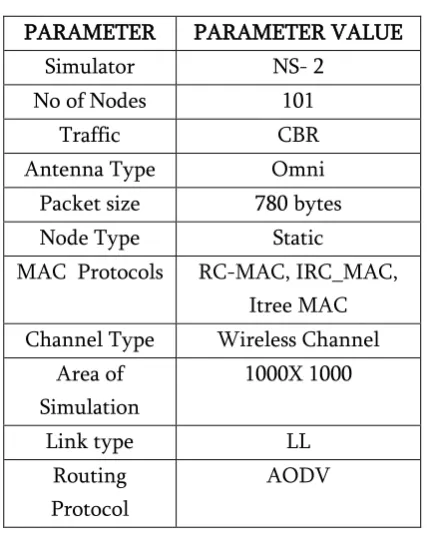
performance of the Receiver Centric -MAC, Improved Receiver Centric -MAC and Itree MAC protocol with various parametric measures like Packet Delivery Ratio, Energy Consumption. In the experimental setup, Analysis of RC-MAC, IRC-MAC and Itree-MAC protocols for WSN’s are performed using the NS2 tool. In experimental setup we are using AODV routing protocol, wireless channel, packet size of 780 bytes and no of nodes used are 101. The analysis of MAC, RC-MAC, IRC-MAC and Itree MAC protocols for wireless sensor networks is performed using NS2 tool. Table 1 shows the parameters used in the simulation setup [06].
TABLE 1. SIMULATION PARAMETERS
PARAMETER PARAMETER VALUE Simulator NS- 2
No of Nodes 101 Traffic CBR Antenna Type Omni
Packet size 780 bytes Node Type Static
MAC Protocols RC-MAC, IRC_MAC, Itree MAC Channel Type Wireless Channel
Area of Simulation
1000X 1000
Link type LL Routing
Protocol
AODV
A. Performance Analysis of Energy Consumption and Packet Delivery Ratio in Itree-MAC Protocol
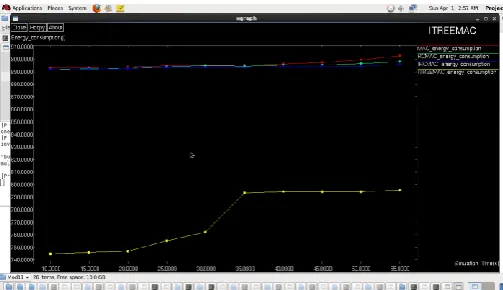
Fig. 2. Itree-MAC Energy Consumption Vs Simulation time
In fig 2,in the proposed work the slots of simulation time in 10, 15, 20, 25 & 30 sec. Here Energy Consumption gradually increase from first point to last point with time.
Fig. 3. Itree-MAC Packet Delivery Ratio Vs Simulation time
In fig 3, in the proposed work, the slots of simulation time in 10, 15,20, 25 & 30 sec. Here Packet Delivery Ratio first decreases and then gradually increases with time.
Fig. 4.Comparison of Energy Consumption between MAC, RC-MAC,IRC MAC and Itree MAC Protocols
Here from the comparison of Energy Consumption of MAC, Receiver Centric -MAC, Improved Receiver Centric -MAC and Itree MAC protocols as shown in fig 4. Results show that Itree MAC protocol have using very less energy compare to MAC, RC-MAC, IRC-MAC.
Fig. 5. Comparison of Packet Delivery Ratio between MAC, RC-MAC,IRC MAC and Itree MAC Protocols
Here for the comparison of the Packet Delivery Ratio of MAC, Receiver Centric -MAC, Improved Receiver Centric -MAC and Itree MAC protocols as shown in fig 5. Results show that Itree MAC protocol has more Packet Delivery Ratio compare to MAC, Receiver Centric -MAC, Improved Receiver Centric -MAC protocols.
V.
CONCLUSIONIn this work, packet delivery ratio and Energy consumption parameters are considered. These parameters are evaluated using MAC IEEE 802.11, Receiver Centric MAC, Improved Receiver Centric -MAC and Itree -MAC protocols for calculating the performance using NS2 tool, with a stable number of nodes in wireless sensor networks. The proposed Itree MAC protocol showed better performance in terms of Energy Consumption and packet delivery ratio. The results show that less energy consumption in Itree MAC protocol compared to IEEE 802.11, Centric -MAC, Improved Receiver Centric -MAC, more packet delivery ratio in Itree MAC protocol compared to IEEE 802.11, Centric -MAC, Improved Receiver Centric -MAC.
VI.
ACKNOWLEDGMENTThe author would like to express sincere thanks for the encouragement and constant support provided by the Management RRGI, Principal and Research Center (CSE) Head, RajaRajeswari College of Engineering, Bangalore-74, India during this research work.
VII.
REFERENCES
[1]. Sun, Kyunghee, and Intae Ryoo. "A study on a medium access control scheme for energy efficiency in wireless smart sensor networks." In Information and Communication Technology Convergence (ICTC), 2015 International Conference on, pp. 623-625. IEEE, 2015.
[3]. Guimaraes, Vinicius Galvao, Adolfo Bauchspiess, and Renato Mariz de Moraes. "Dynamic timed energy efficient and data collision free MAC protocol for wireless sensor networks." IEEE Latin America Transactions 13, no. 2 (2015): 416-421.
[4]. Elhelw, Hesham Sh, Ahmed H. Zahral, and Khaled F. Elsayed. "E2MAC: An Energy-Efficient MAC protocol for wireless sensor networks." In Radio Science Conference (NRSC), 2014 31st National, pp. 244-251. IEEE, 2014.
[5]. K S Ananda Kumar, and R. Balakrishna. "Evaluation of Energy Consumption using Receiver–Centric MAC Protocol in Wireless Sensor Networks." International Journal of Electrical and Computer Engineering (IJECE) 8, no. 1 (2018): 87-93.
[6]. K S Ananda Kumar, and R. Balakrishna. "Comparative analysis of delay and throughput using IEEE 802.11 and receiver centric-MAC protocol in wireless sensor networks." In Power and Advanced Computing Technologies (i-PACT), 2017 Innovations in, pp. 1-5. IEEE, 2017.
[7]. Zhou, Xiaoli, and Azzedine Boukerche. "Energy Efficiency of MAC Protocols in Wireless Sensor Networks." In Distributed Computing in Sensor Systems (DCOSS), 2017 13th International Conference on, pp. 209-214. IEEE, 2017.
[8]. Aouami, Rachid, Mounir Rifi, and Mohamed Ouzzif. "Improve the energy efficiency in wireless sensor networks fountain code theory." In Information Technology, Electronics and Mobile Communication Conference (IEMCON), 2017 8th IEEE Annual, pp. 582-587. IEEE, 2017.
[9]. K S Ananda Kumar, R Balakrishna; “An Improved Receiver – Centric MAC Protocol for Effective Power Management In Wireless Sensor Networks”, International Journal of Engineering Science and Technology (IJEST),