© 2018 IJSRCSEIT | Volume 3 | Issue 5 | ISSN : 2456-3307
A Novel Approach on Mobile User Authentication for Internet of
Things
Telu Alekhya1, M.K.S. Prasad2
1M. Sc. CS, Rajamahendri Degree & P.G College for Women, Rajamahendravaram, Andhra Pradesh, India 2HOD, M.C.A, Rajamahendri Degree& P.G College for Women, Rajamahendravaram, Andhra Pradesh, India
ABSTRACT
The expanding number of gadgets inside the IoT is raising worries over the proficiency and exploitability of existing validation techniques. The shortcomings of such strategies, specifically passwords, are very much archived. Albeit elective strategies have been proposed, they regularly depend on clients having the capacity to precisely review complex and frequently dreary data. With the bounty of particular online records, this can frequently be a difficult errand. The developing advanced recollections idea includes the production of a store of recollections specific to people. We trust this wealth of individual information can be used as a type of verification. In this paper, we propose our computerized recollections based two-factor validation system, and furthermore display our promising assessment comes about.
Keywords : Digital Memories, Internet of Things (IoT), Authentication, Security
I.
INTRODUCTIONAs the Internet of Things (IoT) idea keeps on growing, a more noteworthy number of customized administrations are getting to be inserted inside our condition, which requires a more prominent level of communication with our own gadgets. With the fast development in portable and wearable innovation, we are seeing gadgets progressively turning into a strategy for confirmation (e.g. cell phones and RFID empowered cards). For instance, numerous cell phones would now be able to be utilized as an installment technique [1]. How-ever, for security or responsibility purposes, cooperation with such administrations regularly requires client verification. Shockingly, huge numbers of the current confirmation components are viewed as illogical, obsolete or feeble. The issues with current validation methodologies will keep on hampering processing, until the point when a more possible approach is
(e.g. web based managing an account). It is in this manner obvious that numerous clients reuse their passwords and mystery answers. Numerous current confirmation challenge questions are nonexclusive, and the responses to which can without much of a stretch be discovered web based utilizing sites such as 192.com or from screening client's online profiles (e.g. organization profiles or online networking accounts). These kinds of confirmation are very helpless to social building and phishing assaults. There have been various endeavors to address this issue. The most recent activity is the presentation of multi-factor verification, which encourages the utilization of different components, which can incorporate cell phones, one-time-utilize secret key generators and RFID cards, among others.
II.
Previous WorkMulti-Factor Authentication
Multi-Factor Authentication is a more vigorous type of access control, whereby clients distinguish themselves in an organized procedure utilizing distinctive individual components. The most generally utilized variables are as per the following: • Knowledge Factor: Referred to as 'something you know', this is data known by the client that they should give to advance in their validation. Such data may incorporate passwords, PINs and replies to incorporate one-time secret word (OTP) generator, ID card or a cell phone.
• Inheritance Factor: Referred to as 'something you seem to be', which are organic qualities of the client that are analyzed for verification. Such comparisons may incorporate fingerprint filter, retina check, facial acknowledgment or voice acknowledgment.
• Location Factor: Referred to as 'some place you seem to be', this uses the client's present area as a
type of verification. The utilization of GPS-empowered keen gadgets has GPS-empowered the simplicity of topographical area confirmation.
• Time Factor: Time is frequently utilized as coherent help to other validation factors. For instance, by com-paring the topographical areas of login endeavors, fake logins can be distinguished if immense geological separations are seen inside a brief span outline.
There have been various multi-factor validation systems proposed, for a wide assortment of purposes. The absolute most as of late proposed versatile based confirmation instruments are as per the following. TouchIn [3] is a two-factor authentication instrument for multi-touch cell phones. Clients draw their very own geometric bend decision (learning propose a versatile based multi-factor validation instrument in light of a pre-shared number (learning factor), GPS Location (area factor) and time stamp (time factor). The approach is planned as a savvy contrasting option to SMS-based multi-factor verification. The significance of utilizing multi-factor confirmation techniques has been featured in the media as of late, by the news encompassing the LastPass hack [5]. In any case, all through our writing survey, we have been not able find a portable multi-factor validation instrument like our own, that depends alone computerized recollections.
IoT Authentication Approaches
logically unfeasible and unreliable. As the level of digital assault complexity expands, data fraud and financial misfortune are expanding each year. Computerized dangers, for instance phishing assaults, are built to take data and make utilization of stolen passwords and client represents financial profit. A standout amongst the most widely recognized phishing assaults is the utilization of a phony site, which is utilized to catch passwords and other individual data. In this manner, distinctive innovative methodologies have been proposed, as an approach to supplant the customary 'username and secret key' login technique, both for practicability and expanding the level of security set up in IoT. Xuechen et al., [7] for instance, propose the utilization of USB Key confirmation to shield gadgets through a hard-product/programming security blend. Their examination talks about how USB Key can enhance security in IoT through putting away a computerized certificate and verification calculations on a different gadget to enhance login qualification security. Despite the fact that the examination proposed is centered on the security of LED shows, the exploration is appropriate in a more extensive IoT condition. The principle issue with this approach, notwithstanding, is that the system requires the USB to be transported with the client and is dependent on a USB association attachment to enable access to a gadget. The two variables are not economically pragmatic in a pervasive situation. Consequently, the eventual fate of verification lies in a more noteworthy mechanized acknowledgment of the client in light of their persona. Therefore, one arrangement proposed is the utilization of facial acknowledgment for verification both utilizing 2D pictures and 3D catch specifically through a webcam. Teymourzadeh et al., [8] for instance, exhibit the utilization of falsification identification utilizing information classification methods and facial acknowledgment on 2D pictures. Their approach depends on the Back Propagation Neural Network Classifier (BPNN) to accomplish a higher picture classification achievement proportion.
III.
Designing of SystemIn this segment, we will give an outline of the proposed confirmation instrument. The inspiration driving this thought is that end-clients are finding verification progressively mind boggling, disappointing and forgettable. This technique tries to give clients a component that enables them to validate them-selves utilizing their own computerized recollections. Their recollections will probably be held in long haul memory and will be much more recallable than pins, passwords or mystery words. This approach has numerous benefits, for example, the wealth of material giving a plenty of one of a kind validation challenges (i.e. not rehashing questions). The decent variety of computerized memory media (e.g. photographs, recordings and sound clasps) and resulting meta-information (e.g. geotagging, timestamps and camera maker data) takes into account different levels of authentication intuitiveness. Also, the level of detail display in advanced memory information gives a high level of flexibility as far as altering the multifaceted nature or extensiveness of the verification challenge, to suit the necessities of the specialist organizations. There are a few classes of potential confirmation questions, including:
• Date/Time acknowledgment: Assess whether the client can decide the time, date or sequence identifying with a computerized memory occasion (e.g. what year is this videoclip from? or then again which of the accompanying pictures speak to your area at 14:00pm on 01/01/2014?).
• Place acknowledgment: Assess whether the client can decide the area of their computerized memory occasions (e.g. select the area on the guide where this memory occasion occurred, or select the majority of your computerized memory pictures that are from your outing to Portugal in 2012).
of the general population/pets featured in the video still or picture)
• Device acknowledgment: Assess whether the client can recognize the gadget used to catch advanced recollections (e.g. recognize the maker of the gadget used to take this photograph).
• Habit acknowledgment: Assess whether the client can recognize their own behavioral propensities (e.g. which of the courses appeared on the guide would you for the most part go up against a Monday morning?).
• Audio acknowledgment: Assess whether the client can perceive autonomous sound or sound tracks separated from video files (e.g. type the names of the general population that can be heard in the sound clasp).
• Ownership acknowledgment: Assess whether the client can perceive media that is from taken their advanced memory, rather than stock pictures (e.g. select those pictures you perceive from your computerized recollections).
As the advanced recollections idea keeps on developing, there will be numerous more potential future classifications that will rise.
There are likewise a few techniques for gathering the authentication reactions, which can give different degrees of between activity, including:
• Choice: Answers are chosen (numerous or single) utilizing things (e.g. radio catches or pictures) that speak to the appropriate responses, which can be introduced as content, pictures, video clasps or sound clasps.
• Image part choice: Selecting some portion of a picture or video cut still as an answer (e.g. select a nation from a guide or select a man from a picture). • Alphanumeric input: A conventional content box input which expects clients to physically type in their answers.
• Interactive categorization: Dragging media into defined arranged envelopes to give their answers (e.g. isolating six pictures into two age particular envelopes).
The correct idea of the confirmation challenge changes haphazardly, however each is intended to suit the required level of many-sided quality and thoroughness. An abnormal state review of the proposed two-factor verification system configuration is appeared in Fig 1. There are three primarieson-screen characters in the instrument; these are the User's Smart-telephone (US), Service Provider (SP) and the Digital Memory Authentication Service (DMAS). The US fills in as an autonomous stage permitting correspondences with different performers.
Fig. 1: Authentication mechanism overview
All the more imperatively, as this is a versatile client verification component, its physical nearness with the client additionally turns into a validation factor. The SP gives a specific support of the client, yet to get to this administration utilizing versatile validation, the client must first enroll their gadget with the SP.
IV.
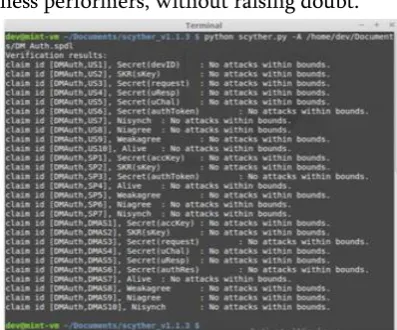
EvaluationWith a specific end goal to assess the security qualities of the validation system proposed in this paper, we utilized the Scyther Tool [3], [4] to give a formal investigation. Scyther is a programmed security convention verification instrument, which is utilized to distinguish potential assaults and vulnerabilities. It has been utilized to check various security conventions, for example, [5]. We utilized Scyther to assess the accompanying properties of our proposed component:
• Replay assault protection: To guarantee protection from assaults whereby interchanges between two certifiable on-screen characters are caught and rehashed by a gatecrasher, consequently enabling them to take on the appearance of a genuine on-screen character.
• Reflection assault protection: To guarantee protection from assaults where validating performing artists can be tricked into giving the solution to their own particular test.
• Man-in-the-center assault protection: To guarantee resistance to assaults where malignant substances can catch and alter interchanges between two honest to goodness performers, without raising doubt.
Fig. 2: Formal analysis results from Scyther
V.
Potential ApplicationsThe expanding interest for imaginative types of versatile validation implies that there are various potential applications for our proposed system. One such application territory that the instrument could be connected to is the rising pattern of BYOD inside corporate set-tings. In those partnerships that don't authorize a sweeping boycott, cell phones (e.g. tablets or cell phones) just require the remote key to get to the system. Presently, in the greater part of cases it is excessively bulky, making it impossible to bring verification into such a setting. Along these lines, there is a developing requirement for a more secure and commonsense process. Using the proposed instrument would permit the physical nearness of the gadget to be utilized as one validation factor, while the right response to computerized
memory based difficulties to give the other. This would give a more powerful access control instrument, taking into consideration more prominent responsibility inside enterprises with BYOD arrangements. Another potential application territory is that of web based keeping money. Current frameworks require passwords, noteworthy words and one-time codes to login. Nonetheless, rather than recollecting convoluted passwords, the client could enter their username and the last 4 digits of their check card number however rather than then entering a secret word, the DMAS could give a test in light of specific recollections. As internet keeping money accounts are viewed as high hazard, this would require verification challenges that could coordinate the higher multifaceted nature and comprehensiveness anticipated. Case challenges for both of the potential applications are appeared in Fig 3 and 4.
Fig. 3: Example interactive question
VI.
ConclusionIn this paper, we have introduced a computerized recollections based confirmation instrument for portable client verification. We have given a nitty gritty review of the system and exhibited our underlying assessment. The outcomes from our assessment demonstrate that convention would be satisfactorily secure for verification purposes. The absence of dependence on SSL implies that it would likewise be appropriate for use inside an IoT situation. Along these lines recommending that if executed, it could give a doable and more compelling type of verification. The novel approach of utilizing individual computerized recollections for confirmation can alleviate a considerable lot of the dangers related with current watchword or non specific inquiry based strategies (e.g. bear surfing, phishing and savage power). A few types of developing versatile verification, for example, biometrics, are exceptionally defenseless to physical assaults (e.g. fingerprint lifting) implying that once such information (e.g. the fingerprint) has been gotten, the validation system is rendered outdated. Be that as it may, with our proposed system this hazard is enormously brought down, as the capacity to replay, rehash or figure the difficulties is significantly diminished. The level of personalization offered implies that clients will probably know the response to the test, rather than overlooking answers or passwords set months beforehand. Also, the different scope of profoundly individual recollections, gives a more flexible way to deal with validation, as both multifaceted nature and extensiveness can be adjusted in the age of interesting difficulties. We trust that the proposed component can supplant the non specific and obsolete methodologies right now being used inside portable client confirmation.
VII.
REFERENCES1. A R. Doherty, N. Caprani, C. . Conaire, V. Kalnikaite, C. Gurrin, A. F. Smeaton, and N. E. OConnor, “Passively Recognising Human Activities Through Lifelogging,” Comput. Human Behav., vol. 27, pp. 1948-1958, 2011. 2. M Dodge and R. Kitchin, “Outlines of a
world coming into existence: pervasive computing and the ethics of forgetting,” Environ. Plan. B Plan. Des., vol. 34, pp. 431-445, 2011.
3. V Bush, “As We May Think,” The Atlantic Monthly, 1945
4. L Kelly, “The Information Retrieval Challenge of Human Digital Memories,” BCS IRSG Symposium: Future Directions in Information, 2007.
5. C Gurrin, D. Byrne, N. OConnor, G. J. F. Jones, and A. F. Smeaton, “Architecture and Challenges of Maintaining a Large-scale, Context- aware Human Digital Memory,” 5th International Conference on Visual Information Engineering, pp. 158-163, 2008. 6. ETulving,“WhatIsEpisodicMemory?”Curr.Dir
.Psychol.Sci.,vol.2, pp. 67-70, 1993.
7. “Precis of elements of episodic memory,” Behav. Brain Sci., vol. 7, pp. 223-268, 1984. 8. A Doherty and A. F. Smeaton,
“Automatically Augmenting Lifelog Events Using Pervasively Generated Content from Millions of People,” Sensors, vol. 10, pp. 1423-1446, 2010.
9. J Garside, “Smartphone swipe payment scheme unveiled — money — the guardian,” http://www.theguardian.com/money/2014/fe b/06/smartphone-swipe- cards-payments-weve/, accessed 12/06/2015.
safety-box-online-accounts- secure.html, accessed 07/06/2015.
11. J. Sun, R. Zhang, J. Zhang, and Y. Zhang, “Sightless two-factor authentication on multi-touch mobile devices,” IEEE Conference on Communications and Network Security (CNS), pp. 436-444, 2014. 12. U. Abdurrahman, M. Kaiiali, and J.
Muhammad, “A new mobile- based multi-factor authentication scheme using preshared number, GPS location and time stamp,” International Conference on Electronics, Computer and Computation (ICECCO), pp. 293-296, 2013.
13. D. Gewirtz, “Lastpass hack reinforces importance of using multi-factor authentication,”
http://www.zdnet.com/article/lastpass-hack-reinforces- importance-of-using-multi-factor-authentication/, accessed 10/06/2015. 14. R. Lennon, “Changing user attitudes to
security in Bring Your Own Device (BYOD) & The Cloud,” Proceedings of the 5th Romania Tier 2 Federation Grid, Cloud & High Performance Computing Science Conference (RO-LCG), pp. 49-52, 2012. 15. Y. Xuechen, “LED Display Screen Monitoring
Platform Based on Iden- tityAuthenticationwithUSBKey,”12th IEEE International Conference on Computer and Information Technology (CIT), pp. 905-909, 2012.