DOI : https://doi.org/10.32628/CSEIT195119
Diagnosis of Various Thyroid Ailments using Data Mining
Classification Techniques
Umar Sidiq1, Dr. Syed Mutahar Aaqib2, Dr. Rafi Ahmad Khan3
1Research Scholar, Department of Computer Science, Mewar University, Rajasthan India
2Assistant Professor, Department of Computer Science, Amar Singh College, Srinagar, Jammu and Kashmir,
India
3Assistant Professor, University of Kashmir Srinagar, Jammu and Kashmir, India
ABSTRACT
Classification is one of the most considerable supervised learning data mining technique used to classify predefined data sets the classification is mainly used in healthcare sectors for making decisions, diagnosis system and giving better treatment to the patients. In this work, the data set used is taken from one of recognized lab of Kashmir. The entire research work is to be carried out with ANACONDA3-5.2.0 an open source platform under Windows 10 environment. An experimental study is to be carried out using classification techniques such as k nearest neighbors, Support vector machine, Decision tree and Naïve bayes. The Decision Tree obtained highest accuracy of 98.89% over other classification techniques.
Keywords : Thyroid disease, K-Nearest Neighbor, Support Vector Machine, Decision Tree, Naïve Bayes.
I. INTRODUCTION
Classification techniques play a vital as well as major role in analyzing survivability of diseases and providing facilities to reduce the cost to the patients. Now-a-days, Disease diagnosis has become very crucial because of occurrence of so many diseases every year. People from all over the world have been suffering from various health issues like diabetes, heart disease, typhoid, tuberculosis, kidney disease etc [16] [17].Beside these health issues , thyroid disease have also been detected worldwide and thus become a serious endocrine health problem and an issue of concern. It is expected that in India about 42 million people suffer from thyroid disorders [2]. As per resent studies, women are 5 to 8 times more prone to thyroid disorders than men worldwide. It is caused by the improper secretion of thyroid
hormones released from the thyroid gland which is one of the important organlocated in the front of the neck and below the Adam's apple of our body. The secretion of thyroid hormones from the thyroid gland are of two types i.e. levothyroxine or T4 and triiodothyronine or T3. These hormones help in production of balanced amount of proteins, regulating the temperature of body, and maintaining overall production of energy [18]. Thyroid disease occurs when thyroid gland stop to functioning properly and are mainly divided into hypothyroidism and hyperthyroidism [4].
hypothyroidism has weight gain, tiredness, weakness, feeling cold etc. One of the most common cause occurred due to hyperthyroidism is graves’ disease [3]. The underestimated thyroid disease causes thyroid storm and myxedema which may lead to death [12]. In this research work, a classification model is trained using classification algorithms like K-nearest neighbor (KNN),support vector machine (SVM), decision tree (DT) and Naïve bayes (NB) for the diagnosis of thyroid diseases. The Decision Tree outperformed over other techniques.
The rest of the paper is followed as: - Section 2 represents related work in diagnosis of thyroid diseases. Section 3 contains dataset and methods. Section 4 represents the results and discussion. Section 5 contains conclusion and at last references are mentioned.
II. RELATED WORK
By studying literature, it seems that several classification methods have been developed for thyroid diseases diagnosis. In year 2002, Ozyilmaz et al in [14] showed that feed forward neural network could be successfully used for diagnosis of thyroid diseases. In this work, three architectures of MLP, RBF and CSFNN were used and achieved accuracy 89.80%, 79.08% and 91.14% respectively. This work shows CSFNN gives the best classification accuracy and takes less training times than all other algorithms.
In 2007, Polat et al. studied on the artificial immune-recognition system (AIRS) classification method for diagnosis of thyroid diseases and achieved 81% classification accuracy. On the other hand AIRS with Fuzzy weighted pre-processing was classified and showed the accuracy of 85.00% .This means AIRS with fuzzy outperformed than AIRS [15].
In year 2008, keles et al. proposed an expert system for thyroid disease diagnosis (ESTDD) and using
neuro fuzzy method emplaced in ESTDD system for thyroid diseases diagnosis and achieved 95.33% of accuracy. ESTDD is one of significant tool for endocrinologists or students studying endocrinology for testing their knowledge by comparing their predictions with ESTDD[21].
In year 2009, Temurtas performed diagnosis of thyroid diseases with the help of artificial neural network with 3-fold and 10-fold cross-validation approaches were used to estimate the performance of the used neural networks. In this work highest accuracy of 94.81% was achieved [12].
In year 2011, EsinDogantekin et al. worked on Wavelet Support Vector Machine (WSVM) with Generalized Discriminant Analysis (GDA) methods for diagnosis of thyroid diseases and achieved 91.86% classification accuracy [22].
K.Saravana Kumar et al in 2014, proposed KNN and SVM classification methods for the diagnosis of thyroid disease. They showed that the prediction accuracy of KNN and SVM are 96.34% and 94.43% respectively [1].
In year 2017 MP Gopinath proposed SVM, FKNN and Decision tree for the diagnosis of thyroid diseases. The SVM obtained highest classification accuracy of 96.30% over other techniques [23].
III. DATASET AND METHODS
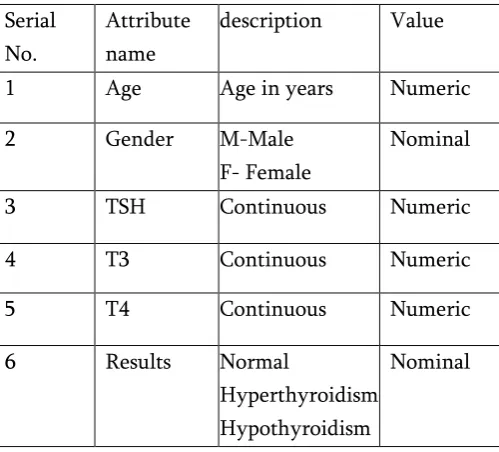
normal or hyperthyroidism or hypothyroidism. Table 1 shows the description of dataset.
Table 1. Attributes used in our dataset.
Serial
K-nearest neighbour (KNN) is a supervised technique as well as non-parametric in nature. The input of K-NN depends on the K closest instances present in the feature space. The generated output depends on whether KNN is Classification or regression methods [7] [8].When prediction is required for undetected data instances, the KNN algorithm will search through the training data instances for the k-most similar instances. The prediction attribute of the most similar instances is summarized and returned as the prediction for the undetected instance [19].
Support Vector Machine
Support vector machine (SVM) is a supervised learning classification technique that are used to analyzethe data for regression and classification methods [9].It constructs an optimal hyper plane in a high- or infinite-dimensional space in which new examples are assigned to one group or the other one[10].The separation of data is achieved by the
hyper plane is generally done, that has largest distance to the closest training data point of any class (so-called functional margin), since in general the greater the margin the smaller the generalization error of the classifier [19].
Decision tree
Decision Tree (DT) is tree like graph known as one of the most admired classification data mining technique that splits the dataset into parts on the on maximum information gain [6].
Naïve Bayes
K- Fold cross- validation
In k-fold validation, the whole dataset is divided into K equal size subsets and one of the subset K is taken as test data and the remaining K-1 folds acts as training data. Thus different test results exist on each iteration and at last average of these results gives the test accuracy of the algorithm [12]. In this study 10-fold cross-validation is used to find out the classification accuracy by the classification methods.
System implementation
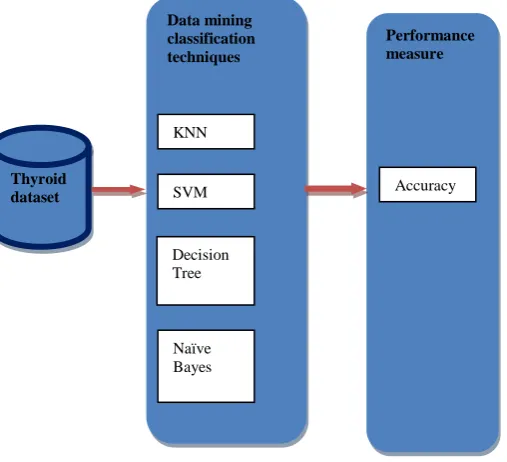
The thyroid dataset has three output categories. First one is Normal, second one is hypothyroidism and third one is hyperthyroidism. The thyroid dataset of five input attributes Age, Gender, TSH, T3 and T4 is supplied to the classifiers of KNN, SVM, Decision Tree and Naïve bayes in PYTHON to classify the data. The performance of each classifier is evaluated in terms of accuracy as shown in figure 1.
Figure 1. Thyroid disease prediction process
IV. RESULTS AND DISCUSSION
In this work, Out of four classifiers, The Decision Tree shows highest test accuracy of 98.89% over other classifiers. The accuracy comparison among classifiers is shown in figure 2. The highest accuracy of our method is higher than some of the methods available in literature as shown in table 2.
Figure 2. Accuracy comparison of classifiers
Study Method Highest
Accuracy Ozyılmaz and
Yıldırım [14 ]
MLPNN with BP
(3×FC)
91.14%
MLPNN with FBP
(3×FC)
RBF
(3×FC)
CSFNN
(3×FC)
Polat et al. [15 ] AIRS (10×FC)
85.00%
AIRS with Fuzzy (10×FC)
weighted preprocessing
keles et al. [21] ESTDD 95.33%
F. Temurtas [12 ] MLNN with LM (3×FC)
94.81%
PNN (3×FC)
LVQ (3×FC)
Thyroid dataset
Data mining classification techniques
Performance measure
KNN
SVM
Decision Tree
Naïve Bayes
MLNN with LM (10×FC)
PNN (10×FC)
LVQ (10×FC)
EsinDogantekinet al.[22]
GDA-WSVM 91.86%
MP
Gopinath.[23]
SVM 96.30%
FKNN
Decision Tree
Our study KNN
(10×FC)
98.89%
SVM
(10×FC)
DT
(10×FC)
NB
(10×FC)
Table-2 shows the highest classification accuracy obtained by our method over other methods used for the diagnosis of thyroid diseases.
V. CONCLUSION
The work has been done using classification data mining techniques for the diagnosis of thyroid disease. For this purpose, K nearest neighbor, Support vector machine, Decision tree and Naive Bayes classifiers have been used. The Decision Tree classifier outperformed over other classifiers. However, if we merge it with any other classification technique such as neural network, then the result might be even better as compared to what we got with the current study.
VI. REFERENCES
[1].K.Saravana Kumar, Dr. R. ManickaChezian, "Support Vector Machine and K- Nearest Neighbor Based Analysis for the Prediction of Hypothyroid. International Journal of Pharma and Bio Sciences",volume - 2,Issue - 5,page no-(447-453),2014 .
[2].http://www.ncbi.nlm.nih.gov/pmc/articles/PMC3 169866/(accessed dec 2015)
[3].G. Zhang, L.V. Berardi, An investigation of neural networks in thyroid function diagnosis, Health Care Manage. Sci. (1998)
[4].Xia C, Hsu W (2006) BORDER: efficient computation of boundary points. In: IEEE, 2006
[5].Available from: http://en.wikipedia.org.Last accessed on Dec24].
[6].Apte & S.M. Weiss, Data Mining with Decision Trees and Decision Rules, T.J. Watson Research Center,
http://www.research.ibm.com/dar/papers/pdf/fgcsapt ewe issue_with_cover.pdf, (1997).
[7].Roychowdhury S (2014) DREAM: diabetic retinopathy analysis using machine learning. In: IEEE, 2014
[8].Chetty N, Vaisla KS, Patil N (2015) An improved method for disease prediction using fuzzy approach. In: IEEE, 2015
[9].S. Sathiya Keerthi, Olivier Chapelle, Dennis DeCoste "Building Support Vector Machines with Reduced Classifier Complexity" Journal of Machine Learning Research, Vol: 7, PP 1493- 515, January - (2006).
[10].Shen X, Lin Y (2004) Gene expression data classification using SVM-KNN classifier". In: IEEE, 2004
[11].www.anaconda.com.
[13].G. H. John and P. Langley, "Estimating Continuous Dis-tributions in Bayesian Classifiers," Proceedings of the 11th Conference on Uncertainty in Artificial Intelligence, San Francisco, 1995, pp. 338-345.
[14].Ozyılmaz, L., Yıldırım, T. (2002). Diagnosis of thyroid disease using artificial neural network methods. In Proceedings of ICONIP’02 9th international conference on neural information processing (pp. 2033-2036). Singapore: Orchid Country Club.
[15].Polat, K., Sahan, S., & Gunes, S. (2007). A novel hybrid method based on artificial immune recognition system (AIRS) with fuzzy weighted preprocessing for thyroid disease diagnosis. Expert Systems with Applications, 32, 1141-1147.
[16].Sehgal MSB, Gondal I (2014) K-ranked covariance based missing values estimation for microarray data classification. In: IEEE, 2004
[17].Bonner A (2004) Comparison of discrimination methods for peptide classification in tandem mass spectrometry. In: IEEE, 2004
[18].HalifeKodaz et al. Medical application of information gain based artificial immune recognition system (AIRS): Diagnosis of thyroid disease.
[19].Joel Jacob et al. "Diagnosis of Liver Disease Using Machine Learning Techniques". (IRJET) Volume: 05 Issue: 04 | Apr-2018
[20].K. Pavya et al. "Diagnosis of Thyroid Disease Using Data Mining Techniques: A Study". (IRJET) Volume: 03 Issue: 11 | Nov -2016.
[21].Keles, A., and Keles, A., ESTDD: Expert system for thyroid diseases diagnosis. Expert Syst. Appl. 34(1):242-246, 2008.
[22]. Dogantekin, E., Dogantekin, A., and Avci, D., An expert system based on generalized discriminant analysis and wavelet support vector machine for diagnosis of thyroid diseases. Expert Syst. Appl. 38(1):146-150, 2011.
[23].M.P.Gopinath "Comparative Study on Classification Algorithm for Thyroid Data Set".
International Journal of Pure and Applied Mathematics Volume 117 No. 7 2017, 53-63.
Cite this article as :
Umar Sidiq, Dr. Syed Mutahar Aaqib, Dr. Rafi Ahmad Khan, "Diagnosis of Various Thyroid Ailments using Data Mining Classification Techniques", International Journal of Scientific Research in Computer Science, Engineering and Information Technology (IJSRCSEIT), ISSN : 2456-3307, Volume 5 Issue 1, pp. 131-136, January-February 2019.
Available at doi :
https://doi.org/10.32628/CSEIT195119