CSEIT184664 | Published – 08 May 2018 | May-June 2018 [ (4 ) 6 : 338-344 ]
National Conference on Engineering Innovations and Solutions (NCEIS – 2018)
International Journal of Scientific Research in Computer Science, Engineering and Information Technology © 2018 IJSRCSEIT | Volume 4 | Issue 6 | ISSN : 2456-3307
338
Grouping of Similar Images into a Folder Based on Face
Recognition
Dr. Sharath Kumar Y.H 1, Anirudha.N 2
1Department of Information Science and Engineering, Maharaja Institute of Technology, Mysuru, Karnataka,
India
2Department of Information Science and Engineering Maharaja Institute of Technology, Mysuru, Karnataka,
India
ABSTRACT
Face recognition has made significant advances in the last decade, but robust commercial applications are still lacking. We address the problem of grouping of all the images of the particular person from the bulk of images into a single folder. We propose a method called Pixtract (picture-extraction) which is an application for supporting the officers or employees of the company/organization to search for all the images in which the particular input face is present. The main aim is to extract all the images which matches with the particular image/pic that is given as an input. These matched images will be extracted and is provided as the output in form of a folder/album that containing all the matched images. The main concentration of this work is on the amusement park where there is a need of this technology.
Keywords: Face detection, Face recognition and Grouping
I.
INTRODUCTION
FACE recognition has been an intensely researched field of computer vision for the past couple of decades. It is becoming an increasingly more important trend in tech development. You may already be engaging with facial recognition technology on a day-to-day basis without realizing, but there are massive implications for the future of tech development. There are several ways in which we can compare one face with other for the recognition. The images to be selected among a group of 10-20 images is easily done by manually searching through all the images for the match. But the problem arises when one wants to select all the images of his/her requirement among thousands of images in such case manual searching is impossible. The paper brief you out about how to extract all the
images which matches with the particular image/picture that is given as an input to the application which intend to select all required matched images automatically without human intervention. This leads the selection of the several images of a particular person who is present in each and every picture and will help to solve the searching of images from bulk very easily, quickly and accurately.
II.
RELATED WORKS
positive values[3]. Each Eigen value is an Eigen vector and it tell how much images vary from mean image. Viola Jones Algorithm is a fast face detection technique but it has some false positive values for images with occluded faces.
Divya Meena at all.,[4] proposes a method for Robust face recognition under uncontrolled illumination conditions , the author has developed a generalized Weber-face (GWF) which extracts the statistics of multi-scale information from face images. By assigning different weights to the inner-ground and outer- ground, further more develop a weighted GWF (wGWF) version.[4] and can obtain promising performance comparable with existing approaches. The author Priyanka Vageeswaran at all.,[1] has explained method that shows that the set of all images obtained by blurring a given image forms a convex set. Based on this set theoretic characterization, and propose the DRBF i.e DIRECT RECOGNITION OF BLURRED FACES[1. Pose and illumination changes for each biometric query, before submitting it to the classifier.[1] Samples with poor quality are possibly discarded or undergo a manual classification or, when possible, trigger a new capture. After such filter, template similarity for matching purposes is measured using a localized version of the image correlation index.
Kavitha R Singh at all.,[7] Gabor filters have proven themselves to be a powerful tool for facial feature extraction. An abundance of recognition technique presented in the literature exploits these filters to achieve robust face recognition. Gabor shortcomings the fact that the filters are not permitted probably the most important[7]. This makes the information contained in the Gabor face representation redundant and also affects the size of the representation. The filters, named principle Gabor filters for the fact that they are computed by means of principle component analysis are assessed in face recognition The author Yan Ouyanga, Nong Sanga,n, Rui Huangb[5] proposed the robust facial expressions recognition [5]. First, Histograms of Oriented
Gradients (HOG) and Local Binary Patterns (LBP) are used to extract features. Second, Sparse Representation based Classification (SRC). Finally, HOG mainly extracts shape information while LBP primarily represents texture information, a strategy of combining HOG&SRC and LBP&SRC is implemented.
III.
PROPOSED METHOD
The motivation of the proposed method is the drawbacks of the existing system. The flow can be explained by classifying it as the modules[Fig: 1].
Figure 1. Overall Flow of System
Modules: The application is divided into three different modules which specifies the overall functionality[Fig:1].
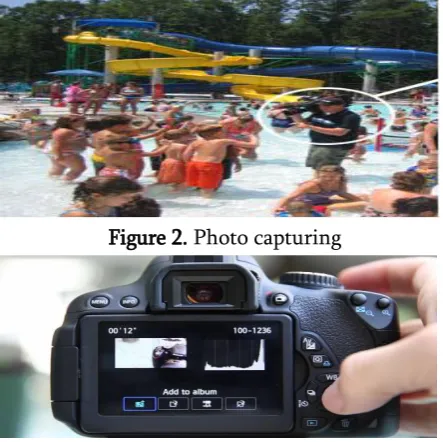
Module 1: Photo capturing & uploading:
Figure 2. Photo capturing
Figure 3. Photo Uploading
Module 2: User image capturing:
This module deals with the capturing of the individual face image [Fig 4] and fed to the database. The booth is setup so that he provides his image through the camera which is deployed in the booth.
Figure 4. User image capturing
Module 3: Grouping and delivery:
This module deals with the main part of our application. The application is fed with the input image which is used to group all the images in which the particular face is found. The matched images is grouped[Fig 5] into folder and is given as an output in the form of folder which is then copied into some secondary storage device.
Figure 5. Photo Grouping
IV.
FACE DETECTION
For the detection we are using a new image feature called Normalized Pixel Difference (NPD) is proposed[8] . It is inspired by the Weber Fraction in experimental psychology.
First NPD feature measures the relative difference between two pixel values[8]. The sign of f(x,y) indicates the ordinal relationship between the two pixels x and y, and the magnitude of f(x,y) measures the relative difference (as a percentage of the joint intensity x+y) between x and y.
f(x,y) = x−y / x + y
where x,y ≥ 0 are intensity values of the two pixels and f(0,0) is defined as 0 when x = y = 0.
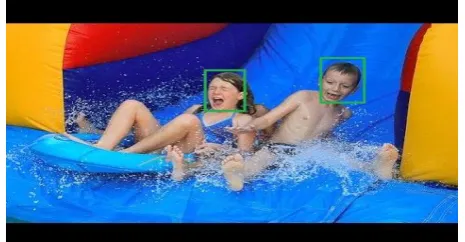
Second the sign of f(x,y) is an indicator of the ordinal relationship between x and y.[12][13][14]. we propose a Deep quadratic tree to learn the optimal subset of NPD features and their combinations. The NPD feature evaluation[Figure 6] is extremely fast, requiring a single memory access using a look up table. [8] Multi scale face detection can be easily achieved by applying pre-scaled detection templates. The unconstrained face detector does not depend on pose specific cascade structure design; pose labeling or clustering in the training stage is also not required. resolution face images in unconstrained scenarios. The [Figure 7] shows how the faces are detected for image.
Figure 6. Learning and combining NPD features in deep quadratic tree.
The NPD algorithm [8] is divided as shown:
representation, resulting in a reduced feature space. Therefore, in an s × s image patch (vectorized as p × 1, where p = s · s), NPD feature f(xi,xj) for pixel pairs 1 ≤ i < j ≤ p is computed, resulting in d = p(p−1)/2 features.
Step 2: The sign of f(x,y) is an indicator of the ordinal relationship between x and y. Ordinal relationship has been shown to be an effective encoding[8] for object detection and recognition.
Figure 7. Face detection
V.
RECOGNITION
The recognition can be done using the Gabor method. Texture analysis using filters based on Gabor functions[15] falls into the category of frequency-based approaches. These approaches are frequency-based on the premise that texture is an image pattern containing a repetitive structure that can be effectively characterized in a frequency domain, such as the Fourier domain. One of the challenges, however, of such an approach is dealing with the trade off between the joint uncertainty in the space and frequency domains[15]. They achieve the optimal tradeoff between localizing the analysis in the spatial and frequency domains[15].The Gabor filter is a linear filter whose impulse response is defined by a harmonic function multiplied by a Gaussian function. Because of the multiplication-convolution property (Convolution theorem), the Fourier transform of a Gabor filter's impulse response is the convolution of the Fourier transform of the harmonic function and the Fourier transform of the Gaussian function and it is given by
and, λ represents the wavelength of the cosine factor, θ represents the orientation of the normal to the parallel stripes of a Gabor function, ψ is the phase offset, σ (sigma) is the Gaussian envelope and γ is the spatial aspect ratio specifying the ellipticity of the support of the Gabor function.
VI.
GROUPING
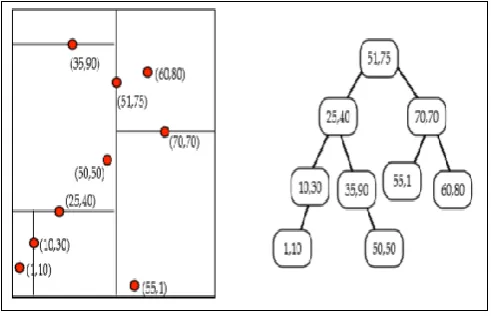
The grouping of the similar images is done using the concept of k-d tree. It is a binary tree in which every node is a k-dimensional point. Every non-leaf node can be thought of as implicitly generating a splitting hyper-plane that divides the space into two parts, known as half-spaces. Points to the left of this hyper-plane are represented by the left sub-tree of that node and points right of the hyper-plane are represented by the right sub-tree as shown in [Figure 8].
The hyper-plane direction is chosen in the following way: every node in the tree is associated with one of the k-dimensions, with the hyper-plane perpendicular to that dimension's axis.
Figure 8. K-D tree formation
Searching for a nearest neighbor in a k-d tree proceeds as follows:
1. Starting with the root node, the algorithm moves down the tree recursively, in the same way that it would if the search point were being inserted (i.e. it goes left or right depending on whether the point is lesser than or greater than the current node in the split dimension).
2. Once the algorithm reaches a leaf node, it saves that node point as the "current best"
3. The algorithm unwinds the recursion of the tree, performing the following steps at each node: If the current node is closer than the current
best, then it becomes the current best.
The algorithm checks whether there could be any points on the other side of the splitting plane that are closer to the search point than the current best.
If the hyper-sphere crosses the plane, there could be nearer points on the other side of the plane, so the algorithm must move down the other branch of the tree from the current node looking for closer points, following the same recursive process as the entire search. If the hyper-sphere doesn't intersect the
splitting plane, then the algorithm continues walking up the tree, and the entire branch on the other side of that node is eliminated.
4. When the algorithm finishes this process for the root node, then the search is complete
VII.
DATASETS
In this work we have created our own database consisting of the images that are collected from the amusement park people [Fig 9]. The data sets is nothing but the collection of images on which the specified work is implemented and experimented. The images considered in the data set consists of the images of the real time scenarios captured. The data sets is having the images that is consisting of the four common challenges that are often encountered in image i.e. pose variation, illumination variation, occlusion and blur face detection and recognition. Some of the sample dataset images are as shown.
Figure 9. Dataset images
VIII.
RESULT AND CONCLUSION
The specified concept can be used efficiently for the grouping of all the images into a particular folder for the given input Image. Proposed system is a combination of the NPD features and tree classifiers. The NPD detector performs better than the Haar, LBP, and POF detectors.
Table 1. Matching accuracy Result Analysis
USER
Number of images present
Number of images matched
Percentage of match
Person 1 40 38 95%
Person 2 62 50 81%
Person 3 27 24 89%
Person 5 35 26 74%
Person 6 22 20 90%
Person 7 54 46 85%
Person 8 15 14 93%
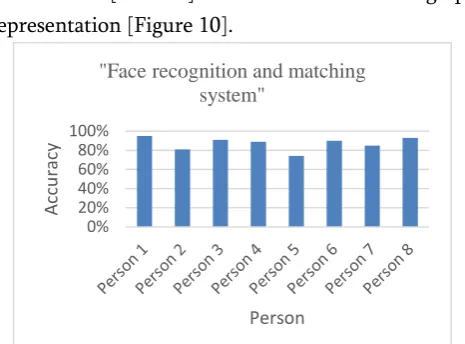
The proposed NPD face detector, compared with the Viola-Jones5 face detector in OpenCV 2.4, which is known to be optimized for speed. The gabor recognition gives high face recognition rate, of approximately 90%, has been reached by our recognition system in the experiments. The result comparison[Table 1] for the set of 8 person to check for the accuracy is as shown .The graphical representation of the accuracy of the match that is tabulated in [Table 1] is as shown in the bar graph representation [Figure 10].
Figure 10. Bar-graph representation for the accuracy of the matched images.
The K-D tree for grouping will have normal efficiency of O(2^d + log n) and log n if the match is near the query point and 2^d to search around the cells in that neighbor. The good performance can be achieved for all types of images. Still we are working on the greatest performance irrespective of the size of images.
IX.
REFERENCES
1. “Blur and Illumination Robust Face Recognition via Set Theoretic Characterization” Priyanka Vageeswaran, Student Member, IEEE, Kaushik Mitra, Member, IEEE, And Rama Chellappa, Fellow, IEEE 1057–7149/$31.00 © 2012 IEEE
2. “Generalized Weber-face for illumination-robust face recognition” YongWu Yinyan Jiang Neuro computing 136(2014)262–267
3. “Robust Face Recognition for Uncontrolled Pose and Illumination Changes” Maria De Marsico, Member, IEEE, Michele Nappi, Daniel Riccio, and Harry Wechsler, Fellow, IEEE 2168-2216/$31.00 © 2012 IEEE
4. “An Approach to Face Detection and Recognition “ Divya Meena , Ravi Sharan Department of Computer Science and Engineering[978-1-5090-2807-8/16/$31.00 ©2016 IEEE]
5. “Accurate and robust facial expressions recognition by fusing multiple sparse representation based classi?ers” Yan Ouyanga, Nong Sanga,n, Rui Huangb http://dx.doi.org/ 10.1016/ j.neucom. 2014.03.073 0925-2312/& 2014 Elsevier B.V. All rights reserved
6. “Face recognition based on pixel-level and feature-level fusion of the top-levels wavelet sub-bands Zheng-Hai Huang, Wen-Juan Li, Jun Wang, Ting Zhang http://dx.doi.org/ 10.1016/ j.neucom.2014.06.001 0925-2312/& 2014 Elsevier B.V. All rights reserved
7. Illumination and pose invariant face recognition” Kavitha R Singh ,Mukesh A Zaveri , Mukesh M Raghuwanshi http://www.mirlabs.org/ijcism IJCISM publications 2010 All rights reserved 8. “A Fast and Accurate Unconstrained Face
Detector” Shengcai Liao, Member, IEEE Anil K. Jain, Fellow, IEEEStan Z.Li, Fellow, IEEE 0162-8828 ©2015 IEEE
9. “Person Recognition in Personal Photo Collections” Seong Joon Oh, Rodrigo Benenson, Mario Fritz, Bernt Schiele Max Planck Institute for Informatics Saarbrucken, Germany 1550-5499/15 $31.00 © 2015 IEEE
10. “A comprehensive review of face detection and tracking techniques” Satbir Kaur , Er Aayushi Chadha www.ijder.org 2017 IJDR All rights reserved
Borgi, Demetrio Labte, Maher EL Arbi, Chokri Ben Amar http://dx.doi.org/ 10.1016 /j.neucom. 2014.07.057-4174 /& 2014 Elsevier B.V. All rights reserved
12. P. Sinha, “Qualitative representations for recognition,” in Biologically Motivated Computer Vision Workshop, 2002.
13. J. Sadr, S. Mukherjee, K. Thoresz, , and P. Sinha, “Toward the ?delity of local ordinal encoding,” in Proceedings of the Annual Conference on Neural Information Processing Systems, 2001.
14. S. Liao, Z. Lei, X. Zhu, Z. Sun, S. Z. Li, and T. Tan, “Face recognition using ordinal features,” in Proceedings of the 1st IAPR International Conference on Biometrics, Hong Kong, 2006. 15. Texture Features and KNN in Classification of
Flower Images D S Guru Department of Studies in Computer Science Manasagangotri, University of Mysore, Mysore-570 006, India and Y. H. Sharath Department of Studies in Computer Science Manasagangotri, University of Mysore, Mysore-570 006, India ,S. Manjunath Department of Studies in Computer Science Manasagangotri, University of Mysore, Mysore-570 006, India
16. “Principal of Gabor filter for face recognition” Vitor Struc, Rok Gajsek, Nikola Pavesic http://fe.uni-lj.si/01-09. University of Ljubljana.All rights reserved.