National conference on Engineering Innovations and Solutions (NCEIS – 2018)
International Journal of Scientific Research in Computer Science, Engineering and Information Technology © 2018 IJSRCSEIT | Volume 4 | Issue 6 | ISSN : 2456-3307
Design of Optimal controller for Enhanced Power System
Stability using Multistage LQR with coordination operation
of PSS and UPFC
Kumara K*, Dr. A. D. Srinivasan
Department of Electrical and Electronics, S.J.College of Engineering, Mysuru, Karnataka, India
ABSTRACT
This paper presents, a multistage LQR is introduced and applied for simultaneous coordinated designing of the unified power flow controller (UPFC ) and power system stabilizer (PSS) as a damping controller in the single machine power system. The results of these studies show that the proposed coordinated controllers have an outstanding capability in damping power system inter-area oscillations and enhance greatly the dynamic stability of the power system. The dynamic stability characteristics are investigated with PSS and UPFC acting individually and as a hybrid system. The hybrid controller shows a better performance compared to individual controllers. The proposed technique is implemented using MATLAB/SIMULINK platform.
Keywords: multistage LQR, unified power flow controller, Power System Stabilizer.
I.
INTRODUCTION
With the ever-increasing complexities in power systems across the world, especially opening of electric power markets, it becomes more and more important to provide stable, secured, controlled and high quality electric power in today`s environment.
In the paper [1], the author has presented the results of comprehensive comparison and assessment of the damping function of multiple damping stabilizers. A multi-stage LQR concept introduced in another paper authored by R. K. Pandey [2],In this paper a settling time, minimum peak overshoot for a multi machine system has been realized.. . Shayeghi & H.A.Shayanfar [3]. Sasongko Pramono Hadi provides a detailed dynamics modeling of a multi machine power system equipped with GUPFC as the extension of UPFC configuration [4]. Mehdi Nikzad etal,provides Three robust methods considered and
applied to design controllers are QFT, u-synthesis and H1 are applied on SMIB power system installed with UPFC and investigations are carried out on the stability parameter [5].
controllers using a new hybrid particle swarm optimization based co-evolutionary cultural algorithm. In this optimization process, the best parameters of PSS and UPFC controller are obtained by using the nonlinear model of the system in order to increase the power system stability [9]. The authors S. Robak, M. Januszewski, D.D. Rasolomampionona have made a comprehensive study of PSS and UPFC from the point of damping of power swings. The work is carried out on a multi machine system.[10].
In this paper dynamic stability study is carried out on SMIB linearized Philips heffron model using Power System Stabilizer and Unified Power Controller based on Multistage LQR technique. The dynamic stability parameters are investigated with Unified Power Flow Controller and Power System Stabilizer acting individually and coordinating together. The coordinated controller (PSS+mB PSS+δB) shows a excellent performance compared to individual controllers
II.
POWER SYSTEM INSTALLED WITH PSSHere a single machine connected to infinite bus is considered for analysis, The linearized model of the studied power system consisted of synchronous machine connected to infinite bus bar through transmission line is represented in a scheme diagram as shown in Figure 1. [11]
Figure 1. Block Diagram of Power System The state space formulation for the above system can be expressed as follows [12] :
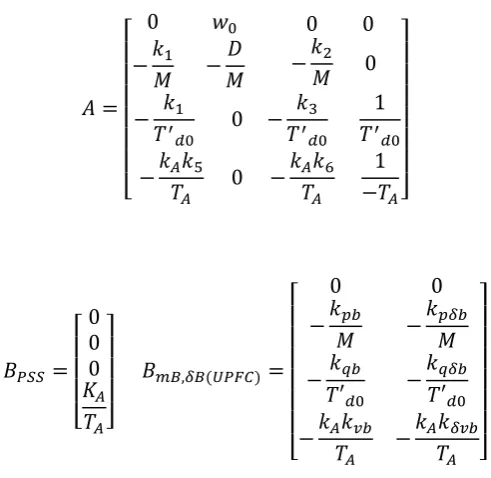
x (t)=Ax(t)+Bu(t) (1) described in the appendix section at the end of paper. The values of matrix A and matrix B for this loading condition are taken from paper authored by L Yathisha [13].
The closed loop control system A1 are given by
(2)
Where, BPSS = Control input matrix of Power System
Stabilizer and BUPFC = Control input matrix of Unified
[
Optimal control theory, an extension of the calculus of variations, is a mathematical optimization method for deriving control policies. Optimal control deals with the problem of finding a control law for a given system such that a certain optimality criterion is computing the state feedback control gain matrix. The optimized feedback controllers for the present research are derived from the Linear Quadratic reference input r is zero and that the response of the system is excited by nonzero initial state x(0), which in turn excited by external disturbances. The problem is then to find a feedback gain to force the response to zero as quickly as possible. This is called
the regulator problem. If r = 0, then the input u = -Kx and the closed loop system is given by
̇
The most systematic and popular method is to find K to minimize the quadratic performance index
∫
where Q and R are the positive-definite Hermitian or real symmetric matrix. From the above equations,
and hence the control law is,
in which P must satisfy reduced Riccati equation
(9)
The LQR function allows you to choose two parameters, R and Q, which will balance the relative importance of the input and state in the cost function that you are trying to optimize.
B. Multistage LQR
Select,
[ ]
(iii) 3 rd stage : Choose matrices as
[
] [ ]
Select,
[ ]
(iv) 4 th stage : Choose matrices as
[
] [ ]
Select,
[ ]
IV.
SIMULATION RESULTS AND DISCUSSIONThe simulation results is carried for all the four state variables rotor angle deviation (∆δ) rotor speed deviation (∆w) q-Axis component deviation (∆E'q)
and field voltage deviation (∆Efd).
The feedback controller gains are given below:
[
]
[ ]
[ ]
[ ]
[ ]
The simulation results of four state variables ( ∆δ, ∆w, ∆E'q& ∆Efd ) for nominal operating conditions
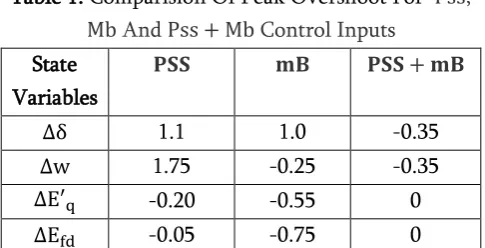
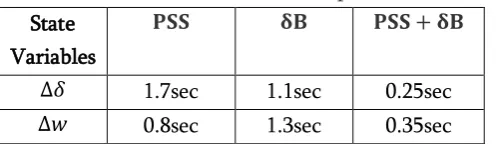
PSS, mB, PSS+mB and PSS, δB, PSS+δB controller are plotted as given in Figures 2-7. Validation of the approach for this operating conditions is done by comparing peak overshoots & settling time as given in Tables 1to 4.
Figure 2 Deviation in rotor angle with Damping controller
( PSS, mB and PSS+mB )
Figure 3 Deviation in rotor speed with Damping controller
Figure 4 Deviation in q-axis component with Damping controller
( PSS, mB and PSS+mB )
Figure 5. Deviation in field voltage with Damping controller
( PSS, mB and PSS+mB )
Figure 6.Deviation in rotor angle with Damping controller
( , and )
Figure 7.Deviation in rotor speed with Damping controller
( , and )
Table 1. Comparision Of Peak Overshoot For ,
And Control Inputs
State Variables
1.1 1.0 -0.35
1.75 -0.25 -0.35
-0.20 -0.55 0 -0.05 -0.75 0
Table 2. Comparision Of Settling Time For ,
And Control Inputs
State Variables
1.4sec 1.3sec 0.65sec 0.9sec 1.4sec 0.7sec 1.0sec 1.0sec 4.5sec
0.15sec 0.8sec 0.01sec
Table 3. Comparision Of Peak Overshoot For ,
And Control Inputs
State Variables
1.1 -0.3 -0.25
Table 4. Comparision Of Settling Time For , and PSS+δB. Tables I to II, show the comparison of peak overshoots and settling time for , and deviation in rotor angle, deviation in rotor speed (∆δ, ∆w) effective in settling time.
V.
CONCLUSIONThis paper tries to provide a coordinated PSS and UPFC controller based on Multistage LQR technique. The main observations are summarized as below
System stability (peak overshoot) is enhanced with proposed PSS+mB damping controller with.respect to ∆δ, ∆E'q∆Efd for nominal loading
condition.
System stability (peak overshoot) is improved with proposed PSS+δB damping controller with respect to ∆δ,and ∆w nominal loading condition
System stability (settling time) is enhanced with proposed PSS+mB damping controller with respect to ∆δ, ∆w and ∆Efd for nominal loading
condition
System stability (settling time) is improved with proposed PSS+δB damping controller with. respect to ∆δ and ∆w for nominal loading condition
APPENDIX The test parameter data values are Synchronous Machine
Excitation System
k constants for the nominal operating conditions
Haji Abd Malek “Performance Improvement of Power System Stability by Using Multiple Damping Controllers Based on PSS and the UPFC”, International Journal of Engineering and Technology: 0975-4024 Vol 5 No 4 Aug-Sep 2013, 3269
2. R. K. Pandey, Senior Member IEEE “Analysis and Design of Multi-Stage LQR UPFC",978-1-4244-8542-0/10/$26.00 ,2010, IEEE
Volume 3 , Number 3, September 2011 , pp. 32-37, ISSN 2077-3528.
4. Sasongko Pramono Hadi “Dynamic Modeling and Damping Function of GUPFC in Multi-Machine Power System" IPTEK, The Journal for Technology and Science, Vol.22, No. 4, November 2011, pp. 205-2013.
5. Mehdi Nikzad, Shoorangiz Shams Shamsabad Farahani, Mehdi Ghasemi Naraghi, Mohammad Bigdeli Tabar and Ali Javadian “Comparison of robust control methods performance in the UPFC controllers design" Indian Journal of Science and Technology, Vol.4, No. 6 (June 2011), ISSN : 0974- 6846, pp. 670-676.
6. Sangu Ravindra & DR.V.C.Veera Reddy “Self Tuning Controllers for Damping Low Frequency Oscillations", International Journal of Engineering Science and Technology, ISSN : 0975-5462, Vol. 4, No.09, September 2012, pp. 4160-4167.
7. A.V.Sudhakara Reddy, M. Ramasekhara Reddy & Dr. M. Vijaya Kumar “Stability Improvement During Damping of Low Frequency Oscillations with Fuzzy Logic Controller", International Journal of Engineering Research and Applications (IJERA), ISSN :2248-9622, Vol. 2, Issue 5, September- October 2012, pp.1560-1565 8. Mahdiyeh ESLAMI, Hussain SHAREEF, Azah
MOHAMED, Mohammad KHAJEHZADEH, “Coordinated design of UPFC and PSS to improve power system stability”, ISSN 0033-2097
9. Mohammad Reza Esmaili, Amin Khodabakhshian, Mosayeb Bornapour, “A New Coordinated Design of UPFC Controller and PSS for Improvment of Power System Stability Using CPCE Algorithm 2016 IEEE Electrical Power and Energy Conference (EPEC)
10. S. Robak, M. Januszewski, D.D. Rasolomampionona “Power system stability enhancement using PSS and UPFC Lyapunov-based controllers:A comparative study”, 2003 IEEE Bologna PowerTech Conference, June 23-26, Bologna, Italy
11. Kumara.K, A.D Srinivasan “Design of Pole Placement Power System Stabilizer For SMIB-Effect of Operating Conditions”, 2nd IEEE International Conference on Electrical, Computer and Communication Technologies (ICECCT-2017) 15th to 16th December 2017,Mysuru,
12. H. F. Wang,“A Unified Model for the Analysis of FACTS Devices in Damping Power System Oscillations - part lll: Unified Power Flow Controller,” IEEE Transactions on Power Delivery, Vol. 15,no 3, pp. 978-983, 2000.