5 6 7 8 9 10 11 12 13 14 15 16 17 18 19 20 21 0.3
0.4 0.5 0.6 0.7 0.8 0.9 1.0
Average F-score
Log Value of Corpus Size
AS-CRF
CityU-CRF
MSRA-CRF
AS-FMM
CityU-FMM
MSRA-FMM
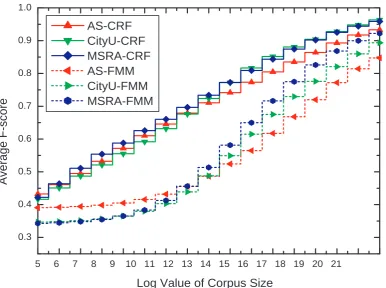
Figure 1: Comparison of learning curves of CRFs and FMM
input data should be exponentially enlarged to overcome such sparsity.
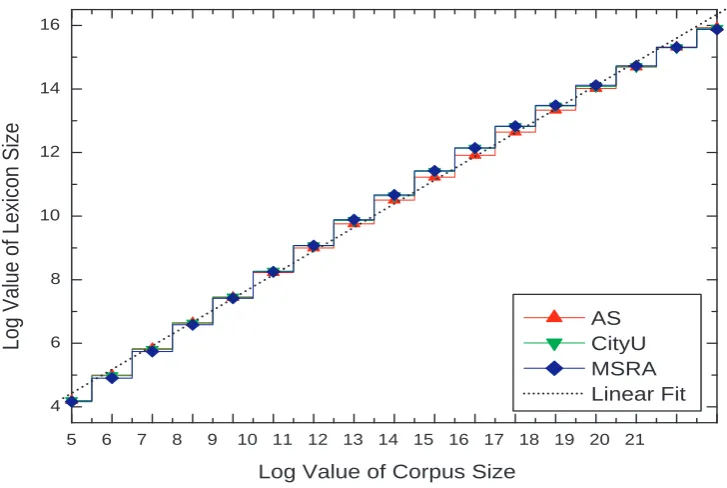
As for a rule-based method, our empirical study shows it is more helpful to overcome data sparsity than a statistical one. Substitutex = log(s)into equation (3), we have a relation between F-score and corpus size (or lexicon size) as
F = a
1−bs = a
1−b0L4/3 (4)
for FMM segmentation, which is actually a negative inverse relation (a >0andb, b0 >0). Though CRFs outperforms
FMM in all the above results, this is due to the limited lexi-con size for FMM. Note that a lexilexi-con is often much easier to obtain than a segmented corpus, while the former is re-quired by FMM and the latter by CRFs. Thus it will be promising for FMM segmentation as the input lexicon is sufficiently large.
Following the similar way as the above discussion, we say that the OOV rate is in the inverse ratio of the size of train-ing data as in equation (4), the only difference is b < 0
at this time. It proves the linear decrease of uncertainty in the data, which helps the linear improvement of the perfor-mance, is kept when the corpus is exponentially enlarged. It is worth noting that this study is actually a computational intensive work, which costs a month to work out nearly 400,000 necessary results of either CRFs or FMM
segmen-tation. Our study on the relations between the learning per-formance and the data size could provide a good reference for large-scale corpus learning and annotation.
5. Conclusion
Under the empirical investigation with FMM and CRFs based Chinese word segmentation, we report our findings for the performance of different methods with regard of cor-pus size. As for the choice of our methods, FMM and CRFs are the prevailing representatives of rule-based and statisti-cal approaches for the task of Chinese word segmentation, respectively. Thus our investigation can be described as a generalized case study in computational linguistics, espe-cially for morphological computation.
5 6 7 8 9 10 11 12 13 14 15 16 17 18 19 20 21 0.4
0.5 0.6 0.7 0.8 0.9 1.0
Average F-score
Log Value of Corpus Size AS
Linear Fit of AS
(a)
5 6 7 8 9 10 11 12 13 14 15 16 17 18 19 20 21
0.3 0.4 0.5 0.6 0.7 0.8 0.9 1.0
Average F-score
Log Value of Corpus Size AS
Sigmoid Fit of AS
(b)
5 6 7 8 9 10 11 12 13 14 15 16 17 18 19 20 21 4
6 8 10 12 14 16
Log Value of Lexicon Size
Log Value of Corpus Size
AS CityU MSRA Linear Fit
Figure 3: lexicon size vs. corpus size
Moreover, the relationships that we have demonstrated in this paper do give us some hints about constructing a bal-anced corpus, and on the other hand, we may find a promis-ing way of joint approach with rule-based and statistical methods incorporated for a certain task on a certain sized corpus.
Acknowledgments
The research described in this paper was partially sup-ported by the National Natural Science Foundation of China (Grant No. 60903119), and partially supported by City University of Hong Kong through the Strategic Re-search Grant 7002267 and 7002388.
6. References
Michele Banko and Eric Brill. 2001. Scaling to very very large corpora for natural language disambiguation. In
ACL-2001, pages 26–33, Toulouse, France.
Gina-Anne Levow. 2006. The third international Chinese language processing bakeoff: Word segmentation and named entity recognition. In Proceedings of the Fifth SIGHAN Workshop on Chinese Language Processing, pages 108–117, Sydney, Australia, July 22-23.
Fuchun Peng, Fangfang Feng, and Andrew McCallum. 2004. Chinese segmentation and new word detection us-ing conditional random fields. InCOLING 2004, pages 562–568, Geneva, Switzerland, August 23-27.
Yan Song, Jiaqing Guo, and Dongfeng Cai. 2006. Chinese word segmentation based on an approach of maximum entropy modeling. InProceedings of the Fifth SIGHAN
Workshop on Chinese Language Processing, pages 201– 204, Sydney, Australia, July.
Nianwen Xue. 2003. Chinese word segmentation as char-acter tagging. Computational Linguistics and Chinese Language Processing, 8(1):29–48.
Hai Zhao and Chunyu Kit. 2008a. Exploiting unlabeled text with different unsupervised segmentation criteria for chinese word segmentation. InResearch in Computing Science, volume 33, pages 93–104.
Hai Zhao and Chunyu Kit. 2008b. Unsupervised segmen-tation helps supervised learning of character tagging for word segmentation and named entity recognition. InThe Sixth SIGHAN Workshop on Chinese Language Process-ing, pages 106–111, Hyderabad, India, January 11-12. Hai Zhao, Chang-Ning Huang, and Mu Li. 2006a. An
im-proved Chinese word segmentation system with condi-tional random field. InProceedings of the Fifth SIGHAN Workshop on Chinese Language Processing, pages 162– 165, Sydney, Australia, July 22-23.
Hai Zhao, Chang-Ning Huang, Mu Li, and Bao-Liang Lu. 2006b. Effective tag set selection in Chinese word seg-mentation via conditional random field modeling. In
Proceedings of the 20th Asian Pacific Conference on Language, Information and Computation, pages 87–94, Wuhan, China, November 1-3.
5 6 7 8 9 10 11 12 13 14 15 16 17 18 19 20 21 0.1
0.2 0.3 0.4 0.5 0.6 0.7 0.8 0.9 1.0
Rate of OOV occurrences or types
Log Value of Corpus Size AS-OOV-occr
CityU-OOV-occr MSRA-OOV-occr AS-OOV-type CityU-OOV-type MSRA-OOV-type
(a)
5 6 7 8 9 10 11 12 13 14 15 16 17 18 19 20 21
0.1 0.2 0.3 0.4 0.5 0.6 0.7 0.8 0.9 1.0
Rate of OOV occurrences or types
Log Value of Corpus Size AS-OOV-occr
AS-OOV-type
Sigmoid Fit of AS-OOV-occr Sigmoid Fit of AS-OOV-type
(b)