Hungarian Dependency Treebank
Veronika Vincze
1, Dóra Szauter
1, Attila Almási
1, György Móra
1,
Zoltán Alexin
2, János Csirik
31University of Szeged, Department of Informatics Árpád tér 2., 6720 Szeged, Hungary
2University of Szeged, Department of Software Development Árpád tér 2., 6720 Szeged, Hungary
3MTA-SZTE Research Group on Artificial Intelligence Tisza Lajos krt. 103., III. lph., 6720 Szeged, Hungary
E-mail: {vinczev, szauter, gymora, alexin, csirik}@inf.u-szeged.hu, [email protected]
Abstract
Herein, we present the process of developing the first Hungarian Dependency TreeBank. First, short references are made to dependency grammars we considered important in the development of our Treebank. Second, mention is made of existing dependency corpora for other languages. Third, we present the steps of converting the Szeged Treebank into dependency-tree format: from the originally phrase-structured treebank, we produced dependency trees by automatic conversion, checked and corrected them thereby creating the first manually annotated dependency corpus for Hungarian. We also go into detail about the two major sets of problems, i.e. coordination and predicative nouns and adjectives. Fourth, we give statistics on the treebank: by now, we have completed the annotation of business news, newspaper articles, legal texts and texts in informatics, at the same time, we are planning to convert the entire corpus into dependency tree format. Finally, we give some hints on the applicability of the system: the present database may be utilized – among others – in information extraction and machine translation as well.
1.
Introduction
By converting the Szeged Treebank into syntactically annotated dependency trees, we aimed at creating the first manually annotated dependency corpus for Hungarian. The database may be utilized in various ways since besides its applicability in machine translation, it may function as a learning database in a number of information extraction systems. In this paper, we outline the corpus building process, present the problems and solutions, moreover, provide data on corpus statistics and finally give some hints on the applicability of the corpus and show how the database fits into international context.
2.
Dependency grammars
Originally, in the Szeged Treebank, syntactic relations between sentence constituents are encoded in phrase-structured format. In the phrase-structured corpus, sentences are represented in a hierarchical structure made up of clauses: sentence constituents are organized into constituent trees. Clauses can be broken down into verbs, verbs can be broken down into arguments (nominal phrases) and other constituents, which, however, do not form a hierarchy below the NP level. The words of the sentence are located on the leaves of the constituent tree, the other nodes represent abstract units of organization (labeled with phrase-structure tags).
The dependency tree format differs from the constituent tree format inasmuch as every node in the tree corresponds to a word in the sentence. On the top of the sentence tree a virtual root node can be found to which words in the sentence are subordinated, that is, no abstract nodes can be found apart from the root node. Every word
in the sentence is strictly subordinated to another one: a word can only have one superordinate, however, there can be several words below a node, e.g. all the arguments of a verb fall under the verb node. Nodes in the dependency tree can have diverse relations, usually tagged to denote the nature of the particular relation.
Tesnière’s book (Tesnière, 1959) is considered to be the first dependency grammar, which lays the foundations of the theory. According to his famous metaphor, the verb is the central element of the sentence, which “expresses a whole little drama”: the arguments of the verb are the actors, which Tesnière calls actants. Consequently, in a sentence subordinated and superordinated elements are integrated into a unit.
grammars where movement is permissible, however, in dependency grammars intersection is accepted.)
• coordination
As has been mentioned in relation to the retagging cases, in coordination not only the tags of nodes but their position also had to be modified. During automatic analysis, the conjunction generally functioned as the main element of the construction and the members of coordination were in dependency relation with it. However, in accordance with Mel’čuk’s (1988; 2003) solution, the first member of
the construction functions as the main element and the conjunction (if there is any) has to be linked to it with CONJ relation, then follow the other members of coordination linked to the preceding element with COORD relation.
• infinitives and preverbs
If there was an (auxiliary) verb in the sentence that had an infinitival argument (szeret ‘likes’, kíván ‘wishes’, fog ‘will’, kell ‘must’…), then automatic analysis linked the incidental preverb of the infinitive to the main verb. This type of error has also been corrected manually.
4.2 Coordination
Coordination poses problems for most theories of syntax: proponents of certain theories think it proper that the conjunction is the main element of the coordination, others argue that the head of the construction is a member of the coordination. Let us now examine these theories one after the other.
Let us postulate that the conjunction is the main element of the construction. The question arises what can be done in the cases of direct coordination when there is no conjunction between the elements. If there is no conjunction, we must postulate a virtual node capable of functioning as the main element. This theory, however, has another disadvantage: if there are more than two coordinated elements, then it is not possible to distinguish type “A and B and C” from type “A, B and C”. This problem can be evaded in such a way that we assume an abstract “and” above “A” and “B”, but then “B” would be linked to two nodes simultaneously (to a virtual AND and a real and) and this is strictly forbidden. A further disadvantage of this theory is that if e.g. the subject of a sentence is a coordinated phrase, then the verb and the conjunction would be linked with SUBJ relation and this is quite unusual.
According to another theory, coordinated elements and the conjunction are represented on the same level but they are not connected, e.g. in the construction Jancsi és Juliska mézeskalácsháza ’the candy-house of Hansel and Gretel’, the following relations can be found: mézeskalácsháza – Jancsi ’candy-house’ – ‘Hansel’ mézeskalácsháza – és, ’candy-house’ – ‘and’ and mézeskalácsháza – Juliska ‘candy-house’ – ‘Gretel’. In this case the problem is that though the relatedness of
Jancsi and Juliska could somehow be indicated (with the ATT relation), however, it is problematic what relation to suppose between mézeskalácsháza and és, not to mention that it is quite unusual to leave the two members of the coordination unconnected.
Neither of the above approaches solve the problem satisfactorily, so we decided to follow Mel’čuk’s theory of
coordination (1988; 2003) where coordination is treated as kind of “subordination”. The main element is always the first member in the coordination because it is capable of functioning as an entire phrase. Let us now examine the following example:
Elmentem a boltba Józsival és Katival. ‘I went shopping with Joe and Katie.’ Elmentem a boltba Józsival.
‘I went shopping with Joe.’ *Elmentem a boltba Józsival és. ‘*I went shopping with Joe and.’ *Elmentem a boltba és Katival. ‘*I went shopping and Katie.‘
The difference between the second, the third and fourth sentences show that coordination cannot be split into two equal parts since if the elements Józsival ‘with Joe’ and és Katival ‘and Katie’ were equivalent, then the last sentence should be acceptable. Józsival ‘with Joe’ is not closely connected to és ‘and’ either since in that case the third sentence would also be grammatical. The solution is that we postulate three parts in the coordination: the first is the main element, the conjunction is linked to it with CONJ relation and the conjunction is followed by the second coordinated member with COORD relation as in Figure 1. From a representational perspective this is in fact subordination and so there will be no difference of structure between coordination and subordination: only the relations (COORD and ATT, respectively) indicate which is which.
Figure 1: Coordination
4.3 Predicative nouns and adjectives
András katona (*van). ‘Andrew is a soldier.’ András legyen katona. ‘Let Andrew be a soldier.’ András katona lesz.
‘Andrew is going to be a soldier.’
Similarly to coordination, there are two ways to solve this particular problem.
First, the main element of the sentence is the predicative noun (or adjective); the subject is linked to it and no virtual node is assumed. The disadvantage of this solution is that a completely different structure is ascribed to the same sentence in the present third person singular (see Figure 2) and all the other tenses / persons (see Figure 3), which is questionable because in one case there is direct, while in the other case there is indirect relation between the predicative element and the subject.
Figure 2: A sentence with a non-overt copula
Compare Figures 2 and 3:
Figure 3: A sentence with an overt copula
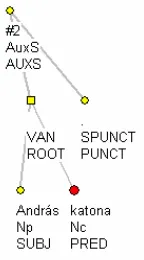
Second, the same structure is retained for any occurrence of the sentence, it is true, however, that the price of it is that a virtual node has to be postulated for the declarative, third person singular, present tense form of the copula (VAN). In this way, dependency trees are structured as in Figure 4.
A further argument for the use of a virtual node is that VAN is by all means present on the syntactic level since it is overt in all the other forms, tenses and moods of the verb. It is only a secondary (morphological) question why its third person singular, present tense form is a zero morpheme (cf. Mel’čuk, 2003). The use of virtual nodes may have advantages with regard to the international
applicability of the corpus since e.g. a translator program based on dependency trees is a lot more effective if it is to map a tree with similar structure to another language as opposed to that if even extra transformational steps have to be inserted into the translation process.
Figure 4: A sentence with a virtual copula
5.
Statistics
The file of the Szeged Treebank 2.0 contains 82.000 sentences, 1.2 million words and 250.000 punctuation marks. Texts were selected from six different domains, ~200.000 words in size from each. The domains are the following:
• fiction
• compositions of pupils between 14-16 years of age
• newspaper articles (from the newspapers Népszabadság, Népszava, Magyar Hírlap, HVG)
• texts in informatics
• legal texts
• business and financial news
The format of the database follows the CoNLL 2007 Shared Task norms (Nivre et al., 2007). It is freely available for research and educational purposes at http://www.inf.u-szeged.hu/rgai.
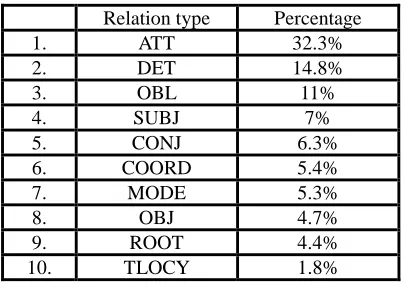
Statistical data on the so far completed corpus are represented in the charts below.
n
ew
sm
l
n
ew
sp
ap
er
s
la
w
in
fo
rm
at
ic
s
to
ta
l
sentences 9574 10210 9278 9759 38821 words 186030 182172 220069 175991 764262 punctuation
marks
25712 32880 33515 31577 125622
Table 1: Number of sentences, words and punctuation marks in the corpus
Herringer, H. J., Lobin, H. (Eds.), Dependency and Valency. An International Handbook of Contemporary Research. Vol. 1. Berlin-New York: W. de Gruyter, pp. 188--229.
Nivre, J. (2003). Theory-Supporting Treebanks. In Nivre, J., Hinrichs, E. (Eds.), Proceedings of the Second Workshop on Treebanks and Linguistic Theories (TLT 2003). Växjö University Press, pp. 117--128.
Nivre, J., Hall, J., Kübler, S., McDonald, R., Nilsson, J., Riedel, S., Yuret, D. (2007). The CoNLL 2007 Shared Task on Dependency Parsing. In Proceedings of the CoNLL Shared Task Session of EMNLP-CoNLL 2007. Prague, pp. 915--932.
Nivre, J., Hall, J., Nilsson, J., Chanev, A., Eryigit, G., Kübler, S., Marinov, S., Marsi, E. (2007). MaltParser: A language-independent system for data-driven dependency parsing. Natural Language Engineering, 13(2), pp. 95--135.
Prokopidis, P., Desipri, E., Koutsombogera, M., Papageorgiou, H., Piperidis, S. (2005). Theoretical and practical issues in the Construction of a Greek Dependency Corpus. In Proceedings of the 4th Workshop on Treebanks and Linguistic Theories (TLT-2005). Barcelona.