© 2015, IRJET.NET- All Rights Reserved Page 327
A Survey on Knowledge Management in Small-Sized Software
Organizations
Gajendra Patil
1, Dr. G R Bamnote
21
Research Scholar, Dept. of CSE, Dr. K N Modi University, Newai, Rajasthan, India
2
Professor and Head, Dept. of CSE, Prof. Ram Meghe Institute of Technology and Research, Badnera, Maharashtra,
India
---***---Abstract -
The aim of this paper is to provide acomprehensive outlook on the area of knowledge
management in small-medium sized software
organization. The paper offers the readers an insight into the theory of knowledge management, a comparison of current practices, and an example of a real knowledge management environment. As software development is a very knowledge intensive task, both researchers and industry have recently turned their attention to knowledge management as a means to improve software development. This often involves developing technical tools, which many companies have spent resources on. But the tools are often not used in practice by developers and managers in the companies, and it is often unknown if the tools improve how knowledge is managed. In order to build efficient knowledge management tools, we need a better understanding of how the tools that exist are applied and used in software development. We present and analyze case studies of knowledge management initiatives from the literature. Further, we examine success criteria in knowledge management codification initiatives, based on Intranet tools in small-sized software companies. We found four factors that we consider important: Having a culture for sharing knowledge, having a stable focus on knowledge management, developing knowledge management tools incrementally, and coupling knowledge management initiatives well to business goals.
1.
INTRODUCTION
This paper is about how Intranet-based Knowledge Management Tools can be used to support what has been called a “Learning Software Organization”. An Intranet-based tool is a software program that provides help for software developers. Software development usually takes place in team-based projects where the participants work
towards a shared goal. Many companies have problems with transferring what people learn in one project to other projects in the same company. Knowledge Management is a set of strategies and techniques to increase the transfer and use of different types of knowledge in a company or organization. We find many knowledge management tools and methods in companies and in the research literature, but most of the scientific work on tools is concentrating on technology to build such tools; on the structure of knowledge and technical work on retrieval mechanisms. Also, work on knowledge management methods usually described an ideal way of collecting and sharing knowledge, which is often difficult to reproduce in practice. In this thesis we discuss how companies can improve their knowledge management by adjusting Intranet-based knowledge management tools, and thus become more of a learning organization. We will base this discussion on an examination of tools and initiatives that are used in small-sized companies that develop software. These small-sized companies are four case companies in a pre-study, and a main and a contrast case in a main study - as well as reports of knowledge management tools from the literature. In this paper, we investigate the correlation between knowledge management and organizational performance with the help of analyzing the previous studies and methods of knowledge management elements.
2.
KNOWLEDGE MANAGEMENT
© 2015, IRJET.NET- All Rights Reserved Page 328 will see more software in cars, kitchen equipment and
perhaps in our own bodies.
To develop software is often referred to as "software engineering"; one definition is that software engineering "is concerned with theories, methods and tools which are needed to develop software for computers", and it differs from engineering in other disciplines because it is "not constrained by materials governed by physical laws or by manufacturing processes".
A common way to look at software development is to divide the work that is required to make a software system into several phases. A common model of such phases is the waterfall model, which come in many variants, but most include:
Analysis - to analyze what the software system will be used for.
Design - make decisions on technical issues, like database design, user interface design and so on.
Implementation - write the actual code in a
programming language.
Maintenance - enhance the software, or fix bugs that are found during usage.
The waterfall model is working best when the requirements for the system is fixed; then you can plan better ahead. If working with software where the requirements are frequently changing, other, more incremental models for software development are used. Now, we have given a broad overview of what software development is about. Let us then go on to discuss some problems.
Managing knowledge successfully in this way that obtain full advantage of knowledge and skill inherent in their system and structures as well as tacit knowledge which is belong to the employees of the organization.
A. Knowledge Management Definition
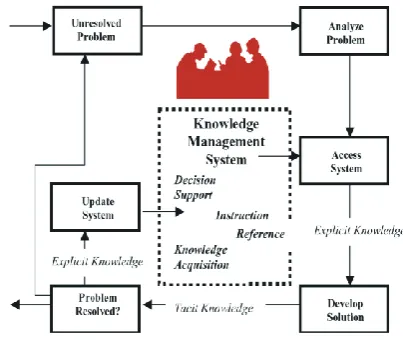
In the context of this thesis, a suitably extended definition by Tiwana [12] might be used: "management of organizational knowledge for creating business value and generating a competitive advantage." Other different and more complex definitions can be found in literature, like
the one from Quintas (1999)[14]: "Knowledge
management enables the creation, communication and application of knowledge of all kinds to achieve business goals," or the one from Davenport and Prusak (1998): "Knowledge Management is the name given to a collection
of organized and disciplined actions that an organization can take to obtain the maximum value from the knowledge over which which it disposes”.
Figure1: Knowledge Management
B. Knowledge Management Process
The knowledge management processes are defined as the degree to which the firm creates, shares, and utilizes knowledge resources across functional boundaries. Many researchers discussed the knowledge management process capabilities through the following elements: acquisitions; conversions; applications storing and protections as shown in Table 1.
Table 1: Knowledge management process elements
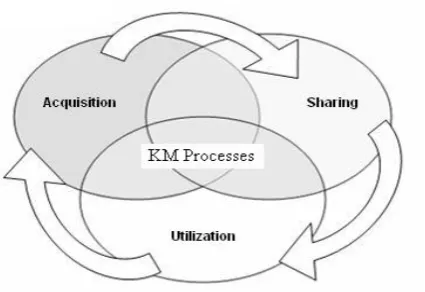
© 2015, IRJET.NET- All Rights Reserved Page 329 Figure 2: Fundamental Process of Knowledge
Management
The Three Fundamental Process of Knowledge Management
Knowledge acquisition
Knowledge sharing
Knowledge utilization
C. Knowledge Management in Software Engineering
This thesis has been reported about knowledge management in software engineering. When we searched for literature, we found that we could divide our work in two major groups: research that develops technology that can be used to effectively manage knowledge, and research that examines the effect of knowledge management on an organization.
D. Knowledge Management Strategies
There are two overall strategies in knowledge management: codification and personalization, as pointed out by Hansen et al[18].
Codification strategies - Some software engineers might be expected to be more sympathetic to a codification strategy. The work mentioned earlier (Wynekoop and Walz, 1998) would suggest that this ought to be especially true of programmers. Codification strategies seem appropriate when the “right answer” from one context is easily transferable to another. Thus sharing knowledge about programming issues should be suited to this strategy. There has indeed been a considerable amount of work on tools to support programming and design work. These include so-called CASE tools and designer workbenches. These are most useful for Retain, Share, and Use activities in knowledge management; they provide little support for Refining knowledge and none for
Creating knowledge. Problem tracking and resolution, and method documentation, identified earlier as categories of knowledge management activity, also seem to be targets for codification strategies. There is, however, a snag here. Much of this work has concentrated on Retaining and Sharing knowledge within a single project. effective Sharing of analysis and design knowledge between applications is a major potential benefit. The more concrete products of the knowledge-based systems work on software engineering mentioned earlier also correspond to a codification approach to knowledge management.
Personalization strategies-Having identified codification strategies as best suited to the more technical activities within software engineering, personalization strategies by implication are more suited to the
managerial and/or organizational activities.
Personalization strategies can be very effective for Creating and Refining knowledge, and also effective for Sharing and Retaining it. They provide less direct help in Using it. Human resource issues in software engineering are clearly candidates for a personalization strategy for knowledge management. Most of the discussion in the
paper by Hellstrom et al [13] concerns successful
personalization strategies. The professional expertise, and learning and experience strands of research into software engineering also ally themselves naturally with this viewpoint. We would argue that the managerial activities (i.e. those relating directly to the people involved with the project) are those where a personalization strategy is likely to be most successful, along with higher-level technical activities such as those in analysis and implementation where Creating and Refining knowledge is crucial, i.e. existing ‘solutions’ aren’t good enough.
E. Tools for Knowledge Management
Knowledge repositories and libraries – These are tools
for handling warehouse of knowledge in the form of documents.
Communities of knowledge workers – This tools to
support communities of practice at work; like organizing work spaces for communities for online discussions and distributed work.
The flow of knowledge - here we find tools for
supporting the interaction between tacit knowledge, explicit knowledge and meta knowledge; i.e., that combines the three parts describe above.
Knowledge cartography - tools for mapping and
© 2015, IRJET.NET- All Rights Reserved Page 330 company to individual expertise; what we can refer to
as “meta knowledge”.
Figure3: KM Architecture Model.
F. Methods of Providing Knowledge to Employees
Software organisations were asked as how employees in their organisations are provided with knowledge helping them to accomplish their tasks in a better way?
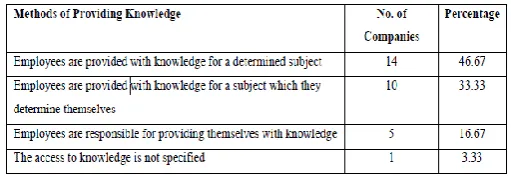
Table 2: Methods of Providing Knowledge to Employees
Table 2 shows that majority of the respondent organisations (46.67%) reported that employees in their organisations are provided with knowledge for a determined subject, i.e. the organisation has pre-decided subjects/ topics on which knowledge is provided to the employees. One-third of the organisations in the survey claimed that their employees are provided with knowledge for a subject which employees themselves determine. That means employees have freedom to ask for the knowledge on any subject/ topic of their choice/ need. 16.67% of the respondent organisations disclosed that there are no formal methods or channels in their organisations to provide knowledge to their employees. Rather employees themselves are responsible for providing with knowledge.
G. Instruments Used for Sharing and Distributing Knowledge
Software organisations were asked to rank in order of the usage the instruments used for sharing and distributing knowledge in their organisations. Emails as an instrument for knowledge sharing and distribution was ranked at number one by SE organisations. Company Intranet and groupware systems are another channels used
for sharing and distributing knowledge within software organisations. The simple reason for the use of technological instruments like emails, Intranets or groupware systems (Lotus Notes) could be the nature of SE organisations where these technologies are widely and easily available to almost every member of the
organisation. That is the reason that formal
communication and paper are the least preferred methods
of knowledge-sharing within these organisations.
Surprisingly the use of informal communication within the members for knowledge transfer is the least used method in SE organisations with an average score of 33.47 ( Table 3).
Table 3: Instruments Used for Sharing and Distributing Knowledge
Our Research Question: What Approaches are used for that and what are their Effects?
In this paper we are inspects the literature on knowledge management advantages in the domain of software engineering. We observe case studies reported of different organizations, to see
1) What kind of knowledge management approaches that have been used.
2) What the results of these actions were.
© 2015, IRJET.NET- All Rights Reserved Page 331 and improve the situation for the employees. More
precisely, we ask: Does the introduction of a knowledge management system:
Improve the work situation of employees in an
organizations?
Improve the quality of software?
Lower the cost of developing software?
Now, first we analyze an overview of research methods, to be able to analyze the claims about the benefits of knowledge management that we find in the case studies. Then, we present the research method used here.
Second, we present knowledge management in software engineering and start by giving an overview of some technology that has been in use, and then present case studies of knowledge management systems applied in software engineering organizations.
Then, we go on to discuss the differences in the initiatives, and the benefit that the organizations and employees claim to have achieved through these programs. Finally, we try to draw some conclusions about knowledge management in software engineering from these case studies, and present what further work we intend to do in this area.
3.
RESEARCH METHODS
There are different ways of sorting research methods. One is to look at which data sources that are available. Studies with primary data sources are studies that collect data through surveys, observations or experiments. Secondary data sources are sources for data collected by others, such as conferences and scientific journals.
Table1: Validation Methods for Software Engineering
With the help of observational mean we assembled information of subjects for our study where we do not
have strict control over the environment and what type of information we have to collect and a appropriate way to collect it. We have includes questionnaires, observation, written, reports, log in the data collection methods. Project monitoring is a type of observational studies which is simply used to collect data that occur for example during a project being performed field study.
Review of Literature
There are various reviews and papers available on knowledge management and the use of various intranet-based tools to develop software in small-sized organizations. The following papers mentioned below are the current works going on in the area of study.
Torgeir Dingsoyr author of the Survey on Knowledge Management in Software Engineering
Note: This article examines the literature on case studies of knowledge management systems in use in organizations that develop software. We investigate what kind of knowledge management approaches that has been taken in eight case studies, and what the reported benefits are. Surprisingly, very few organizations claim to have lowered software production costs or increased the quality of the software, but many claim to have improved the work situation for software developers and managers. However, most of the studies are done in a subjective fashion, so we should treat the results more as ‘vague indications” than “facts”.
Augmenting Experience Reports with Lightweight Postmortem Reviews
Note: Most of the small and small-sized companies that are develop software facing the same problems frequently, and they have insufficient systems in place to learn from their own mistakes as well as their own successes. Here, we suggest a lightweight method to collect experience from completed software projects, and compare the results of this method to more widely applied experience reports. The new methods that we find are captures more information’s about core processes related to software development in contrast to experience reports that emphasis more on management processes.
Managing Hard Skills: Findings from Practical Tool Use in a Software Consulting Company
© 2015, IRJET.NET- All Rights Reserved Page 332 actual usage of this in a small-sized software consulting
company. These type of tools to be in use for assigning resources for new projects, but also found three different types of usage: finding areas for new projects, searching for competence to solve problems, and skills upgrading.
Skills Management as Knowledge Technology in Software Consultancy Company
Note: This paper presents a skills management system in small-sized software consulting company, and how it is used. We found four different types of usage: allocating resources, searching for competence to solve problems, finding areas for new projects, and to develop competence. Most people in the company seem to regard this tool as useful, both for themselves, and for the company as a whole.
Davenport, Long and Beers (Davenport et al., 1998b) studied 31 knowledge management projects in 24 different companies - by interviewing persons in the companies. They recognized “success factors” in these projects, which were:
Senior management support (d1).
Standard, flexible knowledge structure (d2).
Technical and organizational infrastructure (d3).
Clear purpose and language (d4).
Knowledge-friendly culture (d5).
Multiple channels for knowledge transfer (d6).
Link to economic performance or industry value
(d7).
In another survey paper of McKinsey's survey (Kluge et al., 2001) on knowledge management of 40 companies in Europe, the US and Japan. In this survey paper looking at companies’ financial success, tried to find success in knowledge management initiatives. This survey shows that companies that are more “successful” focus more on the following factors (non-extensive list) in knowledge management, process efficiency, quality standards, development efficiency, product innovation. Also find some other factors such as “involvement of employees in process improvement decisions actively” and “flow of information in production,” financial incentives for cooperation.”
Knowledge Management in Software Engineering
The demands on software speed and quality press on the productivity of software organizations. However, the organizations’ available resources are not increasing along with the increasing needs. It is unthinkable for software
organizations to double their staffing levels every two years; besides, it would not even guarantee to double the
organizations’ productivity. Therefore, software
organizations expect a rise in productivity of their current employees. And that is the time when knowledge management comes into play.
4.
CONCLUSIONS
After discussing various success criteria for knowledge management initiatives for codification this is a way to obtain feedback in software development projects, we achieve the four criteria by stating that we think are most important:
Good coupling to business goals.
Incremental development; show benefits during
development
Stable focus on knowledge management
A culture for sharing knowledge
This paper aims to help its readers to choose and set up a
suitable infrastructure for supporting knowledge
management in small and medium sized software organizations. After reading the paper, one should be able to spot why to employ knowledge management, how to operate it, and what its enablers are.
The research has shown that comparing the knowledge management approaches and factors is not nearly as straightforward as one might think since there are no hard metrics to measure its outcomes. Thus, a theoretical background which enables at least comparing the knowledge management assets has been introduced at the beginning of this thesis.
Once the comparison has been possible, the reasons why
one should take knowledge management into
© 2015, IRJET.NET- All Rights Reserved Page 333
REFERENCES
[1]. T. Dingsoyr, An Evaluation of Research on Experience factory,” Proc. Of the Workshop on Software Organizations at the International Conference on Product-Focused Software Process Improvement, 2000, Pp 55-56.
[2].Bryant, “It’s Engineering Jim…but not as we know it Software Engineering – solution to the software crises, or part of the problem?,” Proc. Of the International Conference on Software Engineering (ICSE), 2000, Pp. 78-79.
[3].M.Polanyi, The Tacit Dimension, Doubleday, 1967, Pp. 108.
[4].I.Nonaka and H. Takeuchi, The Knowledge-Creating Company, Oxford University Press, 1995, pp. 284
[5].K. M. Wiig, "Knowledge Management: Where Did It Come From and Where Will It Go?" Expert Systems with Applications,
13, (1997) 1-14.
[6].R. S. Taylor, “Information Use Environments,” Proc. Of Progress
in Communication Science, 1991, Pp. 217-254.
[7].M. Jorgensen. R. Conradi and D. Sjoberg, “Reuse of Software development experience at Telenor Telecom Software, “ Proc. of the European Software Process Improvement Conference
(euroSPI’98).
[8]. V. R. Basill, “Quantitative Evaluation of Software Engineering
Methodology,” Proc. of the First Pan Pacific Computer Conference,
1985.
[9].Aamodt and E. Plaza, "Case-Based Reasoning: Foundational Issues, Methodological Variations, and System Approaches", AI Communications, 7, (1994) 39-59. A.
[10].K. D. Althoff, A. Birk, C. G. V. Wangenheim and C. Tautz“CBR for Experimental Software Engineering,” Proc. of the Case-Based Reasoning Technology – from Foundations to Application,
1998, Pp, 235-254.
[11].A. Tiwana, The Knowledge Management Toolkit. Prentice Hall PTR, 2002.
[12].Hellstorm W J, Overstreet J W, Yu A. Saikali K, Shen W, Beasley C M Jr, Watkins V S Tadalafil, Has no Detrimental
Effect on Human Spermatogenesis or Reproductive Hormones. J Urol, 2003;
170: 887-891.
[13].P. Quintas, Head Back to the Business Cafe. The Independent, London, February 4, 1999.
[14].I. Rus and M. Lindvall. Knowledge Management in Software Engineering. IEEE Software, 19(3):26–38, 2002.
[15].K.-D. Althoff, F. Bomarius, and C. Tautz, "Using Case-Based Reasoning Technology to Build Learning Software Organizations," Proc. of the Interdisciplinary Workshop on Building, Maintaining, and Using Organisational Memories, OM-98, 1998.
[16].T. H. Davenport and L. Prusak. Working Knowledge: How Organizations Manage What They Know. Harvard Business school Press, Boston, 1998.
[17].M. Hansen, N. Nohria, and T. Tierney. What’s Your Strategy for Managing Knowledge? Harvard Business Review, pages 106–116, March–April 1999.
[18]S. Carlsen, S. G. Johnsen, H. D. Jørgensen, G. J. Coll, Å. Mæhle, A. Carlsen, and M.Hatling, "Knowledge Re-Activation Mediated Through Knowledge Carriers," Proc. of the International Conference on Management of Information and Communication Technology,