© 2015, IRJET.NET- All Rights Reserved
Page 116
A Study of Video Watermarking Techniques Based on Energy Model
1
Ms. Anchal Gupta, M.tech(CSE) , CGCTC, Jhanjeri, Mohali, India, [email protected]
2
Er. Rimanpal kaur, AP (CSE), CGCTC, Jhanjeri, Mohali, India, [email protected]
---****---Abstract-
Recent years have witnessed rapid developmentin Digital video watermarking. Security and copyright protection are getting to be imperative issues in media applications and administrations. Video watermarking is relatively a new technology that has been proposed to solve the problem of illegal manipulation and distribution of digital video. It is the process of embedding copyright information in video bit streams. Most of the proposed video watermarking schemes are based on the techniques of image watermarking. But video watermarking introduces some issues not present in image watermarking. In this paper, we perform a survey on available video watermarking techniques and it provides a critical review on various available techniques.
Keywords-
Video Watermarking, Singular Value
Decomposition (SVD), Robustness, Imperceptibility,
Human Visual System.
I.
Introduction
In recent years, the circulation of works of art, including pictures, music, video and textual archives, has ended up easier [1]. With the broad and expanding utilization of the Internet, digital forms of these media (still images, audio, video, text) are effortlessly open. This is obviously profitable, in that it is less demanding to market and offer one's centrepieces. Then again, this same property debilitates copyright protection [2]. Computerized records are anything but difficult to duplicate and appropriate, taking into consideration pilfering. There are various strategies for ensuring possession. One of these is known as digital watermarking. Digital Watermarking is
predominantly a course of intercalating a motif or a digital signal which signifies the owner of the content into digital proportion. Authentication of the content as well as pursuit of illicit facsimiles can be made easier using this signal facilitating us to identify the owner of subjected content [3]. Hence to warrant the ownership, origin, bona fide and root, Watermarks of various grades of prominence are adjoined to the content. A good Watermark should be crystalline in nature so that it does not affect the quality of content besides being undetectable. In the wake of implanting watermark, the watermarked media are sent over Internet or some other transmission channels [4, 5]. At whatever point the copyright of the digital media is under inquiry, the embedded information is decoded to recognize copyright holder The decoding process can remove the watermark from the watermarked media (watermark extraction) or can distinguish the presence of watermark in it (watermark location).
© 2015, IRJET.NET- All Rights Reserved
Page 117
II.
Video Watermarking
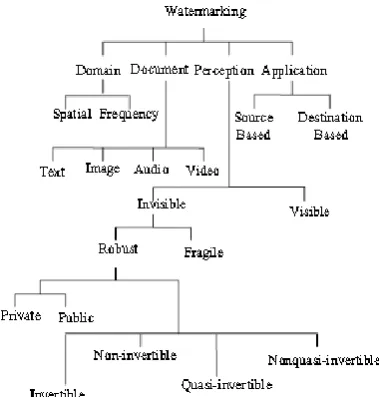
As digital video-based application technologies grow, such as Internet video, wireless video, videophones, and video conferencing, the problem of unauthorized copying and distribution of digital video rises more and more, thus creating copyright dilemma for the multimedia industry in general, and to the audio-video industry in particular. Many researches and technologies were proposed to provide methods to solve the problem of illegal copying and manipulations of digital video[6]. An attractive method that has been proposed a decade ago to implement copyright information in multimedia documents is digital watermarking [7]. Video watermarking methodologies can be arranged into two primary classes based on the method of hiding watermark data bits in the host video. Fig.2 gives an overview of diverse sorts of watermarking systems relying upon their working domains, cover media, perceptibility and application areas.
Figure 2. Watermarking Types
III.
Video watermarking terminologies:
Video watermarking describes the process of embedding information in video data. Different data hiding
terminologies are given in [8]. The imperative terminologies relating to digital video watermarking are:
Digital Video: Video sequence is an accumulation of continuous and similarly time separated still pictures.
Payload: It is the measure of data that can be put away in a watermark. An imperative idea with respect to the video watermarking payload is watermark granularity. Watermark granularity can be characterized as the amount of information is needed for inserting one unit of watermark data. Perceptibility: Video watermarking methodology is called vague if people can't recognize the original video from the video with embedded watermark.
Robustness: A fragile watermark should not be robust against intentional modification techniques, as failure to detect the watermark signifies that the received data is no longer authentic. In case of application such as copyright protection, it is desirable that watermark always remains in the video data, even if the video data is subjected to intentional and unintentional signal processing attacks. Hence, depending on the requirements of the application the watermark is embedded in a robust, semi-fragile or fragile manner.
Security: The security of the watermarking algorithm is ensured in the same way as in encryption methodology. According to the Kerckhoff’s assumption, the algorithm for
watermark embedding can be considered to be public, where as the security depend solely on the choice of a key from a large key space.
IV.
Survey of Techniques
© 2015, IRJET.NET- All Rights Reserved
Page 118
spatial pixels values (luminance, chrominance, shade space) or on the general feature outline [9]. Spatial-space procedures are not difficult to actualize; in any case they are not hearty against regular computerized indicator transforming operations, for example, feature packing. A few methods install watermark in the spatial area by changing the pixel values in each one edge however these systems are not vigorous to ambushes and normal indicator bends. Interestingly, different methods are heartier to twists when they include the watermark in the recurrence area. In these sorts of plans, the watermark is inserted by changing the convert coefficients of the casings of the feature arrangement. Watermarked feature arrangements are really defenseless to privateer strike, for example, edge averaging, casing swapping, measurable investigation, digital analog (AD/DA) transformation, and lossy compressions. Feature watermarking provisions could be gathered as security related like Copy control, fingerprinting, proprietorship distinguishing proof, confirmation, decrease safety and so on or worth included requisitions like legacy framework upgrade, database interfacing, feature labeling, computerized feature show observing, Media Bridge and so forth. Diverse advanced feature watermarking calculations have been proposed. A few strategies install watermark in the spatial area by adjusting the pixel values in each one edge however these routines are not vigorous to ambushes and basic indicator bends. The most ordinarily utilized changes are the Discrete Fourier Transform (DFT), the Discrete Cosine Transform (DCT), and the Discrete Wavelet Transform (DWT). A few inquires about focused on utilizing DWT as a result of its multiresolution aspects, it gives both spatial and recurrence area attributes so it is perfect with the Human Visual System (HVS).
Least Significant Bit Modification
This technique is simple and straight-forward and uses the least significant bits to embed the watermark. This method provides high capacity which can be used to embed the
watermark frequently in a cover media. This technique is resistant against cropping while is fragile against noise addition, lossy compression and resetting the LSBs to 1[10]. LSB substitution however despite its simplicity brings a host of drawbacks. Although it may survive transformations such as cropping, any addition of noise or lossy compression is likely to defeat the watermark. An even better attack would be to simply set the LSB bits of each pixel to one fully defeating the watermark with negligible impact on the cover object. Furthermore, once the algorithm is discovered, the embedded watermark could be easily modified by an intermediate party. An approach to enhance the robustness is to applying a pseudo random generator to determine the LSB bits to modify. This technique can improve the security and prevent the third party from tracing the watermark, yet it is vulnerable against substitution of LSBs [8] by a constant. Even in locations that were not used for watermarking bits, the impact of the substitution on the cover image would be negligible. LSB modification proves to be a simple and fairly powerful tool for stenography, however lacks the basic robustness that watermarking applications requires. Although it is not robust scheme but it is very simple and powerful method.
Correlation-Based Techniques
Another technique for watermark embedding is to exploit the correlation properties of additive pseudo-random noise patterns as applied to an image. A pseudo-random noise (PN) pattern W(x,y) is added to the cover image I(x,y), according to the equation shown below in Equation 1.
Iw (x, y) = I (x, y) + k × W (x, y) (1)
© 2015, IRJET.NET- All Rights Reserved
Page 119
with the same key, and the correlation between the noise pattern and possibly watermarked image computed. If the correlation exceeds a certain threshold T, the watermark [9] is detected, and a single bit is set.
Discrete Cosine Transform
The excellent and still most well known area for picture preparing is that of the Discrete Cosine Transform, or DCT. The DCT permits a picture to be split up into distinctive recurrence groups, making it much less demanding to implant watermarking data into the centre recurrence groups of a picture. The centre recurrence groups are picked such that they have minimize they maintain a strategic distance from the most visual critical parts of the picture (low frequencies) without over-presenting themselves to evacuation through clamping and clamour assaults (high frequencies). DCT [13] based watermarking procedures are classified into Global DCT watermarking and Block based DCT watermarking. The fundamental playing point of DCT procedures is in strength against for the most part straightforward picture preparing adjustments, for example, low pass sifting, brilliance, contrast change and obscuring. In any case, the defect with these systems is safety against alterations, for example, turn, scaling and trimming.
Discrete Wavelet Transform
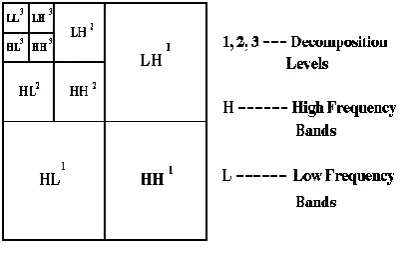
Wavelets likewise speaking to indicators in a structure closely resembling sines and cosines while tending to the issue with Fourier investigation. DWT is a change focused around recurrence space. In DWT the circulations of the recurrence is changed in each one stage of DWT, where L speaks to Low recurrence, H speaks to High recurrence and subscript behind them speaks to the amount of layers of converts [11]. Sub diagram LL speaks to a low recurrence band the more level determination rough guess of the first feature, LH a flat high recurrence band, HL vertical high recurrence band, HH an inclining high recurrence band. In DWT, the most noticeable data in the
sign shows up in high amplitudes and the less conspicuous data shows up in low amplitudes. Information clamping might be accomplished via tossing these low amplitudes. The wavelet converts empowers high packing degrees with great nature of recreation Wavelet convert escapable of giving the time and recurrence data all the while, consequently giving a time frequency representation of the sign. DWT is accepted to all the more correctly model parts of the HVS (Human Visual System) as contrasted with the FFT or DCT. This permits to utilize higher vitality watermarks as a part of districts that the HVS is known to be less delicate to inserting watermarks in these regions increases the vigour of watermark, extra effect on picture quality. Tentatively it is, no doubt found that insertion in the LL part of the DWT turns out to be most powerful against different sorts of assaults.
Figure 3 DWT filter up to 3-level
One of main strengths of wavelet transform compared to the DCT and DFT is its similarity with Human Visual System (HVS) which allows the watermark to be embedded in the regions that the HVS is known to be less sensitive to, such as the high resolution detail bands LH, HL, and HH [12]. Embedding watermarks in these regions allow us to increase the robustness of our watermark, at little to no additional impact on image quality.
Discrete Fourier Transform
© 2015, IRJET.NET- All Rights Reserved
Page 120
genuine impairments. Throughout the converting to a recurrence space time data lost. The watermark is installed into chose recurrence groups of the registered greatness space of the DFT, in this way making a watermarked size area [4]. The chose recurrence groups contain one or more centre recurrence groups, and the centre recurrence groups embody a band of roundabout rings of the greatness area. An opposite Discrete Fourier Transform is performed on the watermarked size area to remake the advanced information with the implanted watermark.
Singular Value Decomposition:
Singular Value Decomposition (SVD) is a numerical technique for diagonalizing matrices in which the transformed domain consists of basis states that is optimal in some sense[13]. The SVD of an N x N matrix A is defined by the operation:
A = U S V T (1)
Where U and V Є R N x Nare unitary, and S Є R N x N is a
diagonal matrix. The diagonal entries of S are called the singular values of A and are assumed to be arranged in decreasing order σi > σi +1. The columns of the U matrix
are called the left singular vectors while the columns of the V matrix are called the right singular vectors of A. Each singular value σi specifies the luminance of an image layer while the corresponding pair of singular vectors specifies the geometry of the image layer . In SVD-based watermarking, a frame image is treated as a matrix decomposed into the three matrices; S, U and V T, as shown below in Figure 4.
Figure 4: The SVD operation SVD
(A) = U S V T
V. Conclusion
Selling and Marketing of art works is easier using multimedia techniques and internet but it also comes with the hard fact that such procedure becomes vulnerable to anti business activities like copying, Thus Copyright Protection is of utmost importance to facilitate widespread and fool proof use of such advanced technologies. Digital Watermarking is one such technique that fire walls content owners from mischievous elements. Various innovative approaches focusing on digital image watermarking have been proposed in the recent past. Digital Video Watermarking has surfaced as a more challenging research topic. Video Watermarking could well be considered as a replacement of the traditional watermarking techniques. A few strategies install watermark in the spatial area by adjusting the pixel values in each one edge however these routines are not vigorous to ambushes and basic indicator bends. Conversely, different methods are more vigorous to contortions when they include the watermark in the recurrence space. The prerequisite for absolute spatial synchronization makes it liable for de-synchronization attacks. Furthermore, due to the lack of consideration of the temporal axis can cause vulnerability to video processing and multiple frame collusion. Moreover, watermark optimization is difficult using only spatial analysis techniques. The main strength of transform domain techniques is addressing the restrictions of spatial methods, moreover special Videos to represent an alternative view of a signal. The main drawback with frequency domain refers to high computational requirement.
REFERENCES
[1] M. Mohamed Sathik, S.S.Sujatha (2012), ‘A Novel based
© 2015, IRJET.NET- All Rights Reserved
Page 121
[2] Swati Tiwari, R. P. Mahajan (2012), ‘A Secure Image Based Steganographic Model Using RSA Algorithm and LSB Insertion’, International Journal of Electronics
Communication and Computer Engineering, 2012,Volume 3, Issue 1, ISSN 2249 –071X.
[3] Sangeeta Mishra,Sudhir Sawarkar (2012), ‘Video
Compression Using Spiht and Neural Network’,
International Journal Of Computational Engineering Research,November 2012,Vol. 2,Issue. 7, Issn 2250-3005. [4] Bibi Isac, V. Santhi (2011), ‘A Study on Digital Image
and Video Watermarking Schemes using Neural Networks’, International Journal of Computer Applications (0975 – 8887), Volume 12– No.9, January 2011
[5] C. Cruz-Ramos, R. Reyes-Reyes, M. Nakano-Miyatake, H. Perez-Meana (2010), ‘A Blind Video Watermarking Scheme Robust To Frame Attacks Combined With MPEG2 Compression’, Journal of Applied Research and Technology, December 2010, Vol.8 No.3,323-339.
[6] Gaurav Bhatnagar, Balasubramanian Raman (2009), ‘A new robust reference watermarking scheme based on
DWT-SVD’, Computer Standards & Interfaces 31 (2009) 1002–1013
[7] Cheng-Han Yang, Hui-Yu Huang, Wen-Hsing Hsu (2008), ‘An adaptive video watermarking technique based
on DCT domain’, 978-1-4244-2358-3/08 © 2008 IEEE [8] Sourav Bhattacharya, T. Chattopadhyay and Arpan Pal (2006), ‘A Survey on Different Video Watermarking
Techniques and Comparative Analysis with Reference to H.264/AVC’, 1-4244-0216-6/06, IEEE 2006.
[9] Sakshi Batra, Harpinder Kang Khattra (2013),’ An Improved Data Transfer Technique Using Steganography with Watermarking and Visual Cryptography’, International Journal of Innovative Technology and Exploring Engineering (IJITEE), , December 2013,Volume-3, Issue-7, ISSN: 2278-3075.
[10] Namita Tiwari, Dr.Madhu Shandilya (2010), ‘Evaluation of Various LSB based Methods of Image
Steganography on GIF File Format’, International Journal
of Computer Applications, September 2010,Volume 6– No.2, 0975 – 8887
[11]Snehal V. Patel, Snehal V. Patel (2011), ‘Invisible Digital Video Watermarking Using 4-level DWT’, National Conference on Recent Trends in Engineering & Technology, 13-14 May 2011, B.V.M. Engineering College, V.V.Nagar,Gujarat,India
[12] Suppat Rungraungsilp, Mahasak Ketcham, Pruch Surakote, Sartid Vongpradhip (2012), ‘Data Hiding Method
for QR Code Based on Watermark by comparing DCT with DWT Domain’, International Conference on Computer and
Communication Technologies(ICCCT), May 26-27,2012 [13] Lama Rajab, Tahani Al-Khatib, Ali Al-Haj (2009), ‘Video Watermarking Algorithms Using the SVD
Transform’, European Journal of Scientific Research, ISSN