R E S E A R C H
Open Access
The classification of the single traveling
wave solutions to
(1 + 1)
dimensional
Gardner equation with variable coefficients
Damin Cao
1*and Lijuan Du
1*Correspondence: [email protected] 1School of Air Transportation,
Shanghai University of Engineering Science, Shanghai, P.R. China
Abstract
In this paper the classification of single traveling wave solutions of (1 + 1) dimensional Gardner equation with variable coefficients is obtained by applying the complete discrimination system to the polynomial and trial equation methods. In particular, the corresponding solutions for the concrete parameters are constructed to show that each solution in the classification can be realized. Moreover, numerical simulations shown in the paper could help us better understand the nature of each solution.
Keywords: Exact solution; (1 + 1) dimensional Gardner equation with variable
coefficients; Complete discrimination system for polynomial method; Trial equation method; Traveling wave solutions
1 Introduction
Nonlinear differential equations have been widely applied to describe physical phenom-ena in many scientific fields, such as physics, electronics and other engineering and applied sciences. For hundreds of years, scientists have been studying both the exact and numer-ical solutions of nonlinear problems [1–4]. Due to the inaccuracy of numerical solutions, especially when we encounter very sensitive problems such as chaos, exact solutions have important applications. Accurate solutions can also help us better understand physical phenomena and models. Therefore, finding the exact solutions is of great significance.
A shallow water wave (or long wave) is considered a nonlinear dynamic system with wavelength much longer than its depth. It is widely used to describe nonlinear phenom-ena in the atmosphere and ocean. In order to describe and study the related nonlinear problems, the KdV equation [5] has been established. However, in some situations, the modified KdV equation should be applied when we discuss the effect of surface tension. But in some conditions such as internal solitary waves in a two-layer fluid with surface ten-sion where the KdV and mKdV equation are not valid at some thickness ratios, we need to combine the KdV equation and mKdV, namely study the Gardner equation, which takes the surface tension on solitary waves in a two-layer (stratified) fluid [6] into consideration. The one-dimensional variable-coefficient Gardner equation
ut+a(t)ux+b(t)u2ux+c(t)uxxx= 0, (1)
wherea(t),b(t),c(t) are nonzero arbitrary functions, was proposed to describe internal solitary waves that occur in coastal areas with inhomogeneous media and boundary, such as the northwest continental shelf of Australia and the Baltic Sea [7, 8]. In this paper, the trial equation method [9–14] and the complete discrimination system for polynomial method [15–20] are applied to the generalized (1 + 1) dimensional Gardner equation with variable coefficients. In order to ensure the existence of the solutions, the concrete exam-ples of specific parameters are given.
In real life applications, most nonlinear differential equations (or systems of differential equations) contain arbitrary functions of dependent variables and their derivatives. Ex-tensive studies have been conducted by using various numerical and analytical methods for the various forms of equations that emerge. However, these approaches may involve approximate solutions [21]. In recent years, many useful methods have been put forward, such as direct method [22], improved tanh–coth method [23], and so on. However, few methods can get all the traveling wave solutions to the nonlinear equations. So Liu pro-posed the trial equation method and the complete discrimination system for polynomial method. By these two methods, many difficult problems have been solved [24]. According to [10], we can see that, by taking a special traveling wave transformation
u(x,y, . . . ,t) =φ(ξ), ξ=κ1(t)x+κ2(t)y+· · ·+ω(t), (2)
we can actually reduce the nonlinear differential equation with variable coefficients
Ψ(t,x,y,u,ux,uy, . . . ) = 0, (3)
to the nonlinear ordinary equation
ψt,x,y,k1,k2,ωu,u,u, . . .= 0. (4)
Then, by taking the following trial equation:
u2=F(u), (5)
and substituting Eq. (5) into Eq. (4), an ordinary equation system is obtained, and the trial functionF(u) could be a polynomial, rational function, or some other irrational function. Upon getting the trial equation, we can obtain the integral form of the original equation as
±(ξ–ξ0) =
dφ
G(φ), (6)
2 The classification of traveling wave solutions to(1 + 1)dimensional Gardner equation with variable coefficients
To find the classification of traveling wave solutions to (1 + 1) dimensional Gardner equa-tion with variable coefficients, we set
u(x,t) =φ(ξ), ξ=κ(t)x+ω(t), (7)
whereκ(t),ω(t) represent nonzero arbitrary functions. Substituting Eq. (7) into Eq. (1) yields
κ(t)x+ω(t)φ+a(t)κ(t)φφ+b(t)κ(t)φ2φ+c(t)κ3(t)φ= 0. (8)
Now we assume that (φ)2is equal to a polynomial function, namely
φ2=anφn+an–1φn–1+· · ·+a1φ+a0, (9)
and, via the balance principle, we getn= 4, so
φ2=a4φ4+a3φ3+a2φ2+a1φ+a0. (10)
Then taking derivatives on both sides of Eq. (10), we have
φ= 6a4φ2φ+ 3a3φφ+a2φ. (11)
Substituting (11) into (8), we get
dκ(t)
dt x+
dω(t)
dt +a2c(t)κ
3(t) = 0, (12)
a(t)κ(t) + 3a3c(t)κ3(t) = 0, (13)
b(t)κ(t) + 6a4c(t)κ3(t) = 0. (14)
Actually, this system of equations is not solvable. So we must impose some restrictions on it. Settinga3= 2b1a4, whereb1is a constant, we have
a(t) =b1b(t), (15)
dκ(t)
dt x= 0, (16)
dω(t)
dt = –
b(t)κ(t) 6a4
. (17)
So we getκ(t) =const, and by settingκ(t) =κ, we obtain
ω(t) = –
κb(t)
6a4
dt. (18)
Let
Φ= (a4)
1 4
φ+b1
2
, ξ1= (a4)
1
then Eq. (10) is deformed into
Then the corresponding complete discrimination system is presented as [11]
D1= 4, D2= –p, D3= –2p3+ 8pr– 9q2, E2= 9q2– 32pr,
D4= –p3q2+ 4p4r+ 36pq2– 32p2r2– 27
4 q
4+ 64r3. (25)
For the purpose of solving Eq. (24), the solutions of the complete discrimination system of the fourth order polynomial in nine cases are discussed separately.
Case1.D4= 0,D3= 0,D2= 0. In this caseG(Φ) has a root of multiplicity 4, i.e.,p= 0,
q= 0,r= 0, and then Eq. (20) is presented by
G(Φ) =Φ4. (26)
Therefore, by using Eq. (24), we have
Φ= –(ξ1–ξ0)–1, (27)
whereξ0is an integral constant. The solutions of Eq. (10) can be shown to be
wherem> 0. By using Eq. (24), we can obtain
Φ=mtanm(ξ1–ξ0) +l, (31)
which is a rational solution. So the solutions of Eq. (10) can be shown to be
φ(ξ) =±a– real root of multiplicity 1. Thus we have
G(Φ) = (Φ–l)3(Φ–m). (34)
thus we have the solution of Eq. (10) as
Correspondingly we have the solution of Eq. (24) as
hence the solution of Eq. (10) is conjugate complex roots, thusG(Φ) is given by
G(Φ) = (Φ–β)(Φ–γ)(Φ–l)2+m2, (60)
Combining expression (63) with (60) leads to the solutions of Eq. (24) given by
wherem2 2=
f22–1
f22 . By Eq. (71) and the definition of Jacobi elliptic functions, we can obtain
sinθ=sn
Expression (75) involves elliptic functions and is a double periodic solution. Whena4= 1,
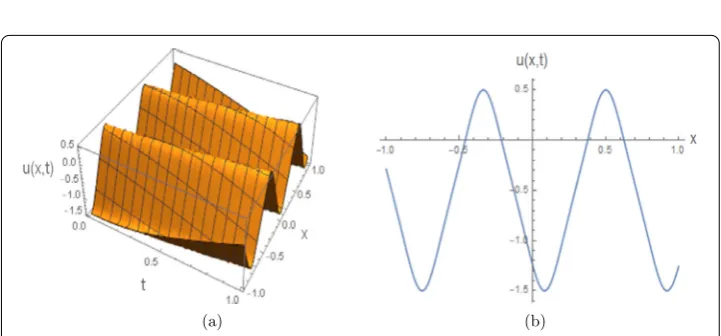
κ = –6,b1= 1,b(t) =t+ 1,α1= root with multiplicity 2. We obtain
Figure 1(a) The 3D graph of a rational function solutionu(x,t) appearing in Eq. (29), whenκ= –6, ω=12t2+tandξ
0= 1; (b) the corresponding 2D graph foru(x,t), whent= 1
Whenα1>α2orα1<α3,
Φ= 2h
(α2–α3)cosh[
√
h(ξ1–ξ0)] – (2α1–α2–α3)
, (81)
and then we have
φ(ξ) = 2a
–14 4 h
(α2–α3)cosh[
√
h(a
1 4
4ξ–ξ0)] – (2α1–α2–α3) –b1
2. (82)
For instance, ifa4= 1,κ= –6,b1= 1,b(t) =t+ 1,p= –9,q= –4,r= 12, thenω(t) =12t2+
t+c. Settingc= 0, the solution can be obtained as
u(x,t) = 15
cosh[√15(–6x+12t2+t–ξ0)] + 4– 1
2. (83)
3 Numerical simulations for modified Gardner equation
In this section, numerical simulations of modified Gardner equation are given. According to the solutions obtained above, each solution is chosen to carry out a typical numerical simulation, using Eqs. (29), (33), (37), (43), (53), (59), (67), (77) and (83). The 3D and the corresponding 2D graphs of are drawn to present the nature of them. In addition, we only focus on the positive one if there is a plus–minus sign in the selected solutions.
Case1. Fora4= 1, see Fig.1. Case2. Fora4= 1, see Fig.2. Case3. Fora4= 1, see Fig.3.
Case4. Fora4= 1, see Fig.4. Case5. Fora4= 1, see Fig.5. Case6. Fora4= 1, see Fig.6.
Figure 2(a) The 3D graph of a triangle function periodic solutionu(x,t) in Eq. (33), whenκ= –6,ω=12t2+t
andξ0= 1; (b) the corresponding 2D graph foru(x,t), whent= 1
Figure 3(a) The 3D graph of a rational function solutionu(x,t) illustrating Eq. (37), whenκ= –6,ω=12t2+t
andξ0= 1; (b) the corresponding 2D graph foru(x,t), whent= 1
Figure 4(a) The 3D graph of a hyperbolic cotangent function solutionu(x,t) demonstrating Eq. (43), when κ= –6,ω=12t2+tandξ0= 1; (b) the corresponding 2D graph foru(x,t), whent= 1
4 Conclusion
Figure 5(a) The 3D graph of Jacobi elliptic function solutionu(x,t) appearing in Eq. (53), whenκ= –6, ω=1
2t
2+tandξ
0= 1; (b) the corresponding 2D graph foru(x,t), whent= 1
Figure 6(a) The 3D graph of a solitary wave solutionu(x,t) reflected in Eq. (59), whenκ= –6,ω=12t2+tand
ξ0= 1; (b) the corresponding 2D graph foru(x,t), when t = 1
Figure 7(a) The 3D graph of Jacobi elliptic function solutionu(x,t) illustrating Eq. (67), whenκ= –6, ω=12t2+tandξ0= 1; (b) the corresponding 2D graph foru(x,t), whent= 1
Figure 8(a) The 3D graph of Jacobi elliptic function solutionu(x,t) demonstrating Eq. (77), whenκ= –6, ω=1
2t
2+tandξ
0= 1; (b) the corresponding 2D graph foru(x,t), whent= 1
Figure 9(a) The 3D graph of a solitary wave solutionu(x,t) appearing in Eq. (83), whenκ= –6,ω=12t2+t
andξ0= 1; (b) the corresponding 2D graph foru(x,t), whent= 1
other methods. In addition, some solutions with the specific parameters are also presented in the paper, thus the existence of the solutions is proved. Our results may be helpful to better understand the two-layer fluid with surface tension, and the problem with specific boundary and initial conditions will be studied in a future work. Moreover, we can also conclude that the trial equation method and the discrimination system for polynomial method are powerful in solving differential equations with variable coefficients arising in mathematical physics.
Acknowledgements
The authors would like to thank the reviewers for their helpful comments and suggestions to improve the manuscript.
Funding
This work was financed by Grant-in-aid for scientific research from the National Natural Science Foundation of China (NO. 51465047).
Competing interests
We would like to declare no conflicts of interest.
Authors’ contributions
Publisher’s Note
Springer Nature remains neutral with regard to jurisdictional claims in published maps and institutional affiliations.
Received: 6 December 2018 Accepted: 12 March 2019 References
1. Ablowitz, M.J., Clarkson, P.A.: Solitons, Nonlinear Evolutions and Inverse Scattering. Cambridge University Press, Cambridge (1991)
2. Liu, C.-S.: Canonical-like transformation method and exact solutions to a class of diffusion equations. Chaos Solitons Fractals42(1), 441–446 (2009)
3. Wadati, M.: Invariances and conservation laws of the Korteweg–de Vries equation. Stud. Appl. Math.59(2), 153–186 (1978)
4. Bulman, G.W., Sukeyuki, K.: Symmetries and Differential Equations. Springer, New York (1991)
5. Korteweg, D.J., de Vries, G.: On the change of form of long waves advancing in a rectangular canal, and on a new type of long stationary waves. Philos. Mag. Ser. 539, 422–443 (1895)
6. Ramollo, M.P.: Internal solitary waves in a two-layer fluid with surface tension. Adv. Fluid Mech.9, 209–219 (1996) 7. Liu, Y., Gao, Y.-T., Sun, Z.-Y., Yu, X.: Multi-soliton solutions of the forced variable-coefficient extended Korteweg–de
Vries equation arisen in fluid dynamics of internal solitary waves. Nonlinear Dyn.66(4), 575–587 (2011) 8. Holloway, P.E., Pelinovsky, E., Talipova, T., Barnes, B.: A nonlinear model of internal tide transformation on the
Australian North West shelf. J. Phys. Oceanogr.27(6), 871–896 (1997)
9. Liu, C.-S.: Trial equation method and its applications to nonlinear evolution equations. Acta Phys. Sin.54(6), 2505–2509 (2005)
10. Liu, C.-S.: Using trial equation method to solve the exact solutions for two kinds of KdV equations with variable coefficients. Acta Phys. Sin.54(10), 4506–4510 (2005)
11. Liu, C.-S.: Trial equation method to nonlinear evolution equations with rank inhomogeneous: mathematical discussions and its applications. Commun. Theor. Phys.45(2), 219–223 (2006)
12. Liu, C.-S.: A new trial equation method and its applications. Commun. Theor. Phys.45(3), 395–397 (2006) 13. Liu, C.-S.: Exponential function rational expansion method for nonlinear differential-difference equations. Chaos
Solitons Fractals40(2), 708–716 (2009)
14. Liu, C.-S.: Trial equation method based on symmetry and applications to nonlinear equations arising in mathematical physics. Found. Phys.41(5), 793–804 (2011)
15. Liu, C.-S.: Classification of all single travelling wave solutions to Calogero–Degasperis–Focas equation. Commun. Theor. Phys.48(4), 601–604 (2007)
16. Liu, C.-S.: All single travelling wave solutions to Nizhnok–Novikov–Veselov equation. Commun. Theor. Phys.45(6), 991–992 (2006)
17. Liu, C.-S.: The classification of travelling wave solutions and superposition of multi-solutions to Camassa–Holm equation with dispersion. Chin. Phys.16(7), 1832–1837 (2007)
18. Liu, C.-S.: Representations and classifications of travelling wave solutions to sinh-Gordon equation. Commun. Theor. Phys.49(1), 153–158 (2008)
19. Liu, C.-S.: Solution of ODEu+p(u)(u)2+q(u) = 0 and applications to classifications of all single travelling wave
solutions to some nonlinear mathematical physics equations. Commun. Theor. Phys.49(2), 291–296 (2008) 20. Liu, C.-S.: Applications of complete discrimination system for polynomial for classifications of travelling wave
solutions to nonlinear differential equations. Comput. Phys. Commun.181(2), 317–324 (2010) 21. Bluman, G.W., Kumei, S.: Symmetries and Differential Equations. Springer, New York (1989) 22. Hirota, R.: The Direct Method in Soliton Theory. Cambridge University Press, Cambridge (2004)
23. Sierra, C.A.G., Molati, M., Ramollo, M.P.: Exact solutions of a generalized KdV–mKdV equation. Int. J. Nonlinear Sci. 13(1), 94–98 (2012)