EQUATION WITH SEVERAL DELAYS
L. BEREZANSKY AND E. BRAVERMANReceived 13 January 2005; Revised 19 July 2005; Accepted 21 July 2005
For a delay difference equation N(n+ 1)−N(n)=N(n)mk=1ak(n)(1−N(gk(n))/K), ak(n)≥0,gk(n)≤n,K >0, a connection between oscillation properties of this equa-tion and the corresponding linear equaequa-tions is established. Explicit nonoscillaequa-tion and oscillation conditions are presented. Positiveness of solutions is discussed.
Copyright © 2006 L. Berezansky and E. Braverman. This is an open access article distrib-uted under the Creative Commons Attribution License, which permits unrestricted use, distribution, and reproduction in any medium, provided the original work is properly cited.
1. Introduction
Difference equations provide an important framework for analysis of dynamical phe-nomena in biology, ecology, economics, and so forth. For example, in population dy-namics discrete systems adequately describe organisms for which births occur in regular, usually short, breeding seasons.
Recently the problem of oscillation and nonoscillation of solutions for nonlinear delay difference equations has been intensively studied; see monographs [1,2,7–9] and refer-ences therein for more details.
In this paper we study the following nonlinear difference equation
N(n+ 1)−N(n)=N(n) m
k=1 ak(n)
1−N
gk(n) K
, ak(n)≥0, gk(n)≤n,K >0, (1.1) where the numbergk(n) is an integer (positive or negative) for everynandk. Equation (1.1) describes populations that die out completely at each generation and have birth rates that saturate for large population sizesN=K. Equation (1.1) is a discrete analogue
Hindawi Publishing Corporation Advances in Difference Equations Volume 2006, Article ID 82143, Pages1–12
of the well-known logistic differential equation with several delays
N(t)=N(t)m k=1
ak(t)
1−N
gk(t) K
. (1.2)
Oscillation properties of (1.2) were considered in [3,4,12].
In [9] oscillation properties of another discrete analogue of autonomous equation (1.2)
N(n+ 1)= bN(n) 1 +mk=1akN
n−σk (1.3)
were obtained.
In [14] the oscillation properties of the following equation were considered
N(n+ 1)=N(n) exp
m
k=1
ak 1−N
n−σk K
. (1.4)
This equation can be treated as another discrete analogue of autonomous equation (1.2). Note that in the nondelay case (gk(n)=n,σk=0) all solutions of (1.1), (1.3) and (1.4) are monotone, similar to the nondelay logistic equations (see, e.g., [6,10]). However, unlike (1.2), solutions of (1.1) can become negative.
Oscillation of (1.1) with a single delay (m=1) was investigated in [13], however con-ditions for the positiveness of solutions were not discussed. To the best of our knowledge there are no oscillation results for (1.1).
The paper is organized as follows.Section 2contains some preliminaries and auxiliary results. InSection 3we reduce oscillation (nonoscillation) of a nonlinear equation which is obtained from (1.1) by the substitutionx(n)=N(n)/K−1 to the oscillation (nonoscil-lation) problem for some linear equation. After applying these results and the developed oscillation theory for linear equations, inSection 4sufficient conditions for oscillation (nonoscillation) of solutions of (1.1) about equilibriumK are presented. These condi-tions are sharp for constant parameters and the only delay. The results on the existence of nonoscillatory solutions provide that there exists a positive solution of (1.1). How-ever oscillation conditions do not distinguish between eventually oscillatory solutions and eventually negative solutions (the population extincts at a certain step).Section 5
contains some discussion on the existence of positive solutions and relevant numerical simulations. As expected, if there is no global attractivity but the solution is positive, then we get asymptotically periodic oscillating solutions. It is to be noted that in the nondelay case (σk=0) with a variable periodic equilibrium (K=K(n)) the existence of periodic solutions for (1.4) was studied in [17].
2. Preliminaries
In addition to (1.1) we consider the following scalar difference equation
x(n+ 1)−x(n)= − m
k=1
with initial conditions
x(n)=ϕ(n), n≤0. (2.2)
We assume that the following condition is satisfied (a1)ak(n)≥0,gk(n)≤n, limn→∞gk(n)= ∞.
Equation (2.1) is obtained if we substitute in (1.1)N(n)=K[x(n) + 1]. Consider also a linear difference equation
y(n+ 1)−y(n)= −
where for parameters of (2.3) conditions (a1) hold.
Definition 2.1. The solutionx(n) ory(n) of (2.1) or (2.3), respectively, is called nonoscil-latory(about zero) if it is eventually positive or eventually negative.
If such solution does not exist we say that all solutions of this equation areoscillatory (about zero).
Lemma2.2 [15]. Equation (2.3) has a nonoscillatory solution if and only if inequality (2.4) has an eventually positive solution and inequality (2.5) has an eventually negative solution.
Supposeck(n)≤bk(n)and (2.3) has a nonoscillatory solution. Then the equation
also has a nonoscillatory solution. Lemma2.3 [16]. (1)Suppose
Then all solutions of (2.3) are oscillatory. (2)Suppose there existsλ∈(0, 1), such that
3. Oscillation and nonoscillation conditions
Lemma3.1. Suppose
∞
n=1 m
k=1
ak(n)= ∞. (3.1)
Ifx(n)is a nonoscillatory solution of (2.1), such that1 +x(n)>0, thenlimn→∞x(n)=0.
Proof. Without loss of generality we can assume thatx(n)>0,n >0,ϕ(n)≥0.
Equality (2.1) implies that 0< x(n+ 1)≤x(n). Then there exists a nonnegative limit l=limn→∞x(n). Supposel >0. Equality (2.1) also implies
x(n+ 1)−x(0)= − n
i=1 m
k=1
ak(i)1 +x(i)xgk(i). (3.2)
The left-hand side of (3.2) tends tol−x(0). Equality (3.1) yields that the right-hand side of (3.2) tends to−∞, which is a contradiction. Thenl=0. The lemma is proven. Theorem3.2. Suppose (3.1) holds and for some>0all solutions of the following linear equation
y(n+ 1)−y(n)= − m
k=1
ak(n)(1−)ygk(n) (3.3)
are oscillatory. Then all solutions of (2.1) satisfyingx(n)>−1are oscillatory.
Proof. Supposex(n) is an eventually positive solution of (2.1). Without loss of generality we can assumex(n)>0,n≥0. From equality (2.1) we have
x(n+ 1)−x(n)≤ − m
k=1
ak(n)xgk(n). (3.4)
It means that inequality (3.4) has an eventually positive solution.Lemma 2.2implies that (3.3) has a nonoscillatory solution, which contradicts the hypothesis of the theorem.
Suppose nowx(n) is an eventually negative solution of (2.1). Without loss of generality we can assumex(n)<0,n≥0.Lemma 3.1implies that for someN >0,−< x(n)<0, n≥N. Hence from (2.1) we have
x(n+ 1)−x(n)≥ − m
k=1
ak(n)(1−)xgk(n), (3.5)
for n≥N. Then difference inequality (3.5) has an eventually negative solution.
Lemma 2.2implies that difference equation (3.3) has a nonoscillatory solution. This
Corollary3.3. Suppose (3.1) holds and Proof. Inequality (3.6) implies that for some>0 we have
lim infn
ByLemma 2.3all solutions of (3.3) are oscillatory. The reference toTheorem 3.2
com-pletes the proof.
Theorem3.4. Suppose for some>0the following linear equation
y(n+ 1)−y(n)= − m
k=1
ak(n)(1 +)ygk(n) (3.8)
has a nonoscillatory solution. Then (2.1) also has a nonoscillatory solution.
Proof. Supposey(n) is an eventually positive solution of (3.8). Without loss of generality we can assumey(n)>0,n≥0. Denote
Condition (3.11) implies Equalities (3.12)-(3.13) imply
u(n)=
Consider now a nonlinear operator
(Tw)(n)=
in the finite dimensional spacel∞(N) with the norm
w l∞(N)= max
0≤n≤Nw(n). (3.22)
the equationw=Tw. Then
w0(n)= m
k=1 ak(n)
1 + n−1
i=0
1−w0(i)
n−1
i=gk(n)
1−w0(i)−1,
0≤n≤N,w0(n)=0,n≤0.
(3.23)
Therefore the function
x(n)= n−1
i=0
1−w0(i), 0≤n≤N,x(n)=0,n <0,x(0)=1, (3.24)
is a positive solution of (2.1) for 0≤n≤N. Since N is an arbitrary integer, then this
completes the proof.
Corollary3.5. Suppose there existsλ∈(0, 1), such that
lim sup n→∞
m
k=1
ak(n)λ(1−λ)n−gk(n)−1<1. (3.25)
Then (2.1) has a nonoscillatory solution.
Proof is based onLemma 2.3andTheorem 3.4.
4. Main oscillation results
Consider now logistic difference equation (1.1), whereK >0 and for the functionsak(n), gk(n) conditions (a1) hold.
Motivated by applications, in this section we consider only solutionsN(n) of (1.1) for whichN(n)>0,n≥0.
We study the oscillation of the solutions of (1.1) about the equilibrium pointK. Definition 4.1. The solutionN(n) of (1.1) is callednonoscillatory aboutKifN(n)−K is eventually positive or eventually negative.
If such solution does not exist we say that all solutions of this equation areoscillatory aboutK.
SupposeN(n) is a positive solution of (1.1) and definex(n)=(N(n)/K)−1. Then x(n) is a solution of (2.1) such that 1 +x(n)>0. Hence, oscillation (or nonoscillation) of N(n) aboutKis equivalent to oscillation (or nonoscillation) ofx(n) about zero.
By applying Theorems3.2,3.4and Corollaries3.3,3.5we obtain the following results for (1.1).
Theorem4.2. Suppose (3.1) holds. IfN(n)is a nonoscillatory aboutKpositive solution of (1.1) thenlimn→∞N(n)=K.
Corollary4.4. Suppose (3.1) and (3.6) hold. Then all positive solutions of (1.1) are oscil-latory aboutK.
Theorem4.5. Suppose for some>0linear equation (3.8) has a nonoscillatory solution. Then (1.1) also has a positive nonoscillatory aboutKsolution.
Corollary4.6. Suppose there exists λ∈(0, 1) such that (3.25) holds. Then (1.1) has a positive nonoscillatory aboutKsolution.
5. Existence of positive solutions
As it is known [3], for positive initial conditions the solution of delay logistic differential
equation (1.2) is positive. The delay logistic difference equations (1.3)-(1.4) enjoy the same property. However for difference equations (1.1) this is not true.
Example 5.1. Consider the following equation
N(n+ 1)−N(n)=N(n)1−N(n−1). (5.1)
IfN(−1)=3,N(0)=1, thenN(n)<0,n >0.
Thus it is interesting to find such constraints on initial conditions and parameters of the equation for which the solution of (1.1) will be positive.
Everywhere above we considered only positive solutions of (1.1). In this section we discuss sufficient conditions for positiveness of solutions and present some results of nu-merical simulations. To this end let us consider for any number b an auxiliary linear equation
y(n+ 1)−y(n)= − m
k=1
ak(n)(1 +b)ygk(n) (5.2)
with the initial conditions
y(n)=ϕ(n), n≤0. (5.3)
Theorem5.2. Suppose (a1) holds, there exists a constantA,0< A <1, such that as far as for the initial condition (5.3) inequality|ϕ(n)|< Aholds and|b|< A, then a solution of the linear equation (5.2) satisfies
y(n)< A. (5.4)
Then all solutions of (1.1), with initial conditions
N(n)−K< AK, n≤0, (5.5)
are positive for anyn >0. Moreover, the solution of (1.1) satisfies (5.5) for anyn.
Corollary5.3. Suppose (a1) is satisfied and for someA,0< A <1,
λ=(1 +A) sup n
m
k=1
ak(n)n−gk(n)<1. (5.6)
Then any solution of (1.1) satisfying initial condition (5.5) is positive.
Proof. Suppose that for (5.2) with|b|< Afor initial condition (5.3) we have|ϕ(n)| ≤A. [5, Theorem 2.2] and condition (5.6) imply
y(n)≤max
n≤0
ϕ(n)≤A (5.7)
for the solution of (5.2). Hence all conditions ofTheorem 5.2are satisfied. Therefore the
solution of (1.1) is positive.
Finally, let us consider the high order difference equation with a constant delay
N(n+ 1)−N(n)=aN(n)1−N(n−h), (5.8)
wherehis a positive integer. In accordance withCorollary 3.5and previous results (5.8) has a nonoscillatory aboutK=1 solution if
a < hh
(h+ 1)h+1. (5.9)
The condition of asymptotic stability of the linear equation
y(n+ 1)−y(n)= −ay(n−h) (5.10)
was obtained in [11]: if
0< a <2 cos hπ
2h+ 1, (5.11)
then (5.10) is asymptotically stable.
When reviewing [13] Ladas made the following conjecture (see, e.g., MathSciNet for the review of [13]). Under the same condition (5.11) (5.8) will have positive solutions for |N(n)−1|< ε,n≤0, whereεis small enough. However this condition is far from being necessary.
1.4
1.2
1
0.8
0.6
0.4
0.2
0 a
1 2 3 4 5 6 7 8 9 10
h
Nonoscillation Asymptotic stability Positive solutions
Figure 5.1. Bounds for oscillation, asymptotic stability and existence of positive solutions for (5.8). The first two estimates are found by formulas (5.9), (5.11), while the latter curve is established nu-merically.
3
2.5
2
1.5
1
0.5
0 N
0 50 100 150 200 250
n a=0.38
a=0.42
a=0.5 Equilibrium
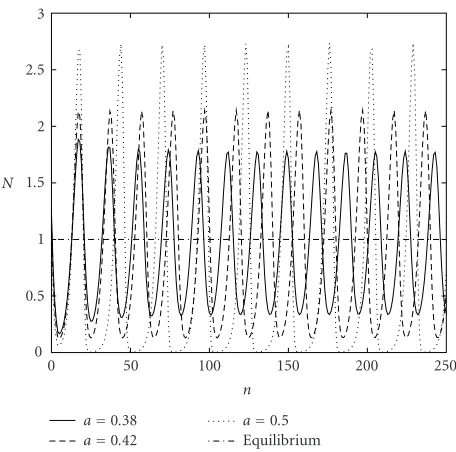
constraints are less restrictive compared to oscillation bounds and asymptotic stability conditions.
It is expected that in the range of parameter abetween extinction and asymptotic stability we get asymptotically periodic solutions.Figure 5.2illustrates this fact.
Acknowledgments
L. Berezansky was partially supported by Israeli Ministry of Absorption. E. Braverman was partially supported by the NSERC Research Grant and the AIF Research Grant.
References
[1] R. P. Agarwal, S. R. Grace, and D. O’Regan,Oscillation Theory for Difference and Functional Differential Equations, Kluwer Academic, Dordrecht, 2000.
[2] R. P. Agarwal and P. J. Y. Wong,Advanced Topics in Difference Equations, Mathematics and Its Applications, vol. 404, Kluwer Academic, Dordrecht, 1997.
[3] L. Berezansky and E. Braverman,On oscillation of a logistic equation with several delays, fixed point theory with applications in nonlinear analysis., Journal of Computational and Applied Mathematics113(2000), no. 1-2, 255–265.
[4] ,Oscillation properties of a logistic equation with several delays, Journal of Mathematical Analysis and Applications247(2000), no. 1, 110–125.
[5] L. Berezansky, E. Braverman, and E. Liz,Sufficient conditions for the global stability of nonau-tonomous higher order difference equations, Journal of Difference Equations and Applications11 (2005), no. 9, 785–798.
[6] F. Brauer and C. Castillo-Ch´avez,Mathematical Models in Population Biology and Epidemiology, Texts in Applied Mathematics, vol. 40, Springer, New York, 2001.
[7] S. N. Elaydi,An Introduction to Difference Equations, 2nd ed., Undergraduate Texts in Mathe-matics, Springer, New York, 1999.
[8] I. Gy¨ori and G. Ladas,Oscillation Theory of Delay Differential Equations: With Applications, Ox-ford Mathematical Monographs. OxOx-ford Science Publications., The Clarendon Press OxOx-ford University Press, New York, 1991.
[9] V. L. Koci´c and G. Ladas,Global Behavior of Nonlinear Difference Equations of Higher Order with Applications, Mathematics and Its Applications, vol. 256, Kluwer Academic, Dordrecht, 1993. [10] M. Kot,Elements of Mathematical Ecology, Cambridge University Press, Cambridge, 2001. [11] S. A. Levin and R. M. May,A note on difference-delay equations, Theoretical Population Biology.
An International Journal9(1976), no. 2, 178–187.
[12] J. Luo,Oscillation and linearized oscillation of a logistic equation with several delays, Applied Mathematics and Computation131(2002), no. 2-3, 469–476.
[13] Ch. G. Philos,Oscillations in a nonautonomous delay logistic difference equation, Proceedings of the Edinburgh Mathematical Society. Series II35(1992), no. 1, 121–131.
[14] H.-R. Sun and W.-T. Li,Qualitative analysis of a discrete logistic equation with several delays, Applied Mathematics and Computation147(2004), no. 2, 515–525.
[15] J. R. Yan and C. X. Qian,Oscillation and comparison results for delay difference equations, Journal of Mathematical Analysis and Applications165(1992), no. 2, 346–360.
[17] Z. Zhou and X. Zou,Stable periodic solutions in a discrete periodic logistic equation, Applied Mathematics Letters. An International Journal of Rapid Publication16(2003), no. 2, 165–171.
L. Berezansky: Department of Mathematics, Ben-Gurion University of the Negev, Beer-Sheva 84105, Israel
E-mail address:[email protected]
E. Braverman: Department of Mathematics and Statistics, University of Calgary, 2500 University Drive N.W., Calgary, Alberta T2N 1N4, Canada