doi:10.1155/2009/347291
Research Article
Inequalities among Eigenvalues of
Second-Order Difference Equations with
General Coupled Boundary Conditions
Chao Zhang and Shurong Sun
School of Science, University of Jinan, Jinan, Shandong 250022, China
Correspondence should be addressed to Chao Zhang,ss [email protected]
Received 11 February 2009; Accepted 11 May 2009
Recommended by Johnny Henderson
This paper studies general coupled boundary value problems for second-order difference equations. Existence of eigenvalues is proved, numbers of their eigenvalues are calculated, and their relationships between the eigenvalues of second-order difference equation with three different coupled boundary conditions are established.
Copyrightq2009 C. Zhang and S. Sun. This is an open access article distributed under the Creative Commons Attribution License, which permits unrestricted use, distribution, and reproduction in any medium, provided the original work is properly cited.
1. Introduction
Consider the second-order difference equation
−∇pnΔyn
qnynλwnyn, n∈0, N−1 1.1
with the general coupled boundary condition
yN−1
ΔyN−1
eiαK
y−1 Δy−1
, 1.2
whereN ≥ 2 is an integer,Δis the forward difference operator:Δyn yn1−yn,∇is the backward difference operator: ∇yn yn −yn−1, andpn, qn,and wn are real numbers with
parameter; the interval 0, N −1 is the integral set{n}Nn−10; α, −π < α ≤ π is a constant parameter;i√−1,
K
k11 k12
k21 k22
, kij ∈R, i, j1,2, with detK1. 1.3
The boundary condition 1.2 contains the periodic and antiperiodic boundary conditions. In fact, 1.2 is the periodic boundary condition in the case where α 0 and
KI, the identity matrix, and1.2 is the antiperiodic condition in the case whereαπand
KI.
We first briefly recall some relative existing results of eigenvalue problems for difference equations. Atkinson1, Chapter 6, Section 2discussed the boundary conditions
y−1αym−1, ymβy0 1.4
when he investigated the recurrence formula
cnyn1
anλbn
yn−cn−1yn−1, n∈0, m−1, 1.5
wherean,bn,cn,α,andβare real numbers, subject toan>0, cn>0,and
αc−1βcm−1. 1.6
He remarked that all the eigenvalues of the boundary value problem1.4 and1.5 are real, and they may not be all distinct. If c−1 cm−1 and α β 1, he viewed the boundary conditions1.4 as the periodic boundary conditions for1.5. Shi and Chen2investigated the more general boundary value problem
−∇CnΔxn Bnxnλwnxn, n∈1, N, N≥2, 1.7
R
−x0
xN
S
C0Δx0
CNΔxN
0, 1.8
where Cn, Bn, and wn are d×dHermitian matrices; C0 and CN are nonsingular; wn > 0 for n ∈ 1, N;R and S are 2d×2d matrices. Moreover,R and S satisfy rankR, S 2d
see4, Theorems 2.2 and 3.1 : the periodic and antiperiodic boundary value problems have exactlyNreal eigenvalues{λi}Ni0−1and{λi}Ni1, respectively, which satisfy
λ0<λ1≤λ2 < λ1≤λ2<λ3≤λ4<· · ·< λN−2≤λN−1<λN, ifN is odd,
λ0<λ1≤λ2< λ1≤λ2 <λ3≤λ4<· · ·<λN−1≤λN< λN−1, ifN is even.
1.9
These results are similar to those about eigenvalues of periodic and antiperiodic boundary value problems for second-order ordinary differential equationscf.5–8 .
Motivated by4, we compare the eigenvalues of the eigenvalue problem1.1 with the coupled boundary condition 1.2 as α varies and obtain relationships between the eigenvalues in the present paper. These results extend the above results obtained in4. In this paper, we will apply some results obtained by Shi and Chen2to prove the existence of eigenvalues of1.1 and1.2 to calculate the number of these eigenvalues, and to apply some oscillation results obtained by Agarwal et al.9to compare the eigenvalues asαvaries. This paper is organized as follows. Section 2 gives some preliminaries including existence and numbers of eigenvalues of the coupled boundary value problems, and some properties of eigenvalues of a kind of separated boundary value problem, which will be used in the next section. Section 3 pays attention to comparison between the eigenvalues of problem1.1 and1.2 asαvaries.
2. Preliminaries
Equation1.1 can be rewritten as the recurrence formula
pnyn1
pnpn−1qn−λwn
yn−pn−1yn−1, n∈0, N−1. 2.1
Clearly,ynis a polynomial inλwith real coefficients sincepn, qn,andwnare all real. Hence, all the solutions of1.1 are entire functions ofλ. Especially, ify0/0,yn is a polynomial of degreeninλforn≤N. However, ify−1/0 andy00,ynis a polynomial of degreen−1 in
λforn≤N.
We now prepare some results that are useful in the next section. The following lemma is mentioned in4, Theorem 2.1.
Lemma 2.14, Theorem 2.1 . Letyandzbe any solutions of1.1 . Then the Wronskian
Wy, zn yn1 zn1 pnΔyn pnΔzn
−pn
yn1zn−ynzn1
2.2
is a constant on−1, N−1.
Theorem 2.2. Ifk11/k12 then the coupled boundary value problem1.1 and1.2 has exactlyN
Proof. By settingd1,Cnpn,Bnqn,
R R1, R2
eiαk
11 1
eiαk
21 0
, S S1, S2
−eiαk
12 0
−eiαk
22 1
, 2.3
shifting the whole interval1, Nleft by one unit, and usingp−1 pN−1 1,1.1 and1.2 are written as1.7 and1.8, respectively. It is evident that rankR, S 2dandRS∗ SR∗. Hence, the boundary condition1.2 is self-adjoint by2, Lemma 2.1. In addition, it follows from2.3 andC−11 that
R1S1C−1, S2
eiαk
11−k12 0
eiαk21−k22 1
. 2.4
By noting thatk11/k12, we get rankR1S1C−1, S2 2. Therefore, by2, Theorem 4.1, the
problem1.1 and1.2 has exactlyNreal eigenvalues. This completes the proof.
Letynλ be the solution of1.1 with the initial conditions
y−1λ 0, y0λ /0. 2.5
Consider the sequence
y0λ , y1λ , . . . , yN−1λ . 2.6
Ifynλ 0 for somen ∈ 0, N−1 , then, we get from 2.1 thatyn−1λ andyn1λ have
opposite signs. Hence, we say that sequence2.6 exhibits a change of sign ifynλ yn1λ <0
for somen∈0, N−1 , orynλ 0 for somen∈0, N−1 . A general zero of the sequence
2.6 is defined as its zero or a change of sign.
Now we consider1.1 with the following separated boundary conditions:
y−10, k12ΔyN−1−k22yN−10, 2.7
where k12, k22 are entries of K. It follows from 2.1 that the separated boundary value
problem1.1 with2.7 has a unique solution, and the separated boundary value problem will be used to compare the eigenvalues of1.1 and1.2 asαvaries in the next section.
In9, Agarwal et al. studied the following boundary value problem on time scales:
yΔΔqt yσ −λyσ, t∈ρa , ρb ∩T, 2.8
with the boundary conditions
Ra
y:αyρa βyΔρa 0, Rb
whereTis a time scale, σt and ρt are the forward and backward jump operators in T,
yΔ is the delta derivative, andyσt : yσt ; q : ρa , ρb ∩T → R is continuous;
α2β2 γ2δ2 /0;a, b∈Twitha < b. They obtained some useful oscillation results. With
a similar argument to that used in the proof of9, Theorem 1, one can show the following result.
Lemma 2.3. The eigenvalues of the boundary value problem are
−pt yΔt Δqσt yσt λrσt yσt , t∈ρa , ρb ∩T, 2.10
with
Ra
yRb
y0, 2.11
wherepΔ, qσ,andrσ are real and continuous functions inρa , ρb ∩T, p >0overρa , b∩
T, rσ >0overρa , ρb ∩T, pρa pb 1are arranged as−∞< λ
0< λ1 < λ2 <· · · ,and
an eigenfunction corresponding toλkhas exactlykgeneralized zeros in the open intervala, b .
By settingρa , b∩T −1, N−1: {n}−1N−1,α 1, β 0, γ −k22, δ k12, the
above boundary value problem can be written as1.1 with2.7, then we have the following result.
Lemma 2.4. The boundary value problem1.1 and2.7 hasN−1 real and simple eigenvalues as
k12 0andNreal and simple eigenvalues ask12/0, which can be arranged in the increasing order
μ0< μ1<· · ·< μNs, whereNs:N−2 orN−1. 2.12
Letynλ be the solution of 1.1 with the separated boundary conditions2.7 . Then sequence2.6
exhibits no changes of sign forλ≤μ0, exactlyk1changes of sign forμk< λ≤μk1 0≤k≤Ns−1 ,
andNs1changes of sign forλ > μNs.
Letϕnandψnbe the solutions of1.1 satisfying the following initial conditions:
ϕ−1 ψ01, ϕ0ψ−10, 2.13
respectively. ByLemma 2.1and usingpN−11, we have
ΔϕN−1ψN−1−ϕN−1ΔψN−1ϕNψN−1−ϕN−1ψN−1. 2.14
Lemma 2.5. Letμk 0≤k≤Ns be the eigenvalues of1.1 and2.7 withk120and be arranged
as2.12 . Then,ψnμk is an eigenfunction of the problem1.1 and2.7 with respect toμk 0≤k≤
Ns , that is, for0≤k≤Ns,ψnμk is a nontrivial solution of 1.1 satisfying
ψ−1μk
ψN−1μk
0. 2.15
Moreover, ifkis odd,ψNμk >0and ifkis even,ψNμk <0for2≤k≤Ns.
A representation of solutions for a nonhomogeneous linear equation with initial conditions is given by the following lemma.
Lemma 2.6see4, Theorem 2.3 . For any{fn}nN−10 ⊂Cand for anyc−1, c0∈C, the initial value
problem
−∇pnΔzn
qn−λwn
znwnfn, n∈0, N−1,
z−1c−1, z0c0
2.16
has a unique solutionz, which can be expressed as
znc−1ϕnc0ψn n−1
j0
wj
ϕnψj−ϕjψn
fj, n∈−1, N, 2.17
where−2j0·−1j0·:0.
3. Main Results
Letϕnandψnbe defined inSection 2, letμk0≤k≤Ns be the eigenvalues of the separated boundary value problem1.1 with2.7 , and letλjeiαK 0≤j ≤N−1 be the eigenvalues of the coupled boundary value problem1.1 and1.2 and arranged in the nondecreasing order
λ0
eiαK≤λ1
eiαK≤ · · · ≤λN−1
eiαK. 3.1
Clearly,λjK 0 ≤ j ≤ N−1 denotes the eigenvalue of the problem1.1 and1.2 with
α0, andλj−K 0≤j≤N−1 denotes the eigenvalue of the problem1.1 and1.2 with
Theorem 3.1. Assume that k11 > 0, k12 ≤ 0 or k11 ≥ 0, k12 < 0. Then, for every fixedα /0,
−π < α < π, one has the following inequalities:
λ0K < λ0
eiαK< λ
0−K ≤λ1−K < λ1
eiαK< λ
1K
≤λ2K < λ2
eiαK< λ2−K
≤λ3−K < λ3
eiαK< λ3K
≤ · · · ≤λN−2−K < λN−2
eiαK< λN−2K
≤λN−1K < λN−1
eiαK< λN−1−K , ifN is odd,
λ0K < λ0
eiαK< λ0−K ≤λ1−K < λ1
eiαK< λ1K
≤λ2K < λ2
eiαK< λ2−K
≤λ3−K < λ3
eiαK< λ3K
≤ · · · ≤λN−2K < λN−2
eiαK< λN−2−K
≤λN−1−K < λN−1
eiαK< λ
N−1K , ifN is even.
3.2
Remark 3.2. Ifk11≤0, k12>0 ork11 <0, k12≥0, a similar result can be obtained by applying
Theorem 3.1to−K. In fact,eiαKeiπα−K forα∈−π,0 andeiαKei−πα−K forα∈
0, π . Hence, the boundary condition1.2 in the cases ofk11 ≤0, k12 >0 ork11 <0, k12 ≥0
andα /0,−π < α < π, can be written as condition1.2 , whereαis replaced byπαfor
α∈−π,0 and−παforα∈0, π , andKis replaced by−K.
Before provingTheorem 3.1, we prove the following five propositions.
Proposition 3.3. Forλ∈C,λis an eigenvalue of1.1 and1.2 if and only if
fλ 2 cosα, 3.3
where
fλ :k22ϕN−1λ k11−k12 ΔψN−1λ −k21−k22 ψN−1λ −k12ΔϕN−1λ . 3.4
Moreover,λis a multiple eigenvalue of 1.1 and1.2 if and only if
ϕN−1λ eiαk11−k12 , ΔϕN−1λ eiαk21−k22 ,
ψN−1λ eiαk12, ΔψN−1λ eiαk22.
Proof. Sinceϕnandψnare linearly independent solutions of1.1 , thenλis an eigenvalue of the problem1.1 and1.2 if and only if there exist two constantsC1andC2not both zero
such thatC1ϕnC2ψnsatisfies1.2, which yields
ϕN−1λ −eiαk11−k12 ψN−1λ −eiαk12
ΔϕN−1λ −eiαk21−k22 ΔψN−1λ −eiαk22
C1
C2
0. 3.6
It is evident that3.6 has a nontrivial solutionC1, C2 if and only if
det
ϕN−1λ −eiαk11−k12 ψN−1λ −eiαk12
ΔϕN−1λ −eiαk21−k22 ΔψN−1λ −eiαk22
0 3.7
which, together with2.14 and detK1, implies that
1e2iα−eiαfλ 0. 3.8
Then3.3 follows from the above relation and the fact thate−iαeiα 2 cosα. On the other hand,1.1 has two linearly independent solutions satisfying1.2 if and only if all the entries of the coefficient matrix of3.6 are zero. Hence,λis a multiple eigenvalue of1.1 and1.2 if and only if3.5 holds. This completes the proof.
The following result is a direct consequence of the first result ofProposition 3.3.
Corollary 3.4. For anyα∈−π, π,
λj
eiαKλj
e−iαK, 0≤j≤N−1. 3.9
Proposition 3.5. Assume thatk11 > 0, k12 ≤ 0or k11 ≥ 0, k12 < 0. Then one has the following
results.
i For eachk,0≤k≤Ns,fμk ≥2ifkis odd, andfμk ≤ −2ifkis even.
ii There exists a constantν0< μ0such thatfν0 ≥2.
iii If the boundary value problem 1.1 and2.7 has exactlyN−1eigenvalues then there exists a constantξ0such thatμN−2 < ξ0andfξ0 ≤ −2, whereNis odd, and there exists
a constantη0such thatμN−2< η0andfη0 ≥2, whereNis even.
Proof. i If ψnμk is an eigenfunction of the problem 1.1 and 2.7 respect to μk then
k12ΔψN−1μk −k22ψN−1μk 0. By Lemma 2.3and the initial conditions2.13 , we have that ifk12<0 then the sequenceψ0μk ,ψ1μk , . . . , ψN−1μk exhibitskchanges of sign and
sgnψN−1μk
Case 2. Ifk120 then it follows from2.7 and2.14 that for eachk, 0≤k≤Ns,
ϕN−1μk
ψN
μk
1. 3.17
From2.15 and by the definition offλ , we get
fμk
k22
ψN
μk
k11ψN
μk
. 3.18
Hence, noting detKk11k22 1,k11>0, and byLemma 2.5, we have that ifkis odd, then
fμk
≥2, 3.19
and ifkis even, then
fμk
≤ −2. 3.20
ii By the discussions in the first paragraph ofSection 2,ϕN−1λ is a polynomial of
degreeN−2 inλ,ϕNλ is a polynomial of degreeN−1 inλ,ψN−1λ is a polynomial of degreeN−1 inλ, andψNλ is a polynomial of degreeNinλ. Further,ψNλ can be written as
ψNλ −1 NANλNAN−1λN−1· · ·A0, 3.21
whereANw0w1· · ·wN−1p0p1· · ·pN−1 −1>0 andAnis a certain constant forn∈0, N−1. Then
fλ −1 Nk11−k12 ANλNhλ , 3.22
wherehλ is a polynomial inλwhose degree is not larger thanN−1. Clearly, asλ → −∞,
fλ → ∞sincek11 −k12 > 0. By the first part of this proposition,fμ0 ≤ −2. So there
exists a constantν0< μ0such thatfν0 ≥2.
iii It follows from the first part of this proposition that ifNis odd,fμN−2 ≥2 and
ifN is even,fμN−2 ≤ −2. By3.22 , if Nis odd,fλ → −∞asλ → ∞; ifN is even,
fλ → ∞asλ → ∞. Hence, if N is odd, there exists a constantξ0 > μN−2 such that
fξ0 ≤ −2; ifNis even, there exists a constantη0 > μN−2such thatfη0 ≥2. This completes
the proof.
Sinceϕnandψnare both polynomials inλ, so isfλ . Denote
d
dλfλ :f
λ , d2
Proposition 3.6. Assume thatk11 > 0, k12 ≤ 0 or k11 ≥ 0, k12 < 0. Equationsfλ 0 and
Differentiating3.25 and3.26 with respect toλ, respectively, yields that
−∇pnΔϕnλ
It follows from2.13 that
ϕ0ϕ−1ψ0 ψ−1 0. 3.28
It follows from3.29 that
Hence, not indicatingλexplicitly, we get
linearly independent,δjλ is identically zero if and only if all the entries of the matrixIλ vanish, namely,
k12ΔψN−1λ −k22ψN−1λ 0,
k11−k12 ΔϕN−1λ −k21−k22 ϕN−1λ 0,
k22ϕN−1λ −k11−k12 ΔψN−1λ k21−k22 ψN−1λ −k12ΔϕN−1λ 0
3.34
which, together withfλ 2 and det K1, implies
ϕN−1λ k11−k12, ΔϕN−1λ k21−k22,
ψN−1λ k12, ΔψN−1λ k22.
3.35
Then byProposition 3.3,λis a multiple eigenvalue of1.1 and1.2 withα0. In addition,
3.34 , together withfλ −2 and detK1, implies
ϕN−1λ −k11−k12 , ΔϕN−1λ −k21−k22 ,
ψN−1λ −k12, ΔψN−1λ −k22.
3.36
Then byProposition 3.3,λis a multiple eigenvalue of1.1 and1.2 withαπ. Conversely, from3.35 or3.36 , it can be easily verified that3.34 holds, thenfλ 0. It follows again from3.35 or3.36 thatfλ 2 orfλ −2. Thusfλ 0 andfλ 2 or−2 if and only ifλis a multiple eigenvalue of1.1 and1.2 withα0 orαπ.
Further, for every fixedλwithfλ 2 or−2, not indicatingλexplicitly,3.33 implies that
k12ΔψN−1−k22ψN−1k11−k12 ΔϕN−1−k21−k22 ϕN−1
k22ϕN−1−k11−k12 ΔψN−1 k21−k22 ψN−1−k12ΔϕN−1
2
4 .
3.37
Therefore, from3.37 and by the definition ofδj, we have
δj
k12ΔψN−1−k22ψN−1
·
ϕj
k22ϕN−1−k11−k12 ΔψN−1 k21−k22 ψN−1−k12ΔϕN−1
2k12ΔψN−1−k22ψN−1 ψj
2 3.38
and consequently, not indicatingλexplicitly, we have
fk12ΔψN−1−k22ψN−1
·N−1
j0
wj
ϕj
k22ϕN−1−k11−k12 ΔψN−1 k21−k22 ψN−1−k12ΔϕN−1
2k12ΔψN−1−k22ψN−1
ψj
2 3.39
ν0λ 0Kλ0e
iαK
λ0−K μ0 λ1−K
−2 2 cosα 2
fλ
λ1eiαK μ1,λ1,2K λ2eiαK
λ2−K
λ
Figure 1:The graph offλ .
Suppose thatfλ 2 or−2 for someλ /μk 0 ≤ k ≤ Ns , we havek12ΔψN−1λ −
k22ψN−1λ /0.From the above discussions again,λis a simple eigenvalue of1.1 and1.2 withα0 orαπ, andδjis not identically zero for 0≤j≤N−1.
For thisλ /μk 0 ≤ k ≤ Ns ,3.39 implies that fλ /0, and from Proposition 3.5
i ,ii thatfμ0 ≤ −2,fν0 ≥ 2. Hence, fλ < 0, whereν0 < λ < μ0. It follows from
Proposition 3.5i thatfμk fμk1 ≤ −4 and−1 kfλ > 0, whereμk < λ < μk1 0≤ k ≤
N−3 . ByProposition 3.5i ,iii ,fμN−2 ≥2 and there existsμN−2< ξ0such thatfξ0 ≤ −2
ifN is odd, andfμN−2 ≤ −2 and there existsμN−2 < η0 such thatfη0 ≥ 2 ifNis even.
Hence,−1 N−2fλ >0 whereμN−2< λ. This completes the proof.
Proposition 3.7. For any fixedα /0,−π < α < π, each eigenvalue of1.1 and1.2 is simple.
Proof. Fixα,−π < α < πwithα /0. Suppose thatλis an eigenvalue of the problem1.1 and
1.2 . ByProposition 3.3, we havef2λ 4 cos2α <4. It follows from3.33 that detIλ >0
and the matrixIλ is positive definite or negative definite. Hence,δj>0 for 0≤j≤N−1 or
δj<0 for 0≤j ≤N−1 sinceϕnandψnare linearly independent.
If λ is a multiple eigenvalue of problem 1.1 and 1.2, then 3.5 holds by Proposition 3.3. By using3.5 , it can be easily verified that3.34 holds, that is, all the entries of the matrixIλ are zero. Thenδj 0 for 0 ≤ j ≤ N−1, which is contrary toδj/0 for 0≤j≤N−1. Hence,λis a simple eigenvalue of1.1 and1.2 . This completes the proof.
Proposition 3.8. Assume thatk11 > 0, k12 ≤ 0 or k11 ≥ 0, k12 < 0. If k is odd, fμk 2,
andfμk 0,thenfμk < 0; ifkis even,fμk −2, andfμk 0,thenfμk > 0for 0≤k≤N−2.
Proof. We first prove the first result. Suppose that k is odd, fμk 2, and fμk 0. Thenμkis a multiple eigenvalue of1.1 and1.2 with α 0 byProposition 3.6. Then by Proposition 3.3,3.5 holds forλμkandα0, that is,
ϕN−1μk
k11−k12, ΔϕN−1μk
k21−k22,
ψN−1μk
k12, ΔψN−1μk
k22.
Differentiatingfλ with respect toλtwo times, we get
which, together with3.41 , implies that
fμk
On the other hand, it follows from3.29 and2.14 that, not indicatingμkexplicitly,
ϕNψN −1−ϕN−1ψN 0 by H ¨older’s inequality, which proves the first conclusion.
The second conclusion can be shown similarly. Hence, the proof is complete.
Finally, we turn to the proof ofTheorem 3.1.
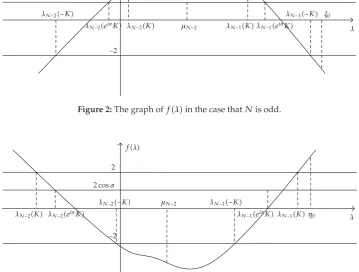
Proof ofTheorem 3.1. By Propositions 3.3–3.8, and the intermediate value theorem, one can obtain the graph off seeFigure 1 , which implies the results ofTheorem 3.1. We now give its detailed proof.
Similarly, by Propositions3.3–3.6, the continuity offλ ,and the intermediate value theorem,
λN−2−K
λN−2eiαK
2 cosα
−2 2
fλ
λN−2K μN−2 λN−1K λN−1eiαK
λN−1−K ξ0
λ
Figure 2:The graph offλ in the case thatNis odd.
λN−2K λN−2eiαK
2 cosα
−2 2
fλ
λN−2−K μN−2 λN−1−K
λN−1eiαK λN−1K η0 λ
Figure 3:The graph offλ in the case thatNis even.
any two consecutive eigenvalues of the separated boundary value problem1.1 with2.7 . Hence, 1.1 and 1.2 with α 0; α /0, −π < α < π; α πhas only one eigenvalue between any two consecutive eigenvalues of 1.1 with 2.7 , respectively. In addition, by Proposition 3.6, iffμk 2 or−2 andfμk 0, thenμkis not only an eigenvalue of1.1 with2.7 but also a multiple eigenvalue of1.1 and1.2 withα0 andαπ.
By Proposition 3.5i , ifN is odd, fμN−2 ≥ 2 and ifN is even, fμN−2 ≤ −2. It
follows3.22 that ifNis odd, thenfλ → −∞asλ → ∞,and ifNis even, thenfλ →
∞asλ → ∞. Hence, ifNis odd, then there exists a constantξ0> μN−2such thatfξ0 ≤ −2,
which, together withProposition 3.6, implies that1.1 and1.2 withα0;α /0,−π < α < π;
απ,has only one eigenvalueλN−1K ,λN−1eiαK , andλN−1−K , satisfying
μN−2≤λN−1K < λN−1
eiαK< λ
N−1−K ≤ξ0 3.46
seeFigure 2. Similarly, in the other case that Nis even, there exists a constantη0 > μN−2
α0;α /0,−π < α < π;απhas only one eigenvalueλN−1K ,λN−1eiαK , andλN−1−K ,
satisfying
μN−2≤λN−1−K < λN−1
eiαK< λN−1K ≤η0 3.47
seeFigure 3 . Therefore, we get that1.1 and1.2 withα /0,−π < α < π,hasNeigenvalues and it is real and satisfies
ν0≤λ0K < λ0
eiαK< λ0−K ≤μ0≤λ1−K < λ1
eiαK< λ1K ≤μ1
≤λ2K < λ2
eiαK< λ2−K ≤μ2≤λ3−K < λ3
eiαK< λ3K ≤μ3
≤ · · · ≤μN−3≤λN−2−K < λN−2
eiαK< λN−2K ≤μN−2≤λN−1K
< λN−1
eiαK< λN−1−K ≤ξ0, ifN is odd,
ν0≤λ0K < λ0
eiαK< λ0−K ≤μ0≤λ1−K < λ1
eiαK< λ1K ≤μ1
≤λ2K < λ2
eiαK< λ
2−K ≤μ2≤λ3−K < λ3
eiαK< λ
3K ≤μ3
≤ · · · ≤μN−3≤λN−2K < λN−2
eiαK< λN−2−K ≤μN−2≤λN−1−K
< λN−1
eiαK< λN−1K ≤η0, ifN is even.
3.48
This completes the proof.
Remark 3.9. LetK I, that is,k11 k22 1,k12 k21 0. Thenfλ ϕN−1λ ψNλ . In this case, Propositions3.5and3.8are the same as those mentioned in4, Propositions 3.1, 3.3–3.5, respectively, and most of the results ofProposition 3.6are the same as the results of
4, Proposition 3.2.
Acknowledgments
Many thanks to Johnny Hendersonthe editor and the anonymous reviewers for helpful comments and suggestions. This research was supported by the Natural Scientific Foundation of Shandong Province Grant Y2007A27 , Grant Y2008A28 , and the Fund of Doctoral Program Research of University of JinanB0621 .
References
1 F. V. Atkinson, Discrete and Continuous Boundary Problems, vol. 8 of Mathematics in Science and Engineering, Academic Press, New York, NY, USA, 1964.
2 Y. Shi and S. Chen, “Spectral theory of second-order vector difference equations,” Journal of Mathematical Analysis and Applications, vol. 239, no. 2, pp. 195–212, 1999.
4 Y. Wang and Y. Shi, “Eigenvalues of second-order difference equations with periodic and antiperiodic boundary conditions,”Journal of Mathematical Analysis and Applications, vol. 309, no. 1, pp. 56–69, 2005.
5 E. A. Coddington and N. Levinson,Theory of Ordinary Differential Equations, McGraw-Hill, New York, NY, USA, 1955.
6 J. K. Hale,Ordinary Differential Equations, vol. 20 ofPure and Applied Mathematics, Wiley-Interscience, New York, NY, USA, 1969.
7 W. Magnus and S. Winkler,Hill’s Equation, Interscience Tracts in Pure and Applied Mathematics, no. 20, Wiley-Interscience, New York, NY, USA, 1966.
8 M. Zhang, “The rotation number approach to eigenvalues of the one-dimensionalp-Laplacian with periodic potentials,”Journal of the London Mathematical Society, vol. 64, no. 1, pp. 125–143, 2001.
9 R. P. Agarwal, M. Bohner, and P. J. Y. Wong, “Sturm-Liouville eigenvalue problems on time scales,”