MP-09.01
Feasibility of Conducting a Randomized Controlled Trial to Investigate Effects of Antibiotic Prophylaxis on Urinary Tract Infection Rate in Infants with Antenatal Hydronephrosis: The ALPHA Pilot Trial
Braga, Luis H.1; Pemberton, Julia1; Heaman, Jessie1; DeMaria, Jorge1;
Lorenzo, Armando2
1McMaster University, Hamilton, ON, Canada; 2Sick Kids, Toronto, ON,
Canada
Introduction and Objectives: To determine feasibility of conducting a
clini-cal trial evaluating effect of antibiotic prophylaxis (AP) on urinary tract infection (UTI) rate in infants with grades III-IV antenatal hydronephrosis (AHN), a blinded randomized placebo controlled trial was piloted.
Methods: Recruitment began in August 2010, and is ongoing. Exclusion
criteria were grades I-II AHN, presence of VUR, duplication anomalies and age at enrollment >5 mo. Feasibility data were obtained prospectively for eligibility and enrollment, adherence to follow up, and medication com-pliance. Families were provided monthly medication logs to record when medication was administered.
Results: Of 241 AHN patients screened, 66 were eligible (28%), 172 (70%)
were not, and 3 (1%) are awaiting VCUG. Of 66 eligible, 39 were enrolled (59%), 24 declined (36%), 1 is pending consent (2%), and 2 (3%) were missed. Reasons for declining participation were: 7 (29%) parents did not want their child on AP, 4 (17%) parents wanted their child on AP, 10 (42%) parents were not interested in being part of research. Of 39 enrolled, 23 (59%) completed the trial, 12 (31%) are in follow up, and 4 (10%) dropped out. Of 23 patients who completed the study, 5 (22%) developed a febrile UTI. Of the 35 patients who have completed the study or are in active follow up, 23 (66%; 95% CI:45-77%) received study medication at least 75% of the time. Of 235 logs dispensed, 191 (81%; 95% CI:75-86%) have been completed and returned. Of 191 returned logs, average medication compliance was 95% (95% CI:89-98%). Adherence to follow up schedule, including 4 clinical visits and 8 phone calls to families, was 93% (95% CI:86-97%).
Conclusion: Due to low outcome rate, multi-centre collaboration is critical
to address effects of AP on UTI rate in this population. Results demonstrate high medication and follow-up compliance, and establish a realistic recruit-ment rate for this group, making a definitive trial on this topic feasible.
MP-09.02
Positively Impacting Parent Involvement in a Randomized Controlled Trial in Pediatric Urology: The Effect of Informative and Easy-to-use Trial Media
Heaman, Jessie; Pemberton, Julia; Jegatheeswaran, Kizanee; Braga, Luis H. McMaster University, Hamilton, ON, Canada
Introduction and Objectives: This study evaluates the effect of an
Easy-to-Use medication log and trial brochure on proportion of logs returned and parents’ decision to participate in a randomized placebo-controlled trial evaluating antibiotic prophylaxis use in infants with grades III-IV hydrone-phrosis (the ALPHA trial).
Methods: Recruitment and medication compliance data were
prospec-tively collected from August 2010 to present. A trial brochure was given to parents before enrollment and medication administration was recorded by medication logs filled by the families. As of Nov 2012, a new version of the medication log was implemented. A survey containing 5-point Likert scale questions was given to parents to evaluate the utility of the pre-trial
brochure and to compare 2 versions of the medication logs. Descriptive statistics were calculated.
Results: Surveys were sent to 35 enrolled families (14 active) and 22 (63%)
responded (12 active). The brochure was rated “informative” or “very infor-mative” by 19 (90%) families, and positively influenced understanding of the trial in 19 (90%) families. Twelve (57%) families indicated the brochure positively influenced their decision to participate in the trial. All 22 (100%) families rated the new version of the medication log as either “easy” or “very easy” to use as compared to 54% of the families rating of Version 1. The new medication log was preferred by 19 (86%) families. 18 (82%) families reported they would be more likely to return the new medication log to research staff.
Conclusions: Parents considered the brochure informative and it
posi-tively affected their understanding and decision to participate in the trial. Parents prefer and would be more likely to return the new medication log. Compliance will be monitored prospectively over 6 months to determine if implementation of an Easy-to-Use medication log will increase propor-tion of medicapropor-tion logs returned, and ultimately medicapropor-tion compliance.
MP-09.03
Society of Fetal Urology Grading System Compared to Anteroposterior Diameter Measurement for Monitoring Infants with High Grade Hydronephrosis: Preliminary Analysis from the Alpha Pilot Trial
Braga, Luis H.1; Heaman, Jessie1; Pemberton, Julia1; DeMaria, Jorge1;
Lorenzo, Armando2
1McMaster University, Hamilton, ON, Canada; 2Sickkids, Toronto, ON,
Canada
Introduction: Both SFU grading system and the APD of the renal pelvis
are used to classify the severity of antenatal hydronephrosis (ANH). This study examines how these systems compare in predicting progression of AHN, risk of developing urinary tract infection (UTI), and need for surgery.
Methods: Patients aged <5 months with high grade (SFU III/IV) AHN were
prospectively followed for 12 months as part of the ALPHA randomized trial. SFU grade and APD of the most severe hydronephrotic kidney were collected at baseline, 3, 6, 9 and 12 months. APD and SFU grade were compared at baseline and at follow-up to identify trends. UTI and surgery rates for patients with SFU grades III and IV were compared using uni- and multivariable analyses. Mean APD of patients who developed UTI (yes vs. no) and who had surgery (yes vs. no) were compared (t-test).
Results: Of 37 (32-male) patients (SFU III-31, IV-6), mean age and mean
APD at enrollment were 3±1 months and 13.2±6 mm, respectively. Median follow-up time was 8.7 months. Gender, circumcision and megaureter status were balanced between SFU grades III and IV groups. Mean APD of 31 SFU III patients decreased from 12 at baseline to 8.5 mm at last follow-up. Of these, 7(23%) improved to grade II over 8-mo mean follow-up. Only 1(17%) SFU IV patient improved to grade III over 12 months. Mean APD of SFU IV patients reduced from 20 at baseline to 18 mm over 12 months. Of the 6 UTI patients, 5 (83%) were uncircumcised and had megaureter. Mean baseline APD was significantly larger in patients who developed UTI (SFU III-4, IV-2) vs. those who did not (19±11.5 vs. 12±5.3 mm, p=0.04), and in patients who had surgery (SFU III-3, IV-2) vs. those who did not (24±8.8 vs. 11.5±4.3 mm, p<0.05).
Conclusions: Renal pelvis APD measurement seems to help identify patients
at risk for UTI and surgery more accurately than the SFU grading system. Most SFU IV patients do not show HN improvement during the first year
and bear a high risk of UTI (34%), especially when they are uncircum-cised and have ureteric dilatation. More patients are needed to confirm these findings.
MP-09.04
Risk Factors for Febrile Urinary Tract Infections in Children with Antenatal Hydronephrosis: Comprehensive Single Centre Analysis of 376 Infants
Merrow, Melissa1; Abdulla, Alym1; Pemberton, Julia1; Heaman, Jessie1;
Lorenzo, Armando2; DeMaria, Jorge1; Braga, Luis H.1
1McMaster University, Hamilton, ON, Canada; 2University of Toronto,
Toronto, ON, Canada
Introduction: In a recent systematic review prophylactic antibiotic (AP)
use was shown to reduce febrile urinary tract infection (fUTI) in infants with high-grade (III-IV) antenatal hydronephrosis (AHN). Due to limita-tions in the data, effect of gender, VUR and circumcision status could not be evaluated. Herein a single-centre experience was analyzed to explore these variables.
Method: An AHN database of infants scheduled to undergo a VCUG
(2008-12) was reviewed. Primary outcome was fUTI development. Five a priori risk factors were explored: AHN grade [low(I-II) vs. high(III-IV)], AP use, VUR, gender, and circumcision status. Univariate and multivariable analyses with odds ratio for potential fUTI risk factors were calculated.
Results: 376 patients (74% male) were reviewed. High grade AHN was
present in 128 (34%). AP was prescribed for 227 (60%); of these 81% had high grade AHN. VUR was present in 79 (21%) of which 76 (96%) were on AP. Circumcision status was available for 268 (84%) boys, and was performed in 76 (28%). On univariate analysis, uncircumcised vs. circumcised boys (16% vs. 5%, p=0.01) and high vs. low grade AHN (20% vs. 10%, p=0.01) were significantly associated with a higher fUTI rate. No positive association was found between VUR (p=0.2), AP (p=0.4) and fUTI rate; likely impacted by the high rate of AP co-intervention (90% in VUR group and 81% in high grade AHN). The female fUTI rate was 16%, significantly higher than that of circumcised boys (5%, p<0.01). On multivariable analysis, high grade AHN (adj.OR=2.1;95% CI=1.1-3.8,
p=0.02) and uncircumcised status (adj.OR=3.7;95% CI=1.3-11.2,p=0.02) remained statistically significant. The NNT was 5 for uncircumcised males.
Conclusion: High grade AHN and uncircumcised status remain
signifi-cant risk factors for fUTI after accounting for AP use and VUR. Female gender shares the same risk of fUTI as uncircumcised boys. Role of AP in this population remains unclear and should be the topic of randomized placebo controlled trials.
MP-09.05
Introducing the Research Electronic Data Capture System: An Innovative Data Management Tool in Pediatric Urology Clinical Research
Kanters, David; Pemberton, Julia; Braga, Luis H.; DeMaria, Jorge McMaster University, Hamilton, ON, Canada
Introduction and Objectives: Electronic Data Capture (EDC) is
well-established as an improved data collection method when conducting clinical research compared to paper-based case report forms. The purpose of this study is to introduce an innovative new EDC system, Research Electronic Data Capture (REDCap), as a secure, freely available, web based application for managing large volumes of data involved in con-ducting multicentre clinical research in pediatric urology.
Methods: We reviewed scientific literature using a list of articles citing
REDCap on the REDCap website supplemented with a keyword search of “REDCap” in Medline from 1946 to 2013. For each article, field, study type, enrollment, funding, and number of centres were recorded. Citations that did not use REDCap to manage study data were excluded.
Results: A total of 534 institutions worldwide are currently conducting
over 55 900 research projects using REDCap. We identified 149 articles that cited REDCap as a resource for managing participant data. Of these, 56 (38%) were related to surgery, with 4 (7%) specifically involving urol-ogy and 2 (4%) pediatric urolurol-ogy. Of the 56 surgical studies, participants numbered from 22-1664 in prospective or randomized controlled trials
(20), 21-9171 in retrospective studies (30) and 47-1356 in surveys (6). Almost 2/3 (64%) of the 56 studies in the surgical field were funded and 18 (32%) involved multiple institutions.
Conclusions: REDCap has been used to conduct small- and large-scale
multicentre clinical research, however its utilization in urological research has been modest thus far. Collaborative research is needed in pediat-ric urology due to the nature of our specialty. REDCap presents as an opportunity to facilitate multicentre research collaboration as it offers investigators a low cost, innovative system which reduces duplication of data collection, improves data quality and provides an accessible web based system with extensive online training materials.
MP-09.06
Agreement between Referring Physicians’ and Pediatric Urologists’ Diagnosis of Undescended Testis as Compared to the Performance of Ultrasound as a Diagnostic Test
Braga, Luis H.1; Brownrigg, Natasha A.2; Pemberton, Julia1; Kanters,
David1; DeMaria, Jorge1
1McMaster University, Hamilton, ON, Canada; 2McMaster University,
Hamilton Health Sciences, Hamilton, ON, Canada
Introduction and Objectives: Evidence has shown that ultrasound (US) is
not reliable for the diagnosis (dx) of undescended testis (UDT). Despite that, referring practitioners continue to adopt this practice. We sought to determine the agreement between referring physicians’ (RP) and pedi-atric urologists’ (PU) dx of UDT, as well as the performance of US as a diagnostic test for UDT.
Methods: A prospective REB approved database was created in 2011 for
all boys referred to McMaster Children’s Hospital for UDT/retractile tes-tis. Data on referral dx, PU’ impression of testicular position by physical examination and US findings were reviewed. Referred patients without an US and those with missing data were excluded. Kappa was used as a measure of agreement. Sensitivity (Sn), Specificity (Sp), Positive (PPV) and Negative Predictive values (NPV), Positive (LR+) and Negative Likelihood Ratios (LR-) of US as a diagnostic tool for UDT were calculated.
Results: Between May 2011 and Dec 2012, 228 patients were entered
into the database, 48 had bilateral UDT, for a total of 276 testes. Of these, US was performed in 134 (59%) patients/182 testes. RP’ dx of UDT was confirmed by PU in 79/134 cases (57% were retractile testes). Agreement occurred in 39%; Kappa=-0.2. When US findings were compared to UDT dx established by PU’ physical examination, agreement was 38%, Kappa=-0.2. The performance of US as a diagnostic test for UDT was: Sn= 92% (95% CI: 84-97%), Sp=11% (95% CI: 6-18%), PPV=44% (95% CI: 37-52%), NPV=65% (95% CI: 38-86 %). LR+=1 (95% CI: 0.9-1.1), LR-=0.7 (95% CI: 0.3-1.9).
Conclusion: Agreement between RP’ and PU’ dx of UDT was very low,
with only 40% of all referrals being for true UDT. US did not alter this referral pattern, as its positive results did not change the probability of a child having UDT (LR+ = 1). Moreover, it may create confusion and anxiety for families who are incorrectly faced with a potential surgical dx of UDT as opposed to that of a more benign retractile testis.
MP-09.07
Hypospadias Outcomes Long-term Database (HOLD): Preliminary Results
Braga, Luis H.; Kanters, David; Pemberton, Julia; DeMaria, Jorge McMaster University, Hamilton, ON, Canada
Objective: To analyze a prospective database on long-term outcomes of
hypospadias repair, examining potential risk factors for urethrocutaneous fistula (UCF).
Method: A web based (Redcap) database was created collecting baseline,
compared between patients who developed UCF vs. those who did not using Student t test. The UP pre-incision of patients with UCF was age matched with 3 controls without UCF (±1 month).
Results: Data were prospectively captured on 156 patients: 5-redos, 7-lost
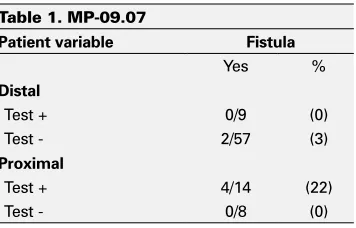
FU, 46-no UP incision, 5-missing data. Of the remaining 93, 6 (6.4%) had UCF: 2/66 distal (3%), 1/13 midshaft (7%) and 3/14 proximal (21%) repairs (p=0.03). Mean age at surgery in patients with no UCF was similar to those with UCF (15 vs. 18 mos, NS). TS was given to 8/66 distal vs. 18/27 proximal cases (12 vs. 67%, p=0.02). Mean UP width pre-incision in patients with no UCF was significantly wider compared to that in boys with UCF (7.1 ± 1.3 vs. 5.5 ± 2.5 mm, p<0.01). Five of the 6 UCF cases had a narrower UP width when compared to age matched controls (5 vs. 7.5 mm, p<0.01). None of the 56 patients with UP described as supple or deep had UCF vs. 6 of 36 with shallow or inelastic UP (0 vs. 16.7%,
p=0.01) (Table 1).
Conclusions: Meatal location after adjustment for TS, UP characteristics
(mainly the width pre-incision) seem to be associated with development of UCF in patients undergoing TIP repair. Analysis of a larger number of patients is needed to corroborate these preliminary findings.
MP-09.08
Randomized Crossover Trial of Hydrophilic Single Use Versus Multiuse PVC Catheter for IC in Children with Neural Tube Defects
Bacsu, Chasta-Dawne1; Moore, Katherine1; Kiddoo, Darcie A.1; Dharamsi,
Nafisa2; Afshar, Kourosh3; Sawatzky, Bonita3; Schopflocher, Donald1 1University of Alberta, Edmonton, AB, Canada; 2University of Manitoba,
Winnipeg, MB, Canada; 3University of British Columbia, Vancouver, BC,
Canada
Introduction and Objectives: Intermittent catheterization (IC) can be
com-plicated by recurrent urinary tract infections (UTIs). Hydrophilic polyvinyl chloride (PVC) catheters are reported to decrease incidence of symptom-atic UTIs compared to traditional PVC catheters but current evidence is inadequate. The objective is to compare the incidence of symptomatic UTIs in children with spina bifida using single use hydrophilic or PVC catheters for IC.
Methods: Randomized crossover two arm trial of 4 tertiary pediatric
centres: each arm was 24 weeks of single use hydrophilic or multiuse PVC catheters cleaned with soap and water (standard of care). Exclusion criteria included urethral deformities, PVC allergy, diabetes mellitus, his-tory of bladder pathology or bladder augmentation. Primary outcome was the number of symptomatic UTIs. Secondary outcomes included weekly urinalysis, physician visits, antibiotic use, days missed of school/ activi-ties, and catheter satisfaction. A Mixed Within-Subjects Between-Subjects Analysis of Variance was used for all statistical analyses.
Results: 70 subjects were randomized; 46 had complete data over 48
weeks; 24 dropouts: hydrophilic catheter too slippery (15%); refused PVC arm (5%); booked for continent diversion (4%); other (8%). Mean age 10.6 (SD 6.2), 21 males and 25 females. All performed IC >3/day: 52% self and 48% caregivers. Mean total weeks of self-reported UTI was 3.6 (SD 4.7) in the hydrophilic group vs. 2.3 (SD 3.3) in the PVC group (p<0.001) but no statistical differences in weeks of febrile UTI, antibiotic use, physician visits, or days missed from school/activities. There were no statistically significant differences in Convenience or Comfort. Ease of
Handling was significantly different favouring the PVC product (p<0.05). Overall satisfaction was not statistically different between products.
Conclusions: A hydrophilic catheter does not appear to reduce febrile
UTI or antibiotic use in community dwelling children using IC. The study results are consistent with the existing Cochrane Review: there is a lack of evidence to state the incidence of UTI is affected by multiuse or hydro-philic catheter use [1]. Large multicentre trials are strongly recommended.
MP-09.09
Feasibility of Conducting a Prospective Randomized Controlled Trial to Evaluate the Effectiveness of Group Versus Individual Urotherapy in Children with Bladder Bowel Dysfunction Brownrigg, Natasha A.1; Merrow, Melissa2; DeMaria, Jorge2; Pemberton,
Julia2; Heaman, Jessie2; Braga, Luis H.2
1Hamilton Health Sciences; McMaster University, Hamilton, ON, Canada; 2McMaster University, Hamilton, ON, Canada
Introduction and Objectives: To determine the feasibility of conducting a
clinical trial in children with non-neurogenic lower urinary tract dysfunc-tion (NLUTD)/dysfuncdysfunc-tional eliminadysfunc-tion syndrome (DES) aimed to evalu-ate the effectiveness of group (GRP) versus individual (IND) urotherapy (UT) from the child’s perspective.
Methods: Children aged 6-10 diagnosed with NLUTD/DES were recruited
from pediatric urology clinics and randomized to receive either standard IND or GRP UT. UT session occurred within 6 weeks of consent and follow-up (f/u) 3 months later. Patients with neurogenic bladder, learning disability, and those who received UT in past 12 months were excluded. NLUTD/DES symptoms and quality of life (QOL) were evaluated using Vancouver NLUTD/DES and PinQ QOL questionnaires. Prospective fea-sibility data included number of patients screened, eligible and enrolled as well as protocol adherence.
Results: Recruitment began in August 2012 and is ongoing. Of 210 patients
screened, 38 (18%) were eligible and 29/38 (76%) have been recruited. Reasons for declining included unable to attend GRP session and prefer-ence for IND teaching. Seven (24%) patients completed the study, 18 (62%) are in follow-up, 2 (7%) are awaiting GRP session and 2 (7%) have dropped out. Protocol adherence was met by all except the dropouts who failed to attend GRP UT within 6 weeks. REB amendments were made to exclude those who had recently had UT as well as to extend protocol timeframe from consent to intervention. Prophylactic antibiotics were prescribed for 6 children (IND=6), 7 were prescribed an anticholinergic (GR=4, IND=3) and 7 were prescribed an osmotic laxative (GR=4, IND=3). Two children whom received IND UT were treated for urinary tract infection during f/u. Questionnaires were completed without difficulty.
Conclusion: High level research is needed to define the most effective
UT modalities in children. Feasibility data demonstrate a low dropout rate and high recruitment rate and protocol adherence, revealing that this study is feasible.
MP-09.10
Assessing Knowledge and Practice of Latex Allergy Prevention in Spina Bifida Patients Using a Validated Tool
Burwash-Brennan, Talia1; Yanchar, Natalie L.2; Psooy, Karen J.3; Watson,
Wade4; MacLellan, Dawn L.5
1Faculty of Medicine, Dalhousie University, Halifax, NS, Canada; 2Department of Surgery, Dalhousie Unversity, Halifax, NS, Canada; 3Department of Surgery, University of Manitoba, Winnipeg, MB, Canada; 4Department of Pediatrics, Dalhousie University, Halifax, NS, Canada; 5Department of Urology, Dalhousie University, Halifax, NS, Canada
Introduction and Objectives: Latex allergy (LA) in the Spina Bifida (SB)
patient population reached 65% in the 1990s. Primary avoidance of latex in the hospital has reduced the prevalence of LA; however the adherence to and role of home avoidance is unknown. The aim of this study was to develop, validate, and administer a survey to assess the knowledge and practice of LA prevention in the pediatric and adult SB population at our local tertiary care centre.
Methods: A 37-item questionnaire was developed assessing awareness,
risk, adherence and burden of LA prevention. Face and content validity
Table 1. MP-09.07
Patient variable Fistula
Yes %
Distal
Test + 0/9 (0)
Test - 2/57 (3)
Proximal
Test + 4/14 (22)
were established by expert review using Content Validity Index (CVI). Reliability was assessed using the test-retest method with % agreement,
κ, and ρ correlation coefficient. Validated questionnaires were mailed to all patients with myelomeningocele (MMC) followed in our pediatric and adult SB clinics. Responses were analyzed qualitatively and using chi squared analysis with SPSS 20.
Results: Seven experts ranked 31 items with high CVI (0.8-1.0, Mean
0.95) and added 6 items. Test-retest had 9 /11 patients (82%) return both surveys. Reliability was moderate-high for 31 items (κ=0.6-0.99, ρ =0.60-0.99, p<0.05). Validated questionnaires were then sent (n=108) and had a 73% response rate. Awareness of LA risk was 97.5% (n=77) and of latex avoidance with SB was 94.9% (n=75). LA was communicated at every healthcare and dental visit in 78.2% (n=61). All latex products listed were avoided in 20.3% (n=16) and none in 9% (n=7). Little to no effort was perceived in avoidance (75.8%) and in communicating LA (93.1%). Further analysis of the impact of home LA prevention as compared to primary prevention is in progress.
Conclusions: This novel questionnaire about LA knowledge and
preven-tion in MMC patients demonstrated good validity and reliability. It identi-fied significant awareness of LA but poor adherence to full recommenda-tions. However, the perceived level of burden was low.
MP-09.11
Experimental Fertility Preservation Interventions in Pre-pubertal Boys: A Report on Preferences of Teenage Cancer Survivors, Parents, and Oncologists
Donen, Rachel1; Gupta, Abha1; Sung, Lillian1; Boydell, Katherine1; Bagli,
Darius1; Lo, Kirk2; Lorenzo, Armando1
1The Hospital for Sick Children, Toronto, ON, Canada; 2Mount Sinai
Hospital, Toronto, ON, Canada
Introduction and Objectives: Infertility from cancer treatment is a source
of great distress for many survivors. Testicular biopsy and sperm banking are options for fertility preservation (FP) in post-pubertal boys; unfortu-nately, there are no options for boys diagnosed before puberty. Results from animal studies have demonstrated that it is possible to grow mature sperm from immature testicular tissue. In order to develop this technology, access to pre-pubertal (PP) tissue will be crucial. Herein we report on preferences for biopsy for both potential FP and research.
Methods: Pediatric oncologists, parents of recently diagnosed boys, and
male teenage cancer survivors were recruited. Participants interviewed and surveyed were asked to consider a hypothetical decision between 1) testicular biopsy (all for clinical storage), 2) testicular biopsy (portion for research), and 3) no biopsy. Factors influencing decisions were also identified.
Results: Since November 2012, 24 interviews and 26 surveys have been
completed. Oncologists favoured presenting all options to families; how-ever, 50% surveyed would recommend biopsy (portion for research) over no biopsy. Testicular biopsy (portion for research) was preferred by 3/4 survivors and 12/18 parents. The main factors influencing survivors’ deci-sions were: chance to have kids, wanting to help all kids with cancer, and concerns about complications. In contrast, parents and oncologists repeatedly also considered: risk of infertility, cost, likelihood technology would develop, and wanting to help find a solution. In addition, biopsy was a way to maintain hope of survival for parents.
Conclusions: Our data suggests that cancer survivors, parents, and
oncolo-gists want the option of PP testicular tissue cryopreservation to be offered and the technology developed. Herein we provide novel information on factors influencing this decision.
MP-09.12
Orchidopexy Practice Patterns Among Canadian Pediatric Urologists: Barriers to Widespread Adoption of Pre-scrotal Orchidopexy for Palpable Undescended Testis (pUDT)
Wehbi, Elias; Kanaroglou, Niki; Schröder, Annette; Pippi Salle, Joao Luiz; Bagli, Darius; Koyle, Martin; Lorenzo, Armando; Farhat, Walid
Hospital for Sick Children, University of Toronto, Toronto, ON, Canada
Introduction and Objectives: Inguinal orchidopexy (I-O) remains the gold
standard for pUDT with modest uptake of routine single incision scrotal orchidopexy (SIS-O). Paucity of data exists on the reasons behind reluc-tance to embrace the SIS technique. Herein we aim to provide insight into barriers to its use.
Methods: A questionnaire was created and distributed via SurveyMonkey®
to the Pediatric Urologists of Canada (PUC), exploring preferences for the surgical approach to pUDT and experience with orchidopexy techniques. A multi-logic algorithm was used to decrease redundancy and maximize completion rates. Anonymized responses were pooled and descriptively analyzed.
Results: Response rate was 98% (41/42). The median years in practice
for the group were 12 (IQR 7-22). Thirty-five (85.4%) of the respondents had performed SIS-O and 26 (74.3%) currently offer it, performing the procedure one-third of the time for pUDT. Of those that perform SIS-O, the most common reasons to favour this approach included shorter operative time and perceived improved cosmesis. Those that perform the procedure rank location of the testis as the number one factor they con-sider when choosing approaches, with body habitus ranked number two. When using SIS-O, 92% (24/26) feel that their outcomes are equivalent to I-O and 73% (19/26) of them report a <10% conversion rate to I-O. Of the 9 surgeons that stopped offering the procedure, 67% did so because their outcomes were thought to be worse. Of those that do not offer the procedure (15/41), the 2 most common reasons are potential difficulty with management of the hernia sac or perceived limitations with cord lengthening maneuvres.
Conclusion: With a high response rate, we confirmed a large proportion of
PUC continue to offer the SIS-O with good outcomes and low conversion rates, identifying barriers to uptake in those that do not. These data may help address specific concerns, ultimately establishing a more definitive role for SIS in select cases.
MP-09.13
Differential Renal Function (DRF) Measured by Scintigraphy in Hydronephrotic Kidneys: Importance of Conjugate Views for Accurate Evaluation
Wehbi, Elias; Kanaroglou, Niki; Salle, Ana Claudia; Sami, Nabil; Lorenzo, Armando; Koyle, Martin; Farhat, Walid; Bagli, Darius; Pippi Salle, Joao Luiz
Hospital for Sick Children, University of Toronto, Toronto, ON, Canada
Introduction and Objectives: Traditionally, a single posterior view is
employed to measure DRF during nuclear renal scintigraphy. Nevertheless, experimental data shows important variations in this measurement in the setting of significant hydronephrosis.To date, the impact of hydrone-phrosis on the accuracy of DRF determination based on varying degrees of hydronephrosis has not been specifically addressed. In this study we evaluate the hypothesis that significant hydronephrosis amplifies the dis-crepancy between anterior and posterior views (APV) when calculating DRF and that either single view may be a highly inaccurate estimation of the true DRF.
Methods: We retrospectively reviewed consecutive MAG3 renal scans
Results: 519 scans with corresponding ultrasounds were analyzed.
Median age at time of the studies was 2.26 years. Kidneys with larger APPD had a greater discrepancy in function on APV, difference that was statistically significant. Mean differences in DRF for APV in each group were 4%, 6%, 6.7% and 7%, for APPD <5 mm, >10 mm, >15 mm and >25mm respectively. When compared to normal kidneys, there was a statistically significant difference in DRF for APPD >15 mm and >25 mm (p=0.03 and p=0.01 respectively), which did not reach significance for APPD >10mm (p=0.07).
Conclusions: The discrepancy in DRF measured by subtracting the
func-tion obtained on the anterior and posterior views is increasingly impacted by APPD, becoming significant when APPD is between 10-15mm. These findings suggest that the use of single views during nuclear renography for grossly hydronephrotic kidneys is inaccurate, and conjugate views may better represent DRF.
MP-09.14
Ultrasound Evaluation for Children with Cryptorchidism is Expensive and Delays Access to Specialized Care: Single Centre Evaluation of Referral Patterns in a Universal Coverage Healthcare System
Hajiha, Mohammad; Kanaroglou, Niki; Wehbi, Elias; Pippi Salle, Joao Luiz; Bagli, Darius; Braga, Luis H.; Daniels, Cathy; Farhat, Walid; Koyle, Martin; Lorenzo, Armando
The Hospital for Sick Children, Urology, University of Toronto, Toronto, ON, Canada
Introduction and Objectives: Existing literature shows that
ultrasonogra-phy (US) adds little guidance when assessing children with undescended testes (UDT). We hypothesize that US remains overused, delaying defini-tive treatment and affecting healthcare resource allocation. Herein, we analyze patterns of US use, focusing on costs and ultimate impact on timely surgical care.
Methods: Consecutive referrals for UDT from 2007-2009 to a single
tertiary care centre were evaluated, excluding children with previous inguino-scrotal surgery. Patients were stratified and compared based on US studies obtained before specialist visit. Times between evaluation by referring doctor and specialist (Rf-Sp), evaluation by referring physician and surgery (Rf-Sx), and specialist exam to surgery (Sp-Sx) were compared. Costs were estimated based on contemporary provincial reimbursement fees.
Results: 362 patients presented for evaluation (236/362, 65%
palpa-ble UDT; 57/362, 16% non palpapalpa-ble, 69/362, 19% normal exam). Of these, 169 (46%) had at least one US prior to specialist visit, totaling ~$28,779CAD. For palpable, non-palpable and normal testes, frequency of US use was comparable (52%, 43% and 45%, p>0.05). Median age at referral was 2.3 years. Most referrals were from family physicians (37%) and pediatricians (42%), with no difference in US ordering preference (p=0.5). Mean Rf-Sp was longer in patients with US before referral (238 vs. 136 days, p<0.0001). Mean Rf-Sx was 347 vs. 213 days in those who did not have US (p<0.0001). There was no difference in mean Sp-Sx for US and non-US groups (74 and 84 days, p=0.5). In 51 boys with US request dates available, mean time from request to referral was 134 days.
Conclusions: Our findings indicate an overall delay in definitive
surgi-cal treatment for UDT, significantly magnified when an US is ordered prior to specialist referral. This highlights a modifiable misuse of valuable resources in the current era of cost containment, particularly in a system already burdened with long surgical wait times.
MP-09.15
Prospective Analysis on the Diagnostic Performance of Measurements of the Normally Descended Gonad in Predicting Monorchidism in Boys with Unilateral Non-palpable Testis Kim, SooJin1; Lorenzo, Armando2; Farrokhyar, Forough1; Braga, Luis H.1 1McMaster University, Hamilton, ON, Canada; 2Sick Kids, Toronto, ON,
Canada
Objective: To identify a cut-off size for the compensatory hypertrophic
tes-tis with the aim to predict monorchidism (M) (intra-abdominal vanishing testis or inguinal/scrotal nubbin) in patients with unilateral nonpalpable testis (NPT).
Methods: Between 2009 and 2013, all patients with UDT treated by a
single surgeon were prospectively segregated into groups based on intra-operative findings: patients with a solitary gonad (M group) and 2 control groups (boys with intra-abdominal testis (IAT) and those with palpable UDT (pUDT). Patients with retractile, bilateral UDT, ascending testes or >5 years of age were excluded. The same individual measured the con-tralateral descended testes (length and width) using a caliper, with the child under anesthesia, before the procedure. All NPT patients underwent diagnostic laparoscopy. When vas and vessels were seen entering the internal inguinal ring an inguinal incision was done to confirm diagnosis and remove any inguinal or scrotal nubbin. Alternatively, laparoscopic or open orchidopexies were performed depending on testicular location. Sensitivity (Sn), specificity (Sp), likelihood ratio (LH) and receiver operat-ing characteristic (ROC) curves were calculated.
Results: Out of 254 patients with UDT, 166 had a pUDT and 88 a NPT.
Of 88 NPT patients, 52 had IAT and 36 M. Mean ages at surgery for M, IAT and pUDT were similar (31.2, 31.2 and 34.4 mos, respectively; NS). Mean length of the contralateral descended testes in groups M, IAT and pUDT was 24.9, 16.5 and 18mm, respectively (p<0.01). Sn of 100% and Sp of 87% were obtained with a cut-off point of 19mm. LH progressively increased for testicular length >18, >19 and >20 (6, 7.4 and 13). The area under the ROC curve was 95.3%, confirming accuracy of the 18-20mm cut-off point in predicting M.
Conclusions: A cut-off length of 18-20mm for the descended testis is an
important threshold, it carries a high Sn and diagnostic performance in suspecting M. If validated, this information will be an important parameter to provide preoperative counseling and plan surgical approach.
MP-09.16
Urological Manifestation of Down Syndrome: Is Abdominal Ultrasound Screening Still Mandatory?
Marceau-Grimard, Maryse; Bolduc, Stéphane; Moore, Katherine CHU de Québec, Université Laval, Quebec City, QC, Canada
Introduction and Objectives: In the routine evaluation of patients
diag-nosed with Down Syndrome (DS), an early abdominal ultrasound is rec-ommended. However, prenatal diagnosis has drastically changed the early management of this population since most anomalies related to DS are now identified prior to birth and the number of DS patients brought to term are decreasing. We aimed to evaluate the urological manifestations of DS in a contemporary population.
Methods: We reviewed the charts of all 234 patients that presented to
our centre with the diagnosis of DS between 2002 and 2011. Patients for whom an abdominal ultrasound was performed in the first two years of life were included. Clinical history of urological anomalies, prenatal evaluation and radiological reports were reviewed and recorded.
Results: Of the 234 patients with a diagnosis of DS seen at our centre,
Conclusions: Clinically significant urological anomalies associated with
DS are rare in our contemporary cohort of patients. Abdominal ultrasound for all DS patients screening for urological anomalies could be optional with a low risk of missing a significant anomaly, in particular following prenatal screening.
MP-09.17
What is the Recurrence Risk of Bladder Stones in Children with Augmented Bladders?
Szymanski, Konrad; Misseri, Rosalia; Kaefer, Martin; Rink, Richard; Cain, Mark
Division of Pediatric Urology, Riley Hospital for Children, Indiana University Medical Center, Indianapolis, IN, United States
Introduction and Objectives: Bladder stones are common after bladder
augmentation. This may result in numerous procedures for removal of recurrent stones over the course of a patient’s lifetime. We aimed to quantify bladder stone recurrence in augmented bladders and determine its risk factors.
Methods: We conducted a retrospective review of 75 patients with
aug-mented bladders treated for a first bladder stone. Patient demographics, prior surgeries, mode of therapy for bladder stones and recurrences were reviewed. Logistic regression was used for variable analysis.
Results: Of 75 patients, 41 (54.7%) were female, 51 (68%) had
myelo-meningocele, 39 (52.0%) used a wheelchair and 19 (25.3%) developed nephrolithiasis during follow-up. Children were augmented at 9.0 years. Segments used for augmentation included ileum (48, 64.0%), sigmoid (18, 24.0%) and cecum/ileocecum (9, 12.0%), with a catherizable channel in 48 (64.0%) and bladder neck procedure in 45 (60.0%) (reconstruction, sling, AUS). First stone surgery occurred 5.6 years post-augmentation. Endoscopy was used in 57.3%, open cystolithotomy in 42.7%. While 44.0% of stones were fragmented, 56.0% were not.
Stones recurred in 39 (52.0%) patients (mean 4.2 years). Stone-free patients were followed for 10.4 years. Immobility, segment used, pres-ence of channel, bladder neck surgery and open vs. endoscopic stone treatment were not significantly associated with recurrence on univariate or multivariate analysis. Fragmented stones were more likely to recur (OR=2.92, p=0.04), even after correcting for aforementioned variables (OR=3.21, p=0.04).
Conclusions: Bladder stones recurred in half of patients at 4 years. Risk
decreased if the stone was removed whole.
MP-09.18
The Estimated Prevalence of Children at Risk for Pediatric Obstructive Sleep Apnea Undergoing Urologic Day-surgery Rudzinski, Jan1; Kirk, Valerie2; Hyndman, William3; Cook, Anthony3;
Weber, Bryce3
1University of Calgary, Calgary, AB, Canada; 2Department of Pediatrics,
Alberta Children’s Hospital, Calgary, AB, Canada; 3Department of Pediatric
Urology, Alberta Children’s Hospital, Calgary, AB, Canada
Introduction: Obstructive sleep apnea (OSA) is characterized by episodes
of partial or complete upper airway obstruction during sleep. The preva-lence of pediatric OSA is 1-5% and is highest among children aged 2-6 years old. Perioperative aggravation of OSA can occur due to; respiratory depression by the anesthetic and opioid analgesics, airway narrowing due to intubation edema, and forced supine position. These children may be at increased risk of serious consequences if discharged too early or prescribed postoperative opioids. We sought to assess the estimated prevalence of pediatric patients at risk for OSA scheduled to undergo urologic day-surgery.
Methods: A 22 item validated Pediatric Sleep Questionnaire (PSQ) was
distributed to the parents of pediatric patients aged 6 months to 18 years scheduled to undergo urologic day-surgery between September 1, 2012 and November 30, 2012. A positive response to 8 or more items on the PSQ is associated with increased risk for having OSA. We computed the estimated prevalence of children at risk for pediatric OSA based on the PSQ results.
Results: In total, 140 patients were analyzed over the 3-month study
interval. The average age for patients was 5.3 years. The most common type day-surgery procedures were; circumcision in 54 (38%), orchidopexy in 21 (15%), hypospadias repair in 13 (9.3%), endoscopic subureteric injection in 9 (6.4%) and phalloplasty in 9 (6.4%). Based on PSQ results, 12 patients showed to be at risk for OSA. The average PSQ score for the children at risk was 9.3; eight of the patients scored 8 items, and remain-ing four scored >8 items on the PSQ.
Conclusions: Our results suggested increased estimated prevalence of
children with OSA awaiting urologic day surgery. In order to optimize the perioperative and postoperative care for children at risk for OSA, screening with PSQ prior to day-surgery at the Pediatric Urology clinic could be beneficial for safe management of these children.
MP-09.19
Inguino-scrotal Ultrasound: Is it a Useful Tool for Surgical Planning in Cases of Non-palpable Testes?
Jamalalail, Yasser; Guerra, Luis; Leonard, Michael
Children Hospital of Eastern Ontario, Ottawa, ON, Canada
Introduction and Objectives: Approximately 20% of undescended testes
(UDT) are non-palpable. Initial management for the non-palpable testes is laparoscopy. The aim of this study is to determine if ultrasonography can be used as a preoperative tool to localize the non-palpable inguinal testis and thus decrease the number of patients that require laparoscopy.
Patients and Methods: Between June 2007 and June 2012 we
identi-fied 46 patients diagnosed with non-palpable UDT who underwent an inguino-scrotal ultrasound preoperatively. Demographic, radiological and surgical data were collected and correlation between radiological and surgical findings was detailed.
Results: 46 patients (53 UDT), median age 14 months (Quartile 1st: 7; 3rd:
80) were accrued. 25/46 (54.3%) patients had left UDT, 14/46 (30.4%) right and 7/46 (15.2%) bilateral. Ultrasound identified 26/53 (49%) intra-canalicular testes, 14/53 (26.4%) intra-abdominal, 12/53 (22.6%) were not seen, and 1/53 (1.8%) scrotal. 21/53 (39.6%) testes underwent ingui-nal orchiopexy, 22/53 (41.5%) were removed and 10 (18.8%) had Fowler-Stephens. Overall in 35/53 (66%) testes the ultrasound correlated with the surgical findings (p<0.001). Ultrasound detection showed 96% sensitivity and 56% specificity for intra-canalicular testes confirmed surgically.
Conclusion: The use of preoperative ultrasound in this series was helpful
in identifying the location of non-palpable testes in children. In particu-lar, the ultrasound finding of an intra-canalicular testis may preclude the need for laparoscopy.
MP-09.20
Population Based Analysis on the Use of Ultrasound Imaging for Children with Cryptorchidism: Evaluation of a Large Provincial Database over a Decade in a Universal Access to Care System Kanaroglou, Niki1; Wehbi, Elias1; Calzavara, Andrew2; Zhu, Jingqin2; To,
Teresa3; Lorenzo, Armando1
1The Hospital for Sick Children, Toronto, ON, Canada; 2Institute for
Clinical Evaluative Sciences, Toronto, ON, Canada; 3Institute for Clinical
Evaluative Sciences, The Hospital for Sick Children, Toronto, ON, Canada
Introduction and Objectives: Management of undescended testes (UDT)
centres on early detection by physical exam and timely surgical explo-ration. Ultrasonography (US) is usually unwarranted. There is paucity of population-based data on the potential overuse of US. Herein we present data from a Canadian provincial database in a universal access healthcare system.
Methods: Records of all boys aged 0-18 diagnosed with UDT in Ontario
between 2000-2011 were identified across health administrative data-bases. Patients with US prior to specialist assessment were compared to those referred without US. Discrepancies in time to visit with a specialist and time to definitive treatment were identified. Trends in the frequency of US over the decade were assessed.
Results: 101,278 boys were diagnosed with inguino-scrotal pathologies.
assessment. UDT was confirmed in 7,466 (7.4%) who had surgery, and 2501 (33.5%) of these had at least 1 prior US. 16,014 did not have surgery after US, indicating an alternate diagnosis (e.g. retractile testes). In boys with an US who had surgery, median time from diagnosis to specialist evaluation was 5 months (IQR 1-11), and median time from diagnosis to surgery was 13 months (IQR 6-22), compared to 2 (IQR 0-8) and 11 (IQR 3-21) months, respectively, in the non-US group (p<0.001). US use increased by 31.4% over the decade (p<0.0001 for trend). Of 1.8 mil-lion CAD spent on US for this population, approximately $275,000 was devoted to boys who had surgery for UDT.
Conclusions: This 10-year population based study confirms the
wide-spread overuse of US for UDT. Time required to order, review and report the test resulted in delays to definitive treatment. These findings highlight an opportunity for optimizing care while containing costs.
MP-09.21
Enhancing Urologic Education: Pediatric Urological Camps as a Model of Global Training Partnerships
Kanaroglou, Niki1; Hudson, R. Guy2; Koyle, Martin1
1The Hospital for Sick Children, Toronto, ON, Canada; 2Swedish Medical
Center, Seattle, Washington, United States
Introduction and Objectives: There is a notable gap in the availability of
pediatric urological training and expertise worldwide. Paradoxically, many ‘index’ cases are concentrated in countries where birth rates are high, pregnancy termination is prohibited, but access to subspecialized care is limited. A uniquely Ugandan approach of hosting surgical camps has been a successful means to offer surgery to patients in need, while disseminat-ing skills to local urologists and enhancdisseminat-ing education for Urology trainees.
Methods: Building on a partnership between urologists in Uganda and
Canada that began in 2010, we propose an ongoing formalized educa-tional alliance for Canadian trainees in pediatric urology. Moving towards this goal, in March 2013, a Canadian team with pediatric expertise in urol-ogy, surgery, anesthesia and nursing was invited to participate in a surgical camp, organized by Ugandan physicians and staff at Mulago Hospital. The goals of the camp were to provide (1) educational and knowledge-sharing opportunities through collaborative surgeries and formal lectures, (2) specialized surgical services free of charge to Ugandan children.
Results: The 2013 camp team in Urology included 2 North American
attendings, 1 Ugandan attending, 1 Canadian trainee and 3 Ugandan trainees. During the 10-day camp, 47 predominantly complex uro-logic surgeries were performed alongside local Ugandan colleagues.
Formalized lecture rounds were held daily to foster exchange of new ideas, evidence and methodologies. This concentrated format of learning and surgical experience corresponds to an accelerated method of training not available in local institutions.
Conclusion: This is a synergistic educational model built upon mutual
exchange of knowledge, ideas, and expertise with Ugandan colleagues. This model improves access to specialized care and disseminates skills in the world of emerging markets, while enriching training experiences for Canadians. In light of incoming work-hour requirements for surgical residents, this educational opportunity can supplement and compliment urologic training in Canada.
MP-09.22
Parental Preferences Regarding the Treatment of Vesicoureteral Reflux
Pugsley, Devin1; Anderson, Peter1; Edmundson, Joanne2
1Dalhousie Urology, Halifax, NS, Canada; 2RN at IWK, Halifax, Canada
Introduction and Objectives: Families have several options when
choos-ing treatment for Vesicoureteral Reflux (VUR). We designed a study to explore the role of various factors on parental treatment decisions for their children with VUR. The objective of this study was to identify the most important source of information for families reaching treatment decisions for VUR. Secondly, we wished to assess the most important factors that influence the choice of treatment.
Methods: We created a 27 item survey that was distributed to and
com-pleted by families of children receiving ongoing management for VUR in our pediatric urology clinics.
Results: Families of children with VUR felt they had enough information to
make decisions regarding the care of their children in 13/15 (87%) surveys completed. The urologist was the most important source of information for families in 100% (16/16) of completed surveys. Less important fac-tors were other healthcare team members, family members, and internet sources of information. Reducing the risk of kidney damage (16/16) and reducing the risk of urinary tract infections (16/16) were the most impor-tant factors influencing the choice of treatment.
Conclusions: Urologists should understand that their bias will have