SYNTHESIS, CHARACTERIZATION, AND
IN VIVO
BIOLOGICAL EVALUATION OF NOVEL
BENZIMIDAZOLES AS POTENTIAL ANTICANCER AGENTS
RANGASWAMY ROOPASHREE, CHAKRABHAVI DHANANJAYA MOHAN, TORESHETTAHALLY RAMESH SWAROOP,
SWAMY JAGADISH, KANCHUGARAKOPPAL SUBBEGOWDA RANGAPPA*
Department of Studies in Chemistry, University of Mysore, Manasagangotri, Mysore, Karnataka, India. Email: [email protected]
Received: 08 July 2014, Revised and Accepted: 15 September 2014
ABSTRACT
Objective: Cancer is one of the major causes of death worldwide irrespective of the sex. The aim of the study was to design, synthesize, and identification of novel anti-proliferative agents that can potently target cancer.
Methods: We are reporting the synthesis of the new series of N-substituted 2-(2-butyl-4-chloro-1H-imidazole-5-yl)-1H-benzo[d]imidazole derivatives and evaluated for their anti-tumor activity against HeLa cell lines. We identified the lead compound in the series and tested its anti-proliferative and anti-angiogenic properties against Ehrlich ascites tumor (EAT) bearing mice.
Results: We identified 2-(2-butyl-4-chloro-1-heptyl-1H-imidazol-5yl)-1H-benzo[d]imidazole as a lead compound with the inhibitory concentration 50% of 25.3 μM. The lead compound significantly decreases the angiogenesis in peritoneum of EAT bearing mice.
Conclusion: Our results clearly demonstrate that benzimidazoles suppress the cell proliferation, peritoneal angiogenesis, and ascites volume. Keywords: Benzimidazoles, Anti-proliferative, Angiogenesis, Ehrlich ascites tumor.
INTRODUCTION
Cancer is the leading cause of mortality in developed countries and second cause in developing countries [1]. Cancer is characterized by cell proliferation independent of growth factor regulation with apoptotic resistance and enhanced angiogenesis which leads to the disruption of homeostatic condition thereby to tumorigenesis [2]. Several types of cancers are known which can affect different organs including brain, liver, lungs, kidney, bone, breast, and ovaries [3]. One of the striking features of the most solid tumors is increased angiogenesis which is essential for tumor expansion and associated with the poor prognosis of cancer [4,5]. Targeting proliferation and angiogenesis is the good approach in developing anticancer drugs.
Benzimidazoles are the multifaceted compounds with broad range of pharmacological properties which includes anti-tumor [6], topoisomerase inhibitors [7], anti-hypertensive [8], anti-parasitic [9], proton pump inhibitors [10], anti-viral [11], anti-inflammatory [12], antifungal [13], anti-diabetic [14], anti-oxidant [15], anti-coagulant [16], psychoactive [17], and anti-allergic activities [18]. Benzimidazole derivatives have been studied extensively and reported to be very potent cytotoxic agents against different cancer cell lines [19]. Our previous report on the synthesis and cytotoxic evaluation of novel 2-(4-(2,2,2-trifluoroethoxy)-3-methylpyridin-2-ylthio)-1H-benzo[d]imidazole derivatives is clear indication of the anti-proliferative effect of benzimidazole derivatives [20]. Previously, we also reported the pro-apoptotic and anti-angiogenic properties of imidazoles and curcumin derivatives in ehrlich ascites tumor (EAT) cells, respectively [21,22]. In the present report, as the continuation of our research on designing the benzimidazoles as antitumor agents, we synthesized new benzimidazole derivatives and evaluated for their cytotoxic effect against HeLa cells. In addition, we identified the lead compound in the newly synthesized molecules and investigated its anti-tumor activity using EAT cells in vivo.
METHODS
The melting points were determined on selaco melting point apparatus and were uncorrected. Infrared (IR) spectra were recorded on
Shimadzu Fourier transform-IR model 8300 spectrophotometer. 1H nuclear magnetic resonance (1H NMR) spectra were recorded on an NMR spectrometer operating at 400 MHz using tetramethylsilane as internal standard. Mass spectra were recorded using electron spray ionization mass spectrometry. The C, H, and N analysis were performed using CE-400 CHN analyzer. Reactions were monitored by thin-layer chromatography (TLC) using pre-coated sheets of silica gel G/UV-254 of 0.25 mm thickness (Merck 60FG/UV-254) using ultraviolet light for visualization. Human cervical cancer line HeLa was obtained from National Centre for Cell Science, Pune. All the in vivo experiments are approved by Institutional Animal Ethical committee, Manasagangotri, Mysore.
Chemicals used
All chemicals were obtained from Sigma-Aldrich, Fluka, and Merck Chemicals.
Synthesis
General procedure for the synthesis of N-substituted 2-(2-butyl-4-chloro-1H-imidazole-5-carbaldehyde derivatives (6)
To a solution of 2-(2-butyl-4-chloro-1H-imidazole-5-carbaldehyde 4 (10 mmol) and tetrabutyl ammonium bromide (1 mmol) in benzene (20 mL), a solution of 20% NaOH (25 mL) was added at 0°C followed by the addition of alkyl\benzyl halide 5 (12 mmol). The reaction mixture was stirred vigorously at room temperature for 6-10 hrs, and the reaction was monitored by TLC. After the completion of the reaction, aqueous phase was separated and the organic phase was washed with water (20 mL) and brine (20 mL), dried over anhydrous sodium sulfate and concentrated to give crude products which were purified by column chromatography over silica gel using hexane-EtOAc (6:4) mixture as eluent.
ethyl acetate (4 mL) and dimethyl sulfoxide (2mL), T3P (1 mmol, 50% solution in ethyl acetate) was added at 0°C and the resulting reaction mixture was stirred at room temperature for 1-2 hrs under nitrogen atmosphere. The reaction was monitored by TLC. After completion of the reaction, the mixture was diluted with water (20 mL) and neutralized with 10% NaHCO3 solution. The product was extracted with ethyl acetate (20 mL), and the organic phase was washed with water (15 mL) and brine solution (15 mL). The organic phase was dried to afford the crude product, which was purified on silica gel using ethyl acetate and hexane to get pure N-substituted 2-(2-butyl-4-chloro-1H -imidazole-5-yl)-1H-benzo[d]imidazole derivatives.
2-(2-butyl-4-chloro-1-methyl-1H-imidazol-5yl)-1H-benzo[d] imidazole (8a)
Yield 88%; mp 128-130°C; IR (KBr)/cm 3025, 2850, 1617, 1560, 1450, 1256; 1H NMR (CDCl
Yield 85%; mp 136-138°C; IR (KBr)/cm 3015, 2874, 1611, 1558, 1452, 1250; 1H NMR (CDCl 132.6, 128.5, 123.3, 122.4, 119.5, 116.5, 110.5, 40.9, 29.9, 29.6, 26.7, 22.5, 16.0, 13.7; MS (ESI): m/z 303 (M+1); Anal. Calcd for C16H19ClN4: C, 63.46; H, 6.32; N, 18.50. Found: C, 63.91; H, 6.99; N, 18.59.
2-(1,2-dibutyl-4-chloro-1H-imidazol-5yl)-1H-benzo[d]imidazole (8c)
Yield 88%; mp 78-80°C; IR (KBr)cm-1 3002, 2789, 1609, 1553, 1451, 1249; 1H NMR (CDCl 123.3, 122.4, 119.5, 116.8, 110.6, 45.6, 32.7, 29.9, 26.8, 22.5, 19.8, 13.8, 13.6; MS (ESI): m/z 331 (M+1); Anal. Calcd for C18H23ClN4: C, 65.34; H, 7.01; N, 16.93. Found: C, 65.30; H, 7.31; N, 16.90.
2-(2-butyl-4-chloro-1-heptyl-1H-imidazol-5yl)-1H-benzo[d] imidazole (8d)
Yield 80%; mp 143-145°C; IR (KBr)/cm 3056, 2865, 1623, 1569, 1461, 1262; 1H NMR (CDCl
Yield 78%; mp 136-138°C; IR (KBr)/cm 3033, 2853, 1619, 1566, 1453, 1269; 1H NMR (CDCl 142.1, 139.4, 136.2, 131.8, 129.6, 126.1, 125.7, 123.9, 123.7, 116.3, 48.9, 31.8, 26.5, 23.6, 13.9; MS (ESI): m/z 379 (M+1); Anal. Calcd for C22H23ClN4: C, 69.74; H, 6.12; N, 14.79. Found: C, 69.85; H, 6.19; N, 14.85.
2-(2-butyl-4-chloro-1-(3-methoxybenzyl)-1H-imidazol-5yl)-1H-benzo[d]imidazole (8f)
Yield 81%; mp 105-107°C; IR (KBr)/cm 3014, 2844, 1609, 1554, 1432, 1241; 1H NMR (CDCl 129.8, 124.5, 123.5, 120.3, 115.3, 114.2, 112.9, 55.8, 48.5, 31.9, 25.6, 23.9, 13.9; MS (ESI): m/z 395 (M+1); Anal. Calcd for C22H23ClN4O: C, 66.91; H, 5.87; N, 14.19. Found: C, 66.95; H, 5.89; N, 14.20.
2-(2-butyl-4-chloro-1-(4-chlorobenzyl)-1H-imidazol-5yl)-1H-benzo[d]imidazole (8g)
Yield 75%; mp 110-112°C; IR (KBr)/cm 3013, 2843, 1606, 1551, 1431, 1245; 1H NMR (CDCl 138.4, 135.2, 131.1, 129.1, 125.9, 125.5, 124.1, 123.6, 115.3, 47.2, 30.9, 25.9, 23.6, 14.3; MS (ESI): m/z 401 (M+2); Anal. Calcd for C21H20Cl2N4: C, 63.16; H, 5.05; N, 14.03. Found: C, 63.26; H, 5.12; N, 14.21.
2-(2-butyl-4-chloro-1-(3,4-dichlorobenzyl)-1H-imidazol-5yl)-1H-benzo[d]imidazole (8h)
Yield 62%; mp 125-127°C; IR (KBr)/cm 3012, 2798, 1613, 1539, 1453, 1245; 1H NMR (CDCl
3, 400 MHz) δ ppm: 0.91 (t, 3H, J=8.0 Hz, -CH3), 1.36 (m, 2H, -CH2), 1.73 (m, 2H, -CH2), 2.63 (t, 2H, J=8.0 Hz, -CH2), 5.92 (s, 2H, N-CH2), 7.21 (m, 3H, Ar-H), 7.32 (s, 1H, Ar-H), 7.43 (m, 3H, Ar-H); 13C NMR (CDCl3, 100 MHz) δ ppm: 154.9, 149.3, 141.9, 140.6, 136.2, 131.9, 130.9, 129.6, 127.9, 124.5, 123.9, 116.3, 47.8, 30.9, 26.8, 23.4, 13.5; MS (ESI): m/z 433 (M+); Anal. Calcd for C
21H19Cl3N4: C, 58.15; H, 4.42; N, 12.92. Found: C, 58.19; H, 4.46; N, 12.98.
2-(2-butyl-4-chloro-1-(4-fluorobenzyl)-1H-imidazol-5yl)-1H-benzo[d]imidazole (8i)
Yield 79%; mp 94-96°C; IR (KBr)/cm 3009, 2823, 1602, 1555, 1427, 1232; 1H NMR (CDCl 128.3, 124.6, 123.3, 116.1, 115.6, 48.3, 31.2, 26.2, 22.5, 13.8; MS (ESI): m/z 383 (M+1); Anal. Calcd for C21H20FClN4: C, 65.88; H, 5.27; N, 14.63. Found: C, 65.89; H, 5.31; N, 14.68.
2-(1-benzyl-2 butyl-4-chloro-1H-imidazol-5yl)-1H-benzo[d] imidazole (8j)
Yield 81%; mp 109-111°C; IR (KBr)/cm 3018, 1642, 1563, 1476, 1265; 1H NMR (CDCl
compounds in a final volume of 0.2 mL for indicated time intervals at 37°C. Thereafter, 20 μl MTT solution (5 mg/ml in phosphate buffered saline) was added to each well. After a 2 hrs incubation at 37°C, 0.1 ml lysis buffer (20% sodium dodecyl sulfate, 50% dimethyl-formamide) was added; incubation was continued overnight at 37°C; and then the optical density at 570 nm was measured by varioskan plate reader.
In vivo tumor model studies
6-8 weeks old inbred Swiss albino mice of either sex were used for establishing EAT model intra-peritoneally for further experiments. Animals were obtained and maintained in the animal house, Department of Zoology, Manasagangotri, Mysore, India.
Analysis of body weight and collection of ascites fluid
Experimental animals were injected with 5 × 10⁶ viable EAT cells intraperitoneally. Weights of the animals were recorded daily up to 10th day to analyze the tumor growth. Animals showed the significant increase in the body weight as the time prolongs. To investigate the in vivo efficacy of compound 8d, we injected 100 mg/kg body weight of 8d into the peritoneum of the EAT bearing mice daily from the 6th day of transplantation. The animals were sacrificed on 10th day, and ascites fluid was collected by making a small incision in the abdomen.
Isolation of EAT cells
EAT cells were isolated from ascites fluid as described previously [25]. Briefly, total ascites fluid collected from the sacrificed animal is centrifuged at 3000 rpm for 10 minutes. EAT cell was obtained as a pellet, and it was used for further analysis. Ascites fluid volume is measured after the separation of tumor cells.
Trypan blue dye exclusion assay
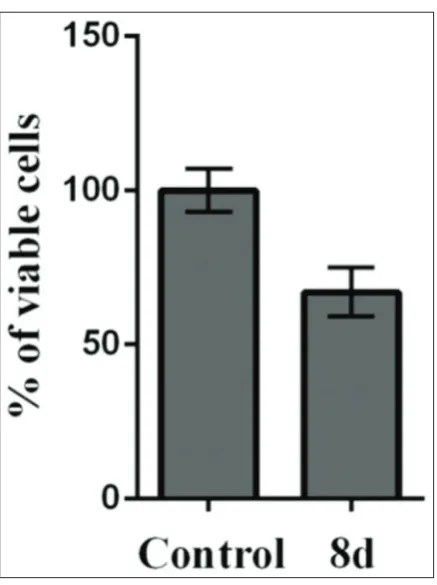
We evaluated the effect of 8d on cell viability. Isolated EAT cells were treated with 8d for 8 hrs. Cell viability was evaluated using 0.4% trypan blue and cells which have up taken the dye are considered to be dead.
Peritoneal angiogenesis
The sacrificed animal was cut open at the abdomen, and inner lining of the peritoneal cavity was analyzed to determine the effect of our compound on angiogenesis. Peritoneal cavity of control and compound treated mice were photographed.
RESULTS AND DISCUSSION Chemistry
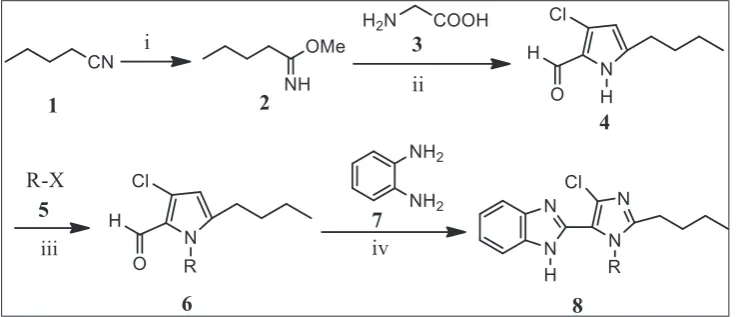
The requisite key intermediate 4 was prepared according to the earlier reported protocol (Scheme 1) [26]. On passing dry hydrogen chloride gas to a solution of valeronitrile 1 in methanol at 0°C, methyl pentanimidate hydrochloride was obtained, which upon neutralization with aqueous sodium hydroxide furnished methyl pentaimidate 2. This was converted into the key intermediate 2-butyl-4-choro-1H
-imidazole-5-carbaldehyde 4 by reacting with Vilsmeier reagent in the presence glycine. Later, N-alkylation/benzylation of the key intermediate using various alkyl/benzyl halides furnished corresponding N-substituted 2-(2-butyl-4-choro-1H-imidazole-5-carbaldehyde) derivatives 6 a-j. Finally, all N-substituted 2-(2-butyl-4-chloro-1H-imidazol-5-yl)1H -benzo[d]imidazole derivatives 8a-i were prepared by oxidative-cyclo condensation of 6a-i with 1,2-phenylenediamine 7 in the presence of T3P. The structures of all the synthesized compounds were confirmed by spectral and microanalytical analysis. All the final compounds showed characteristic triplet between 0.8 and 0.9 ppm for methyl protons, two multiplets and one triplet between 1.3 and 2.8 ppm for methylene protons and a singlet around 9.0 ppm for N-H proton. The structures and yields of the synthesized compounds are summarized in Table 1.
Pharmacology
8d induces its cytotoxic effect in time and dose dependent manner in HeLa cells
We investigated the anti-proliferative effect of newly synthesized benzimidazoles on HeLa cells using MTT assay. Among them, 8d proved to be very potent compound with the inhibitory concentration 50% (IC50) of 25.3 μM compared to other derivatives (Table 1). Compounds 8e, 8h and 8i are also found to be good cytotoxic agents with IC50 30.2 μM, 31.9 μM and 30 μM respectively. All remaining compounds had no significant activity. Sorafenib was used as a positive control which showed the IC50 of 4.1 μM. Thus, benzimidazoles with short chain alkyl groups (8a-c) are less effective than one with higher alkyl group (8d). On the other hand, benzimidazoles with benzyl groups bearing a methyl, chloro and fluro at 3-,3,4- and 4- positions (8e, 8h and 8i) showed good activity. It should be
Table 1: Summary of the newly synthesized benzimidazole derivatives
S. no. R-X 5 R (6) 8 Yield (%) IC50 (μM)±SD
1 MeI Me 8a 88 >50
2 EtBr Et 8b 85 >50
3 CH3(CH2)2CH2Br CH3(CH2)2CH2 8c 88 >50 4 CH3(CH2)5CH2Br CH3(CH2)5CH2 8d 80 25.3±4.18 5 3-MeC6H4CH2Br 3-MeC6H4CH2 8e 78 30.2±2.27 6 3-MeOC6H4CH2Br 3-MeOC6H4CH2 8f 81 >50 7 4-ClC6H4CH2Br 4-ClC6H4CH2 8g 75 >50 8 3,4-Cl2C6H3CH2Br 3,4-Cl2C6H3CH2 8h 62 31.9±4.77 9 4-FC6H4CH2Br 4-FC6H4CH2 8i 79 30.0±5.12 10 C6H5CH2Br C6H5CH2 8j 81 >50
11 Sorafenib 4.1±0.9
SD: Standard deviation, IC50: Inhibitory concentration 50%
noted that potencies of N-benzyl derivatives are comparatively less than N-alkyl derivatives.
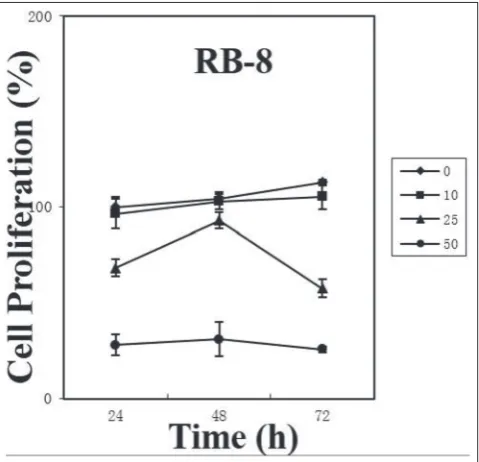
Furthermore, we tested 8d on HeLa cells at indicated dose and time points and found a substantial decrease in viable cells (Fig. 1). We identified 8d as potent molecule to take further for in vivo studies.
8d suppresses peritoneal angiogenesis in EAT bearing mice Studies have shown that tumor expansion by uncontrolled cell proliferation and metastasis are entangled with angiogenesis [27]. Therefore, suppression of angiogenesis is a direct indication of increased prognosis. We evaluated whether 8d could down-regulate neovasculature in the peritoneal cavity of EAT bearing mice. Fig. 2 clearly shows that 8d notably suppress the angiogenesis.
8d significantly decrease ascites volume, cell number and body weight
We further analyzed the effect of 8d on ascites volume and cell number in the intraperitoneal tumor of drug-treated and control mice. We observed a significant decrease in the body weight after the administration of 8d (Fig. 3). Based on this observation, we quantified the ascites volume and cells. Results obtained confirmed the decrease of ascites fluid (Fig. 4) and cell count (Fig. 5). This concludes that our lead molecule possess very good anticancer property.
CONCLUSION
Benzimidazoles are known for making favorable interaction with multiple targets and thereby contributing to the development of several potential therapeutic agents. The plausible explanation for multiple targeting by benzimidazoles is due to its close structural relation with the purine nucleotide. Especially, with respect to the antitumor activity of these heterocycles makes them a good pharmacophore. In the current study, we evaluated and proved the cytotoxic effect of different benzimidazole derivatives both in vitro and in vivo. We found that the benzimidazole with higher alkyl group (heptyl) showed the highest activity. Although, few N-benzyl derivatives are active, their potencies are slightly less than their N-alkyl counterparts. In brief, compound 8d proved to be a potent cytotoxic agent against HeLa cells and good anti-tumor and anti-angiogenic agent in vivo. Further, small molecular
Fig. 4: 8d significantly decrease ascites fluid Fig. 2: 8d suppresses peritoneal angiogenesis in Ehrlich ascites
tumor-bearing mice
Fig. 1: 8d suppresses proliferation of HeLa cells in time and dose dependent manner
Fig. 5: 8d substantially reduce viable cells
variations in the structure of 8d may result in the improved efficacy as an anti-cancer agent.
ACKNOWLEDGMENTS
Authors are grateful to Board of Research in Nuclear Sciences (BRNS), University Grants Commission (UGC) and Indo-French Center for the Promotion of Advance Research (IFCPAR), Government of India for financial support to KSR under the projects vide No. 2009/37/40/ BRNS/2266 dated 23-11-2009, F-39-106/2010 (SR) dated 24-12-2010 and No. IFC/4303-1/2010-11 Dated 22-12-2010. RR thank University Grants Commission for Rajiv Gandhi National Fellowship, CDM thank Department of Science and Technology for Innovation in Science Pursuit for Inspired Research fellowship and TRS thank Council of Scientific and Industrial Research for Junior and Senior Research Fellowship.
REFERENCES
1. Jemal A, Bray F, Center MM, Ferlay J, Ward E, Forman D. Global cancer statistics. CA Cancer J Clin 2011;61:69-90.
2. Sumalatha D, Nithya TG. In vitro anti-oxidant and anticancer activity of Murraya koenigii against human colon cancer HT-29 cell lines. Asian J Pharm Clin Res 2014;7:83-6.
3. Gurupadaswamy HD, Girish V, Kavitha CV, Raghavan SC, Khanum SA. Synthesis and evaluation of 2,5-di(4-aryloylaryloxymethyl)-1,3,4-oxadiazoles as anti-cancer agents. Eur J Med Chem 2013;63:536-43. 4. Marusyk A, Polyak K. Tumor heterogeneity: Causes and consequences.
Biochim Biophys Acta 2010;1805(1):105-17.
5. Kreeger PK, Lauffenburger DA. Cancer systems biology: A network modeling perspective. Carcinogenesis 2010;31(1):2-8.
6. Koronkiewicz M, Romiszewska A, Kazimierczuk Z, Chilmonczyk Z. Anticancer activity of benzimidazole derived isothioureas in vitro. Ann Oncol 2013;24:i23.
7. Oksuzoglu E, Tekiner-Gulbas B, Alper S, Temiz-Arpaci O, Ertan T, Yildiz I, et al. Some benzoxazoles and benzimidazoles as DNA topoisomerase I and II inhibitors. J Enzyme Inhib Med Chem 2008;23(1):37-42. 8. Ries UJ, Mihm G, Narr B, Hasselbach KM, Wittneben H, Entzeroth M,
et al. 6-Substituted benzimidazoles as new nonpeptide angiotensin II
receptor antagonists: Synthesis, biological activity, and structure-activity relationships. J Med Chem 1993;36:4040-51.
9. Yurttas L, Demirayak S, Çiftçi GA, Yildirim SU, Kaplancikli ZA. Synthesis and biological evaluation of some 1,2-disubstituted benzimidazole derivatives as new potential anticancer agents. Arch Pharm (Weinheim) 2013;346:403-14.
10. Iwahi T, Satoh H, Nakao M, Iwasaki T, Yamazaki T, Kubo K, et al. Lansoprazole, a novel benzimidazole proton pump inhibitor, and its related compounds have selective activity against Helicobacter pylori. Antimicrob Agents Chemother 1991;35(3):490-6.
11. Townsend LB, Devivar RV, Turk SR, Nassiri MR, Drach JC. Design, synthesis, and antiviral activity of certain 2,5,6-trihalo-1-(beta-D-ribofuranosyl) benzimidazoles. J Med Chem 1995;38(20):4098-105. 12. Sondhi SM, Singh N, Kumar A, Lozach O, Meijer L. Synthesis,
anti-inflammatory, analgesic and kinase (CDK-1, CDK-5 and GSK-3) inhibition activity evaluation of benzimidazole/benzoxazole derivatives and some Schiff’s bases. Bioorg Med Chem 2006;14(11):3758-65. 13. Göker H, Ertan R, Akgün H, Yulug N. Synthesis and antifungal
activity of some new benzimidazole derivatives. Arch Pharm (Weinheim)1991;324:283-6.
14. Vinodkumar R, Vaidya SD, Siva Kumar BV, Bhise UN, Bhirud SB, Mashelkar UC. Synthesis, anti-bacterial, anti-asthmatic and anti-diabetic activities of novel N-substituted-2-(4-phenylethynyl-phenyl)-1H-benzimidazoles and N-substituted 2[4-(4,4-dimethyl-thiochroman-6-yl-ethynyl)-phenyl)-1H-benzimidazoles. Eur J Med Chem 2008;43:986-95.
15. Kus C, Ayhan-Kilcigil G, Can Eke B, Iscan M. Synthesis and antioxidant properties of some novel benzimidazole derivatives on lipid peroxidation in the rat liver. Arch Pharm Res 2004;27(2):156-63. 16. Wienen W, Stassen JM, Priepke H, Ries UJ, Hauel N. In-vitro profile
and ex-vivo anticoagulant activity of the direct thrombin inhibitor dabigatran and its orally active prodrug, dabigatran etexilate. Thromb Haemost 2007;98(1):155-62.
17. Kalliomäki J, Annas P, Huizar K, Clarke C, Zettergren A, Karlsten R, et al. Evaluation of the analgesic efficacy and psychoactive effects of AZD1940, a novel peripherally acting cannabinoid agonist, in human capsaicin-induced pain and hyperalgesia. Clin Exp Pharmacol Physiol 2013;40(3):212-8.
18. Nakano H, Inoue T, Kawasaki N, Miyataka H, Matsumoto H, Taguchi T, et al. Synthesis of benzimidazole derivatives as antiallergic agents with 5-lipoxygenase inhibiting action. Chem Pharm Bull 1999;47:1573-78. 19. Abonia R, Cortés E, Insuasty B, Quiroga J, Nogueras M, Cobo J.
Synthesis of novel 1,2,5-trisubstituted benzimidazoles as potential antitumor agents. Eur J Med Chem 2011;46(9):4062-70.
20. Ranganatha SR, Kavitha CV, Vinaya K, Prasanna DS, Chandrappa S, Raghavan SC, et al. Synthesis and cytotoxic evaluation of novel 2-(4-(2,2,2-trifluoroethoxy)-3-methylpyridin-2-ylthio)-1H-benzo[d]imidazole derivatives. Arch Pharm Res 2009;32(10):1335-43. 21. Kumar CA, Jayarama S, Basappa, Salimath BP, Rangappa KS. Pro-apoptotic activity of imidazole derivatives mediated by up-regulation of Bax and activation of CAD in Ehrlich Ascites Tumor cells. Invest New Drugs 2007;25(4):343-50.
22. Chandru H, Sharada AC, Bettadaiah BK, Kumar CS, Rangappa KS, Sunila, et al. In vivo growth inhibitory and anti-angiogenic effects of synthetic novel dienone cyclopropoxy curcumin analogs on mouse Ehrlich ascites tumor. Bioorg Med Chem 2007;15(24):7696-703. 23. Keerthy HK, Mohan CD, Siveen KS, Fuchs JE, Rangappa S,
Sundaram MS, et al. Novel synthetic biscoumarins target tumor necrosis factor-a in hepatocellular carcinoma in vitro and in vivo. J Biol Chem 2014.
24. Bellamakondi PK, Godhavarthi A, Ibrahim M, Kulkarni S, Naik RM, Maradam S. In vitro cytotoxicity of Caralluma species by MTT and trypan dye exclusion. Asian J Pharm Clin Res 2014;7:17-9.
25. Prabhakar BT, Khanum SA, Jayashree K, Salimath BP, Shashikanth S. Anti-tumor and proapoptotic effect of novel synthetic benzophenone analogues in Ehrlich ascites tumor cells. Bioorg Med Chem 2006;14(2):435-46. 26. Gaonkar SL, Lokanatha Rai KM, Suchetha Shetty N.
Microwave-assisted synthesis and evaluation of anti-inflammatory activity of new series of N-substituted 2-butyl-5-chloro-3 H-imidazole-4-carbaldehyde derivatives. Med Chem Res 2009;18:221-30.