R E S E A R C H
Open Access
Availability evaluations for IPTV in VANETs with
different types of access networks
Sadaf Momeni
*and Bernd E Wolfinger
Abstract
Vehicular ad hoc networks (VANETs) represent a quickly emerging area of communication that offers a wide variety of possible applications, ranging from safety to entertainment. Internet Protocol Television (IPTV) services as an
entertainment application over VANETs is considered to play an important role in the future of intelligent
transportation systems and vehicular infotainment systems. Quality of experience (QoE) has a strong impact when choosing adequate IPTV services for end users. Among QoE measures, TV Channel Availability (CA) is utmost important. In this work, we investigate the channel availability in IPTV services offered to vehicular usersviadifferent access network technologies. We focus on different traffic intensities and various number of TV channels and we predict the CA of TV channels and the Channel Blocking Probability (CBP) to be expected. The comprehensive simulation experiments for motor-highway scenarios are achieved by means of an own simulation tool which is based on a detailed IPTV user behavior model.
Keywords: IPTV systems; Wireless access networks; VANETs; Quality of experience; Simulation; Channel availability; Channel blocking probability
1 Introduction
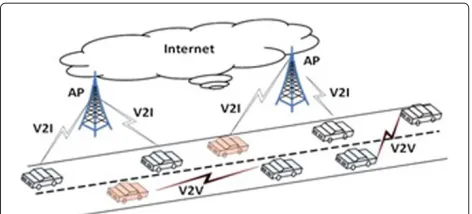
VANETs are a kind of wireless ad hoc networks that are intended for vehicles to communicate with each other and possibly with a roadside infrastructure to provide numer-ous applications varying from transit safety to driver assis-tance and Internet access. In VANETs, nodes have high mobility, long battery life and specific, strongly restricted, mobility patterns. As shown in Figure 1, the major goals of the VANET are to enable vehicle-to-vehicle (V2V) or vehicle to infrastructure (V2I)/Road-Side-Unit (RSU) communications so as to provide more safety, comfort and entertainment to the passengers [1].
Many research efforts in the area of VANETs try to increase transportation safety, efficiency and secu-rity. Lately, the focus in this research area moved also towards VANET infotainments that aim to increase user satisfaction during car journeys. IPTV service over VANETs is an attractive feature to many IPTV service providers by transmitting television programs through IP-based wireless networks. VANET-IP-based IPTV services are
*Correspondence: [email protected]
Department of Computer Science, University of Hamburg, Vogt-Kölln-Strasse 30, 22527 Hamburg, Germany
considered to play a very important role in the future of vehicular infotainment and intelligent transportation sys-tems. Vehicular IPTV aims to make the traditional IPTV and related services available to users anywhere, anytime also during the car journey. The vehicular IPTV ser-vices can be provided using different types of access net-works. The vehicular IPTV user may connect with mobile WiMAX, IEEE 802.11 and LTE networks or other wireless networks.
An essential aspect of IPTV services is the QoE achieved. Channel blocking probability (CBP) quantifies the ratio of unsuccessful user requests when demanding a TV channel. A high CBP can dramatically decrease the channel availability (CA), and therefore can significantly decline QoE. Hence, CA and CBP are some of the most important metrics regarding QoE of IPTV.
In vehicular IPTV, the limited available bandwidth in the wireless access network and the large number of han-dover events during the car journey, are the main causes of IPTV blocking and decreasing QoE in IPTV systems. QoE is extremely important as subscribers will choose for IPTV based on the QoE. In the literature, there are not yet many researches regarding vehicular IPTV services.
Figure 1General model of vehicular networks.AP: access point.
However, some efforts to evaluate CBP for IPTV with different types of access networks have been done. In [2], J. Lai et al. proposed to decrease the CBP and to improve the channel availability in DSL-based access net-works. J. Lai et al. [3,4] investigated the CBP not only in stationary but also in more realistic peak-hour scenarios and provided algorithms which allow one to reduce CBP efficiently. A. Abdollahpouri et al., in [5], suggested a real-istic model to reflect the typical behavior of IPTV users and studied the influence of different channel popularities in WiMAX-based IPTV systems. In particular, they have proposed a user behavior model reflecting, both, zapping and viewing periods. Momeni et al., in [6], investigated the availability of IPTV services in roadside-backbone-networks with vehicle-to-infrastructure communication. In this effort, they assumed small size of cell coverage in highway scenarios and predicted the resulting CBP but unlike the current study, presented in this paper, they did not look at different access network technologies lead-ing to strongly different sizes of cells. There are some recent efforts on live video streaming and multimedia over VANETs in the literature [7-9]. There also exist practical achievements for vehicle-to-infrastructure communica-tions to build-up roadside-backbone-networks (RBNs): At the University of Rostock, an RBN architecture was elab-orated including early prototype implementations assum-ing fixed access nodes along the roads that can be accessed by the vehicles by means of wireless communication [10]. It is also suitable to use this infrastructure for broad-casting IPTV or other multimedia services for vehicular users.
In this paper, which is a revised and extended version of [11], we focus on the CA and CBP as our QoE measure of interest, and ask the following questions:
• What are the main factors having impact on CA and CBP in an IPTV service for vehicular users?
• Which access network technology causes the lowest CBP and highest CA?
• What proportion of the call blocking events is due to handover and what is due to TV channel switching?
• What is the number of TV channels which still can be offered by the IPTV service if the resulting QoE has to stay above a given threshold?
We conduct a set of experiments in two different case studies in order to answer the above questions. As an improvement of our earlier research, published in [11], the case studies of this paper are now based on more realistic traffic assumptions. Moreover, the new experiments allow one to judge the impact of different cell sizes on CA and CBP for strongly varying traffic densities in a comprehen-sive and significantly more transparent manner than the case studies of [11].
The remainder of this paper is organized as follows: Section 2 presents vehicular ad hoc networks and IPTV. In Section 3, the scenarios and basic simulation assumptions will be motivated and specified. The results of our case studies will be presented and interpreted in Sections 4 and 5. Finally, we conclude in Section 6.
2 Vehicular ad hoc networks and IPTV 2.1 VANETs and access network technologies
(LTE, WiMAX, IEEE 802.11p)
VANET is a new technology which has taken enor-mous attention in the recent years. In VANETs, vehicles communicate with roadside units (RSUs), referred to as vehicle-to-infrastructure (V2I) communications. In addi-tion, vehicles can communicate with each other in an infrastructureless mode, referred to as vehicle-to-vehicle (V2V) communications. In general, the duration of exis-tence of each link is very limited, due to high dynamics in the network’s topology.
VANETs are an extreme case of Mobile ad hoc NET-works (MANETs). High speed and the already mentioned frequent network topology changes are the main charac-teristics of vehicular networks. These characcharac-teristics lead to special issues and challenges in the network design.
Many technologies are related to vehicle-to-infra-structure cooperation and may play a role in communicat-ing between vehicles and infrastructure.
There are many access network technologies to support V2I communications, e.g., IEEE 802.11p, WiMAX, LTE.
• IEEE802.11p: IEEE 802.11p, cf. [4], is an approved amendment to the IEEE 802.11 standard to add wireless access in vehicular environments (WAVE). It defines enhancements to 802.11 (the basis of
products marketed as Wi-Fi) required to support Intelligent Transportation Systems (ITS) applications in the short-range communications between vehicles (V2V) or between the vehicles and the roadside infrastructure (V2I). This includes data exchange between (possibly high-speed) vehicles and between the vehicles and the roadside infrastructure in the licensed ITS band of 5.9 GHz. 802.11p will be used as the groundwork for Dedicated Short-Range
Communications (DSRCs). DSRC has been used for years for many types of short-range dedicated links transmitting on various frequencies.
• WiMAX: Worldwide Interoperability for Microwave Access (WiMAX) technology is based on IEEE 802.16 and 802.16e standards for fixed and mobile wireless access in metropolitan area networks (MAN) [21]. It can deliver data rates of 70 Mbps, cover ranges in excess of 30 km, and it can provide secure delivery of content and support mobile users at vehicular speeds. • LTE: The Long Term Evolutionary access technology
called LTE is quickly becoming the network
technology of choice for 4G deployments around the world. The goal of LTE was to increase the capacity and speed of wireless networks using new DSP (digital signal processing) techniques and modulations that were developed around the turn of the millennium. A further goal was the redesign and simplification of the network architecture to an IP-based system with significantly reduced transfer latency compared to the 3G architecture. The LTE wireless interface is incompatible with 2G and 3G networks, so that it must be operated on a separate wireless spectrum.
2.2 IPTV
IPTV services are becoming popular and are expected to rapidly expand in the near future. IPTV is defined as a ser-vice that includes multimedia serser-vices such as TV, video, audio, text, graphics, and data over IP-based networks.
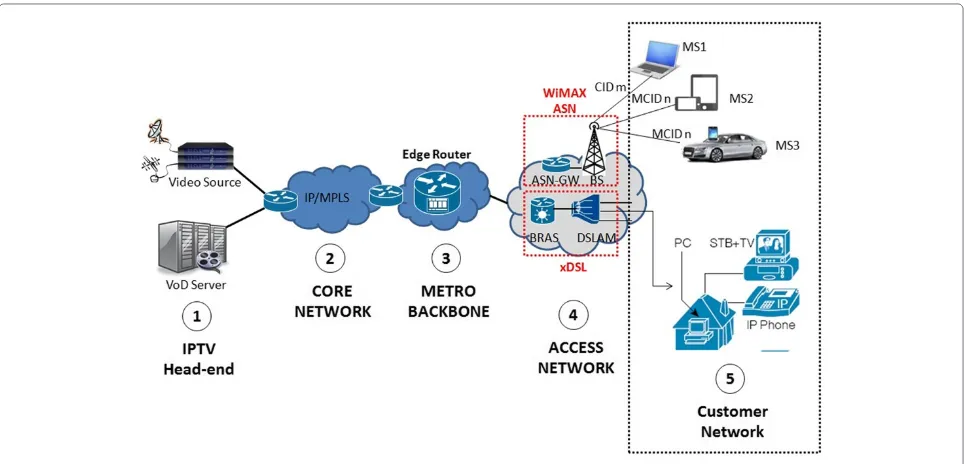
We define an IPTV network as the interconnection of several broadband networks that are capable to support the required bandwidth for video delivery (in particular, delivery of TV channels). In addition, an IPTV network topology can be split into five main parts: IPTV head-end, core network, metro backbone, access network and subscribers (cf. Figure 2).
The IPTVhead end (1) or a video-on-demand (VoD) server is responsible of delivering video and content, i.e. the original TV channels, to the core network which rep-resents a high-speed communication infrastructure. The
core network (2) distributes the video streams from the head end to the metro backbone. Themetro backbone(3) interconnects the core network with the different access
networks. Its main function is to multiplex the different service providers and to adapt the transport system to the specific characteristics of the subscriber loop. Therefore, the metro backbone must perform data transmission and switching tasks efficiently. The elements that transport the multimedia content to the end users (subscribers) form theaccess network(4) which may be DSL-based contain-ing BRASes (broadband remote access servers) and DSL access multiplexers (DSLAMs). Alternatives for the access network could be WiMAX with components such as ASN-GW (access service network - gateway) connecting the edge router to a base station (BS) which may trans-mit the TV channels to the mobile users either using unicast (cf. CID for connection identifier) or multicast (cf. MCID for multicast CID). In case of a VANET-based IPTV system, the mobile stations MS in Figure 2, would represent the devices in the cars which there will present the TV programs to the users. If WLANs or LTE would be used to deliver IPTV services in a VANET, the situation would be very similar to what is illustrated for WiMAX in Figure 2 and, therefore, it is not explicitly depicted in this figure to reduce complexity. The access network manages the user demands by using the return channel. The main requirement of an access network is to have enough band-width to support multiple IPTV channels as demanded by the currently active set of subscribers. Finally, the sub-scribers (5), e.g., sitting in the cars if we assume access
via a V2I communication system, may be connected to the access network either directly or have their own local network which enables indirect communication and infor-mation exchange between the user’s device (e.g. TV set) and the access network. This direct or indirect communi-cation allows accessing the available resources in the IPTV network.
2.3 Channel availability in VANET-based IPTV systems In the analog cable TV network, all the channels are available simultaneously for subscribers. Analog cable TV transmits all the channels at onceviaa fixed cable to the subscribers, and each active subscriber then chooses a channel for viewing by using a set-top box (STB). There-fore, channel change is almost instantaneous. But IPTV differs significantly from analog cable TV, in its transmis-sion system. In the IPTV system, a subscriber uses the STB to request for only the specific channel required at that time, and only the required channel is transmitted to this user (possibly by means of multicast).
To make the IPTV services a success, it is required to guarantee a certain level of QoE. Therefore, it is criti-cal for an IPTV service provider to ensure an acceptable level of QoE. Subscribers will choose IPTV based on the QoE. Among QoE measures, TV channel availability (CA) is one of the most significant. Thus, it is highly desirable to evaluate the probability that requested TV channels
cannot be provided, namely the CBP, in IPTV systems. A high CBP will dramatically degrade CA and consequently QoE. For providing QoE and CA for vehicular IPTV users, there are two major challenges: lack of network bandwidth and a possibly large number of handover events during the car journey.
The focus of this paper is on IPTV service availability and therefore modeling the details of the lower layer com-munication protocols (as done, e.g. in [22]), is dispensable in our studies. The fact that we consider VANETs and not mobile networks in general has a strong impact on the resulting mobility model being quite specific in highway scenarios.
3 Scenario investigated by means of simulation IPTV services can be divided into two groups: Video on demand (VoD) for stored contents and Broadband-TV (BTV) for live TV channels. In an IPTV system, the TV channels are distributed towards the subscribers by using either IP unicast or multicast. In general, unicast is applied for VoD and multicast is used for BTV service for the delivery of live TV channels.
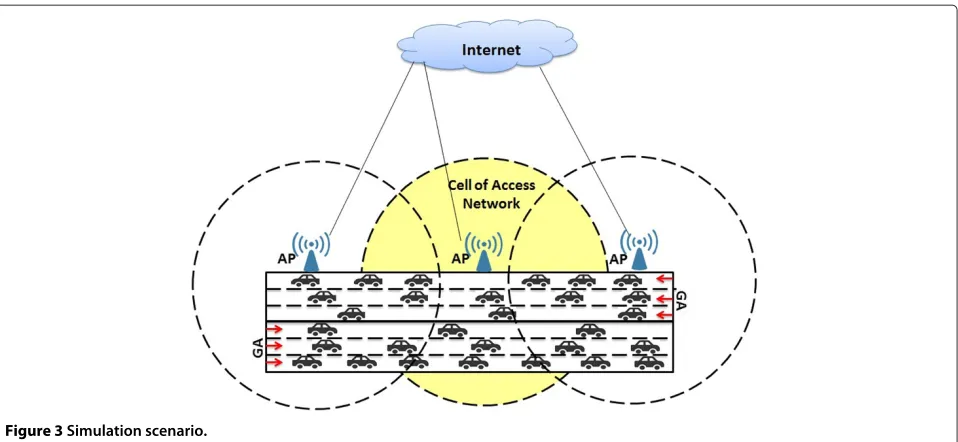
In our simulation model, vehicles entering the cell at the border of the geographical area (GA) are assumed to contain either 0 or at least 1 passenger watching TV (of course, the driver should not watch!). TV is not switched on or off in a car during the car journey along the complete highway sector observed. The system model as used in our work is demonstrated in Figure 3. A switching event hap-pens when a user chooses a new TV channel. TV channels will be selected according to a Zipf distribution [23] which has an ability to represent the skewed popularity distri-bution of objects. The request probability Pi of the ith
popular channel is determined by the Zipf distribution and calculated as
where N is the total number of distinct channels, k is their rank andis the Zipf parameter that determines the degree of popularity skew. Whenis 0, all channels are equally popular. As the value ofincreases, the popular-ity of channels is increasingly skewed. For, we choose a value of 1.3 which is realistic according to measurements of IPTV user behavior (cf. [5,24]).
Figure 3Simulation scenario.
phase and is not contained in the zapping block. The user switches between zapping activities and viewing phases.
In addition to the switching of channels (zapping or normal switching from one channel viewed to another), during the viewing phase, users are undergoing a number of handover events when changing their cell within the vehicular network. During handover, when a car passes the border between two adjacent cells C1 and C2, blocking of a TV channel may occur.
When a vehicular IPTV user is in viewing phase and watches a given TV channel P, two situations may happen: Firstly, the user can continue to watch channel P, if P is already broadcasted in the new cell C2 reached, because channel P has been watched already by other users in cell C2, or if P is not yet transmitted in C2 but there is enough free bandwidth remaining to broadcast P as well as the other channels already broadcasted in C2. However, if P is not yet broadcasted in C2 and there is not enough free bandwidth left in C2 to broadcast P, then the user cannot continue to view P in C2. We call this a blocking event because a request for a TV channel could not be satisfied and the request was ‘blocked’. We define the overall Chan-nel Blocking Frequency (CBF) having occurred during a time interval T as:
CBF(T)= nb(T)
nr(T),
where nb(T) = number of blocking events having occurred during interval T and nr(T) = number of all channel requests during T. For |T| → ∞, where |T|
denotes the length of interval T, CBF(T) will tend to the
Channel Blocking Probability (CBP).
Based on CBP, we definechannel availability (CA)as follows:
CA=1−CBP.
LetHBPnow denote theHandover Blocking Probability
which is reflecting blocking because of handover events of vehicles using IPTV, and letSBPdenote theSwitching Blocking Probabilitywhich is reflecting blocking because of TV channel switching events. Then:
CBP=HBP+SBP,
and
HBP=lim|T|→∞nh(T) nr(T),
where nh(T) = number of handover-induced blocking requests of all cars which are using IPTV during interval T.
SBP=lim|T|→∞
ns(T)
nr(T),
where ns(T) = number of switching-induced blocking requests of all cars which are using IPTV during interval T.
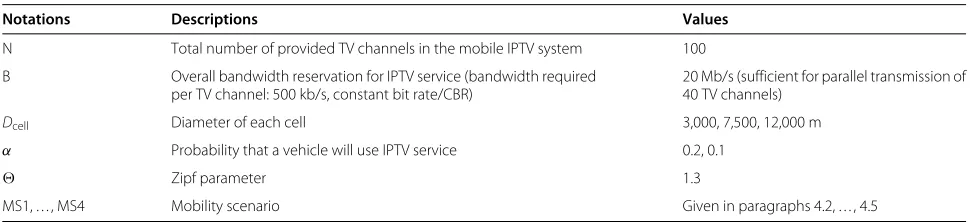
Table 1 Parameter values for first case study
Notations Descriptions Values
N Total number of provided TV channels in the mobile IPTV system 100
B Overall bandwidth reservation for IPTV service (bandwidth required per TV channel: 500 kb/s, constant bit rate/CBR)
20 Mb/s (sufficient for parallel transmission of 40 TV channels)
Dcell Diameter of each cell 3,000, 7,500, 12,000 m
α Probability that a vehicle will use IPTV service 0.2, 0.1
Zipf parameter 1.3
MS1, . . . , MS4 Mobility scenario Given in paragraphs 4.2, . . . , 4.5
switching events for the vehicular IPTV users. LoadSpec has been elaborated in our TKRN research group [25]. It is an artificial load generator for different interfaces, and it is capable of producing realistic network traffic with different characteristics in a very simple and flexi-ble manner. Other simulators for VANETs (such as ns-2 [26], JiST/SWANS [27], Shawn [28], GloMoSim [29] and OMNeT++ [30]) emphasize on the lower protocol layers as they have completely different research goals. Doing availability studies based on those simulators would be extremely inefficient, if possible at all. Therefore, we are using our own tool for evaluating the availability of IPTV services (cf. Sections 4, 5).
4 Case study I: variation of traffic density and cell sizes
By means of simulation experiments, we now want to determine the channel availabilities for various scenar-ios assuming boundary conditions as realistic as possible. So, we are able to provide decision support regarding the question whether the QoE to be expected is acceptable for the IPTV users in the VANET. As suggested before we will look at CBP and CA as measures characterizing the QoE. In order to know more precisely which kind of events (channel switching or handover, respectively) lead to TV channel blocking, we not only look at CBP but also at the values resulting for SBP and HBP.
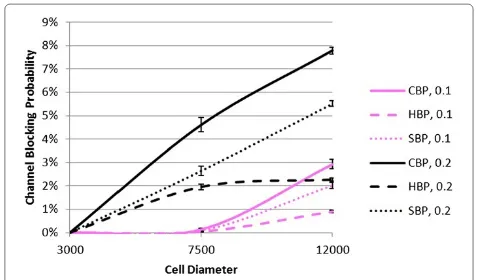
Figure 4CBP results for 400 cars per km.On a two-lane highway against access network technologies (MS1).
In the first case study, we want to evaluate the impact of different cell sizes and vehicle traffic densities (vehi-cles per kilometer) on CBP, SBP, HBP and CA in highway scenarios. The traffic density is given in ‘cars per km’ in order to simplify the language though also other entities like lorries, motorcycles, etc. will drive on the highway.
Please note that average speed SP is always combined with the average distance between adjacent vehicles. For example, in the worst case of the traffic situation (in which all vehicles are stuck in a traffic jam and can move only very slowly, if at all, where we assume a speed on lane
i of SP[i] = 10 km/h) then the average distance between adjacent vehicles on lanei(denoted bydavg[i]) isdavg[i]= 10 m and in the best traffic situation (i.e. if SP[i] = 160 km/h) we assume davg[i] = 55 m. Moreover, the actual distance always varies +/- 5 m around the average. The dif-ferent mobility scenarios (MS) (cf. description of scenarios MS1,. . ., MS4 in paragraphs 4.2,. . ., 4.5) are obtained by investigating the 11 different average distances between neighboring vehicles.
4.1 Experimental setup
In our experiments, we consider different traffic density on a motor highway with various numbers of vehicles per km in cells of different sizes (due to the usage of dif-ferent access network technologies). In our experiments, vehicles are generated for each lane in each direction.
Figure 6CBP results for 232 cars per km.On a three-lane highway against access network technologies (MS2).
Before presenting the results, we describe the experimen-tal setup.
The total number of provided TV channels is 100, and this is a typical number of TV channels which are cur-rently provided by IPTV service providers. We assume the quality of video is according to the CIF standard for all the channels and the probability to select each channel is according to the Zipf distribution. Moreover, the user model assumed for IPTV user behavior is according to [5]. As mentioned, in this case study, we executed experiments to find out, which channel availability can be expected if there exist different number of vehicles per kilometer (i.e. assuming different traffic densities) and if we would use different access network technologies with different cell sizes. Table 1 summarizes the essential experimental boundary conditions assumed in case study I.
4.2 MS1: traffic jam on highway
This is the worst case scenario assuming a serious traf-fic jam. Speed is 10 km/h on all lanes (here, two or three lanes per direction, i.e. four or six lanes in total for both directions) and the motor highway is characterized by
Figure 7CBP results for 116 cars per km.On a three-lane highway against access network technologies (MS2).
Figure 8CBP results for 58 cars per km.On a three-lane highway against access network technologies (MS2).
an extremely high traffic density. Average inter-vehicle distance on all lanes is 10 m, i.e. the actual inter-vehicle distances vary in the range 10 +/- 5 m; there-fore, on the average, there are 100 cars per lane and per km.
4.3 MS2: high traffic density on highway
Now, let us look at a high traffic density situation. We assume the highway has three lanes per direction and that SP[1]= 80 km/h and SP[2]= SP[3]=100 km/h, respectively, and the minimum distance between the vehicles on the three lanes aredavg[1]= 20 m anddavg[2]=davg[3] = 30 m (same for each direction). Besides investigating situations with exactly these minimum distances, we are going to study this scenario with 2 × Minimum davg[i] and also 4×Minimumdavg[i]. Again, the minimum distances are denoting means and the actual distances vary +/- 5 m.
4.4 MS3: medium traffic density on highway
This is in the medium traffic density situation. In this case, again assuming three lanes per direction, SP[1] = 100 km/h, SP[2] = 120 km/h and SP[3] = 140 km/h,
Figure 10CBP results for 78 cars per km.On a three-lane highway against access network technologies (MS3).
respectively, where the minimum distances between the vehicles aredavg[1]= 30 m,davg[2]= 40 m anddavg[3]= 50 m. Different distances of 2 × Minimum davg[i] and also of 4×Minimumdavg[i]are also considered again in this mobility scenario.
4.5 MS4: low traffic density on highway
Now, we look at the low traffic density situation. In this mobility scenario, we assume SP[1] = 110 km/h, SP[2] = 140 km/h and SP[3] = 160 km/h, respectively and thus the minimum distances between the vehicles aredavg[1]= 35 m,davg[2] = 45 m anddavg[3] = 55 m. Moreover, dif-ferent distances of 2× Minimumdavg[i]and also of 4× Minimumdavg[i]are also studied in this scenario.
4.6 Results obtained and their interpretation
Experimental results are depicted in Figures 4, 5, 6, 7, 8, 9, 10, 11, 12 and 13. Confidence intervals are based on a confidence level of 95% in all experiments. In general, the results have been obtained by increasing the dis-tance between vehicles with different speeds; accordingly, traffic density will reduce and this leads to a reduction of
Figure 11CBP results for 39 cars per km.On a three-lane highway against access network technologies (MS3).
Figure 12CBP results for 136 cars per km.On a three-lane highway against access network technologies (MS4).
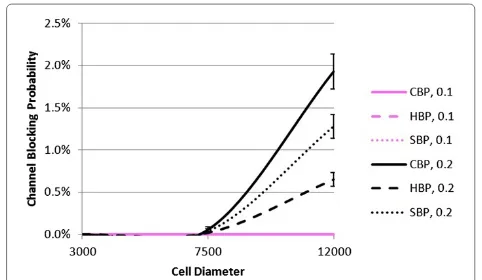
CBP. More specifically, in order to increase the distance between adjacent vehicles the speed of the vehicles has to be increased too. The figures not only present the CBP results obtained but also the percentage of blocking events resulting from handover (HBP) as well as the percentage of blocking events resulting from channel switching (SBP). As is to be expected, both, CBP and SBP increase when we increase traffic density and this holds for all of the access network technologies (because of having more IPTV users per cell). For HBP, the shape of the curves could be slightly different. With growth of cell size and high traffic density, nearly all of the TV channel blockings are due to channel switching events.
Let us now assume that the maximum acceptable threshold for CBP is 1%. Then, in the worst case, as one can see in Figures 4 and 5, for all cell sizes the 1% requirement can no longer be fulfilled for α = 0.2, and only the scenario with a cell diameter of 3 km (withα= 0.1) still reaches the acceptable CBP. Figures 6, 7 and 8 depict the results for the high traffic situation. With both values of α, only a cell size of 3 km leads to an accept-able blocking probability in the minimum inter-vehicle
Table 2 Parameter values for second case study
Notations Descriptions Values
N Total number of provided TV channels in the mobile IPTV system
40, 60, 80, 100
k Number of lanes in each direction of the highway 2,3
SPi Average speed of a vehicle in each laneiper direction [km/h] 90 (lane 1), 120 (lane 2), 150 (lane 3)
davg[i] Average distance in laneibetween two adjacent vehicles [m] 20 (lane 1), 25 (lane 2), 30 (lane 3)
dmax[i] Maximum distance in laneibetween two adjacent vehicles [m] 30 (lane 1), 35 (lane 2), 40 (lane 3)
dmin[i] Minimum distance in laneibetween two adjacent vehicles [m] 10 (lane 1), 15 (lane 2), 20 (lane 3)
distance scenario. With increasing the distance between vehicles to 2× Minimum davg[i] in the case of α = 0.2, only 3 km cell diameter has the allowable CBP, but forα= 0.1 and also 4×Minimumdavg[i], all the cell sizes achieve an adequate CA. Cell size diameters of 3 and 7.5 km still meet the CA requirement. For 4 × Minimumdavg[i]all the cell sizes offer an acceptable CBP. In Figures 9, 10 and 11, the results for medium traffic density are shown. For
α= 0.2, only scenarios with a 3-km cell diameter and for
α = 0.1, cell diameters of 3 and 7.5 km keep their CBP below the threshold, with 2× Minimumdavg[i], forα = 0.2, cell diameters of 3 and 7.5 km and forα= 0.1 and also 4×Minimumdavg[i]all the cell sizes lead to an acceptable value of CBP. Figures 12 and 13 illustrate the charts for low traffic density. We observe that the situation is similar to the medium traffic density. The scenario MS4 leading to 34 cars per km (4×Minimumdavg[i]) is not illustrated by an own figure because here, CBP (and therefore also SBP and HBP) is negligibly small - CBP below 0.01%.
5 Case study II: variation of number of TV channels offered, lanes and cell sizes
In the second case study, we try to find out in which way various factors have an impact on CA and CBP. This evi-dently would be a quite important and relevant question for an IPTV service provider. In particular, we would like to know what is the effect of increasing the number of TV
Figure 14Channel Blocking Probability results.Against number of TV channels offered for different cell sizes and number of lanes.
channels which is provided by the IPTV service provider on the channel blocking events and thus on the availability of the IPTV service for vehicular users.
5.1 Experimental setup
Except the number of provided channels N and the density and speed parameters which are now fixed, the simulation parameter values are the same as in the first case study for all experiments of the second case study. In our exper-iments, we varied the number of TV channels offered by IPTV service provider, the number of lanes of the high-way as well as the cell sizes in different access network technologies. The value ofαwas kept constant, assuming
α= 0.1. The essential experimental boundary conditions underlying case study II are summarized in Table 2.
5.2 Results obtained and their interpretation
The simulation results demonstrate the implication of varying the number of the lanes, the number of TV channels provided and access network technologies in Figures 14, 15 and 16. Again, the results are given with 95% confidence intervals. The curves in Figure 14 are depicting the values of CBP whereas SBP, HBP are illus-trated by Figures 15 and 16. It is observed that, as it is to be expected, when increasing the number of the lanes and the number of TV channels provided, CBP will be increased, too. As can be seen, with increasing the cell size
Figure 16HBP and SBP results for highway with three lanes. Against number of TV channels offered for different cell sizes.
according to the different access network technologies we assumed (namely IEEE 802.11p, WiMAX and LTE), the handover-induced blocking probability (HBP) increases much less quickly than the switching-induced blocking probability (SBP). Our questions can be answered with these experiments: access networks with small area cov-erage will boost the channel availability (CA). However, if we increase the number of lanes and the number of TV channels provided, CA will decrease and CBP will increase. Taking again a maximum channel blocking prob-ability threshold of 1% in our IPTV service, we observe that
• For the 12-km cell size: assuming the three- and two-lane highway scenarios, the number of TV channels (N) which still can be provided with sufficiently high availability is aboutN= 48 (for three lanes) andN= 75 (for two lanes).
• For the 7.5-km cell size: a three-lane highway requires
N≤68, and for a two-lane,N≤100 is still acceptable. • For the 3-km cell size, for two-lane as well as for
three-lane highways, we even do not have any significant number of blocking events.
6 Conclusion
The general contribution of this paper has been a quan-titative evaluation of the availability of IPTV services in VANETs where availability is expressed by the probabil-ity that a requested TV channel can indeed be offered at that time. More specifically, the main results achieved by us comprise elaboration of a dedicated simulation tool, which allows us to determine CBP based on a detailed model of IPTV user behavior; execution of a large variety of case studies, e.g. investigating the influence of differ-ent access network technologies, traffic densities, etc.; in-depth investigations of the reasons for channel block-ing to occur, namely due to handover or due to TV channel switching events.
As future work, we plan to elaborate algorithms which help to reduce channel blocking due to handover because this kind of blocking has a very negative impact on the QoE of IPTV users; to investigate scenarios which assume rural roads instead of the motor-highway scenarios on which this paper has put its focus; last but not least, it will be interesting to study also the impact of infotain-ment applications, other than IPTV, on the performance and availability of different types of access networks in VANETs.
Competing interests
The authors declare that they have no competing interests.
Received: 31 January 2014 Accepted: 28 May 2014 Published: 15 July 2014
References
1. V Gau, CW Huang, JN Hwang, Reliable multimedia broadcasting over dense wireless ad-hoc networks (invited paper). J. Comm.4, 614–627 (2009)
2. J Lai, BE Wolfinger, S Heckmüller, Decreasing call blocking probability of broadband TV services by a channel access control scheme. ICUMT 2010 Moscow 18-20 October 2010
3. J Lai, BE Wolfinger, S Heckmüller, Decreasing call blocking probability of broadband TV services in networks with tree topology. SPECTS 2011, The Hague, The Netherlands, 27-30 June 2011
4. D Jiang, L Delgrossi, IEEE 802.11p: towards an international standard for wireless access in vehicular environments, inProceedings of Vehicular Technology Conference(Budapest, Hungary, 15-18 May 2011), pp. 2036–2040
5. A Abdollahpouri, BE Wolfinger, J Lai, C Vinti, Elaboration and formal description of IPTV user models and their application to IPTV system analysis, inMMBnet2011(Hamburg, September 2011)
6. S Momeni, J Lai, BE Wolfinger, Availability evaluation of IPTV services in roadside backbone networks with vehicle-to-infrastructure
communication, inIEEE Conference IWCMC 2013(Cagliari, Sardinia, 1-5 July 2013)
7. F Xie, KA Hua, W Wang, YH Ho, Performance study of live video streaming over highway vehicular ad hoc networks, inIEEE 66th Vehicular Technology Conference, (30 Sept-3 Oct 2007), pp. 2121–2125
8. MA Bonuccelli, G Giunta, F Lonetti, F Martelli, Real-time video transmission in vehicular networks, inMobile Networking for Vehicular Environments(Anchorage, Alaska, USA, 11 May 2007), pp. 115–120 9. JS Park, U Lee, SY Oh, JS Park, U Lee, SY Oh, M Gerla, DS Lun, Emergency
related video streaming in VANET using network coding, in3rd International Workshop on Vehicular Ad-hoc Networks(Los Angeles, CA, 24-29 Sept 2006), pp. 102–103
10. A Gladisch, R Daher, M Krohn, D Tavangarian, OPAL-VCN: open-air-lab for vehicular communication networks, inWiMob’10(Niagara Falls, Canada, 11-13 Oct 2010), pp. 555–561
11. S Momeni, BE Wolfinger, Availability of IPTV services in VANETs using different access network technologies, in13th International Conference on ITS Telecommunications, ITST 2013(Tampere, Finland, 16-18 Oct 2013) 12. V Navda, AP Subramanian, K Dhanasekaran, K Timm-Giel, S Das,
Mobisteer: using steerable beam directional antenna for vehicular network access, inProceedings of the 5th International Conference on Mobile Systems, Applications and Services (MobiSys ‘07)(San Juan, Puerto Rico, 11-14 June 2007), pp. 192–205
13. W Kellerer, Mobile communication in a heterogeneous and converged world. IEEE Pers. Comm. Mag.8(6), 41–47 (2001)
14. W Franz, R Eberhardt, T Luckenbach, FleetNet - Internet on the road, in
Proceedings of the 8th World Congress on Intelligent Transport Systems (ITS)
(Sydney, Australia, 30 Sep - 4 Oct 2001)
15. JH Winters, MJ Gans, Versus phased arrays in mobile radio systems. IEEE Trans. Veh. Tech.48(2), 353–362 (1999)
Pervasive Computing and Communications Workshops, 2006, PerCom Workshops 2006(Pisa, 13-17 March 2006), pp. 352–356
17. B Hull, V Bychkovsky, Y Zhang, et al., CarTel: A distributed mobile sensor computing system, in4th ACM Conference on Embedded Networked Sensor Systems (SenSys)(New York, USA, 01-03 Nov 2006)
18. V Bychkovsky, B Hull, AK Miu, et al., A measurement study of vehicular internet access using in situ WiFi networks, inProceedings of the 12th Annual International Conference on Mobile Computing and Networking (MOBICOM ‘06)(Los Angeles, CA, USA, 24-29 Sept 2006)
19. A Nandan, S Das, G Pau, et al., Cooperative downloading in vehicular ad hoc networks, inSecond Annual Conference on Wireless On demand Network Systems and Services (WONS)(St. Moritz, Switzerland, 19-21 Jan 2005)
20. R Sengupta, Q Xu, Calif. PATH-Partners Adv. Transit Highways.10(4), 2–5 (2004)
21. IEEE Standard for Local and Metropolitan Area Networks Part 16: Air Interface for Fixed and Mobile Broadband Wireless Access Systems. IEEE 802.16 WG, IEEE Standard for Local and Metropolitan Area Networks Part 16: Air Interface for Fixed and Mobile Broadband Wireless Access Systems, Amendment 2, IEEE, Dec. 2005
22. A Vinel, 3GPP LTE versus IEEE 802.11p/WAVE: which technology is able to support cooperative vehicular safety applications? IEEE Wireless Commun. Lett.1(2), 125 - 128 (2012)
23. MEJ Newman, Power laws, pareto distributions and zipf’s law. Contemp. Phys.46(5), 323-351 (2005)
24. A Abdollahpouri,QoS-Aware Live IPTV Streaming Over Wireless Multi-hop Networks, (Shaker-Verlag, Aachen, 2012)
25. A Kolesnikov, UniLoG: A Unified Load Generation Tool, in16th International GI/ITG Conference, MMB and DFT(Kaiserslautern, 19-21 March 2012) 26. Ns2 (The Network Simulator). http://www.isi.edu/nsnam/ns. Accessed
June 2014
27. JiST/SWANS - Java in Simulation Time/Scalable Wireless Ad Hoc Network Simulator. Available At: http://jist.ece.cornell.edu. Accessed June 2014 28. A Kröller, D Pfisterer, C Buschmann, SP Fekete, S Fischer, Shawn: a new approach to simulating wireless sensor networks, inProceedings of the Design, Analysis, and Simulation of Distributed Systems (DASD 05)(San Diego, USA, 5 April 2005)
29. X Zeng, R Bagrodia, M Gerla, GloMoSim: a library for parallel simulation of large-scale wireless networks, inProceedings of 12th Workshop on Parallel and Distributed Simulation (PADS ’98)(Banff Canada, 26–29 May 1998), pp. 154–161
30. OMNeT++ Discrete Event Simulation System. http://www.omnetpp.org/ index.php, Accessed June 2014
doi:10.1186/1687-1499-2014-117
Cite this article as:Momeni and Wolfinger:Availability evaluations for IPTV in VANETs with different types of access networks.EURASIP Journal on
Wireless Communications and Networking20142014:117.
Submit your manuscript to a
journal and benefi t from:
7Convenient online submission 7Rigorous peer review
7Immediate publication on acceptance 7Open access: articles freely available online 7High visibility within the fi eld
7Retaining the copyright to your article