R E S E A R C H
Open Access
An orthogonal spectrum sharing scheme for
wireless sensor networks
Vivek A Bohara
1*, See Ho Ting
1, Yang Han
1and Ashish Pandharipande
2Abstract
It is not economically viable to allocate a dedicated spectrum band to wireless sensor networks (WSNs). Moreover, sharing a spectrum band with incumbent (primary) system compromises the reliability and performance of both the systems due to interference from one system to another. In this article, we address this limitation by proposing a two-phase orthogonal spectrum sharing protocol for a WSN which exploits multiple sensor nodes to effectively cancel out the interference from a WSN to the primary system, and vice versa. As a consequence, it is possible to achieve spectrum access for the WSN without compromising on the performance of either systems. Performance of WSN as well as the primary system is quantified in terms of average received signal to noise ratio. We then validate the efficiency of the proposed scheme through analytical and simulation results.
Introduction
Recently, wireless sensor networks (WSNs) [1-5] are being increasingly deployed all over the world at an accelerated pace. This has been made practically feasible by significant advances in microelectro-mechanical sys-tems (MEMS) technology, radio communications and digital electronics [2]. A typical WSN consists of spa-tially distributed sensor nodes deployed in an ad hoc
manner which collects data and pass on to a central base station (CBS) via a radio link. The CBS can be a PC, data server, dedicated monitoring device, or any other gateway to a higher data rate device. WSNs are used for various applications including military surveil-lance, habitat monitoring, object tracking, traffic moni-toring, etc.
Most of the sensor nodes are autonomous and send data over the radio link only when required. Further-more, there is an increasing trend of deploying WSN in urban areas as part of the infrastructure to support smart building initiatives and power meter readings for smart grids, to name a few. However, radio spectrum in urban areas are generally extremely crowded as evident from the National Telecommunications and Information Administrations (NTIA) frequency allocation chart1and
thus it is not possible nor economically viable to allocate a dedicated radio spectrum band to a WSN.
Factors such as the above have spurred the demand for alternative spectrum access techniques for WSNs [6,7]. This demand has been further compounded by the inefficient usage of the licensed bands by the incumbent (primary) systems [8]. Researchers over the years have proposed dynamic spectrum access (DSA) techniques to utilize the spectrum more efficiently by allowing a sec-ondary system (for example a WSN) to co-exist in the same frequency band as a primary system and opportu-nistically access the licensed bands [9-11]. But most of this techniques are interference limited, and the perfor-mance of the systems are limited by the amount of interference acceptable from one system to another [12-16].
In this article, by taking the above factors into consid-eration, we propose an orthogonal spectrum sharing scheme (OSSS) which allows a WSN to gain spectrum access along with a primary system without causing any interference to one another. As a result, the perfor-mance of primary system is not limited by the interfer-ence from WSN and vice versa. In the proposed scheme, a WSN, henceforth known as secondary system, is assumed to be a single-hop network with every sensor node being able to directly communicate with every other node. Secondary transmitters (STs) are spatially distributed sensor nodes that cooperatively monitor their physical environmental conditions and send an * Correspondence: [email protected]
1
School of Electrical and Electronic Engineering, Nanyang Technological University, Singapore, 639801 Singapore
Full list of author information is available at the end of the article
update to their CBS, which for simplicity will be denoted as secondary receiver (SR). STs can communi-cate with each other in real time and the communica-tion link between them can be formed by using a radio, infrared or an optical media depending upon the avail-ability [2]. This inter-node communication helps in sta-tus monitoring of the STs and also avoids duplication of data at SR. Moreover, it also keeps all STs well informed of the latest information being sent to SR.
Under the proposed framework, the secondary system operates in the same frequency band as an incumbent primary system, which comprises of primary transmitter (PT) and primary receiver (PR). A higher priority is given to the primary system and the secondary system operates on a lower priority with a constraint that its operation does not affect the performance of primary system. For ease of analysis, we limit ourselves to two ST nodes, ST (1) and ST(2) and denote them as a ST cluster or simply STwherever necessary. Do note that due to inter-node communication, ST(1) and ST(2) has access to the same sensor information that is to be sent to SR.
Cooperation techniques to enhance the performance of a communication system in terms of diversity, coverage extension, etc, have been studied extensively in literature [17-21]. Control signalling for practical cooperation schemes have also been proposed in [22-28]. In our pro-posed scheme, we presume that the primary system is an advanced system with a relaying functionality, like IEEE 802.16j [29], and it employs a practical handshake mechanism for cooperative relaying [27].
Consider a scenario in which the average signal to noise ratio (SNR) between PT and PR drops below a particular threshold. PT will seek cooperation from neighboring terminals to enhance its transmission per-formance by broadcasting a cooperative right-to-send (CRTS) message which also indicates the target average
SNR, SNRT, for the primary system. PR responds to
CRTS by transmitting a cooperative clear-to-send (CCTS) message. Upon overhearing CRTS and CCTS, STdecides2 whetherSNRTcan be met if it serves as an amplify-and-forward (AF) relay for the primary system. If yes, ST(2) responds by sending a cooperative clear-to-help (CCTH) message to PT and PR, and the primary system correspondingly switches to a two-phase AF relaying transmission mode, with ST(1) acting as the primary relay. However, ifST is not able to assist the primary system to achieve SNRT, it will simply remain silent.
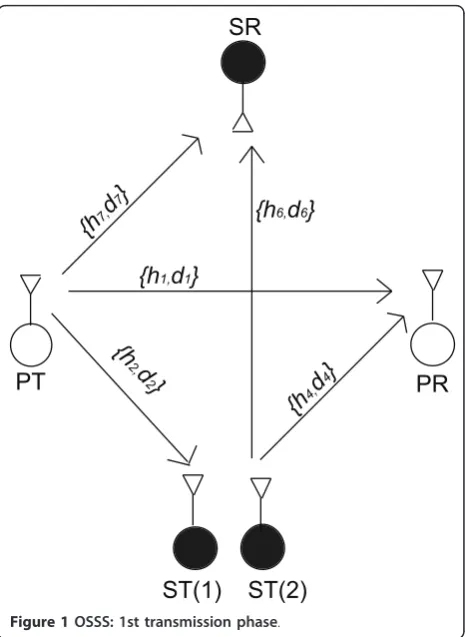
OnceSTis confirmed as a relay, secondary spectrum access is achieved by adopting the following two-phase transmission protocol. The system models for the 1st and 2nd phase are shown in Figures 1 and 2, respectively. In the 1st phase, the primary signal transmitted by PT to PR is overheard by ST(1) and SR. Simultaneously in the
PT
PR
ST(1)
SR
{h
1,d
1}
{h
4,d
4}
{h
2,
d
2}
{h
7,d
7}
{h
6,d
6}
ST(2)
Figure 1OSSS: 1st transmission phase.
PT
PR
SR
{h
5,d
5}
{h
6,d
6}
{h
3,d
3
}
{h
4,d
4
}
ST(1) ST(2)
same phase, ST(2) transmits the secondary signal which is received by SR as well as PR. At ST(1), the primary sig-nal received in the 1st phase is amplified according to its power constraint.
The 2nd phase of the proposed scheme is similar to a space time block code (STBC) design [30]. ST(1) and ST(2) transmit the negative complex conjugate of the amplified primary signal and complex conjugate of the secondary sig-nal, respectively. At PR, the received signals after the two-phase transmission are multiplied by an orthogonalization vector to cancel out the interference due to secondary sig-nal and retrieve the primary sigsig-nal. The secondary sigsig-nal is retrieved at SR in the same way.
The most important attribute of the proposed scheme is that it is not interference-limited because of the orthogonality between the received primary and second-ary signals. As a result, the performance of primsecond-ary (sec-ondary) system is not limited by the interference from secondary (primary) system. As shown later in this arti-cle, the secondary user is able to achieve spectrum access as long as it is willing to increase its transmit power such thatSNRTis met. This ability to trade-off transmit power with spectrum access opportunity is an attractive feature for WSNs as it allows the sensor nodes to maintain its Quality of Service (QoS), such as delay constraints. Another point to note is that although the proposed scheme has been illustrated by using WSN as a secondary system, the obtained analytical and per-formance results are also applicable to any radio (sec-ondary user) that is interested in accessing the licensed spectrum as long as it does not compromise the perfor-mance of licensee3.
As a basic requirement for the proposed scheme, we assume that the primary system supports STBC [31] and the necessary channel state information (CSI) needed at the receiving terminals can be obtained through standard pilot symbol-aided channel estimation methods [32-34]. We analyze the above proposed scheme, henceforth called as orthogonal spectrum shar-ing scheme (OSSS), by derivshar-ing the closed-form expres-sions for average SNR of the primary system. For comparison, we also consider an interference limited
scheme where ST uses AF with superposition coding
(AF-SC) [35]. We show that for the same SNRT
requested by the primary system, OSSS can achieve a much higher performance for the secondary system than AF-SC.
The remainder of this article is organized as follows. Section 2 discusses the system model for OSSS and gives the general protocol description. Sections 3 and 4 present the analysis for OSSS and AF-SC schemes, respectively. Section 5 provides the simulation results. Finally, Section 6 concludes the article. The following notations are used in this article. E[·] denotes the
statistical expectation operator and a complex Gaussian
random variable z with mean μ and variance s 2 is
denoted as z∼CN(μ, σ2). An exponential distributed
random variablex with mean1
λis denoted as x ~ε(l) We denote the transpose and conjugate transpose of matrixAasATand AH, respectively.
System model and protocol description System model
The system model under consideration for the 1st and 2nd transmission phase is shown in Figures 1 and 2, respectively. The channel between all the links, i.e., PT-PR, PT-ST(1), ST(1)-PT-PR, ST(2)-PT-PR, ST(1)-SR, ST(2)-SR, and PT-SR are modeled as Rayleigh flat fading with channel coefficientsh1,h2, h3,h4,h5, h6, andh7, respec-tively, thushi∼CN(0, d−iν),i= 1, 2, 3, 4, 5, 6, 7 where
ν is the path loss component and di is the distance
between the respective transmitters and receivers. Thus, all the links between the terminals can be characterized by the set of parameters {hi, di} as shown in Figures 1 and 2. The instantaneous channel gain of each link is denoted by gi=|hi|2. The primary and secondary signals
are denoted by xpand xs, respectively, have zero mean and E[x∗pxp] = 1, E[x∗sxs] = 1. We denote the transmit power at PT andSTasPpandPs, respectively.
Protocol description
In the situation where only the primary system is oper-ating, i.e., there is no spectrum sharing, the average received SNR between PT and PR is given by
SNRd= E
Ppγ1 σ2
= Pp
dν1σ2 (1)
where s2 is the variance of additive white Gaussian noise (AWGN) at PR. The following steps illustrate the control signalling involved.
(1) PT obtainsSNRdfrom PR through conventional channel quality feedback mechanism [36] and checks whetherSNRd<SNRT. If yes, go to step 2. Other-wise continue with the ongoing transmission. (2) PT checks whether a retransmission of the same signal as part of an ARQ protocol will assist in achievingSNRT, i.e.,
SNRMRC≥SNRT (2)
whereSNRMRC=
2Pp
(3) PT transmits CRTS which indicates SNRT required by the primary system and PR responds by sending CCTS.
(4) Upon overhearing CRTS and CCTS from PT and PR, respectively, STwill decide whether it is able to assist the primary system in achieving SNRTby
cal-culating SNRp, which is the achievable average
received SNR of the primary system with OSSS. If
SNRp≥SNRT, then ST(2) will broadcast CCTH, and the primary system correspondingly switches to the two-phase OSSS protocol. Otherwise, STwill simply remain silent.
Average received SNR for OSSS
Average received SNR of primary system with OSSS 1) Phase 1:In the 1st transmission phase, as shown in Figure 1, the primary signal xpis transmitted by PT and secondary signalxsis transmitted by ST(2) simul-taneously. Denoting the signals received by PR, SR and ST(1) asy(1)pr,y(1)sr andyst, respectively, we have,
respective receivers in the 1st transmission phase.
2) Phase 2: Let z(1)
s and z(2)s be the transmitted
sig-nals from ST(1) and ST(2) during the 2nd phase,
respectively. The transmitted signal vector in the 2nd phase from ST can then be written as
zs=
. The signal received at PR in the
2nd phase is thus,
y(2)pr =hpzs+n21 (7) where hp = [h3 h4 ] and n21 ∼CN(0, σ2) is the AWGN. Taking the complex conjugate of (7) at PR we obtain, the two-phase transmission can be written as
yp=Hpx+np (9)
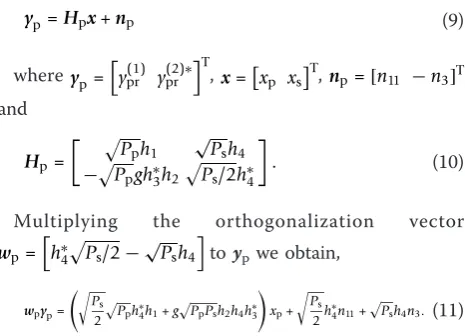
Multiplying the orthogonalization vector
wp=
It is clear that the secondary signal xs has been
completely removed. Thus, the signal received at PR experiences no interference from the secondary transmission. The channel estimate h4 required at PR for the orthogonalization vector wp can be obtained from the pilot-aided channel estimation procedures detailed later in Sect. III.C. The instantaneous received SNR at PR after the two-phase transmission is given by
The average received SNR at PR for the primary trans-mission can be derived as
SNRp= E[SNRp]
Average received SNR of secondary system with OSSS 1) Phase 1:In the 1st transmission phase, the signal received at SR isy(1)
sr which is given in (4).
2) Phase 2: The signal received at SR in the 2nd phase is
y(2)sr =hszs+n22 (14)
where hs=
h5 h6
and n22∼CN(0, σ2) is the AWGN. Substituting (6) into (14) and taking the com-plex conjugate, we obtain
y(2)sr ∗=
Ps
2h ∗ 6xs−g
Pph∗5h2xp−n4. (15) wheren4=gh∗5n13−n∗22. Thus, the signal at SR after the two-phase transmission can be written as
ys=Hsx+ns (16) whereys=y(1)sr y(2)sr ∗
T
,ns =[n12 −n4]Tand
Hs=
Pph7 √Psh6
−Ppgh∗5h2
Ps/2h∗6
. (17)
Multiplying ys with an orthogonalization vector
ws=
Ppgh∗5h2Pph7
, we obtain,
wsys=
Ps
2
Pph∗6h7+g
PpPsh6h∗5h2
xs+g
Pph∗5h2n12−
Pph7n4. (18)
It is clear from (18) that the primary signalxphas been completely removed. Therefore, SR does not experience any interference from the primary transmission. The channel estimate h7 andh∗5h2required at SR for the orthogonalization vectorwscan be obtained from the pilot-aided channel estimation procedures detailed in Sect. III.C. The instantaneous received SNR at SR after the two-phase transmission can be obtained as
SNRs=
h∗6Ps/2Pph7+gPpPsh6h∗5h2 2
EgPph∗5h2n12−
Pph7n4 2
= Ps
γ6γ7+ 2g2γ6γ5γ2+ 2√2gRe(h 2h∗5h7)γ6
(g2γ5γ2+g2γ5γ7+γ7)2σ2 . (19)
The average received SNR at SR, SNRsis intractable and we will analyze it numerically.
Channel estimation and other requirements
For the various transmitting and receiving terminals in OSSS, we assume that channel estimation can be done through the pilot symbols in the control frames (CRTS, CCTS, and CCTH) and data frames originating from PT
and ST. With the help of pilot symbols in the CRTS
frame, SR is able to estimate h7. Similarly,h4 can be obtained by PR by making use of the pilot symbols in CCTH. The product channel for PT-ST(1)-SR (the relay channel from PT to SR), i.e., h2h∗5can be estimated at SR in the 2nd phase from PT’s pilot symbols since ST (1) is an AF relay [34]. The multiplication of the ortho-gonalization vector at PR is similar to STBC decoding and thus we presume that the primary system supports STBC. Moreover, the flag indicating the switch from conventional decoding to STBC decoding at PR can be incorporated in CCTH.
Average received SNR for AF with superposition coding
In this section we discuss and derive the average SNR for AF-SC protocol. The control signalling involved is exactly the same as OSSS which is given in Section IIB.
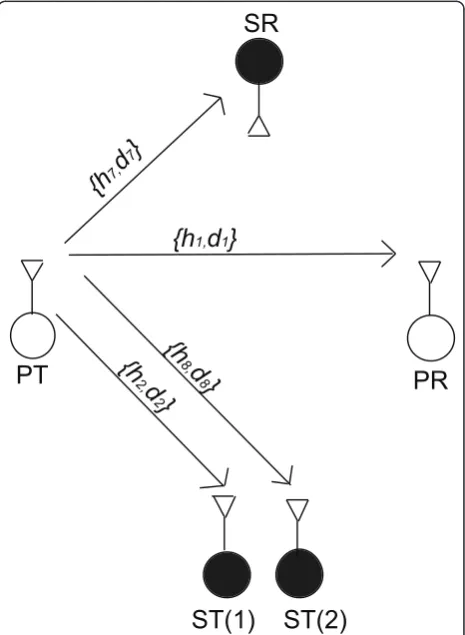
Average received SNR of primary system with AF-SC 1) Phase 1:The system model for the 1st transmis-sion phase of AF-SC is shown in Figure 3. In this phase, both ST(1) and ST(2) overhears the signal
transmitted from PT5. The channel coefficient
PT
PR
SR
{h1,d1}
{h
2,d
2
}
{h
7,d
7
}
{h
8,d
8
}
between PT-ST(2) is denoted by h8 where
st are the signal
received by ST(1) and ST(2), respectively, andh11, h2, h8,h14are the AWGN with variance s2at the respec-tive receivers. ST will then select the received signal
with a higher received power, i.e.,
s(τopt)
As a result, selection diversity is achieved at STin the 1st phase. After performing selection,STnormalizes the received primary signal based on its power constraint and further amplifies it with the power allocation factor
a where 0 ≤ a ≤ 1. The remaining power (1 - a) is
assigned to the secondary signal. Thus, the signal vector regenerated fromSTcan be written as
vst=Vxaf (24)
is the transmit vector fromST,
and v(1)st , v (2)
st are the signals from ST(1) and ST(2),
respectively,6
and the power normalization factor is
given byκ=
Ps
(Ppγτopt+σ2)
.
2) Phase 2: The system model for the 2nd transmis-sion phase of AF-SC is the same as OSSS as shown in Figure 2. In this phase, the signal received by PR is given by AWGN. After substituting (24) in (26) we obtain,
s(2)pr =
Unlike OSSS, s(2)pr also contains interference from the secondary signal. This interference limits the achievable performance of primary system in AF-SC. The signals
s(1)pr and s(2)pr are then combined at PR using MRC for decoding ofxp. The SNR after MRC is given by
SNRAFP −SC= Ppγ1 AF-SC is intractable and we will analyze it numerically.
Average received SNR of secondary system with AF-SC 1) Phase 1: The signal received at SR in the 1st transmission phase is given by
s(1)sr =
Pph7xp+η13 (29) whereη13∼CN(0, σ2)is the AWGN. At SR, an esti-mate ofxpis obtained using (29) as
2) Phase 2: The signal received at SR in the 2nd transmission phase is
s(2)sr =hsafvst+η22 (31) where hsaf =h5h6
. and η22∼CN(0, σ2) is the AWGN. Substituting (24) in (31) we obtain
s(2)sr =
The estimatexpin (30) is used to cancel out the inter-ference component(Ppακhτopth5)xpfroms
SNRAFs −SC=
Ps(1−α)γ6γ7 ακ2(γ
τopt+γ7)γ5σ2+γ7σ2
. (34)
The average received SNR at SR,SNRAFs −SC is intract-able and we will analyze it numerically.
Simulation results and discussion
For ease of exposition, PT, SR, STand PR are assumed to be collinear and the distance between ST(1) and ST (2) is assumed to be much smaller than the distance between the other system nodes, thus d2 ≈d8, d3 ≈ d4 and d5 ≈ d6. The position of PT, SR, ST and PR are fixed to (0, 0), (0.25,0), (0.5,0) and (1,0), respectively, as shown in Figure 4. The path loss component is chosen to beν = 4. Thus all the radio links between PT, PR,ST and SR can be characterized by their respective posi-tions on the straight line.
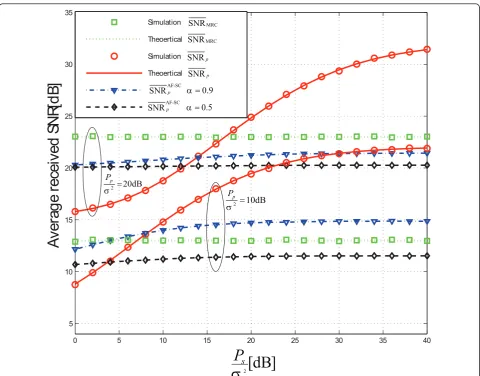
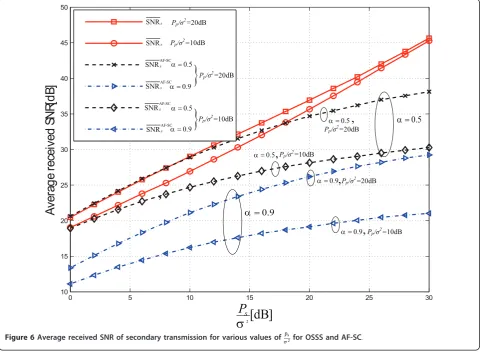
Figure 5 shows the average SNR performance of
primary system for OSSS, SNRpwith respect to Ps σ2 for different values of Pp
σ2. The corresponding plot for sec-ondary system,SNRs, is shown in Figure 6. For compari-son purposes, we have also plotted the results for
SNRMRCwhich is the average received SNR of primary system for direct transmission with ARQ. SNRMRCwill
be a useful benchmark for comparison as SNRMRC
shows the performance of primary system with retrans-mission in the absence of any secondary system. Good agreement between the simulation and theoretical results forSNRpandSNRMRCin Figure 5 validates the analytical results obtained in this article.
From Figures 5 and 6, it can be observed that the per-formance of primary as well as secondary system for
OSSS improves with an increase in Ps
σ2 for a given value of Pp
σ2. This proves that the secondary transmission does not interfere with the primary transmission; in fact it contributes to the performance of the primary transmis-sion. Moreover, it also shows that an increase in second-ary transmission powerPsbenefits both the primary as well as secondary systems. Another observation that can be made from Figure 5 is that when the primary system is interested in improving its QoS (e.g.,SNRT>13dBat
Pp
σ2 = 20dB or SNRT>23dB at
Pp
σ2 = 20dB), it can always request the help ofST to improve its QoS while at the same time allowing spectrum access by the sec-ondary system. QoS improvement of up to 8dB can be achieved by the primary system in the case of OSSS
with respect to SNRMRC at
Ps
σ2 = 40dB for both
Pp
σ2 = 10dBand
Pp
σ2 = 20dB. From Figure 5, we can also conclude that if QoS requirement for the primary
sys-tem is set too high (e.g., SNRT>22dBat
Pp
σ2 = 10dB),
SNRp<SNRT and secondary spectrum access is not possible. This limitation is due to the noise amplification at ST(1) in the AF relaying. Thus whenSNRT require-ment is reasonable, secondary system is always able to achieve spectrum access as long as it is willing to increase its transmit power such thatSNRTis met.
Figures 5 and 6, respectively, show SNRAFp −SC and
SNRAFS −SCfor AF-SC ata= 0.5 anda= 0.9. From the two figures it can be easily deduced that there is a trade-off between the performance of primary and secondary sys-tems, and the performance of one system is limited by the interference from the other system. As we increase the value ofa, the performance of primary system improves whereas the performance of secondary system deteriorates and vice versa. In AF-SC, the performance of primary system is limited by the interference from the secondary system as well as amplified noise in the 2nd phase. From
Figure 5, at Pp
σ2 = 20dBSNR AF−SC
p < SNRMRC for all
values of Ps
σ2even witha= 0.9. Thus there is no possibility of spectrum access for the secondary system in this case.
Furthermore, fora = 0.9 atPp
σ2 = 10dB, AF-SC achieves the closest possible performance to OSSS for the primary system, but OSSS outperforms AF-SC by a large margin for the secondary transmission as can be observed from Figure 6.
Conclusions
In this article, we proposed a two-phase OSSS based on cooperative amplify-and-forward relaying for a WSN (a.k.a secondary system) to achieve spectrum
SR (0.25,0)
PT (0,0)
ST (0.5,0)
PR (1,0)
access along with a primary system. We showed that by using the proposed scheme, the two systems can co-exist in the same frequency band without causing any interference to one another. Moreover, when the PT-PR link is weak, WSN can be used to enhance the QoS of the primary system. We further showed that in OSSS, WSN is always able to achieve spectrum access as long as it is willing to increase its transmit power such thatSNRTis met.
We analyzed the performance of OSSS by obtaining closed form expressions for the average SNR of the pri-mary system. In order to validate its efficiency, we also analyzed an interference limited scheme (AF-SC) and compared it with OSSS. Simulation results showed that performance of OSSS is always better than AF-SC for both the primary system and WSN.
Appendix A Derivation for average SNR of primary system with OSSS
From (12) and (13), we obtain
SNRp= Pp σ2E
γ1+ 2g2γ2γ3+ 2√2Re(h 2h∗3h1)g
(2g2γ3+ 3)
= Pp
σ2(δ1+δ2+δ3)
(35)
where δ1= E
γ
1 2g2γ3+ 3
, δ2= E
2g2γ2γ3
2g2γ 3+ 3
and
δ3= E
2√2gRe(h∗3h1h2)
2g2γ3+ 3
·δ1 can be evaluated as
δ1=
∞
0
∞
0
∞
0
γ1 2g2γ
3+ 3
pγ1(γ1)pγ2(γ2)pγ3(γ3)dγ1dγ2dγ3 (36)
0 5 10 15 20 25 30 35 40
5 10 15 20 25 30 35
Simulation
Theoertical
Simulation
Theoertical SNRp
AF-SC SNRp
AF-SC SNRp
SNRp
2 10dB
p P
σ =
2 20dB
p P
σ =
2
[dB]
s
P
σ
Av
er
ag
e r
ecei
ved
S
NR
[d
B]
0.5
α =
0.9
α =
MRC SNR
MRC SNR
Figure 5Average received SNR of primary transmission for various values of ps
σ2for OSSS, AF-SC, and direct transmission with ARQ.
where pγ1(γ1), pγ2(γ2)and pγ3(γ3)are the probability
density function (pdf) ofg1,g2and g3, respectively. Addi-tionally,γi∼ε(dνi),i= 1, 2, 3. Thus from (36),
Similarly, we can obtain
δ2=
Figure 6Average received SNR of secondary transmission for various values ofps
End notes 1
http://www.ntia.doc.gov/osmhome/allochrt.pdf. 2
It should be noted that whetherST is able to assist PT or not, is a probabilistic event due to the random fading channels.
3
However, in return for an opportunity to access the spectrum, there will be an increase in hardware com-plexity and cost.
4
Please note that ST(1) and ST(2) continuously update each other of the information that needs to be send to the SR. Thus, in the 1st phase, even if ST(1) receives the signalxsfrom ST(2), it hasa prioriknowledge ofxsso it can be cancelled out easily from the received signal at ST(1).
5
If there is only one ST node, then AF-SC reduces to the spectrum sharing scheme proposed in [35].
6
We may consider other choices such as
V=
Though not given in this article, simulation results show that theVwe used in (25) achieves the best perfor-mance among the three.
Abbreviations
AF-SC: AF with superposition coding; AWGN: additive white Gaussian noise; CBS: central base station; CCTS: cooperative clear-to-send; CCTH: cooperative clear-to-help; CRTS: cooperative right-to-send; CSI: channel state information; DSA: dynamic spectrum access; MRC: maximum ratio combining; MEMS: microelectro-mechanical systems; NTIA: National Telecommunications and Information Administrations; OSSS: Orthogonal Spectrum Sharing Scheme; PT: primary transmitter; PR: primary receiver; QoS: Quality of Service; SR: secondary receiver; STs: Secondary transmitters; SNR: signal to noise ratio; STBC: space time block code; WSNs: wireless sensor networks.
Acknowledgements
This work is supported by the Singapore Ministry of Education Academic Research Fund Tier 2, MOE2009-T2-2-059.
Author details
1School of Electrical and Electronic Engineering, Nanyang Technological
University, Singapore, 639801 Singapore2Philips Research, High Tech
Campus, 5656AE Eindhoven, The Netherlands
Competing interests
The authors declare that they have no competing interests.
Received: 23 December 2010 Accepted: 10 June 2011 Published: 10 June 2011
References
1. R Frank,Understanding Smart Sensors (Artech House, Norwood, MA, 2000) 2. IF Akyildiz, W Su, Y Sankarasubramaniam, E Cayirci, Wireless sensor
networks: a survey. Int J Comput Telecommun Netw.38(4), 393–422 (2002) 3. FL Lewis, Wireless sensor networks, inSmart Environments: Technology,
Protocols, and Applications, ed. by Cook DJ, Das SK (Wiley, New York, 2004) 4. A Kansal, M Srivastava, Energy-harvesting-aware power management, in
Wireless Sensor Networks, ed. by Bulusu N, Jha S (Artech House, Norwood, MA, 2005)
5. I Demirkol, C Ersoy, F Alagoz, MAC protocols for wireless sensor networks. IEEE Commun Mag.44(4), 115–121 (2006)
6. G Zhou, JA Stankovic, S Son, Crowded spectrum in wireless sensor networks, inProceedings of IEEE EmNets, (2006)
7. Q Zhao, L Tong, A Swami, Decentralized cognitive MAC for opportunistic spectrum access in ad hoc networks: a POMDP framework. IEEE J Select Areas Commun.25, 224–232 (2007)
8. Federal Communications Commission, Spectrum policy task force, Rep. ET Docket no. 02-135, Nov 2002
9. Q Zhao, BM Sadler, A survey of dynamic spectrum access: signal processing, networking, and regulatory policy. IEEE Signal Process Mag.24(3), 79–89 (2007)
10. IF Akyildiz, W-Y Lee, MC Vuran, S Mohanty, Next generation/dynamic spectrum access/cognitive radio wireless networks: a survey. Comput Netw.
50(13), 2127–2159 (2006)
11. Y Xing, R Chandramouli, S Mangold, S Shankar, Dynamic spectrum access in open spectrum wireless networks. IEEE J Select Areas Commun.24(3), 626–637 (2006)
12. A Goldsmith, SA Jafar, I Maric, S Srinivasa, Breaking spectrum gridlock with cognitive radios: an information theoretic perspective. inProceedings of IEEE.
97, 894–914 (2009)
13. Y Han, SH Ting, A Pandharipande, Cooperative decode-and-forward relaying for secondary spectrum access. IEEE Trans Wireless Commun.8(10), 4945–4950 (2009)
14. Q Li, SH Ting, A Pandharipande, Y Han, Cognitive spectrum sharing with two-way relaying systems. IEEE Trans Veh Technol.60(3), 1233–1240 (2011) 15. S Sriram, S Vishwanath, On the capacity of a class of MIMO cognitive radios.
IEEE J Select Top Signal Process.2(1), 103–117 (2008)
16. S Sriram, S Vishwanath, S Jafar, S Shamai, On the capacity of cognitive relay assisted Gaussian interference channel, inProceedings of 2008 International Symposium On Information Theory, Toronto, Canada, July 2008
17. ECVD Meulen Three-terminal communication channels. Adv Appl Prob.3, 120–154 (1971)
18. JN Laneman, DNC Tse, GW Wornell, Cooperative diversity in wireless networks: efficient protocols and outage behavior. IEEE Trans Inform Theory.
50, 3062–3080 (2004)
19. G Kramer, M Gastpar, P Gupta, Cooperative strategies and capacity theorems for relay networks. IEEE Trans Inform Theory,51, 3037–3063 (2005)
20. VA Bohara, SH Ting, Preliminary measurement results for cognitive spectrum sharing based on cooperative relaying. inProceedings of International International conference on wireless communication and signal processing, Suzhou, China, Oct. 2010.
21. H Wicaksana, SH Ting, CK Ho, WH Chin, YL Guan, AF two-path half duplex relaying with inter-relay self interference cancellation: diversity analysis and its improvement. IEEE Trans Wireless Commun.8(9), 4720–4729 (2009) 22. C Fischione, K Johansson, F Graziosi, F Santucci, Distributed cooperative
processing and control over wireless sensor networks. inProceedings of the International Conference on Communications and Mobile Computing, 1311–1316 (2007)
23. H Yang, HY Shen, B Sikdar, A MAC protocol for cooperative MIMO transmissions in sensor networks. inProceedings of IEEE Global Communications Conference, Exhibition and Industry Forum, Washington, USA, 636–640 (2007)
24. P Liu, Z Tao, S Narayanan, T Korakis, SS Panwar, CoopMAC: a cooperative MAC for wireless LANs. IEEE J Select Areas Commun.25(2), 340–354 (2007) 25. A Bletsas, A Khisti, DP Reed, A Lippman, A simple cooperative diversity
method based on network path selection. IEEE J Select Areas Commun.
24(3), 659–672 (2006)
26. A Sharma, V Gelara, S Singh, T Korakis, P Liu, S Panwar, Implementation of a cooperative MAC protocol using a software defined radio platform. in
Proceedings of IEEE LANMAN, Cluj-Napoca, Romania, Sept. 2008 27. S Valentin, HS Lichte, H Karl, S Simoens, G Vivier, J Vidal, A Agustin,
Implementing cooperative wireless networks. inCognitive Wireless Networks, ed. by Fitzek FHP, Katz MD (Netherlands, Springer, 2007), pp. 155–178 28. Y Han, SH Ting, A Pandharipande, Cooperative spectrum sharing protocol
with secondary user selection. IEEE Trans Wireless Commun.9(9), 2914–2923 (2010)
30. V Tarokh, H Jafarkhani, AR Calderbank, Space-time block coding for wireless communications: performance results. IEEE J Select Areas Commun.17(3), 451–460 (1999)
31. Q Li, XL Lin, J Zhang, W Roh, Advancement of MIMO technology in WiMAX: from IEEE 802.16d/e/j to 802.16m. IEEE Commun Mag.47(6), 100–107 (2009) 32. Y Li, Pilot-symbol-aided channel estimation for OFDM in wireless systems.
IEEE Trans Veh Technol.49(4), 1207–1215 (2000)
33. L Tong, BM Sadler, M Dong, Pilot-assisted wireless transmissions: General model, design criteria, and signal processing. IEEE Signal Process Mag.21, 12–25 (2004)
34. CS Patel, GL Stuber, Channel estimation for amplify and forward relay based cooperation diversity systems. IEEE Trans Wireless Commun.6(6), 2346–2356 (2007)
35. Y Han, A Pandharipande, SH Ting, Cooperative spectrum sharing via controlled amplify-and-forward relaying. inProceedings of IEEE International Symposium on PIMRC, Cannes, France, Sept 2008
36. M Dottling, B Raaf, J Michel, Efficient channel quality feedback schemes for adaptive modulation and coding of packet data. inProceedings of IEEE Vehicular Technology Conference, Los Angeles, Sept. 2004
doi:10.1186/1687-1499-2011-10
Cite this article as:Boharaet al.:An orthogonal spectrum sharing scheme for wireless sensor networks.EURASIP Journal on Wireless Communications and Networking20112011:10.
Submit your manuscript to a
journal and benefi t from:
7Convenient online submission 7Rigorous peer review
7Immediate publication on acceptance 7Open access: articles freely available online 7High visibility within the fi eld
7Retaining the copyright to your article