R E S E A R C H
Open Access
An efficient multi-level clustering approach for a
heterogeneous wireless sensor network using link
correlation
Nalamani G Praveena
1*and Helen Prabha
2Abstract
The key issue in determining the lifetime of wireless sensor network (WSN) is the energy burning up of individual node. The cluster based routing improves the energy usage of WSN compared to other routing approach. In this paper, an effective multi-level cluster algorithm using link correlation is proposed for heterogeneous WSN. The level-k hierarchy with single-hop communication between nodes within a cluster is achieved using link correlation. The heterogeneous nodes are adopted as level-k cluster heads and implementing network coding on those nodes increases network lifetime significantly. Meanwhile, implementing time division multiple access (TDMA) technique within a cluster creates an organized cluster architecture improving the energy efficiency.
Keywords:Wireless sensor network (WSN); Link correlation; Network coding; TDMA
1 Introduction
The WSN is widely applied for smart environments such as battlefield surveillance, smart living, environmental monitoring, transportation and traffic monitoring [1]. Due to the recent technology advancement, the sensor nodes are available in a very low cost [2,3]. In WSN, these low-cost sensor nodes are deployed in large numbers either regularly or randomly. Each sensor node consists of a data acquisition module (sensors), data processing module and transmission module (radio transceivers) [1]. Once the network becomes active, the sensor node keeps on sensing the data and transmits it to a base station. The limited energy of sensor nodes is the major constraint in WSN [4]. The inefficient energy usage will drain the battery power faster and make the node die quickly affecting the network lifetime. In WSN, data transmis-sion consumes more energy compared to sensing and data processing [5]. The energy usage of overall network can be improved by reducing the amount of data traffic. The WSN is classified into two types, namely homoge-neous and heterogehomoge-neous networks [6]. In homogehomoge-neous networks, the sensor nodes deployed are ideal in terms of energy and hardware functionalities. In heterogeneous
networks, a certain number of nodes are deployed with more energy and additional processing capabilities to en-hance the network lifetime. Since the additional battery cost is very low compared to the sensor cost, adapting the heterogeneous network does not create a huge impact on overall WSN cost.
In WSN, the nodes surrounding the sink will die quickly, due to heavy traffic flow around the sink [7]. This region is referred as bottleneck zone. To overcome this drawback, network coding will be included in those nodes, which reduces the amount of traffic using the same bandwidth. Compared to other types of routing protocols, hierarchy-based routing protocols provide better energy consumption. In hierarchy-based routing protocol, clustering algorithm is considered as the effect-ive routing protocol [8-10]. There are many clustering-based approaches that have been evolved so far. LEACH [11] and PEGASIS [12] are some of the clustering proto-cols for homogeneous networks. SEP [13] and DEEC [14] are some examples of heterogeneous networks. The SEP protocol is effective for a two-level clustering approach whereas the DEEC is more suitable for a multi-level clus-tering hierarchy. The communications within a cluster is either single-hop or multi-hop, depending upon the appli-cation need. In a single-hop communiappli-cation, the data of a node is forwarded only to a single neighbor avoiding * Correspondence:[email protected]
1RMK College of Engineering and Technology, Tamil Nadu 601206, India
Full list of author information is available at the end of the article
redundant data transmission in the network. In a single-hop network, reliability is decreased, but the energy consump-tion is improved. In case of a multi-hop communicaconsump-tion, the node transmits data to all the neighboring nodes pro-viding higher reliability at the cost of energy [15].
In this paper, a clustering approach with a single-hop communication based upon link correlation is adopted. The heterogeneous nodes are employed along the bottleneck zone. These nodes act as a cluster head which communicate with the base station. The leaf nodes are randomly employed. At a regular interval, clusters are formed with leaf nodes and heterogeneous nodes. In this paper, section 2 deals with related work such as LEACH, SEP and DEEC in various aspects. Section 3 mainly focuses on the proposed cluster algorithm and dis-cusses the proposed algorithm in terms of its functionality and energy model. Section 4 discusses the performance of the proposed algorithm with LEACH, SEP and DEEC.
2 Reference works
The LEACH [11] is an adaptive clustering algorithm which works well for homogeneous networks. In LEACH, the cluster head selection is based upon a desired percentage of cluster heads and the number of times it has been a cluster head so far. Each node will be given an equal chance to become a cluster head (CH) once every 1/Prounds.‘P’is the desired percent-age of cluster heads based on our priority, and it is given byk/N. Ndenotes the total number of nodes in the network and k represents the expected number of CHs for this round.‘G’is the set of nodes that have not been CHs in the last 1/P rounds. The threshold value for a node to become a CH in the current round‘r’is given by T(x). For a node ‘x’ to become a CH, it chooses a random number between 0 and 1. If the number is less than the threshold value, it becomes the CH for that round.
At the first round, each node has a probability ofPto become a CH. The node selected as CH in the first round cannot get a chance for a cluster head in the next 1/P rounds, but the probability for remaining nodes to become CHs has been increased. After (1/P–1) rounds, the nodes that have not yet been CHs so far were given a chance to become CHs. Once 1/P rounds were over, again all nodes will be given an equal chance to become CHs. The LEACH is not suitable for heterogeneous networks. SEP [6,13] works well for heterogeneous networks, as it considers the initial energy of nodes
compared to other nodes in the network for choosing the CH. SEP improves the network stability. In a two-level heterogeneous network model, the initial energy of net-work depends upon normal nodes and advance nodes (heterogeneous nodes). Therefore, the total initial energy
Etotalof a two-level heterogeneous network is given by
Etotal ¼EnrmþEadv ð2Þ
Here,Enrm andEadvare the initial energy of all normal and advance nodes, respectively. LetNbe the total num-ber of sensor nodes in the network. There are‘m’fractions of advance nodes and (1–m) fractions of normal nodes. The advance node has‘a’times more energy than normal nodes. Then the total energy can be expanded as in (3),
Etotal¼Nð1−mÞE0þNmE0ð1þaÞ ¼NE0ð1þamÞ; ð3Þ
where, E0is the initial energy of the individual normal node. The total energy of the system is increased by (1+ am). In SEP, the probability of choosing the ad-vance nodes to become a CH is higher than the nor-mal nodes. LetPnrmbe the probability that a normal node to become a CH, andPadvis the probability that advance nodes to become a CH, which is (1 +a) times the normal
In Equations 4 and 5, Popt is the optimal probability that a node to be a cluster head based on optimal con-struction of clusters given by
Popt¼kopt
wherekoptis the optimal number of clusters,dtoBSis the distance between a CH to the base station in an M × M square region.
energy used to estimate the network lifetime andEi(r) is the residual energy of the node‘xi’
E rð Þ ¼ 1
N
XN
i¼1E rð Þ ð9Þ
Piis the average probability for node ‘xi’ to become a CH and Popt is the optimal probability of the network. For a node with more energy, Pi is higher than Popt. In normal homogeneous networks,Poptis used as a reference forPi, as all nodes have an equal amount of energy. By using Ē(r) as a reference energy, the value of Pi is
The heterogeneous network contains both normal and advance with different energy levels. The average probabil-ityPifor normal and advance nodes is given by
Pi¼
Based on these assumptions, for multi-level hetero-geneous networks, the probability P(xi) of a node xito become a CH is expanded as
P xð Þ ¼i PoptN
1þai
ð Þ
NþXni¼1ai
ð12Þ
Let xi represent an additional energy factor for the nodes at ith level of heterogeneous networks. In multi-level heterogeneous networks, the hierarchy multi-levels are formed based on the energy of the nodes, such that nodes in the same level have an approximately equal amount of energy. The nodes in a higher level will have more energy than lower level nodes.
3 A proposed cluster algorithm
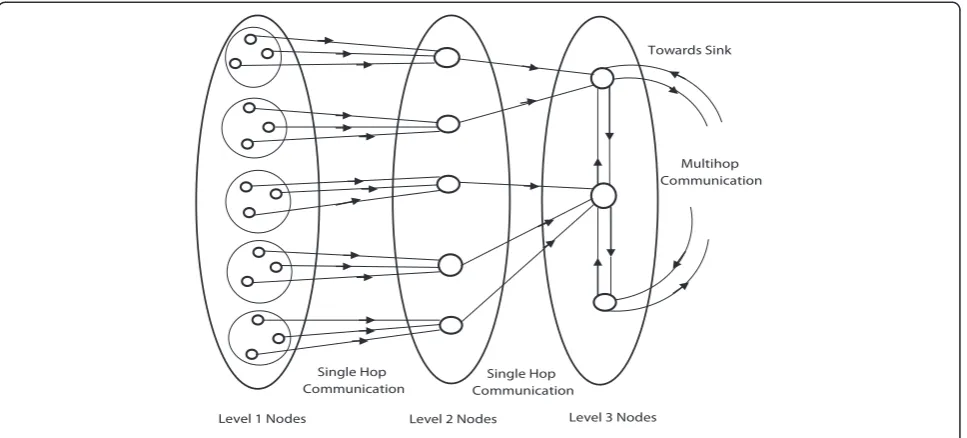
In this proposal, using link correlation [16,17], a level-k cluster hierarchy (i.e. multi-level) is formed with a single-hop communication. The level-k clusters are the higher level in the hierarchy with {k-1, k-2,–2} denoting the hierarchy of sub-clusters in the subsequent level. The nodes in each level will act as cluster heads for its corresponding sub-level nodes and level-1 nodes act as leaf nodes. The energy level should be considered while forming a cluster hierarchy, such that nodes of a higher hierarchy level have more energy than lower level nodes. Each node in the network is connected in a single-hop communication to its corresponding cluster head in the above hierarchy level using link correlation, whereas in
level-k hierarchy multi-hop communication is adopted between cluster heads. The level-k cluster heads form the bottleneck zone of the sink which has heavy traffic flow. This results in faster depletion of its energy reducing the network life time. To overcome it, the heterogeneous nodes are adopted as level-k cluster head, since it have more energy compared to normal nodes. After establish-ing a level-k cluster hierarchy usestablish-ing link correlation as described in section 3.1, the level-k cluster head forms a TDMA time slot for its corresponding a level-(k-1) cluster head, while the level-(k-1) cluster head forms a TDMA time slot for a level-(k-2) cluster head and it is followed for all the sub-clusters. The TDMA time slot adopted between cluster heads in subsequent levels of hierarchy helps to remove the data collision and cutback the data aggregation (DA) time.
If the CH at each level randomly transmits to its next-level CH, then data loss will occur due to colli-sion. For avoiding data collision, the CH at each level communicates with the corresponding next-level CH only in its allocated TDMA time slot. Other than the level-k CH, most of the CH incorporates DA to reduce the amount of data for transmission if needed. Data aggregation [18-20] is a suppression technique for removing redundant data that are created due to large deployment of sensor nodes. Since DA is a time-consuming process, the data collection and aggregation are always performed other than its own TDMA time slot with suc-cessive cluster heads. For a level-k hierarchy, the data packets are transmitted in a multi-hop communication between cluster heads to reach the base station. This multipath forwarding between cluster heads increases the network traffic. A random linear (RL) [21-23] network coding used in level-k cluster heads reduces the data traf-fic amount, thus increasing the network lifetime.
network coding and forwards it to the sink. Due to a multi-hop link between level-3 CHs, the data is forwarded in multiple paths to the sink increasing the network traffic. Network coding overcomes this drawback and provides reliable transmission to the sink.
3.1 Link correlation model
In the cluster formation process, a single-hop communi-cation is formed between all levels of clusters, based upon link correlation [16]. The key factor in shaping the link correlation is packet reception rate (PRR) [24,25] which are determined using conditional packet reception probability (CPRP). Initially, each node uses link correl-ation to choose its cluster head at the next hierarchy level. The nodes will transmit a sequence of ‘hello’messages to the next-level nodes in short-time duration.‘t’is the num-ber of messages transmitted. The hello messages consist of a sender ID and packet number. The next-level nodes store the hello messages in a separate bitmap format from all possible nodes of a sub-hierarchy level. The bitmap for-mats consist of 1 s and 0 s for the message reception sta-tus as success and failure arranged upon the packet number. After receiving ‘t’ hello messages, the next-level
nodes will transmit its bitmap as a packet in the form of node ID, sender ID, and bitmap. The nodes will receive the packet sent from next-level nodes when sender ID in the bitmap packet matches with it, for finding the link cor-relation using CPRP. The nodes choose its cluster head in the next hierarchy level that is having high link correlation with it. By using this link correlation technique, hierarch-ies of clusters are formed up to level-k. After establishing a cluster hierarchy, the stored bitmap is cleared to save memory.
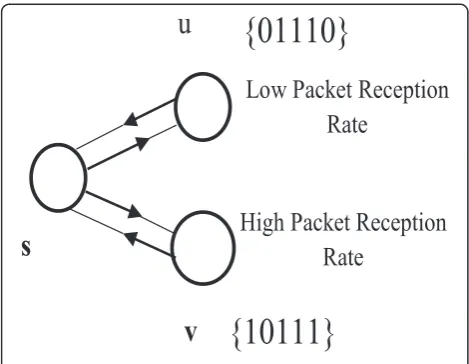
Figure 3 shows a link correlation model; here the link correlation is measured between a node in a sub-hierarchy level and two nodes in next hierarchy level. Lets be the nodes in sub-hierarchy levels which act as a sender, and
uand v are the next-level nodes which act as receivers. The sender s transmits five hello messages for short-time duration (i.e.t=5).Xudenotes the bitmap {01110} in receiver u for sender s, and Xv denotes the bitmap {10111} in receivervfor senders.P u
v
andP v u
are the CPRP foruandv, respectively.
Xuv¼ Xt
i¼1xu½ i xv½ i ð13Þ
Single Hop Communication
Level 1 Nodes Level 2 Nodes Level 3 Nodes
Towards Sink
Multihop Communication
Single Hop Communication
Figure 1Cluster architecture.
1 2 3 … Nlevel-2 1 2 3 … Nlevel-2 1 …
Xu¼
Xuv specifies the number of packets received in both receivers. xu[i] and xv[i] represent an ith bitmap entry. By using these CPRP of two receivers, the PRR for receiver
uandvare calculated as
PRRu¼1−P v
u ð18Þ
PRRv¼1−P u
v ð19Þ
The receiver having a higher packet reception rate is considered as a node having more link correlations which is selected as its cluster head in the next hierarchy level.
In order to find link correlation for more number of next-level nodes, the previous link correlation procedure is extended, since the nodes that are possible to receive the ‘hello’ messages can be considered for finding the link correlation. The computational complexity is in-creased, as the link correlation process using two nodes is calculated for all combinations of nodes for finding the highly correlated node. It is overcome by avoiding the nodes having a low packet reception ratio to enter the link correlation calculation using an optimum threshold level. The threshold level is kept at (t-2), such that the nodes having a packet reception greater than this threshold level is selected. The
selected nodes are further restricted by only choosing the higher common packet reception nodes for link correlation calculation. Let {r1, r2, …rm} represent the ‘m’ number of nodes selected for finding link correl-ation whose packet reception is greater than threshold level. In order to find link correlation for‘m’nodes, the nodes having a high common packet reception from all node combinations are found using Equation 20. Then for those nodes, the link correlation is calculated using Equation 14 to Equation 19. This helps to reduce the complexity involved in finding link correlation for ‘m’ number of nodes.
Network coding is a technique used for removing re-dundant data transmission in a network. When packets are moved from a cluster to sink, due to a multi-hop communication among CH, redundant data will be experienced between clusters. In this proposal, an RL [21] network coding is used in all level-3 CHs to remove the redundant data transmission by discarding the previously forwarded packets from transmission. When a node receives the coded packet, it first checks the buffer; if received packet is not independent, it discards the packet. Otherwise, the network coding will code the packets with other packets in the node to generate some linear combinations with the coded packets. The level-3 CH performs RL network coding for the packets in buffer to generate ‘b’ linear combinations of coded data. The coded packets of random linear coding is given as
p′i ¼ Xb
i¼0cipi ð21Þ
where ci is the co-efficient over a finite field used for coding, pi is the original packet and pi′ is the coded packet.
The coded packets are transmitted along with the co-efficient. To retrieve the original data, the sink will perform a decoding process after it receives the coded packet. The decoding is performed using the formula
pi¼
In WSN, the overall energy consumption of the network will depend on the energy consumed by individual node [11]. In each node, the power consumed during processing is negligible when compared to the transmission power [26]. Thus, reducing the redundant bits transmitted leads to an efficient network in terms of energy. The energy
s
dissipation model of the proposed cluster architecture is discussed here. Figure 4 shows the general Radio Energy Dissipation model [11] of a single sensor node. During transmission, the energy dissipated by the transmitter due to propagation loss is proportional to the distance between a transmitter and receiver dn. ‘n’is path loss exponent given by
n¼ 24 for multipath interferencefor free space
In a direct communication between all sensor nodes and sink, the distance between them is large and it includes a multipath interference, so the propagation loss is proportional tod4(i.e.d≥d0). Whereas, in other cases such as multipath routing, the distance between the nodes and the sink is less, thus the propagation loss is propor-tional tod2(i.e. d<d0). Based on those assumptions, the energy consumption for a transmitter and receiver to transmit‘l’bit message [2] is modeled as
ETxðl;dÞ ¼ lEelecþlεfsd
Let ht and hr represent a transmitter and receiver antenna height with a value of 1.5 m.‘λ’represents the signal wavelength having a value of 0.325 m. Eelec repre-sents energy for transmitter electronics to transmit a bit and it is the same for the receiver also.εfsandεmpare the transmitter amplifier energy based on the amplifier chosen. In the level-k cluster hierarchy, the node at each level is allowed to communicate only with next-level nodes. The level-k CH uses a multi-hop communication for transmitting the data packets towards the sink. In both these cases, the transmission path uses only a less distance (i.e.d<d0). Thus in the proposed cluster algo-rithm, the path loss exponent for the transmission and transmitter amplifier energy is assumed to ben =2 and
εfs, respectively. In this model, a level-3 cluster hierarchy for a heterogeneous network is assumed. To transmit an
‘l’ bit message, the energy consumption of a cluster is given byEcluster
Ecluster¼ðn1=k1ÞEnonCHþðn2=k2ÞECH1þECH2 ð25Þ
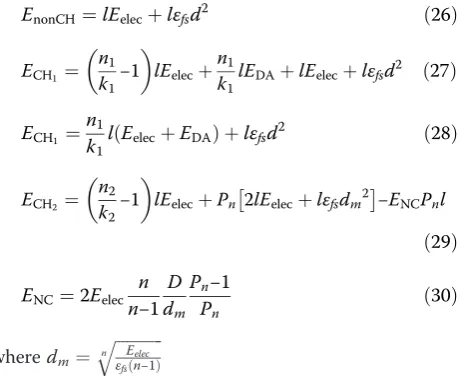
In (25), the energy consumption of level-1 to level-3 nodes is given by,EnonCH,ECH1andECH2, respectively.
Here,n1is number of nodes in a cluster,n2is number of nodes in a network, k1 is number of a sub-cluster in the cluster andk2is number of a cluster in the network.
Thus as level-1 nodes only transmit its data, the energy consumption for those nodes include the transmitter alone. The level-2 CHs receive the data from level-1 nodes, perform data aggregation and transmit its data to level-3 cluster heads. For level-2 nodes, the energy consumption includes all those operation. EDA gives the energy of data aggregation. The energy consump-tion of level-3 cluster heads is derived by considering a multi-hop communication between cluster heads and energy saved by network coding. Since the network coding process dissipates negligible energy, it is not in-cluded [27]. ENC represents the energy saved by using network coding.
wherePnis the number of packets that are coded into a single packet due to network coding, D is the approxi-mate bottleneck radius anddmis optimal hop length.
Transmitter
4 Performance evaluation metrics
For evaluating the performance of WSN, the following metrics are considered. They are network lifetime, mes-sage packet delivered to sink and stability for a cluster.
4.1 Simulation results
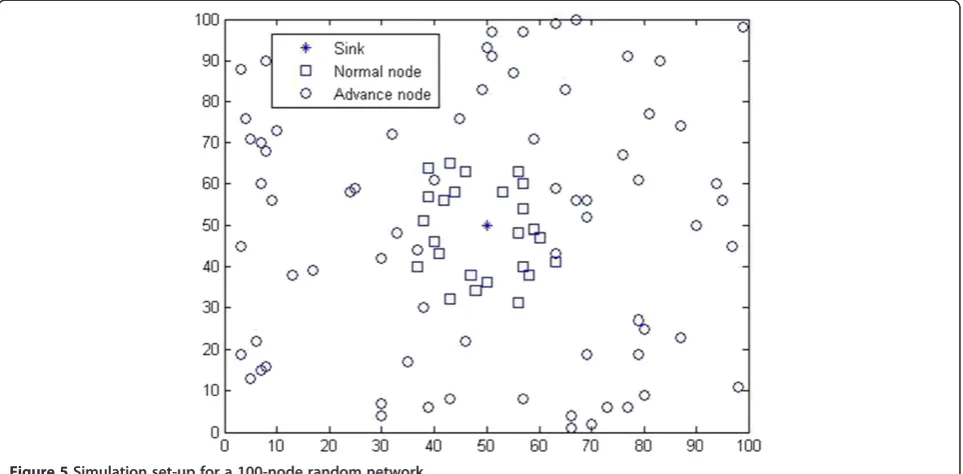
The performance of the proposed heterogeneous network model is evaluated using MATLAB. In this network model, 100 nodes are deployed in 100 × 100 m region. For modeling the network, the radio characteristic parameters are given in Table 1. The initial energy distribution for heterogeneous nodes is assumed to be five times (i.e.
a =4) of the normal node. The heterogeneous node
distribution is given by a factor of m =0.3 in total nodes of a network. The heterogeneous nodes are mostly distributed around the bottleneck zone. Figure 5 shows the simulation environment of the 100-node random network.
The proposed cluster algorithm is compared with SEP, LEACH and DEEC for performance evaluation. To obtain the performance improvement of the proposed algorithm upon the inclusion of a link correlation technique, TDMA
and network coding, it is compared in particularly with DEEC. The LEACH and SEP are level-2 hierarchy clusters in nature where as DEEC is a multi-level hierarchy cluster type. Since the proposed cluster architecture is of a multi-level hierarchy cluster type, here a multi-level-3 hierarchy cluster is adopted for comparison. The LEACH and SEP are ex-tended to a multi-level cluster for effective comparison. The DEEC clustering algorithm works similarly to that of the proposed clustering algorithm. The former algorithm organizes the cluster based on the energy level of nodes; while the latter follows the former algorithm. In addition to that, it also considers link correlation, TDMA and network coding. By comparing both algorithms, the performance improvement achieved due to link correl-ation and network coding is obtained. In DEEC, a multi-hop communication is established at all levels of cluster hierarchy, such that there will be more redundant data transmission which affects the network lifetime and stabil-ity. Further, due to a lack of co-ordinance between the nodes of a cluster, there will be more occurrences of data collision affecting the message delivered to the sink.
The proposed clustering algorithm overcomes those drawbacks by adopting a single-hop communication using link correlation within the clusters along TDMA and network coding at higher level CHs. The single-hop communication using link correlation along with TDMA provides organized cluster architecture with co-ordinance at all levels. This avoids the data collision increasing the message delivery to the sink and increase the network lifetime by removing redundant data trans-mission. Since the proposed algorithm employs a multi-hop communication between level-k CHs, implementing Table 1 Parameter of the radio model
Parameter Value
Eelec 50 nJ/bit
εfs 10 pJ/bit/m
2
εmp 0.0013 pJ/bit/m4
EDA(for data aggregation) 5 nJ/bit/signal
Message size 4,000 bits
network coding in it reduces the data traffic and maintain reliability of a network. This helps to increase the network lifetime and stability by reducing the energy depletion of nodes around the bottleneck zone. The detailed perform-ance analysis of the proposed algorithm with DEEC, SEP and LEACH is clearly explained below.
In this model, for most of the cases, the heterogeneous nodes are selected as cluster heads. The energy con-sumption task such as network coding, multi-hop
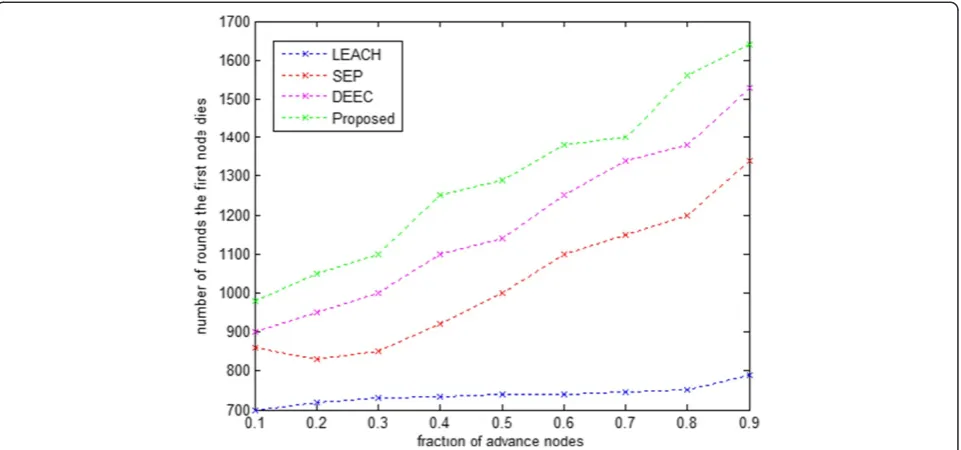
communication and data reception from all sub-clusters is performed by a level-3 cluster head. Thus the stability of network is increased a lot. The stable region of a proposed cluster architecture is determined by varying the fraction of advance nodes m from (0.1 to 0.9)
as-suming a =2 and a =4. For both cases, the LEACH
does not show any difference.
Figures 6 and 7 show the comparison of a stable region of a proposed cluster architecture with other heterogeneous Figure 6Comparison of stability for proposed cluster architecture over LEECH, SEP and DEEC (a=2).Comparison of stability for proposed cluster architecture over LEECH, SEP and DEEC with variation of number of advance nodes (assumptiona=2).
networks. The stable region of SEP and LEACH has a less number of rounds compared to other heterogeneous network.
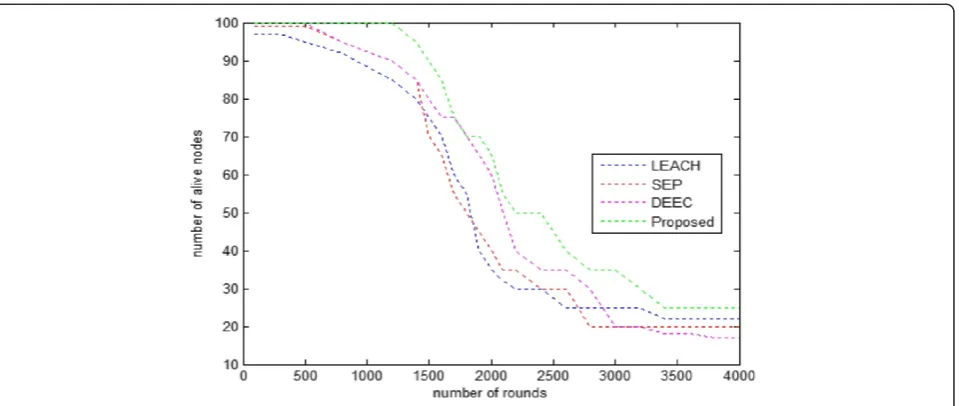
The proposed cluster protocol achieves a 26% and 10% increase in number of rounds when the first node dies, compared to that of SEP and DEEC resulting in higher stability for a =4. Comparing to LEACH, the proposed cluster architecture achieves over a 70% increase in sta-bility for both values ofa. The proposed cluster protocol achieves a 12% increase in overall network lifetime com-pared to DEEC. The comparison of network lifetime is shown in Figure 8. Meanwhile, the network coding in level-3 cluster heads decreases the number of bits in a multi-hop communication and increases the reliability of
message delivery to the sink. Figure 9 shows the message delivered to the sink. Comparing to SEP and DEEC, we achieve 59% and 15% increases in message delivery to the sink, respectively.
5 Conclusions
The proposed cluster algorithm is more suitable for the multi-level heterogeneous networks. For efficient com-parison, the cluster level-k chosen in this architecture is 3. Compared to LEACH, SEP and DEEC, the proposed cluster architecture is remarkable in message delivery, stability and network lifetime. The proposed cluster archi-tecture is well organized by establishing a single-hop com-munication within the cluster using link correlation along Figure 8Comparison of network life time for proposed cluster architecture with LEECH, SEP and DEEC.
with the TDMA time slot. On the other hand, a multi-hop communication among cluster heads is well controlled by network coding. This cluster architecture works well for medium-sized WSN. Since the heterogeneous nodes are mostly chosen as cluster heads and by incorporating the energy consuming task on those nodes increase the energy efficiency of networks.
Competing interests
The authors declare that they have no competing interests.
Author details
1RMK College of Engineering and Technology, Tamil Nadu 601206, India. 2RMD Engineering College, Tamil Nadu 601206, India.
Received: 12 September 2014 Accepted: 26 September 2014 Published: 16 October 2014
References
1. IF Akyildiz, W Su, Y Sankara Subramaniam, E Cayirci, A survey on sensor networks. IEEE Commun. Mag.40(8), 102–114 (2002)
2. LP Clare, GJ Pottie, JR Agre, Self-organizing distributed sensor networks, in SPIE Conference on Unattended Ground Sensor Technologies and Applications, 1999, pp. 229–237
3. M Dong, K Yung, W Kaiser, Low power signal processing architectures for network microsensors, inProceedings 1997 International Symposium on Low Power Electronics and Design, 1997, pp. 173–177
4. RP Mann, KR Namuduri, R Pendse, Energy-Aware Routing Protocol for Ad Hoc Wireless Sensor Networks. EURASIP J. Wirel. Commun. Netw.5(1900), 635–644 (2005)
5. S Tilak, NB Abu-Ghazaleh, W Heinzelman, A taxonomy of wireless micro-sensor network models. ACM SIGMOBILE Mobile Computing and Communications Review6(2), 28–36 (2002)
6. V Mhatre, C Rosenberg, Homogeneous vs. Heterogeneous Clustered Sensor Networks: A Comparative Study, inProceedings of 2004 IEEE International Conference on Communications (ICC 2004), 2004
7. Q Wang, T Zhang, Bottleneck zone analysis in energy-constrained wireless sensor networks. Commun. Lett., IEEE13(6), 423–425 (2009)
8. D Estrin, R Govindan, J Heidemann, S Kumar, Next Century Challenges: Scalable Coordination in Sensor Networks, inProceedings of the 5th Annual ACM/IEEE International Conference on Mobile Computing and Networking (MobiCom’99), 1999, pp. 263–270
9. S Lee, HS Lee, Analysis of network lifetime in cluster-based sensor networks. Commun. Lett., IEEE14(10), 900–902 (2010)
10. P Krishna, NH Vaidya, M Chatterjee, D Pradhan, A cluster-based approach for routing in dynamic networks. Comput. Comm. Rev.27(2), 49–65 (1997) 11. WR Heinzelman, A Chandrakasan, H Balakrishnan, Energy-efficient communication
protocol for wireless microsensor networks, inSystem Sciences, 2000. Proceedings of the 33rd Annual Hawaii International Conference on. IEEE, 2000, p. 10 12. S Lindsey, CS Raghavenda, PEGASIS: Power Efficient Gathering in Sensor
Information Systems, inProceeding of the IEEE Aerospace Conference, Big Sky, Montana, 2002
13. G Smaragdakis, I Matta, A Bestavros, SEP: A Stable Election Protocol for Clustered Heterogeneous Wireless Sensor Networks, inSecond International Workshop on Sensor and Actor Network Protocols and Applications (SANPA 2004), 2004
14. L Qing, Q Zhu, M Wang, Design of a distributed energy-efficient clustering algorithm for heterogeneous wireless sensor networks. Comput. Comm.
29(12), 2230–2237 (2006)
15. D Ganesan, R Govindan, S Shenker, D Estrin, Highly-resilient, energy-efficient multipath routing in wireless sensor networks. MCCR5(4), 11–25 (2001) 16. T Zhu, Z Zhong, T He, ZL Zhang, Exploring link correlation for efficient
flooding in wireless sensor networks, inProc. NSDI, 2010
17. K Srinivasan, P Dutta, A Tavakoli, P Levis, An empirical study of low power wireless. ACM Trans. Sens. Netw.6(2), (2010)
18. B Krishnamachari, D Estrin, S Wicker, The Impact of Data Aggregation in Wireless Sensor Networks, inProceedings of IEEE INFOCOM, New York, NY, 2002, pp. 575–578
19. D Hall,Mathematical Techniques in Multisensor Data Fusion(Artech House, Boston, MA, 1992)
20. L Klein,Sensor and Data Fusion Concepts and Applications(SPIE Optical Engr Press, WA, 1993)
21. S Chachulski, M Jennings, S Katti, D Katabi, Trading Structure for Randomness in Wireless Opportunistic Routing, inACM SIGCOMM, 2007 22. S-Y Li, RW Yeung, N Cai, Linear network coding. IEEE Trans. Inf. Theory
49(2), 371–381 (2003)
23. OM Al-Kofahi, AE Kamal, Network coding-based protection of many-to-one wireless flows. IEEE J. Sel. Areas Commun.27(5), 797–813 (2009) 24. C Reis, R Mahajan, D Wetherall, J Zahorjan, Measurement Based Models of
Delivery and Interference. ACM SIGCOMM Comp. Com. Rev.
36(4), 51–62 (2006)
25. G Zhou, T He, JA Stankovic, Impact of Radio Irregularity on Wireless Sensor Networks, inProceedings of the 2nd international conference on Mobile systems, applications, and services, 2004, pp. 125–138
26. S Halawani, A Waheed Khan, Sensors lifetime enhancement techniques in wireless sensor networks. J. Comput.2(5), 2151–9617 (2010)
27. R Ranjan Rout, SK Ghosh, Enhancement of lifetime using duty cycle and network coding in wireless sensor networks. IEEE Trans. Wireless Comm.
12(2), 656–667 (2013)
doi:10.1186/1687-1499-2014-168
Cite this article as:Praveena and Prabha:An efficient multi-level
clustering approach for a heterogeneous wireless sensor network using link correlation.EURASIP Journal on Wireless Communications and Networking 20142014:168.
Submit your manuscript to a
journal and benefi t from:
7 Convenient online submission
7 Rigorous peer review
7 Immediate publication on acceptance
7 Open access: articles freely available online
7 High visibility within the fi eld
7 Retaining the copyright to your article