4(4): 1002-1007, 2014 SCIENCEDOMAINinternational
www.sciencedomain.org
Decitabine Induced Localized Maculopapular
Eruption
Ilhami Berber
1*, Mehmet Ali Erkurt
1, Mustafa Koroglu
1, Recep Bentli
2,
Ilknur Nizam
1, Emin Kaya
1, Irfan Kuku
1and Sevgi Sezgin
31Department of Hematology, Faculty of Medicine, Inonu University, Malatya, Turkey. 2Department of Internal Medicine, Faculty of Medicine, Inonu University, Malatya, Turkey. 3Department of Dermatology, Tatvan Can Hospital, Bitlis, Turkey.
Authors’ contributions This work was carried out in collaboration between all authors. Author IB designed the study, performed the statistical analysis, wrote the protocol, and wrote the first draft of the manuscript. Authors MAE and MK managed the analyses of the study. Authors RB, IN, EK, IK and SS managed the literature searches. All authors read and approved the final manuscript.
Received 10thAugust 2013 Accepted 9thOctober 2013 Published 28thOctober 2013
ABSTRACT
Aims: Decitabine is a drug for the treatment of myelodysplastic syndromes and acute myeloid leukemia. It has a side-effect profile affecting many systems, including dermatologic side effects. Herein, we report a case with a maculopapular-type drug eruption due to decitabine.
Presentation of Case: A 51-year-old previously healthy woman was diagnosed with myelodysplastic syndrome RAEB-1, and decitabine [20mg/m2/day/i.v (5 days with cycles repeated every 28 days)] chemotherapy was given. On the seventh day of the second treatment cycle, we diagnosed a maculopapular eruption on the front of the left arm. The patient presented with skin that was itchy, puffy, maculopapular and erythematous. The rash faded when pressed and tended to coalesce with each other, indicating a drug eruption due to decitabine. Maculopapular type drug reaction depending on decitabine was considered. The eruption improved remarkably within 10 days, and the patient's rash had disappeared by the 17thday of treatment.
Discussion: Drugs occasionally induce cutaneous side effects. Ecchymosis, rash, erythema, petechiae skin lesion and pruritus have been described in decitabine’s
prospectus. Maculopapular eruptions can affect all age groups. This type of eruption is common with certain drugs as well as with several diseases and medical conditions including scarlet fever, measles, rubella, secondary syphilis, parvovirus B19 and heat rash. A number of drugs may cause the appearance of maculopapular eruptions.
Conclusion: Practitioners should be aware of this rare, but potentially serious, adverse event, especially as decitabine is commonly used for myelodysplastic syndromes and acute myeloid leukemia.
Keywords: Decitabine; localized; maculopapular; eruption.
1. INTRODUCTION
Decitabine is a drug for the treatment of myelodysplastic syndromes (MDS) and acute myeloid leukemia. It is a cytidine analog and hypomethylating agent. Decitabine is indicated for the treatment of MDS including previously treated; untreated; de novo and secondary MDS of all French-American-British subtypes (refractory anemia, refractory anemia with ringed sideroblasts, refractory anemia with excess blasts, refractory anemia with excess blasts in transformation and chronic myelomonocytic leukemia); and Intermediate-1, Intermediate-2 and High-Risk International Prognostic Scoring System groups [1]. Dermatologic side effects, including ecchymosis (22%), rash (19%), erythema (14%), petechiae (39%), pruritus (11%), urticaria (6%), facial edema (6%), pallor (23%) and cases of Sweet's syndrome (acute febrile neutrophilic dermatosis), have been described in decitabine’s prospectus [2]. Drug reactions may appear including maculopapular rash, urticaria/angioedema, acute generalized exanthematous pustulosis, erythema multiforme, toxic epidermal necrolysis and fixed drug eruption[3]. In this paper, we present a case with a maculopapular-type drug eruption due to decitabine.
2. PRESENTATİON OF CASE
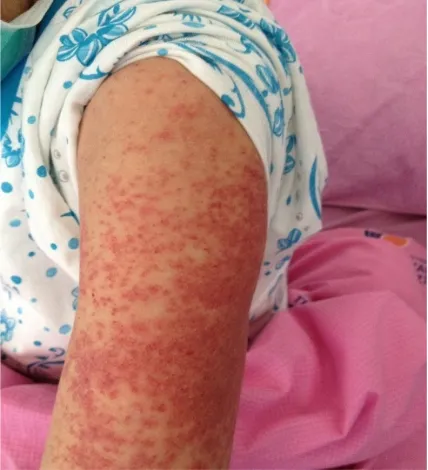
itchy, puffy, maculopapular and erythematous. The rash faded when pressed and tended to coalesce with each other, indicating a drug eruption due to decitabine (Figs. 1 and 2).
Fig. 1. Localized maculopapular eruptions on the front of the left arm
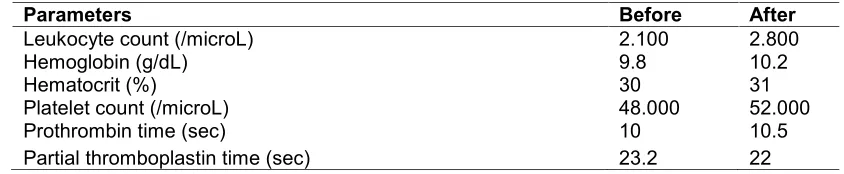
At this time, laboratory values were as follows: leukocyte count 2,100/microL, hemoglobin 9.8 g/dL, hematocrit 30%, platelet count 48,000/microL, prothrombin time 10 sec, partial thromboplastin time 23.2 sec (Laboratory values before (maculopapular eruptions observed) and after( maculopapular eruptions appeared) on Table 1). The patient was being given granisetron (1x3mg/day/i.v) and esomeprazole (1x40 mg/day/i.v) when the maculopapular eruption began. A decitabine drug allergy was considered. Treatments of granisetron and esomeprazole were continued and the patient did not consent to having a biopsy performed on the skin. The patient was treated with antihistamines, topical betamethasone butyrate propionate ointment and systemic steroid (methylprednisolone 1 mg/kg/i.v for 3 days). The eruption improved remarkably within 10 days, and the patient's rash had disappeared by the 17thday of treatment.
Table 1. Laboratory values before (maculopapular eruptions observed) and after (maculopapular eruptions appeared)
Parameters Before After
Leukocyte count (/microL) 2.100 2.800
Hemoglobin (g/dL) 9.8 10.2
Hematocrit (%) 30 31
Platelet count (/microL) 48.000 52.000
Prothrombin time (sec) 10 10.5
Partial thromboplastin time (sec) 23.2 22
3. DISCUSSION
Drugs occasionally induce cutaneous side effects. Sweet's syndrome and Stevens-Johnson syndrome were considered in the differential diagnosis of this patient. Ecchymosis, rash, erythema, petechiae skin lesion and pruritus have been described in decitabine’s prospectus [2].
Maculopapular eruptions can affect all age groups. These may appear on any parts of the body and sometimes may be localized [4]. Generally, these eruptions are red in appearance and may become discoloured in the later stages. This type of eruption is common in conjunction with drugs as well as several diseases and medical conditions, including scarlet fever, measles, rubella, secondary syphilis, parvovirus B19 and heat rash. A number of drugs may cause the appearance of maculopapular eruptions [3]. Chemotherapeutic drugs in cancer patients can also cause maculopapular eruptions. Ohashi et al., 2013 reported on a new case of azacitidine-induced maculopapular erythematous eruptions [5]. Amoxicillin, Cefobid, cefoperazone sodium and other antibiotics as well as cutaneous infiltration due to leukaemic cells may also give rise to appearance of these eruptions Maculopapular eruptions can sometimes be seen in graft-versus-host disease developed after a blood transfusion and can appear one week or several weeks after the blood transfusion. In the case of graft-versus-host disease, the maculopapular eruptions may progress to a condition similar to toxic epidermal necrolysis [3]. The maculopapular eruptions can be a result of large doses of niacin or no-flush niacin (2000–2500 mg/day/PO) [6]. Our patient did not use antibiotics and she was in remission when the eruptions began.
treatment with decitabine [7]. The following criteria were taken into account: the adverse drug reaction developed within a week after starting decitabine, the condition improved within 12 days of discontinuation of decitabine, there was marked improvement by the 17th day and the adverse drug reaction could not be explained by any other condition (any allergy or the other drugs). Our patient was being treated with granisetron and esomeprazole, along wih decitabine, when maculopapular eruption started. However, even though the granisetron and esomeprazol treatment was continued, maculopapular eruption (or simply: patient’s condition”) improved. Hence we considered that the rash was possibly (Naranjo’s score +5) caused by decitabine and not by granisetron or esomeprazole.). The World Health Organization (WHO)-Uppsala Monitoring Centre causality assessment criteria also indicated a probable association [8]. Sweet's syndrome is a skin disease characterized by the sudden onset of fever, leukocytosis and tender, erythematous, well-demarcated papules and plaques that show dense infiltrates by neutrophil granulocytes on histologic examination. Sweet’s syndrome was not thought to be the cause of the eruptions due to the lack of fever, neutrophilia, painful plaques and nodules [9]. Stevens-Johnson syndrome is characterized to be a hypersensitivity complex that affects the skin and the mucous membranes, but our patient did not have mucosal involvement (oral or vaginal mucosa) [10]. That none of those conditions can be associated with symptoms observed in the patient
4. CONCLUSION
Practitioners should be aware of this rare but potentially serious adverse event, especially as decitabine is commonly used for myelodysplastic syndromes and acute myeloid leukemia.
CONSENT
Written informed consent was obtained from the patient’s next-of-kin for publication of this manuscript and the accompanying images.
ETHICAL APPROVAL
This case report was approved by the Institutional Ethics Committee of the Inonu University Medical School.
COMPETING INTERESTS
The authors declare that they have no competing interests.
REFERENCES
1. Lyons RM. Myelodysplastic syndromes: therapy and outlook. Am J Med. 2012;125(7):18–23. doi: 10.1016/j.amjmed.2012.04.018.
2. Jerome Z. Litt. Litt’s D.E.R.M, Drug Eruptions & Reactions Manual. 16th Ed. Informa UK Limited; 2010.
3. Heinzerling LM, Tomsitz D, Anliker MD. Is drug allergy less prevalent than previously assumed? A 5-year analysis. Br J Dermatol. 2012;166(1):107–14
5. Ohashi A, Hayashi K, Okuyama R. Case of azacitidine-induced maculopapular erythematous eruption. J Dermatol. 2013. doi: 10.1111/1346-8138.12181. [Epub ahead of print]
6. McGovern ME. Taking aim at HDL-C. Raising levels to reduce cardiovascular risk. Postgrad Med 2005;117(4):29–30, 33–5, 39. doi:10.3810/pgm.2005.04.1610.
7. Naranjo CA, Busto U, Sellers EM, Sandor P, Ruiz I, Roberts EA, et al. A method for estimating the probability of adverse drug reactions. Clin Pharmacol Ther. 1981;30:239–45
8. The use of the WHO–UMC system for standardised case causality assessment. Accessed from: http://www.WHO-UMC.org/graphics/4409.pdf [last accessed on 2011 Feb 12].
9. Cohen PR, Kurzrock R. Sweet's syndrome revisited: a review of disease concepts. Int J Dermatol. 2003;42:761–78.
10. Chang YS, Huang FC, Tseng SH, Hsu CK, Ho CL, Sheu HM. Erythema multiforme, Stevens-Johnson syndrome, and toxic epidermal necrolysis: acute ocular manifestations, causes, and management. Cornea. 2007;26(2):123–29.
© 2014 Berber et al.; This is an Open Access article distributed under the terms of the Creative Commons Attribution License (http://creativecommons.org/licenses/by/3.0), which permits unrestricted use, distribution, and reproduction in any medium, provided the original work is properly cited.
Peer-review history: