Ashish Kundu1and Elisa Bertino2 1
IBM T J Watson Research Center, New York, USA 2
Department of Computer Science and CERIAS, Purdue University, West Lafayette, USA
Abstract. Collision resistant one-way hashing schemes are the basic building blocks of almost all crypto-systems. Use of graph-structured data models are on the rise – in graph databases, representation of biological and healthcare data as well as in modeling systems for representing system topologies. Therefore, the problem of hashing graphs with respect to crypto-systems needs to be studied and addressed. The traditional Merkle Hash technique cannot be applied as it is because graphs are more complex data structures than trees. In this paper, we make the following contributions: (1) we define the formal security model of hashing schemes for graphs, (2) we define the formal security model of leakage-free hashing schemes for graphs, (3) we describe a hashing scheme for hashing directed and undirected graphs that uses Merkle hash technique, (4) and a hashing scheme that uses structural information instead of Merkle hash technique, (5) we define leakage-free hashing schemes for graphs. Our constructions use graph traversal techniques and are highly efficient with respect to updates to graphs: they require as little as two (O(1)) hash values to be updated to refresh the hash of the graph, while the Merkle Hash Technique and Search DAG schemes for trees and DAGs respectively require as many asO(|V|)andO(|V|+|E|).
1
Introduction
One of the fundamental building blocks of modern cryptography is hash functions. Hash functions are used towards verification of data integrity as well as message authentica-tion codes and digital signature schemes. Tradiauthentica-tional hash funcauthentica-tions handle messages as bit strings.H:{0, 1}∗ → {0, 1}n defines a hash function that takes a bitstring of any size as input and outputs a hash-value of sizen-bits. Integrity protection of data includes not only data objects that are bit strings but also data objects that are graphs.
Some of the several contexts where graph-structured data models are widely used are healthcare, biological, geographical and location data as well as financial databases [7, 15]. Often it is required to check if a given graph has been updated or not or whether two graphs are identical3. Hashing is used to evaluate these operations. Authenticating the graph-structured data is often required as a security property in databases [14, 13]. Authentication schemes use hashing as a basic building block.
Hashing graphs pose several challenges: graphs have several nodes and edges, with each node having multiple incoming edges and outgoing edges. The edges maybe di-rectional and there maybe cycles in the graphs. There are four types of graphs that are of interest in this paper: (a) trees, (b) directed acyclic graphs, (c) graphs with cycles and
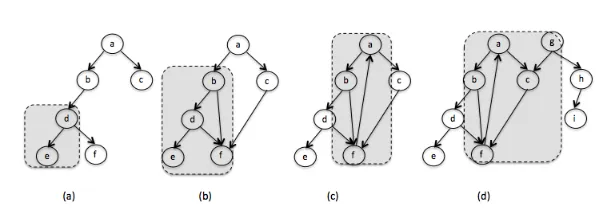
Fig. 1.Graphs: (a) Tree, (b) DAG, (c) Graph with cycles, (d) Graph with multiple sources (vertices with no incoming edge) and cycles. The shadowed with dotted boundary are the subgraphs that a user may receive.
(d) graphs with multiple sources. In the Figure 1, these types of graphs are seen. From (a) onwards, the complexity of hashing increases because the complexity of the graph increases from (a) to (b) and so on.
the formalization of such secure hashing schemes for graphs is an essential requirement besides their constructions.
In this paper, we make the following contributions: (1) we define the formal security model of collision-resistanthashing schemes for graphs, (2)we define the formal secu-rity model of perfectly collision-resistant hashing schemes for graphs, (3) we describe a hashing scheme for hashing directed and undirected graphs that uses the MHT, (4) and a hashing scheme that uses structural information instead of the MHT, (5) we propose a perfectly collision-resistant hashing scheme for graphs.
2
Related Works and Background
There are two techniques in the literature that come closest to the constructions pre-sented in this paper: Merkle hash technique [12] (MHT) and the Search-DAG tech-nique [11] (SDAG). Integrity assurance of tree-structured data is primarily carried by the Merkle hash technique [12]. This scheme requires information about other nodes and edges (extraneous information) in order to verify the integrity of a subtree, which is why it leaks. We would describe the issues associated with MHT in the next sec-tion, and the following secsec-tion, we would describe the SDAG technique. Martel et al. [11] proposed SDAG – an authentication technique for directed acyclic graphs re-ferred to as “Search DAGs” in third party distribution frameworks. Their technique uses Merkle hash technique. The SDAG technique only covers DAGs, not the general directed graphs, which is of greater interest in this paper.
2.1 Hashing Trees with Merkle Hash Technique
The Merkle hash technique [12] works bottom-up. For a nodex in treeT(V, E), it computes a Merkle hash (MH)mh(x)as follows: if xis a leaf node, thenmh(x)=
H(cx); elsemh(x)=H(mh(y1)kmh(y2)k. . .kmh(ym)), wherey1,y2, . . . ,ymare the
mchildren ofxinT in that order from left to right. For example, consider the tree in Figure 1(a). The Merkle hash for this tree is computed as follows. The MH ofeandfare computed asH(ce) andH(cf), respectively, which are then used to compute the MH of
dasmh(d)=H(mh(e)kmh(f)). The MH ofbis computed asH(mh(d)). Similarly the MH ofcandaare computed asH(cc) andH(mh(b)kmh(c)), respectively.
In order to account for the contents in non-leaf nodes, two simple variants of the Merkle hash technique can be used to compute the MH of a non-leaf node from the MH of its children and the contents (or hash of the content) of the non-leaf node itself. Supposexto be a non-leaf (thus a root/intermediate) node inT. The MH ofxis defined as follows:mh(x)=H(H(cx)kmh(y1)kmh(y2)k. . .kmh(ym)).
Consider again the tree in Figure 1(a). MH ofd,bandaare computed respectively asH(H(cd)kmh(e)kmh(f)),H(H(cb)kmh(d)), andH(H(ca)kmh(b)kmh(c)).
1. With respect to each node inTδ, MH of its siblings4that are inT but not inTδ. For example, in Figure 1,mh(f)(with respect toe) is sent.
2. With respect to each nodexinTδ, the MH of each sibling of each ancestor ofx, if that sibling is not inTδ. In our example,mh(a)andmh(b)are also sent.
3. With respect to each node inTδ, the hash of the content of each of its ancestor. In our example,H(ca) andH(cb) are sent to the user.
4. The structural order between a node inTδ and its sibling(s) that are not inTδ, and the structural order between the sibling nodes that are not inTδ. In our example, the order betweeneandf, and the order betweenbandcare sent to the user. 5. Parent-child/ancestor-descendant relationship(s) between a node inTδ and another
node not inTδ (such as the relationship betweenbandd), and those between the nodes that are not inTδ (such as betweenaandb, and betweenaandc).
6. The fact that a given node is the root of T (even if it is the root ofTδ). In our example,ais the root of the tree and this fact is conveyed to the user.
The user then computes the MH of the whole tree using such information (the sub-tree andVO) and compares it with the received signed MH of the root. If they are equal, the integrity of the subtree is validated. Moreover, this process verifies the integrity of the subtree against the original tree.
2.1.2 Privacy Attacks The attacks on the Merkle hash technique are based on the set ofverification objectssent to the user. By exploiting the knowledge of these informa-tion, inference attacks described below can be carried out on the MHT.
– The first attack exploits the information (1), (2), and(3). By comparing the Merkle hash of a nodeein the shared subtree with the MH of another nodefreceived, the user can infer whether contents ofeis same as that off and if the subtree with root
eis identical to the subtree with rootf.
– The second attack exploits the information (1), (2), (3), and (6). By comparing the Merkle hashes of two nodes (candf) that are received, the user can infer whether the contents ofcis same as that off.
2.1.3 Inefficiency of Updates using MHT Consider that there is a change to the nodee. The change affects the hash values ofe,d,b, anda. A single change led to four changes. In general in MHT, a change in a node may lead to changes inO(n)nodes, withnnodes in the tree. This leads to several performance issues especially in memory integrity, integrity in databases and indices.
2.2 Hashing Graphs
Graphs are more complex structures than trees. Nodes may have multiple incoming edges, there maybe no roots or source nodes; perhaps, there maybe a number roots or source nodes. The major challenges in hashing graphs arise out of the fact that (i) a
graph may have cycles, (ii) changes to the nodes affects hashes of multiple other nodes, and (iii) a graph can be shared with a user in parts or in terms of subgraphs. For example, in the figure, subgraphs that are shared are shown as shadowed regions on each of the graphs.
Consider the DAG in Figure 1(b). Nodef has three incoming edges. If we use SDAG technique, then hash of node f influences hashes of three other nodes from which these nodes originate: d, b, and c. While that is acceptable, any update tof
affects the hashes of all nodes other thane. In general in SDAG technique, an update to a node in a DAG affects|V|+|E|nodes.
Hashing graphs with cycles is more complex because such graphs cannot be ordered topologically [4]. For the graphs in Figure 1(c) and (d), the cycles involve nodesa,b,c
andf. How can we hash such graphs so that the cyclic structure is also preserved in the hash – dissimilar structures should not have the same hash even if the contents maybe identical.
2.3 Formal Security Models
Existing works [12, 11] do not formally define the notion of graph hashing, nor they define nor construct perfectly collision-resistant hash functions. Canetti et al. [1, 2] developed the notion of perfectly collision-resistant hash functions for messages that are bit-strings and are not graphs nor any structured/semi-structured objects. Canetti et al. [2] also proposed thatverifymethod should be included in the definition of random oracles. In this paper, we have also proposed a similarhash-verifymethod as well as a
hash-redactmethod that is specific for structured/semi-structured data.
3
Terminology
Trees and Graphs: A directed graph G(V, E)is a set of nodes (or vertices)V and a set of edgesEbetween these nodes:e(x, y)is an edge fromxtoy, (x,y)∈V ×V. Undirected graphs can be represented as directed graphs. Therefore in what follows we consider only the case of directed graphs and we will use the term graph with the mean-ing of directed graph. A nodexrepresents an atomic unit of data, which is always shared as a whole or is not shared at all. A source is a node that does not have any incoming edge. A nodexis called the ancestor of a nodeyiff there exists a path consisting of one or more edges fromxtoy. Nodexis an immediate ancestor, also called parent, ofyin
Giff there exists an edgee(x, y)inE. Nodes having a common immediate ancestor are called siblings. LetG(V, E)andGδ(Vδ, Eδ)be two graphs. We say thatGδ(Vδ, Eδ)is a
redacted subgraphofG(V, E)ifGδ(Vδ, Eδ)⊆G(V, E).Gδ(Vδ, Eδ)⊆G(V, E)if an only ifVδ⊆V andEδ ⊆E. AlsoGδ(Vδ, Eδ)⊂G(V, E)if and only ifVδ ∪Eδ⊂V
∪E. A redacted subgraphGδ(Vδ, Eδ)is derived from the graphG(V, E)by redacting the set of nodesV \Vδ and the set of edgesE \Eδ fromG. A directed treeT(V, E) is a directed graph with the following constraint: removal of any edgee(x, y)fromE
Redacted subgraphTδ(Vδ, Eδ)is derived from the treeT(V, E)by redacting the set of nodesV \Vδ and the set of edgesE \Eδ fromT. Two trees/graphs/forests with the same nodes and edges, butdifferent orderingbetween at least one pair of siblings are different trees/graphs/forests.
4
Review of Standard Hashing Schemes
In this section, we review the standard definition of hashing schemes (adopted from [9]). A standard hashing schemeΠis a tuple (Gen,H). (sis not a secret key in standard cryptographic sense.)
Definition 1 (Standard hashing scheme).A hashing schemeΠ consists of two probabilistic polynomial-time algorithmsΠ= (Gen,H) satisfying the following requirements:
KEY GENERATION: The probabilistic key generation algorithmGentakes as input a security parameter1λand outputs a keys:s←Gen(1λ).
HASH: There exists a polynomiallsuch thatHtakes a keysand a stringx ∈ {0,1}∗and outputs a stringHs
(x)∈ {0,1}l(λ)
(whereλis the value of the security paramrter implicit ins).
IfHs
is defined only for inputsx∈ {0,1}l0(λ)
andl0(λ)> l(λ), then we say that (Gen,H) is a fixed-length hash function for inputs of lengthl0(λ).
4.1 Security of Hash Functions
The strongest form of security for hash functions include three properties: (1) collision resistance, (2) second pimage resistance, and (3) pimage resistance. Collision re-sistance is the strongest notion and subsumes second pre-image rere-sistance, which in turn subsumes pre-image resistance [9]. In other words, any hash function that satisfies (2) satisfies also (3) but the reverse is not true; and any hash function that satisfies (1) satisfies also (2) (and transitively (3)) but the reverse is not true. In the rest of the paper, security of hash functions refer to the strongest property, i.e., collision resistance.
For the traditional hash functions defined in the previous section, we are now re-viewing the collision-finding experiment (adapted from [9]). In the rest of the paper,A
is a probabilistic polynomial time (PPT) adversary.
Collision-finding Experiment:GH-CollA,gΠ(λ)
1. Key(pk, sk)←Gen(1λ)
2. Ais givensand outputsxandx0. (IfΠ is a fixed-length hash function then for inputs of lengthl0(λ)thenx, x0∈ {0,1}l0(λ)
)
3. The output of the experiment is 1 if and only ifx 6= x0andHs
(x) =Hs
(x0). In such a case, we say thatAhas found a collision forHs
; else the output of the experiment is0.
Definition 2. A hash functionΠ= (Gen,H) is collision-resistant if for all probabilistic polyno-mial adversariesAthere exists a negligible functionneglsuch that
5
Collision-resistant Hashing of Graphs
The standard definition of hashing schemes cannot be applied directly to graphs because the standard definition operates on messagesx∈ {0,1}∗and each message is shared either fully shared or not shared at all with a user. In contrast, a graphG(V, E)is a set of nodes and edges, where each node may be represented byx, and a user may have access to one or more subgraphs instead of the complete graph.
As discussed earlier, a hashing scheme for graphs requires a key generation algo-rithm and a hash function algoalgo-rithm. We would also need a method to verify hashes for a graph as well as its subgraphs. We refer to this algorithm as the “hash-verification” method. This is because as mentioned earlier, users may receive entire graphs or sub-graphs, and need to verify their integrity. To that end, if the hash function used to com-pute the hash of a graph is a collision-resistant hash function, then the user would need certain extra information along with the proper subgraphs. Otherwise, the hash value computed by the user for the received subgraphs would not match the hash value of the graph unless there is a contradiction to the premise that the hash function is collision-resistant. We refer to this extra information as “verification objects”VO. Computation of theVO for a subgraph with respect to a graph is carried out by another algorithm also part of the definition of the hashing scheme for graphs. We call this algorithm as “hash-redaction” of graphs.
The conceptualization of these two algorithms for verification and redaction de-scribed in the previous paragraph is already in use by schemes such as the Merkle hash technique, but have not been formalized. As essential components of our formalization of the notion of graph hashes, we need to formalize these methods. Such formalization is also essential for a correct design and rigorous analysis of the protocols that realize these definitions. The definition of the graph hashing schemes is as follows.
Definition 3 (Collision-resistant graph hashing scheme).A hashing schemegΠconsists of three probabilistic polynomial-time algorithms and one deterministic algorithm
gΠ= (gGen, gH,ghRedact,ghVrfy) satisfying the following requirements:
KEY GENERATION: The probabilistic key generation algorithmgGentakes as input a secu-rity parameter1λand outputs a keys:s←gGen(1λ).
HASHING: The hash algorithm gHtakes a keysand a graphG(V, E)and outputs a string gHs(G(V, E)) ∈ {0,1}l(λ)
, wherel a polynomial, andλ is the value of the security parameter implicit ins.
HASH-REDACTION: The redaction algorithmghRedactis a probablistic algorithm that takesG(V, E) and a set of subgraphsGδ (such that eachGδ ∈ Gδ,Gδ ⊆G(V, E)) as
inputs and outputs a setVOGδ,G(V,E)of verification objects for those nodes and edges that
are inG(V, E)but not in any of the subgraphs inGδ.
VOGδ,G(V,E) ← ghRedact(Gδ, G(V, E))
5.1 Correctness
A hashing scheme for graphs is correct if the following properties hold.
Hashing Correctness (Empty redaction): For any graphG(V, E), any positive integer value ofλ, any keys←gGen(λ), and anygH←gHs(G(V, E))
,VO ←ghRedact({G}, G),
ghVrfys(gH,{G(V, E)},VO) always outputs 1.
Hash-Redaction Correctness: For any graphG(V, E), any positive integer value ofλ, any key
s←gGen(λ), any setGδof subgraphsGδ(Vδ, Eδ)⊆G(V, E)such that the union of all
the subgraphs inGδresults in a graph that is a proper subgraph ofG, and
gH←gHs
(G),VO ←ghRedact(Gδ, G),ghVrfys(gH,Gδ,VO) always outputs 1.
5.2 Security of Hash Functions
The strongest form of security for hash functions for graphs also includes three prop-erties: (1) collision resistance, (2) second pimage resistance, and (3) pimage re-sistance. As earlier, collision resistance is the strongest notion and subsumes second pre-image resistance, which in turn subsumes pre-image resistance.
Collision-finding Experiment:GH-CollA,gΠ(λ)
1. Keys←gGen(1λ)
2. Ais givensand outputs (a)G(V, E)andG0(V0, E0), and (b)VOGδ,G(V,E) ← ghRedact(Gδ, G(V, E))andVO
0 G0
δ,G0(V0,E0) ← ghRedact(G
0
δ, G
0
(V0, E0)) 3. The output of the experiment is 1 if and only if any of the following is true: in such a case,
we say thatAhas found a collision forHs
; else the output of the experiment is0. (a) G(V, E)6= G0(V0, E0)andgH =gH0, wheregH←gHs
(G), and gH0←gHs
(G0(V0, E0)).
(b) G(V, E)6= G0(V0, E0)andghVrfys(gH0,Gδ,VO) =gHs(gH ,Gδ0,VO
0
).
Definition 4. A hash functiongΠ= (gGen, gH,ghRedact,ghVrfy) is collision-resistant if for all probabilistic polynomial adversariesAthere exists a negligible functionneglsuch that
Pr(GH−CollA,gΠ(λ) = 1)≤ negl(λ)
6
Perfectly Collision-resistant Hashing of Graphs
In this section, we formalize the notion of perfectly one-way (i.e., collision-resistant) hash functions for graphs.
Standard hashing schemes may leak information about the image being hashed. Even though such schemes are one-way in a computational sense (informally speaking, to find a collision one needs to solve a hard problem or do intractable amount of work), the hash valueH(x) of imagexreveals some information aboutx. Such information leaks in the reverse direction –H(x) toxmakes this function “not perfectly one way”; such leakage may allow the attacker to construct pre-images and second-preimages with less work than what was defined by the random oracle model. In the case of sensitive data, such leakages via hash values lead to another security issue: leakage of sensitive information. As Canetti et al. describe in [2], ifxrepresents a confidential information,
H(x) may leak the length ofxand bits ofx, which is a serious security breach. The formal definition of hashing schemes does not capture the requirement of non-leakage of information about pre-images. Canetti has introduced a formal definition for
x∈ {0,1}∗and several constructions for perfectly one-way hash functions [2]. However, for graphs no such notion has been defined. Graphs are often used to represent sensitive data, and it is thus essential to hide all the information contained in the nodes. There is another reason for the need of perfectly collision-resistant hash functions: the standard definition operates on messagesx∈ {0,1}∗and each message is either fully shared or not shared at all with a user. In contrast, a graphG(V, E)is a set of nodes and edges, where each node may be represented byx, and a user may have access to one or more subgraphs instead of the complete graph. As in the Merkle hash technique, when a subtree is shared with a user, the user also receives a set of Merkle hash values for some of the nodes that are not in the shared subtree. If the hash function used is not perfectly collision-resistant, then the hash values could lead to leakage of information about the unshared nodes, which needs to be prevented. Encryption is too heavyweight and has different security properties than those required for hash functions. We thus need a perfectly collision-resistant hash functions for graphs.
In the previous section, we formally defined the notion of collision-resistant graph hashing schemes. The definition of a perfectly collision-resistant graph hash function is identical to this definition but includes an extra element: a key that is used towards making the scheme perfectly collision-resistant (as well as hiding).
Definition 5 (Perfectly collision-resistant graph hashing scheme).A hashing schemegΠ con-sists of three probabilistic polynomial-time algorithms and one deterministic algorithm gΠ= (gGen, gH,ghRedact,ghVrfy) satisfying the following requirements:
KEY GENERATION: The probabilistic key generation algorithmpgGentakes as input secu-rity parameter1λ
and outputs a keys.
s←pgGen(1λ).
RANDOMIZER GENERATION: The probabilistic randomizer generation algorithmpgRandom
takes as input security parameter1λrand outputs a uniformly chosen randomr∈ {0,1}λr.
r←pgRandom(1λr).
HASHING: There exists a polynomiallsuch that the hash algorithm pgHtakes a keysand a graphG(V, E)and outputs a stringpgH ←pgHs,r
HASH-REDACTION: The redaction algorithmghRedactis a probabilistic algorithm that takesG(V, E) and a set of subgraphsGδ (such that eachGδ ∈ Gδ,Gδ ⊆G(V, E)) as
inputs and outputs a setVOGδ,G(V,E)of verification objects for those nodes and edges that are inG(V, E)but not in any of the subgraphs inGδ.
VOGδ,G(V,E) ← pghRedact(Gδ, G(V, E)).
HASH-VERIFY: pghVerifyis a deterministic algorithm that takes a hash value pgH, a set of graphsG, and a set of verification objectsVO, and returns a bitb, whereb= 1meaning valid if the hash valuepgH is a valid hash forGandVO, andb= 0meaning invalid hash value.
b←pghVerifys,r(pgH ,G,VO)
6.1 Correctness
A perfectly collision-resistant hashing scheme for graphs is correct if the following properties hold: Hashing Correctness (Empty redaction) and Hash-Redaction Correct-ness. These two properties have definitions similar to the definitions of such properties for the collision-resistant hash function for graphs in section 5.1.
6.2 Security
There are two security requirements: (1) collision-resistance, and (2) semantically per-fect one-wayness of graph hash functions. The collision-resistance experiment is similar to the one defined earlier in Section 5.2.
Collision-finding Experiment:PGH-CollA,pgΠ(λ, λr)
1. Keys←pgGen(1λ)
2. Randomizerr←pgRandom(1λr)
3. Ais givens,r;Aoutputs (a)G(V, E)andG0(V0, E0), and (b)VOGδ,G(V,E) ← pghRedact(Gδ, G(V, E))and
VO0 G0
δ,G0(V0,E0) ← pghRedact(G
0
δ, G
0
(V0, E0))
4. The output of the experiment is 1 if and only if any of the following is true: in such a case, we say thatAhas found a collision forHs
; else the output of the experiment is0. (a) G(V, E)6= G0(V0, E0)andpgH =pgH0, wherepgH ←pgHs,r
(G), and pgH0←pgHs,r
(G0(V0, E0)).
(b) G(V, E)6= G0(V0, E0)andpghVerifys,r(pgH0,Gδ,VO) =pgHs,r(pgH ,Gδ0,VO
0
).
Privacy experiment-1:PGH-Priv1A,pgΠ(λ, λr)
1. Keys←pgGen(1λ)
2. Randomizersr1,r2←pgRandom(1λr)
3. Any two random graphsG0(V0, E0), andG1(V1, E1)that differ only at the contents of one or more nodes, drawn uniformly fromG.
4. Toss an unbiased coin; if it returns head then bitb= 1, elseb= 0.
5. Compute the following:pgH0←pgH(r0, G0(V0, E0)).pgH1←pgH(rb, Gb(Vb, Eb)).
6. Ais givens,pgH0andpgH1;Aoutputs a bitb
0
.
7. The output of the experiment is 1 if and only if any ofb=b0.
The following experiment is for privacy, but is with respect to the hash-redaction algorithm.
Privacy experiment-2:PGH-Priv2A,pgΠ(λ, λr)
1. Compute Keys←pgGen(1λ)
2. Compute randomizerr←pgRandom(1λr)
3. Draw a random graphG(V, E). Determine any two sets of subgraphsGδ0,Gδ1⊆G(V, E). Compute the hash ofG(V, E):pgH ←pgHs,r(G(V, E))
. 4. Toss an unbiased coin; if it returns head then bitb= 1, elseb= 0.
5. Compute the following:VO0 ← pghRedact(Gδ0, G(V, E))andVO1 ← pghRedact(Gδ1, G(V, E))
6. Ais givens,pgH,VO0andVO1;Aoutputs a bitb0. 7. The output of the experiment is 1 if and only if any ofb=b0.
Definition 6. A hash functionpgΠ= (pgGen, pgH,pghRedact,pghVerify) is collision-resistant if for all probabilistic polynomial adversariesAthere exists a negligible functionnegl
such that
Pr((PGH−CollA,pgΠ(λ, λr) = 1))≤ negl(λ, λr)
Definition 7. A hash functionpgΠ = (pgGen, pgH,pghRedact,pghVerify) is perfectly collision-resistant if for all probabilistic polynomial adversariesAthere exists a negligible func-tionneglsuch that
Pr((PGH−Priv1A,pgΠ(λ, λr) = 1)∨(PGH−Priv2A,pgΠ(λ, λr) = 1))≤
1
2+negl(λ, λr)
7
Construction of Collision-resistant Hashing Scheme for Graphs
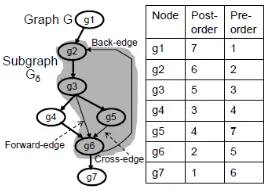
Fig. 2.A graph with depth-first tree in bold.
7.1 Graph Traversal
A graphG(V, E)can be traversed in a depth-first manner or breadth-first manner [4]. Post-order, pre-order, and in-order graph traversals are defined in [10, 4]. While post-order and pre-post-order traversals are defined for all types of trees, in-post-order traversal is defined only for binary trees. In each of these traversals, the first node visited is assigned
1as itsvisit count. For every subsequent vertex visited, thevisit countis incremented by
1and is assigned to the vertex. This sequence of numbers is called the sequence of post-order (PON), pre-post-order (RON), or in-post-order (ION) numbers for the treeT, depending on the particular type of traversal. Figure2shows the traversal numbers and the DFT for a graph.
Properties of traversal numbers:The post-order number of a node is smaller than that of its parent. The pre-order number of a node is greater than that of its parent. The in-order number of a node in a binary tree is greater than that of its left child and smaller than that of its right child. A specific traversal number of a node is always smaller than that of its right sibling. The following lemma provides the basis for using traversal numbers in hash computation.
Lemma 1. The pair of post-order and pre-order number for a node in a non-binary tree correctly and uniquely determines the position of the node in the structure of the tree, where the position of a node is defined by its parent and its status as the left or right child of that parent.
Proof. From the post-order and pre-order traversal sequences of the vertices, it is pos-sible touniquelyre-construct a non-binary tree [5] [8]. Thus from these sequences or from their counterparts, for a node, it is possible to correctly identify its parent and its status as left or right child of that parent in the tree.
7.2 Graphs
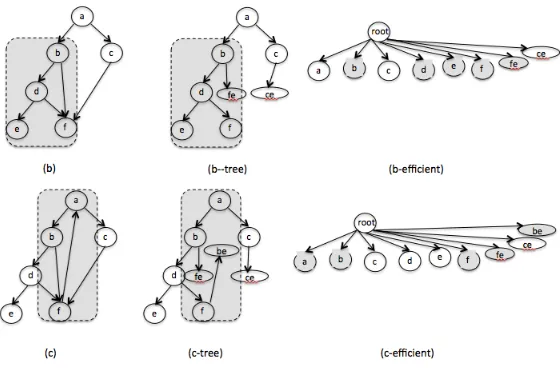
Fig. 3.Tree representation of the running examples from Figure 1: (b-tree) and (c-tree) are tree-representations of the graphs in (b) and (c) – each node contains its (post-order, pre-order) num-ber. (b,c-efficient) are one-level tree representations of the graphs exploiting the post-order and pre-order numbers of graph traversals. Each node contains their numbers.fe,ce, andberepresent forward-edges, cross-edges and back-edges, respectively. Each of these nodes contain the post-and pre-order numbers of the origin post-and target of the edges post-and the hashes of their contents.
The various types of edges in a graph are defined below using the notion of traversal numbers. An example of depth-first tree, types of edges are given in Figure 2 with the post- and pre-order numbers for each node being given in the table in the figure. Edgee(g3, g6)is a forward-edge, edgee(g5, g6)is a cross-edge and edgee(g6, g2)is a back-edge. However, DFTs do not capture the edges that are called forward-edges, cross-edges and back-edges.
Definition 8. Letτbe the depth-first tree (DFT) of a directed graphG(V, E). Letx,y
∈V, ande(x, y)∈E. Letoxandqxrefer to post-order number and pre-order number
of nodex, respectively. With respect to the DFTτ,e(x, y)is a (1) tree-edge, iffox>oy,
andqx<qy; (2) forward-edge, iff there is a path fromxtoyconsisting of more than one
tree-edges,ox>oy, andqx<qy; (3) cross-edge, iffox>oy, andqx>qy; (4) back-edge,
iffox<oy, andqx>qy.
7.3 Construction of Collision-resistant Hash Scheme for Graphs
The construction of the collision-resistant hash functions for graphsgΠis given below.
Hrefers to a standard hash function as defined byΠ. The last statement in gH com-putes the hash of a tree as shown in Figure3(b-efficient) and (c-efficient).
gH:
1. Input: a graphG(V, E)and its efficient tree-representation.
2. Sort the source nodes of the graphs in the non-decreasing order of their contents or label. 3. Carry out depth-first traversal of the graphG(V, E)on the first source nodexin the sorted
order. If there are no source nodes inG(V, E), choosexrandomly. 4. If nodeyis visited in DFS, assign its (post-order, pre-order) number to it.
5. If the edgee(y, z)is not a tree-edge and is cross-edge, then create an edge-nodeyz hav-ing the followhav-ing contentce((py, ry),(pz, rz)); if forward-edge:f e((py, ry),(pz, rz)), and
back-edge:be((py, ry),(pz, rz))
6. Add an edge fromyto the new nodeyz, and remove the edgee(y, z). 7. Removexfrom the sorted order of source nodes if exists.
8. If there are nodes inG(V, E)that are yet to be visited, then repeat from 2. 9. Compute hash of each nodexas follows:Hy← H((py, ry)||y).
10. To each edge-nodeyz, assignHyz← H(Hy||Hz).
11. Compute the hash of graphgH G(V, E)as follows:
gHG(V,E)← H(Hy1||Hy2||. . .||Hym)
whereyirefers to the i’th node in the increasing order of the post-order numbers of the nodes, and of the originating nodes of the edge-nodes, andmis the total number of nodes in the efficient-tree including original nodes and the edge-nodes.
ghRedact:
1. Input: a set of subgraphsGδthat contains the efficient tree representations of the subgraphs,
the efficient tree-representation of graphG(V, E).
2. GivenGδ, andG(V, E), determine the setV −excludedandE−excludedconsisting
of excluded nodes and edge-nodes, respectively, in the efficient tree-representation of the graph.
3. VO← ∅
4. VO ← VO ∪((py, ry), Hy, wherey∈V −excluded.
5. VO ← VO ∪(τ((py, ry),(pz, rz), Hyz), whereτdefines the type of the edge-node: fe, ce,
and be, andyz∈E−excluded.
ghVrfy:
1. Input: a set of subgraphsG0
δthat contains the efficient tree representation of the subgraphs,
a set of verification objectsVO, and the hash of the complete graphgH.
2. Sort the received nodes, edge-nodes in the increasing order of the post-order numbers of the nodes or origins of the edge-nodes.
3. For each nodexthat is in a subgraphGδ∈ Gδ0, computeHx.
4. For each edge-nodexythat is in a subgraphGδ∈ Gδ0, computeHxy.
5. Compute the hashgH0 ← H(Hx1||Hx2||. . .||Hxm0), wherexirefers to the i’th node in
6. IffgH0=gH, return1, else return0.
Cost: Each of the schemes gH,ghRedact, andghVrfy, perform a traversal on the graph in the worst case (when the graph is shared as it is with no redaction). The cost of such traversal and each of these methods is:O(|V|+|E|).
Updates using Efficient-Trees: Updates to a node in a graph when applied in its tree-representation, leads to only a constant numberO(1)(two) of updates to hash values. In contrast, as we saw earlier, when a node is updated, MHT requiresO(|V|)number of hash values to be updated. SDAG scheme requires O(|V|+|E|)number of hash values to be updated. For example, consider the Figure 3. Consider that the nodef is updated. SDAG requires4hash values to be updated. However, if we use the efficient-tree representation of the DAG, then the number of hashes updated is2: one for the nodef and another for the root. This is true for any node at any depth in a graph.
7.4 Constructions of Perfectly Collision-resistant Hashing Scheme for Graphs
We are going to use the GGM trees to generate random numbers using the length-doubling pseudo-random functions. Due to space constraints, we refer the reader to [6, 3] for a discussion on these trees.
The random numbers are used with each node, and edge-node towards computing the perfectly one-way hashes of the contents of the nodes and edge-nodes. Any scheme from Canetti’s schemes can be used. The random numbers are then supplied as part of the hash values for the nodes or edge-nodes. Then hash computation, hash-redaction and hash-verification proceeds as in the previous section.
7.5 Security
The following lemma states the security of the proposed constructions forgΠandpgΠ.
Lemma 2. Under the random-oracle model, thegΠis a collision-resistant hash func-tion for graphs.
Lemma 3. Under the random-oracle model, thepgΠis a perfectly collision-resistant hash function for graphs.
8
Conclusions and Future Works
graph traversal techniques and are highly efficient with respect to updates to graphs: they require as little as two (O(1)) hash values to be updated to refresh the hash of the graph, while the Merkle Hash Technique and Search DAG schemes for trees and DAGs respectively require as many as O(|V|) andO(|V|+|E|). Moreover, our proposed schemes are also as efficient as these schemes: both of them require a single traver-sal on the graph. We have also proposed the first perfectly collision-resistant hashing schemes for graphs. We are in the process of implementing these schemes in C++.
References
1. Ran Canetti. Towards realizing random oracles: Hash functions that hide all partial informa-tion. InCRYPTO, pages 455–469, 1997.
2. Ran Canetti, Daniele Micciancio, and Omer Reingold. Perfectly one-way probabilistic hash functions (preliminary version). InSTOC, pages 131–140, 1998.
3. Ee-Chien Chang, Chee Liang Lim, and Jia Xu. Short redactable signatures using random trees. InProceedings of the The Cryptographers’ Track at the RSA Conference 2009 on Top-ics in Cryptology, CT-RSA ’09, pages 133–147, Berlin, Heidelberg, 2009. Springer-Verlag. 4. T. H. Cormen, C. E. Leiserson, R. L. Rivest, and C. Stein.Introduction to Algorithms. MIT
Press, 2001.
5. S. K. Das, K. B. Min, and R. H. Halverson. Efficient parallel algorithms for tree-related prob-lems using the parentheses matching strategy. InProceedings of the 8th International Sympo-sium on Parallel Processing, pages 362–367, Washington, DC, USA, 1994. IEEE Computer Society.
6. Oded Goldreich, Shafi Goldwasser, and Silvio Micali. How to construct random functions. J. ACM, 33(4):792–807, August 1986.
7. H. V. Jagadish and Frank Olken. Database management for life sciences research.SIGMOD Rec., 33(2):15–20, June 2004.
8. V. Kamakoti and C. Pandu Rangan. An optimal algorithm for reconstructing a binary tree. Inf. Process. Lett., 42(2):113–115, 1992.
9. J. Katz and Y. Lindell. Introduction to Modern Cryptography: Principles and Protocols. Chapman & Hall/CRC, 2007.
10. D. E. Knuth. The Art of Computer Programming, volume 1. Pearson Education Asia, third edition, 2002.
11. Charles Martel, Glen Nuckolls, Premkumar Devanbu, Michael Gertz, April Kwong, and Stu-art G. Stubblebine. A general model for authenticated data structures.Algorithmica, 39:21– 41, 2004. 10.1007/s00453-003-1076-8.
12. R. C. Merkle. A certified digital signature. InCRYPTO, 1989.
13. Kai Samelin, Henrich Phls, Arne Bilzhause, Joachim Posegga, and Hermann de Meer. Redactable signatures for independent removal of structure and content. In Mark Ryan, Ben Smyth, and Guilin Wang, editors,Information Security Practice and Experience, vol-ume 7232 ofLecture Notes in Computer Science, pages 17–33. Springer Berlin / Heidelberg, 2012.
14. Man Lung Yiu, Eric Lo, and Duncan Yung. Authentication of moving knn queries. In Proceedings of the 2011 IEEE 27th International Conference on Data Engineering, ICDE ’11, pages 565–576, Washington, DC, USA, 2011. IEEE Computer Society.