Real Time Control Strategy for Hybrid Electric Vehicles
Professor Dr. Sorush Niknamian
Board Member of Weston A Price Foundation, Washington DC, USA
Abstract
Based on the complex structure of electric hybrid car and uncertainty in driving force structure of electric hybrid car, different strategies have been presented for optimal management of energy based on smart methods. In this study by the decision making nature of fuzz logic, a movement map for Parallel Hybrid Electric Vehicle (PHEV) is made based on the required path. In a parallel hybrid car, recharging control of battery and auxiliary torque of electric engine are used as the key points of movement. Based on the disadvantages of pure electric car, to increase the life of battery and its easy use, we need a movement strategy balancing the battery charge for a movement path. If the battery is charged at no load by the combustion engine, NOx emission is increased and the battery charge is not good and adequate for HEV performance under no-load condition by the energy retrieval power and combustion engine. For a movement structure, it is hard to define the conversion point between the motor performance and generator performance exactly. By a drive strategy based on crisp methods, the battery charge is sensitive to the moving samples of driver, path condition and load conditions. Using fuzzy control strategy to control varied non-linear systems is very suitable and it is robust against the changes of components of sub-systems and inexact measurements. New York City Cycle (NYCC) is considered to perform simulation. As shown in paper, the fuzzy control strategy can keep the charge stage of batteries at good range
Keywords: Fuzzy Control Strategy, Hybrid Electric Vehicles, supervisory control strategy,
Hybrid System, Switching Strategy.
Introduction
The control strategy in hybrid cars is an algorithm by which the energy is generated, stored and consumed. The control strategies are designed to achieve some simultaneous goals. The goa of these strategies is reducing fuel consumption and pollutants and maintaining or increasing the functional capabilities of car as increasing acceleration and slope paths. Different types of control strategies are introduced for hybrid cars [1]. Due to the complex nature of hybrid cars, the designed control strategies based on engineering attitude don’t provide the optimal performance of car and using optimization algorithms to achieve an optimal control strategy is necessary. The present study applies simulation based on fuzzy logic to design the controller system of parallel electric hybrid cars.
As there is little practical experience in construction and making the low hybrid electric cars and their hardware is costly, it is suitable to use math modelling and computer simulation techniques to evaluate the initial designs and different aspects of task. In modelling and
simulation of cars, there are two different approaches as facing-backward and forward–facing [2].
In the present study, backward method is applied. The simulations using facing-backward method respond this question, if it is assumed that the car takes the required path, how does each part of card power chain works? In this method, there is no need to the driver model and the required force is calculated for acceleration of car during the time directly from the required speed (as planned based on the driving cycle) during the path. Then, the required force is converted to the moment as provided by the upstream component and the linear speed of car is converted into the required rotational speed. Stage by stage of these computations is continued inside the car power chain as backward, opposite to the running power, in order to calculate the consumed fuel or electric energy to drive. Facing-backward method is suitable as it is corresponding to the dynamometer tests of chassis. These tests are standard one being used to evaluate the fuel consumption and pollutants of cars [3].
Among the introduced structures for hybrid cars, parallel structure is suitable. The control strategy of parallel hybrid cars determines that how the required moment of the driver is distributed among combustion engine, electric engine and brakes. For the negative required moments, the sum of electric engine moments and brake should be equal to the required moment of the driver. For the positive moments, the sum of moments of combustion engine and electric engine should be equal to the required moment of driver. There are different control strategies for parallel hybrid cars among which, control strategy of electric aid is much more applied. The control strategies of hybrid cars are designed to achieve some purposes simultaneously. These goals include reduction of fuel consumption, mitigation of pollutants of exhaust and improvement of functional features of car such as accelerating and slope. Thus, the problem of the design of controller of hybrid cars is a multi-purpose optimization problem [4].
Review of literature
Demirli K, Khoshnejad M (2009, a neuro-fuzzy model has been developed for autonomous
parallel parking of a car-like mobile robot. In the approach they have focused on the most
difficult case of parallel parking which is the case when the parking space dimensions cannot
be identified. The proposed model uses the data from three sonar sensors mounted in the front
left corner of the car to decide on the turning angle. Fifth-order polynomial reference paths for
three different size parking dimensions have been used to generate the training data. The fuzzy
model has been identified by subtractive clustering algorithm and trained by ANFIS. The
simulation results show that the model can successfully decide about the motion direction at
each sampling time without knowing the parking space width, based on the direct sonar
readings which serve as inputs. The results which are based on real dimensions of a typical car
Montazeri-Gh M, Mahmoodi-k M (2015) in a study stated that reduction of greenhouse gas
emission and fuel consumption as one of the main goals of automotive industry leading to the
development hybrid vehicles. The objective of this paper is to investigate the energy
management system and control strategies effect on fuel consumption, air pollution and
performance of hybrid vehicles in various driving cycles. In order to simulate the hybrid
vehicle, the combined feedback–feedforward architecture of the power-split hybrid electric
vehicle based on Toyota Prius configuration is modeled, together with necessary dynamic
features of subsystem or components in advisor. Multi input fuzzy logic controller developed
for energy management controller to improve the fuel economy of a power-split hybrid electric
vehicle with contrast to conventional Toyota Prius Hybrid rule-based controller. Then, effects
of battery’s initial state of charge, driving cycles and road grade investigated on hybrid vehicle
performance to evaluate fuel consumption and pollution emissions. The simulation results
represent the effectiveness and applicability of the proposed control strategy. Also, results
indicate that proposed controller is reduced fuel consumption in real and modal driving cycles
about 21% and 6% respectively [24].
Zabibhi (2016) stated that with the growth of modern community, the increase of vehicles and
shortage of fossil fuels, environmental pollution in recent years, based on the energy resources
use and reduced dependence on fossil fuels, using hybrid car is much prevalent. Generally,
hybrid electric cars are those using more than on power sources in driving. Automotive mostly
compete about the design of control system of these cars. Thus, the thesis investigated and
designed control strategy to manage energy. The method of using driving cycles in energy
management is of great importance. Most of the researches in energy management are with
definite cycles but we don’t have these cycles in real conditions. At first we identify the driving
cycles using LVQ neural network. For these 4 cycles including the different road conditions,
the features are extracted from these driving cycles, by the indefinite driving cycle features and
using DCR algorithm, we classify indefinite driving cycle. Then, we design the control
strategies. In the first stage, we design control strategy with definite cycle by fuzzy controller.
Finally, we considered control strategy based on indefinite cycle and its optimization with ants
algorithm. The proposed strategies include some control techniques to take some steps to
develop this model of cars as the energy requirements are met as reduction of fuel and battery
level is acceptable and pollution is also reduced. The applied car in the thesis was selected as
Najfi et al., (2017) stated that plug-in electric hybrid cars were electric hybrid cars being
charged by connecting to electricity. Plug-in cars can work in electric mode or a combination
of batter and internal engine. Energy management is an important issue in these cars as their
performance is affected considerably. Thus, the design of a good control method is of great
importance. The dynamic planning is an off-line optimization method giving the optimal
solution to us. However, high computation volume has made its online application impossible.
The strategies based on rules can be used as a method in online applications. As the hybrid
driving force system is non-linear and varied over time, fuzzy logic is the best method to solve
the reduction of fuel consumption in these cars. This method doesn’t present an optimized
solution. This paper didn’t apply a dynamic planning to determine the fuzzy controller rules.
The parameter of electric engine efficiency as one of the inputs of fuzzy system eliminates the
dependency of method on special driving cycle. The strategy aimed to reduce the fuel
consumption in al driving cycles. The proposed strategy was simulated on the assumed car and
was compared with the results of simulation of dynamic planning [18].
Modelling engine [1]
Based on the complexity of driving force system of electric hybrid car, various strategies have
been designed based on fuzzy logic to manage energy. Based on decision making of fuzzy logic
and its robustness against the turmoil such as road conditions and existing uncertainties in the
driving force, it is used to design a strategy of real time control to optimize the system
performance based on the system instantaneous conditions. Using fuzzy control strategy to
control varied non-linear systems is very suitable and it is robust against the changes of
components of sub-systems and inexact measurements. This part deals with the design of a
control strategy using stateflow tool box and then the energy management strategy is designed
based on fuzzy logic using Fuzzy environment for parallel electric hybrid cars based on advisor
1 The design of smart supervisory control strategy based on fuzzy logic for parallel hybrid
car
In reference [5], most of the modellings used in Advisor software is based on static and
quasi-static models. The models used in this software are mostly based on the optimized maps and
tables. The structure of existing parallel hybrid car in Advisor software is as shown in Figure
(2).
High level supervisory controller
The supervisory controller is used to determine the performance modes of electric hybrid cars.
Indeed, high level supervisory control controller defines when the combustion engine should
be on and when the combustion engine should be off. To do this, all the required conditions for
Condition 1) As the combustion engine should work in maximum efficiency region, if the
vehicle speed is lower than limit, the combustion engine should be off. This definite limit in
Advisor software is as cs_electric_launch_spd. If the car speed is below this value, the hybrid
car is driven as an electric car and the pollution is zero.
Condition 2) If the battery charge state is above minimum and the car speed is lower than the
minimum value in condition 1, the combustion engine is again turned off.
Condition 3: If the demanded torque is higher than the threshold torque and the car speed is
higher than its minimum limit, the combustion engine is turned on.
(1) Tth = cs_off_trq_frac×Teng_max
Where, Teng_max is the torque of combustion engine is maximum in efficiency area and
cs_off_trq_frac as a value is ranging zero and one.
Condition 4) If the demanded power is higher than the maximum battery power, the combustion
engine is turned on.
Condition 5) If the demanded torque is lower than the threshold torque and the combustion
engine temperature is lower than its maximum level and the battery charge state is higher than
its minimum value, the combustion engine is turned off. Maximum allowed temperature for
combustion engine is 81.6 ℃.
Condition 6) If the temperature of combustion engine is lower than its maximum level and
combustion engine is on already, the combustion engine is turned on as the combustion engine
has high fuel consumption and low efficiency if the temperature of combustion engine is lower
than its maximum level at lower temperature. If the combustion engine has been on already
and the clutch is involved, the combustion engine is turned on.
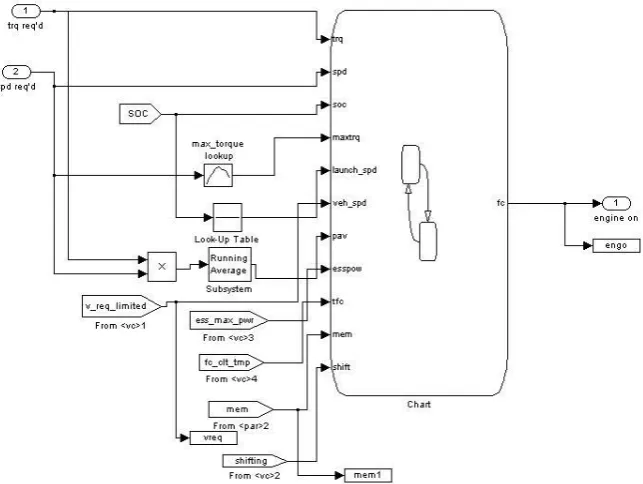
To design the strategy of supervisory control, all the above conditions are implemented in
Figure 3 The structure of supervisory control is implemented in stateflow tool box.
The structure of high level supervisory controller strategy as implemented by Stateflow tool
box in Simulink environment is illustrated in Figure 4.
The optimization of energy management based on fuzz logic
(2) TEM_desired = TLOAD - TICE_Set
Where, TLOAD is the demanded torque, TICE_Set optimized torque of combustion engine and TEM_Desired is the optimal torque for electric engine.
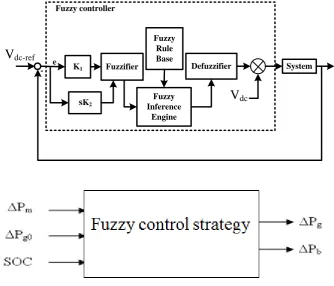
Figure 5 The general structure of fuzzy control strategy
The general fuzzy controller is consisted of the followings:
1) Scaling the input signals
2) Fuzzy controller
3) Scaling output signals
To design the fuzzy control strategy, the results of existing comparative control strategy in
Advisor software are used as benchmark. The most important issue in the design of fuzzy
control strategy is optima l tune up of membership function parameters and the rule bases.
To do this, by Fuzzy Inference System in fuzzy toolbox, an optimal fuzzy controller is
designed.
Fuzzifier
Fuzzy Rule Base
Defuzzifier
Fuzzy Inference
Engine
sK2
K1 System
e
-Fuzzy controller
Vdc-ref
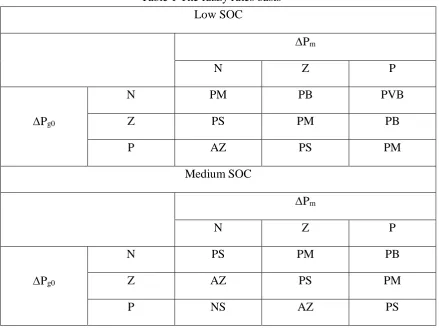
Figure 6 shows the input membership functions of fuzzy controller The fuzzy rules basis is shown in Table 1.
Table 1 The fuzzy rules basis Low SOC
Pm
P Z
N
PVB PB
PM N
Pg0 Z PS PM PB
PM PS
AZ P
Medium SOC
Pm
P Z
N
PB PM
PS N
Pg0 Z AZ PS PM
PS AZ
High SOC
Pm
P Z
N
PM PS
AZ N
Pg0 Z NS AZ PS
AZ NS
NM P
For example, if the charge state of batteries is low and Pg0 is positive and Pm is zero, the output is PS
(positive small).
If the battery charge state is medium and Pg0 is negative and Pm positive, the output is
The simulation results
The control strategy is based on the dynamic model of series hybrid car designed in Matlab
environment. The simulation is performed on NYCC driving cycle. Figure 7 indicates the
Figure 7 The simulation results of fuzzy control strategy based on dynamic modelling of sub-systems
a. Driving cycle, b car speed, c battery charge state, d battery voltage e combustion engine power
As shown in Figure 7, the combustion engine power is in good range when it is on 42KW and the charge state of battery is increased when the combustion engine is one. The control strategy can keep the charge of batteries at good level. Other features of fuzzy control strategy are robustness against the driving cycle changes. As shown in the simulation results, the control strategy can keep the driving capability of car.
By the evaluation of control strategies in the first chapter, the control strategies based on optimal control theory are not implemented under the real conditions of driving as these strategies are mostly based on the driving cycles and the results are achieved as benchmark for other control strategies. The control strategy based on static optimization is based on static modelling of sub-systems.
To achieve a strategy of real time control, the control strategy decide based on current conditions and real conditions of hybrid car system and control strategy is not dependent upon the driving cycle conditions. Based on the hierarchy control structure in electric hybrid car and identification of control models and selection of good switching chain by which the system states are used to fulfill the system performance conditions as a set of discrete outcomes and we investigate the control strategy of real time for electric hybrid car. Here, by a Hybrid Dynamical Control for a driving outcome system, the control strategy is designed. The optima real time control strategy doesn’t mean that it is attempted that the global efficiency of system is maximized and to design the real time control strategy, at first the trend line of system is divided into small parts and each section is corresponding to a performance region. Then, the optimization is performed on each performance region being used to minimize the objective function. Thus, control commands here are not absolute optima and they are sub-optimal. Such strategies are practical and in such strategy, we don’t need a pre-defined cycle.
The possible strategies for control system are as follows:
1- Providing the required torque by combustion engine alone 2- Providing the required torque by electric engine alone
3- Using combustion engine for driving electric motor as a generator of battery charge and using the remaining of torque of combustion engine for driving cars.
4- In braking, using the energy retrieving of brake for charging the batteries as the electric motor is driven by electric motor and acts as a generator.
5- Providing the required torque by the electric and combustion motors
In case 5, instead of using a state, we use the limited set of states. To do this, power division problem is divided into three groups:
Indeed, each of power division strategies has different result for different inputs for driving resources, electric motor and combustion motor.
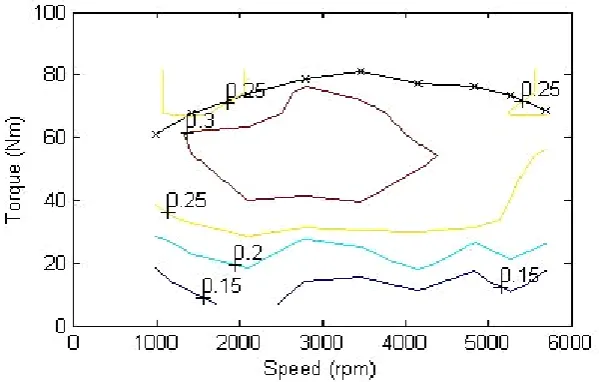
For optimal distribution of power, efficiency curves of each of components are used. Figure 8 shows the efficiency curves of combustion engine of sample as it is used as sample. The curve shown by arrow indicates the operating points in which combustion engine has the maximum efficiency. Thus, the combustion engine point should be in this region.
Figure 8 The optimal operating points and combustion engine efficiency curve
Also, Figure 9 is the curve of electronic motor efficiency. Here, the curve being shown by arrow indicates the operating points in which electric motor efficiency is maximum.
Figure 9 The optimal operating points and curve of electric motor efficiency
Conclusion
1- Until now, various control algorithms are presented for optimal energy management in electric hybrid cars. Most of these methods are based on the algorithms of optimal control and the like. These methods due to its high calculation volume are not implemented under real conditions of movement as the future of movement is not clear for us. Thus, we should design a controller for hybrid car system to select an optimal performance based on the real conditions of system. A real time control strategy should be as the system performance is optimized locally at any time and on the other hand, it should have structural simplicity. Thus, we need a hierarchy control structure for hybrid cars. As shown in the results of simulation, the designed control strategy is not dependent upon the pre-defined movement cycle and it can select the optimal performance mode in the mode system and the related changes and real time is suitable for a control strategy.
2- Other features of the strategy of required control is keeping the battery charge state at good level and this doesn’t reduce the battery charge considerably. By dividing the performance region of control strategy, the batteries are charged during the system performance in some states.
3- By dividing the system performance path, the problem of combustion engine function in maximum efficiency regions is removed. When the combustion engine works in the maximum efficiency region, this increases fuel consumption due to the engine function at high torques. But in this state, due to the existing conditions in system, the combustion engine is switched to the other performance modes in some states and this transfers the generating torque to the lower levels and fuel consumption is reduced. 4- In the complex systems, other conditions are added to the supervisory controller, such
as the effect of combustion engine temperature and this is one of the important features of supervisory hierarchy control structure.
References
[1] B. Mashadi, B. A. Emadi, Dual-Mode Power- Split Transmission for Hybrid Electric
Vehicles, IEEE Trans. On VEHICULAR TECHNOLOGY, vol. ۹٥ , no. ۷, Sep. ۲۰۱۰.
[2] Mehran Mazandarani, Ali Vahidian Kamyad , Naser Pariz, Fuzzy Optimal Control
under Generalized Differentiability of Fuzzy-number-valued Functions, ٤PthP
International Conference of Iranian Operations Research Society, ۲۰۱۱.
[3] N. J. Schouten, M. A. Salman, N. A. Kheir, Fuzzy Logic Control for Parallel Hybrid
Vehicles, IEEE Trans. On Control Systems Technology, Vol. ۱۰, NO. ۳, May ۲۰۰۲.
[4] J. Balakrishnan, Indulal. S., Adaptive Neuro-Fuzzy Control of Internal Combustion
Engine for Hybrid Electric Vehicle, ۱۰PthP National Conference on Technological Trends
[5] National Renewable Energy Laboratory, ADVISOR Documentation, ۳۰ April, ۲۰۰۲.
[6] Xia MENG, N. LANGLOIS, Optimized Fuzzy Logic Control Strategy of Hybrid
Vehicles Using ADVISOR, International Conference on Computer, Mechatronics, Control
and Electronic Engineering (CMCE), ۲۰۱۰.
[7] Ali Mohammadi, Seyed Mohammad, Mohammadian. Mohsen Zabihi Behzad,
Analysis and Review of Strategies and Provide Control Strategy in Energy Management
on Hybrid Electric Vehicles, 2016.
[8] Najafi, Nazila, Rahmani Zahra, Hassanzadeh.Mojtaba, Fuzzy logic based energy
management strategy to reduce fuel consumption in in-plug electric hybrid vehicles, 2017.
[9] Najaran, Samiya, Rahmani Zahra, Hasanzadeh, Mojtabi, Smart Energy Management
Energy Management Strategy to Reduce Fuel Consumption in Electric Hybrid Electric
Vehicles with Parallel structure, 2016.
[10] [Soleimani, Mehdi, Sobhani, Amir Hossein, Ismailiun, Abed, Designing an Intelligent
Control Strategy to Reduce Fuel Consumption and Disclosures in Hybrid Electric Vehicles
With Parallel Structure in Arak . Authors, 2015.
[11] Dawei M, Yu Z, Meilan Z, Risha N. Intelligent fuzzy energy management research for
a uniaxial parallel hybrid electric vehicle. Computers & Electrical Engineering. 2017 Feb