Automatic Classification of Tweets for Analyzing Communication Behavior of
Museums
Nicolas Foucault
1, 2, Antoine Courtin
3, 4 1UMR 7114 – Modèles, Dynamiques, Corpus, Nanterre, France2Julie Desk, Paris, France
3Labex "Les Passés dans le Présent", Nanterre, France
4Institut National d’Histoire de l’Art, Paris, France
[email protected], [email protected]
Abstract
In this paper, we present a study on tweet classification which aims to define the communication behavior of the 103 French museums that participated in 2014 in the Twitter operation:MuseumWeek. The tweets were automatically classified in four communication cate-gories: sharing experience, promoting participation, interacting with the community, and promoting-informing about the institution. Our classification is multi-class. It combines Support Vector Machines and Naive Bayes methods and is supported by a selection of eighteen subtypes of features of four different kinds: metadata information, punctuation marks, tweet-specific and lexical features. It was tested against a corpus of 1,095 tweets manually annotated by two experts in Natural Language Processing and Information Communication and twelve Community Managers of French museums. We obtained an state-of-the-art result of F1-score of 72% by 10-fold
cross-validation. This result is very encouraging since is even better than some state-of-the-art results found in the tweet classification literature.
Keywords:NLP, classification, tweets, communication, behavior, museums, annotation, community managers, corpus, Twitter, MuseumWeek.
1.
Introduction
In the last decade, the two American companies, Facebook and Twitter, have captured the lion’s share of the competi-tive international market built around the creacompeti-tive and par-ticipatory practices of social media. Their business model is based on the expectations and participation of audiences. Beyond studying the behavior of audiences, social media call for a deeper analysis of the actions of profession-als, such as Community Managers (CMs) of museums, who use social networks for promotional/institutional pur-poses, in order to better understand their practices and in-tentions Johnson et al. (2012). To do so, it is essential to achieve a fine-grained classification of the communica-tion content of their messages in micro-blogs such as those found on Twitter, on a large-scale.
The work presented in this paper was conducted with this aim in view and is part of the NOS project1. NOS aims at providing CMs of French cultural institutions with a tool dedicated to help them in the analysis of social-media mes-sages sent by other institutions or users.
2.
Literature Overview
Tweet analysis has led to a large number of studies in many domains such as ideology prediction in Information Sci-ences (Djemili et al., 2014), spam detection in Security (Ya-masaki, 2011), dialog analysis in Linguistics (Boyd et al., 2010), and natural disaster anticipation in Emergency (Gel-ernter and Mushegian, 2011; Sakaki et al., 2013).
Complementary efforts have been made in Social Sci-ences and Digital Humanities to develop tweet classifica-tions (Dann, 2010; Riemer and Richter, 2010; Shiri and Rathi, 2013; Stvilia and Gibradze, 2014).
1bit.ly/1Z5VI7x
However, few studies aim at classifying tweets according to communication classes. They mostly rely on small ref-erence sets analyzed by experts in Information Communi-cation (InfoCom) rather than by Twitter users. An excep-tion worth menexcep-tioning is the work presented in Lovejoy and Saxton (2012), in which the authors (Twitter users) analyze the global behavior of nonprofit organizations on Twitter based on three communication classes: Information, Com-munity and Action classes.
Recently, several studies on tweet classification have been carried out in Natural Language Processing (NLP) (Karimi et al., 2012; Kothari et al., 2013; Lin et al., 2014; Zubiaga et al., 2015). Basically, these analyses aim at categorizing open-domain tweets using a reasonable amount of manu-ally classified data and either small sets of specific classes (e.g. positive versus negative classes in sentiment analy-sis) or larger sets of generic classes (e.g. News, Events and Memes classes in topic filtering). To the best of our knowl-edge, only Courtin et al. (2014) has classified institutional tweets in communication categories based on NLP tech-niques. The advantage of NLP approaches is that they can automatically classify large corpora of tweets. The most commonly used models are supervised learning, Support Vector Machine (SVM) and Naive Bayes (NB) (Sriram et al., 2010; Kouloumpis et al., 2011; Kothari et al., 2013; Malandrakis et al., 2014). In supervised learning, features are extracted from tweets and metadata and then vectorized as training examples to build models.
Compared to English, little work has been done on tweet classification in French except in sentiment analy-sis (Fraisse and Paroubek, 2015), and only two corpora of (non institutional) tweets exist: the FRENCHSOCIALME
The rest of this paper is organized as follows: in Section 3., we present the corpus of tweets we collected on Twitter and used in our experiments. In Section 4., we present the classes and features created in our work. Section 5. de-tails the approach we followed to classify tweets automati-cally in communication categories. In this section, we also present the training and testing data used and the results obtained. In section 6., we present an analysis of the be-havior of the 103 French museums who participated in the
MuseumWeekin 2014 based on our classification method.
Finally, we conclude and suggest some perspectives of this work in Section 7.
3.
Corpus
We collected an initial corpus of 38,756 French tweets (i.e. theMW14 corpus) based the Twitter stream API2. We used Python’s library Twython3 to request the API based on the seven hashtags defined for the first edition of
Mu-seumWeek. MuseumWeekis a cultural event driven by a
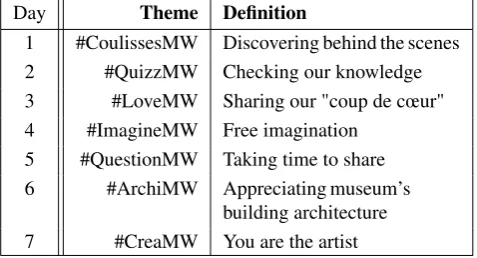
group of twelve community managers of French museums and Twitter (Courtin et al., 2014). It took place over a pe-riod of seven days from the 24thto the 30thof March, 2014. Each day, a different theme (i.e. a hashtag) allowed any registered institution to value its collections, activities and programming while encouraging the public to share their own experiences/content on Twitter. A unique set of hash-tags was defined for each country participating in the event. France’s set is presented in Table 1.
The final version of theMW14 corpus contains 33,658 pre-processed tweets (9,933 tweets and 23,725 retweets). The number of tweets sent by the 103 French institutions who participated in theMuseumWeekwas 6,691 (5,307 tweets and 1,384 retweets). Table 2 provides the number of tweets for each version of this corpus per theme of the Muse-umWeek.
Day Theme Definition
1 #CoulissesMW Discovering behind the scenes
2 #QuizzMW Checking our knowledge
3 #LoveMW Sharing our "coup de cœur"
4 #ImagineMW Free imagination
5 #QuestionMW Taking time to share 6 #ArchiMW Appreciating museum’s
building architecture
[image:2.595.326.520.68.211.2]7 #CreaMW You are the artist
Table 1: Theme of theMuseumWeek(2014).
The preprocessing applied to obtain the final version of the
MW14 corpus was threefold: data cleaning, data extraction, and data normalisation.
Data cleaning comprised two stages:
(i) Removing invalid/duplicated tweets from Twython’s output (json structure);
2
https://dev.twitter.com
3https://github.com/ryanmcgrath/twython
MW14 corpus Processing step Collection Preprocessing
CoulisseMW 6,557 6,040
QuizzMW 4,947 4,296
LoveMW 7,999 7,210
ImagineMW 5,565 4,222
QuestionMW 2,978 2,382
ArchiMW 6,051 5,522
CreamMW 4,659 3,986
Total 38,756 33,658
Table 2: Number of tweets for each theme found in the
MW14 corpus and each data processing step applied on it.
(ii) Solving encoding errors so that tweets were encoded properly in UTF-8 (with Unicode characters).
Data extraction was also a two-stages process:
(i) Extraction of relevant information from the cleaned data;
(ii) Conversion to csv format (the same charset as for the cleaned data). An example of extracted data is given in Figure 1 (the first line corresponds to a csv head-ing).
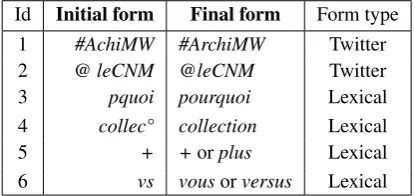
Data normalisation is one-fold: it is an iterative process dedicated to textual normalization. We did not have to un-dertake a complex normalisation process as is often the case with micro-blogging data (Chanier et al., 2014). Pattern matching based on regular expressions was used to map syntactic, lexical and Twitter specific forms found in tweets to their normalized forms. Mostly, we dealt with abbrevi-ated forms and tokenization errors relabbrevi-ated to Twitter forms as illustrated in Table 3 (examples 5 and 6 are context-dependent in this table).
tweet_id,date_UTC,username,tweet_text
448230958396080128,2014-03-24
22:52:42,Fred,"RT @CVersailles: Dernier tweet de la journée #CoulissesMW, demain
la MuseumWeek continue avec #QuizzMW, bonne nuit ! http://t.co/MeTw3kkvBO"
Figure 1: Example ofMW14 data (csv format).
Data extraction was done in csv and was performed at streaming time, to avoid having to deal with heavy json structures as returned by the Twitter API later on.
TheMW14 corpus is available in xslx format4(initial ver-sion only) but will be available (initial and preprocessed versions) on a repository at the Bibliothèque Nationale de France (BnF) and on Dataverse5in csv format.
4
http://bit.ly/1PM68Y2
5http://www.bnf.fr
[image:2.595.52.291.495.624.2]Id Initial form Final form Form type
1 #AchiMW #ArchiMW Twitter
2 @ leCNM @leCNM Twitter
3 pquoi pourquoi Lexical
4 collec° collection Lexical
5 + +orplus Lexical
[image:3.595.66.274.69.167.2]6 vs vousorversus Lexical
Table 3: Textual normalisation examples.
4.
Classification
The main idea of our approach is to categorize automati-cally tweets based on their textual content. Our classifica-tion is multi-class (i.e. any given tweet may be classified into more than one category). In this section, we introduce the classes and features used in our experiments and pre-sented in section 5.
Both categories and features have been determined based on a small set of 200 tweets taken from theMW14 corpus. As hashtags are a distinctive characteristic of tweets (Jack-iewicz and Vidak, 2014), these 200 tweets have been se-lected randomly based on the distribution of tweets found in theMW14 corpus over the different hashtags of the Mu-seumWeek(see Table 1).
The categories and features presented in this section have been designed by two researchers familiar with Twitter: a specialist in NLP and an expert in InfoCom who works in the cultural field.
4.1.
Categories
We defined four communication categories to classify tweets in our work:
1. Sharing experience: sharing an experience/opin-ion/sentiment (e.g. @TanjaPraske pouvez-vous nous en dire plus?);
2. Promoting participation: asking users to do some-thing and/or to participate in an activity on-line or in-real-life (e.g.Et si vos ados venaient enregistrer leur jam session au #Studio1316 ? http://t.co/33Tq3d2H);
3. Interacting with the community: hailing or re-plying to one or several accounts at the same time (e.g. @NathBoiss en effet, depuis plusieurs mois la tenture est en restauration. Chaque pièce sera bichon-ner ainsi! ;));
4. Promoting-informing about the institution: pro-moting or informing people about activities, collec-tions and practical information concerning the mu-seum (e.g. Découvrez les processus d’aller-retour dans l’oeuvre de #Matisse avec l’expo "Paires et séries" http://t.co/qYXpeMaK).
These categories were defined by our expert in InfoCom and validated by two Community Managers (CMs) of French museums in Paris. They have been initially used in Courtin et al. (2014).
4.2.
Features
We used 18 types of features subsumed in four main types in order to represent tweets in this study. They are based on manual analysis performed on the aforementioned set of 200 tweets by our NLP specialist and InfoCom expert, in addition of automatic term frequency extractions conducted on theMW14 corpus.
These features extend those used in Courtin et al. (2014) and draw on two previous studies done on tweet classifi-cation in sentiment analysis (Kouloumpis et al., 2011) and comment detection (Kothari et al., 2013). They were as-signed boolean value, coding for the presence or absence of a specific piece of information in the textual content of tweets. The four main types of features used in this study are:
• Metadata information: whether the author of a tweet is a museum (is_museum), whether the author of the tweet is mentioned in the tweet (@self), whether a museum is mentioned in the tweet (@museum), whether another Twitter user than the author of the tweet is mentioned in the tweet@user);
• Punctuation marks: whether a tweet contains an exclamation mark (punct!) or a question mark (punct?). We noticed that these marks are partic-ularly common in interactions between museum indi-viduals;
• Tweet-specific features: whether a tweet contains url (url), hashtags (#), emoticons (smileys), whether a tweet is a modified tweet (is_MT) and whether it contains Twitter conventions such as cc (cc) or .@ (.@). The latter two features both give the tweet more visibility. The first one means: "share my tweet with all the friends mentioned explicitly after the cc refer-ence" while the other one means: "make my tweet vis-ible to everybody". These two features mostly appear in tweets of classes 1–3;
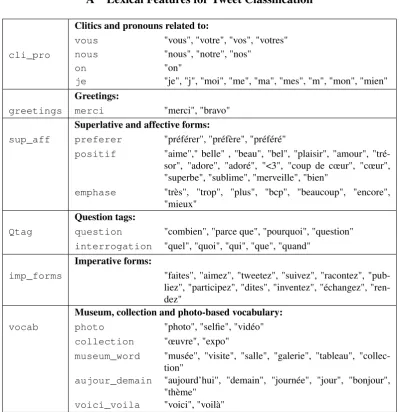
• Lexical features: each subtype of lexical features de-scribed below is detailed in Appendix A (Table A.1).
– cli_pro: clitics and pronouns related toje,on,
nousandvous(used in tweets of classes 1–2);
– greetings: used in tweets promoting partici-pation and by CMs to hail people;
– sup_aff: superlative and affective forms (e.g.très,beau);
– Qtag: question tags used by CMs to interact with people;
– imp_forms: imperative forms (e.g.tweetezand
participez), most likely to appear in museum
tweets to make people share their experience;
5.
Evaluation
In this section, we present the data used to train and test our classifiers, the methodology applied and the related results.
5.1.
Training and Testing Data
We annotated manually a total of 1,309 tweets into cate-gories. These data were split into four corpora:TRN,DEV,
TSTandCMR. Tweet distributions for each corpus are given in Table 4. All the data were selected randomly from the
MW14 corpus (normalized version; no duplicates) and all annotations were done using the same guideline which de-scribes the annotation procedure, rules and categories along with some examples.
Dist. TRN DEV TST CMR All %All
cat1 129 10 8 121 268 24
cat2 106 5 37 65 213 20
cat3 211 14 29 57 311 28
[image:4.595.357.489.69.190.2]cat4 106 37 17 143 303 28 All 552 66 91 386 1,095 100
Table 4: Overall and per class tweet distributions.
The NLP and InfoCom experts who designed the categories and features aforementioned also annotated the three first corpora. TheTRNandDEVcorpora were annotated by the former expert while both experts annotated the TST cor-pus. TheCMRcorpus contains annotations made by twelve Community Managers of museums during an annotation campaign that we conducted. The campaign consisted in making six different samples of 100 tweets to be annotated by two different CMs each. So far, no inter-annotators con-sensus has been assigned. Therefore, the actualCMRcorpus comprises only the reference annotations corresponding to straightforward agreements between annotators. The total number of references in this corpus represents 386 annota-tions over the 600 performed by the CMs. In addition to the other references (TRN: 552,DEV: 66 andTST: 91 tweets), the total number of references used in our experiments was 1,095 annotations.
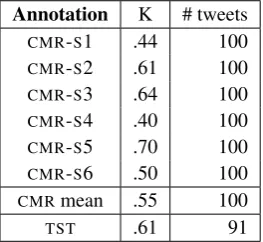
We used Cohen’s Kappa inter-annotator agreement (Cohen, 1960) as implemented in R 6. Kappa results for theCMR and TSTdata are given in Table 5. According to Landis and Koch (1977) interpretation scale, these results are ac-ceptable, lying between moderate (CMR) and strong (TST). In particular it is interesting to note that qualitatively there is no difference between those who are familiar with the annotation task (our NLP and InfoCom experts) and those unfamiliar with the task (CMs) as the inter-annotator agree-ments obtained on the two corpora are almost the same. Our intuition on this point is that CMs balanced their lack of experience in the annotation domain with their knowl-edge in institutional communication and their expertise of Twitter which was the reason why we preferred to choose CMs rather than professional annotators in the first place.
6http://personality-project.org/r/psych
Annotation K # tweets
CMR-S1 .44 100
CMR-S2 .61 100
CMR-S3 .64 100
CMR-S4 .40 100
CMR-S5 .70 100
CMR-S6 .50 100
CMRmean .55 100
TST .61 91
Table 5: Inter-annotator agreements (K) obtained on the Community Managers samples (CMR-S1 toCMR-S6) and theTSTcorpus. # tweets: number of tweets.
5.2.
Methodology
We used standard precision (P) and recall (R) rather than accuracy to evaluate our approach (Ben-David, 2007). We opted for anF0.5-measure as in Kothari et al. (2013) since this measure is more appropriate to evaluate performances if precision prevails over recall as in our case7.
We conducted global and per class evaluations and applied both direct and 10-CV (Kohavi, 1995) evaluations. In the first case (i.e. all evaluations except 10-CV), the training corpus was: TRN. Otherwise (i.e. for 10-CV evaluation), training/testing splits were defined with respect to the over-all and per class proportions of tweets indicated in Table 4 (%All column). Consequently, 10-CV training and testing splits comprised 986 and 109 tweets per run respectively. In both cases, we relied on theScikit-learnmachine learning framework (Pedregosa et al., 2011) to build our classifiers, based on the one-against-all schema (Rifkin and Klautau, 2004) to train our SVMs and all standard parameters other-wise (i.e. for NB).
5.3.
Results
Overall and per class results are presented respectively in Tables 6 and 7 while the impact of each main kind of feature is described in Section 4. on the classification performances is given in Table 8.
Eval. P R F1 F0.5
TRN .746 .768 .757 .750
DEV .774 .742 .757 .767
TST .541 .780 .639 .577
[image:4.595.59.282.250.333.2]CMR .693 .841 .760 .718 10-CV .680 .768 .721 .696
Table 6: Overall results (all features).
In Table 6, can be seen that the result performed on the
TRN andDEVcorpora are the same (F1 score of .757 for each corpus). This table also shows that the result obtained by CV on all the corpora merged together was very close to the previous result with an overall F1score of .721. This
7However, the tables of results giveF
1scores for the sake of
[image:4.595.340.503.572.657.2]result is rather surprising since CV evaluation usually leads to lower results than direct evaluation (as it takes into ac-count 10 times more results on smaller and much more var-ied samples of data) and means that the categories, features and corpora produced are consistent enough to automate the classification process of tweets in communication classes according to their textual content. The corollary of this re-sult is that the different corpora produced, and especially the TRN and DEV corpora annotated by the same person (our NLP specialist) and the CMR corpus annotated by a large number of non professional annotators (twelve CMs) in a very segmented way (six subcorpora of 100 tweets, each subcorpus annotated by two different CMs), present annotations of quality. Even theCMR corpus presents the best results with an F1score of .760 which is very promis-ing for future work as it is a state-of-the-art result (Pak and Paroubek, 2010; Kouloumpis et al., 2011; Maynard et al., 2012; Zubiaga et al., 2014; Zubiaga et al., 2015).
Eval.-CMR P R F1 F0.5 cat1 .618 .847 .715 .653 cat2 .576 .853 .688 .616 cat3 .809 .750 .778 .796 cat4 .822 .870 .845 .831
Table 7: Results per class (all features).
The lower performances obtained on theTSTdata as shown in Table 6 can be attributed to the number of tweets in the first two categories (respectively 8 and 37 tweets) compared to the small amount of data it contains. In fact, these cate-gories are the most difficult to distinguish for classification purposes as they obtained the lowest F1 scores in the per class evaluation results presented in Table 7 (.653 and .616 for each category respectively). Further investigations are necessary concerning this point.
Eval.-CMR P R F1 F0.5
lex .567 .745 .644 .595
lex+punct .580 .752 .655 .607 lex+punct+meta .701 .832 .761 .723
[image:5.595.79.259.298.367.2]lex+punct+meta+tweets .693 .841 .760 .718
Table 8: Results per main types of features (CMRcorpus).
Finally, Table 8 shows that metadata information features are the most discriminating for the classification of tweets in our communication categories since the overall perfor-mance gain is about 12% in terms of F1score (lex+punct: .607 versus lex+punct+meta: .723). The performance gain with punctuation marks is much smaller (about 1%) whereas there is no gain concerning the tweet-specific features; the result is even slightly lower compared to the lex+punct+meta combination (lex+punct+meta+tweets: .718). This is very surprising as this kind of fea-tures always provides a classification benefit in the litera-ture (Kouloumpis et al., 2011) and therefore needs further
investigation. It would be interesting for example to carry out the same kind of analysis as here but for each subtype of features in order to filter out irrelevant features.
6.
Communication Behavior
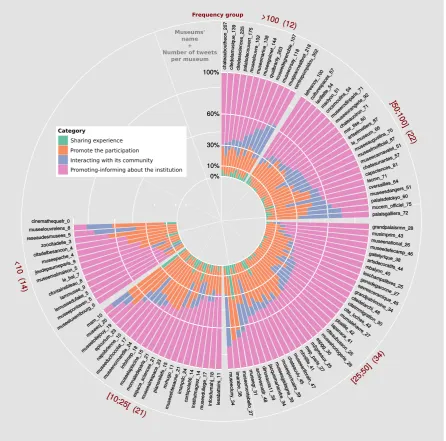
The global behavior of the 103 Museums which partici-pated in theMuseumWeekis given in Figure 2. This anal-ysis was obtained by applying our classification method presented in the previous section to the 5,307 tweets (no retweets) sent by the 103 French museums during the Mu-seumWeek. In this case, we trained our classifiers on the
TRNcorpus.
Figure 2 reveals for instance that French museums were communication-centric since most of their tweets con-cerned promotion of their own institution (in pink on the figure). It also shows that very few participants exchanged with people on Twitter since the proportion of tweets cate-gorized as Interacting with the community (in blue on the figure) is only the third most representative behavior, ex-cept for the most active museums, i.e., the twelve museums that sent more than 100 tweets during the week like the Centre Pompidou (302 tweets) and Musée du Quai Branly (263 tweets).
7.
Conclusion and Perspectives
In this work, we collected a corpus of 30K tweets from Twitter during the first edition of theMuseumWeekand used it to create the first event-based corpus (available online) of French tweets categorized in communication classes. Our approach is multi-class and combines SVMs and Naive Bayes classifiers based on four kinds of features: metadata information, punctuation marks, tweet-specific and lexical features. We evaluated it on 1,095 tweets annotated by twelve community managers of museums, one NLP spe-cialist and an expert in Information Communication. We obtained a state-of-the-art result of .695F0.5-score. We are still completing our reference corpus (CMRcorpus) and we plan in future work to extend our classifier using n-grams and POS tag features. In the meanwhile, this study was also applied on a new corpus of data collected during theMuseumWeeklast year (600K tweets) in order to carry out a comparative study of theMuseumWeekevent between 2014 and 2015. This study was recently published officially for the French Minister of Culture (Courtin and Foucault, 2015).
8.
Bibliographical References
Ben-David, A. (2007). A Lot of Randomness is Hiding in Accuracy. Engineering Applications of Artificial Intelli-gence, 20(7):875–885.
[image:5.595.56.281.530.603.2]Sharing experience Promote the participation Interacting with its community Promoting-informing about the institution
Museums' name
+ Number of tweets
per museum
Category
[image:6.595.74.521.71.512.2]Frequency group
Figure 2: Behavior of the 103 French museums which participated in theMuseumWeek(2014). Behavior is defined ac-cording to our 4 communication categories. Museums are presented by frequency groups in descending order, based on the total number of initial tweets (i.e. no retweets) they sent during the event.
Cohen, J. (1960). A Coefficient of Agreement for Nom-inal Scales. Educational and Psychological Measure-ment, 20(1):37–46.
Courtin, A. and Foucault, N. (2015). Quantitative and Categorial Analysis of Tweets Sent During the #Muse-umWeek2015 Event. Research Report V0.2, Labex les passés dans le présent, October.
Courtin, A., Juanals, B., Minel, J., and de Saint Léger, M. (2014). A Tool-Based Methodology to Analyze So-cial Network Interactions in Cultural Fields: The Use Case "MuseumWeek". InProceedings of the 6th Inter-national Conference on Social Informatics (SocInfo’14), pages 144–156.
Dann, S. (2010). Twitter Content Classification. First Monday, 15(12).
Djemili, S., Longhi, J., Marinica, C., Kotzinos, D., and Sar-fati, G.-E. (2014). What does Twitter have to say about
ideology? InNLP 4 CMC: Natural Language Process-ing for Computer-Mediated Communication / Social Me-dia, volume 1, pages 16–25.
Fraisse, A. and Paroubek, P. (2015). Comparable Mi-croblogs for Multilingual Affective lexicons. Natural Language Engineering, 1(1):1–20.
Gelernter, J. and Mushegian, N. (2011). Geo-parsing Mes-sages from Microtext. Transactions in GIS, 15(6):753– 773.
Jackiewicz, A. and Vidak, M. (2014). Étude sur les mots-dièse. SHS Web of Conferences, 8:2033–2050.
Johnson, L., Adams, S., and Cummins, M. (2012). NMC Horizon Report: 2012 Higher Education Edition. Tech-nical report, New Media Consortium.
Confer-ence (TREC’12).
Kohavi, R. (1995). A Study of Cross-validation and Boot-strap for Accuracy Estimation and Model Selection. In
Proceedings of the International Joint Conference on Ar-tificial Intelligence (IJCAI’95), pages 1137–1143. Kothari, A., Magdy, W., Darwish, K., Mourad, A., and Taei,
A. (2013). Detecting Comments on News Articles in Microblogs. In Emre Kiciman, et al., editors, Proceed-ings of the 7th International Conference on Web and
So-cial Media (ICWSM). The AAAI Press.
Kouloumpis, E., Wilson, T., and Moore, J. (2011). Twitter Sentiment Analysis: The Good the Bad and the OMG! In Proceedings of the 5th International Conference on
Web and Social Media (ICWSM).
Landis, J. R. and Koch, G. G. (1977). The Measurement of Observer Agreement for Categorical Data. Biometrics, 33(1):159–174.
Shou-De Lin, et al., editors. (2014). Proceedings of the
2nd Workshop on Natural Language Processing for
So-cial Media. Association for Computational Linguistics and Dublin City University, Dublin, Ireland.
Lovejoy, K. and Saxton, G. D. (2012). Information, Com-munity, and Action: How Nonprofit Organizations Use Social Media. Journal of Computer-Mediated Commu-nication, 17(3):337–353.
Malandrakis, N., Falcone, M., Vaz, C., Bisogni, J. J., Potamianos, A., and Narayanan, S. (2014). SAIL: Sen-timent Analysis using Semantic Similarity and Contrast Features. InProceedings of the 8th International Work-shop on Semantic Evaluation (SemEval’14), pages 512– 516, Dublin, Ireland.
Maynard, D., Bontcheva, K., and Rout, D. (2012). Chal-lenges in developing opinion mining tools for social me-dia. InProceedings of @NLP can u tag #usergenerated-content?! Workshop at International Conference on Lan-guage Resources and Evaluation, LREC 2012, 26 May
2012, Istanbul, Turkey. European Language Resources
Association.
Pak, A. and Paroubek, P. (2010). Twitter as a corpus for sentiment analysis and opinion mining. InProceedings of the International Conference on Language Resources and Evaluation, LREC 2010, 17-23 May 2010, Valletta, Malta.
Pedregosa, F., Varoquaux, G., Gramfort, A., Michel, V., Thirion, B., Grisel, O., Blondel, M., Prettenhofer, P., Weiss, R., Dubourg, V., Vanderplas, J., Passos, A., Cour-napeau, D., Brucher, M., Perrot, M., and Duchesnay, E. (2011). Scikit-learn: Machine Learning in Python. Jour-nal of Machine Learning Research, 12:2825–2830.
Riemer, K. and Richter, A. (2010). Tweet Inside: Mi-croblogging in a Corporate Context. In Proceedings 23rd Bled eConference eTrust: Implications for the In-dividual, Enterprises and Society.
Rifkin, R. and Klautau, A. (2004). In Defense of One-Vs-All Classification. Journal of Machine Learning Re-search, 5:101–141.
Sakaki, T., Okazaki, M., and Matsuo, Y. (2013). Tweet Analysis for Real-Time Event Detection and Earthquake
Reporting System Development. IEEE Transactions on
Knowledge and Data Engineering, 25(4):919–931.
Seddah, D., Sagot, B., Candito, M., Mouilleron, V., and Combet, V. (2012). The French Social Media Bank: a Treebank of Noisy User Generated Content. In Proceed-ings of the 24th International Conference on Computa-tional Linguistics (COLING’12), pages 2441–2458. Shiri, A. and Rathi, D. (2013). Twitter Content
Categori-sation: A Public Library Perspective. Journal of Infor-mation & Knowledge Management (JIKM), 12(04). Sriram, B., Fuhry, D., Demir, E., Ferhatosmanoglu, H., and
Demirbas, M. (2010). Short Text Classification in Twit-ter to Improve Information FilTwit-tering. In Fabio Crestani, et al., editors,SIGIR, pages 841–842. ACM.
Stvilia, B. and Gibradze, L. (2014). What do Academic Li-braries Tweet About, and What Makes a Library Tweet Useful? Library & Information Science Research, 36(3–4):136–141.
Yamasaki, S. (2011). A Trust Rating Method for Informa-tion Providers over the Social Web Service: A Pragmatic Protocol for Trust among Information Explorers and In-formation Providers. InProceedings of the 11thAnnual International Symposium on Applications and the Inter-net (SAINT’11), pages 578–582.
Zubiaga, A., Vicente, I. S., Gamallo, P., Campos, J. R. P., Loinaz, I. A., Aranberri, N., Ezeiza, A., and Fresno-Fernández, V. (2014). Overview of tweetlid: Tweet lan-guage identification at SEPLN 2014. InProceedings of the Tweet Language Identification Workshop co-located with 30th Conference of the Spanish Society for Natural Language Processing, TweetLID@SEPLN 2014, Girona, Spain, September 16th, 2014., pages 1–11.
Zubiaga, A., Spina, D., Martínez, R., and Fresno, V. (2015). Real-time Classification of Twitter Trends.
A
Lexical Features for Tweet Classification
cli_pro
Clitics and pronouns related to:
vous "vous", "votre", "vos", "votres"
nous "nous", "notre", "nos"
on "on"
je "je", "j", "moi", "me", "ma", "mes", "m", "mon", "mien"
greetings
Greetings:
merci "merci", "bravo"
sup_aff
Superlative and affective forms:
preferer "préférer", "préfère", "préféré"
positif "aime"," belle" , "beau", "bel", "plaisir", "amour", "tré-sor", "adore", "adoré", "<3", "coup de cœur", "cœur", "superbe", "sublime", "merveille", "bien"
emphase "très", "trop", "plus", "bcp", "beaucoup", "encore", "mieux"
Qtag
Question tags:
question "combien", "parce que", "pourquoi", "question"
interrogation "quel", "quoi", "qui", "que", "quand"
imp_forms
Imperative forms:
"faites", "aimez", "tweetez", "suivez", "racontez", "pub-liez", "participez", "dites", "inventez", "échangez", "ren-dez"
vocab
Museum, collection and photo-based vocabulary:
photo "photo", "selfie", "vidéo"
collection "œuvre", "expo"
museum_word "musée", "visite", "salle", "galerie", "tableau", "collec-tion"
aujour_demain "aujourd’hui", "demain", "journée", "jour", "bonjour", "thème"
[image:8.595.96.496.76.489.2]voici_voila "voici", "voilà"