Joint Estimation and Decoding of Space-Time
Trellis Codes
Jianqiu Zhang
Department of Electrical and Computer Engineering, State University of New York at Stony Brook, Stony Brook, NY 11794-2350, USA
Email: [email protected]
Petar M. Djuri´c
Department of Electrical and Computer Engineering, State University of New York at Stony Brook, Stony Brook, NY 11794-2350, USA
Email: [email protected]
Received 31 May 2001 and in revised form 22 January 2002
We explore the possibility of using an emerging tool in statistical signal processing, sequential importance sampling (SIS), for joint estimation and decoding of space-time trellis codes (STTC). First, we provide background on SIS, and then we discuss its application to space-time trellis code (STTC) systems. It is shown through simulations that SIS is suitable for joint estimation and decoding of STTC with time-varying flat-fading channels when phase ambiguity is avoided. We used a design criterion for STTCs and temporally correlated channels that combats phase ambiguity without pilot signaling. We have shown by simulations that the design is valid.
Keywords and phrases:space-time coding, sequential importance sampling, Kalman filtering, phase ambiguity, design criterion.
1. INTRODUCTION
Space-time coding (STC) originally introduced by Foschini [1] and further developed by Tarokh et al. in [2] provides a framework for exploiting spatial and temporal diversity to increase data rate in wireless communications. A general in-troduction of space-time coding can be found in [3]. Among families of space-time codes, we are interested in STTCs be-cause of their many advantages over block STCs as pointed out in [2].
It is generally assumed that STCs will be used in fading environments, and therefore in decoding it is necessary to obtain channel state information (CSI), that is, estimate of the fading coefficients of the channel. In the literature, most of the time it is assumed that CSI becomes available through sending pilot sequences periodically from the transmit to the receive side. When CSI is not available, we have to estimate the channel, and that presents many challenges because the wireless channel may vary with time or frequency or both, and in systems with multiple transmit and receive antennas, many channels need to be estimated. Some design efforts have been directed to the construction of STCs which al-low for circumventing channel estimation such as the unitary ST-modulation scheme discussed in [4] or differential space-time modulation considered in [5]. An interesting Kalman
filter space-time algorithm for joint estimation and decoding of Alamouti’s block ST code [6] was proposed in [7], where Kalman filtering is used for tracking the channel. We have not seen similar work for STTCs. Here we consider the problem of joint channel estimation and decoding of STTCs when no pilot signal is available and the channel is modeled as time-varying flat-fading channel. Because STTCs use complicated modulation schemes, the observation at the receive side may not be a linear function of the transmitted data. Also, the CSI is hidden in the observation, and it is hard to use conven-tional methods like the Kalman filter to solve this problem. In this paper, we address joint estimation and detection of STTC by the sequential importance sampling (SIS) method combined with Kalman filtering.
The following text is a brief summary of SIS. The statisti-cal property of many parameters in communication prob-lems, like the fading coefficients in flat-fading channels, channel impulse response in frequency selective fading chan-nels, and the trellis coded user data can be characterized by hidden Markov processes (HMPs). Consequently, many sys-tems, including STTC syssys-tems, can be described adequately by dynamic state space models (DSSMs) [8, 9], which use state equations for describing the dynamics of the HMPs
the observations {yt}as functions of{xt}. In the Bayesian framework, all information about the unknowns{xt}is in-cluded in the posterior distribution, p(x0, . . . ,xT|y0, . . . ,yT), up to time T, from which the marginalized posterior dis-tribution of interest, p(xt|y0, . . . ,yT) for all t ≤ T, can be derived. However, the posterior density is usually high di-mensional, and it is hardly ever possible to find the analyt-ical expression for the density function, let alone to evaluate it. Due to the properties of the HMP, the posterior distribu-tion, p(x0, . . . ,xT|y0, . . . ,yT), can be factored in many ways and each term after the factorization may be evaluated indi-vidually. For example, if the posterior density is written as
px0, . . . ,xT|y0, . . . ,yT
∝px0, . . . ,xT−1|y0, . . . ,yT−1pyT|xT−1,
(1)
this factorization provides a way to evaluate the desired pos-terior density recursively. However, except in the few special cases like in the linear Gaussian DSSM when Kalman filter-ing can be applied, there is usually no analytical solution to evaluate it recursively. Recently, a variety of Monte Carlo sampling methods, like importance sampling, Markov Chain Monte Carlo (MCMC) including Gibbs sampling [10, 11, 12], have revived Bayesian signal processing with their ability to sample from highly complicated probability density func-tions and thereby allowing for the computation of complex high dimensional integrals. In the literature, SIS [13, 14, 15], was introduced for solving problems that can be described by DSSMs without the strict restrictions imposed by the Kalman filter. In communications, SIS methods have been used for blind detection of user data [16, 17, 18]. Because there are no mathematical approximations of the model, SIS methods are found to perform better than traditional methods like the Extended Kalman Filter (EKF) [19, 20] or the Gaussian Sum Filter (GSF) [21]. It should be noted, however, that the sam-pling based methods use approximations too in that they ap-proximate relevant densities with samples from these densi-ties. The good performance, versatility, and the potential for implementation in VLSI make SIS methods very attractive.
This paper is organized as follows: Section 2 introduces the basic concept of SIS, where many aspects of SIS are dis-cussed. Section 3 elaborates the application of SIS to the joint estimation and decoding of STTCs. In Section 4, we analyze the problem of phase ambiguity and find that when the chan-nel is temporally correlated, it is possible to design ST cod-ing schemes that alleviate phase ambiguity. There we pro-pose an ad hoc space-time coding scheme, which is effective in combating phase ambiguity. Simulations are presented in Section 5, and in Section 6, conclusions are drawn.
2. SEQUENTIAL IMPORTANCE SAMPLING
In this section, we provide some background of SIS and the important special case of mixture SIS and Kalman filtering, which is suitable for joint estimation and decoding of STTCs in a time-varying flat-fading environment.
The SIS algorithm is applicable to systems that can be described by DSSMs which consist of state and observation
equations, that is,
xt =f
xt−1,ut
, yt=g
xt,vt
, (2)
where f(·) is the state transition function, which defines how the state vectorxt evolves with time based on the previous state vectorxt−1and the input noise vectorut at timet, and
g(·) is an observation function of xt and the observation noise vectorvt. We can see that the state transition function defines a Markov process because, given the previous state vectorxt−1, the current state vector is no longer dependent
on other previous state vectors or observations. Note that the state vector is not observed directly, and therefore the model describes an HMP.
From Bayesian perspective, all information about the state vectors is contained in the full posterior density
p(x0:t|y0:t) from which the filtering densityp(xt|y0:t) and the smoothing density p(xt|y0:T) for allt < Tcan be obtained. Here,x0:t = {x0, . . . ,xt}is the set of all state vectors from time 0 to timet, andy0:tis defined similarly. When the full posterior density is available, the expected value of any func-tion of the state vectors,ξ(x0:t) can be evaluated by
Ex0:t|y0:t
ξx0:t
=
ξx0:t
px0:t|y0:t
dx0:t. (3)
If a DSSM is linear and Gaussian, that is, both the state transi-tion and the observatransi-tion functransi-tions are linear and both noise vectorsut andvt are Gaussian, the full posterior density of interest, p(x0:t|y0:t), can be obtained using the Kalman fil-ter. In other cases, if the DSSM is not linear and Gaussian, approximations to the model must be made before apply-ing the Kalman filter. Because of these approximations, the performance of the Kalman filter is limited. On the other hand, SIS can be used in such cases as discussed in [13, 16]. With SIS, the goal is to generate samples fromp(x0:t|y0:t) that are used for computation of statistical expectations as in (3). However, it is generally hard to draw samples directly from the posterior distribution, p(x0:t|y0:t), and instead, the im-portance sampling method is employed. Samples,{x(0:jt)}Jj=1, where j = 1,2, . . . , J is a sample index, are generated from a proposal density function π(x0:t|y0:t), and subsequently they are weighted according to the real posterior distribu-tion p(x0:t|y0:t). The weight of a particular sample is given by
wt(j)=
px(0:jt)|y0:t
πx(0:jt)|y0:t
. (4)
The expectation in (3) is then approximated using Monte Carlo integration, that is,
ˆ
Ex0:t|y0:t
ξx0:t
= 1
Wt J
j=1
ξx(0:jt)w(tj), (5)
also called a particle, and sometimes SIS is referred to as par-ticle filtering. Note that in this paper,x(tj)is called a sample element.
An interesting characteristic of the full posterior density function at timetis that it can be factored as a product of the full posterior density of the previous time instantt−1 and an incremental term,
px0:t|y0:t
∝px0:t−1|y0:t−1×pyt|xt
pxt|xt−1. (6)
If the incremental termp(yt|xt)p(xt|xt−1) can be evaluated at
each time instant, we can obtain the full posterior density re-cursively. If the importance function is chosen in the form of
πx0:t|y0:t=πx0:t−1|y0:t−1πxt, (7) we can derive an SIS algorithm which allows us to draw sam-ples and evaluate their weights recursively. Suppose that we have obtained the sample set {x(0:jt)−1}Jj=1 properly weighted with respect to p(x0:t−1|y0:t−1) from previous recursions.
Then at timetfor thejth sample, we
(1) draw a new sample elementxt(j)from the incremental proposal densityπ(xt),
(2) append the new sample elementxt(j)tox(0:jt)−1and ob-tain the new samplex(0:jt), and
(3) evaluate the weight for the new samplex(0:jt)according to (4), that is,
w(tj)=
px(0:jt)|y0:t
πx0:(jt)|y0:t
= p
x(0:jt)−1|y0:t−1pyt|x( j) t
px(tj)|x(0:jt)−1 πx(0:jt)−1|y0:t−1πx(tj)
=w(t−1j)p
yt|x(tj)
pxt(j)|xt(−1j) πx(tj) .
(8)
The same procedure is repeated for allJ samples. The path that each sample takes is also called a trajectory and so there are totally J trajectories when running the SIS algorithm. Note that the incremental proposal density functionπ(xt) is simply referred to in the literature as the proposal density function or importance function.
Next question of interest is the selection of the impor-tance function, π(xt). First of all, π(xt) must have appro-priate support. Second, we should be able to draw samples from π(xt), and third,π(xt) should be easily computable. There are many choices, two of which are the prior den-sity functionp(xt|xt−1) and the so-called “optimal” proposal
function p(xt|x0:t−1,y0:t). Intuitively, good proposal func-tions take into account all the available observafunc-tions and past state vectors.
The optimal importance function is proportional to the product of two density functions,
pxt|x( j) 0:t−1,y0:t
∝pyt|xt
pxt|x(
j) t−1
(9)
and after obtaining the new sample elementx(tj), its weight
x(0:jt)is assigned using (8)
w(tj)=w (j) t−1
pyt|xt(j)
pxt(j)|x(t−1j) pxt(j)|x0:(jt)−1,y0:t
=w(t−1j)p
yt|x(t−1j)
.
(10)
We can see that to computew(tj)fromw (j)
t−1, we need to
eval-uate an integral because
pyt|x(t−1j)
=
pyt|xt
pxt|xt(−1j)
dxt. (11)
Ifxt is defined on a finite discrete space, there would be no problem in computing (11) when the size of the space is small because the integration simply becomes a sum of small num-ber of proposal densities. Whenxt is defined on an infinite discrete space or continuous space, there is in general no an-alytical solution to (11).
2.1. Mixture SIS and Kalman filtering
An important special case of SIS is when the state vector can be partitioned into two parts, where one of them is condi-tionally linear and Gaussian given the other part. For exam-ple, in wireless communications with flat fading, the obser-vation is the product of the sent user signal and the fading coefficients embedded in additive noise. The state vectorxt contains two parts (ht,st), wherehtis the state vector of the fading coefficients (channel state vector) andst is the user state vector. The user state vector and channel state vector can all be modeled as HMPs, that is,
st=zst−1, dt, (12)
ht=Fht−1+Eut, (13) wheredtis the user data input at timet,z(·) is the state tran-sition function of the user state vector, andEis a known ma-trix. The observation equation can be written as
yt=C
st
Rht+vt, (14)
where C(·) is a matrix coding and modulation function of the communication system andRis another known matrix of model coefficients (their meaning will be explained in the sequel). Givenst, the DSSM is linear and Gaussian inht, that is, both noise vectors ut andvt are complex Gaussian and the state transition and observation functions are linear and are described by the state transition matrixFand matrixR. Note that in most cases, one can find the unique inverse func-tion of the state transifunc-tion funcfunc-tion of the user state vector,
pst|s(0:jt)−1,y0:t and (14) becomes linear Gaussian for the channel state vec-torht, and therefore the density function p(ht|s(
j)
0:t−1,y0:t−1)
can be evaluated using the predictive step of Kalman fil-tering in terms of its mean and variance. In turn, because
p(yt|st,ht) is a Gaussian function, the integration in (15) can be carried out analytically. In essence, when the state vec-tor is composed of two parts, we integrate out the part that we are not interested in. This method is referred to as Rao-Blackwellization in [22].
Based on this line of reasoning, a mixture of SIS and Kalman filtering algorithm was developed in [16]. Sup-pose that at time instant tfor the jth trajectory, we have obtained from previous recursions via Kalman filtering and SIS the posterior estimate of the channel state vector
p(ht−1|s(0:jt)−1,y0:t−1) ands(0:jt)−1weighted according to the
pos-terior distribution p(s0:t−1|y0:t−1). The following steps are
then performed:
(1) predict the current channel state vector using the Kalman filter based on the previous sample and all available observations, that is, find p(ht|s(0:jt)−1,y0:t−1)
based onp(ht−1|s(0:jt)−1,y0:t−1) and (13);
(2) sample from the posterior distribution p(s0:t|y0:t) us-ing importance samplus-ing. The optimal importance functionp(st|s(0:jt)−1,y0:t) is given by (15);
(3) the weight of the drawn samples is computed by (11), which involves integration. Note that, the transmitted user signals belong to a finite signal setᏭand the in-tegration becomes a summation, or
w(tj)∝w
(4) compute the posterior probability of the channel state vectorp(ht|s(0:jt),y0:t) using the Kalman filter.
2.2. Delayed estimates
When there exists channel coding or Inter Symbol Inter-ference (ISI), future observations, too, contain information about the current state vector. In such cases, a delayed esti-mate will be more accurate. There are two methods pertain-ing to delayed estimation, one of which is the delayed weight method and the other, the delayed sample method [16]. In the following discussion, first we assume that the only un-known portion of the state vector is the user state vector, which belongs to a finite discrete space, that is,st∈Ꮽ.
The distribution function of interest of the delayed weight method is p(st|y0:t+q). It can be obtained through marginalizing the full delayed posterior distribution,
p(s0:t+q|y0:t+q). If at time t+q, we have obtained samples
{s(j) 0:t+q}
J
j=1 appropriately weighted with weights {w (j) t+q}
J j=1,
the full posterior distribution att+qis approximated by,
ˆ
whereI(·) is an indicator function which equals to 1 when
s(0:jt)+q =s0:t+q. Similarly, the distribution function of interest
The second method of delayed estimation comes from the observation that we can improve sampling efficiency by incorporating future observations to the proposal distribu-tion, which becomes p(st|s0:(jt)−1,y0:t+q). This proposal distri-bution can be expanded according to
pst|s(0:jt)−1,y0:t+q
The evaluation of this proposal density is quite complex be-cause in essence, the algorithm is propagated for all possible future state vectors fromt+ 1 tot+qand then marginalized forst. If the state vectors are continuous, the summation will become integration in (19) and in most cases there will be no analytical solution.
The delayed proposal distribution also needs to be weighted according to the desired posterior distribution
p(st|y0:t+q), or
where the denominator can be expanded as
User data
s0, . . . , st Space-time
trellis encoder
c1(st)
. . .
cN(st)
T Antenna 1
T AntennaN
× +
α11,t v1,t
× αN1,t
R Antenna 1
R AntennaN
Figure1: STTC system.
Now we assume that the channel state vector is also un-known and the two parts of the state vector are condition-ally Gaussian. Then the proposal distribution for the delayed sampling method can be derived similarly as the one of the non-delay case, and it results in
pst|s0:(jt)−1,y0:t+q=
st+1,t+q∈Ꮽq
pst,st+1:t+q|s0:(jt)−1,y0:t+q. (22)
The term inside the summation in (22) can be further ex-pressed as
pst,st+1:t+q|s0:(jt)−1,y0:t+q
∝pyt+q|st+1:t+q,st,s(0:jt)−1,y0:t+q−1
×pst,st+1:t+q|s0:(jt)−1,y0:t+q−1
= pyt+q|st+q,ht+q
×pht+q|st+1:t+q,st,s0:(jt)−1,y0:t+q−1dht+q
×pst,st+1:t+q|s0:(jt)−1,y0:t+q−1
=
q
l=0
pyt+l|st+l,ht+l
×pht+l|st+1:t+l,st,s(0:jt)−1,y0:t+l−1dht+l
×pst,st+1:t+q|s(0:jt)−1,y0:t−1.
(23)
The probability density function of the channel state
p(ht+l|st+1:t+l,st,s(0:jt)−1,y0:t+l−1) can be obtained using the
pre-diction step of Kalman filtering if the channel state is Gaus-sian. The prediction can give the mean and covariance matrix of the channel state, and the integral
pyt+l|st+l,ht+lpht+l|st+1:t+l,st,s(0:jt)−1,y0:t+l−1dht+l (24)
can be readily evaluated. The weights of the samples are ob-tained similarly as in (20). Based on these derivations, an
al-gorithm was developed for the online estimation of user data using the delayed sample method when the state vector can be partitioned into two parts. The details of the algorithm can be found in [16]. The complexity of the algorithm is pro-portional to the size of the setᏭq. If the size of the set is mod-erate, the algorithm is still practical; otherwise, the algorithm is just too computationally intensive to be applied.
3. APPLICATION OF SIS ON JOINT ESTIMATION
AND DECODING OF STTCs
In Section 2, we showed that the SIS algorithm can be used for systems described by DSSMs, and when the state vector consists of two parts, that the mixture SIS and Kalman filter-ing algorithm can be applied. Therefore, to use the SIS algo-rithm, first we try to represent the STTC system as a DSSM.
Suppose that a communication system employsN trans-mit andMreceive antennas as in Figure 1. A sequence of user data symbols,s0, . . . , st, wherest ∈Ꮽ, is put through a trellis time encoder. The new state vector of the trellis space-time encoder at space-timetis determined according to the state transition equationst=z(st−1, st), wherest−1is the previous
state, and st is the new user state. For example, in the case of delayed diversity STTC, the state vector simply consists of the last two user symbols,sT
t =[st, st−1]. Based on the current
state vector, the space-time encoder then generates a set ofN
symbols,cT(s
t)=[c1(st), . . . , cN(st)], to be transmitted byN antennas whereci(·) denotes the code and modulation func-tion of theith antenna. Supposeαnm,tis the fading coefficient from thenth transmit antenna to themth receive antenna at timet. When assuming ideal timing and frequency informa-tion, the received signal in the flat fading environment at the
mth antenna can be written as
ym,t= N
n=1
αnm,tcn
st
+vm,t, m=1,2, . . . , M, (25)
represent the set of channel states from all transmit anten-nas to themth receive antenna. If we arrange all the channel states at timetinto a singleNM×1 vectorαt =[α1,t· · ·αM,t], all the received signals at timetcan be written in the vector form as
Note that here0is anN×1 all-zero vector. This somewhat odd matrix representation is selected to simplify the descrip-tion of our joint estimadescrip-tion and decoding algorithm.
The fading coefficients from thenth to themth antenna can be modeled as an ARMA process to match the power spectral density of the channel [16]. An ARMA(r1, r2)
pro-cess can be represented as
αnm,t+φ1αnm,t−1+· · ·+φr1αnm,t−r1
=ρ0unm,t+· · ·+ρr2unm,t−r2,
(28)
whereunm,tis a unit variance i.i.d. complex Gaussian process that drives the ARMA process, and{φi}and{ρi}are known auto-regressive (AR) and moving-average (MA) coefficients. In order to represent the ARMA process as a DSSM, we as-sume equal orders of the AR and MA parts of the model, that isr1=r2=r. Otherwise, we make the orders equal with zero
padding. The ARMA process can be described as a DSSM if we introducehnm,t =[hnm,t, . . . , hnm,t−r]T as the state vector of dimensionr+ 1 for the AR part of the ARMA model (see the appendix for more detailed information). The state tran-sition equation is in the form of
hnm,t =Φhnm,t−1+eunm,t, (29)
The observation equation of the ARMA DSSM is αnm,t =
ρTh
nm,t, whereρis a vector of known MA coefficients, that is,ρT =[ρ
0, ρ1, . . . , ρr].
Considering all the fading coefficients involved, one can represent the whole system in a compact DSSM form given by
ht =Fht−1+Eut, αt=Rht, (31)
where ht = [h11,t, . . . ,hN1,t, . . . ,h1M,t, . . . ,hMN,t]T is the ex-tended state vector. The other symbols,R,F,E, in the above equations are defined similarly (see the appendix).
Now the received signal vector can be written as
yt=CstRht+vt. (32)
3.1. Mixture Kalman filtering and sequential importance sampling for STTC
We have represented the STTC system by a DSSM, and we notice that the state vector consists of two parts. One part is the user state vectorst, and the other is the channel state vector ht, which is linear Gaussian given st. Consequently, the mixture SIS and Kalman filtering algorithm can be ap-plied. Define the set of all received signals at timetasy0:t =
{y0,y1, . . . ,yt}, and defines0:tandh0:t similarly. Our goal is to sample from the posterior distributionp(s0:t|y0:t). The al-gorithm for doing it is summarized as follows: for the recur-sion of the jth sample at thetth time instant:
(1) sample from the optimal proposal distribution follow-ing (15). In the case of STTC, the proposal distribution forst =ai ∈ Ꮽor equivalentlyst =z(ai,s(t−1j)) can be Kalman filtering given the previous elements of the
jth samples0:t−1. Then we can find that the likelihood
Here,Qvis the covariance matrix of the received noise vector of dimensionM×M. At the end of this step, we (2) compute the weight of the jth sample according to
(16);
The predictive density of the channel state vector is Gaussian, that is,ᏺc(µ(ˆj)
ht,Σ
(j) ˆ
ht ). The likelihood func-tion is proporfunc-tional to a Gaussian with mean and co-variance given by (34), and the posterior density of the channel state vector is a complex Gaussian distribution with mean and covariance
and (·)H stands for Hermitian transpose. Note that
C(s(tj)) need not be full rank to ensure the existence of the matrix inversion in (37). Equation (37) is equiv-alent to the Kalman filter equations andKis analogous to the Kalman filter gain when the code matrixC(s(tj)) is known;
(4) predict the channel state vector for the next time in-stant and calculate the mean and covariance matrix of the prediction. The mean vector and covariance ma-trix are
HereQu is theNM ×NM covariance matrix of the complex Gaussian noise process that drives the ARMA process of the fading coefficients;
(5) draw inference about the transmitted data. According to [16], thea posteriorisymbol probability is estimated by
Note that in the algorithm described above, it is not required that the fading coefficients or the noise vector at the receive antennas be independent as required in most other algo-rithms.
Since the space-time code is trellis coded, besides the cur-rent and previous received signals y0:t, future observations hold information about the current user state, hence it is ap-propriate to use the delayed importance function as well as the delay weight method in evaluating the posterior density function. The number of delays can be chosen according to the constraint length of the trellis code.
4. PHASE AMBIGUITY
The fading coefficients and the modulated user data are the unknowns to be estimated, and there may be multiple pairs
of solutions for an observation. For example, if (C(st),αt) is the true solution for the observation equation
yt =C an equally likely solution, whereΘis a phase shifting matrix. Such unfavorable condition is called phase ambiguity.
LetC0:T ={C(s0), . . . ,C(sT)}represent a sequence of ST coded vectors and letα0:T ={α0, . . . ,αT}be the sequence of channel state vectors from time 0 toT. Denote a phase shifted but legitimate code vector sequence as
˜ vector sequence and the accompanying phase shifted chan-nel estimates ˜α0:T ={Θ−10 α0, . . . ,Θ−1TαT}have the same like-lihood as the true code vector sequence and channel vector sequence, that is,
This obviously is a major problem that needs consider-ation. In the literature, unless unitary STC is employed, pi-lot signal is used for channel estimation. However, unitary STC or pilot signal are not necessarily the best strategies. To reduce phase ambiguity while providing better coding gain, here we opt to use an STTC designed using a new criterion proposed in [23] and summarized here.
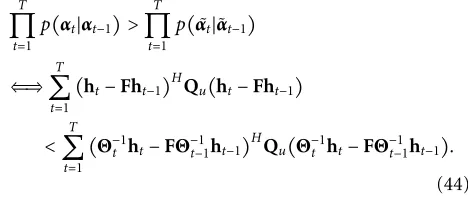
It is desirable to design a set of code vector sequences so that with optimal joint estimation and decoding for any pair (C0:T,C˜0:T), the condition p(C0:T,α0:T|y0:T) >
p( ˜C0:T,α˜0:T|y0:T) is met. With the assumption in (42) and be-cause the code vector sequences are independent of the chan-nel vector sequences, the above condition can be simplified as
T
t=1
pαt|αt−1> T
t=1
pα˜t|α˜t−1
⇐⇒T
t=1
ht−Fht−1HQuht−Fht−1
<
T
t=1
Θ−1
t ht−FΘ−1t−1ht−1HQuΘ−1t ht−FΘ−1t−1ht−1.
(44)
It can be verified that the only case when the above con-dition is not satisfied is when the phase difference se-quence is homogeneous, that is, Θ0 = · · · = ΘT. Therefore, in designing the code vector sequence set, we should avoid the situation when the phase difference se-quences are homogeneous between any pair of code vec-tor sequences. If this cannot be avoided completely, one should try to alleviate frequent appearance of code vec-tor sequences with homogeneous phase difference se-quences.
Consider, for example, the 8PSK delay diversity STTC with two transmit antennas as described in [2]. We refer to this code as Tarokh STTC. The constraint length of the trellis is two and the codes for the two transmit antennas are
c1st=e−j(3π/4)st, c2st=ej(π/4)st−1, (45) wherest = [st, st−1]T, and each user data symbolst ∈ Ꮽ =
{0,1, . . . ,7}. The first two constellations in Figure 4 illus-trate the two codes represented by (45). The phase shift-ing matrix in this case has two elements and it is given by Θ=diag{θ1, θ2}.A phase shifted version of the channel state
estimate will produce erroneous estimate of the transmitted user data. For example, if the two channel estimates over two consecutive time slots are phase shifted by π, then the es-timate of st att is ˆst,1 = c−11 (c1(st)e−jπ), and att+ 1, it is ˆ
st,2 =c−12 (c2(st)e−jπ). It can be verified that for the code and modulation functionc1(·) andc2(·) in (45), the two estimates
of st are equal for all st ∈ Ꮽ. Therefore, the phase shifted channel estimate and ˆst are equally likely estimates ofst. In summary, for this STTC the condition for the occurrence of homogeneous phase difference sequences is equivalent to the following:
c1−1c1
st
ejθ1=c−1
2
c2
st
ejθ2, ∀θ
1, θ2. (46)
To address the problem of phase ambiguity, one may design space-time codes such that the probability of the condition specified in (46) is minimized given a certain coding gain. Define the degree of phase regularity as the number of pairs of user data which have the same phase difference among all the modulation constellations. For example, the phase dif-ference ofst =2 andst =4, is the same in constellationsc1
andc2. We can find 12 pairs of such user data and the
de-gree of phase regularity is 12. To reduce the occurrence of (46) is equivalent to reduce the degree of phase regularity. We can reduce phase regularity by redesigning the constellation and/or by increasing the number of constellations at the ex-pense of coding, spatial, or temporal efficiency. The design of
temporal/spatial varying modulation constellations that best explore the spatial and temporal diversities while balancing the need of reducing phase regularity is a very challenging task itself.
We consider the usage of pilot signal as a special case of the general idea for reducing phase regularity by using diff er-ent constellations across different antennas or time slots. The use of pilot signal can be viewed as a special constellation, where all user data are modulated at one point, and the pilot signal is transmitted periodically.
5. SIMULATION
We simulated a two transmit and one receive antenna STTC system. The ARMA model for the fading coefficient is as de-scribed in [16], and it is of order (3,3). This model corre-sponds to a fast fading scenario with a normalized Doppler frequency (with respect to the symbol rate 1/T) fdT=0.05.
We applied the mixture SIS and Kalman filtering algo-rithm to the Tarokh STTC system described in Section 4. Due to phase ambiguity, the algorithm invariably breaks down. Figure 2 displays the tracking of the complex fading coeffi -cients where the dotted lines represent the true channel, and the solid lines show the estimated channel. Consequently, the estimated user symbols are erroneous under the phase shifted channel estimates. To alleviate phase ambiguity, first we tried the traditional way of sending pilot signals. To ac-commodate pilot signals, each time-slot was divided into two sub-slots (an increase in bandwidth), and it was considered that fading coefficients did not change between the sub-slots. The first set of sub-slots were assigned to transmit user sig-nals coded by Tarokh STTC, and the second set of sub-slots were used to send pilot signals, that is, both transmit anten-nas sent known signals to the receiver. In our scheme, the pilot signals used the same amount of energy as the user sig-nals. Pilot signals were inserted every other symbol because of the considered fast fading channel. The tracking of the channel is shown in Figure 3. We can see that phase ambi-guity no longer exists. However, the performance of the al-gorithm in terms of symbol error rate (SER) is not satisfac-tory which is shown in Figure 6. In Section 4 we pointed out that if we design the code vector sequences so that the phase difference sequences are not homogeneous, phase ambiguity can be avoided. Here we propose 4 ad-hoc designed 8PSK constellations to be used when each time-slot is divided into two sub-slots as in the case with pilot signals. The received signal at time slottcan be described as
y1
t
y2 t
=
c1(st) c2(st−1)
c3(st−1) c4(st)
α11,t
α12,t
+
v1
t
v2 t
. (47)
In the above equation, y1
t and yt2 represent the received signals at two sub-time slots, wherec1andc2have the same
definition as in (45), andc3andc4are defined as
c3=
1, e(−jπ/4),−j, e(−jπ3/4), e(jπ/4), j, e(jπ3/4),−1,
c4=
20 30 40 50 Timet
60 70 80
−40
−20 0 20 40
Im
(
h1
)
Imaginary part
20 30 40 50 60 70 80
−40
−20 0 20 40
Re
(
h1
)
Real part
Figure2: Example of phase ambiguity.
The constellations ofc1toc4are shown in Figure 4. It can be
verified that only two data pairs, (4,6) and (5,7), have the same phase difference across all four constellations. The de-gree of phase regularities is reduced to 2 as opposed to 12 in the original Tarokh STTC. Unless a long string of user data composed of only 4–7 occurs, which has very low probability when the user data symbols are i.i.d., phase ambiguity can be avoided. The tracking of the channel estimates is shown in Figure 5, which verifies our analysis of phase ambiguity. From Figure 6, we can see that the proposed system performs much better than the system using pilot signals although the two systems have the same time and frequency efficiency. In general, we have found that using pilot signals is not neces-sarily as efficient as using carefully designed space-time cod-ing schemes.
It is well known that in the implementation of the SIS method, as the recursions proceed, the variance of the sam-ple weights increases. This means that only a few samsam-ples have significant weights leading to poor estimates of the un-knowns. This problem can be addressed by resampling [14], which is a process of redrawing a new set of samples from the old set where the variance of the new weights is smaller than the variance of the old weights. During our simulations, we found that we had to apply resampling frequently, which is essential for good performance of the algorithm. We used the same residual resampling process as described in [16] and resampling was performed every 5 steps. Because the con-straint length is one in the STTC, the number of delayed weights and delayed samples was all selected as one. As a lower bound, the results were compared with the Genie aided case when a separated stream of known user data was space-time coded in the same proposed scheme and sent through the same channel for the estimation of the channel. The true user data were then decoded using the additional transmitted data. As we can see from Figure 6, there is a 3 dB performance
20 30 40 50
Timet
60 70 80
−40
−20 0 20 40
Im
(
h1
)
Imaginary part
20 30 40 50 60 70 80
−40
−20 0 20 40
Re
(
h1
)
Real part
Figure3: Channel tracking with pilot signals.
6 5 4
3 2 1
0 7
C1(s)
6 1 4
7 2 5
0 3
C2(s)
2 3 7
5
6 4
0 1
C3(s)
2 4 7
5
1 3
0 6
C4(s)
Figure4: Constellations of the STTCs.
20 30 40 50
Timet
60 70 80
−40
−20 0 20 40
Im
(
h1
)
Imaginary part
20 30 40 50 60 70 80
−40
−20 0 20 40
Re
(
h1
)
Real part
Figure5: Channel tracking of the proposed STTC.
20 20.5 21 21.5 22 22.5 23 23.5 24 24.5 25
Es/N0(dB)
Proposed ST code Pilot aided Genie aided
10−4
10−3
10−2
10−1
100
SER
Figure6: Simulation result.
20 20.5 21 21.5 22 22.5 23 23.5 24 24.5 25
Es/N0(dB)
∆=1,δ=1 ∆=1,δ=0 ∆=0,δ=1 ∆=0,δ=0 Genie aided
10−3
10−2
10−1
100
SER
Figure7: Comparison of delayed samples and delayed weights.
For every simulated point, at least 100 symbol errors were accumulated.
If the delayed weight and delayed sample methods are not used, the performance deteriorates considerably. In Figure 7, we compared the performance when different number of de-layed samples∆=0,1 and delayed weightsδ=0,1 were used in the algorithm. The results in Figure 7 are consistent with the ones in [16].
6. CONCLUSIONS
In this paper, we proposed and showed the viability of mix-ture SIS and Kalman filtering algorithm for joint estimation and decoding of STTCs. The channels in the system were modeled as ARMA processes of known orders and model co-efficients, and the whole system was represented by a DSSM. Good results can only be obtained if the problem of phase ambiguity is addressed appropriately. Four ad hoc designed constellations were used in our simulations and the results showed that the phase ambiguity was avoided.
Future research could extend to the design of STTCs that can best explore the spatial/temporal diversity and reduce phase ambiguity when using the SIS algorithm. Another di-rection is to apply more computationally efficient delayed sampling algorithms based on SIS for the joint estimation and decoding of STTC.
APPENDIX
A.1. The construction of channel state vectorhnm,t The fading coefficientsαnm,t when modeled as an ARMA (r, r) process, are represented as
αnm,t+φ1αnm,t−1· · ·+φrαnm,t−r
=ρ0unm,t+· · ·+ρrunm,t−r,
(A.1)
where {ρi} and {φi} are the AR and MA coefficients, re-spectively. In the Z domain, (A.1) becomes αnm(Z) = (ρ(Z)/φ(Z))unm(Z). If we introduce a new entity,hnm(Z)=
u(Z)nm/φ(Z), we obtainαnm(Z)= ρ(Z)hnm(Z). In the time domain, we have
hnm,t =−φ1hnm,t−1· · · −φrhnm,t−r+unm,t,
αnm,t =ρ0hnm,t+· · ·+ρrhnm,t−r.
(A.2)
If we lethnm,t=[hnm,t, . . . , hnm,t−r]Tbe the channel state vec-tor, its dynamics in time is described by (29), and the fading coefficient becomesαnm,t=ρThnm,t.
A.2. The construction of extended matrices
In this part we list the construction ofR,E, andF. First, the
NM(r+ 1)×NMmatrixRis represented as
RT =
ρ 0 · · · 0 0 ρ · · · 0
..
. ... ... ...
0 0 · · · ρ
, (A.3)
whereρis the (r+ 1)×1 vector as defined before, and0is an all-zero vector of the same dimension.Eis of dimension
NM(r+ 1)×NMand it is written as
E=
e 0 · · · 0 0 e · · · 0
..
. ... ... ...
0 0 · · · e
, (A.4)
where0is also an (r+1)×1 all-zero vector. Finally, the square matrixFof dimensionNM(r+ 1)×NM(r+ 1) is constructed according to
F=
Φ 0 · · · 0 0 Φ · · · 0
..
. ... ... ...
0 0 · · · Φ
, (A.5)
ACKNOWLEDGMENTS
We thank Joaqu´ın M´ıguez Arenas, Tadesse Ghirmai, and Yufei Huang for their helpful comments and suggestions.
REFERENCES
[1] G. J. Foschini, “Layered space-time architecture for wireless communications in a fading environment when using multi-element antennas,” Bell Labs Technical Journal, vol. 1, no. 2, pp. 41–59, 1996.
[2] V. Tarokh, N. Seshadri, and A. R. Calderbank, “Space-time codes for high data rate wireless communications: perfor-mance criterion and code construction,” IEEE Transactions on Information Theory, vol. 44, no. 2, pp. 744–765, 1998. [3] A. F. Naguib, N. Seshadri, and A. R. Calderbank,
“Increas-ing date rate over wireless channels,” IEEE Signal Processing Magazine, vol. 17, no. 3, pp. 76–92, 2000.
[4] B. Hochwald and T. L. Marzetta, “Unitary space-time modu-lation for multiple-antenna communications in Rayleigh flat fading,”IEEE Transactions on Information Theory, vol. 46, no. 2, pp. 543–564, 2000.
[5] B. L. Hughes, “Differential space-time modulation,” IEEE Transactions on Information Theory, vol. 46, no. 7, pp. 2567– 2578, 2000.
[6] S. M. Alamouti, “A simple transmit diversity technique for wireless communications,” IEEE Journal on Selected Areas in Communications, vol. 16, no. 8, pp. 1451–1458, 1998. [7] Z. Liu, X. Ma, and G. B. Giannakis, “Space-time coding and
Kalman filtering for time-selective fading channels,” submit-ted to IEEE Trans. Communications, vol. 50, no. 2, pp. 183– 186, 2002.
[8] R. S. Kennedy,Fading in Dispersive Communication Channels, Wiley-Interscience, New York, NY, USA, 1969.
[9] M. West,Bayesian Forecasting and Dynamic Models, Springer-Verlag, New York, NY, USA, 1997.
[10] S. Geman and D. Geman, “Stochastic relaxation, Gibbs dis-tributions, and the Bayesian restoration of images,” IEEE Trans. on Pattern Analysis and Machine Intelligence, vol. 6, no. 6, pp. 721–741, 1984.
[11] D. Gamerman, Markov Chain Monte Carlo, Chapman and Hall, New York, NY, USA, 1997.
[12] W. R. Gilks, S. Richardson, and D. J. Spiegelhalter, Markov Chain Monte Carlo in Practice, Chapman and Hall, New York, NY, USA, 1996.
[13] A. Doucet, S. Godsill, and C. Andrieu, “On sequential Monte Carlo sampling methods for Bayesian filtering,”Statist. Com-put., vol. 10, no. 3, pp. 197–208, 2000.
[14] J. S. Liu and R. Chen, “Sequential Monte Carlo methods for dynamic systems,”J. Amer. Statist. Assoc., vol. 93, no. 443, pp. 1032–1044, 1998.
[15] A. Kong, J. S. Liu, and W. H. Wong, “Sequential imputations and Bayesian missing data problems,” J. Amer. Statist. Assoc., vol. 89, no. 425, pp. 278–288, 1994.
[16] R. Chen, X. Wang, and J. S. Liu, “Adaptive joint detection and decoding in flat-fading channels via mixture Kalman fil-tering,”IEEE Transactions on Information Theory, vol. 46, no. 6, pp. 2079–2094, 2000.
[17] J. H. Kotecha and P. M. Djuri´c, “Sequential Monte Carlo sam-pling detector for Rayleigh fast-fading channels,” inProc. IEEE ICASSP, Istanbul, Turkey, 2000.
[18] J. S. Liu and R. Chen, “Blind deconvolution via sequential imputations,”J. Amer. Statist. Assoc., vol. 90, no. 430, pp. 567– 576, 1995.
[19] B. D. O. Anderson and J. B. Moore,Optimal Filtering, Prentice Hall, Englewood Cliffs, NJ, USA, 1979.
[20] J. H. Lodge and M. L. Moher, “Maximum likelihood se-quence estimation of CPM signals transmitted over Rayleigh flat-fading channels,” IEEE Trans. Communications, vol. 38, no. 6, pp. 787–794, 1990.
[21] D. L. Aspach and H. W. Sorenson, “Nonlinear Bayesian es-timation using Gaussian sum approximation,” IEEE Trans. Automat. Contr., vol. 17, no. 4, pp. 439–448, 1972.
[22] G. Casella and C. P. Robert, “Rao-Blackwellisation of sam-pling schemes,”Biometrika, vol. 83, no. 1, pp. 81–94, 1996. [23] J. Zhang and P. M. Djuri´c, “A new design criterion for
space-time trellis codes that combat phase ambiguity,” Technical report 794, State University of New York at Stony Brook, NY, USA, 2002.
Jianqiu Zhangreceived her B.S. and M.S. degrees in electrical engineering from Zhe-jiang University, Hangzhou, and Zhong-shan University, Guangzhou, China, in 1992 and 1995, respectively. From 1995 to 1997, she was a software engineer with the Re-search and Development of Guangdong Nortel, Guangzhou, China. Since 1997 she has been studying for her Ph.D. in the De-partment of Electrical and Computer
Engi-neering at the State University of New York at Stony Brook, USA, where she is a currently research assistant. Her research interests include statistical signal processing, turbo coding and decoding, space-time coding, multiuser detection, and joint channel estima-tion and detecestima-tion. Ms. Zhang is a student member of the IEEE. Petar M. Djuri´creceived his B.S. and M.S.
degrees in electrical engineering from the University of Belgrade, Yugoslavia, in 1981 and 1986, respectively, and his Ph.D. degree in electrical engineering from the Univer-sity of Rhode Island, USA, in 1990. From 1981 to 1986 he was Research Associate with the Institute of Nuclear Sciences, Vinca, Bel-grade, Yugoslavia. Since 1990 he has been with the State University of New York at