Fast compression of a current sheet during externally driven
magnetic reconnection
Y. Ono, M. Inomoto, Y. Ueda, T. Matsuyama, and Y. Murata
High Temperature Plasma Center, University of Tokyo, Tokyo 113-8656, Japan (Received June 20, 2000; Revised January 5, 2001; Accepted February 28, 2001)
Magnetic reconnection of two toroidal plasmas with arbitraryq values revealed a dependence of sheet-current dissipation and ion heating on ion-gyromotion. Effective sheet-current resistivity was found to increase significantly, when an external force compressed the current sheet shorter than the ion-gyroradius, and both the reconnection speed and ion temperature increased with decreasing current sheet width and with increasing ion-gyroradius.
1.
Introduction
Magnetic reconnection has been investigated as important key physics for explaining global restructuring of various magnetized plasmas, such as the solar corona, the magne-totail and various fusion plasmas. Its physics contains not only magnetohydrodynamic (MHD) effects but also several “anomalous” effects which are related to particle and two fluid motions. Recently, the solar satellite “Yohkoh” and the magnetospheric satellite “Geotail” have measured many sig-natures of anomalous dissipation and heating effects of mag-netic reconnection (Shimizuet al., 1994; Saitoet al., 1995; Tsuneta, 1996). Speeds of these reconnections are much higher than that of the Sweet-Parker model (Sweet, 1953; Parker, 1957), suggesting that their effective sheet-current resistivities are a few order higher than the classical resis-tivity. It leads to anomalous release of magnetic energy into plasma kinetic and thermal energies during preferential heat-ing of solar coronas (Shimizuet al., 1994; Tsuneta, 1996). The current sheet in the reconnecting magnetotail lobes has been observed to have their ion temperature higher than elec-tron temperature (Saito et al., 1995). Theoretically, their current sheet widths have been predicted to be on the order of the ion-gyroradius (Truemann and Baumjohann, 1997). It is noted that reconnection of the southward interplane-tary magnetic field (IMF) with the northward dipole field of the earth is faster than that of the northward IMF. The latter has a much larger field component BX parallel to the
“X-point” line than the former. Also in periodic/continuous reconnection of laboratory plasmas, the plasma resistivity, magnetic fluctuation amplitude, and temperature ratio of ions to electrons are significantly higher in RFPs (Reversed Field Pinches) with small BX than in ohmic heating tokamaks
with large BX. An important question then arises: by what
mechanism does the reconnection speed/heating depend on BX? Is it related to the ion-gyromotion determined by BX
and current-sheet-compression? Mechanisms for the
anoma-Copy right cThe Society of Geomagnetism and Earth, Planetary and Space Sciences (SGEPSS); The Seismological Society of Japan; The Volcanological Society of Japan; The Geodetic Society of Japan; The Japanese Society for Planetary Sciences.
lous dissipation have been investigated by macroparticle sim-ulations (Leboeuf et al., 1982; Tajima and Sakai, 1989; Horiuchi and Sato, 1997; Shay et al., 1998) and their ef-fects on spatial field structures by various MHD simulations (Sato and Hayashi, 1979; Biskamp, 1986; Satoet al., 1992). In RFPs, several experimental groups have measured mag-netic fluctuations caused by reconnection and their mode cascade up to the ion-gyro-mode number as a cause for the anomalous ion heating (Scime et al., 1992). Stenzel and Gekelman first demonstrated laboratory reconnection with current sheet widths shorter than the ion-gyroradius (Stenzel et al., 1982; Gekelman and Pfister, 1988). They reported non-MHD/particle effects, such as Whistler wave activities. However, the relation of anomalous resistivity/ion heating to the sheet-compression process and its dependence on theBX
component are left unsolved. We have been reporting that the counterhelicity merging of two spheromaks with merg-ing angleθ≈180◦is faster than the cohelicity merging with
θ ≈90◦, both in the fast and slow reconnection regimes us-ing the TS-3 (Onoet al., 1993, 1996) and the MRX devices (Yamadaet al., 1997), respectively. Recently, our new toka-mak/spheromak/RFP merging with wide range ofq values was found to be more effective when the BX field
compo-nent was varied continuously from 0 to 5B. As shown in Fig. 1, this method enables us to keep constant the reconnect-ing field componentB. The external force for sheet-current compression is provided by an acceleration-coil current, en-abling us to vary the reconnection speed widely. This paper addresses two important issues: (1) how the resistivity of a current sheet is related to its sheet-current compression in terms of external compressing force and BX field
com-ponent, (2) how the anomalous current sheet dissipation is related to anomalous ion-heating (Ti > Te) of
reconnec-tion. High-resolution measurements of the current-sheet and ion temperature revealed a relationship between the effective sheet-current resistivity and the current-sheet width normal-ized by the ion-gyroradius.
Fig. 1. Control ofBX component of magnetic reconnection using two
merging tokamak, spheromaks and RFPs (Reversed Field Pinches).
Fig. 2. Experimental setup of TS-3 merging/reconnection device.
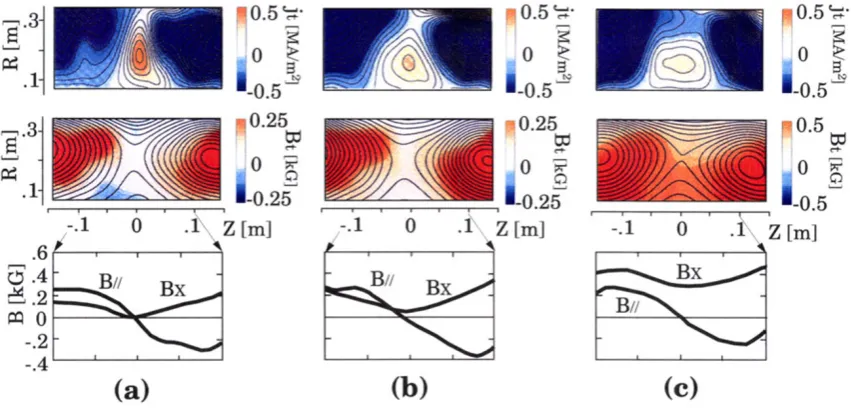
Fig. 3. 2-D contours of poloidalflux and toroidalfield (red and blue colors) of two merging (a) RFPs (Reversed Field Pinches), (b) spheromaks, and (c) tokamaks and their axial profiles of reconnectionfieldBandfield componentBX parallel to the X-point line.
2.
Experimental Setup
As shown in Fig. 2, the TS-3 merging device (Onoet al., 1993) has two internal poloidalfield (PF) coils and two sets each of eight pairs of electrodes to produce poloidal and toroidal fluxes of two separate toroids. A center torus coil with diameter of 12 cm is located along the center geometric axis to produce the toroidalfield Bt,ext. Right after
forma-tion, the two plasma toroids have major and minor radii of 18 cm and 12 cm, respectively. The initial ion and electron temperatures (Ti andTe) are about 10 eV and 5 eV,
respec-tively. The electron densityne is order of 1019 m−3 in the
bulk plasma and 0.5–1×10²⁰m−3inside the current sheet. After the two toroid formation, the reversed currents of PF coils are also used as an acceleration-coil currentsIaccto push
located on anr-zplane of the vessel to measure profiles of the magneticfield (Bz,Br,Bt) profiles within 1% accuracy
(typically smaller than 0.5%). The accuracy of measuredB field is assured by probe calibration/orientation insides the vacuum vessel (after its installation), digitizers with 12 bit resolution and adjustable amplifiers to maximize the dynamic range of digitizers. Based on the 2-D magneticfield profile, 2-D contours of poloidalfluxand toroidal current density jt are calculated on each single discharge, as shown in Ono
et al.(1993). The spatial resolution is asfine as 5 mm in the axial direction and 3 cm in the radial direction around current sheet. This resolution isfine enough to measure the present current sheet whose typical size is 2L ≈15–20 cm and 2δ≈3–10 cm, as shown in Fig. 3. Scans of the 2-D probe allowed us to improve probe resolutions further to 2 mm to check how this major error factor affects the magneticfield measurement. Using this technique, the measurement errors of jtandare found to be smaller than 10% and 2%
respec-tively. A 1 m polychromater with a 2-D CCD (584×386) detector array is located on the midplane to measure a ion temperature Ti profile with wavelength resolution of 0.01
nm (Onoet al., 1993). The Hβ line is used to measure the fast (10μsec) increase in ion temperature during the recon-nection because the charge exchange time between H and H+: 0.1 μsec is much shorter than the equi-partition time between the impurity ions and hydrogen ions. Thirty lines of sights perpendicular to the plasma outflow direction are located horizontally on the midplane (Moritaet al., 1995; Onoet al., 1996; Murataet al., 2000; Balandinet al., 2001). For each single discharge, the radial Ti (parallel to the
X-line) profile is calculated by applying the Abel inversion to the measured line-integrated signals from the outer edge to the X-point (or further inside). An electrostatic probe was inserted axially atr = 14 cm to measure the axial profile of the electron temperatureTeand densityne. A CO2laser
interferometer was used to calibrate the absolute value ofne.
3.
Experimental Results
An external toroidalfield Bt,ext is applied to two
merg-ing toroids with parallel internal toroidalfieldsBt,i nto form
arbitrary BX (= Bt,ext +Bt,i n) around a toroidal X-point
line. TheBX component was varied continuously from the
RFP regime (BX ≤ B) shown in Fig. 3(a) to the tokamak
regime (BX B) in Fig. 3(c). Figures 4(a), (b), and (c)
show the dependence of reconnection rate γ on the field component BX, when current sheets of the merging toroids
are compressed by the acceleration-coil currentsIacc ≈13
kA, 10 kA and 6 kA, respectively. Theγ value is a time-averaged growth rate ofαdefined asγ = ddtα/α, whereαis the ratio of reconnected poloidalflux to total poloidalflux (commonflux ratio) (Onoet al., 1993). We kept equal the initial poloidal flux of each merging toroid for this scan, realizing an equal (within 10%) initial B (= B0)
condi-tion. The reconnection rateγ is observed to increase with increasing external compressing force provided byIacc. The
γ value forIacc=13 kA is about 2.1 times larger than that
forIacc =6 kA, if BX/B0 =2. All three curves also agree
thatγ increases inversely withBX. In Fig. 4(a), the
recon-nection withBX/B0=1 is about 1.3 times faster than that
withBX/B0=3.5. It is noted that abrupt changes inγ are
observed aroundBX/B0=2.5 in (a), 1.8 in (b), and 1 in (c).
This large increase inγ is connected with the rise in ion temperature. Figures 5(a), (b) and (c) show the peak ion temperatures Ti0 before and after reconnection (att = 20
μsec and at t = 35 μsec, respectively) as a function of BX/B0. The ion temperature profile tend to peak around
the O-point right after the reconnection. The ion temperature Ti0after reconnection increases with decreasingBXand with
increasing Iacc. IfBX/B0 ≈2, theTi increment increases
from 20 eV to 105 eV, as Iaccis increased from 6 kA to 13
kA. If Iacc ≈13 kA, it increases from 30 eV to 105 eV, as
BX/B0is decreased from 3.5 to 1. The electron temperature
stays around 5–10 eV during each reconnection. In the case of BX/B0 ≈ 1 in Fig. 5(a), the ion heating energy is as
large as 80% of the dissipated magnetic energy, suggesting the preferential ion heating effect of reconnection.
An important question is why the reconnection speed as well as the ion heating energy depend on BX/B0and Iacc.
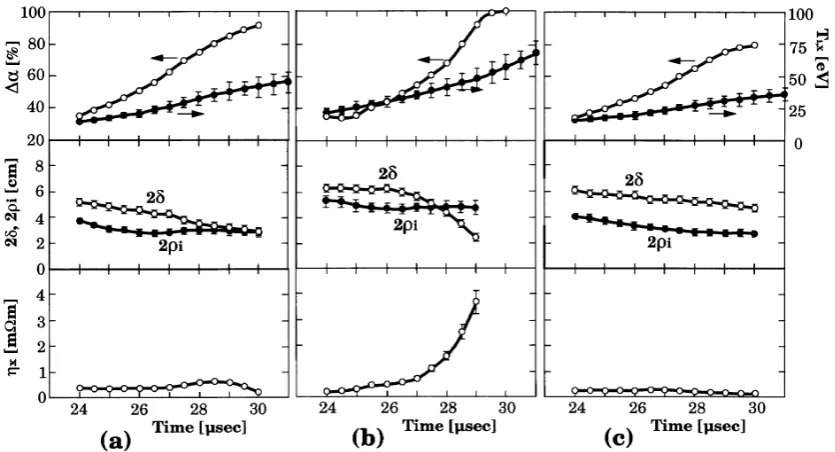
Figures 6(a), (b) and (c) show time evolutions of common flux ratio α, ion temperature Ti,X at the X-point,
current-sheet width 2δ, and ion-gyroradius×2 (diameter) 2ρi at
the X-point, and effective resistivity ηX at the X-point, for
three different reconnections: (a) BX ≈ 1.0B0, Iacc ≈ 5
kA, (b)BX ≈1.0B0,Iacc ≈10 kA, and (c)BX ≈2.7B0,
Iacc≈10 kA. The ion-gyroradiusρiis calculated from the
magneticfield BX and ion temperatureTi,X measured at the
X-point. After confirming null velocityvz≈0 at the X-point
(by Mach probe measurement), the effective resistivityηX is
calculated based on the following equations:
ηXjt =Et+(v× B)t ≈
and toroidal current density at the X-point, magneticfield, plasma velocity, reconnected poloidalflux, and radius of the “X-point”line, respectively (Onoet al., 1993). Though the “effective”resistivity with particle or twofluid effect is not the real resistivity, it is still a useful indicator to interpret macroscopic reconnection physics based on the MHD ap-proximation. In Fig. 6(a), the current sheet width 2δis larger because of the weak external compressing force ofIacc≈5
kA. During the slow and weak compression process, ηX
is observed to be constant (≈0.3 mm). However,ηX
in-creases slightly when 2δbecomes as short as 2ρi. In Fig. 6(b),
the largerIacc ≈10 kA provides the compression force large
than that in (a) under the same BX condition. It is noted
thatηX is initially as small as (a) but that it increases
signif-icantly right after 2δis compressed shorter than 2ρi≈5 cm
(t >27.5μsec). Aftert=27.5μsec, 2δis also observed to decrease faster than before.
In Fig. 6(c), the largerBX ≈2.7B0sets 2ρishorter than
that in Fig. 6(b). It is observed that 2δis always longer than the small 2ρiand thatηXstays as small as 0.2–0.3 mm. No
change in 2δdecaying speed occurs, even if 2δis compressed shorter than 5 cm.
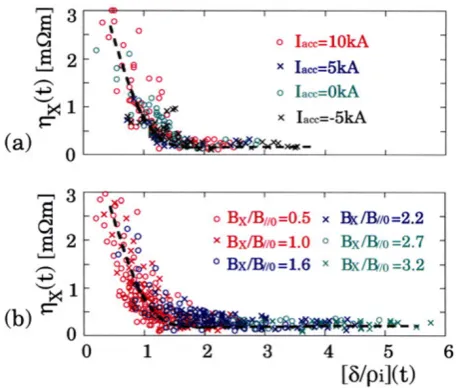
Figures 7(a) and (b) show more clearly the relationship be-tween anomalous increase inηXand 2δ-compression shorter
than 2ρi. In Fig. 7(a),fifteen time-evolutions of ηX under
four differentIaccare superposed on the same plot, in terms
Fig. 4. Averaged reconnection ratesγof two merging toroids as a function ofBX/B0for three different acceleration-coil currents: (a)Iacc=13 kA, (b)
10 kA, and (c) 6 kA.
Fig. 5. Peak ion temperaturesTi0before and after the magnetic reconnection as a function ofBX/B0for three different acceleration-coil currents: (a)
Iacc=13 kA, (b) 10 kA, and (c) 6 kA.
Fig. 6. Time evolution of commonflux ratioα, ion temperatureTi,X at the X-point, current-sheet width 2δand ion-gyroradius×2 (diameter) 2ρi, and
effective resistivityηX for three different reconnections: (a)BX ≈1.0B0,Iacc ≈ 5 kA, (b)BX ≈1.0B0,Iacc ≈10 kA, and (c)BX ≈2.7B0,
Fig. 7. Time evolution of effective current sheet resistivitiesηXas a function
ofδnormalized byρiwhen four different acceleration-coil currentsIacc
(a) and six differentBXfields (b) are applied to the merging toroids.
All curves agree in thatηX stays as small as the Spitzer
re-sistivity≈0.2 mm calculated from the measured electron temperature≈5 eV, as long as 2δ is longer than 2ρi.
How-ever,ηX increases significantly, once a large external force
compresses 2δshorter than 2ρi. The maximumηX ≈3–3.5
mm atδ/ρi ≈0.5 is almost 15 times larger than the Spitzer
resistivity, leading to the fast reconnection observed in the largeIaccregime. In Fig. 7(b), several evolutions ofηXunder
six differentBX field amplitudes are superposed to confirm
the mentioned relationship. All cases have equalIacc =10
kA. WhenBX/B0is varied,ηXstays constant (≈0.2 mm)
when 2δ >2ρiand becomes markedly large when 2δ <2ρi.
Both curves in Figs. 7(a) and (b) agree well with each other, indicating that the anomalous increase inηX is correlated to
2δbeing smaller than 2ρi.
4.
Discussion
Both scan experiments of external-compression-force and BX, consistently revealed the dependence of the effective
sheet-current resistivity onδnormalized byρi. Especially, it
is important thatηXin Fig. 6(a) is initially as small as (a) and
(c) but that it increases significantly (∂B/∂t =0) right after 2δis compressed shorter than 2ρi. This fact clearly indicates
that possibly some particle effect causes the onset of anoma-lous current-sheet dissipation when 2δbecomes shorter than the threshold value: 2ρi. Initially, the thermal pressure of
the current-sheet is considered to sustain the external com-pressing force of the magneticfield, maintaining the current sheet width. However, once the sheet width becomes shorter than the ion-gyroradius, ions no longer sustain the external force as afluid, but start meandering inside and outside of the current-sheet unlike magnetized electrons. Horiuch and Sato studied the further sheet-compression processes with meandering ions using their macroparticle simulation. They observed that the reconnection speed increased significantly when the sheet width was compressed shorter than the ion-gyroradius (Horiuchi and Sato, 1997). Their results agree qualitatively with our observation mentioned above. They
reported that the main cause for the anomalous sheet dissi-pation was the combination of lower hybrid drift instability and drift kink instability. The ion-gyroradiusρi tends to be
close toc/pi in the low-BX reconnection. We measured
electron densityneof the current sheet with variedBXusing
electrostatic probes and observed that the effective resistivity is correlated withδ/ρi, not withδ/(c/pi)(Inomotoet al.,
2000). The ion-gyroradiusρi increases with increasing ion
temperature and with decreasing magneticfield. This is the most probable reason why the reconnection speed increases with increasing external force and with decreasing BX in
Figs. 4(a), (b), and (c). This result also suggests that change in the current sheet structure (∂B/∂t =0) is sometimes es-sential to the fast reconnection, in sharp contrast with slow and steady reconnection (Jiet al., 1998). In agreement with our observation, several MHD and particle simulations also reported that drastic changes in the sheet-structure and re-connection speed were triggered by increase in the effective resistivity (Ugai, 1992, 1994; Tajimaet al., 1989).
The ion-heating-suppression effect ofBX agrees with the
general tendency that the Ti/Te ratio is roughly equal to
unity in ohmic tokamak plasmas withBX B, and much
larger than unity in RFP and spheromak plasmas globally withBX ≤ B. In smallBX reconnection, the ion
accelera-tion effect of magneticfield lines is considered to heat bulk ions selectively through the large ion viscosity effect. The unmagnetized ions are easily mixed together and are thermal-ized after the ion-acceleration phenomenon of reconnection. Since the ion-gyroradius is much larger than the electron-gyroradius, this anomalous heating is considered to occur only for ions not for electrons. The merging process also compresses the effective minor radius of merging toroids by factor: C ≈ 1.3–1.4, suggesting that the compression ef-fect also contribute to the increase inTi. However, its effect
on Ti increment ≈ C4/3 ≈ 1.4–1.6 is much smaller than
the large (factor 10) difference inTi before and after the
re-connection as shown in Fig. 5(a). On the other hand, the application of BX decreases the ion-gyroradius and
magne-tizes ions like electrons, preventing the ion-thermalization process. A decreases in ion-gyroradius and plasma outflow speed (reconnection speed) provide a possible explanation for the ion-heating-suppression effect of BX, because the
viscosity coefficient becomes smaller with increasing BX
around the X-point. It is also noted that both the Ti
incre-ments and reconnection rates become markedly large when BX/B0is smaller than the threshold values: 2.5 in Figs. 5(a),
1.8 in (b), and 1 in (c). In each case, the compressed 2δ is observed to reach 2ρiwhenBX/B0is below each threshold
value, indicating the close relationship between anomalous dissipation of the current sheet and the selective ion heating.
5.
Summary
This BX effect is consistent with the high magnetic
fluc-tuations and Ti Te characteristics of the RFPs whose
reconnections have small BX ≤ B globally. The
appli-cation of BX B suppresses this anomalous increase in
sheet-current resistivity and ion temperature. This feature is consistent with low magnetic fluctuation andTi ≈Te
char-acteristics of tokamaks whose reconnecion has large toroidal magnetic fieldBX B.
Acknowledgments. We would like to thank the TS-3 group: M.
Katsurai, T. Okazaki, M. Ohi, S. Takeuchi, and A. Morita for exper-imental support and M. Yamada, R. Kulsrud, and H. Ji at Princeton Plasma Physics Laboratory for theoretical collaboration and useful discussions.
References
Balandin, A.et al., Design study of 3-D tomography diagnostics for spher-ical tokamaks,Eur. Phys. J.,D14, 97–103, 2001.
Biskamp, D., Magnetic reconnection via current sheets,Phys. Fluids,29, 1520–1531, 1986.
Gekelman, W. and H. Pfister, Experimental observations of the tearing of an electron current sheet,Phys. Fluids,31, 2017–2025, 1988. Horiuchi, R. and T. Sato, Particle simulation study of collisionless driven
reconnection in a sheared magnetic field,Phys. Plasmas,4, 277–289, 1997.
Inomoto, M.et al., Mechanism of fast reconnection in TS-3 plasma merging experiment, in Proc. MR2000, p. 23, Univ. Tokyo, Japan, Mar., 2000. Ji, H.et al., Experimental test of the Sweet-Parker model of magnetic
re-connection,Phys. Rev. Lett.,80, 3256–3259, 1998.
Leboeuf, J. N., T. Tajima, and J. M. Dawson, Dynamic magnetic X-point, Phys. Fluids,25, 784–798, 1982.
Morita, A.et al., Tomotraphic reconstruction algorithm for an annular cross section of toroidal plasmas by use of modified Fourier-Bessel expansions, Trans. Inst. Electr. Eng. Japan,115, 37–43, 1995.
Murata, Y.et al., Bulletin of American Physical Society 45, 7, YP1 53, 2000.
Ono, Y., A. Morita, M. Katsuraiet al., Experimental investigation of three-dimentional magnetic reconnection by use of two colliding spheromaks,
Phys. Fluids,B5, 3691–3701, 1993.
Ono, Y.et al., Ion acceleration and direct ion heating in three-component magnetic reconnection,Phys. Rev. Lett.,86, 3328–3331, 1996. Parker, E. N., Mechanism for merging magnetic fields in conducting fluids,
J. Geophys. Res.,62, 509–520, 1957.
Saito, Y.et al., Slow-mode shocks in magnetotail,J. Geophys. Res.,100, 23567–23581, 1995.
Sato, T. and T. Hayashi, Exterally driven reconnection and a powerful mag-netic energy converter,Phys. Fluids,22, 1189–1202, 1979.
Sato, T., T. Hayashi, K. Watanabeet al., Role of compressibility on driven magnetic reconnection,Phys. Fluids B,B4, 450–457, 1992.
Scime, E.et al., Ion heating and magnetohydrodynamic fluctuations in the reversed-field pinch,Phys. Fluids,4, 4062–4071, 1992.
Shay, M. A.et al., Structure of the dissipation region during collisionless magnetic reconnection,J. Geophys. Res.,103, 9165–9176, 1998. Shimizu, T., S. Tsuneta, and A. C. Acton, Morphology of active region
tran-sient brightenings with the YOHKOH soft X-ray telescope,Astrophys. J.,422, 906–911, 1994.
Stenzel, R.et al., Magnetic field line reconnection experiments 4. resistivity, heating and energy flow,J. Geophys. Res.,87, 111–117, 1982. Sweet, P. A., The neutral point theory of solar flares, inElectromagnetic
Phenomena in Cosmical Physics, edited by B. Larnert, p. 123, Cambridge, New York, 1953.
Tajima, T. and J.-I. Sakai, Explosive coalescence of magnetic islands and acceleration of changed particles,Sov. J. Plasma Phys.,15, 519–525, 1989.
Treumann, R. A. and W. Baumjohann,Advanced Space Plasma Physics, Imperial College Press, 1997.
Tsuneta, S., Interacting active regions in the solar corona,Astrophys. J.,456, L63–L65, 1996.
Ugai, M., Computer studies on development of the fast reconnection mech-anism for different resistivity model,Phys. Fluids,B4, 2953–2963, 1992. Ugai, M., Computer studies on fast reconnection mechanism under an ex-ternally driven boundary condition,Phys. Plasmas,1, 2853–2863, 1994. Yamada, M.et al., Identification of Y-shaped and O-shaped diffusion regions during magnetic reconnection in a laboratory plasma,Phys. Rev. Lett.,78, 3117–3120, 1997.