R E S E A R C H
Open Access
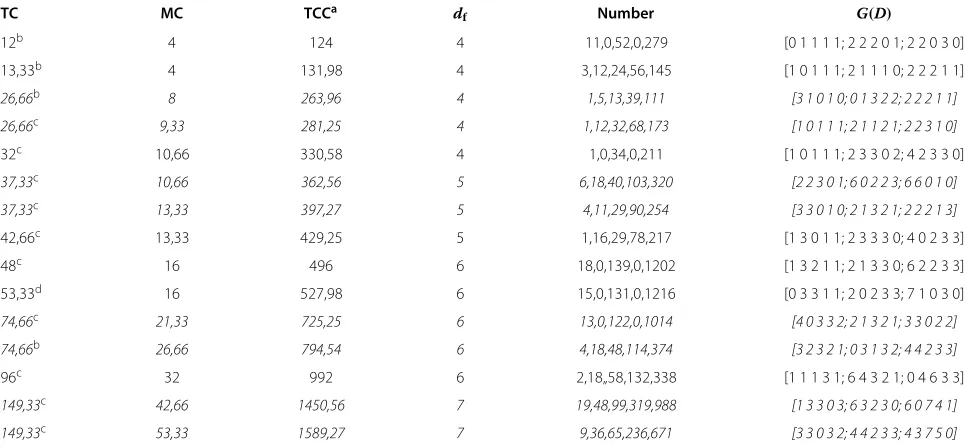
A new computational decoding complexity
measure of convolutional codes
Isaac B Benchimol
1, Cecilio Pimentel
2*, Richard Demo Souza
3and Bartolomeu F Uchôa-Filho
4Abstract
This paper presents a computational complexity measure of convolutional codes well suitable for software
implementations of the Viterbi algorithm (VA) operating with hard decision. We investigate the number of arithmetic operations performed by the decoding process over the conventional and minimal trellis modules. A relation between the complexity measure defined in this work and the one defined by McEliece and Lin is investigated. We also conduct a refined computer search for good convolutional codes (in terms of distance spectrum) with respect to two minimal trellis complexity measures. Finally, the computational cost of implementation of each arithmetic operation is determined in terms of machine cycles taken by its execution using a typical digital signal processor widely used for low-power telecommunications applications.
Keywords: Convolutional codes; Computational complexity; Decoding complexity; Distance spectrum; Trellis module; Viterbi algorithm
1 Introduction
Convolutional codes are widely adopted due to their capacity to increase the reliability of digital communica-tion systems with manageable encoding/decoding com-plexity [1]. A convolutional code can be represented by a regular (or conventional) trellis which allows an efficient implementation of the maximum-likelihood decoding algorithm, known as the Viterbi algorithm (VA). In [2], the authors analyze different receiver implementations for the wireless network IEEE 802.11 standard [3], showing that the VA contributes with 35% of the overall power consumption. This consumption is strongly related with the decoding complexity which in turn is known to be highly dependent on the trellis representing the code. Therefore, the search for less complex trellis alternatives is essential to some applications, especially for those with severe power limitation.
A trellis consists of repeated copies of what is called a trellis module [4-6]. McEliece and Lin [4] defined a decoding complexity measure of a trellis module as the total number of edge symbols in the module (normal-ized by the number of information bits), called the trellis
*Correspondence: [email protected]
2Federal University of Pernambuco (UFPE), Av. Prof. Morais Rego, 1235, Recife, Pernambuco 50670-901, Brazil
Full list of author information is available at the end of the article
complexity of the moduleM, denoted by TC(M). In [4], a method to construct the so-called ‘minimal’ trellis module is provided. This module, which has an irregular structure presenting a time-varying number of states, minimizes various trellis complexity measures. Good convolutional codes with low-complexity trellis representation are tab-ulated in [5-13], which indicates a great interest in this subject. These works establish a performance-complexity tradeoff for convolutional codes.
The VA operating with hard decision over a trellis module M performs two arithmetic operations: integer sums and comparisons [4,13-15]. These operations are also considered as a complexity measure of other decod-ing algorithms, as those used by turbo codes [16]. The number of sums per information bit is equal to TC(M). Thus, this complexity measure represents the additive complexity of the trellis moduleM. On the other hand, the number of comparisons at a specific state ofMis equal to the total number of edges reaching it minus one [14]. The total number of comparisons inMrepresents the merge complexity. Both trellis and merge complexities govern the complexity measures of the VA operating over a trellis moduleM. Therefore, considering only one of these com-plexities is not sufficient to determine the effort required by the decoding operations.
In this work, we propose a complexity measure, called computational complexity of M, denoted by TCC(M), that more adequately reflects the computational effort of decoding a convolutional code using a software imple-mentation of the VA. This measure is defined by con-sidering the total number of sums and comparisons in M as well as the respective computational cost (complexity) of the implementation of these arithmeti-cal operations using a given digital signal processor. More specifically, these costs are measured in terms of machine cycles consumed by the execution of each operation.
For illustration purposes, we provide in Section 4 one example where we compare the conventional and the min-imal trellis modules under the new trellis complexity for a specific architecture. We will see through other examples that two different convolutional codes having the same complexity TC(M)defined in [4] may compare differently under TCC(M). Therefore, interesting codes may have been overlooked in previous code searches. To remedy this problem, as another contribution of this work, a code search is conducted and the best convolutional codes (in terms of distance spectrum) with respect to TCC(M)are tabulated. We present a refined list of codes, with increas-ing values of TCC(M)of the minimal trellis for codes of rates 2/4, 3/5, 4/7, and 5/7.
The remainder of this paper is organized as follows. In Section 2, we define the number of arithmetic opera-tions performed by the VA and define the computational complexity TCC(M). Section 3 presents the results of the code search. In Section 4, we determine the computational cost of each arithmetic operation. Comparisons between TC(M)and TCC(M)are given for codes of different rates and based on two trellis representations: the conventional and minimum trellis modules. Finally, in Section 5, we present the conclusions of this work.
2 Trellis module complexity
Consider a convolutional codeC(n,k,ν), whereν,k, and
nare the overall constraint length, the number of input bits, and the number of output bits, respectively. In gen-eral, a trellis moduleMfor a convolutional codeC(n,k,ν) consists ofn trellis sections, 2νt states at deptht, 2νt+bt edges connecting the states from depthtto deptht+1, andltbits labeling each edge from depthtto deptht+1, for 0 ≤ t ≤ n−1 [5]. The decoding operation at each trellis section using the VA has three components: the
Hamming distance calculation (HDC), the
add-compare-select (ACS), and the RAM Traceback. Next, we analyze the arithmetic operations required by HDC and ACS over the trellis module Musing the VA operating with hard decision. The RAMTracebackcomponent does not require arithmetic operations; hence, it is not considered in this work. In this stage, the decoding is accomplished by
tracing the maximum likelihood path backwards through the trellis ([1] Chapter 12).
We develop next a complexity metric in terms of arith-metic operations - summations (S), bit comparisons (Cb) and integer comparisons (Ci). We define the follow-ing notation for the number of operations of a given complexity measure
s S+c1Cb+c2Ci
to denotessummations,c1bit comparisons, andc2integer comparisons.
The HDC consists of calculating theHammingdistance between the received sequence and the coded sequence at each edge of a section t of the trellis module M. As each edge is labeled by lt bits, the same amount of bit comparison operations is required. The results of the bit comparisons are added withlt−1 sum operations. The total number of edges in this section is given by 2νt+bt; therefore, lt2νt+bt bit comparison operations and (lt − 1)2νt+btsum operations are required. From the above, we conclude that the total number of operations required by HDC at sectiont, denoted byTtHDC, is given by
TtHDC=(lt−1)2νt+bt(S) + lt2νt+bt(Cb). (1)
The ACS performs the metric update of each state of the section module. First, each edge metric and the cor-responding initial state metric are added together. There-fore, 2νt+btsum operations are required. In the next step, all the accumulated edge metrics of the edges that con-verge to each state at section t+ 1 are compared, and the lowest one is selected. There are 2νt+1states at section t+1, and 2νt+btedges between sectionstandt+1. There-fore, 2νt+bt/2νt+1 edges per state are compared requiring
(2νt+bt/2νt+1) − 1 comparison operations. Considering now all the states at sectiont+1, a total of 2νt+bt −2νt+1 integer comparison operations are required [12,13]. We conclude that the total number of operations required by ACS at sectiont, denoted byTtACS, is then given by
TtACS=2νt+bt(S)+2νt+bt−2νt+1(C
i). (2)
From (1) and (2), the total number of operations per information bit performed by the VA over a trellis module
Mis
TC(M)= 1 k
n−1
t=0
lt2νt+bt (4)
and the merge complexity per information bit, MC(M), over a trellis moduleMis [12,13]
MC(M)= 1
We rewrite (3) using (4) and (5) as follows:
T(M)=TC(M) (Cb+S) + MC(M)Ci. (6)
For the conventional trellis module,Mconv, wherelt=n,
n=1,ν0=ν1=ν, andb0=k, we obtain
The minimal trellis module consists of an irregular structure with n sections which can present different number of states. Each edge is labeled with just one bit [4]. For this minimal trellis module,Mmin, wheren = n,
Example 1.Consider the convolutional codeC1(7, 3, 3) generated by the generator matrix
The trellis and merge complexities of the conventional trellis module forC1(7, 3, 3)are TC(Mconv)=149.33 and MC(Mconv)=18.66. Therefore, we obtain from (6)
T(Mconv)=149.33(S+Cb)+18.66(Ci).
The single-section conventional trellis module Mconv has eight states with eight edges leaving each state, each edge labeled by 7 bits. The minimal trellis module for
C1(7, 3, 3)is shown in Figure 1. Defining the state and the
In this example, the relative number of operations required by the minimal trellis module if compared with the conventional trellis is 25% forSandCband 42,8% for
Ci.
Once the number of operations performed by the VA over a trellis module is determined, we must obtain the individual cost of the arithmetic operationsS,Cb, andCi for a more appropriate complexity comparison.
2.1 Computational complexity of VA
Based on (6), we define in this subsection a computational complexity of a trellis module M, denoted by TCC(M). For this purpose, letS,Cb, andCi be the individual computational cost of the implementation of the arith-metic operationsS,Cb, andCi, respectively, in a particular architecture. This cost can be measured in terms of the machine cycles consumed by each operation, the power consumed by each operation, and many other cost mea-sures. Thus,
TCC(M)=TC(M)(Cb+S) + MC(M) Ci. (12)
We observe that TCC(M) depends on two complex-ity measures of the module M: the trellis complexity, which represents the additive complexity, and the merge complexity. The relative importance of each complexity depends on a particular implementation, as will be dis-cussed later. Note, however, that the complexity measure defined in (12) is general, in the sense that it is valid for any trellis module and relative operation costs.
In the next section, we conduct a new code search where TC(Mmin)and MC(Mmin)are taken as complexity mea-sures. This refined search allows us to find new codes that achieve a wide range of error performance-decoding complexity trade-off.
3 Code search
0 1 2 3 4 5 6 7 16
12 8 4 0
Sections
States
Figure 1Minimal trellis for theC1(7, 3, 3)convolutional code.Solid edges represent ‘0’ codeword bits, while dashed lines represent ‘1’ codeword bits.
search, it is possible that for some particular examples, a code with given TC(Mmin)and MC(Mmin)better than the ones we have tabulated herein may be found elsewhere in the literature. Credit to these references is provided when applicable.
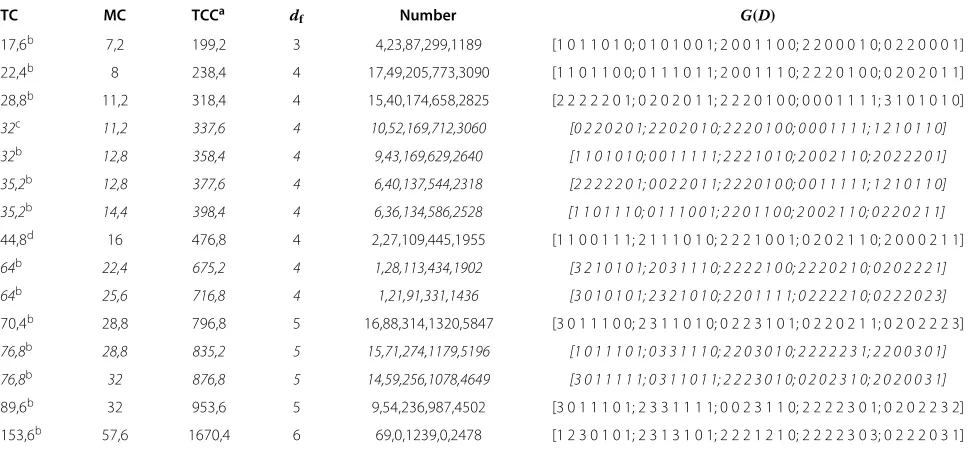
The results of the search are summarized in Tables 1, 2, 3, and 4. For each TC(Mmin)and MC(Mmin)considered, we list the free distancedf, the first six terms of the code weight spectrumN, and the generator matrixG(D)of the
best code found. The generator matrices are in octal form with the highest power inDin the most significant bit of the representation, i.e., 1+D+D2=1+2+4=7. The italicized entries in Tables 1, 2, 3, and 4 indicate codes presenting same TC(Mmin) but different MC(Mmin). For instance, for the rate 2/4 and TC(Mmin) = 192 in Table 1, we obtain MC(Mmin)=48 and MC(Mmin)=64 withdf = 8 anddf = 9, respectively. New codes with a variety of trellis complexities are shown in these tables.
Table 1 Good convolutional codes of rate 2/4 for variousTC(Mmin)andMC(Mmin)values
TC MC TCCa
df Number G(D)
18b 6 186 4 1,3,5,9,17 [1 3 0 1; 2 3 3 0]
24b 6 222 5 2,4,8,16,32 [6 3 2 0; 2 0 3 3]
24b 8 248 6 10,0,26,0,142 [4 2 3 3; 6 6 4 2]
48c 16 496 7 6,10,14,39,92 [7 1 3 2; 4 6 7 3]
56b 16 544 7 4,9,16,38,86 [6 3 1 3; 5 7 7 0]
64d 16 592 7 2,8,18,35,70 [6 4 3 3; 3 3 6 4]
96b 24 888 8 12,0,52,0,260 [12 7 0 7; 6 6 7 4]
96b 32 992 8 4,15,16,36,104 [14 6 1 7; 3 7 7 2]
112b 32 1088 8 4,14,17,36,114 [16 4 2 7; 2 16 15 6]
128d 32 1184 8 2,10,16,31,67 [16 3 7 4; 6 16 14 7]
192b 48 1776 8 1,9,15,33,80 [13 14 13 1; 6 7 3 6]
192b 64 1984 9 4,12,27,46,109 [11 7 2 7; 14 16 15 3]
aSpecific measure for the TMS320C55xx DSP.bNew code found in this study.cCode with the same TC(M
min), MC(Mmin), and distance spectrum as a code listed in [5].
dCode with the same TC(M
Table 2 Good convolutional codes of rate 3/5 for variousTC(Mmin)andMC(Mmin)values
TC MC TCCa df Number G(D)
12b 4 124 4 11,0,52,0,279 [0 1 1 1 1; 2 2 2 0 1; 2 2 0 3 0]
13,33b 4 131,98 4 3,12,24,56,145 [1 0 1 1 1; 2 1 1 1 0; 2 2 2 1 1]
26,66b 8 263,96 4 1,5,13,39,111 [3 1 0 1 0; 0 1 3 2 2; 2 2 2 1 1]
26,66c 9,33 281,25 4 1,12,32,68,173 [1 0 1 1 1; 2 1 1 2 1; 2 2 3 1 0]
32c 10,66 330,58 4 1,0,34,0,211 [1 0 1 1 1; 2 3 3 0 2; 4 2 3 3 0]
37,33c 10,66 362,56 5 6,18,40,103,320 [2 2 3 0 1; 6 0 2 2 3; 6 6 0 1 0]
37,33c 13,33 397,27 5 4,11,29,90,254 [3 3 0 1 0; 2 1 3 2 1; 2 2 2 1 3]
42,66c 13,33 429,25 5 1,16,29,78,217 [1 3 0 1 1; 2 3 3 3 0; 4 0 2 3 3]
48c 16 496 6 18,0,139,0,1202 [1 3 2 1 1; 2 1 3 3 0; 6 2 2 3 3]
53,33d 16 527,98 6 15,0,131,0,1216 [0 3 3 1 1; 2 0 2 3 3; 7 1 0 3 0]
74,66c 21,33 725,25 6 13,0,122,0,1014 [4 0 3 3 2; 2 1 3 2 1; 3 3 0 2 2]
74,66b 26,66 794,54 6 4,18,48,114,374 [3 2 3 2 1; 0 3 1 3 2; 4 4 2 3 3]
96c 32 992 6 2,18„58,132,338 [1 1 1 3 1; 6 4 3 2 1; 0 4 6 3 3]
149,33c 42,66 1450,56 7 19,48,99,319,988 [1 3 3 0 3; 6 3 2 3 0; 6 0 7 4 1]
149,33c 53,33 1589,27 7 9,36,65,236,671 [3 3 0 3 2; 4 4 2 3 3; 4 3 7 5 0]
aSpecific measure for the TMS320C55xx DSP.bCode with the same TC(M
min), MC(Mmin), and distance spectrum as a code listed in [5].cNew code found in this study.
dCode with the same TC(M
min), MC(Mmin), and distance spectrum as a code listed in [8].
The existing codes (with possibly different G(D)) are also indicated. We call the reader’s attention to the fact that other codes with TC(Mmin), MC(Mmin) or weight spectrum different from those in Tables 1, 2, 3, and 4 are documented in the literature (see for example [8] and [10]), and they could be used to extend the performance-complexity trade-off analysis performed in this work.
It should be remarked that the values of TCC shown in Tables 1, 2, 3, and 4 are calculated from (12) with the costs S,Cb, andCi implemented in the next section (refer to (13)) using C programming language running on a TMS320C55xx fixed-point digital signal processor (DSP) family from Texas Instruments, Inc. (Dallas, TX, USA) [17]. The cost of each operation, based on the number of machine cycles consumed by its execution, is substituted
Table 3 Good convolutional codes of rate 4/7 for variousTC(Mmin)andMC(Mmin)values
TC MC TCCa d
f Number G(D)
20b 5 185 4 6,12,21,58,143 [1 1 1 1 0 1 0; 0 1 1 1 1 0 1;2 2 1 1 0 0 0; 2 0 0 1 1 1 0]
22b 6 210 4 3,7,18,54,125 [0 2 2 2 0 1 1; 2 0 2 0 1 1 0;0 0 0 1 1 1 1; 3 3 1 0 1 0 0]
22c 7 223 4 1,9,21,45,118 [1 1 0 1 1 0 1; 0 1 1 0 1 1 0;2 2 0 1 1 1 0; 0 0 2 2 1 1 1]
26d 8 260 5 7,17,39,96,249 [1 1 0 1 1 1 1; 2 1 1 1 0 0 1;0 2 2 1 1 1 0; 2 2 0 2 0 1]
28e 8 272 5 3,14,29,72,205 [0 1 1 1 1 1 1; 3 1 0 0 1 1 0;2 3 1 0 0 2 3; 2 3 3 1 1 0 0]
40b 12 396 5 3,11,31,70,176 [1 0 1 0 1 1 1; 2 3 1 1 1 1 0;2 0 2 1 0 1 1; 2 2 2 2 1 3 0]
40b 14 422 6 24,0,144,0,1021 [3 1 1 0 1 0 1; 0 0 3 3 0 1 1;2 2 2 0 1 1 1; 0 2 2 2 2 3 0]
44b 14 446 6 23,0,140,0,993 [3 1 0 1 0 1 1; 2 3 1 2 1 1 1; 2 2 2 1 1 1 0; 0 2 2 2 2 1 1]
48b 14 470 6 17,0,133,0,855 [1 1 1 0 1 1 1; 2 1 2 1 3 0 0; 2 2 1 1 1 1 0; 2 0 0 2 2 3 1]
48c 16 496 6 15,0,120,0,795 [3 0 1 0 1 1 1; 0 1 3 2 1 0 1; 2 2 2 1 1 1 0; 2 2 2 2 2 3 1]
56c 16 544 6 7,21,47,132,359 [3 1 1 1 1 1 0; 2 3 0 2 3 1 0;2 2 2 1 1 1 1; 2 0 0 0 2 3 3]
80b 24 792 6 3,18,36,96,291 [1 3 2 1 1 0 1; 2 3 1 2 1 1 1;2 2 0 1 3 1 0; 0 0 2 2 2 3 3]
88b 28 892 6 1,18,35,73,258 [3 3 2 1 0 1 0; 2 1 1 3 1 1 1;0 2 0 3 3 3 0; 2 2 2 2 2 1 3]
88b 32 944 7 18,44,77,234,703 [3 3 1 1 1 0 0; 0 1 3 2 1 1 1; 0 2 0 3 3 3 0; 4 0 2 2 2 3 3]
104d 32 1040 7 15,34,72,231,649 [1 3 2 1 1 1 1; 0 1 1 3 2 3 1; 2 2 0 3 3 1 0; 6 2 2 0 0 3 3]
aSpecific measure for the TMS320C55xx DSP.bNew code found in this study.cCode with the same TC(M
min)and MC(Mmin)as a code listed in [5], but with a better distance spectrum.dCode with the same TC(M
Table 4 Good convolutional codes of rate 5/7 for variousTC(Mmin)andMC(Mmin)values
TC MC TCCa df Number G(D)
17,6b 7,2 199,2 3 4,23,87,299,1189 [1 0 1 1 0 1 0; 0 1 0 1 0 0 1; 2 0 0 1 1 0 0; 2 2 0 0 0 1 0; 0 2 2 0 0 0 1]
22,4b 8 238,4 4 17,49,205,773,3090 [1 1 0 1 1 0 0; 0 1 1 1 0 1 1; 2 0 0 1 1 1 0; 2 2 2 0 1 0 0; 0 2 0 2 0 1 1]
28,8b 11,2 318,4 4 15,40,174,658,2825 [2 2 2 2 2 0 1; 0 2 0 2 0 1 1; 2 2 2 0 1 0 0; 0 0 0 1 1 1 1; 3 1 0 1 0 1 0]
32c 11,2 337,6 4 10,52,169,712,3060 [0 2 2 0 2 0 1; 2 2 0 2 0 1 0; 2 2 2 0 1 0 0; 0 0 0 1 1 1 1; 1 2 1 0 1 1 0]
32b 12,8 358,4 4 9,43,169,629,2640 [1 1 0 1 0 1 0; 0 0 1 1 1 1 1; 2 2 2 1 0 1 0; 2 0 0 2 1 1 0; 2 0 2 2 2 0 1]
35,2b 12,8 377,6 4 6,40,137,544,2318 [2 2 2 2 2 0 1; 0 0 2 2 0 1 1; 2 2 2 0 1 0 0; 0 0 1 1 1 1 1; 1 2 1 0 1 1 0]
35,2b 14,4 398,4 4 6,36,134,586,2528 [1 1 0 1 1 1 0; 0 1 1 1 0 0 1; 2 2 0 1 1 0 0; 2 0 0 2 1 1 0; 0 2 2 0 2 1 1]
44,8d 16 476,8 4 2,27,109,445,1955 [1 1 0 0 1 1 1; 2 1 1 1 0 1 0; 2 2 2 1 0 0 1; 0 2 0 2 1 1 0; 2 0 0 0 2 1 1]
64b 22,4 675,2 4 1,28,113,434,1902 [3 2 1 0 1 0 1; 2 0 3 1 1 1 0; 2 2 2 2 1 0 0; 2 2 2 0 2 1 0; 0 2 0 2 2 2 1]
64b 25,6 716,8 4 1,21,91,331,1436 [3 0 1 0 1 0 1; 2 3 2 1 0 1 0; 2 2 0 1 1 1 1; 0 2 2 2 2 1 0; 0 2 2 2 0 2 3]
70,4b 28,8 796,8 5 16,88,314,1320,5847 [3 0 1 1 1 0 0; 2 3 1 1 0 1 0; 0 2 2 3 1 0 1; 0 2 2 0 2 1 1; 0 2 0 2 2 2 3]
76,8b 28,8 835,2 5 15,71,274,1179,5196 [1 0 1 1 1 0 1; 0 3 3 1 1 1 0; 2 2 0 3 0 1 0; 2 2 2 2 2 3 1; 2 2 0 0 3 0 1]
76,8b 32 876,8 5 14,59,256,1078,4649 [3 0 1 1 1 1 1; 0 3 1 1 0 1 1; 2 2 2 3 0 1 0; 0 2 0 2 3 1 0; 2 0 2 0 0 3 1]
89,6b 32 953,6 5 9,54,236,987,4502 [3 0 1 1 1 0 1; 2 3 3 1 1 1 1; 0 0 2 3 1 1 0; 2 2 2 2 3 0 1; 0 2 0 2 2 3 2]
153,6b 57,6 1670,4 6 69,0,1239,0,2478 [1 2 3 0 1 0 1; 2 3 1 3 1 0 1; 2 2 2 1 2 1 0; 2 2 2 2 3 0 3; 0 2 2 2 0 3 1]
aSpecific measure for the TMS320C55xx DSP.bNew code found in this study.cCode with the same TC(M
min), MC(Mmin), and distance spectrum as a code listed in [10].
dCode with the same TC(M
min), MC(Mmin), and distance spectrum as a code listed in [7].
into (12) in order to obtain a computational complex-ity for this architecture. This allows us to compare the complexity of several trellis modules.
4 A case study
In this section, we describe the implementation of the operations S, Cb, and Ci to obtain the respective num-ber of machine cycles based on simulations of the TMS320C55xx DSP from Texas Instruments. This device belongs to a family of well-known 16-bit fixed-point low-power consumption DSPs suited for telecommunication applications that require low power, low system cost, and high performance [17]. More details about this proces-sor can be found in [18,19]. We work with the integrated development environment (IDE) Code Composer Studio (CCStudio) version 4.1.1.00014 [19]. The simulations are conducted with theC55xx Rev2.x CPU Accurate Simula-tor. Once the number of machine cycles of each operation is obtained, we utilize (12) to have the computational com-plexity measure for a trellis module for this particular architecture.
4.1 DSP implementation of the VA operations
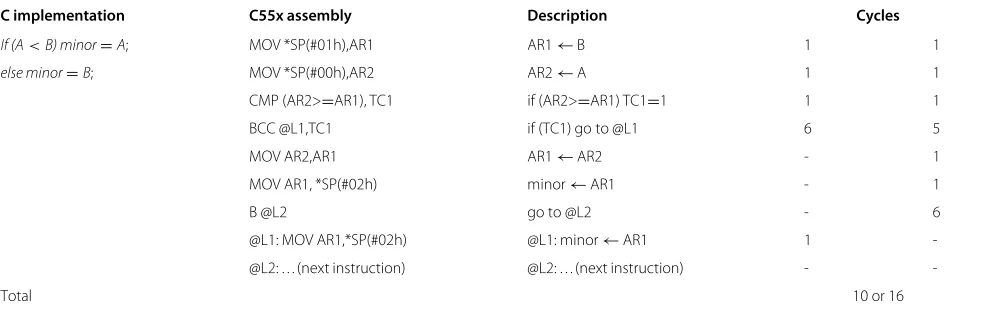
Tables 5, 6, and 7 show the implementation details of the operations S, Cb, and Ci, respectively. In each of these tables, the operation in C language, the corresponding C55x assembly language code generated by the compiler, a short description of the code, and the resulting number of machine cycles are given in the first, second, third, and fourth columns, respectively.
4.1.1 Sum operation (S)
Table 5 shows the implementation details of the opera-tion S. As we can observe from the third column, two storage operations and an S operation, each taking one machine cycle, are performed. Therefore, the operationS
is performed with three machine cycles.
4.1.2 Bit comparison operation (Cb)
The bit comparison operation Cb is implemented with a bitwise logical XOR instruction, assuming that each bit of the received word has been previously stored in an integer type variable. Table 6 shows the details of the implementation of this operation. Similarly, three
Table 5 Implementation of theSoperation
C implementation C55x assembly Description Cycles
S=code1+code2; MOV *SP(#01h),AR1 AR1←code1 1
ADD *SP(#00h), AR1,AR1 AR1←AR1+code2 1
MOV AR1,*SP(#02h) S←AR1 1
Table 6 Implementation of theCboperation
C implementation C55x assembly Description Cycles
Cb=code1 ^code2; MOV *SP(#01h), AR1 AR1←code1 1
XOR *SP(#00h),AR1,AR1 AR1←AR1 XOR code2 1
MOV AR1,*SP(#02h) Cb←AR1 1
Total 3
machine cycles are necessary to implement the operation
Cb.
4.1.3 Integer comparison operation (Ci)
The operationCiis implemented with anif-elsestatement, which includes the storage of the lowest accumulated edge metric. Table 7 shows how this operation is implemented. The if statement is used to compare two accumulated edge metrics, and the lowest one is stored at the inte-ger type variable minor. In the third column, AR1 and AR2 are accumulator registers loaded with the accumu-lated metrics values, represented here by the variables B and A, respectively. Next, the metrics are compared; if B < A, then status bit TC1 is set, and the program flow is deviated to the label specified by @L1, where the value of B is stored at minor. Following this path, the code consumes 10 (=1+1 + 1 + 6+1) machine cycles. Otherwise, if A ≤ B, then the value of A is stored in
minor, and the program flow is deviated to the label spec-ified by @L2, where the next instruction to be executed is located. The architecture of this processor cannot trans-fer the value stored at AR2 directly to memory. Instead, it copies the AR2 value to AR1 and then to the mem-ory. Following this path, the code consumes 16 (= 1+ 1+1+5+1+1+6) machine cycles. We consider the average value consumed by the operation, i.e., 13 machine cycles.
In summary, the computational cost of the VA opera-tions is shown in Table 8.
4.2 Computational complexity
By substituting the results in Table 8 into (12), a computa-tional complexity of a trellis moduleM, for this particular architecture, is
TCC(M)=TC(M)6+MC(M)13. (13)
We observe that the weight of the latter is approxi-mately two times the weight of the former. Hereafter, (13), a particular case of (12), will be referred to as the compu-tational complexity measure even though the complexity analysis performed in this section is valid for the particu-lar DSP in [17].
For the code C1(7, 3, 3) of Example 1, we obtain TCC(Mconv)=1138.5 and TCC(Mmin)=328. The com-putational complexity of the minimal trellis is 28.8% of the computational complexity of the conventional trellis. The trellis and merge complexities of the minimal trellis are 42.87% and 25% of the conventional trellis, respectively. In the remainder of this paper, we no longer consider the conventional trellis. In the next examples, we analyze the impact of trellis, merge, and computational complexities over codes of same rate.
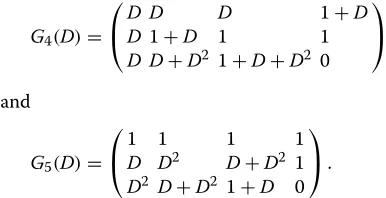
Example 2. Consider the convolutional codesC2(4, 2, 3) with profiles ν˜ = (3, 2, 3, 4) and b˜ = (0, 1, 1, 0), and
C3(4, 2, 3)with profilesν˜ =(3, 3, 3, 3)andb˜ =(1, 0, 1, 0). The generator matricesG2(D)andG3(D)are, respectively, given by
Table 7 Implementation of theCioperation
C implementation C55x assembly Description Cycles
If (A<B) minor=A; MOV *SP(#01h),AR1 AR1←B 1 1
else minor=B; MOV *SP(#00h),AR2 AR2←A 1 1
CMP (AR2>=AR1), TC1 if (AR2>=AR1) TC1=1 1 1
BCC @L1,TC1 if (TC1) go to @L1 6 5
MOV AR2,AR1 AR1←AR2 - 1
MOV AR1, *SP(#02h) minor←AR1 - 1
B @L2 go to @L2 - 6
@L1: MOV AR1,*SP(#02h) @L1: minor←AR1 1
-@L2: . . . (next instruction) @L2: . . . (next instruction) -
Table 8 Computational cost of the operations of VA
The trellis, merge, and computational complexities of the minimum trellis module for C2 are, respectively, TC(Mmin)=24, MC(Mmin)=6, and TCC(Mmin)=222. ForC3, these values are TC(Mmin)=24, MC(Mmin)=8, and TCC(Mmin) = 248. Although both codes have the same trellis complexity, this is not true for the merge com-plexity. As a consequence, the computational complexity is not the same. CodeC3has a computational complexity approximately 11.7% higher with respect toC2. This fact indicates the importance of adopting the computational complexity to compare the complexity of convolutional codes.
Example 3. Consider the convolutional codesC4(4, 3, 4) with profiles ν˜ = (4, 4, 4, 4) and b˜ = (0, 1, 1, 1), and 464. Both codes have the same merge complexity, but this is not true for the trellis and computational complexities. In this case, the computational complexity ofC5is 7.5% higher than that ofC4.
It is clearly shown by these examples that considering only the trellis complexity as in [5,10], or the merge com-plexity, it is not sufficient to obtain a real evaluation of the
decoding complexity of a trellis module. This is the rea-son we propose the use of the computational complexity TCC(M).
As a final comment, note from the codes listed in Tables 1, 2, 3, and 4 that TC(M) is typically p times MC(M), where 2.4≤p≤4. This is a code behavior, and it is independent of the specific DSP. On the other hand, for the TMS320C55xx, MC(M)costs more than twice as much as TC(M), i.e.,Ci =2.17(Cb+S). So, MC(M) has a great impact on the TCC(M)for this particular pro-cessor. It is possible, however, that the costs of TC(M)and MC(M)are totally different in another DSP. As a conse-quence, it is possible that given two different codes, the less complex code for one processor may not be the less complex one for the other processor. In other words, car-rying out the computational complexity proposed in this paper is an essential step for determining the best choice of codes for a given DSP.
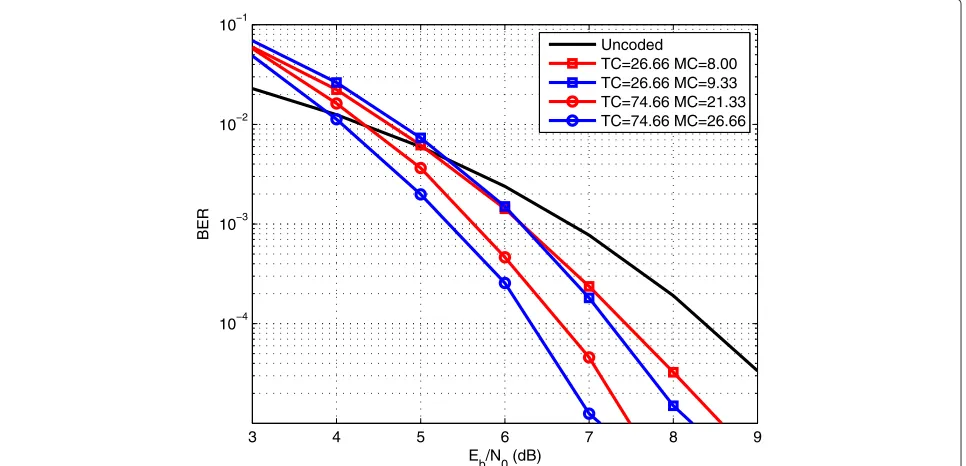
In the following, we provide simulation results of the bit error rate (BER) over the AWGN channel for some of the codes that appear in Tables 1, 2, 3, and 4. In particular, we consider two code rates, 2/4 and 3/5, and plot the BER versusEb/N0for two pairs of codes for each rate. The pairs of codes are chosen so that the effect of a slight increase in the distance spectra may become apparent in terms of error performance.
For the case of rate 2/4, as shown in Figure 2, we con-sider the two codes with TC(Mmin) = 96 and the two codes with TC(Mmin) = 192 listed in Table 1 in the manuscript. One of the codes with TC(Mmin) = 96 has MC(Mmin) = 24 while the other has MC(Mmin) = 32. Such change in MC(Mmin), and thus in the overall com-plexity, is sufficient to slightly improve the distance spec-trum (for the same free distance). As shown in Figure 2, this is sufficient to make the more complex code perform around 0.2 dB better in terms of requiredEb/N0at a BER of 10−5. For the case of TC(Mmin)=192, one of the codes has MC(Mmin)=48 while the other has MC(Mmin)=64. In this case, the increase in complexity is sufficient to increase the free distance of the second code with respect to the first, resulting in an advantage in terms of required
Eb/N0at a BER of 10−5around 0.2 dB as well.
3 3.5 4 4.5 5 5.5 6 6.5 7 10−4
10−3 10−2 10−1
E
b/N0 (dB)
BER
Uncoded TC=96 MC=24 TC=96 MC=32 TC=192 MC=48 TC=192 MC=64
Figure 2BER versusEb/N0for codes with the sameTC(Mmin)and differentMC(Mmin).Rate 2/4 as listed in Table 1.
5 Conclusions
In this paper, we have presented a computational decod-ing complexity measure of convolutional codes to be decoded by a software implementation of the VA with hard decision. More precisely, this measure is related with the number of machine cycles consumed by the decoding operation. A case study was conducted by deter-mining the number of arithmetic operations and the
corresponding computational costs of execution based on a typical DSP used for low-power telecommunica-tions applicatelecommunica-tions. More general analysis related to other processor architectures is considered for future work.
We calculated the trellis, merge, and computational complexities of codes of various rates. In consider-ing codes of same rate, those which present the same trellis complexity can present different computational
3 4 5 6 7 8 9
10−4 10−3 10−2 10−1
E
b/N0 (dB)
BER
Uncoded
TC=26.66 MC=8.00 TC=26.66 MC=9.33 TC=74.66 MC=21.33 TC=74.66 MC=26.66
complexities. Therefore, the computational complexity proposed in this work is a more adequate measure in terms of computational effort. A good computational complexity refinement is obtained from a code search conducted in this work.
Competing interests
The authors declare that they have no competing interests.
Acknowledgements
This work was supported in part by FAPEAM, FACEPE, and CNPq (Brazil).
Author details
1Federal Institute of Amazonas (IFAM), Av. General Rodrigo, Octávio, 6200,
Coroado I, Manaus, Amazonas 69077-000, Brazil.2Federal University of Pernambuco (UFPE), Av. Prof. Morais Rego, 1235, Recife, Pernambuco 50670-901, Brazil.3Federal University of Technology - Paraná (UTFPR), Av. Sete de Setembro, 3165, Rebouças, Curitiba, Paraná 80230-901, Brazil.4Federal University of Santa Catarina (UFSC), Campus Universitário Reitor João David Ferreira Lima - Trindade, Florianópolis, Santa Catarina 88040-900, Brazil.
Received: 15 May 2014 Accepted: 15 November 2014 Published: 4 December 2014
References
1. S Lin, DJ Costello,Error Control Coding, 2nd edn. (Prentice Hall, Upper Saddle River, 2004)
2. B Bougard, S Pollin, G Lenoir, W Eberle, L Van der Perre, F Catthoor, W Dehaene, inProceedings of the IEEE Workshop on Signal Processing Advances in Wireless Communications. Energy-scalability enhancement of wireless local area network transceivers (Leuven, Belgium, 11–14 July 2004), pp. 449–453
3. IEEE. IEEE Standard 802.11, Wireless LAN Medium Access Control (MAC) and Physical (PHY) Layer Specifications: High Speed Physical Layer in the 5 GHz band (IEEE, Piscataway, 1999)
4. RJ McEliece, W Lin, The trellis complexity of convolutional codes. IEEE Trans. Inform. Theory.42(6), 1855–1864 (1996)
5. BF Uchôa-Filho, RD Souza, C Pimentel, M Jar, Convolutional codes under a minimal trellis complexity measure. IEEE Trans. Commun.57(1), 1–5 (2009) 6. HH Tang, MC Lin, On (n,n-1) convolutional codes with low trellis
complexity. IEEE Trans. Commun.50(1), 37–47 (2002)
7. IE Bocharova, BD Kudryashov, Rational rate punctured convolutional codes for soft-decision Viterbi decoding. IEEE Trans. Inform. Theory. 43(4), 1305–1313 (1997)
8. E Rosnes, Ø Ytrehus, Maximum length convolutional codes under a trellis complexity constraint. J. Complexity.20, 372–408 (2004)
9. BF Uchôa-Filho, RD Souza, C Pimentel, M-C Lin, Generalized punctured convolutional codes. IEEE Commun. Lett.9(12), 1070–1072 (2005) 10. A Katsiotis, P Rizomiliotis, N Kalouptsidis, New constructions of
high-performance low-complexity convolutional codes. IEEE Trans. Commun.58(7), 1950–1961 (2010)
11. F Hug, I Bocharova, R Johannesson, BD Kudryashov, inProceedings of the International Symposium on Information Theory. Searching for high-rate convolutional codes via binary syndrome trellises (Seoul, Korea, 28 June–3 July 2009), pp. 1358–1362
12. I Benchimol, C Pimentel, RD Souza, inProceedings of the 35th International Conference on Telecommunications and Signal Processing (TSP). Sectionalization of the minimal trellis module for convolutional codes (Prague, Czech Republic, 3–4 July 2012), pp. 227–232
13. A Katsiotis, P Rizomiliotis, N Kalouptsidis, Flexible convolutional codes: variable rate and complexity. IEEE Trans. Commun.60(3), 608–613 (2012) 14. A Vardy, inHandbook of Coding Theory, ed. by V Pless, W Huffman. Trellis
structure of codes (Elsevier, The Netherlands, 1998), pp. 1989–2117 15. RJ McEliece, On the BCJR trellis for linear block codes. IEEE Trans. Inform.
Theory.42(4), 1072–1092 (1996)
16. GL Moritz, RD Souza, C Pimentel, ME Pellenz, BF Uchôa-Filho, I Benchimol, Turbo decoding using the sectionalized minimal trellis of the constituent code: performance-complexity trade-off. IEEE Trans. Commun. 61(9), 3600–3610 (2013)
17. Inc Texas Instruments,TMS320C55x Technical Overview, Literature no. SPRU393. (Texas Instruments, Inc., Dallas, 2000)
18. SM Kuo, BH Lee, W Tian,Real-Time Digital Signal Processing: Implementations and Applications, 2nd edn. (Wiley, New York, 2006) 19. Inc Texas Instruments,TMS320C55x DSP CPU Reference Guide, Literature
no. SPRU371F. (Texas Instruments, Inc., Dallas, 2004)
doi:10.1186/1687-6180-2014-173
Cite this article as:Benchimolet al.:A new computational decoding complexity measure of convolutional codes.EURASIP Journal on Advances in Signal Processing20142014:173.
Submit your manuscript to a
journal and benefi t from:
7Convenient online submission
7 Rigorous peer review
7Immediate publication on acceptance
7 Open access: articles freely available online
7High visibility within the fi eld
7 Retaining the copyright to your article