Timing-Free Blind Multiuser Detection for Multicarrier
DS/CDMA Systems with Multiple Antennae
Stefano Buzzi
DAEIMI, Universit`a degli Studi di Cassino, Via Di Biasio 43, 03043 Cassino (FR), Italy Email:[email protected]
Emanuele Grossi
DAEIMI, Universit`a degli Studi di Cassino, Via Di Biasio 43, 03043 Cassino (FR), Italy Email:[email protected]
Marco Lops
DAEIMI, Universit`a degli Studi di Cassino, Via Di Biasio 43, 03043 Cassino (FR), Italy Email:[email protected]
Received 30 December 2002; Revised 30 July 2003
The problem of blind multiuser detection for an asynchronous multicarrier DS-CDMA system employing multiple transmit and receive antennae over a Rayleigh fading channel is considered in this paper. The solutions that we develop require prior knowledge of the spreading code of the user to be decoded only, while no further information either on the user to be decoded or on the other active users is required. Several combining rules for the observables at the output of each receive antenna are proposed and assessed, and the implications of the different options are studied in depth in terms of both detection performance and computational complexity. A closed form expression is also derived for the conditional error probability and a lower bound for the near-far resistance is provided. Results confirm that the proposed blind receivers can cope with both multiple access interference suppression and channel estimation at the price of a limited performance loss as compared to the ideal linear receivers which assume perfect channel state information.
Keywords and phrases:MC CDMA, multiple antennae, MIMO systems, channel estimation, timing-free detection, near-far resistance.
1. INTRODUCTION
Multicarrier code division multiple access (MC-CDMA) has been conceived as a transmission format which retains the potentials of direct sequence CDMA (DS-CDMA)— and in particular its resistance to multipath effects induced by the radio channel as the communication rate grows larger and larger [1]—while relaxing some very demand-ing requirements posed by its competitor. In particular, the efficacy of DS-CDMA on wireless channels is mainly due to the recombination of multiple rays so as to in-crease the average signal-to-noise ratio, but this inevitably poses the problem of a tight synchronization so as to avoid heavy mismatch losses in the replicas-retrieving process. MC-CDMA, instead, by partitioning the available band-width in many subbands, no larger than the channel co-herence bandwidth, and allocating in each subband inde-pendently modulated digital signals, achieves two
advan-tages, that is, (a) the propagation channel in each sub-band is frequency-flat, and (b) the symbol duration for the data signals occupying the frequency subbands grows lin-early with the number of subbands, thus implying that the need for fast electronics and high-performance synchroniza-tion schemes is less stringent. The combinasynchroniza-tion of the MC concept with the CDMA technology has led to the birth of three main access schemes, that is, multitone CDMA [2,3], MC CDMA [4,5,6], and MC DS-CDMA [7, 8,9, 10].
law approximately linear in the minimum between the num-ber of transmit and receive antennae [11]. Roughly speak-ing, multiple transmit antennae generate a spatial diversity which can be successfully exploited at the receiver end to improve performance, especially if space-time coding tech-niques are employed at the transmitter [12]. Motivated by these considerations, many studies have been recently pub-lished for either single-user or multiuser multiantenna sys-tems [13,14].
All of these studies, though, assume either perfect chan-nel state information (CSI) or error-free estimation thereof. The problem of evaluating the cost of such an information has been only recently considered [15] and the main results are as follows: (a) the training and the data transmission phase should be carefully designed in order to ensure reliable transmission in a multiantenna system on wireless channel; (b) in the large signal-to-noise ratio regime, the length of the training phase should be in the order of the number of transmit antennae; (c) in the region of low signal-to-noise ratios, about half the transmission time should be devoted to training, and, moreover, the capacity of trained systems is far from the optimal one. It is also worth pointing out that in a CDMA multiaccess network, the signal-to-interference-plus-noise ratio is expected to be quite low, at least as far as the network load increases, whereby the task of reducing—if not nullifying—the training phase is more and more strin-gent.
Motivated by these results, the present paper deals with the problem of blind multiantenna systems employing an MC DS-CDMA modulation format.1Since the prior uncer-tainty as to the CSI results in a complete lack of knowledge of the spatial signatures of both the user of interest and of the other users, while knowledge of the spreading code of all of the active users can be reasonably assumed only at the “base station” of an isolated cell, we consider the more gen-eral scenario where the receiver cannot avail itself of any prior information beyond the spreading code of the user of in-terest, and is thus faced withasynchronouscochannel inter-ference (whether from the same cell or from nearby cells); thus differential encoding-decoding is assumed, as a result of the lack of a phase reference. For the sake of simplicity, we also consider uncoded transmission, even though the results can be extended to account for space-time block coding. The main contributions of this paper can be summarized as fol-lows.
(1) We develop a signal model for an MC DS-CDMA sys-tem operating over a fading dispersive channel and employing multiple transmit and receive antennae that resembles the signal model developed in [16,17,18] with reference to a single-antenna DS-CDMA system operating in the same conditions.
(2) Based on the above analogy, we extend the subspace techniques developed in [16,19] to the multiantenna
1The results presented here can be easily extended to the multitone CDMA and to the MC-CDMA techniques as well.
MC DS-CDMA system and, moreover, we propose several combining schemes to integrate the statistics observed on each receive antenna branch. It should be noted that the resulting receivers are blind and timing-free, that is, they do not require any information be-yond the spreading code of the user to be detected. In-terestingly, not even the propagation delay and initial transmitter timing offset for the user of interest is re-quired.
(3) As a by-product of the previous derivations, we also introduce a subspace-based technique which enables blind channel estimation up to a complex scaling fac-tor.
(4) We also provide a thorough performance analysis of the proposed receivers; in particular, we derive closed-form closed-formulas for the conditional error probability and for the near-far resistance, given the channel im-pulse response realization. It is worth noticing that the methodology outlined here is quite general and can be used to express the performance of any linear receiver in differentially encoded systems.
The rest of the paper is organized as follows.Section 2 outlines the system model, whileSection 3is devoted to the development of the detection structures. In Section 4, the statistical analysis of the receiver is provided, whileSection 5 is devoted to the discussion of the numerical results. Finally, concluding remarks are given inSection 6.
Notation
In the following, (·), (·)T, and (·)Hdenote conjugate,
trans-pose, and conjugate transtrans-pose, respectively;Mm×n(C) is the
set of all the m×n-dimensional matrices with complex-valued entries. E[·] denotes statistical expectation; (·) and(·) denote real part and coefficient of the imaginary part, respectively; column-vectors and matrices are indicated through boldface lowercase and uppercase letters, respec-tively. The term Im(A) is the image of A, that is, its col-umn span, while Ker(A) is the null space ofA, that is, the orthogonal complement of Im(A); dim(S) is the dimension-ality of the subspace S; the symbols ·,·, ⊗, and de-note the canonical scalar product, the Kronecker product, and the Schur (i.e., component-wise) matrix product, re-spectively;Indenote the identity matrix of ordern;Om,nand
0m are the m×n-dimensional matrix and m-dimensional
vector with null entries, respectively, and diag(a) is a di-agonal matrix containing the elements of the vector a on its diagonal;A+ is theMoore-Penrosegeneralized inverse of
A. supp{f} is the support of the function f, that is, the set of its arguments for which f is not zero and uT(τ)
Rx
ADC rnr−1(τ) MC mod
bknt−1(i) S/P bk(i)
b0k(i)
MC mod
r0(τ) ADC
. . . .
. .
Figure1: Scheme of a communication system with multiple transmit and receive antennae.
2. SYSTEM MODEL
The general scheme of an MC communication system equipped with multiple transmit and receive antennae is shown inFigure 1. A block ofnt symbols is converted from
serial to parallel and each symbol feeds a (spatially) separate antenna. Thus, the nt symbols are transmitted in parallel,
achieving annt-fold increase in the data rate, and received
onnrspatially separated receive antennae, providing annr
th-order receive diversity to combat fading.
The complex envelope of the signal received on therth antenna can be formally written as
ρr(τ)
=
K−1
k=0
P−1
l=0 Ak
nt−1
t=0 bkt(l)βkt
τ−τk−lTb
∗hkt,r(τ) +wr(τ),
(1)
where
(1) Kis the number of active users;
(2) Pis the length of the transmitted frame;
(3) Akis the amplitude of the signal transmitted by thekth
user; (4) bk
t(l) is the symbol transmitted by thetth antenna of
thekth user at thelth bit interval; (5) βk
t(τ) is the signature assigned to thetth transmitter of
thekth user;
(6) Tbis the bit duration;
(7) τk is thekth user’s overall delay, that is, the sum of
thekth user transmission delay and of the propagation time through the channel;
(8) hkt,r(τ) is the channel impulse response from thetth
transmit of thek-user to therth receive;
(9) wr(τ) is the additive white Gaussian noise on therth
receive antenna, independent for different antennae, with power spectral density 2N0.
On the other hand, the signatures in (1) are
βkt(τ)= N−1
n=0
M−1
m=0
ctk(nM+m)ψtx
τ−mTc
e2πi fnτ, (2)
where
(1) Nis the number of subcarriers provided to each user; (2) M is the spreading gain on each subcarrier (hence
PG=MNis the overall processing gain); (3) ck
t(l),l=0,. . .,MN−1, is the spreading sequence
as-signed to thetth antenna of thekth user; (4) Tc=Tb/Mis the chip duration;
(5) ψtx(τ) is a unit-energy chip waveform supported in
[0,∆txTc], with bandwidthBsc;∆txis a suitable integer
so that the signal energy content outsideBscis
negligi-ble;
(6) fn,n=0,. . .,N−1, are the frequencies assigned to the
subcarriers.
Notice that, denoting byEbkthe energy per bit of thekth user, we haveAk=2Ek
b/NM.
The number of subcarriersN employed in an MC sys-tem and their spacing∆f have to be properly chosen, based on the channel characteristics. Indeed, ifBcoher is the coher-ence bandwidth of the channel,Nshould be chosen so as to ensure fading flatness in each subband and fading indepen-dence between adjacent subbands; thus, if 2W is the overall bandwidth assigned for transmission,N,Bsc, and∆f result
from the following set of constraints:
(i) Bsc≤Bcoher: fading flatness on the single subband;
(ii) ∆f ≥ Bcoher: fading independence for different sub-band;
(iii) (N−1)∆f +Bsc=2W: available bandwidth.
For givenN, the processing gain on each subcarrier is fixed (M = PG/N), and the channel frequency response can be approximated as follows:
Hk
t,r(f)u2W(f −W) N−1
n=0 Hk
t,r
fn
u∆f
f −
fn−∆
f 2
=
N−1
n=0 Hk
t,r,nu∆f
f −
fn−∆
f 2
,
(3)
where fn =(n−(N−1)/2)∆f. We assume a slowly fading
channel, namely, whose coherence time exceeds the packet duration PTb. As to Htk,r,n, it is modelled as a sequence of
2M
Figure2: General A/D converter for an MC DS-CDMA system.
for alln; additionally, due to the spatial separation, they are also independent for differentt,r, andk.
At the receiver side, the signal observed on each antenna is converted to discrete-time. According to the scheme in Figure 2, there areN branches (i.e., as many as the number of carriers) in the anolog-to-digital converter (ADC), each one consisting of a mixer and of a low-pass filter ψrx(τ),
whose output is sampled every Tc seconds. Ideally, the
fil-ter ψrx(τ) should be strictly bandlimited, with bandwidth
not smaller thanBscand not larger than∆f; in practice, it
is realized through a waveform with finite support [0,∆rxTc]
and bandwidth extending betweenBscand∆f. It is also
re-quired to have a Nyquist autocorrelation, that is,rψrx(jTc)=
Rψrx(τ)ψrx(τ − jTc)dτ = δ(j): this implies that output
noise samples are uncorrelated. At thenth branch, the output of the low-pass filter at therth antenna is written as follows:
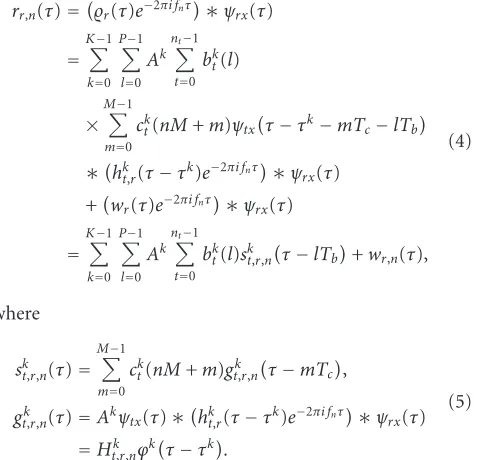
rr,n(τ)=
been made of the fact that the channel is flat on each subcar-rier. It is worthwhile noticing that
(i) in (4), the only substream surviving filtering is thenth one as, due to the bandlimitedness of the transmitted chip waveform, there is no intercarrier interference; (ii) all of the unknown parameters (Htk,r,nandτk) due to
propagation through the channels and users transmit-ting delay have been shoved in theunknownfunctions gk
t,r,n(τ).
Notice that the prior uncertainty as to the delay parameter τkderives from the initial timing offset of thekth
transmit-ter and from the propagation delay. However, while the lattransmit-ter contribution could be easily absorbed in the channel impulse response, the former should be explicitly accounted for in the context of an asynchronous network: this fact, coupled with the use of strictly bandlimited chip waveforms, poses some limitations on the maximum users number that will be dis-cussed in greater detail later on in the paper.
Upon sampling at chip rate, the signalrr,n(τ) is converted
where the inclusions stem from the assumption that τk+
decoding the information symbols transmitted by the 0th antenna of the 0th user, as sk
t,r,n(jTc−iTb) = 0 only for
j =iM+ 1,. . ., (i+ 2)M,b00(i) can be detected through the windowed observablesrr,n(jTc), forj=iM+ 1,. . ., (i+ 2)M,
that can be arranged in the vector
rr,n(i)=
Stacking now the discrete-time version ofgk
t,r,n(τ) into the
and defining the following matrices:
Ck discrete-time versionsk
t,r,n(jTc−lTb),l=i−1,i,i+ 1, of the
Stacking up the vectors corresponding to the N sub-carriers, we obtain the following discrete observable at the rth receive antenna:
rr(i)=
where we have let
skt,r,l=
Notice that in (14), skt,r,0 is the complete signature trans-mitted by thetth antenna of the k-user and received, after propagation, at therth antenna (namely, it is a spatial signa-ture related to the real one through the channel impulse re-sponse);skt,r,−1andskt,r,+1are parts of the signature related to the previous and successive transmitted symbol; the vectors
gkt,rcontain both the unknown channel coefficients (through
the vectorshkt,r∼N(0N,IN)) and the users timings (through
the vectorsϕk); finally,w
r(i)∼N(02MN, 2N0I2MN) accounts
for the thermal noise.
representation derived for single-antenna DS-CDMA sys-tems operating over fading dispersive channels [16,17,18, 19]. In this scenario, in order to allow possible joint process-ing of the observables at all of the receive antennae, it is useful to define the vectorr(i)=(r0(i)· · ·rnr−1(i))
can be also written as follows:
r(i)= interference, multiuser interference (MAI), and intersym-bol interference (ISI) contribution, andw(i) ∼ N(02MNnr, 2N0I2MNnr) is the thermal noise. Notice that the subscript “t” points out that each transmit antenna of a given user is as-signed a different spreading sequence, a condition that will be shown to be necessary in blind uncoded systems. For future
reference, notice that the covariance matrix ofr(i) is equal to
Rrr =E
The detectors that are considered in this paper are linear, and thus uniquely specified by a suitable complex-valued vectorm.2As anticipated, differential coding/decoding is to be adopted to cope with the absence of a phase reference, whereby the desired information is contained in the quantity d0
0(i) =b00(i)b00(i−1). At the receiver side, the observables
r0(i),. . .,rnr−1(i) can be either processed separately and then combined or processed jointly through the vector in (17); we refer to the former case as noncooperativedetection and to the latter case ascooperativedetection.
Noncooperative detection
If we adopt a noncooperative scheme, the signals at the out-put of thenr antennae are processed through as many
de-tectors, whose outputs are expressed byϑr(i)= rr(i),mr,
r =1,. . .,nr−1. The vectorϑ(i) = (ϑ0(i)· · ·ϑnr−1(i))T is then forwarded to a combining block, which makes the de-cisionsd00(i)= f(ϑ(i),ϑ(i−1)). We consider three different scenarios.
(1) Soft integration. In this case, the decision rule assumes the form
that is, the decision takes place after the integration of the soft differential statisticsϑr(i)ϑr(i−1).
(2) Hard integration(with a randomized offset):
that is, the combination takes place after one-bit quan-tization of the soft differential statistics. Observe that, fornrodd, the randomized offset has no effect and this
decision amounts to a majority rule, which is optimal for hard-quantized statistics; on the other hand, fornr
even, the possibility that f(ϑ(i),ϑ(i−1))=0 is ward offthrough the secondary thresholdu.3
(3) Maximal ratio combiner (MRC). According to (14), the vectorϑ(i) is expressed as follows:
ϑ(i)=
s00,0,0,m0 .. .
s00,nr−1,0,mnr−1
b00(i) +
z0(i),m0 .. .
znr−1(i),mnr−1
+
w0(i),m0 .. .
wnr−1(i),mnr−1
=ab0
0(i) +z+w.
(21)
A possible detection strategy consists of weighting thenr
un-quantized statistics of the vector ϑ(i) with the elements of thegain vectora, thus realizing an MRC; afterwards, the un-certainty on the phase can be removed though differential detection. The detection rule is thus
d0
0(i)= f
ϑ(i),ϑ(i−1)
=sgnϑ(i),aϑ(i−1),a !.
(22)
Cooperative detection
In this scheme, the observables are first stacked in a unique vector and then jointly processed, obtainingϑ(i)= r(i),m; a decision is finally made through
d0
0(i)=sgn
ϑ(i)ϑ(i−1). (23)
Obviously, the cooperative scheme is expected to achieve, at the price of some complexity increase, a substantial perfor-mance improvement with respect to the noncooperative de-tection schemes.
Notice also that (17) reduces to (14) for nr = 1; as a
consequence, the synthesis of the receiver can be carried out starting from the observables in (17) and then specify the re-sults to the casenr =1. There are, of course, a number of
different criteria to designm. The first step is to generalize the subspace-based detector, introduced in [16,21], to the new scenario and then move on to the newly proposed detec-tor family that is referred to as “two-stage” receivers in what follows.
3.1. Subspace-based receiver
The correlation matrixRrr of the received signal can be
de-composed as
Rrr =UΛUH=UsΛsUHs +UnΛnUHn, (24)
3For further details on the optimality of randomized tests, see [20].
where U = (UsUn), Λ = diag(Λs,Λn); Λs = diag(λ1,. . ., λ3Knt) contains the 3Knt largest eigenvalues of Rrr in de-scending order and Us the corresponding orthonormal
eigenvectors; Im(Us) and Im(Un) are the signal subspace and
the noise subspace, respectively. Based on the above decom-position, the orthogonality between the noise subspace and the useful signals0
0,0can be exploited to obtain an estimate,
g00, say, of the vectorg00. In particular, under the condition4
dimImRqq
∩ImS00,0S00,0H
=1, (25)
g00can be obtained as the unique, nontrivial solution of the equation
0=UH
ns00,0=UHnS00,0g00. (26) Since in practice the covariance matrix Rrr is not
known, it has to be replaced by its sample estimate Rrr =
(1/Q)"Qi=−01r(i)rH(i), whose spectral decomposition is
Rrr =UsΛsUHs +UnΛnUHn. (27)
Accordingly,g0
0solves the problem
g0
0=arg min
x=1##U
H nS00,0x##
2
, (28)
that is, it is the eigenvector corresponding to the smallest eigenvalue of the matrixS00,0HUnUHnS00,0.
The vectorg00 is then used to obtain the classical mini-mum mean square error (MMSE) and zero-forcing (ZF) re-ceivers, that is,
mMMSE=R−rr1S00,0g00,
mZF=R+qqS00,0g00,
(29)
with
Rqq =UsΛs−2N$0I UHs ,
2N$0= 1 2MNnr−3Knt
2MNnr
i=3Knt+1
Λn
ii.
(30)
3.2. Two-stage receiver
The subspace-based receivers exhibit a noticeable perfor-mance degradation as the users number grows large, since the dimensionality of the noise subspace decreases and the estimate of the vector g00becomes worse and worse. A pos-sible mean to cope with these overloaded scenarios is to re-sort to the “two-stage” receivers, introduced in [18,19] with reference to single-antenna DS-CDMA networks. As a con-sequence, the mathematical proofs of the results in Sections 3.2.1and3.2.3will be omitted so as to avoid any overlap with available literature.
4Remember that Im(R
mHr(i) e
y(i) D
r(i)
Figure3: Two-stage linear receiver scheme.
Two-stage detectors owe their name to a functional split of their operation in a suppression block, represented by the matrixDofFigure 3, and a BER optimization block, repre-sented by the vectoreof the same figure. Obviously, the two stages may collapse into the single vectorm=De.
3.2.1. Synthesis of the interference cancellation stageD
The useful signatures00,0lies in Im(S00,0), which, in turn, is a vector subspace ofC(M+1)Nnr. The first stage is thus a nonin-vertible transformation of the observables, that is,
y(i)=DHr(i), (31)
whereD∈M2MNnr×(M+1)Nnr(C) solves one of the following two constrained minimization problems:
E##DHr(i)##2!=min, detDHS00,0
=0;
E##DHq(i)##2!=min, detDHS0 0,0
=0. (32)
The former cost function is the classical one for minimum mean output energy (MOE), while the latter involves the minimization of the noise-free observables; in both cases, the constraint ensures that the signal of interest always survives after the noninvertible transformation. Under the condition (25), the solution to the above problems can be shown to be written as follows:
D=R+S00,0S00,0H −1
S00,0
×S00,0
R+S00,0S00,0H +
S00,0H
I−1diag(α), (33)
whereα∈C(M+1)Nnris an arbitrary vector with strictly posi-tive entries andRcan be eitherRrrorRqq. IfR=Rrr,Dis the
solution to the former problem in (32) and subsumes, as the special case of nonfading channel with known timing, the minimum MOE solution equivalent to the MMSE receiver; accordingly, we refer to this solution as an MMSE-like re-ceiver. Otherwise, ifR =Rqq,Dis the solution to the latter
problem in (32) and subsumes in the same way the linear ZF receiver; we thus refer to this solution as ZF-like receiver. Since scalar multiplicative constants have no influence on the decision rule (see [19]), the matrixDcan be also expressed as follows:
D=R+S00,0S00,0H +
S00,0. (34)
Before proceeding in the system derivation, it is worth commenting on condition (25), which was advocated to sup-port solution (33). Indeed, the constraints in (32) just ensure
that the output useful signature is nonzero with probability one, but they do not offer any guarantee that all of the inter-ference be blocked before further processing. On the other hand, defining
X=s0
0,−1· · ·skt,l· · ·sKnt−−11,+1S 0 0,0
, (35)
that is, the matrix containing all the 3Kntsignaturesskt,land
S0
0,0, and noticing that
Rqq+S00,0S0,00H=XXH, DZF-like=
XXH+S0
0,0, (36)
it is seen that a necessary condition for
DHZF-likeskt,l=S0H
0,0
XXH+skt,l=0 for (k,t,l)=(0, 0, 0), (37)
(i.e., for all the interferers to be nullified and the useful sig-nal to survive) is thatskt,land the columns ofS0
0,0be linearly independent with respect toXfor all (k,t,l)=(0, 0, 0) (see [19] for more details). Ensuring that s00,0 is the only signa-ture linearly dependent on the columns ofS00,0with respect toXamounts to forcings00,0=S00,0g00to be the only direction which belongs both to Im(S00,0S00,0H) and to Im(Rqq), that is, to
forcing (25) to hold true. This condition will be, in the fol-lowing, referred to asidentifiability condition, a term we bor-row from [17]: notice however that, while in the subspace-based detectors such a condition is a necessary one in order to ensure the channel identification—and indeed its viola-tion would result in a useless receiver—in our approach, (25) is not a precondition, even though its violation usually results in a performance degradation and in the loss of the near-far resistance properties.
It is also worth pointing out here that, in the consid-ered scenario, (25) cannot be relaxed through signal-space oversampling, as suggested in [16], and implemented in [19], where rectangularchip waveforms were adopted. The MC modulation format, instead, requires avoiding the in-tercarrier interference, which, for asynchronous systems, can be accomplished through the use of strictly bandlimited chip waveforms: obviously, no further sampling beyond the Nyquist rate may be advantageous in this situation.
3.2.2. Blind implementation ofD
In order to implement in a blind fashion the MMSE-like re-ceiver, the covariance matrixRrr is to be replaced in practice
by its sample estimateRrr; the blocking matrix is then
DMMSE-like=Rrr+S00,0S00,0H +
S0
0,0. (38)
The implementation of the ZF-like receiver requires, instead, more attention since an estimate ofRqq+S00,0S00,0H is needed. To this end, first note that, based on (25),
dimImRqq+S00,0S00,0H
=dimImRqq
+ dimImS00,0S00,0H
−1
=3Knt+ (M+ 1)Nnr−1;
whereby, upon eigendecomposition, we obtain
Rqq+S00,0S00,0H=UΛUH=U1Λ1UH1 +U2Λ2UH2, (40) whereU =[U1 U2],Λ = diag(Λ1,Λ2),Λ1 =diag(λ1,. . ., λ3Knt+(M+1)Nnr−1) contains the 3Knt+ (M+ 1)Nnr−1 largest eigenvalues and U1 the corresponding orthonormal eigen-vectors. An estimate ofRqq+S00,0S00,0His thus
Rqq+S00,0S0,00H=U1Λ1UH1 (41)
and the blind implementation of the ZF-like filter is
DZF-like=
Rqq+S00,0S00,0H +
S0
0,0. (42)
3.2.3. Synthesis of the second stagee
Assuming that the blocking matrix Dhas suppressed all of the interference (the termDHz(i) is very small if the
MMSE-like solution is adopted, while it is exactly zero for the ZF-MMSE-like one), the observables at the output of the second stage can be written as
y(i)=b0
0(i)DHS00,0g00+DHw(i). (43) The vector e can be now chosen so as to minimize the BER, that is, it is the cascade of a whitening filter and of a filter matched to the warped useful signal. Upon considering the “economy size” singular value decompo-sition D = UDΛVH, the whitening filter is VΛ−1, with
Λ ∈ M(M+1)Nnr×(M+1)Nnr(C) a diagonal matrix and V ∈ M(M+1)Nnr×(M+1)Nnr(C) a unitary square matrix. Accordingly, the whitened observables are given by
yw(i)=
VΛ−1HDHr(i)
=Λ−1VHVΛUH
Dr(i)=UHDr(i)
=b0
0(i)UHDS00,0g00+UHDw(i)
(44)
and the matched filter isUH
DS00g00. The second stage is then
e=VΛ−1UHDS00,0g00 (45)
and the expression of the complete receiver is given by
m=De=UDΛVHVΛ−1UHDS0,00 g00=UDUDHS00,0g00. (46) 3.2.4. Blind implementation ofe
Since in practice the vectorg00 is not known, a further pro-cessing is needed to obtain an estimate of the second stage (45). To this end, notice that the correlation matrix ofyw(i)
can be written as
Rywyw =U
H DS00,0g00
UHDS00,0g00 H
+ 2N0I(M+1)Nnr, (47) that is, it consists of the sum of a full-rank matrix and of a unit rank one, the latter admittingUHDS00,0g00 as its unique eigenvector. Consequently, the eigenvectorumax correspond-ing to the largest eigenvalue ofRywyw is parallel toU
H DS00,0g00,
and the receiver’s second stage ise = VΛ−1u
max. Thus the receiver is given by
m=UDumax. (48)
In practice, the vector umax is estimated through an eigen-decomposition of the sample covariance matrixRywywof the whitened observablesyw(i) with
Rywyw= 1 Q
Q−1
i=0
yw(i)yw(i)H=UHDRrrUD. (49)
3.3. Channel estimation
As a by-product of the previous derivations, an estimate (up to a complex scalar factor) of the discrete-time channel im-pulse responseg0
0 can be obtained, based on the considera-tion thatumax is parallel toUHDS00,0g00. Accordingly, the esti-mateg0
0ofg00is
g0
0= UHDS00,0 −1
umax=d. (50)
This estimate (and, in the same way, the subspace-based one) can be further improved based on (16), which shows that
g00 = h00⊗ϕ0 is a structured vector. Thus we can look for the nearest vector todhaving this structure, that is, we can consider the following optimization problem:
h⊗ϕ−d2=min, h∈CNnr,ϕ∈RM+1. (51)
Unfortunately, the cost function in (51) can be shown to have multiple minima, and no closed-form solution can be de-vised to compute its global minimum. A suitable strategy is to minimize this function alternately with respect tohandϕ, which yield the following iterative rule:
hn=## 1
ϕn−1## 2
INnr⊗ϕn−1)Hd,
ϕn=
1 ##hn##2
hn⊗IM+1 H
d ,
g00(n)=hn⊗ϕn,
(52)
where we have denoted by g00(n) the estimate of g00 at the nth iteration. Note that convergence of this procedure to the global minimum is not guaranteed; however, experimental evidence has shown that after few iteration (i.e., 3–4), a fixed point is reached.
3.4. Gain vector estimation
If a noncooperative scheme with maximal ratio combining is adopted, after we have realized thenrreceivers, one for each
antenna, a further processing is needed in order to get an es-timate of the gain vectora.
Assuming again complete suppression of all of the inter-ference, (21) becomes
A simple blind method for estimatinga(see [21]) can be de-veloped noticing that the correlation matrix ofϑ(i) is given by5
Rϑϑ=aaH+ 2N0Inr. (54)
Thus, the eigenvector corresponding to the largest eigenvalue of Rϑϑ is parallel to aand so, except for a complex scaling
factor, it is an estimate of the gain vector a(note that the phase ambiguity introduced by this complex constant is re-moved by the differential detection rule). Finally, note that this estimation technique can be easily made adaptive using the tracking algorithm suggested in [21].
3.5. Maximum number of users and system complexity The identifiability condition sets a limit on the maximum rank ofRqq and, consequently, on the maximum number of
users, Kmax say, that the system can accommodate reliably. Since, based on (39),
2MNnr≥dim
ImRqq+S00,0S00,0H
=3Knt+ (M+ 1)Nnr−1,
(55)
we have
K≤
%
(M−1)Nnr+ 1
3nt
&
. (56)
Recalling that each user is assignednt spreading sequences,
the maximum number of active users is
Kmax= %
(M−1)N+ 1 3nt
& ,
Kmax=min '%
(M−1)Nnr+ 1
3nt
& ,MN
nt
( (57)
for noncooperative and cooperative detection, respectively. Note that the cooperative detection scheme, jointly elaborat-ing the signals received at the nr antennae, achieves better
BER performance and, at the same time, can accommodate a larger number of users than the noncooperative scheme, as expected, at the price of some complexity increase. In fact, due to the matrix inversion in the first stage and to the singu-lar value decomposition in the second one, the receiver com-plexity is cubic with the dimension ofRrr, that is, the
com-plexity is O((MNnr)3). Noncooperative receivers, instead,
rely onnrparallel operations conducted on matrices of order
2MN and entail a complexityO(nr(MN)3). Note, however,
that, coupling a recursive least squares (RLS) procedure with subspace tracking techniques as in [18,19], the overall com-plexity can be limited to be quadratic, that is,O((nrMN)2)
andO(nr(MN)2) for cooperative and noncooperative
detec-tion, respectively. Moreover, sincenris not very large for real
applications, the complexity increase involved by cooperative over the noncooperative detection is often negligible.
5Note that the channel attenuations and thermal noise are “spatially” uncorrelated and that the receiver filtersmrhave unit energy.
A final key remark is now in order. Conditions (57) rep-resent the extension to the case of MC DS-CDMA employ-ing multiple transmit and receive antennae of the condi-tion reported in [19] for single-antenna DS-CDMA systems employing rectangular chip pulses. As already anticipated, such an identifiability condition cannot be relaxed through signal-space oversampling, once bandlimited waveforms are employed. Indeed, adopting rectangular pulses corresponds to enlarging the bandwidth beyond 1/Tc and to using
infi-nite effective bandwidth which in turn corresponds to a the-oretically infinite precision in delay estimation (see [20]). Thus, in the case of asynchronous systems with unknown de-lays, the DS-CDMA multiplex actually spans, in the ensem-ble of the delays realizations, an infinite-dimensional space whose principal directions can be in principle resolved by progressively enlarging the front-end bandwidth (i.e., “over-sampling” by a factorL, which corresponds to chip-matched filtering through a unit-height pulse of duration Tc/L and
sampling at rateL/Tc). In the considered strictly bandlimited
scenario, instead, the signal span is strictly finite, whereby there appear to be just two alternatives in order to increase the maximum user number: the former is obviously an in-crease of the number of receive antennae, while the latter, that we just mention here, is to enlarge the processing win-dow.
introduced in order to adapt the BER optimization stage in such a time-varying scenario. All of the above issues form the objects of current investigations.
4. STATISTICAL ANALYSIS
In this section, we develop a statistical performance analysis of the proposed receiver and, in particular, we derive ana-lytical expressions for the conditional error probability and near-far resistance, given the timing and the channel realiza-tions of all of the users, that is, conditioned on the vector
g=g00T· · ·gkTt · · ·g
(K−1)T nt−1
T
∈CKnt(M+1)Nnr. (58)
4.1. Probability of error
First of all, recall that the decision rule is written as
Assuming that the MAI plus ISI contributionmHz(i) at the
output of the filter is approximately Gaussian with zero mean (see [22]), the termζ(i) in (60) can be modeled as a complex Gaussian random variate with zero mean. Thus, givengand b00(i), the random variablexiis itself Gaussian and matrix if the ZF-like receiver is adopted. Since the probability of error can be written as
Pe|g=Pe|g,d0 correlated complex-valued Gaussian random variables, upon defining
and using the results in [23], we obtain
Pe|g=Q1(a,b)−αI0(ab)e−(a
Notice that (65) is the expression of the probability of error of any linear receiver employing differential data detection. In order to obtain the unconditional error probability, we should carry out the expectation with respect to the vector
g; however, this task cannot be easily accomplished, whereby we resort to a numerical average over a finite number of ran-dom realizations ofg.
So far, the case of a cooperative reception has been ana-lyzed; moving to the noncooperative receiving scheme with hard integration, denote by pethe conditional probability of
error over each of thenr receive antennae (note thatpe can
be computed with the same approach as in the case of co-operative detection); since the channel gains and the thermal noise are assumed independent across the receive antennae, the hard integration strategy amounts to a Bernoulli count-ing and the overall probability of error is easily shown to be written as follows:
are Gaussian variates, statistically independent of each other but not identically distributed, thus implying that the re-sults in [23] cannot be directly applied. For the sake of brevity, we do not dwell any further on this issue, and just point out that the system error probability in this scenario is lower and upper bounded by those of the cooperative scheme and noncooperative scheme with hard integration, respectively.
4.2. Near-far resistance
For a multiuser detector, the asymptotic efficiency and the near-far resistance for the 0th transmit antenna of the 0th user are defined as follows:
η=sup
respectively, wherePo
e is the probability of error of the
opti-mum receiver (maxiopti-mum likelihood) for an isolated system (i.e., with no other user except the 0th one); the performance measures in (66) determine the loss due to the presence of the MAI in the limit of very low background noise. We just focus on the ZF-type receiver, since the MMSE-like solution converges to the ZF-like one asN0vanishes.
First of all, note that if (25) is met, the proposed receiver achieves asymptotic multiuser efficiency, since the first stage is able to completely suppress interference (see (37)). How-ever, asPecannot be easily computed in a closed form, in the
sequel we condition on the vectorgand consider the follow-ingconditionalnear-far resistance:
η(g)= inf
Note that even thoughη(g) does not coincide with the actual system near-far resistanceη, it is still a measure of the re-ceiver capability to combat interference with arbitrarily large strength in the low-noise region: precisely,η(g) is the near-far resistance that the receiver experiences during the trans-mission of a frame.
Now, since a closed-form expression ofPoe|g is not
avail-able, a lower bound for η(g) can be obtained by replac-ingPo
e|gitself with the error probabilityQ(
s00,02/N0) of a synchronous single-antenna system employing binary phase-shift keying; thus, we have
η(g)
Now, we evaluate this parameter. For the ZF-like receiver,
the quantities in (61) and (64) simplify to
µ=b00(i)mHs00,0,
respectively, and the probability of error for the 0th transmit antenna of the 0th user givengin (65) can be also written as follows: (see [24]), the conditional near-far resistance admits the fol-lowing lower bound:
It is obviously understood that averaging the above quan-tity with respect togleads to a sort ofaverage near-far resis-tance, that is, the near-far resistance experienced, on the av-erage, by the receiver during the transmission of many (the-oretically infinite) packets; in this case too, the expectation with respect to the vectorgcan be evaluated numerically.
5. NUMERICAL RESULTS
In this section, we discuss numerical results illustrating the performance of the proposed receivers. We use both semi-analytical procedures exploiting the previously derived ana-lytical formulas, and plain Monte Carlo simulations. In both situations, the curves shown will be the result of an average over 104channels and delays realizations. We assume that
(a) each user is equipped with two transmit antennae; (b) the convolution (ψtx∗ψrx)(τ)=ϕ(τ) is a raised cosine
with duration 4Tc(∆=4) and roll-offfactor 0.22;
(c) the number of subcarriers isN=4 and the spreading over each one isM=8 (the composite spreading gain is thenPG=32 and the spreading sequences are PN∈ {−1, 1}of length 31 stretched out with a−1);
(d) the sample correlation matrixRrris obtained through
2 4 6 8 10 12 14 16 k
1 receive antenna 3 receive antennae 2 receive antennae 4 receive antennae 0.65
0.7 0.75 0.8 0.85 0.9 0.95 1
η
Figure4: Lower bound for the average near-far resistance of the two-stage receiver versus the number of users for severalnr:M = 8,N=4, andnt=2.
InFigure 4, the computed lower bound for theaverage near-far resistanceof the two-stage receiver with cooperative detection is represented versus the number of active users for different number of receive antennae (nr =1,. . ., 4). Results
show that the proposed receiver is near-far resistant and, also, that increasing the number of receive antennae yields a re-markable performance improvement (note that fornr = 4,
the limiting factor of the number of users is no longer dic-tated by (25), but by the number of available spreading se-quences, that is, sixteen times two). Figures 5 and6 show the probability of error (obtained through the semianalytical procedure) of the nonblind receivers with cooperative detec-tion versus the ratio γ0 = Eb0/N0, for several values of the number of receive antennae and of active users. It is here as-sumed that perfect average power control has been pursued, even though, due to the said near-far resistance feature of the proposed receivers, the system performance is only slightly degraded in a near-far scenario. It is seen fromFigure 5that as the number of receive antennae grows, the receiver per-formance improves and, for a fixed error probability value, a higher number of users can be accommodated. On the other hand, Figure 6shows the error probability for different re-ceivers and fixed number of users, that is, K = 4. It can be seen that the MMSE-like receiver behaves slightly worse than the MMSE one for nr = 1, while for nr = 2, all the
nonblind receivers exhibit the same performance. Simula-tion results, not provided here for the sake of brevity, have also confirmed a perfect agreement between the semianalyti-cal procedure and the Monte Carlo-based performance eval-uation technique.
With regard to the performance of the blind receivers, re-sults of Monte Carlo simulations are presented in Figures7, 8,9,10,11, and12for a severe near-far scenario (the inter-fering users are 15 dB above the user of interest) and with K=4 active users, for both cooperative and noncooperative
1 receive antenna 2 receive antennae 3 receive antennae
γ0(dB)
0 2 4 6 8 10 12 14 16
10−5 10−4 10−3 10−2 10−1 100
Pe
K=2 K=3 K=4
K=3 K=5 K=7
K=5 K=8 K=11
Figure 5: Probability of error for the nonblind ZF-like receiver versus γ0 for different number of users and of receive antennae:
M=8,N=4, andnt=2.
MMSE-like MMSE ZF-like, ZF
γ0(dB)
0 2 4 6 8 10 12 14 16
10−5 10−4 10−3 10−2 10−1 100
Pe
nr=2 nr=1
Figure6: Probability of error for the nonblind receivers: MMSE-like, MMSE, ZF-MMSE-like, and ZF:K=4,M=8,N=4, andnt=2.
reception (observe that the maximum number of userKmax for the noncooperative scheme is 4 implying that the network is fully loaded). Figures7and8show the performance of the proposed subspace-based channel estimation procedure for a noncooperative and a cooperative reception scheme, respec-tively. In particular, the correlation coefficient
ρ= ))g00,g00)) ##g00## ##g00##
MMSE-like MMSE-like mod Subspace-based
Subspace-based mod ZF-like
ZF-like mod γ0(dB)
0 2 4 6 8 10 12 14 16
0.3 0.4 0.5 0.6 0.7 0.8 0.9 1
ρ
Figure 7: Channel estimation for a noncooperative reception scheme:K =4,M =8,N =4,nt =2,nr = 2,Q=1300, and
P=1500.
Subspace-based Subspace-based mod MMSE-like
MMSE-like mod ZF-like ZF-like mod γ0(dB)
0 2 4 6 8 10 12 14 16
0.3 0.4 0.5 0.6 0.7 0.8 0.9 1
ρ
Figure8: Channel estimation for a cooperative reception scheme:
K=4,M=8,nt=2,nr=2,Q=1300, andP=1500.
is reported versus γ0. Here, the word “mod” in the legends refers to the improved channel estimation rule in (52). Fig-ures9to11show the system error probability for the nonco-operative scheme with hard and soft integration, and for the cooperative scheme, respectively. Here, the curve labeled as “like limit” reports the performance of the MMSE-like receiver in the limit of increasingly large sizeQof the sample set used to estimate the covariance matrix of the data. Inspecting the figures, it is seen that in the noncooperative case, with the network fully loaded, the best channel
esti-MMSE-like MMSE-like limit ZF subspace-based
ZF-like
MMSE subspace-based MMSE nonblind γ0(dB)
0 2 4 6 8 10 12 14 16
10−5 10−4 10−3 10−2 10−1 100
Pe
Figure9: Probability of error for the blind receivers; noncoopera-tive reception with hard integration:K=4,M=8,nt=2,nr =2,
Q=1300, andP=1500.
MMSE-like MMSE-like limit ZF subspace-based
ZF-like
MMSE subspace-based MMSE nonblind γ0(dB)
0 2 4 6 8 10 12 14 16
10−5 10−4 10−3 10−2 10−1 100
Pe
Figure10: Probability of error for the blind receivers; noncoopera-tive reception with soft integration:K =4,M=8,N =4,nt=2,
nr=2,Q=1300, andP=1500.
MMSE subspace-based MMSE-like
ZF subspace-based
ZF-like MMSE-like limit MMSE nonblind γ0(dB)
0 2 4 6 8 10 12 14 16
10−5 10−4 10−3 10−2 10−1 100
Pe
Figure11: Probability of error for the blind receivers; cooperative reception scheme:K=4,M=8,N =4,nt=2,nr=2,Q=1300, andP=1500.
also seen that the soft integration achieves superior perfor-mance with respect to the hard integration scheme and that both of them incur a loss with respect to the cooperative re-ception. Notice that for the noncooperative receiver, due to the network full load, the MMSE-like limit performance is not coincident with that of the ideal MMSE receiver; con-versely, for cooperative reception, since now the users num-ber is smaller than the maximum one, the MMSE-like limit curve is quite coincident with the ideal MMSE receiver per-formance. Finally, inFigure 12a comparison between the er-ror probability of the soft integration and MRC techniques in a noncooperative reception scheme is provided. Notice that, at the price of some complexity increase, the MRC scheme achieves better results with respect to the soft integration one for the nonblind receivers; on the other hand, concern-ing the blind receivers, the performance improvement is less evident due to the not perfect estimation of the vector gain (Rϑϑwas obtained though a sample estimate overQ2=1000 samples).
6. CONCLUSIONS
In this paper, we have considered the problem of blind mul-tiuser detection for asynchronous MC DS-CDMA systems equipped with multiple transmit and receive antennae. This is nowadays an interesting research topic, since MC mod-ulation formats coupled with the use of multiple antennae represent a suitable means to achieve high data rates on the wireless channel at a reasonable computational and practical implementation cost.
The receivers that have been proposed here are code-aided in the sense that they require knowledge of the
spread-MMSE-like, soft MMSE-like, MRC ZF-like, soft ZF-like, MRC
ZF nonblind, soft MMSE nonblind, soft ZF nonblind, MRC MMSE nonblind, MRC γ0(dB)
0 2 4 6 8 10 12 14 16
10−5 10−4 10−3 10−2 10−1 100
Pe
Figure12: Probability of error for both soft integration and max-imal ratio combiner in a noncooperative scheme:K =4,M =8,
N =4,nt=2,nr=2,Q=1300,P=1500, andQ2=1000.
ing code for the user of interest only, while no prior knowl-edge on the channel state and on the timing offset is needed. Several combining rules for the statistics obtained at the output of each antenna have been considered and assessed. A thorough statistical analysis has been derived for the proposed receivers (and for any linear receiver employing binary differential transmission), while the performance of the blind version has been evaluated through Monte Carlo simulations. Results have shown that these receivers exhibit performance levels close to those of the MMSE and ZF ones and that the use of multiple receive antennae has a beneficial impact on the system performance.
Future work on this topic comprises the consideration of space-time and space-frequency codes, as well as the ex-tension of the proposed detection strategy to the situation in which the channel is time-dispersive, that is, it does not re-main constant over the whole transmitted frame.
ACKNOWLEDGMENT
The authors wish to thank the anonymous reviewer A for his constructive comments and for suggesting the MRC combin-ing rule reported inSection 3.4.
REFERENCES
[1] F. Adachi, M. Sawahashi, and H. Suda, “Wideband DS-CDMA for next-generation mobile communication systems,” IEEE Communications Magazine, vol. 36, no. 9, pp. 56–69, 1998. [2] L. Vandendorpe, “Multitone direct-sequence CDMA system
[3] L. Vandendorpe, “Multitone spread spectrum multiple access communication systems in a multipath Rician fading chan-nel,”IEEE Trans. Vehicular Technology, vol. 44, no. 2, pp. 327– 337, 1995.
[4] N. Yee, J. P. Linnartz, and G. Fettweis, “Multicarrier CDMA in indoor wireless radio networks,” inProc. IEEE Int. Symp. Per-sonal, Indoor and Mobile Radio Communications, pp. 109–113, Yokohama, Japan, September 1993.
[5] X. Gui and T. S. Ng, “Performance of asynchronous orthog-onal multicarrier CDMA system in frequency selective fad-ing channel,”IEEE Trans. Communications, vol. 47, no. 7, pp. 1084–1091, 1999.
[6] P. Zong, K. Wang, and Y. Bar-Ness, “Partial sampling MMSE interference suppression in asynchronous multicarrier CDMA system,”IEEE Journal on Selected Areas in Communi-cations, vol. 19, no. 8, pp. 1605–1613, 2001.
[7] S. Kondo and L. B. Milstein, “Performance of multicarrier DS CDMA systems,”IEEE Trans. Communications, vol. 44, no. 2, pp. 238–246, 1996.
[8] S. L. Miller and B. J. Rainbolt, “MMSE detection of multicar-rier CDMA,” IEEE Journal on Selected Areas in Communica-tions, vol. 18, no. 11, pp. 2356–2363, 2000.
[9] J. Namgoong, T. F. Wong, and J. S. Lehnert, “Subspace mul-tiuser detection for multicarrier DS-CDMA,” IEEE Trans. Communications, vol. 48, no. 11, pp. 1897–1908, 2000. [10] L. Fang and L. B. Milstein, “Performance of successive
in-terference cancellation in convolutionally coded multicarrier DS/CDMA systems,” IEEE Trans. Communications, vol. 49, no. 12, pp. 2062–2067, 2001.
[11] I. E. Telatar, “Capacity of multi-antenna Gaussian channels,”
European Transactions on Telecommunications, vol. 10, no. 6, pp. 585–595, 1999.
[12] V. Tarokh, N. Seshadri, and A. R. Calderbank, “Space-time codes for high data rate wireless communications: perfor-mance criteria and code construction,” IEEE Transactions on Information Theory, vol. 44, no. 2, pp. 744–765, 1998. [13] G. J. Foschini and M. J. Gans, “On limits of wireless
com-munication in a fading environment when using multiple an-tennae,” Wireless Personal Communications, vol. 6, no. 3, pp. 311–335, 1998.
[14] H. Huang, H. Viswanathan, and G. J. Foschini, “Multiple antennae in cellular CDMA systems: transmission, detection, and spectral efficiency,”IEEE Trans. Wireless Commun., vol. 1, no. 3, pp. 383–392, 2002.
[15] B. Hassibi and B. M. Hochwald, “How much training is needed in multiple-antenna wireless links?,” IEEE Transac-tions on Information Theory, vol. 49, no. 4, pp. 951–963, 2003. [16] X. Wang and H. V. Poor, “Blind equalization and multiuser detection in dispersive CDMA channels,” IEEE Trans. Com-munications, vol. 46, no. 1, pp. 91–103, 1998.
[17] M. K. Tsatsanis and Z. D. Xu, “Performance analysis of min-imum variance CDMA receivers,”IEEE Trans. Signal Process-ing, vol. 46, no. 11, pp. 3014–3022, 1998.
[18] S. Buzzi, M. Lops, and H. V. Poor, “Timing-free code aided blind adaptive joint MAI and ISI suppression in dispersive CDMA channels,” inProc. IEEE Wireless Communications and Networking Conference, pp. 542–548, Orlando, Fla, March 2002.
[19] S. Buzzi, M. Lops, and H. V. Poor, “Blind adaptive joint mul-tiuser detection and equalization in dispersive CDMA chan-nels,” IEEE Trans. Signal Processing, vol. 51, no. 7, pp. 1880– 1893, 2003.
[20] H. L. Van Trees, Detection, Estimation, and Modulation The-ory, vol. 1–3, John Wiley & Sons, 1971.
[21] X. Wang and H. V. Poor, “Bind multiuser detection: a sub-space approach,” IEEE Transactions on Information Theory, vol. 44, no. 2, pp. 677–690, 1998.
[22] H. V. Poor and S. Verd ´u, “Probability of error in MMSE mul-tiuser detection,” IEEE Transactions on Information Theory, vol. 43, no. 3, pp. 858–871, 1997.
[23] J. G. Proakis, Digital Communications, McGraw-Hill, New York, 4th edition, 2001.
[24] S. Verd ´u, Multiuser Detection, Cambridge University Press, Cambridge, UK, 1998.
Stefano Buzzi was born in Piano di Sor-rento, Italy, on December 10, 1970. He re-ceived with honors the Dr. Eng. degree in 1994, and the Ph.D. degree in electronic engineering and computer science in 1999, both from the University of Naples “Fed-erico II.” In 1996, he spent six months at Centro Studi e Laboratori Telecomuni-cazioni (CSELT), Turin, Italy, while from November 1999 through December 2001,
he spent eight months at the Department of Electrical Engineer-ing, Princeton University, as a Visiting Research Fellow. He is cur-rently an Associate Professor at the University of Cassino, Italy. His current research and study interests lie in the area of statistical sig-nal processing, with emphasis on sigsig-nal detection in non-Gaussian noise and multiple access communications. Dr. Buzzi is currently serving as an Associate Editor for theJournal of Communications and Networks. He was awarded by the Associazione Elettrotecnica ed Elettronica Italiana (AEI) the “G. Oglietti” scholarship in 1996, and was the recipient of a NATO/CNR advanced fellowship in 1999 and of a CNR short-term mobility Grant in 2000 and 2001.
Emanuele Grossi was born in Sora, Italy, on May 10, 1978. He received the Dr. Eng. degree in telecommunication engineering from the University of Cassino in 2002. He is currently a Ph.D. student at the Uni-versity of Cassino, Italy. His current re-search interests concern wireless multiuser communication systems in CDMA applica-tions, MIMO systems with space-time cod-ing, and signal detection for radar systems.
Marco Lopswas born in Naples, Italy, on March 16, 1961. He received the Dr. Eng. degree in electronic engineering from the University of Naples in 1986. From 1986 to 1987, he was in Selenia, Roma, Italy, as an Engineer in the Air Traffic Control Systems Group. In 1987, he joined the Department of Electronic and Telecommunications En-gineering of the University of Naples as a Ph.D. student in electronic engineering. He