R E S E A R C H
Open Access
A novel parallel hash function based on 3D
chaotic map
Amir Akhavan
1*, Azman Samsudin
1and Afshin Akhshani
2Abstract
As the core of cryptography, hash function is one of the basic techniques for information security. During the last few years, considerable effort has been devoted to research on chaos-based hash functions. Nevertheless, the
corresponding analysis of them lag far behind. In this paper, a new efficient scheme for parallel hash function based on high-dimensional chaotic map is proposed. In the proposed scheme, the confusion as well as the diffusion effect is enhanced significantly by utilizing two nonlinear coupling parameters. Theoretical and experimental results indicate that the proposed scheme can satisfy all performance requirements of hash function such as desired statistical properties and strong collision resistance. At the same time, the proposed scheme can keep the parallel merit and message sensitivity with high potential to be adopted for network security.
Keywords: Hash function; High-dimensional chaotic map; Chaos-based cryptography
1 Introduction
As a ubiquitous phenomenon in nature, chaos is a kind of deterministic random-like process generated by non-linear dynamical systems. Chaotic dynamical systems possess the following main characteristics: sensitivity to tiny changes in initial conditions, random-like behavior, ergodicity, unstable periodic orbits, desired diffusion and confusion properties, and one-way property. Due to these properties, chaotic systems have become a very good can-didate for use in the field of cryptography. The existing related research progress includes chaos-based symmet-ric encryptions [1-7], security protocols [8,9], asymmetsymmet-ric encryptions [10,11], and hash functions [12-18].
Hash function is one of the major tools in cryptog-raphy, which is usually used for integrity protection in conjunction with message authentication and digital sig-nature schemes. There are many famous hash functions such as MD4, MD5, and SHA-1 [19-21] which are real-ized by complicated methods based on logical operations or multi-round iteration of some available ciphers [22]. Recently, some of the weaknesses of the famous and widely used hash functions MD5 and SHA-1 have been
*Correspondence: [email protected]
1School of Computer Sciences, Universiti Sains Malaysia, 11800 USM, Penang, Malaysia
Full list of author information is available at the end of the article
discovered. Apparently, it is very easy to carry out colli-sion attack on MD5 [23-25], and at the same time, the collision attack on SHA-1 is close to practical [26]. Thus, the research on the design of secure and efficient hash functions attracts more and more attention.
In recent years, there has been a considerable advance in the construction of one-way hash functions based on chaotic maps, including 1D piecewise linear/nonlinear chaotic map [27,28], 2D nonlinear piecewise linear chaotic map [29], high-dimensional chaotic map [30], chaotic neural networks [31], hyper chaos [32], and chaos S-Box [33], which indicates extensive effort in constructing hash functions based on different new methods although some of these new algorithms have been proven to be insecure [22,34-37].
Recently, high-dimensional dynamical systems have been an attractive research field for many scientific areas particularly in computer sciences and have received con-siderable attention in secure communication field. This kind of chaotic map has better mixing nature and higher complexity. Moreover, it is more difficult or even impos-sible to predict the time series generated by the system. These properties granted them to be a good candi-date for secure communications. To the best of our knowledge, only a few chaos-based hash functions with high-dimensional dynamical systems have been reported
[30,32,38]. For instance, an algorithm for image encryp-tion based on a high-dimensional chaotic map with high efficiency is proposed in [4]. The high-dimensional chaotic maps [4] possess remarkable dynamical proper-ties such as invariant measure, ergodicity, the possibility of KS-entropy calculation, and bifurcation without any period doubling [4,39,40].
Hence, in this paper, a new scheme for constructing parallel hash function based on high-dimensional trigono-metric map is suggested, and efficiency of the scheme is investigated in detail. The proposed algorithm fulfills the performance requirements of hash functions. Theoretical analysis and experimental results indicate that the pro-posed scheme demonstrated several interesting features, such as good statistical properties, strong collision resis-tance, and high flexibility. At the same time, it can keep the parallel structure and message sensitivity as required by practical hash functions.
2 A one-way hash function based on high dimensional chaotic map
2.1 High dimensional chaotic map
Hierarchy of the high-dimensional chaotic maps with ergodic behavior in the two intervals [ 0, 1] and [ 0,∞)is presented in [4,39,40]. One-parameter families of chaotic maps of the interval [0, 1] with an invariant measure can be defined as the ratio of polynomials of degreeN
N(x,α)=
α2F 1+(α2−1)F,
whereα is the control parameter. Fsubstitutes with the Chebyshev polynomial of the first kindTN(x), andNis the degree of Chebyshev polynomials. Hence,
N(x,α)=
α2(TN(√x))2 1+(α2−1)(TN(√x))2.
We used its conjugate or isomorphic map [39,41]. Con-jugacy means that the invertible maph(x) = (1−xx) maps I=[ 0, 1] into [ 0,∞)[39,42]. Using the hierarchy of fami-lies of one-parameter chaotic maps, we can generate new hierarchy of tripled maps with an invariant measure. In this paper, one of the hierarchies of the chaotic map in the interval [ 0,∞) is adapted for constructing chaos-based hash function. Hence, this chaotic map can be defined as [4] are degrees of Chebyshev polynomials. In this paper, Equation 1 as a high-dimensional chaotic map is used in the process of generating a hash function.
2.2 Proposed algorithm
In this section, the framework of the proposed algorithm is described.
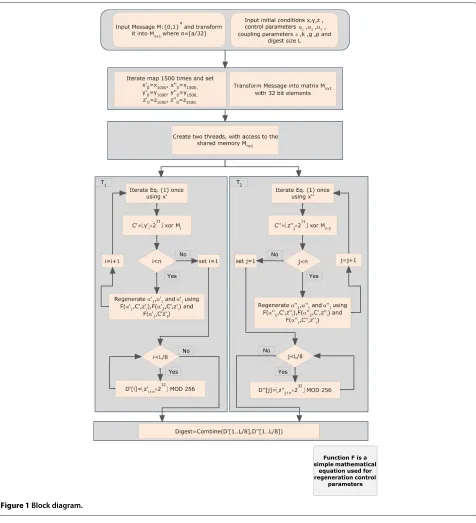
Step 1. First, the messageM:{0, 1}ais input and transformed into message blocksMn×1.
Step 2. Keys of the algorithm (initial conditions, control parameters, and coupling parameters) are input.
Step 3. Creation and initiation of the threads T1 and T2. In this step, the two separate threads are generated, and initial conditions and control parameters are initiated (the threads are
demonstrated in Figure 1 using two parallel vertical rectangles).
Step 4. In order to remove the transient effect and also initiate the initial conditions of the threads, Equation 1 is iterated 1,500 times, and the initial conditions for the threads are set (x0=x1,000, y0=y1,000, andz0=z1,000for thread one (T1) and x0=x1,500,y0=y1,500, andz0=z1,500for thread
two (T2)).
Figure 1Block diagram.
Step 6. The matricesDandDare generated using the final values ofznin step 5 (see Figure 1). In this step, the chaotic map, Equation 1, is iteratedL/8
times (L is the final size of the hash value which by default is set to 256). Finally, the matrices are combined using the function mentioned below.
Function Combine(D[ 1..k] ,D[ 1..k])
For i=0to k
If D[i] mod2=0
D[i]=D[i] XOR D[i]; Else
D[i]=D[i] mod28XOR D[i]; End if
end for Return D;
Return Result;
End Function
Figure 1 shows a block diagram that illustrates the steps in the algorithm. In this algorithm, the values of the parameters are as follows:
Initial conditions:x=3,y=8, andz=93
Control parameters:α1=12,α2=1.5, andα3=3
Coupling parameters:=0.2and=0.3 N1=20,N2=4, andN3=4
Note that all of the control parameters are selected in the chaotic region.
3 Performance analysis 3.1 Hash results of messages
We have chosen a message with the length of 1, 024 char-acters, and all the characters are chosen equal to zero; in this way, it is easier to show the sensitivity of the hash function to the message.
Condition 1: The original message contains1, 024
null characters.
Condition 2: Change the first character to 1. Condition 3: Change the 800th character toZ. Condition 4: Add a space to the end of the message. Condition 5: Change the hash key from keyα1=12
toα1=12.00000000000001.
Condition 6: Change the hash key from keyx=3to
x=3.00000000000001.
The corresponding hash values in hexadecimal format are given as follows:
Condition 1:
FD97319170D87CB2F25CDCD8917ACA60 Condition 2:
E0BC3C61DFC69D6D40B7491BF88427EC Condition 3:
9EEAFAAABFFE6539A011C180CA4E70B9
Condition 4: A164446E3387324D7E267991225B6C9 Condition 5: 3E5576B020A6095859217050F59E97F Condition 6:
761B97931E7528308A4ED14F7ACA8028
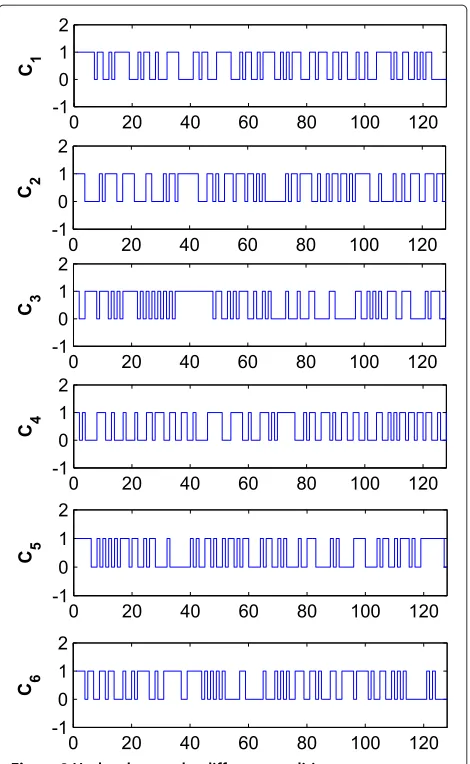
The graphical display of binary sequences is shown in Figure 2. The simulation results indicate that the one-way property of the proposed algorithm is remarkably high, and any least difference of the message or key will cause huge changes in the final hash value.
3.2 Statistic analysis of diffusion and confusion
In order to hide message redundancy, Shannon pointed in his masterpiece [43] that ‘It is possible to solve many kinds of ciphers by statistical analysis,’ and therefore, he suggested two methods of diffusion and confusion for the purpose of frustrating the powerful statistical analysis. For the hash value in binary format, each bit is only 1 or 0, so
Figure 2Hash values under different conditions.
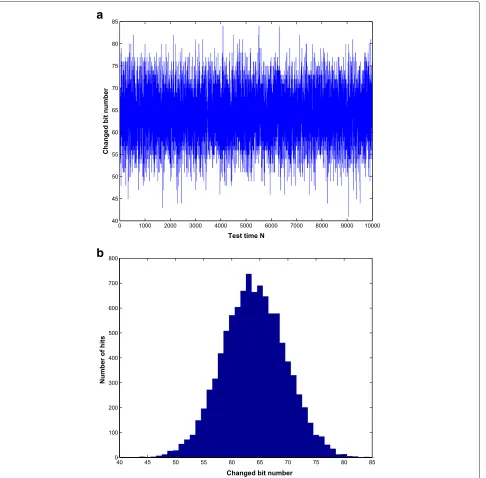
the ideal diffusion effect should be that any tiny changes in initial conditions lead to the 50% changing probabil-ity of each bit. A message is selected and the hash value for the message is generated; then, 1 bit of the message is changed randomly and a new hash value is generated. The two hash values are compared with each other, and the changed bits are counted and called Bi. This test is per-formedNtimes, and the corresponding distribution ofBi is shown as Figure 3a,b, whereN=10, 000.
Minimum changed bit numberBmin=min({Bi}N1);
Maximum changed bit numberBmax=max({Bi}N1);
Mean changed bit numberB¯= Ni=1Bi/N; Mean changed probabilityP=(B¯/128)×100%; Standard variance of the changed bit number B=
1
N−1iN=1(Bi− ¯B)2; Standard variance
P=
1
b
a
Figure 3Distribution of changed bit number.(a) Plot ofBiand (b) histogram ofBi.
Through the tests with N = 512, 1,024, 2,048, and 10,000, respectively, the corresponding data are listed in Table 1. Based on the analysis of the data in Table 1, we can draw the conclusion: the mean changed bit number B and the mean changed probability P are both very close to the ideal value of 64 bits and 50%, while B and P are very little, which indicates that the capability for diffusion and confusion is very stable and strong.
3.3 Analysis of collision resistance and birthday attack resistance
opera-Table 1 Static number of changed bitBi
N=512 N=1, 024 N=2, 048 N=10, 000 Mean
¯B 63.8808 63.8339 63.8945 63.9192 63.88212
P (%) 49.9069 49.8703 49.9176 49.9369 49.90793
B 6.0032 5.8662 5.7711 5.6467 5.8218
P(%) 4.6900 4.5830 4.5087 4.4115 4.5483
Bmin 45 45 43 41 43.5
Bmax 80 82 82 84 82
tions will ensure that each bit of the final hash value is related to all the bits of the message. Therefore, even 1-bit change in the message would lead to a completely different hash code. Moreover, the initial conditions and the control parameters of the chaotic map are related to the message and the state of the map, so the keyed hash function is so much sensitive to the keys.
3.4 Collision test
In order to investigate the collision resistance capability of the proposed algorithm, we have performed the following test [12,28,29]: first, a message is randomly chosen, and the hash value is generated for it and stored in ASCII for-mat. Then, a bit from a random position in the message is chosen and its value is changed, and a new hash value is generated for the new changed message and is stored in ASCII format. Two hash values are compared, and the number of ASCII character with the same value at the same location in the hash value is counted. The absolute difference of two hash values and the theoretical number ofωwith different values duringN independent experi-ments which is denoted byWN(ω)is calculated using the following formulas:
d=
N
i=1
|t(ei)−t(ei)|, (2)
ω= N
i=1
f(t(ei)−t(ei)), where f(x,y)
= ⎧ ⎨ ⎩
1, x=y,
0, x=y.
(3)
WN(ω)=N×Prob{ω} =N
s! ω!(s−ω)!(
1 2k)
ω(1− 1 2k)
s−ω,
(4)
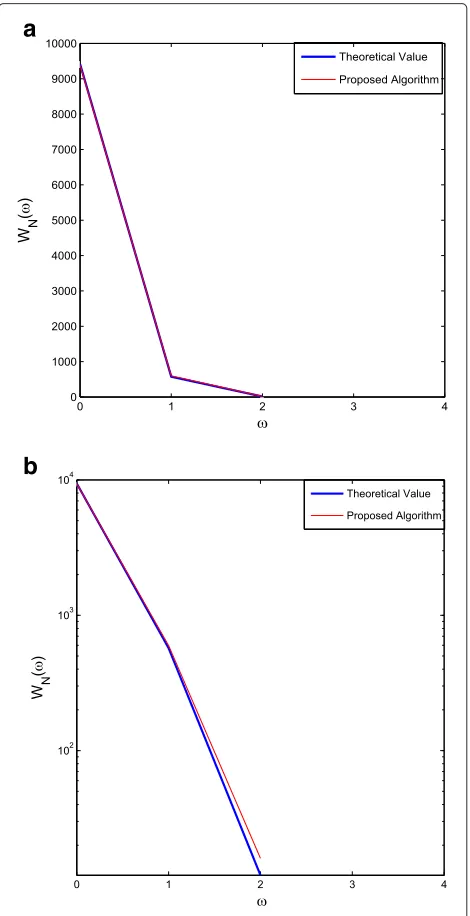
whereei andei are theith entry of the original and the new hash value, respectively, and function t(.) converts the entries to their equivalent decimal value. In Equation 4, ω=0, 1, ...,s. The theoretical values for Equation 4 are as follows [14]:WN(0)=9, 416,WN(1)=572,WN(2)=12,
and WN(ω) = 0 for ω = 3, 4, ..., 16. Also, the experi-mental values ofWN(ω), the proposed algorithm, are as follows: WN(0) = 9, 387,WN(1) = 591,WN(2) = 22, andWN(ω) = 0 forω = 3, 4, ..., 16. A plot of the distri-bution of the number of ASCII characters with the same value at the same location in the hash value is given in Figure 4a,b. It seems that the proposed algorithm pos-sesses a stronger collision resistance capability than the algorithms in [12,14,27,44] and can be compared with [45,46].
b
a
Figure 4Distribution ofw.wrepresents the number of 8-bit subblocks with the same value at the same location in hash value (N=10, 000). (a) Decimal scale ofWN(ω)and (b) logarithmic scale of
3.5 Theoretical value of mean of absolute difference With the assumption thatHis a discrete uniform distribu-tion in the range of 0 to 255 (with 16 elements), the ideal mean value of this distribution would be equal to the 12 maximum value of the distribution (in the maximum value condition, all elements are equal to 255):2552×16 =2, 040. Using the ideal theoretical value of the hash digestH, we can calculate the ideal theoretical absolute difference of the two hash digests. With the assumption that the two hash digests H andH are ideally uniform, the ‘Sum of Absolute Difference’ of these two digests has to be equal to 23 of the mean value of a uniform distribution [47]. As the mean value of a uniform distribution with the char-acteristics of a hash digest with the size of 128 bits is equal to 2,040, therefore, the ideal mean value of the abso-lute difference for H and H is equal to 23 × 2, 040 = 1, 360. Minimum, maximum, and mean values of the abso-lute difference of two hash values are 547, 2, 246, and 1, 365.9641, respectively. It can be seen that the mean of absolute difference is 1, 365.9641 and is very close to the ideal value.
3.6 Pseudo-collision resistance
Without loss of generality, normally in a collision attack, the attacker not only has access to the message (M) and can modify each block (Mi) of the message during the hashing process, but also can change the medial hash value (Hi−1). This type of collision attack is usually called pseudo-collision attack. The main goal of this attack is to use the weaknesses in the compression function so that the attacker can find a way to reconstruct a hash value for a different message [45,46]. In the proposed algorithm, the message is processed twice (two different threads), once from the beginning to the end and once from the end to the beginning of the message, so that there would be two medial hash values at the same time for each message block, which with regard to a small change in one or both of the medial values (in here, the control parameters and initial conditions) would lead to a completely different sequence (because of the nature of the proposed high-dimensional chaotic map), so it is almost impossible to find a pattern by changing these values.
3.7 Resistance of forgery attacks
Most of the parallel hash function algorithms have a mixing section in their structure which usually uses the XOR operation for this propose. This operation lets the attackers use the privilege of communicative law and practice forgery attack on the hash function. Some of these algorithms are broken by forgery attack [37]. Not only does the proposed algorithm process the whole message from two sides (which leads to high complex-ity in mixture), but also in the final step, instead of
a simple XOR operation, a conditional method is used in order to resist forgery attack in any section of the algorithm.
3.8 Key space analysis
In this algorithm, besides the control parameter and ini-tial condition of the piecewise nonlinear chaotic map, the parameters of the one-dimensional chaotic map are cho-sen as the secret keys. From the security point of view, the key space for a cryptographic algorithm should not be less than 2128in order to resist brute force attacks [48,49]. If the precision 10−14is used, the key space size for two coupling parameters, three initial conditions, and three control parameters of the chaotic map is over 2279, so the key space is very large to resist all kinds of brute force attacks.
3.9 Analysis of speed
The proposed hash function is a multi-threaded algo-rithm which works fine on both single and multi-core processors, while the speed of the algorithm eventually doubles on a multi-core processor. Moreover, the process time needed for generating the hash value is in direct relation with the message length; in Figure 5, we can see that the computational complexity of the algorithm is linear and almost equal to (n). Although the speed of the algorithms is lower than the existing traditional hash functions such as SHA-1 and MD5 [20], it is, how-ever, acceptable for practical use; at the same time, the algorithm is so flexible since the digest size can be 128, 160, 256, or 512 bits in length. Finally, we present the average encryption speed comparison based on the spec-ified platform with some hash algorithms [12,13,20,21, 28,29,50,51]. The average encryption speed of our algo-rithm (45 Mbps) is higher than that in [12,13,50,51]. In addition, the algorithms of [20,21,28,29] show higher encryption speed.
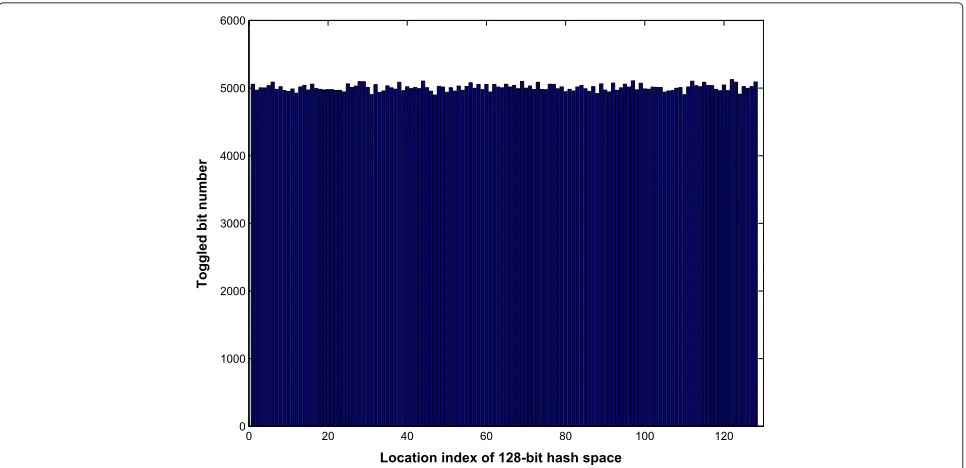
3.10 Uniform distribution on hash space
0 1 2 3 4 5 6 7 8 9 x 10⁷ 0
2000 4000 6000 8000 10000 12000 14000
Message Size (Bytes)
Computation Time (Miliseconds)
Figure 5Computational time vs. message size.
3.11 Randomness tests for the hash
Cryptographic hash functions are an important tool of cryptography and play a fundamental role in efficient and secure information processing. Cryptographic hash func-tions can be used to construct pseudo-random number generators. To ensure the security of a cryptosystem, the
cipher must have some properties such as good distribu-tion, long period, high complexity, and efficiency. In this algorithm, several tests of randomness are performed on a stream of random numbers generated by the main dynam-ical system (Equation 1) of the hash function in order to test the randomness of the presented algorithm. These
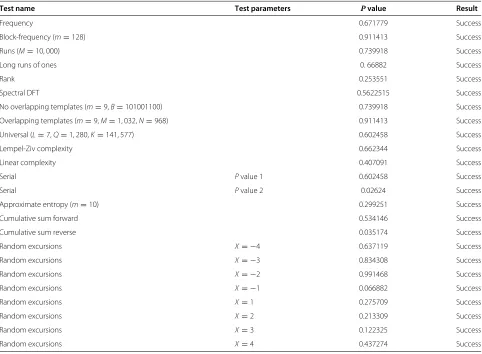
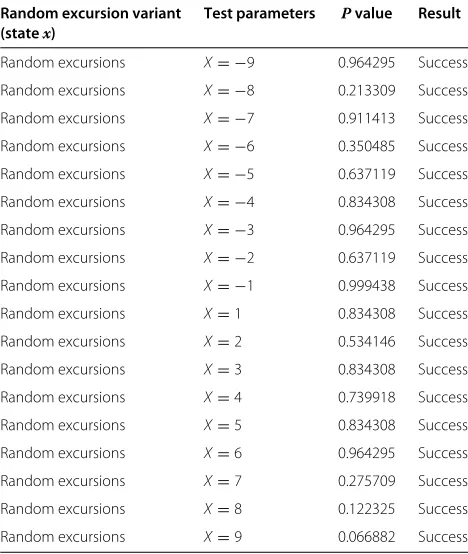
tests include DIEHARD [52], NIST statistical test suite [53], and ENT test suite [54]. According to Tables 2 and 3, 4, and 5 which present NIST, DIEHARD, and ENT test results, respectively, of the sample, it can be concluded that the stream has a highly random behavior.
3.12 Resistance to birthday attack
The birthday attack is one of the common classic attacks on cryptographic hash functions, which is independent of the algorithm, and can be applied on any algorithm. The main goal of this attack is to find two messages with iden-tical hash values with less than 2n/2trials (nis the size of hash value) [46,51,55]. In fact, the algorithm is flexible so that the length of the hash value can be tuned. If the hash value size is set to 128, the difficulty of the attack is 264 which is huge enough to resist brute force attack. Also in the proposed algorithm, in order to analyze the security and resistance against such an attack, several tests includ-ing the random number batteries and collision tests are applied. It can be seen from the results in Table 5 that the entropy of the random numbers generated by the hash function is very close to the ideal value (7.999994 ≈ 8)
and that the serial correlation coefficient in the same table is very close to zero, which demonstrates the collision resistance nature of the algorithm. The proposed algo-rithm, which is visually discussed using the block diagram (Figure 1), is very complex, and the initial conditions and control parameters are modified in each round. According to [56], ‘if an appropriate padding scheme is used and the compression function is collision-resistant, then the hash function will also be collision resistant’. Therefore, the results of the tests, size of the hash value for the presented algorithm, and collision resistance of the proposed algo-rithm suggest that the effectiveness of the birthday attack is almost impossible and that the algorithm is resistant against this type of attack.
3.13 Flexibility
In this paper, an algorithm based on high-dimensional chaotic map is proposed in order to solve the problems such as the size of hash functions, padding of the mes-sage, resistance against differential attacks, and capability of efficiently working on multi-core CPUs using paral-lel processing. Although the algorithm is designed as an
Table 2 Results of the SP800-22 test suite for the 32-bit proposed high-dimensional map
Test name Test parameters Pvalue Result
Frequency 0.671779 Success
Block-frequency (m=128) 0.911413 Success
Runs (M=10, 000) 0.739918 Success
Long runs of ones 0. 66882 Success
Rank 0.253551 Success
Spectral DFT 0.5622515 Success
No overlapping templates (m=9,B=101001100) 0.739918 Success
Overlapping templates (m=9,M=1, 032,N=968) 0.911413 Success
Universal (L=7,Q=1, 280,K=141, 577) 0.602458 Success
Lempel-Ziv complexity 0.662344 Success
Linear complexity 0.407091 Success
Serial Pvalue 1 0.602458 Success
Serial Pvalue 2 0.02624 Success
Approximate entropy (m=10) 0.299251 Success
Cumulative sum forward 0.534146 Success
Cumulative sum reverse 0.035174 Success
Random excursions X= −4 0.637119 Success
Random excursions X= −3 0.834308 Success
Random excursions X= −2 0.991468 Success
Random excursions X= −1 0.066882 Success
Random excursions X=1 0.275709 Success
Random excursions X=2 0.213309 Success
Random excursions X=3 0.122325 Success
Table 3 Results of the SP800-22 test suite for the 32-bit proposed high-dimensional map
Random excursion variant Test parameters Pvalue Result (statex)
Random excursions X= −9 0.964295 Success
Random excursions X= −8 0.213309 Success
Random excursions X= −7 0.911413 Success
Random excursions X= −6 0.350485 Success
Random excursions X= −5 0.637119 Success
Random excursions X= −4 0.834308 Success
Random excursions X= −3 0.964295 Success
Random excursions X= −2 0.637119 Success
Random excursions X= −1 0.999438 Success
Random excursions X=1 0.834308 Success
Random excursions X=2 0.534146 Success
Random excursions X=3 0.834308 Success
Random excursions X=4 0.739918 Success
Random excursions X=5 0.834308 Success
Random excursions X=6 0.964295 Success
Random excursions X=7 0.275709 Success
Random excursions X=8 0.122325 Success
Random excursions X=9 0.066882 Success
Table 4 DIEHARD test suite for the 32-bit proposed high-dimensional map
Test name Average value Result
Birthday spacing 0.800832 Success
Overlapping permutation 0.693145 Success
Binary rank 31×31 0.974342 Success
Binary rank 32×32 0 .770208 Success
Binary rank 6×8 0.264802 Success
Bitstream 0 .45412 Success
OPSO 0.6788 Success
OQSO 0.3555 Success
DNA 0.5722 Success
Count the ones 01 0.104101 Success
Count the ones 02 0.651653 Success
Parking lot 0.926198 Success
Minimum distance 0 .748646 Success
3DS spheres 0 .137205 Success
Squeeze 0 .019340 Success
Overlapping sum 0 .964091 Success
Runs 0.645063 Success
Craps 0.480936 Success
Table 5 Max grade of ENT test suite
Test name Average value Result
Entropy 7.999994 Success
Arithmetic mean 127.5165 Success
Monte Carlo 3.140157946 Success
Chi square 55.73 Success
Serial correlation coefficient 0.000277 Success
unkeyed hash function, the control parameters and the initial conditions of the algorithm can be treated as the secrete key for a keyed hash function. In comparison to the conventional hash algorithm such as MD5, MAC-DES, and HMAC-MD5 with fixed length, the proposed algorithm is advantageous in terms of adaptation to 160, 256, or 512 bits, with a small change in the steps, and since the algorithm is designed in such a way that it can work in parallel, therefore in longer digest speed, it would not be affected so much. Furthermore, in the proposed algorithm, the chaotic map is iterated with a double-precision floating-point arithmetic. A double-double-precision floating-point number is represented according to the IEEE 754 floating-point standard found in virtually almost all computers produced since 1980 [57]. The program is implemented in Visual C++.NET, and the standard of the floating point which is used in this compiler is the IEEE 754 floating-point standard so that the hash values generated on any computer would be the same.
4 Conclusion
Competing interests
The authors declare that they have no competing interests.
Acknowledgements
This work was supported by USM (no. 1001/PICOMP/817059).
Author details
1School of Computer Sciences, Universiti Sains Malaysia, 11800 USM, Penang,
Malaysia.2School of Physics, Universiti Sains Malaysia, 11800 USM, Penang,
Malaysia.
Received: 26 July 2012 Accepted: 6 June 2013 Published: 3 July 2013
References
1. S Li, Analyses and new designs of digital chaotic ciphers. Ph.D. thesis, School of Electronic and Information Engineering, Xi’an Jiaotong University, Xi’an, China (2003)
2. S Behnia, A Akhshani, S Ahadpour, H Mahmodi, A Akhavan, A fast chaotic encryption scheme based on piecewise nonlinear chaotic maps. Phys. Lett. A.366, 391–396 (2007)
3. A Akhshani, H Mahmodi, A Akhavan, A novel block cipher based on hierarchy of one dimensional composition chaotic maps IEEE Int. Conf. Image Process, 1993–1996. (IEEE, ICIP 2006)
4. S Behnia, A Akhshani, S Ahadpour, A Akhavan, H Mahmodi, Applications of tripled chaotic maps in cryptography. Chaos Soliton Fract.40, 505–519 (2009)
5. A Akhshani, S Behnia, A Akhavan, H Abu Hassan, Z Hassan, A novel scheme for image encryption based on 2D piecewise chaotic maps. Optics Comm.283, 3259–3266 (2010)
6. Z-L Zhu, W Zhang, K-W Wong, H Yu, A chaos-based symmetric image encryption scheme using a bit-level permutation. Inform. Sci.181, 1171–1186 (2011)
7. A Akhavan, H Mahmodi, A Akhshani, A new image encryption algorithm based on one dimensional polynomial chaotic maps. Lect. Notes Comput. Sci.4263, 963–971 (2006)
8. JW Byun, DH Lee, JI Lim, EC2C-PAKA: an efficient client-to-client password-authenticated key agreement. Inform. Sci.177, 3995–4013 (2007)
9. D Xiao, X Liao, S Deng, A novel key agreement protocol based on chaotic maps. Inform. Sci.177, 1136–1142 (2007)
10. K Wang, WJ Pei, LH Zou, YM Cheung, ZY Hea, Security of public key encryption technique based on multiple chaotic systems. Phys. Lett. A. 360, 259–262 (2006)
11. B Wang, Q Wu, Y Hu, A knapsack-based probabilistic encryption scheme. Inform. Sci.177(19), 3981–3994 (2007)
12. Y Wang, X Liao, D Xiao, K Wong, One-way hash function construction based on 2D coupled map lattices. Inform. Sci.178, 1391–1406 (2008) 13. X Yi, Hash function based on chaotic tent maps. IEEE Trans. Circuits Syst. II.
52(6), 354–357 (2005)
14. J Zhang, X Wang, W Zhang, Chaotic keyed hash function based on feedforward ˝Ufeedback nonlinear digital filter. Phys. Lett. A.362, 439–448 (2007)
15. Q Zhou, X Liao, K-W Wong, Y Hu, D Xiao, True random number generator based on mouse movement and chaotic hash function. Inform. Sci.179, 3442–3450 (2009)
16. Z Huang, A more secure parallel keyed hash function based on chaotic neural network. Commun. Nonlinear Sci. Numer. Simulat.16, 3245–3256 (2011)
17. S Deng, D Xiao, Y Li, W Peng, A novel combined cryptographic and hash algorithm based on chaotic control character. Commun. Nonlinear Sci. Numer. Simulat.14, 3889–3900 (2009)
18. M Amin, OS Faragallah, AA Abd El-Latif, Chaos-based hash function (CBHF) for cryptographic applications. Chaos Solitons Fractals.42, 767–772 (2009) 19. R Rivest, inAdvances in Cryptology-CRYPTO’90. The MD4 message digest
algorithm (Springer-Verlag, London, 1991), pp. 303–311 20. R Rivest, The MD5 Message-Digest Algorithm. RFC 1321 (1992) 21. NIST, FIPS PUB 180-1, Secure Hash Standard (1995)
22. S Deng, Y Li, D Xiao, Analysis and improvement of a chaos-based Hash function construction. Commun. Nonlinear Sci. Numer. Simulat.15(5), 1338–1347 (2010)
23. J Liang, X-J Lai, Improved collision attack on hash function MD5. J. Com. Sci. Tech.22, 79–87 (2007)
24. Y Sasaki, Y Naito, N Kunihiro, K Ohta, Improved collision attack on MD5. Cryptology ePrint Archive, Report 2005/400 (2005). http://eprint.iacr.org/ 2005/400 Accessed 23 June 2013
25. X Wang, D Feng, X Lai, H Yu, Collisions for hash functions MD4, MD5, HAVAL-128 and RIPEMD. Cryptology ePrint Archive, Report 2004/199 (2004). http://eprint.iacr.org/2004/199. Accessed 23 June 2013 26. X Wang, YL Yin, H Yu, Finding collisions in the full SHA-1. Lect. Notes
Comp. Sci.3621, 17–36 (2005)
27. D Xiao, X Liao, S Deng, One-way hash function construction based on the chaotic map with changeable-parameter. Chaos Soliton Fract.24, 65–71 (2005)
28. A Akhavan, A Samsudin, A Akhshani, Hash function based on piecewise nonlinear chaotic map. Chaos Soliton Fract.42, 1046–1053 (2009) 29. A Akhshani, S Behnia, A Akhavan, MA Jafarizadeh, H Abu Hassan,
Z Hassan, Hash function based on hierarchy of 2D piecewise nonlinear chaotic maps. Chaos Soliton Fract.42, 2405–2412 (2009)
30. HS Kwok, WKS Tang, A chaos-based cryptographic hash function for message authentication. Int. J. Bifurcation Chaos.15, 4043–4050 (2005) 31. S Lian, ZX Liu, Hash function based on chaotic neural networks. IEEE
ISCAS, 237–240 (2006)
32. J Peng, S-Z Jin, H-L Liu, W Zhang, A novel hash function based on hyperchaotic Lorenz system. Fuzzy Inform. Eng.2, 1529–1536 (2009) 33. A Ghaemi Bafghi, R Safabakhsh, B Sadeghiyan, Finding the differential
characteristics of block ciphers with neural networks. Inform. Sci.178, 3118–3132 (2008)
34. K Wong, A combined chaotic cryptographic and hashing scheme. Phys. Lett. A.307, 292–298 (2003)
35. G Alvarez, F Montoya, M Romera, G Pastor, Cryptanalysis of dynamic look-up table based chaotic cryptosystems. Phys. Lett. A.326, 211–218 (2004)
36. D Xiao, W Peng, X Liao, T Xiang, Collision analysis of one kind of chaos-based hash function. Phys. Lett. A.374, 1228–1231 (2010) 37. W Guo, W Xiaomin, H Dake, C Yang, Cryptanalysis on a parallel keyed hash
function based on chaotic maps. Phys. Lett. A.373, 3201–3206 (2009) 38. F Peng, SS Qiu, M Long, One-way hash function construction based on
two-dimensional hyper-chaotic mappings. Acta. Phys. Sin.54, 4562–607 (2005). [in Chinese]
39. MA Jafarizadeh, S Behnia, S Khorram, H Naghshara, Hierarchy of chaotic maps with an invariant measure. J. Stat. Phys.104, 1013–1028 (2001) 40. MA Jafarizadeh, S Behnia, Hierarchy of chaotic maps with an invariant
measure and their coupling. Physica D.159, 1–21 (2001)
41. S Behnia, A Akhshani, H Mahmodi, A Akhavan, A novel algorithm for image encryption based on mixture of chaotic maps. Chaos Soliton Fract. 35, 408–419 (2008)
42. MA Jafarizadeh, S Behnia, Hierarchy of chaotic maps with an invariant measure and their compositions. J. Nonlinear Math. Phys.1, 1–16 (2002) 43. CE Shannon, Communication theory of secrecy systems. Bell Sys. Tech. J.
28, 656–715 (1949)
44. H Yang, K-W Wong, X Liao, Y Wang, D Yang, One-way hash function construction based on chaotic map network. Chaos Soliton Fract.41, 2566–2574 (2009)
45. D Xiao, X Liao, Y Wang, Parallel keyed hash function construction based on chaotic neural network. Neuralcomputing.72, 2288–2296 (2009) 46. Y Wang, K-W Wong, D Xiao, Parallel hash function construction based on
coupled map lattices. Commun. Nonlinear Sci. Numer. Simulat.16, 2810–2821 (2011)
47. R Johnsonbaugh,Discrete Mathematics. (Macmillan Pub. Co./Collier Macmillan Publishers, New York/London, 1984)
48. B Schneier,Applied Cryptography: Protocols, Algorithms, and Source Code in C, 2nd edn. (Wiley, New York, 1996)
49. ECRYPT I I, ECRYPT II yearly report on algorithms and keysizes (2010). http://www.ecrypt.eu.org/documents/D.SPA.13.pdf. Accessed 23 June 2013
50. H Zhang, X Wang, Z Li, D Liu, One way hash function construction based on spatiotemporal chaos. Acta. Physica Sinica.54, 4006–4011 (2005) 51. A Kanso, H Yahyaoui, M Almulla, Keyed hash function based on a chaotic
map. Inform. Sci.186, 249–264 (2012)
53. A Rukhin, J Sotto, J Nechvatal, M Smid, E Barker, S Leigh, M Levenson, M Vangel, D Banks, A Heckert, J Dray, S Vo, A statistical test suite for random and pseudorandom number generators for cryptographic applications. NIST Special Publication 800-22. NIST Gaithersburg 2001 54. J Walker, ENT, A pseudorandom number sequence test program (1998).
http://www.fourmilab.ch/random/. Accessed 23 June 2013 55. A Menezes, P van Oorschot, S Vanstone,Handbook of Applied
Cryptography. (CRC, Boca Raton, 1996)
56. IB Damgård, inAdvances in cryptology - CRYPTO ’89 Proceedings,Lect. Notes Comput. Sci.A design principle for hash functions (Springer, New York, 1989), pp. 416–427
57. D Goldberg, D Priest, What every computer scientist should know about floating-point arithmetic. ACM Comput. Surv.23, 5–48 (1991)
doi:10.1186/1687-6180-2013-126
Cite this article as:Akhavanet al.:A novel parallel hash function based
on 3D chaotic map.EURASIP Journal on Advances in Signal Processing2013 2013:126.
Submit your manuscript to a
journal and benefi t from:
7Convenient online submission
7Rigorous peer review
7Immediate publication on acceptance
7Open access: articles freely available online
7High visibility within the fi eld
7Retaining the copyright to your article