R E S E A R C H
Open Access
Cyclostationarity-based DOA estimation
algorithms for coherent signals in impulsive
noise environments
Yang Liu
1, Qiong Wu
1, Yinghui Zhang
1*, Jing Gao
2and Tianshuang Qiu
3Abstract
Estimating direction of arrival (DOA) is important in a variety of practical applications. Conventional
cyclostationarity-based coherent DOA estimation algorithms are not robust to non-Gaussianα-stable impulsive noise. Additionally, fractional lower-order statistics (FLOS)-based algorithms are tolerant to impulsive noise; however, they experience performance degradation for coherent signals and interference. To overcome these drawbacks, two types of fractional lower-order cyclostationarity-based subspace DOA estimation methods are proposed for
coherent signals in the presence of interference andα-stable impulsive noise. The new proposed algorithms exploit the fractional lower-order cyclostationarity properties of the signals and are immune to the impulsive noise and interference. Moreover, they can provide more accurate DOA estimates of coherent signals than conventional cyclostationarity-based and FLOS-based methods. The simulation results illustrate the robustness and effectiveness of the proposed methods for coherent signals based on a comparison with traditional methods. The new
algorithms can be used in the presence of a wide range of interference, Gaussian noise, andα-stable distribution impulsive noise environments.
Keywords:Cyclostationarity, Direction of arrival (DOA), Coherent signals, Fractional lower-order statistics,α-Stable process
1 Introduction
The direction of arrival (DOA) is the base problem in array signal processing and is the core of many civilian and military applications, such as communication regu-lation enforcement, search-and-rescue operations, and military reconnaissance [1–3]. In realistic radio environ-ments, correlated signals are not negligible. Evans and Shane et al. proposed derived spatial smoothing tech-niques for the DOA estimation of coherent signals; in the study, a uniform linear array was divided into several subarrays, and the covariance matrices of the subarrays were then calculated and averaged together [4]. Add-itionally, subspace smoothing, modified smoothing, and other smoothing methods have been proposed [5–8]. A new formulation of the Khatri-Rao has been used to esti-mate DOA which can cope with more coherent signals
than classical multiple signal classification (MUSIC) with the spatial smoothing [9]. The unitary estimation of signal parameters via rotational invariance techniques (U-ES-PRIT) incorporates forward-backward averaging that can lead to higher resolution than classical ESPRIT [10–12]. Since the performance of subspace-based algorithms is limited by the number of snapshots, the sparse reconstruction-based methods have been proposed to deal with the DOA estimation of coherent signals [13–16].
Many artificial modulated communications signals and nature signals have the cyclostationarity properties, which can break through previous limitations and fur-ther improve the DOA estimation performance of sub-space algorithms. If received signals can be divided into the signal of interest (SOI) and interference (including noise) based on their cyclostationary characteristics, the signals of interest can be selected and the noise and interfering signals can be removed by utilizing cyclosta-tionarity [17]. Therefore, there are many advantages of DOA estimation using cyclostationary characteristics © The Author(s). 2019Open AccessThis article is distributed under the terms of the Creative Commons Attribution 4.0
International License (http://creativecommons.org/licenses/by/4.0/), which permits unrestricted use, distribution, and reproduction in any medium, provided you give appropriate credit to the original author(s) and the source, provide a link to the Creative Commons license, and indicate if changes were made.
* Correspondence:[email protected]
1College of Electronic Information Engineering, Inner Mongolia University, Hohhot, Inner Mongolia, China
compared to conventional methods [18, 19]. These ad-vantages include selective direction finding, interference and noise suppression, and breakthrough-limited multi-signal processing. Therefore, DOA estimation based on cyclostationarity has been widely studied [20–
23].
Noise, interference, and coherent signals can affect the performance of DOA estimation in wireless communica-tion, radar, sonar, and other systems. The noise and interference can affect the estimation accuracy, and the coherent and correlated signals caused by multipath propagation can, in turn, cause the correlation function to produce several peaks and widen the main peak, which may lead to erroneous estimations by the corre-sponding algorithms [24]. However, most of the trad-itional cyclostationarity-based DOA methods for coherent signals assume that the additive noise obeys a Gaussian distribution. Many theoretical studies and ex-periments have shown that underwater acoustic noise, atmospheric noise, artificial noise, and other noise types contain numerous impulsive components. Previous stud-ies [25–27] demonstrated that it is inappropriate to model these noises as Gaussian. In fact, the phenomena with impulsive components encountered in practice are appropriate to be modeled as non-Gaussian processes. Although cyclostationarity-based methods are tolerant to coherent signals and Gaussian noise, a significant deg-radation in their performance can occur when non-Gaussian impulsive noise is present. To suppress the impulsive components, robust fractional lower-order statistics (FLOS)-based DOA estimation methods have been developed [26–29]. The FLOS-based algorithms can provide accurate DOA estimates for Gaussian and non-Gaussian impulsive noises; however, they suffer from poor performance when interfering signal is present which occupies the same spectral band as the source signal. Recent advances on communications, array processing, and identification have indicated that non-Gaussian impulsive noise can be modeled by α-stable distributions [29,30]. According to the General-ized Central Limit Theorem, the Gaussian distribution is the limiting case of the α-stable distribution (α= 2). Therefore, the α-stable distribution is a more realistic class of distribution than the Gaussian distribution in communication, radar, sonar, and similar application. In real applications, we are interested in developing DOA algorithms that are robust to interference, Gaussian noise, and non-Gaussianα-stable distribution noise and that account for the coherent signals in real-world environments.
In this paper, we address the issue of the DOA estima-tion of cyclostaestima-tionary coherent signals in impulsive noise environments. Two novel types of robust fractional lower-order cyclostationarity-based signal-selective
subspace DOA estimation algorithms for coherent sig-nals are developed. Compared with conventional cyclic subspace DOA estimation algorithms, the proposed methods are not only immune to the interference and Gaussian noise, but can account for impulsive noise and coherent signals. Moreover, because the proposed methods are applicable to coherent signals in the pres-ence of impulsive noise and interferpres-ence, they are super-ior to the methods that are merely robust against impulsive noise or suitable for coherent sources. The proposed DOA estimation algorithms have three notable advantages over traditional methods: (1) in the presence of interfering signals, the proposed methods exhibit sig-nal selectivity and performance improvements over the FLOS-based MUSIC and ESPRIT algorithms; (2) in im-pulsive environments, the proposed methods are more robust to impulsive noise than the cyclic MUSIC and cyclic ESPRIT algorithms; and (3) the proposed methods are effective for cyclostationary coherent signals in im-pulsive noise and interference environments, while con-ventional coherent cyclic methods are limited to DOA estimation from Gaussian noise, and FLOS-based coher-ent methods exhibit degradation in the presence of interference.
2 Methods
DOA estimation has been widely used in various import-ant applications (e.g., radar, sonar, communications, and wireless sensor networks) and has garnered considerable attention in recent years. The conventional subspace DOA estimation methods are not robust against non-Gaussian α-stable impulsive noise. Although FLOS-based algorithms are robust to the impulsive noise, they do not achieve satisfactory performance in the presence of coband interference. Conventional cyclostationarity-based methods are highly immune to interference; however, they are severely degraded in the presence of α-stable impulsive noise and useless for co-herent signals. Therefore, we address the problem of DOA estimation for coherent signals in the presence of impulsive noise and interference based on cyclostationarity.
further circumvent the coherent signals in impulsive noise, we propose a type of modified fractional lower-order cyclic DOA estimation method. Compared with spatial smoothing fractional lower-order cyclic rithms, the modified fractional lower-order cyclic algo-rithms combine the cyclic and conjugate-cyclic statistics together to improve the performance for coherent signals in impulsive noise. Finally, we perform experiments to evaluate the performance of the new proposed algorithms. The designed methods are implemented by using MATLAB. The parameters in the experiments are intro-duced in Section5.
3 Preliminary
The DOA problem involves estimating the signal arrival angle using the receive array, which is also called spatial spectral estimation. In this paper, the system is based on a uniform linear array. To simplify the problem, it is as-sumed that the received signal can be treated as a paral-lel plane wave and that the distance between any two adjacent elements is not greater than half of the signal wavelength. Assuming that the array spacing of the an-tenna array is d, the number of elements is M, and the wavelength of the signal is λ, the array output can be expressed as
In general, the signal model for DOA estimation can be rewritten in vector form as,
Xð Þ ¼t ASð Þ þt Nð Þt ð2Þ
whereS(t) = [s1(t) s2(t) ⋯ sK(t)]Tis the signal vector, XðtÞ ¼½x1ðtÞ x2ðtÞ ⋯ xMðtÞT is the vector of signals re-ceived by the array sensors, A¼
a1ðθ1Þ a2ðθ2Þ ⋯ aMðθKÞ
½ is the matrix of array steering vectors, andNðtÞ ¼½n1ðtÞ n2ðtÞ ⋯ nMðtÞT
is the noise vector.
In wireless communications, multipath signals are ubi-quitous phenomena inradio propagation that can result in signals reaching the antenna array via two or more paths. For example, if a transmitted wave or echo propa-gates along multiple paths, the received signals are co-herent in wireless communications systems. At the same time, the complexity of the propagation path can result in multiple propagation paths between the base station and users are reached, thereby creating a multipath
problem. Therefore, it is important to consider efficient signal processing techniques to limit coherent signals.
For two stationary signalssi(t) andsj(t), the correlation coefficients can be written as follows,
ρij¼
The correlation of the signals is defined as follows:
ρij¼0; uncorrelated expressed in the following form [4].
sið Þ ¼t uisjð Þt ð5Þ
whereuiis a complex.
Many manmade signals encountered in communica-tions, radar, and sonar systems are from a special class of processes whose statistical functions are periodic functions of time, such as signals with amplitude modu-lation (AM), binary phase shift keying (BPSK), and qua-ternary phase shift keying (QPSK). These signals are referred to as cyclostationary signals, which exhibit in-herent cyclostationarity properties. The cyclostationarity can be used for effective signal processing and make the signals immune to interference and noise, which have different cyclostationarity as that of the signals of inter-est or are not cyclostationary signals.
The cyclic autocorrelation ofx(t) is defined by
Rεxð Þ ¼τ x tð þτ=2Þx
ðÞdt is the time-averaging operation, ε represents all the harmonics of the funda-mental cycle frequencies ofx(t), and“∗”denotes the con-jugate operation. The cyclic autocorrelation function is a characteristic property of second-order cyclostationarity. The signalx(t) is said to contain cyclostationarity if and only if RεxðτÞ≠0 for some non-zero cycle frequencies ε.
The cyclic spectrum (also called the spectral correlation function) is defined as the Fourier transform of the cycle autocorrelation function:
The analytic properties of the Gaussian distribution have made it the most significant statistical distribution for noise modeling. However, there are many noises in communication, radar, and sonar systems that are de-cidedly non-Gaussian and inherently impulsive in na-ture. The α-stable distribution is appropriate for describing these non-Gaussian noises and has been ef-fectively used to characterize impulsive phenomena. However, the α-stable distribution only has a closed form probability density function in some special cases. The characteristic function of theα-stable distribution is given as follows:
We find that the stable distribution can be determined by four parameters, the characteristic exponent α (0 <α≤2), symmetric parameter β (−1≤β≤1), scale par-ameter γ (γ> 0), and location parameter a (− ∞ <α< +∞). When β= 0, the stable distribution is called sym-metric α-stable distribution (SαS). The smaller the char-acteristic exponent α is, the heavier the tails of theSαS
distribution. The Gaussian distribution is a special case of theSαSfamily (α= 2).
Compared with Gaussian noise which has an exponen-tial tail, α-stable distributions have algebraic tails. This property makes the second-order or higher order mo-ments of stable distribution non-existence (α> 2). In particular, even the first-order moment of it is non-existent when α> 1. Thus, the α-stable impulsive components of x(t) make the second-order autocorrel-ation functionRx(t,τ) non-existent. As a result, the cyc-lic autocorrelation function RεxðτÞ and spectral correlation function SεxðfÞ become useless. Therefore,
the conventional second-order statistics-based subspace DOA algorithms and the cyclostationarity-based sub-space DOA algorithms degrade in the presence of im-pulsive noise.
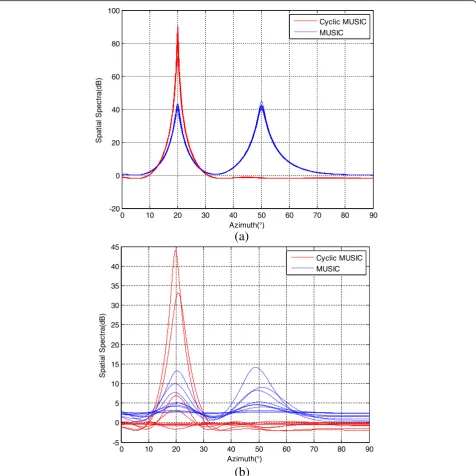
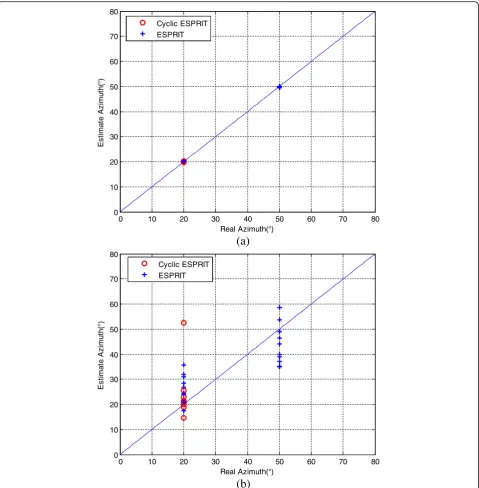
The conventional MUSIC, ESPRIT, cyclic MUSIC, and cyclic ESPRIT algorithms measured with interfering sig-nal and noise are shown in Figs.1and2. The number of arrays is M= 8, the signal-to-noise ratio (SNR) is 0 dB, the number of snapshots is N= 1024, and the sampling frequency is fs= 10
9
Hz. The SOI is a BPSK signal. The carrier frequency of the BPSK signal is f1= 0.25fs, and
the symbol rate isε1= 0.025fs. The interfering signal is a
QPSK signal with a carrier frequency of f2= 0.2fs and a symbol rate ofε2= 0.02fs. The angles of incidence of the BPSK and QPSK signals are 20∘ and 50∘, respectively. The cycle frequency exploited by the cyclic algorithms is ε= 2f1, which is the cycle frequency of the BPSK signal.
The simulation results indicate that the traditional MUSIC, ESPRIT, cyclic MUSIC, and cyclic ESPRIT algo-rithms work normally in Gaussian noise. However, the cyclic MUSIC and cyclic ESPRIT are signal selective and can suppress the interfering QPSK signal for only one peak corresponding to the measured DOA. In contrast, MUSIC and ESPRIT cannot suppress the effects of inter-ference. There are two peaks for MUSIC and ESPRIT, one for the DOA of the SOI and one for the DOA of the interference. Although all the algorithms are robust to Gaussian noise, Figs. 1b and 2b show that all the algo-rithms exhibit severe degradation when impulsive noise is encountered. Moreover, they are not robust toα-stable distributed impulsive noise.
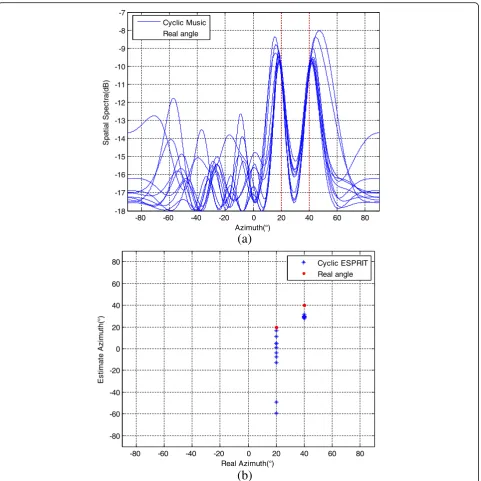
Figure3shows the DOA estimation results of the cyc-lic subspace methods for coherent BPSK signals. In this simulation, the parameters of the array are the same as those in Figs. 1and 2. The carrier frequency and keying rate of the coherent BPSK signals are the same as those for the BPSK signal in Figs. 1 and 2. The interference and noise are absent in this case. The DOAs of the two coherent BPSK signals are 20∘and 40∘, respectively. All estimation results are obtained from 10 realizations. Fig-ure 3 shows that cyclic MUSIC and cyclic ESPRIT are not applicable for coherent signals, and they cannot pro-vide accurate DOA estimates for coherent signals.
The simulation results (Figs.1,2, and 3) indicate that the cyclic MUSIC and cyclic ESPRIT algorithms can suppress Gaussian noise and interference signals, but cannot be applied to coherent sources and impulsive noise. To overcome the limitations of these cyclic sub-space DOA estimation algorithms, it is necessary to ex-ploit the additional signal properties and develop novel signal processing techniques that enable the use of cyclostationarity-based subspace algorithms and are tol-erant to coherent signals and robust to impulsive noise.
4 Methods of cyclostationarity-based DOA estimation for coherent signals
immune to the interference, Gaussian noise, and impul-sive noise and are applicable to coherent signals.
4.1 The proposed smoothing fractional lower-order cyclic DOA methods
The performance of conventional cyclic DOA algorithms degrades in impulsive noise and coherent signal scenes. It is necessary to develop new cyclostationarity-based DOA estimation algorithms that are tolerant to coherent
signals and interference and are robust to both Gaussian noise and impulsive noise.
In realistic communication scenarios, the case of cor-related or coherent signals is inevitable, and the meas-urement vector at the receiver can be written as
Xð Þ¼t A Cð s tð ÞÞþNð Þ ¼t ASð Þþt Nð Þt ð11Þ
where C is the K× 1 complex constant attenuation
(a)
(b)
0 10 20 30 40 50 60 70 80 90
-20 0 20 40 60 80 100
Azimuth(°)
)
B
d(
art
c
e
p
S
l
ait
a
p
S
Cyclic MUSIC
MUSIC
0 10 20 30 40 50 60 70 80 90
-5 0 5 10 15 20 25 30 35 40 45
Azimuth(°)
)
B
d(
art
c
e
p
S
l
ait
a
p
S
Cyclic MUSIC MUSIC
vector andS(t) =Cs(t). TheKsources are coherent, and thus, the signals can be described as
Sð Þ ¼t
c1s tð Þ
c2s tð Þ ⋮
cKs tð Þ 2 6 6 4
3 7 7 5¼
1
c2 ⋮
cK 2 6 6 4
3 7 7
5s tð Þ ð12Þ
where c1= 1. The covariance matrix of X(t) can be ob-tained as follows:
R¼EXXH¼AESSHAHþσ2I ð13Þ
From (12), the covariance matrix of S(t) can be given by,
(a)
(b)
0 10 20 30 40 50 60 70 80
0 10 20 30 40 50 60 70 80
Real Azimuth(°)
)°
(
ht
u
mi
z
A
et
a
mit
s
E
Cyclic ESPRIT ESPRIT
0 10 20 30 40 50 60 70 80
0 10 20 30 40 50 60 70 80
Real Azimuth(°)
)°
(
ht
u
mi
z
A
et
a
mit
s
E
Cyclic ESPRIT ESPRIT
ESSH¼js1ð Þt j2 1
c2 ⋮
cK 2 6 6 4
3 7 7
5½1 c2 ⋯ cK ð14Þ
The coherent signals have a certain relationship, that is, they change in a unified way with time, causing the information to be hidden. Therefore, the signal and noise subspaces cannot be constructed by eigenvalue de-composition, and direction estimates based on the
conventional feature structure subspace are invalid for coherent signals.
To address cyclostationary signal coherence phenom-ena in the impulsive noise environment, we introduce two spatial smoothing-based fractional lower-order cyc-lic algorithms. The performance of the MUSIC and ES-PRIT algorithms can be drastically improved compared to that of the ordinary MUSIC and ESPRIT algorithms by using the Hermitian sample covariance in DOA esti-mation [7,8]. TheM(M>K) element uniform line array
(a)
(b)
-80 -60 -40 -20 0 20 40 60 80
-18 -17 -16 -15 -14 -13 -12 -11 -10 -9 -8 -7
Azimuth(°)
)
B
d(
art
c
e
p
S
l
ait
a
p
S
Cyclic Music Real angle
-80 -60 -40 -20 0 20 40 60 80
-80 -60 -40 -20 0 20 40 60 80
Real Azimuth(°)
)°
(
ht
u
mi
z
A
et
a
mit
s
E
Cyclic ESPRIT
Real angle
is divided into Luniformly overlapping subarrays of di-mension Q (Q>K), in such a way that each sub-array shares all but one of its sensors with an adjacent sub-array [6]. The signal of thelth sub-array is
xf
lð Þ ¼t ½xlð Þt ;xlþ1ð Þt ;⋯;xlþN−1ð Þt
T
¼AMDl−1s tð Þ þnlð Þt ;1≤l≤L ð15Þ
where AM is the direction matrix of Q×K dimension, which is theQdimensional steering vector aM(θi) (i= 1, 2,⋯,K), andD¼ diagðej2π
λsinθ1;ej2λπsinθ2;⋯;ej2λπsinθKÞ. Since the conventional cyclic statistics are useless for exploiting cyclostationarity in impulsive noise, it is ne-cessary to use other properties of signals to develop ro-bust coherent DOA estimation algorithms. It has been shown in [30] that FLOS-based cyclic statistics can be applied to suppress the impulsive noise for cyclostation-ary signals, and a new type ofpth-order cyclostationarity has been developed. Considering a cyclostationary signal
x(t), thepth-order correlation ofx(t) is defined by
where the pth-order phased fractional lower-order mo-ment (PFLOM) is defined asz〈p〉= |z|p−1z. The PFLOM can be re-expressed in a polar form (z=rejθ) as follows:
zh ip ¼rpejθ ð17Þ
Note that the PFLOM acts only on the magnitude of the operand and preserves the corresponding phase; thus,z〈p〉has the same period asz, andx(t) and (x(t))〈p〉 have the same period.
According to the PFLOM properties, the Fourier series ofRp
whereεrepresents all cycle frequencies ofx(t). The Fou-rier coefficientRεx;pðτÞis referred to as thepth-order
cyc-lic correlation function and given as follows:
Rxε;pð Þ ¼τ x tð þτ=2Þ½xðt−τ=2Þh ipe−j2πεt
D E
ð19Þ
According to the pth-order and stable process theory [31], the covariation〈x(t+τ/2)[x∗(t−τ/2)]〈p〉〉is robust to the impulsive noise when 1≤p<α; thus, the pth-order cyclic correlation function can refrain the effects of im-pulsive noise. In fact, the cyclic correlation function can be represented as the cross-correlation of frequency-shifted versions of RεxðτÞ ¼ huðtþτ=2Þvðt−τ =2Þi where u(t) =x(t)e−jπεt and v(t) =x(t)ejπεt. By using the properties of z〈k〉e±jπεt= (ze±jπεt)〈k〉 and (z∗)〈k〉= (z〈k〉)∗,
the pth-order cyclic correlation function (19) can be re-written as Therefore, thepth-order cyclic correlation function is an alternative but equivalent characterization of the second-order cyclic function. Furthermore, compared to conventional second-order cyclic correlation function,
pth-order cyclic correlation function is robust to SαS
distributed (1 <α≤2) impulsive noise. When p= 2, the
pth-order cyclic autocorrelation function Rεx;pðτÞ be-comes the traditional cyclic autocorrelation function Rεxð
τÞ. When the cycle frequencyε= 0, the pth-order cyclic autocorrelation functionRεx;pðτÞreduces to thepth-order
correlation function Rp
xðτÞ. The pth-order cyclic
correl-ation function plays an essential role in high-resolution direction finding.
It is assumed that interference does not exhibit the same cyclostationarity as the SOI and that noise is not a cyclostationary process. Thus, the fractional lower-order covariance matrix of thelth sub-array is obtained as
Rε;p
Xlð Þ ¼τ AMDl−1RSε;pð Þτ AMDl−1
H
ð22Þ
where ε is one cycle frequency of s(t). The spatial smoothing fractional lower-order cyclic covariance matrix is given by
Rε;p
Furthermore, we can use singular value decomposition (SVD) to decompose the covariance matrixRεX;pðτÞ,
Rε;p timation is achieved based on the orthogonality ofA(θ) andUQ,
Pð Þ ¼θ 1
aHð Þθ UQUH Qað Þθ
ð25Þ
Due to the computational complexity of the MUSIC algorithm, we further propose an improved cyclic ES-PRIT algorithm called the smoothing fractional lower-order cyclic ESPRIT algorithm. As in the cyclosta-tionary MUSIC algorithm, the received signal can be expressed as in (12). According to Eq. (22) and the spatial smoothing method, we get the following equation:
Then, using spatial smoothing and SVD, the covari-ance matrixRεX;pðτÞcan be rewritten as smoothing fractional lower-order cyclic ESPRIT algo-rithm, US is divided into US1 and US2. Specifically, the
relation betweenUS1andUS2can be determined by US2¼US1T−1ΦT¼US1Ψ ð28Þ
whereΨ=T−1ΦT. Additionally,
Φ¼ diagejμ1;ejμ2;…;ejμk ð29Þ
whereμk=ω0Δsinθk/c(k= 1, 2,…,K). Note that (28) in-dicates that the characteristic value of Ψ is a diagonal element of Φ. Therefore, after obtaining Ψ¼UþS1US2, the eigenvalues and diagonal elements of Φ can be ob-tained. The DOA estimate can be obtained by,
θk ∧
¼ arcsinfcangleð Þλk =ðω0ΔÞg ð30Þ
whereλkis the eigenvalue ofΨ.
4.2 The proposed modified fractional lower-order cyclic DOA methods
Both cyclic and conjugate-cyclic statistics can be com-bined to improve the performance of the signal selective DOA estimation method [23]. To circumvent the coher-ent signals, we define a new matrix based on the conjugate-cyclic statistics, Then, the fractional lower-order cyclic covariance matrix ofY(t) is defined in the following form:
Rε;p
To develop new DOA estimation methods, we define a modified fractional lower-order cyclic covariance matrix,
From (36), we can obtain the Ka non-zero singular values of Rε, p(τ), and the other M−Ka singular values fractional lower-order cyclic MUSIC method is obtained using the orthogonality ofA(θ) andUN,
Pð Þ ¼θ 1
aHð Þθ U
NUHNað Þθ
ð38Þ
Thus, the DOA can be obtained from a search for the peaks in the spectrum of (38).
We further propose an improved ESPRIT algorithm called the modified fractional lower-order cyclic ESPRIT algorithm. As in the cyclostationary MUSIC algorithm, the fractional lower-order covariance matrix RεX;pðτÞ is obtained, andY(t) is defined as the product ofJand the complex conjugate of X∗(t). Based on the SVD of Rε, p(τ), the signal subspace U
S and noise subspace UN are determined. Then, we can extractUS1andUS2fromUS. According to the property of rotational invariance, we obtain,
US2¼US1T−1ΦT¼US1Ψ ð39Þ
When Rε,p(τ) is nonsingular, the space of Aand USis the same, and the linear transformation matrix ofAand
US is T. By establishing the relation between the rota-tionally invariant factorΦand the transformation matrix Ψ, we obtain the following equation,
Φ¼TΨT−1 ð40Þ
Finally, we can determine the diagonal elementsΦ by finding the eigenvalue ofψ, that is the DOA estimates is obtained as
θ∧k ¼ arcsinfcangleð Þλk =ðω0ΔÞg ð41Þ
5 Simulation results and discussion
In this section, we present various simulation results that are used to assess the performance of the proposed algo-rithms. We verify the effectiveness and robustness of the proposed smoothing fractional lower-order cyclic MUSIC (SFCyclic-MUSIC), smoothing fractional lower-order cyclic ESPRIT (SFCyclic-ESPRIT), modified fractional lower-order cyclic MUSIC (MFCyclic-MUSIC), and modified fractional lower-order cyclic ESPRIT (MFCyclic-ESPRIT) algorithms and compare their performance to the performance of four classes of existing FLOS-based, cyclostationarity-based, sparse representation algorithms, namely, the fractional lower-order moment-based MUSIC (FLOM-MUSIC) and ESPRIT (FLOM-ESPRIT), the modified MUSIC (M-MUSIC) and ESPRIT (M-ESPRIT), the cyclic MUSIC (Cyclic-MUSIC) and ESPRIT (Cyclic-ESPRIT), the Bayes-optimal algorithm [24], and conventional sparse Bayesian learning (SBL) algorithms for those frequently en-countered communication signals (e.g., BPSK and QPSK).
Because the α-stable distribution process has finite variance only for α= 2, the traditional SNR is inappro-priate for determining the power ofSαSnoise. Thus, we use a generalized signal-to-noise ratio (GSNR) which is defined as [27],
According to the GSNR metric, the SαS impulsive noise samples are power scaled by the dispersion param-eter γ. The performance of the algorithms is evaluated by the root-mean-square error (RMSE) of the DOA esti-mates and the probability of resolution. The RMSE is defined by
The probability of resolution is also called the success probability which is defined as the ratio of the number
of successful runs to the total number of Monte Carlo runs. The number of arrays isM= 10, the number of the snapshots is N= 1024, and the sampling frequency isfs = 109Hz.
5.1 DOA estimation of the proposed methods
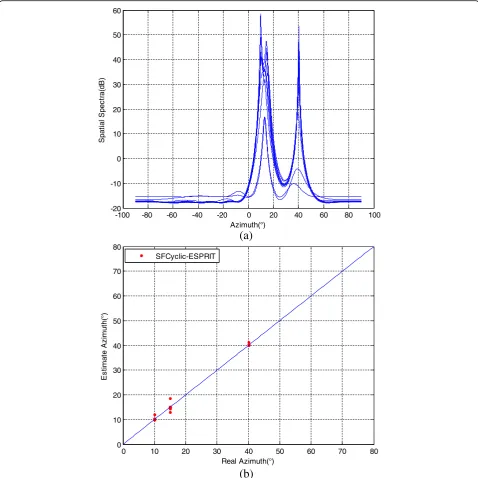
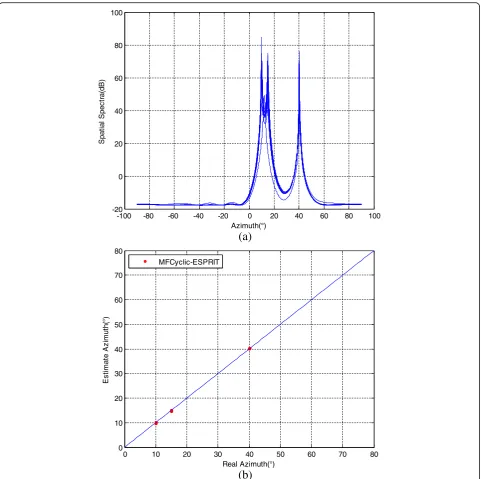
In this case, the incident signals ares1(t),s2(t),s3(t), and s4(t) with DOA(θ1,θ2,θ3,θ4) = (10∘, 15∘, 40∘, 50∘). The
car-rier frequency and symbol rate of the coherent BPSK signals ofs1(t) ands2(t) aref1= 0.25fsandε1= 0.025fs,
re-spectively.s3(t) is a BPSK signal with a carrier frequency
of f2= 0.25fs and keying rate of ε2= 0.025fs. s4(t) is a
QPSK signal with a carrier frequency and symbol rate of
f3= 0.1fs and ε3= 0.05fs, respectively. s3(t) and s4(t) are
independent ofs1(t) ands2(t). The cycle frequency used
by the cyclic algorithms isε= 2f1, which is the cycle
fre-quency ofs1(t),s2(t), ands3(t).
The performance of the proposed methods for coher-ent signals in impulsive noise with α= 1.6 (GSNR = 10 dB) is shown in Figs. 4and5. The simulation results indicate that all the proposed methods are robust to im-pulsive noise. However, the MFCyclic-MUSIC and MFCyclic-ESPRIT methods make better use of fractional lower-order cyclostationarity and conjugate fractional lower-order cyclic cyclostationarity and are superior to the SFCyclic-MUSIC and SFCyclic-ESPRIT methods. Figure 5 illustrates that the MFCyclic-MUSIC and MFCyclic-ESPRIT methods can still suppress extremely impulsive noise (α= 1.6) and provide accurate DOA esti-mates for cyclostationary coherent sources in the pres-ence of impulsive noise and interferpres-ence signals.
5.2 Influence of impulsive noise
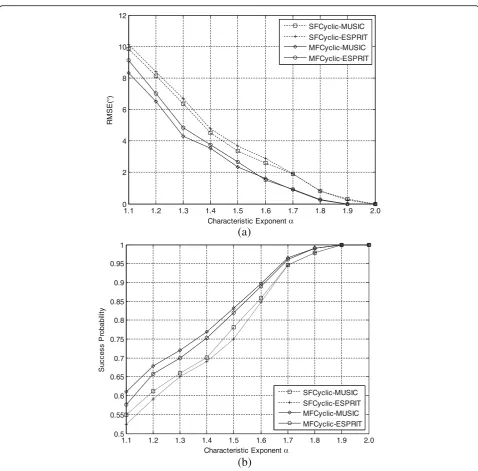
We consider a BPSK communication signal representing the SOI. The carrier frequency of the BPSK signal isfc= 0.25fs, the keying rate is εk= 0.0625fs, and the DOA of the signal is 10∘. The interference in this case is a BPSK signal with a carrier frequency off1= 0.2fs, keying rate of ε1= 0.025fs, and a DOA of 20∘. The signal-to-interference ratio (SIR) is 3 dB. We use a cycle frequency of ε=εk= 0.0625/Ts and p= 1.2. The estima-tion results are obtained from 1000 Monte Carlo realizations.
are strong. Whenα≥1.9, the two types of algorithms are basically the same.
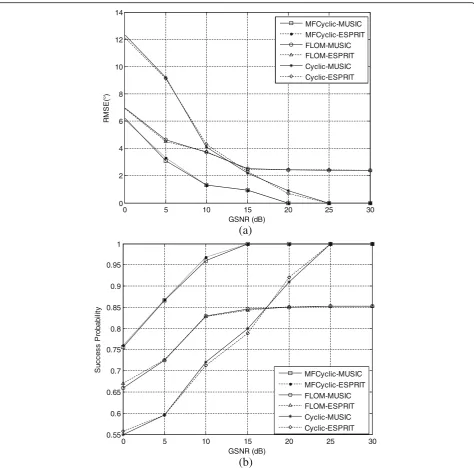
Simulations that compare the performance of the pro-posed MFCyclic-MUSIC and MFCyclic-ESPRIT algo-rithms with FLOM-MUSIC, FLOM-ESPRIT, cyclic MUSIC, and cyclic ESPRIT in impulsive noise and inter-ference are given in Fig.7. The results in Fig.7a and 7b indicate that the second-order cyclic statistics-based methods display the worst performance for the impul-sive noise, because these second-order cyclic statistics
methods fail with impulsive noise, especially the GSNRs is less than 13 dB. Although the impulsive noise is sup-pressed by the FLOM-based methods, due to the inter-fering signal, the performance of FLOM-MUSIC and FLOM-ESPRIT remains essentially unchanged when the GSNR is greater than approximately 10 dB. Compared to
the conventional FLOM-based and
cyclostationarity-based algorithms, the proposed algo-rithms can simultaneously suppress the effects of impul-sive noise and interfering signals; thus, the performance
(a)
(b)
-100 -80 -60 -40 -20 0 20 40 60 80 100
-20 -10 0 10 20 30 40 50 60
Azimuth(°)
)
B
d(
art
c
e
p
S
l
ait
a
p
S
0 10 20 30 40 50 60 70 80
0 10 20 30 40 50 60 70 80
Real Azimuth(°)
)°
(
ht
u
mi
z
A
et
a
mit
s
E
SFCyclic-ESPRIT
of the proposed algorithms is better than that of the other methods studied.
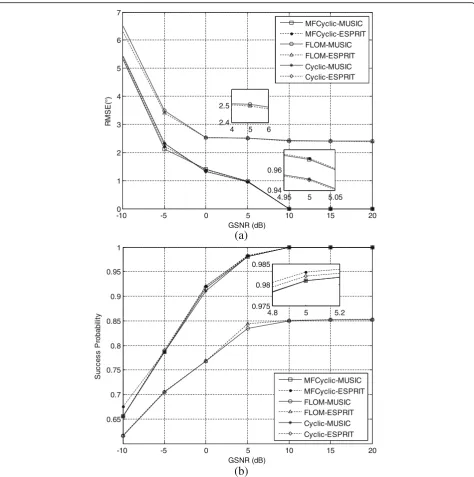
The performance of the proposed algorithms and the exiting methods in Gaussian noise and interfer-ence is shown in Fig. 8. Figure 8 shows that al-though the FLOM-based methods can effectively suppress Gaussian and non-Gaussian impulsive noises, the performance does not improve as the GSNR increases due to the interfering signal. There-fore, the proposed fractional lower-order
cyclostationarity-based methods outperform the FLOM-based methods in the presence of interfer-ence. Compared Figs. 7 with 8, we can see that, al-though the proposed algorithms are equivalent in performance to the second-order cyclostationarity-based methods in Gaussian noise and interference environment, they perform much better performance in the presence of impulsive noise. Therefore, the proposed methods display good adaptability to Gaussian noise and non-Gaussian im-pulsive noise.
(a)
(b)
-100 -80 -60 -40 -20 0 20 40 60 80 100
-20 0 20 40 60 80 100
Azimuth(°)
)
B
d(
art
c
e
p
S
l
ait
a
p
S
0 10 20 30 40 50 60 70 80
0 10 20 30 40 50 60 70 80
Real Azimuth(°)
)°
(
ht
u
mi
z
A
et
a
mit
s
E
MFCyclic-ESPRIT
5.3 Influence of coherent signals
In this case, we consider two coherent QPSK communica-tion signals. The carrier frequency of the QPSK signals isfc = 0.2fs, and the keying rate isεk= 0.025fs. The DOA of the signals are 10∘and 15∘, and the angle to be estimated is 10∘. The coband interference is an AM signal that has the same carrier frequency and bandwidth as that of the QPSK signals. The DOA of the AM signal is 20∘. The cycle frequency exploited by the cyclic algo-rithm is set to ε=εk and GSNR = 0 dB. The
estimation results are obtained from 1000 Monte Carlo realizations.
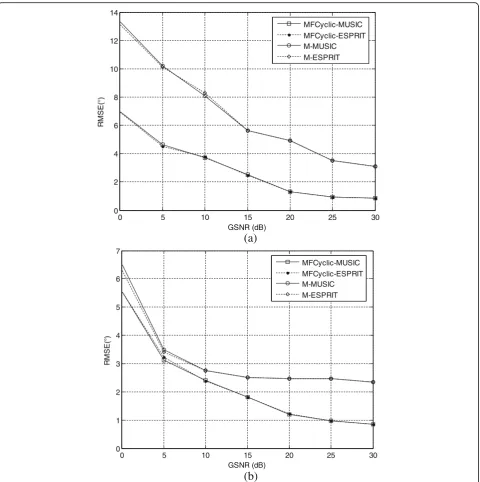
A simulation is conducted to compare the RMSE versus GSNR for the proposed algorithms, modified MUSIC, and modified ESPRIT, considering both impulsive noise and Gaussian noise for the coherent sources. The accuracy of the algorithms in impulsive noise and Gaussian noise en-vironments is shown in Fig.9. Although the second-order cyclic statistics-based M-MUSIC and M-ESPRIT are suit-able for coherent signals, they cannot suppress
(a)
(b)
1.1 1.2 1.3 1.4 1.5 1.6 1.7 1.8 1.9 2.0
0 2 4 6 8 10 12
Characteristic Exponent
)°
(
E
S
M
R
SFCyclic-MUSIC SFCyclic-ESPRIT MFCyclic-MUSIC MFCyclic-ESPRIT
1.1 1.2 1.3 1.4 1.5 1.6 1.7 1.8 1.9 2.0
0.5 0.55 0.6 0.65 0.7 0.75 0.8 0.85 0.9 0.95 1
Characteristic Exponent
yti
li
b
a
b
or
P
s
s
e
c
c
u
S
SFCyclic-MUSIC SFCyclic-ESPRIT MFCyclic-MUSIC MFCyclic-ESPRIT
impulsive noise. Thus, both the two methods de-grade severely when impulsive noise is encountered. The M-MUSIC and M-ESPRIT are effective for co-herent signals in Gaussian noise; however, because of the existence of AM interference, the performance of traditional modified algorithms is not further
improved. These algorithms failed in the case in which coband interference is present. In contrast, the proposed algorithms are superior to the trad-itional modified algorithms, and they effectively sup-pressed impulsive noise. It can be seen from Fig. 9
that the proposed algorithms are immune to the
(a)
(b)
0 5 10 15 20 25 30
0 2 4 6 8 10 12 14
GSNR (dB)
)°
(
E
S
M
R
MFCyclic-MUSIC MFCyclic-ESPRIT FLOM-MUSIC FLOM-ESPRIT
Cyclic-MUSIC Cyclic-ESPRIT
0 5 10 15 20 25 30
0.55 0.6 0.65 0.7 0.75 0.8 0.85 0.9 0.95 1
GSNR (dB)
yti
li
b
a
b
or
P
s
s
e
c
c
u
S
MFCyclic-MUSIC MFCyclic-ESPRIT FLOM-MUSIC FLOM-ESPRIT Cyclic-MUSIC
Cyclic-ESPRIT
Fig. 7DOA estimation accuracy versus GSNR in impulsive noise:aRMSE andbsuccess probability.a□—represents DOA estimation accuracy of MFCyclic-MUSIC.·-- represents DOA estimation accuracy of MFCyclic-ESPRIT.о—represents DOA estimation accuracy of FLOM-MUSIC.Δ --represents DOA estimation accuracy of FLOM- ESPRIT. *—represents DOA estimation accuracy of cyclic MUSIC.◇--represents DOA estimation accuracy of cyclic ESPRIT.b□—represents DOA success probability of MFCyclic-MUSIC.·-- represents DOA success probability of MFCyclic-ESPRIT.
effects of the coband interfering signal and can pro-vide accurate DOA estimates for coherent signals in Gaussian noise and impulsive noise.
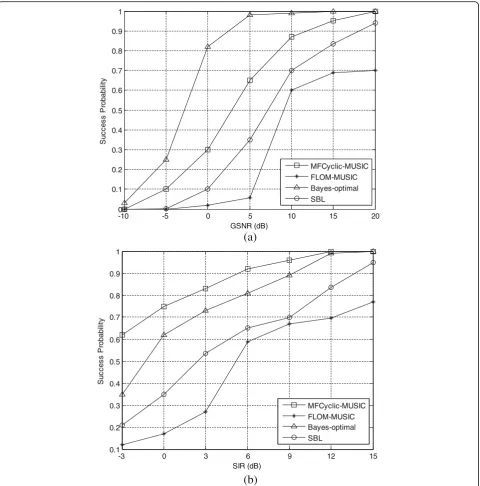
The sparse representation methods can estimate co-herent sources in impulsive noise; we compare the per-formance of the proposed MFCyclic-MUSIC algorithm with Bayes-optimal algorithm, conventional SBL
algorithms, and FLOM-MUSIC method in the impulsive noise (α= 1.5) and in the coband interfering environ-ments, respectively. Because the FLOM-MUSIC cannot estimate coherent signals, it can be seen from Fig. 10
that the FLOM-MUSIC achieves the worst performance. Moreover, comparing Fig. 10a with b, we can see that the Bayes-optimal algorithm achieves the best
(a)
(b)
-100 -5 0 5 10 15 20
1 2 3 4 5 6 7
GSNR (dB)
)°
(
E
S
M
R
MFCyclic-MUSIC MFCyclic-ESPRIT FLOM-MUSIC
FLOM-ESPRIT Cyclic-MUSIC Cyclic-ESPRIT
4.95 5 5.05
0.94 0.96
4 5 6
2.4 2.5
-10 -5 0 5 10 15 20
0.65 0.7 0.75 0.8 0.85 0.9 0.95 1
GSNR (dB)
yti
li
b
a
b
or
P
s
s
e
c
c
u
S
MFCyclic-MUSIC MFCyclic-ESPRIT FLOM-MUSIC FLOM-ESPRIT Cyclic-MUSIC
Cyclic-ESPRIT
4.8 5 5.2
0.975 0.98 0.985
suppression performance for the impulsive noise and the proposed method outperforms Bayes-optimal algorithm against interference.
Cycle frequency is one of the most important represen-tation of cyclosrepresen-tationarity. Typical cycle frequencies for many communications signals include the double carrier frequency, the keying rate and the corresponding har-monics, as well as the sums and differences of these cycle frequencies. For example, for a BPSK signal or a QPSK
signal, the cycle frequencies are ±2fc,εk, andεi= ± 2fc+iεk (i= 0, ± 1, ± 2,…), wherefc is the carrier frequency andεk represents the keying rate. If we use the cycle frequency at which the spectral correlation is stronger, the performance of the proposed cyclic algorithms can be improved.
The estimation accuracy of the proposed algorithms at different cycle frequencies is shown in Fig.11. The impul-sive noise withα= 1.8 is added only in the simulation. The simulation results indicate that the proposed methods
(a)
(b)
0 5 10 15 20 25 30
0 2 4 6 8 10 12 14
GSNR (dB)
)°
(
E
S
M
R
MFCyclic-MUSIC MFCyclic-ESPRIT M-MUSIC M-ESPRIT
0 5 10 15 20 25 30
0 1 2 3 4 5 6 7
GSNR (dB)
)°
(
E
S
M
R
MFCyclic-MUSIC MFCyclic-ESPRIT M-MUSIC M-ESPRIT
perform effectively at the two cycle frequencies. However, for the QPSK signal, the cyclostationarity characteristic is stron-ger at ε= 2fc than at ε=εk, so the performance of the two proposed algorithms is slightly better atε= 2fcthan atε=εk.
6 Conclusions
In this paper, new fractional lower-order cyclostationarity-based DOA estimation algorithms for
coherent signals in the presence of α-stable impulsive noise and interference are introduced. Traditional second-order cyclostationarity-based and FLOS-based DOA estimation methods severely degrade for coherent signals, under α-stable distributed impulsive noise and interfering signals. By exploiting the fractional lower-order cyclostationarity properties of signals, new smoothing fractional lower-order cyclic subspace
(a)
(b)
-10 -5 0 5 10 15 20
0 0.1 0.2 0.3 0.4 0.5 0.6 0.7 0.8 0.9 1
GSNR (dB)
yti
li
b
a
b
or
P
s
s
e
c
c
u
S
MFCyclic-MUSIC
FLOM-MUSIC Bayes-optimal
SBL
-3 0 3 6 9 12 15
0.1 0.2 0.3 0.4 0.5 0.6 0.7 0.8 0.9 1
SIR (dB)
yti
li
b
a
b
or
P
s
s
e
c
c
u
S
MFCyclic-MUSIC
FLOM-MUSIC Bayes-optimal
SBL
algorithms and modified fractional lower-order cyclic subspace algorithms are proposed. The new proposed al-gorithms not only provide the signal selectivity in the presence of impulsive noise, but also are highly tolerant to coherent signals. Moreover, these algorithms yield more reliable DOA estimates of cyclostationary coherent signals than do cyclostationarity-based and FLOS-based methods in the presence of interference and impulsive noise. The effectiveness and robustness of the proposed algorithms are evaluated via simulations, and the results indicate that the new algorithms are applicable to a wide range of interference, Gaussian noise, and non-Gaussian impulsive noise environments for coherent signals.
Abbreviations
AM:Amplitude modulation; BPSK: Binary phase shift keying; DOA: Direction of arrival; FLOM: Fractional lower-order moment; FLOS: Fractional lower-order statistics; GSNR: Generalized signal-to-noise ratio; MUSIC: Multiple signal classification; PFLOM: Phased fractional lower-order moment; QPSK: Quaternary phase shift keying; RMSE: Root-mean-square error; SIR: Signal-to-interference ratio; SNR: Signal-to-noise ratio; SOI: Signal of interest; SVD: Singular value decomposition;SαS: Symmetricα-stable distribution; U-ESPRIT: Unitary estimation of signal parameters via rotational invariance techniques
Acknowledgements
The authors would like to thank the editors and anonymous reviewers. The authors are grateful to the National Science Foundation of China for its support of this research. This work is supported by the National Science Foundation of China under Grant 61461036, 61761033, and 61501325.
Funding
This work is supported by the National Science Foundation of China under Grant 61461036, 61761033, and 61501325.
Availability of data and materials
Not applicable.
Authors’contributions
The algorithms proposed in this paper have been conceived by Dr. YL, Dr. YZ, and Prof. TQ. Dr. YL, Dr. YZ, and Dr. JG designed the experiments. Dr. JG and B.S. QW performed the experiments and analyzed the results. Dr. YL and Dr. YZ wrote the paper. All authors read and approved the final manuscript.
Competing interests
The authors declare that they have no competing interests.
Publisher’s Note
Springer Nature remains neutral with regard to jurisdictional claims in published maps and institutional affiliations.
Author details
1
College of Electronic Information Engineering, Inner Mongolia University, Hohhot, Inner Mongolia, China.2Tianjin Key Laboratory of Wireless Mobile Communications and Power Transmission, Tianjin Normal University, Tianjin, China.3Faculty of Electronic Information and Electrical Engineering, Dalian University of Technology, Dalian, China.
Received: 15 September 2018 Accepted: 19 March 2019
References
1. H. Krim, M. Viberg, Two decades of array signal processing research: the parametric approach. IEEE Signal Process Mag13(4), 67–94 (1996) 2. B. Ottersten, M. Viberg, T. Kailath, Performance analysis of the total least
squares ESPRIT algorithm. IEEE Trans Signal Process39(5), 1122–1135 (1991) 3. A. Liu, F. Li, B. Li, et al., Spatial polarimetric time-frequency distribution
based DOA estimation: combing ESPRTI with MUSIC. EURASIP J Wirel Commun Netw2018(51), 1–8 (2018)
4. M. TJ Shan, T.K. Wax, On spatial smoothing for direction-of-arrival estimation of coherent signals. IEEE Trans Acoust Speech Signal Process33(4), 806–811 (1985)
Fig. 11RMSE as a function of GSNR at different cycle frequencies in impulsive noise.□—represents DOA estimation accuracy of MFCyclic-MUSIC whenε=εk. +—represents DOA estimation accuracy of MFCyclic-ESPRIT whenε=εk.—□—represents DOA estimation accuracy of
5. H. Shi, Z. Li, D. Liu, H. Chen, Efficient method of two-dimensional DOA estimation for coherent signals. EURASIP J Wirel Commun Netw2017(53), 1–10 (2017)
6. D. W, R.L. Kirlin, Improved spatial smoothing techniques for DOA estimation of coherent signals. IEEE Trans Signal Process39(5), 1208–1210 (1991) 7. H. Shi, Z. Li, J. Cao, H. Chen, Two-dimensional DOA estimation of coherent
sources using two parallel uniform linear arrays. EURASIP J Wirel Commun Netw2017(60), 1–9 (2017)
8. D. Kundu, Modified MUSIC algorithm for estimating DOA of signals. Signal Process48(1), 85–90 (1996)
9. M. Inoue, K. Hayashi, H. Mori, T. Nabetani, A DOA estimation method with Kronecker subspace for coherent signals. IEEE Commun Lett22(11), 2306– 2309 (2018)
10. Z. Liu, J. Wang, F. Wang, Conjugate unitary ESPRIT for real sources adapted to the coherent case. Signal Process89(7), 1403–1411 (2009)
11. T. Wang, B. Ai, R. He, Z. Zhong, Two-dimension direction-of-arrival estimation for massive MIMO systems. IEEE Access2015(3), 2122–2128 (2015)
12. Y. Zhou, Z. Fei, S. Yang, J. Kuang, S. Chen, L. Hanzo, Joint angle estimation and signal reconstruction for coherently distributed sources in massive MIMO systems based on 2-D unitary ESPRIT. IEEE Access2017(5), 9632–9646 (2017)
13. W. Cui, T. Qian, J. Tian, Enhanced covariances matrix sparse representation method for DOA estimation. Electron Lett51(16), 1288–1290 (2015) 14. J. Cai, D. Bao, P. Li, DOA estimation via sparse recovering from the
smoothed covariance vector. J Syst Eng Electron27(3), 555–561 (2016) 15. B. Li, X. Wang, Sparse representation-based DOA estimation of coherent
wideband LFM signals in FRFT domain. EURASIP J Wirel Commun Netw
2017(210), 1–9 (2017)
16. J. Liu, W. Zhou, X. Wang, D. Huang, A sparse direction-of-arrival estimation algorithm for MIMO radar in the presence of gain-phase errors. Digital Signal Process2017(69), 193–203 (2017)
17. W.A. Gardner, A. Napolitano, L. Paura, Cyclostationarity: half a century of research. Signal Process86(4), 639–697 (2006)
18. A. Napolitano, Generalizations of cyclostationarity: a new paradigm for signal processing for mobile communications, radar, and sonar. IEEE Signal Process Mag30(6), 53–63 (2013)
19. A. Napolitano, Cyclostationarity: limits and generalizations. Signal Process
120(3), 323–347 (2016)
20. W.A. Gardner, Simplification of MUSIC and ESPRIT by exploitation of cyclostationarity. Proc IEEE76(7), 845–847 (1988)
21. G. Xu, T. Kailath, Direction of arrival estimation via exploitation of cyclostationary - a combination of temporal and spatial processing. IEEE Trans Signal Process40(7), 1775–1786 (1992)
22. H.Q. Yan, H.H. Fan, Signal-selective DOA tracking for wideband cyclostationary sources. IEEE Trans Signal Process55(5), 2007–2015 (2007) 23. W.J. Zeng, X.L. Li, X.D. Zhang, X. Jiang, inIEEE International Conference on
Acoustics, Speech and Signal Processing, Taipei. An improved signal-selective direction finding algorithm using second-order cyclic statistics (2009), pp. 2141–2144
24. J.S. Dai, H.C. So, Sparse Bayesian learning approach for outlier-resistant direction-of-arrival estimation. IEEE Trans Signal Process66(3), 744–756 (2018)
25. W.J. Zeng, H.C. So, Outlier-robust matrix completion viaℓp-minimization.
IEEE Trans Signal Process66(5), 1125–1140 (2018)
26. H. Belkacemi, S. Marcos, Robust subspace-based algorithms for joint angle/ Doppler estimation in non-Gaussian clutter. Signal Process87(7), 1547–1558 (2007)
27. P. Tsakalides, C.L. Nikias, The robust covariation-based MUSIC (ROC-MUSIC) algorithm for bearing estimation in impulsive noise environments. IEEE Trans Signal Process44(7), 1623–1633 (1996)
28. T.H. Liu, J.M. Mendel, A subspace-based direction finding algorithm using fractional lower order statistics. IEEE Trans Signal Process49(8), 1605–1613 (2001)
29. M. Rupi, P. Tsakalides, E.D. Re, C.L. Nikias, Robust spatial filtering of coherent source for wireless communications. Signal Process80(3), 381–396 (2000) 30. Y. Liu, Y.H. Zhang, T.S. Qiu, J. Gao, S. Na, Improved time difference of arrival
estimation algorithms for cyclostationary signals inα-stable impulsive noise. Digital Signal Process2018(76), 94–105 (2018)