Optical Wireless Sensor Network System
Using Corner Cube Retroreflectors
Shota Teramoto
Department of Electrical Engineering, Tokyo University of Science, 2641 Yamazaki, Noda, Chiba 278-8510, Japan
Tomoaki Ohtsuki
Department of Electrical Engineering, Tokyo University of Science, 2641 Yamazaki, Noda, Chiba 278-8510, Japan Email:[email protected]
Received 18 March 2004; Revised 16 September 2004
We analyze an optical wireless sensor network system that uses corner cube retroreflectors (CCRs). A CCR consists of three flat mirrors in a concave configuration. When a light beam enters the CCR, it bounces offeach of the three mirrors, and is reflected back parallel to the direction it entered. A CCR can send information to the base station by modulating the reflected beam by vibrating the CCR or interrupting the light path; the most suitable transmission format is on-offkeying (OOK). The CCR is attractive in many optical communication applications because it is small, easy to operate, and has low power consumption. This paper examines two signal decision schemes for use at the base station: collective decision and majority decision. In collective decision, all optical signals detected by the sensors are received by one photodetector (PD), and its output is subjected to hard decision. In majority decision, the outputs of the PDs associated with the sensors are subjected to hard detection, and the final data is decided by majority decision. We show that increasing the number of sensors improves the bit error rate (BER). We also show that when the transmitted optical power is sufficiently large, BER depends on sensor accuracy. We confirm that collective decision yields lower BERs than majority decision.
Keywords and phrases:corner cube retroreflector, optical wireless sensor network, collective decision, majority decision.
1. INTRODUCTION
Recently, sensor networks consisting of small sensors that have the abilities of detection, data processing, and com-munication have attracted much attention owing to the de-velopment of wireless communications and electric devices [1, 2]. Since wireless sensor networks have several advan-tages, such as autonomous distributed control, network ex-tensibility, and simple setup, their use to realize surveillance and security in various places, such as hospitals, dangerous areas, and polluted areas, is expected. However, since the electric power, memory, and throughput of the sensor itself are restricted, we need to improve its power efficiency. There-fore, the use of passive transmitters such as the corner cube retroreflector (CCR), which do not have a light source in the sensor itself, is attractive for improving the power efficiency of the sensor. An ideal CCR consists of three mutually or-thogonal mirrors that form a concave corner. A CCR, as a
This is an open-access article distributed under the Creative Commons Attribution License, which permits unrestricted use, distribution, and reproduction in any medium, provided the original work is properly cited.
micro machine, has attracted much attention because of the following advantages: small size, ease of operation, and low power consumption (lower than 1 nJ/bit). It is most often used in distance measurement systems. When a light beam enters the CCR, it bounces offeach of the three mirrors, and is reflected back parallel to the direction it entered [3]. A CCR can send an optical signal to the base station by modulating the reflected beam through techniques such as vibrating the CCR or interrupting the light path to create on-off-keying (OOK) modulated optical signals. Pister analyzed the signal-to-noise-ratio (SNR) of the optical wireless sensor network system, where the transceiver and CCR have a one-to-one correspondence, however, the accuracy of the observation at the sensor was not considered [4]. Karakehayov proposed an optical wireless sensor network system where the transceiver and CCR have a one-to-one correspondence. Unfortunately, the paper did not address the performance [5].
Phenomenon (H0,H1)
One-to-many correspondence Detection
Sensor Sensor Sensor
CCR CCR CCR
1 2 · · · N
OOK
Fusion center
Decision
H0/H1
Figure1: Optical wireless sensor network model with CCRs.
performance, shorten decision time, and provide other ben-efits [6].Figure 1shows the optical wireless sensor network model that pairs one decision center (transceiver) with many CCRs. We note that this one-to-many correspondence be-tween the transceiver and CCR has been neither proposed nor evaluated in any other paper. In this figure, the local de-cision made on each CCR stream is communicated to the decision system. Upon receiving this binary information, the decision system combines the local decisions and arrives at the final decision according to a rule. The performance of the distributed detection scheme is usually measured by a function involving the probability of making an incorrect decision.
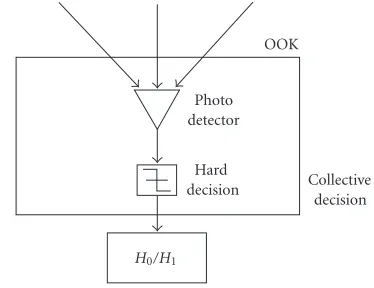
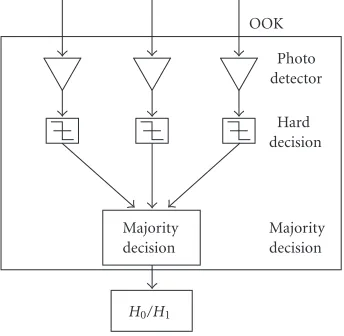
In this paper, we analyze the bit error rate (BER) of an optical wireless sensor network system that uses the one-to-many transceiver-CCR configuration as shown inFigure 1. We evaluate two approaches to implementing the decision system: collective decision and majority decision. In collec-tive decision, all optical signals are received by one photode-tector (PD), and a hard decision is made on the PD output. In majority decision, the output of each PD associated with a sensor is subjected to hard decision and the final data yielded by taking a majority decision on the hard decision outputs. We show that BER is improved by increasing the number of sensors. We also show that when the transmitted optical power is sufficient, BER depends on sensor accuracy. We con-firm that BER is improved by using collective decision rather than majority decision.
2. SENSOR ACCURACY
We consider a distributed detection system withN sensors, NCCRs, and one fusion center arranged in a parallel struc-ture (seeFigure 1). Each detector employs a predetermined local decision rule, and we assume that, conditioned on each
hypothesis, the local binary decisions are statistically inde-pendent. First, we analyze the accuracy of the sensors. We consider two hypothesesH0andH1. Theith CCR transmits bit 0 or 1, which is detected by theith sensor, if it favors hy-pothesesH0orH1, respectively. The a priori probabilities of the two hypotheses,H0 andH1, are denoted byP(H0) and P(H1), respectively, whereP(H0) +P(H1)=1. At each CCR unit, sensor output is analog-to-digital (A/D) converted and OOK modulated. The modulated optical signals are sent to the fusion center.
p(x|Hi) denotes the conditional probability density func-tion (pdf) of the observafunc-tion of each sensor,Hi. We assume the observation to be Gaussian distributed (Gaussian obser-vation). We also assume that the means of the observation of H0andH1are 0 and 1, respectively, and that the variance of the observation for either event isσ2
s. The conditional pdfs are expressed as [8]
p0(x)=pxH0
= 1
2πσ2 s
exp
− x2
2σ2 s
,
p1(x)=pxH1
= 1
2πσ2 s
exp
−(x−1)2
2σ2 s
. (1)
3. LINK ANALYSIS
We analyze the SNR of the above optical wireless sensor net-work [4]. The single laser at the transceiver emits a beam of powerPt with semiangle of illuminated fieldθf. We denote the horizontal distance between the laser and thenth CCR by r, the angle between the laser and the axis of the link byθs,n, the link distance between the laser andnth CCR byr/cosθs,n and the effective diameter of CCR bydc. Note that the system uses a single source. We assume the light path to be line of sight and that all light paths arrive at PD at the same time. The optical power captured by thenth CCR is expressed as
Pcc,n=Ptd 2
ccos2θs,ncosθc,n 4r2tan2θ
f
, (2)
where θc,n represents the angle between the center of the beam and the axis of the link and dc represents the eff ec-tive diameter of CCR (not tilted). Considering multiple re-flection, we assume that the CCR has effective reflectivityRc. The CCR modulates the cw downstream signal into an OOK signal with non-return-to-zero (NRZ) pulses. Assuming that 0 and 1 are equiprobable, the average power reflected by the nth CCR is given byPc,n =RcPcc,n/2. Using the Fraunhofer diffraction theory [9], the diffracted irradiance at the lens as reflected by thenth CCR is expressed as
Il,n= Pc,nπd 2
ccos2θs,ncosθl,n
4λ2r2 , (3)
bandwidth∆λto reject ambient light. The average received photocurrent reflected by thenth CCR is given by [4]
isig,n=Il
,nπd2lTlTffactR
4 , (4)
whereTlrepresents the effective transmission of the camera lens,Tf represents the optical filter transmission, fact repre-sents the fraction of the camera pixel area that is active, R represents the pixel responsivity, anddlrepresents the eff ec-tive diameter of lens (not tilted).
We assume that the region around the CCR is illuminated by the ambient light with power spectral density (PSD) pbg, and that this region reflects the ambient light with reflectivity Rbg. Within the bandwidth of the optical bandpass filter, the photocurrent per pixel due to ambient light is given by [4]
ibg,n=π pbgRbg∆λ tan2θ
fd2lTfTlfactR
4N , (5)
whereNis the number of CCRs and∆is the optical band-pass filter’s bandwidth. The ambient light induces the white shot noise having a one-sided PSDSbg=2qibg. The load re-sistanceRFdepends on the white noise having PSD given by [10]
SR=
4kBT
RF , (6)
wherekBis Boltzmann’s constant andTis the absolute tem-perature. The preamplifier contributes to the white noise with PSDSamp. Thus, the total variance is given by [10]
σtot2 =
Sbg+SR+Samp
Rb, (7)
whereRbis the bit rate. The noise is dominated by approx-imately equal contributions from ambient light shot noise and thermal noise from the feedback resistor; the amplifier noise is negligible.
The peak electrical SNR is given by [3]
SNR= i
4. DECISION METHODS ANALYSIS
4.1. Collective decision
Figure 2shows the fusion center model with collective de-cision. In collective decision, all optical signals are received by one PD, and then a hard decision is made on the PD’s output. If the total received signal has optical intensity larger than the hard decision threshold for the system using collec-tive decision θcol, it is judged as 1. The BER of the system
OOK
Figure2: Model of the decision system using collective decision.
using collective decisionPcolis given by
Pcol=P
whereP(H0) andP(H1) represent the a priori probabilities of the two hypotheses,Nrepresents the number of CCRs,i represents the number of CCRs deciding 1, andsallrepresents the total received power at the PD.
4.2. Majority decision
Figure 3shows the fusion center model with majority deci-sion. In majority decision, the output of each PD is subjected to hard detection and the resulting data is processed by ma-jority decision. The BER of the system using mama-jority deci-sion,Pmaj, is given by
OOK
Figure3: Model of the decision system using majority decision.
4.3. Floor probability
We consider the floor probability of the sensor network sys-tem where we define the floor probability as the BER at which there is no channel error. Regardless of the decisions, the floor probability of the system depends on sensor accuracy. The floor probabilityPflooris derived as
Pfloor=P
wherei represents the number of CCRs deciding 1,ts rep-resents the local threshold of the sensor, tf represents the threshold at the fusion center. Note thattf = N/2for de-riving the floor probability irrespective of the decisions.
5. NUMERICAL RESULTS
In this section, we evaluate the BER of the above optical wire-less sensor network system. We evaluate two decision tech-niques: collective decision and majority decision. We assume that all sensors observe the same environment (received opti-cal power, incident angle, reflected angle, and so on).Table 1
shows the parameters of the optical wireless sensor network systems.Figure 4shows the optical wireless sensor network system using CCRs.
5.1. BER versus transmitted optical power
Figure 5shows the BERs versus the transmitted optical power with collective decision, whereσ2
s =1. The solid lines plot BERs and the dashed lines plot the floor probabilities of the
Table1: The parameters of optical wireless sensor network system.
Description Typical value
Effective diameter of CCR (not tilted) dc=5×10⁻⁴m
Effective diameter of lens (not tilted) dl=0.1 m
Effective reflectivity of CCR Rc=0.85
Effective transmission of camera lens Tl=0.8
Optical filter transmission Tf =0.8
Fraction of camera pixel area that is active fact=0.75 Pixel responsivity R=0.5 A/W Angle between laser and axis of link θc=60 degree
Angle between center of beam
and direction to CCR θc=60 degree Angle between axis of link
and direction to camera lens θl=60 degree Interrogation wavelength λ=830 nm
Link range r=500 m
Semiangle of illuminated field tf =1 degree
Ambient light spectral irradiance pbg=0.8 W/(m2·nm) Reflectivity of background behind CCR Rbg=0.3
Optical bandpass filter bandwidth ∆=5 nm Number of pixels in image sensor N=105
Boltzmann’s constant kB=1.38×10⁻²³J/K
Absolute temperature T=300 K Feedback resistance RF=20 MΩ
Figure4: Optical wireless sensor network system model with CCR.
system. InFigure 5we can see that the BERs of the system are improved as the number of CCRs increases. We can also see that when the transmitted optical power is sufficiently large, BER depends on sensor accuracy and equals the floor proba-bilities of the system as derived by (12).
Figure 6shows the BERs versus the transmitted optical power with majority decision, where σ2
s = 1. The trends
10 1
0.1 0.01
Transmitted optical powerPt(W)
10−5 10−4 10−3 10−2 10−1 100
BER
N=10 N=20 N=50 N=100
N=10 (floor) N=20 (floor) N=50 (floor) N=100 (floor) Figure5: BER versus transmitted optical power with collective de-cision.
10 1
0.1 0.01
Transmitted optical powerPt(W)
10−5 10−4 10−3 10−2 10−1 100
BER
N=10 N=20 N=50 N=100
N=10 (floor) N=20 (floor) N=50 (floor) N=100 (floor) Figure6: BER versus transmitted optical power with majority de-cision.
The limitations placed on BER are as follows. As we noted previously, we have neglected imperfection in the CCR and any atmospheric attenuation. As the number of sensors goes to infinity, the floor probability becomes zero under the as-sumption, which is derived by the central limit theorem [11]. When the transmitted optical power is adequately large, the
10 1
0.1
Variance of Gaussian observationσ2
s
10−4 10−3 10−2 10−1 100
BER
Pt=0.5 W (collective)
Pt=1 W (collective)
Pt=5 W (collective)
Pt=inf. W (collective)
Pt=0.5 W (majority)
Pt=1 W (majority)
Pt=5 W (majority)
Pt=inf. W (majority)
Figure7: BER versus the variance of Gaussian observation (N =
10).
10 1
0.1
Variance of Gaussian observationσ2
s
10−15 10−13 10−11 10−9 10−7 10−5 10−3 10−1
BER
Pt=0.5 W (collective)
Pt=1 W (collective)
Pt=5 W (collective)
Pt=inf. W (collective)
Pt=0.5 W (majority)
Pt=1 W (majority)
Pt=5 W (majority)
Pt=inf. W (majority)
Figure8: BER versus the variance of Gaussian observation (N =
100).
BERs depend on the accuracy of the sensors and converge to the floor probabilities, as shown in Figures5and6.
decision and majority decision with 10 and 100 sensors. The solid (dashed) lines plot the BER with collective (majority) decision. Note that at the transmitted power of 1 W, BER equals the floor probabilities of the systems as derived by (12). Sensor accuracy depends on the variance of the Gaus-sian observation. We can see that BER improves with the number of sensors. For instance, at the variance of Gaussian observation of 0.5, transmitted optical power of 5 W, and collective decision, the BERs are 6×10⁻²and 2×10⁻⁸for 10 and 100 sensors, respectively. We can also see that BER im-proves as the variance of the Gaussian observation decreases. Note that collective decision yields better BER than majority decision.
6. CONCLUSIONS
We analyzed an optical wireless sensor network system based on corner cube retroreflectors (CCRs). A CCR can send in-formation to the base station by modulating the reflected beam via vibration of the CCR or interruption of the light path, and one can transmit an on-off-keying (OOK) mod-ulated optical signal. Our analysis evaluated two decision techniques: collective decision and majority decision. We showed that for both techniques, BER improves with the number of sensors. We also showed that when the trans-mitted optical power is sufficiently large, bit error rate (BER) depends on the accuracy of the sensors. We con-firmed that collective decision yields better BER than major-ity decision.
REFERENCES
[1] S. Arnon, “Collaborative network of wireless microsensors,” IEE Electron. Lett., vol. 36, no. 2, pp. 186–187, 2000.
[2] D. Kedar and S. Arnon, “Laser “firefly” clustering: A new con-cept in atmospheric probing,”IEEE Photon. Technol. Lett., vol. 15, no. 11, pp. 1672–1674, 2003.
[3] X. Zhu, V. S. Hsu, and J. M. Kahn, “Optical modeling of MEMS corner cube retroreflectors with misalignment and nonflatness,” IEEE J. Select. Topics Quantum Electron., vol. 8, no. 1, pp. 26–32, 2002.
[4] V. S. Hsu, J. M. Kahn, and K. S. J. Pister, “Wireless communi-cations for smart dust,”Electronics Research Laboratory Tech-nical Memorandum Number M98/2, February 1998.
[5] Z. Karakehayov, “Zero-power design for smart dust net-works,” inProc. 1st International IEEE Symposium Intelligent Systems, vol. 1, pp. 302–305, Varna, Bulgaria, 2002.
[6] R. Viswanathan and P. K. Varshney, “Distributed detection with multiple sensors I. fundamentals,” Proc. IEEE, vol. 85, no. 1, pp. 54–63, 1997.
[7] Z. Chair and P. Varshney, “Optimum data fusion in multiple sensor detection systems,”IEEE Trans. Aerosp. Electron. Syst., vol. 22, no. 1, pp. 98–101, 1986.
[8] J. F. Chamberland and V. V. Veeravalli, “Decentralized detec-tion in sensor networks,” IEEE Trans. Signal Processing, vol. 51, no. 2, pp. 407–416, 2003.
[9] M. Born and E. Wolf, Principles of Optics, Pergamon Press, New York, NY, USA, 6th edition, 1980.
[10] L. Zhou, J. M. Kahn, and K. S. J. Pister, “Corner-cube retrore-flectors based on structure-assisted assembly for free-space optical communication,” J. Microelectromech. Syst., vol. 12, no. 3, pp. 233–242, 2003.
[11] H. Delic, P. P. Kazakos, and D. Kazakos, “Fundamental struc-tures and asymptotic performance criteria in decentralized bi-nary hypothesis testing,”IEEE Trans. Commun., vol. 43, no. 1, pp. 32–43, 1995.
Shota Teramotoreceived the B.E. and M.E. degrees in electrical en-gineering from Tokyo University of Science, Noda, Japan, in 2002 and 2004, respectively. His area of research is optical wireless com-munications.
Tomoaki Ohtsukireceived the B.E., M.E., and Ph.D. degrees in electrical engineering from Keio University, Yokohama, Japan, in 1990, 1992, and 1994, respectively. From 1994 to 1995, he was a Postdoctoral Fellow and a Visiting Researcher in electrical en-gineering at Keio University. From 1993 to 1995, he was a Special Researcher of fellow-ships of the Japan Society for the Promo-tion of Science for Japanese Junior