Watermarking-Based Digital Audio
Data Authentication
Martin Steinebach
Fraunhofer Institute IPSI, MERIT, C4M Competence for Media Security, D-64293 Darmstadt, Germany Email:[email protected]
Jana Dittmann
Platanista GmbH and Otto-von-Guericke University Magdeburg, 39106 Magdeburg, Germany Email:[email protected]
Received 11 July 2002 and in revised form 4 January 2003
Digital watermarking has become an accepted technology for enabling multimedia protection schemes. While most efforts con-centrate on user authentication, recently interest in data authentication to ensure data integrity has been increasing. Existing concepts address mainly image data. Depending on the necessary security level and the sensitivity to detect changes in the media, we differentiate between fragile, semifragile, and content-fragile watermarking approaches for media authentication. Furthermore, invertible watermarking schemes exist while each bit change can be recognized by the watermark which can be extracted and the original data can be reproduced for high-security applications. Later approaches can be extended with cryptographic approaches like digital signatures. As we see from the literature, only few audio approaches exist and the audio domain requires additional strategies for time flow protection and resynchronization. To allow different security levels, we have to identify relevant audio features that can be used to determine content manipulations. Furthermore, in the field of invertible schemes, there are a bunch of publications for image and video data but no approaches for digital audio to ensure data authentication for high-security appli-cations. In this paper, we introduce and evaluate two watermarking algorithms for digital audio data, addressing content integrity protection. In our first approach, we discuss possible features for a content-fragile watermarking scheme to allow several postpro-duction modifications. The second approach is designed for high-security applications to detect each bit change and reconstruct the original audio by introducing an invertible audio watermarking concept. Based on the invertible audio scheme, we combine digital signature schemes and digital watermarking to provide a public verifiable data authentication and a reproduction of the original, protected with a secret key.
Keywords and phrases:multimedia security, manipulation recognition, content-fragile watermarking, invertible watermarking, digital signature, original protection.
1. INTRODUCTION
Multimedia data manipulation has become more and more simple and undetectable by the human audible and visual system due to technology advances in recent years. While this enables numerous new applications and generally makes it convenient to work with image, audio, or video data, a cer-tain loss of trust in media data can be observed. As we see in Figure 1, small changes in the audio stream can cause a different meaning of the whole sentence.
Regarding security particularly in the field of multime-dia, the requirements on security increase. The possibil-ity and the way of applying securpossibil-ity mechanisms to multi-media data and their applications need to be analyzed for each purpose separately. This is mainly due to the struc-ture and complexity of multimedia, see, for example, [1].
I am not guilty
I am guilty
Figure1: Digital audio data is easily manipulated.
properties of digital watermarking techniques are robust-ness, security, imperceptibility/transparency, complexity, ca-pacity, and possibility of verification and invertibility, see, for example, [2].
Robustnessdescribes whether the watermark can be reli-ably detected after media operations. It is important to note that robustness does not include attacks on the embedding schemes that are based on the knowledge of the embed-ding algorithm or on the availability of the detector func-tion. Robustness means resistance to “blind,” nontargeted modifications, or common media operations. For example, the Stirmark tool [3] attacks the robustness of watermark-ing algorithms with geometrical distortions. For manipula-tion recognimanipula-tion, the watermark has to be fragile to detect altered media.
Securitydescribes whether the embedded watermarking information cannot be removed beyond reliable detection by targeted attacks based on full knowledge of the embedding and detection algorithm and possession of at least one water-marked data. Only the applied secret key remains unknown to the attacker. The concept of security includes procedural attacks or attacks based on a partial knowledge of the car-rier modifications due to message embedding. The security aspect also includes the false positive detection rates.
Transparencyrelates to the properties of the human sen-sory system. A transparent watermark causes no perceptible artifacts or quality loss.
Complexitydescribes the effort and time we need to em-bed and retrieve a watermark. This parameter is essential for real-time applications. Another aspect addresses whether the original data is required in the retrieval process or not. We distinguish between nonblind and blind watermarking schemes, the latter require no original copy for detection.
Capacity describes how many information bits can be embedded into the cover data. It also addresses the
possibil-ity of embedding multiple watermarks in one document in parallel.
Theverificationprocedure distinguishes between private verification similar to symmetric cryptography and public verification like in asymmetric cryptography. Furthermore, during verification, we differ betweeninvertible and nonin-vertible techniques, where the first one allows the reproduc-tion of the original and the last one provides no possibility to extract the watermark without alterations of the original.
The optimization of the parameters is mutually compet-itive and cannot be clearly done at the same time. If we want to embed a large message, we cannot require strong robust-ness simultaneously. A reasonable compromise is always a necessity. On the other hand, if robustness to strong distor-tions is an issue, the message that can be reliably hidden must not be too long.
Therefore, we find different kinds of optimized water-marking algorithms. The robust waterwater-marking methods for owner and copyright holder or customer identification are usually unable to detect manipulations in the cover media and their design is completely different from that of fragile watermarks. When dealing with fragile watermarks, different aspects of manipulation have to be taken into account.
A fragile watermark is a mark that is easily altered or destroyed when the host data is modified through a linear or nonlinear transformation. The sensitivity of fragile water-marks to modification leads to their use in media authentica-tion. Today we find several fragile watermarking techniques to recognize manipulations. For images, Lin and Delp [4] summarize the features of fragile schemes and their possi-ble attacks. Fridrich [5] gives an overview of existing image techniques. In general, we can classify the techniques as ones which work directly in the spatial domain or in the trans-form (DCT, wavelet) domains. Furthermore, Fridrich clas-sifies fragile (very sensitive to alterations), semifragile (less sensitive to alterations), visufragile (sensitive to visual al-terations) watermarks (here we can generalize such schemes into content-fragile watermarks), and self-embedding water-marking as a means for detecting both malicious and inad-vertent changes to digital imagery.
the problem of compression. But very often, scaling, format conversion, or filtering are also allowed transformations.
Furthermore, for high-security application, we have the requirement to detect each bit change in an audio track and to extract the watermark embedded as additional noise. In-vertible schemes face this problem and have been introduced for image and video data in recent publications [8]. To ensure a public verification, these approaches have been combined with digital signatures by Dittmann et al. [9]. As we see from the literature, there are no approaches for an invertible audio watermarking scheme.
Our contribution focuses mainly on the design of a content-fragile audio watermarking scheme to allow several postproduction processes and on the design of an invert-ible watermarking scheme combined with digital signatures for high-security applications. We introduce two watermark-ing algorithms: our first approach is a content-fragile wa-termarking scheme combining fragile feature extraction and robust audio watermarking, and the second approach is de-signed to detect each bit change and reconstruct the original audio, where we combine digital signature schemes and dig-ital watermarking to provide a public verifiable data authen-tication and a reproduction of the original protected with a secret key.
In the following subsections, we firstly review the state of the art of basic concepts for audio data authentication; sec-ondly, we describe the general approaches for content-fragile and invertible schemes as basis for our conceptual design in Sections2and3. InSection 4, we show example applications, and we summarize our work inSection 5.
1.1. Digital audio watermarking parameters and general methods for data authentication
There are numerous algorithms for audio watermarking; as selection, see [10,11,12,13,14,15,16]. Most of them are designed as copyright protection mechanisms, and therefore, the robustness, security, capacity, and transparency are the most important design issues, while in a lot of approaches, complexity and possible verification methods come second.
In the case of fragile watermarking for data authentica-tion, the importance of the parameters changes. The fragility and security with a moderate transparency are most impor-tant. Depending on what kind of fragility we expect, re-member that we differentiate between fragile, semifragile, content-fragile, self-embedding, and invertible schemes; a high payload of the watermarking algorithm is necessary to embed sufficient data to verify the integrity. Security is im-portant as the whole idea of fragile watermarking is to pro-vide integrity security, and a weak watermarking security would mean a weak overall system as embedded information could be forged. Using cryptography while embedding, the data can further increase security, for example, asymmetric systems could be used to ensure the authenticity of the em-bedded content descriptions. Robustness is not as important as security. If, due to media manipulations, a certain loss of quality is reached and the content is changed or is not recog-nizable any more, the watermark can be destroyed. Depend-ing on the application transparency can be less important as
content protected by this scheme is usually not to be used for entertainment with high-end quality demands. Complex-ity can become relevant if the system is to work in real time, which is the case if it is applied directly into recording equip-ment like cameras.
Fragile watermarking can also be applied to audio data. If the algorithm is fragile against an attack, the watermark cannot be retrieved afterwards. Therefore, not being able to detect a watermark in a file, which is assumed to be marked, identifies a manipulation.
Content-fragile watermarks discriminate between content-preserving and content-manipulating operations. In the literature, we find only few approaches for audio authentication watermarks. In [17], the focus of audio content security has been on speech protection. Wu and Kuo describe two methods for speech content authentica-tion. The first one is based on content feature extraction integrated in CELP speech coders. Here, content-relevant information is extracted, encrypted, and attached as header information. The second one embeds fragile watermarks in content-relevant frequency domains. They stress the fact that common hash functions are not suited for speech protection because of unavoidable but content-preserving addition of noise during transmission and format changes. Feature extraction and watermarking are both regarded as a more robust alternative to such hash functions. Wu and Kuo provide experimental results regarding false alarms and come to the conclusion that discrimination between weak content-preserving operations and content manipulations is possible with both methods. This is similar to our results provided inSection 2.
Dittmann et al. [18] introduce a content-fragile water-marking concept for multimedia data authentication, espe-cially for a/v data. While previous data authentication wa-termarking schemes address a single media stream only, the paper discusses the requirements of multimedia protection techniques, where the authors introduce a new approach called 3D thumbnail cube. The main idea is based on a 3D hologram over continuing video and audio frames to verify the integrity of the a/v stream.
1.2. Feature-based authentication concept: content-fragile watermarking
As introduced, the concept of a content-fragile watermark combines a robust watermark and a content abstraction from a feature extraction function for integrity verification. Dur-ing verification, the embedded content features are com-pared with the actual content, similar to hash functions in cryptography. If changes are detected, content and water-mark differ, a warning message is prompted. The idea of content-fragile watermarking is based on the knowledge that we have to handle content-preserving operations, manipula-tions that do not manipulate the content.
generate information packages of smaller size based on the extracted features.
Direct embedding. In direct embedding, the extracted fea-tures are embedded bit by bit into the corresponding media data. The feature description has to be coded as a bit vector to be embedded in this way. The methods of embedding differ for every watermarking algorithm. What they have in com-mon is that the feature vector is the embedded watermarking information. The problem with direct embedding is the pay-load of the watermarking technology: to embed a complete and sufficiently exact content description, very high bit rates would be necessary, which most watermarking algorithms cannot provide.
Seed-based approach. Features are used to achieve robust-ness against allowed media manipulations while still being able to detect content manipulations. The amount of data for the describing features is much less than the described me-dia. But usually, even this reduced data cannot be embedded into the media as a watermark. The maximum payload of to-day’s watermarking algorithms is still too small. Therefore, to embed some content description, we have to use sum-maries or very global features—like the root mean square (RMS) of one second of audio. This leads to security prob-lems: if we only have information about a complete second, parts smaller than a second could be changed or removed without being noticed. A possible solution is to use a seed-based approach. Here, we use the extracted features as an ad-dition to the embedding key. The embedding process of the watermark now depends on the secret key and the extracted features. The idea is that only if the features have not been changed, the watermark can be extracted correctly. If the fea-tures are changed, the retrieval process cannot be initialized to read the watermark.
InSection 2, we introduce a content-fragile audio water-marking algorithm based on the direct embedding strategy.
Remark1. There are also more simple concepts of audio data authentication, which we do not address here, as they include no direct connection with the content. For example, embed-ding of a continuous time code is a way to recognize cutout attacks. The retrieved time code will show gaps at the corre-sponding positions if a sufficiently small step size has been chosen.
1.3. Invertible concept
The approach in [19] has introduced the first two invertible watermarking methods for digital image data. While virtu-ally all previous authentication watermarking schemes in-troduced some small amount of noninvertible distortion in the data, the new methods are invertible in the sense that if the data is deemed authentic, the distortion due to authen-tication can be completely removed to obtain the original data. Their first technique is based on lossless compression of biased bit streams derived from the quantized JPEG co-efficients. The second technique modifies the quantization matrix to enable lossless embedding of one bit per DCT co-efficient. Both techniques are fast and can be used for general
distortion-free (invertible) data embedding. The two meth-ods provide new information assurance tools for integrity protection of sensitive imagery, such as medical images or high-importance military images viewed under nonstandard conditions when usual criteria for visibility do not apply. Further improvements in [8] generalize the scheme for com-pressed image and video data.
In [9], an invertible watermarking scheme is combined with a digital signature to provide a public verifiable in-tegrity. Furthermore, the original data can only be repro-duced with a secret key. The concept uses the general idea of selecting public key dependent watermarking positions (here, e.g., the blue channel bits) and compressing the origi-nal data at these positions losslessly to produce space for in-vertible watermark data embedding. In the retrieval, the wa-termarking positions are selected again, the watermark is re-trieved, and the compressed part is decompressed and writ-ten back to recover the original data. The scheme is highly fragile and the original can only be reproduced if there was no change. The integrity of the whole data is ensured with two hash functions: the first is built over the remaining im-age and the second over the marked data at the watermark-ing positions by uswatermark-ing a message authentication code HMAC. The authenticity is granted by the use of an RSA digital signa-ture. The reproduction by authorized persons is granted by a symmetric key scheme: AES. The protocol for image data from [9] can be written as follows:
IW =IremainingWDatainfo//Datafill,
//HMACSelectedblueBits, Ksecret
//HMACselectedblueBits, Ksecret
, Kprivate
.
The watermarked image dataIW contains the remain-ing nonwatermarked image bitsIremainingand the image data
at the watermarking bit positions derived from the public key (see cursive in the equation) where the watermark is placed. The watermark dataWitself contains the compressed original data C of the marking position bits, which are en-crypted with the functionEby AES using an encryption key
kH(Iremaining) derived by the hash value from the remaining
image to verify the integrity. As invertibility protection [9], use an additional AES encryption Eof the first encryption with the secret key parameterKsecretonly known by
Provider side Customer side
Audio file Marked audio file
Channel Transmitted audio file
WM extraction
FV (1) marking
Water-•Noise
•Attacks
FV (2) Extracted FV (1)
Public key encryption
Key distribution
Public key decryption
Compare
Figure2: Content-fragile data authentication scheme.
and verify the RSA signature with the public key. For original reproduction, the secretk is necessary to decrypt the com-pressed data. With the HMAC function, the authenticity and integrity of the decrypted original data can be ensured. The general scheme can be described as dividing the digital docu-ment into two sets A and B. The set A is kept unchanged. The set B will be severed as a cover for watermark embedding, where B is compressed to C to produce room for embedding the digital signatureS. To ensure that C belongs to A, we en-crypt C with a content-depending key derived from A, and to restrict reproduction of original C, it is again encrypted with a secret key. The digital signatureSis built over A and the twice encrypted C as well as the message authentication code to ensure correct reproduction of C.
In our paper, we adopt the scheme of [9] for digital au-dio data and introduce a new invertible auau-dio watermark, see Section 3.
2. CONTENT-FRAGILE AUDIO WATERMARKING
In this section, we introduce our approach to content-fragile audio watermarking based on the concepts introduced in Section 1.2. We address suitable features of audio data, in-troduce an algorithm, and provide test results.
2.1. Content-fragile authentication concept
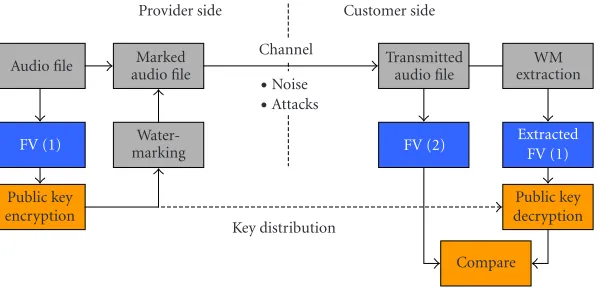
Figure 2illustrates the general content-fragile audio water-marking concept: from an audio file, a feature vector (FV) is extracted and may be encrypted. This information is embed-ded as a watermark. The audio file is then transmitted via a noisy channel. At some time, the content has to be verified. Now the watermark (WM) is extracted and the embedded and decrypted FV is compared to a newly generated FV. If a certain level of difference is reached, integrity cannot be ver-ified. A PKI may be helpful to handle key management.
Remember, fragility is about losing equality of extracted and embedded contents in this case with the challenge to handle content-preserving operations—manipulations that do not manipulate the content. The well-known problem of “friendly attacks” occurs here as in any watermarking scheme: some signal manipulations must be allowed
with-out breaking the watermark. In our case, every editing pro-cess that does not change the content itself is a friendly attack. Compression, dynamics, A/D-D/A-conversion, and many other operations that only change the signal but not the content described by the signal should not be detected. The idea is to use content information as an indicator for manipulations. The main challenge is to identify audio fea-tures appropriate to distinguish between content-preserving and content-changing manipulations.
Figure 3shows the verification process of our content-fragile watermarking approach. We divide the audio file into frames ofnsamples. From thesensamples, the feature check-sums and the embedded watermark are retrieved and com-pared at the integrity check. As audio files are often cut, a resynchronization function is necessary to find the correct starting point of the watermark corresponding with the fea-tures. Our watermarking algorithm is robust against crop-ping attacks, but cutting out samples can lead to significant differences between extracted watermark and retrieved fea-tures. Therefore, a sync compare function tries to resynchro-nize both (features and watermark) if the integrity check is negative. Only if this is not successful, an integrity error is prompted.
2.2. Digital audio features
Extracted audio features are used to achieve robustness against allowed media manipulations while still being able to detect content manipulations. We want to ignore content-preserving operations which would lead to false alarms in cryptographic solutions and only identify real changes in the content. Additionally, we need to produce a binary represen-tation of the audio content that is small enough to be embed-ded as a watermark and detailed enough to identify changes. To produce a robust description of sound data, we have to examine which features of sound data can be extracted and described. Research has addressed this topic in psychoa-coustics, for example, [20], and automated scene detection for videos, as in [20,21]. We use the RMS, zero-crossing rate (ZCR), and the spectrum of the data as follows.
Audio file nsamples Start position
File n x=static pos=0
Reading samples from file
Samples Samples
x=sync pos Retrieving WM Creating checksum x=x+n
retr check extr check
sync pos Integrity check
No Yes
Sync compare dev>200 dev<200
Modified Ok
Figure3: Content-fragile watermarking-based integrity decision.
Figure4: RMS curve of a speech sample.
as loudness. If we can embed RMS information in a file and compare it after some attack, we can recognize muted parts or changes in the sequence (seeFigure 4). (ii) ZCR provides information about the amount of high frequencies in a window of sound data. It is calculated by counting the time the sign of the samples changes. The brightness of the sound data is described by it. Parts with small volume often have a high ZCR as they consist of noise or are similar to it (seeFigure 5). (iii) The transformation from time domain to frequency
domain provides the spectrum information of audio data (seeFigure 6). Pitch information can be retrieved from the spectrum. The amount of spectral informa-tion data is similar to the original sample data. There-fore, concepts for data reduction, like combining fre-quencies into subbands or quantization, are necessary.
To protect the semantic integrity of audio data, usually only a part of its full spectrum is required. For our approach, we choose a range similar to the frequency band transmitted with analogue telephones, from 500 Hz to 4000 Hz. Thereby, all information to detect changes in the content of spoken
Figure5: ZCR curve of a speech sample.
20 kHz
15 kHz
10 kHz
5 kHz
0 kHz
t
Figure6: Spectrum of eight seconds of speech.
Table1: Required bit rates for feature embedding.
FFT size Features Detail Sync bits Bit rate
Samples # Bit/feature Bit Bit/s
1.024 4 8 4 6,201.56
2.048 4 8 4 3,100.78
4.096 4 8 4 1,550.39
10.240 4 4 4 344.53
51.200 4 4 4 68.91
81.920 4 4 4 43.07
Binary data Watermark
Features
Feature checksum
Figure7: Feature checksums reduce the amount of embedded data.
RMS of one second of audio. This leads to security problems. As we only have information about a complete second, parts smaller than a second could be changed or removed without the possibility of localization. One cannot trust the complete second regardless the amount and position of change. It will also be a major challenge to disable possible specialized at-tacks trying to keep the overall feature the same while doing small but content-manipulating changes.
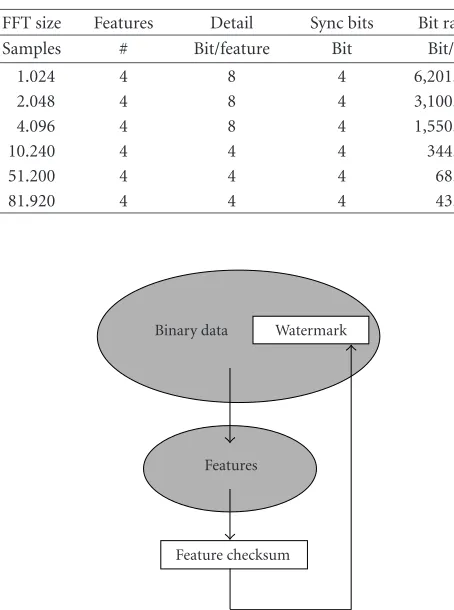
Table 1shows a calculation of theoretically required wa-termarking algorithm bit rates. Here we extract four features (e.g., ZCR, RMS, and two frequency bands) and encode them with 8 or 4 bits. Quantization of the feature values is neces-sary to use a small number of bits. It also increases the fea-ture robustness: less different values yield more robust ones against small changes. Quantization will set both original feature and modified feature to the same quantized value. We use quantization steps from 0.9 to 0.01. These are incremen-tal values stepping from 0 to 1. If 0.9 is used, only one step is present, and basically no information regarding the feature is provided. With quantizer 0.01, 100 steps from 0 to 1 are made. The algorithm can differentiate between 100 values for feature representation.
Additionally, sync bits are required for resynchroniza-tion. This leads to very high bit rates at small FFT window sizes. Using big windows and low resolution reduces the re-quired bit rates to about 43 bps. We could embed a content
Table2: Feature checksums based on different algorithms.
Window size Key size Sync bits Type Bit rate
Seconds Samples Bit Bit Bit/s
15.3252 675,840 160 4 SHA 10.7
12.3066 542,720 128 4 MD5/MAC 10.7
3.3669 148,480 32 4 CRC32 10.7
1.8576 81,920 16 4 CRC16 10.8
1.1146 49,152 8 4 XOR 10.8
0.7430 32,768 4 4 XOR 10.8
description about 5 times per second. But as 43 bps are still a rather high payload for current audio watermarking, ro-bustness and transparency are not satisfactory. This leads to high error rates at retrieval and therefore to high false error rates. Our prototypic audio watermarking algorithm offers a bit rate of up to 30 bps if no strong attacks are to be expected, which would be the case in manipulation recognition scenar-ios. But with this average to high bit rate, compared to other algorithms available today, not only does robustness decrease but also error rates increase. Very robust watermarking algo-rithms today offer about 10 bits down to 1 bps.
2.3. Feature checksums
To circumvent the payload problem, we use feature check-sums. We do not embed the robust features but only their checksum. Figure 7illustrates this concept. The checksums can be compared to the actual media features checksums to detect content changes. An ideal feature is robust to all al-lowed changes—the checksum would be exactly the same af-ter the manipulation. As we employ a sequence of features in every window, we need additional robustness: quantization reduces the required amount of bits and, at the same time, in-creases robustness as it maps similar values to the same quan-tized value. In Table 2, we list a number of checksums like hash functions (SHA, MD5), cyclic redundancy checks, or simple XOR functions. For hash functions, a certain amount of bits is required, therefore we can only work with big win-dow sizes or a sequence of frames. XOR functions offer small window sizes. We can embed a feature checksum in less than a second with a bit rate of 10.8 bps into a single channel of CD quality PCM audio.
2.4. Test results
We use a prototypic implementation based on our own pro-totypic watermarking algorithm which uses spread spectrum and statistical techniques, different feature extractors, a fea-ture comparison algorithm, and a feafea-ture checksum gener-ator to evaluate our content-fragile watermarking concept. The basic idea of our tests can be described in the following steps.
(1) Select an audio file as a cover to be secured.
Table3: Embed/retrieve comparison for 4-bit RMS.
: :
Mode: Embed Mode: Retrieve
Bits per checksum: 4 bit Bits per checksum: 4 bit
Bit rate: 5.3833 bps Bit rate: 5.3833 bps
Frames per checksum: 48 frames Frames per checksum: 48 frames
Included features: Included features:
RMS in frequency domain 2000–6000 Hz RMS in frequency domain 2000–6000 Hz
Checksum
No Time (min:s) Checksum No Time (min:s) Extr Retr Integrity
0 0:0 11 0 0:3.72719 11 12 modified
1 0:2.22912 9 1 0:3.71299 9 4 modified
2 0:4.45823 7 2 0:6.68261 7 12 modified
3 0:6.68735 13 3 0:12.6269 13 12 modified
4 0:8.91646 9 4 0:11.1427 9 0 modified
5 0:11.1456 3 5 0:12.6313 3 4 modified
6 0:13.3747 7 6 0:13.3739 7 7 ok
7 0:15.6038 12 7 0:15.6022 12 12 ok
8 0:17.8329 9 8 0:17.8322 9 9 ok
9 0:20.062 3 9 0:20.0586 3 3 ok
10 0:22.2912 8 10 0:23.775 8 4 modified
11 0:24.5203 4 11 0:24.5186 4 4 ok
12 0:26.7494 1 12 0:26.7523 1 1 ok
13 0:28.9785 12 13 0:28.9769 12 12 ok
14 0:31.2076 15 14 0:32.6924 15 8 modified
15 0:33.4367 11 15 0:37.8899 11 12 modified
16 0:35.6659 14 16 0:37.1661 14 12 modified
17 0:37.895 14 17 0:37.9079 14 14 ok
18 0:40.1241 0 18 0:40.1361 0 0 ok
19 0:42.3532 7 19 0:42.3515 7 7 ok
20 0:44.5823 4 20 0:44.5798 4 4 ok
Embed mode: Checksums are generated and embedded as a watermark
Retrieve mode: Checksums are generated and compared to those retrieved as a watermark
(5) Embed the feature checksum as a watermark. (6) Attack the cover.
(7) Retrieve the watermark from the attacked cover. (8) Retrieve the features from the attacked cover and
gen-erate the checksums.
(9) Compare both to decide if a content-change has oc-curred.
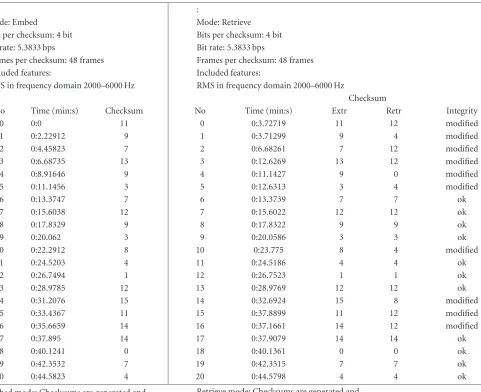
Table 3shows an example where a 4-bit checksum and two sync bits are embedded every 48 frames. In the left row, the embedded feature checksums are presented and in the right row, the results of a retrieve process. The comparison in-cludes actual extracted features, retrieved features, and a de-cision if integrity has been corrupted. In this example, we see that extracted feature checksums after embedding and re-trieval are matching, while the extracted watermark shows other features. This may seem confusing at first sight as one
would assume the embedded information and the extracted features in embed mode to be similar. In this example, the chosen watermarking parameters are too weak and produce bit errors at retrieval but at the same time do not influence the robust features. It is clear that an optimal trade-off be-tween the robustness and transparency of the watermark will provide the best results.
50
40
30
20
10
0
Er
ro
rs
%
0.9 0.7 0.5 0.3 0.1 0.09 0.08 0.07 0.06 0.05 0.04 0.03 0.02 0.01 Quantizer values
Teenage Enya Alive
Ateam TKKG
Figure8: Optimized parameters lead to error rates below 20% (RMS, checksum 4 bit).
parameters has been identified and tested with five audio files ranging from rock music to radio drama. RMS is chosen as the extracted feature. To receive optimal results, we keep a certain distance between the frequency band the watermark is embedded in and the feature it is extracted from. In this example, the feature band is 2 kHz to 6 kHz. The watermark is embedded in the band from 10 kHz to 14 kHz.
Even with these optimized parameters, for the retrieval of feature checksums, a false error rate between 5% and 20% is usual. Today’s audio watermarking algorithms offer error rates of 1% or less per embedded bit. This adds up to a bigger error rate in our application as one wrong bit in the multibit checksum results in an error. For common audio watermark-ing applications, a 5% error rate for embedded watermarks is acceptable. Both, the error rate of the watermarking algo-rithm and the possibility of changing the monitored feature by embedding the watermark, sum up to a basic error rate, which is detected even if no attacks have occurred. This ba-sic error rate has to be taken into account when a decision regarding the integrity of the audio material is made.
As already stated inSection 2.2, quantizer sizes influence robustness. For the results inFigure 8, a quantizer value of 0.9 basically means that all features are identified by the same value, while 0.01 provides a detailed representation. Error rates increase with the level of detail.
InFigure 9, we show test results after performing a stir-mark benchstir-mark audio attack [22] for the parameter RMS. We embed a feature vector with the parameters ofFigure 8 and run a number of audio manipulations of different strength on the marked file. Then the watermark is retrieved and both the retrieved and the recalculated feature vectors are compared.
The content-preserving attacks “normalize,” “invert,” and “amplify” result in equal error rates as in the no-operation attack “nothing” or after only embedding the wa-termark. An error rate below 20% can be seen as a
thresh-old for content-preserving operations. Content manipula-tions like filters (lowpass, highpass), the addition of noise (addnoise) or humming (addbrumm), and removal of sam-ples result in higher error rates up to almost 100%. The dif-ferent quantization values have a significant influence on the error rate again, but the behavior is the same for all attack types: a lower resolution results in lower error rates.
While these attacks may be assumed to be content pre-serving in some cases, for example, lowpass filtering com-mon in audio transmission, the results show that a certain discrimination between attacks is possible. The results also correspond to the attack strength. Lower noise values lead to lower error rates.
The test results are encouraging. A threshold may be nec-essary to filter an unavoidable error level of about 20%, but attacks can be identified. Quantization values can be used as a fragility parameter. A similar behavior is observed in diff er-ent audio files including speech, environmer-ental recordings, and music, making this approach useful for various applica-tions.
3. INVERTIBLE AUDIO WATERMARKING
rc lowpass rc highpass Nothing Normalize Invert Cutsamples Zerocross Compressor Amplify Addsinus Addnoise 900 Addnoise 700 Addnoise 500 Addnoise 300 Addnoise 100 Addbrumm 9100 Addbrumm 8100 Addbrumm 7100 Addbrumm 6100 Addbrumm 5100 Addbrumm 4100 Addbrumm 3100 Addbrumm 2100 Addbrumm 1100 Addbrumm 10100 Addbrumm 100 Marked original
0 10 20 30 40 50 60 70 80 90 100
Error rate % Quantizer value: 0.02
Quantizer value: 0.1 Quantizer value: 0.9
Figure9: Stirmark audio test results. Stronger attacks lead to higher error rates (RMS, checksum 4 bit).
· · ·001001010101011010· · ·
· · ·001001010101011010· · ·
· · ·001001010101011010· · ·
· · ·001001010101011010· · ·
· · ·001001010101011010· · ·
· · ·001001010101011010· · ·
· · ·001001010101011010· · ·
· · ·001001010101011010· · ·
Sync Comp H(Y)H(X) F ID Fill
· · ·001001010101011010· · ·
Figure10: Invertible audio watermarking. The bits of one bit layer are compressed and the resulting free space is used to embed additional security information.
resulting 1 000 bits can be used as security information like, for example, a hash of the other 15 bit layers. The original bit vector is replaced by the compressed bit vector and the security information. As the complete information about the original bit layer is still available in compressed form, it can be decompressed at any time, and by overwriting the new
in-formation with the original bits, we get the original frame back.
3.1. Invertible authentication for audio streams
Sequence ID
Figure 11: Audio watermarking requires stream synchronization to allow cutting the material. Therefore, an incremental frame ID is
included in the watermark.
will be protected. If the same concept is transferred to au-dio data, certain problems arise: the amount of data for a long recording can easily become more than one GB. If the invertible watermark is to be embedded in a special device, very large memory reserves would be necessary. Besides this technical problem, integrity may not be lost even if the orig-inal data is not completely present. A recording of an in-terview may be edited later, removing an introduction of the reporter or some regards at the end. The message of the interview will not be corrupted if this information is removed.
Therefore, we suggest a frame-based solution like that in-troduced inSection 2. A number of consecutive samples are handled as an audio frame, for example, 44100 samples for one second of CD-quality mono data. This frameFiis now protected like, for example, a single image. It includes all nec-essary information to prove its integrity. But additional secu-rity information and a synchronization header are necessary as shown inFigure 11.
(i) A sequence IDSis embedded in every frameFi. It veri-fies that the frame belongs to a certain recording. This provides security versus exchanges from other record-ings. If IDSis not included, an attacker could overwrite a part of the protected audio data with a different but also protected stream from another recording but from the same position without being detected.
(ii) An incremental frame IDTis also embedded. This pro-vides security against exchanges in the sequence of framesFiof the protected sequence. Swapping a num-ber of frames would not be detectable without this ID and would lead to manipulation possibilities.
(iii) A synchronization header (Datasync) is also necessary.
Otherwise, cutting the audio data would usually lead to a complete loss of the security information, as the correct start position of a new frame would be unde-tectable. With the help of the synchronization header, the algorithm can scan for a new starting point if it de-tects a corrupt frame.
With these three additional mechanisms, invertible audio watermarking becomes more usable for many applications as a number of attacks are disabled and a certain amount
of editing is allowed. A tool for integrity verification could identify gaps in the sequence and inform the user about it. This user then can decide whether to trust the information close to the gaps or not as, for example, a third party could have removed words from a speech. From our discussion in Section 1.3, the protocol for audio data can be written for each audio frameFi(i = 1. . .number of audio frames) as
CAudioLayerBits, kHFiremaining
, Ksecret
//HMACAudioLayerBits, Ksecret
CAudioLayerBits, kH
Firemaining
, Ksecret
//HMACAudioLayerBits, Ksecret
//DataSync
,
where AudioLayerBits is the bit vector to be replaced in Fi, andFiremainingis the set of the remaining bit vectors inFi.
3.2. Compression techniques and capacity evaluation
Based on the general invertible concepts, the next major question is how to perform a lossless audio compression C to achieve invertibility: to get back the exact original of the audio representation, common audio compressions like mp3 are not acceptable due to their lossy characteristics. Com-pression schemes also applied to text or software, like the common zip compression C, satisfy this requirement but are far less efficient than lossy audio compression.
Therefore, we design the following compression algo-rithm.
(1) The required number of bitsrand the number of sam-plesnto be used as one frame are provided as param-eters.
(2) From thensamples, each lowest bit is added to a bit vector B of the lengthn.
(3) B is compressed by a lossless algorithm, producing a compressed bit vector Bof lengthn.
(4) Ifn−n< r, the compression of the bit layer is not
(5) If we winrbits from the compression, the current bit layer becomes the one we embed the information into for this frame.
(6) If even at bit layer #15 the compression is not suf-ficiently efficient, embedding is not possible in this frame.
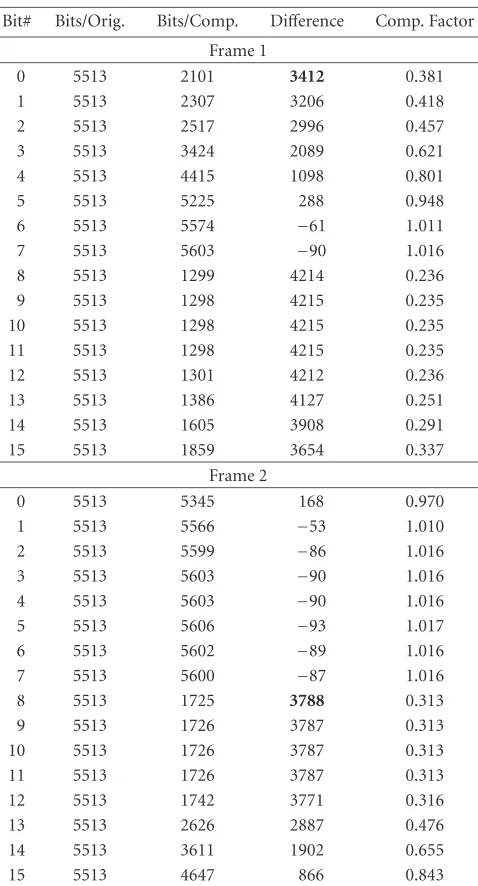
Table 4shows an example of this process. The parame-ters are 44100 samples for one frame and a requirement of 2000 bits. In the first frame at bit #0, we already receive good compression results. The differencen−nis 3412, more than required. In the second frame, bits #0 to #7 do not provide a positive compression ratio, so bit #8 is selected as the com-pressed layer. To identify the chosen bit layer, a synchroniza-tion sequence embedded into the Datainfois necessary,
iden-tifying the compressed layer for every frame.
InTable 5, we provide a comparison of capacities of four example files A to D for two frames of 44100 samples. A first assumption about bit requirements can be made based on the knowledge about required components. As multiple hash functions are available and the length of the RSA signature is key dependent, the capacity requirements are calculated as follows:
(i) sync info, for example, 64 bit; (ii) two hash values:
(a) remaining audio information, for example, 256 bit, (b) selected bit layer, for example, 256 bit;
(iii) RSA digital signature, for example, 512 bit;
(iv) compressed bits are encrypted by a symmetric key scheme (AES), that is, adding max. 63 bits.
This sums up to about 1100 bits. Therefore, any compres-sion result providing 1100 bits of gain would be suitable for embedding invertible security information. In the example ofTable 5, in frame 1, the information will be embedded in bit layer #8 of file A and in layer #0 of B, C, and D. In frame 2, A and C require bit layer #8, while B and D can use bit layer #0. An important observation is the fact that the capacity of compression results is not always increasing as one would as-sume when looking at the examples for still images of [9]. In frame 2 ofTable 5, column D, the amount of received bits de-creases from bit layer #0 to #7 and then becomes a constant value for bit layers #8 to #15. Quantization, changes of bit representation, and addition of noise are possible reasons for this effect.
4. APPLICATIONS
Content security for digital audio is not discussed today as much as for images or video data. In this section, we discuss a selection of possible scenarios where either content-fragile or invertible watermarking schemes like the ones we described in Sections2and3will become necessary.
4.1. News data authentication
Digital audio downloads on the Internet can replace radio news. Interviews and reports will be recorded, digitized, and
Table4: Compression efficiency changes from frame to frame.
Bit# Bits/Orig. Bits/Comp. Difference Comp. Factor Frame 1
0 5513 2101 3412 0.381
1 5513 2307 3206 0.418
2 5513 2517 2996 0.457
3 5513 3424 2089 0.621
4 5513 4415 1098 0.801
5 5513 5225 288 0.948
6 5513 5574 −61 1.011
7 5513 5603 −90 1.016
8 5513 1299 4214 0.236
9 5513 1298 4215 0.235
10 5513 1298 4215 0.235
11 5513 1298 4215 0.235
12 5513 1301 4212 0.236
13 5513 1386 4127 0.251
14 5513 1605 3908 0.291
15 5513 1859 3654 0.337
Frame 2
0 5513 5345 168 0.970
1 5513 5566 −53 1.010
2 5513 5599 −86 1.016
3 5513 5603 −90 1.016
4 5513 5603 −90 1.016
5 5513 5606 −93 1.017
6 5513 5602 −89 1.016
7 5513 5600 −87 1.016
8 5513 1725 3788 0.313
9 5513 1726 3787 0.313
10 5513 1726 3787 0.313
11 5513 1726 3787 0.313
12 5513 1742 3771 0.316
13 5513 2626 2887 0.476
14 5513 3611 1902 0.655
15 5513 4647 866 0.843
uploaded to news servers. With content-fragile watermark-ing, the trust in the information can be increased. The source of the news, for example, a reporter or even the recording device, embeds a content-fragile watermark into the audio data and encrypts the content information with a private key. Now everybody who uses a corresponding detection algo-rithm would be able to verify the content. If the watermark-ing keys were distributed freely, only the public key of the embedding party would be required for verification.
Table5: Capacity comparison of four example files and two frames.
Frame Bit# A B C D Frame Bit# A B C D
1 0 0 5362 1702 3793 2 0 0 5097 0 2708
1 1 0 5362 1690 3792 2 1 0 5098 0 2359
1 2 0 5362 1670 3793 2 2 0 5047 0 1666
1 3 0 5362 1648 3792 2 3 0 4946 0 772
1 4 0 5361 1630 3779 2 4 0 4861 0 144
1 5 0 5362 1631 3708 2 5 0 4801 0 0
1 6 0 5347 1625 3584 2 6 0 4715 0 0
1 7 0 5347 1630 2395 2 7 0 4701 0 0
1 8 3113 5362 4195 3792 2 8 3151 5097 4051 2746
1 9 3114 5361 4195 3793 2 9 3151 5097 4051 2746
1 10 3113 5362 4128 3792 2 10 3151 5097 3987 2746
1 11 3113 5362 3567 3792 2 11 3151 5098 3114 2746
1 12 2998 5362 2941 3793 2 12 2982 5097 2118 2746
1 13 2081 5361 2328 3792 2 13 1984 5097 1116 2746
1 14 1115 5362 1844 3793 2 14 1027 5097 276 2746
1 15 128 5362 1741 3792 2 15 84 5097 0 2746
therefore can be sure the content is not censored or manipu-lated by third parties.
4.2. Surveillance recordings
Surveillance recordings are most often made by cameras. Re-cently, requirements regarding the trustworthiness of digi-tal versions of such cameras became an important issue. If the recorded content is easily manipulated, the concept of surveillance and its weight at court is flawed. With digital audio content authentication, the audio channels of surveil-lance recordings can be protected.
Invertible methods would be applied in scenarios where a high security is required and the audio data is not com-pressed but stored directly onto high-capacity mediums. The watermark would act like a seal that will be broken if ma-nipulations take place. At the same time, the inversion op-tion enables a selected group of persons to work with original quality if necessary.
Content-fragile watermarking will be applied if opera-tions like compression are forecasted and accepted after em-bedding. The robust watermark applied in this approach will survive the compression algorithm and provide the con-tent information at a later time to verify the integrity of the recording.
4.3. Forensic recordings
The assumption that an audio file has to be highly secured can be made with forensic recordings. When such a record-ing is performed, for example, of an interview with wit-ness, protection of the content is very important and our invertible approach can be used to ensure data authentica-tion. Usually the invertible aspect will not be required as the spoken language is not very fragile against bit changes in the lower layers. Invertibility is important when very small changes in the audio can have some effect. This may be the
case when a digital copy of an analogue recording is made, and later based on the digital copy, assumptions about cuts in the analogue media shall be made. Now the addition of noise from the watermark may mask the slight changes one can perceive at the cutting points. The possibility of setting back the recording to its original state is an important in-crease of usability here. A similar case is the detection of en-vironmental noises in telephone calls, for example. A marked recording with added noise will also make it hard to estimate the nature of the background noise as both types of noise will mix.
4.4. CD-master protection
In the examples given above, only speech or environment in-formation is protected. But music can also be the subject of our protection schemes; CD masters are valuable pieces of audio data, which also require an exact reproduction to en-sure copies of high quality. Our invertible audio watermark-ing scheme offers two valuable mechanisms for this scenario. When the CD master is protected by an invertible water-mark, it can be sent without any additional security require-ments via mail or internet. Any third party capturing the copy and not possessing the secret key can get an idea how the CD will sound like, but audio quality is too low for ille-gal reproduction. After the CD arrives at its destination, the CD copy plant will use the sender’s public key to verify the integrity of the audio tracks and the previously exchanged secret key to remove the watermark. Thereby an error-proof and secure copy has been transmitted via an insecure environment.
5. SUMMARY AND CONCLUSION
based on combining robust watermarking and fragile con-tent features. It is suitable for applications where certain operations changing the binary representation of the con-tent are acceptable. The robust nature of the watermark and the right choice of content features and their quantization provide tolerance to such operations while they still enable us to identify content changes. The invertible watermark-ing approach is suited for high-security scenarios. It offers no robustness to any kind of operation but cutting. Our frame-based approach allows the detection of cuts and the resynchronization afterwards. The verification of integrity is much more exact than in the content-fragile approach since cryptographic hash functions are applied. An important ad-ditional feature is the invertibility allowing recreating the original state of the data if the corresponding secret key is present.
We provide test results for both authentication schemes. Content-fragile watermarking error rates increase with the strength of attacks. Therefore, a threshold-based identifica-tion of content changes depending on the applicaidentifica-tion is pos-sible. One source of false alarms in this approach is errors in the retrieved watermark. Improving the watermarking algo-rithm will decrease false alarms. Both, a better transparency to reduce the effects of the embedded watermark on the re-trieved features and a more reliable watermarking detection would decrease the basic error rate.
The test results of the invertible approach address mainly compression results. We show that a flexible detection of suit-able bit vectors from frame to frame is necessary to achieve an optimal trade-offbetween quality and compression. We also prove the general possibility to embed a suitable amount of security data. The compression rates of the audio bits are suitable to carry all required information in all examples.
The security of both introduced approaches depends on keys. A secure watermarking algorithm like the one applied to embed the content-fragile information inSection 2will al-ways be based on a secret user key. One can assume that the basic embedding function will become known to the pub-lic sooner or later, so security based on secret algorithms will lead to serious security risks. The invertible approach in Section 3 includes two key management methods. The compressed data is encrypted with a secret key scheme while the verification of integrity is based on a public key scheme. Therefore, key management is an important issue for both approaches.
Content-fragile watermarking requires at least a key dis-tribution concept for the watermark key that will be applica-tion dependent. The key could be distributed to every inter-ested party so everyone can verify the integrity of the content, or the key is present at a trusted third party where the marked material can be uploaded for verification. If our suggestion to use asymmetric encryption to add authentication of the em-bedding party of the content-fragile data is applied, a PKI is necessary.
Invertible watermarking also requires a PKI for integrity verification as the hash values of the original data are en-crypted with an asymmetric scheme. Secure key exchange between those parties that should be able to decrypt the
com-pressed data and set back the audio data to its original state is also necessary.
To conclude, we see that audio content security is an im-portant new domain in audio processing and watermarking as well as in general audio research. Our paper shows up dif-ferent promising directions. Future work in content-fragile audio watermarking concentrates on further feature extrac-tion and development of a demonstrator software to finally achieve a complete framework. Current test results show the general correctness of our ideas but also identify the necessity of further research.
ACKNOWLEDGMENT
We would like to thank Patrick Horster from University Kla-genfurt (Austria) for his input regarding formalizations of the invertible watermarking scheme.
REFERENCES
[1] J. Dittmann, P. Wohlmacher, and K. Nahrstedt, “Using cryp-tographic and watermarking algorithms,” IEEE Multimedia, vol. 8, no. 4, pp. 54–65, 2001.
[2] J. Dittmann, M. Steinebach, T. Kunkelmann, and L. Stoffels, “H2O4M - watermarking for media: Classification, quality evaluation, design improvements,” inProc. 8th ACM Inter-national Multimedia Conference (ACM Multimedia ’00), pp. 107–110, Los Angeles, Calif, USA, November 2000.
[3] F. Petitcolas, R. Anderson, and M. Kuhn, “Attacks on copy-right marking systems,” inProc. 2nd International Workshop on Information Hiding (IHW ’98), vol. 1525 ofLecture Notes in Computer Science, pp. 219–239, Springer-Verlag, Portland, Ore, USA, April 1998.
[4] E. Lin and E. J. Delp, “A review of fragile image water-marks,” in Proc. ACM International Multimedia Confer-ence (ACM Multimedia ’99), J. Dittmann, K. Nahrstedt, and P. Wohlmacher, Eds., pp. 25–29, Orlando, Fla, USA, October– November 1999.
[5] J. Fridrich, “Methods for tamper detection of digital im-ages,” in Proc. ACM International Multimedia Conference (ACM Multimedia ’99), J. Dittmann, K. Nahrstedt, and P. Wohlmacher, Eds., pp. 29–34, Orlando, Fla, USA, October– November 1999.
[6] J. Dittmann, M. Steinebach, I. Rimac, S. Fischer, and R. Stein-metz, “Combined video and audio watermarking: embedding content information in multimedia data,” inSecurity and Wa-termarking of Multimedia Contents II, vol. 3971 ofSPIE Pro-ceedings, pp. 455–464, San Jose, Calif, USA, January 2000. [7] J. Dittmann, “Content-fragile watermarking for image
au-thentication,” inSecurity and Watermarking of Multimedia Contents III, vol. 4314 ofSPIE Proceedings, pp. 175–184, San Jose, Calif, USA, January 2001.
[8] J. Fridrich, M. Goljan, and R. Du, “Lossless data embedding— new paradigm in digital watermarking,” Journal on Applied Signal Processing, vol. 2002, no. 2, pp. 185–196, 2002. [9] J. Dittmann, M. Steinebach, and L. Croce Ferri,
[10] M. Arnold, “Audio watermarking: Features, applications and algorithms,” inProc. IEEE International Conference on Mul-timedia and Expo (ICME ’00), pp. 1013–1016, New York, NY, USA, July–August 2000.
[11] J. D. Gordy and L. T. Bruton, “Performance evaluation of dig-ital audio watermarking algorithms,” inProc. 43rd IEEE Mid-west Symposium on Circuits and Systems (MWSCAS ’00), pp. 456–459, Lansing, Mich, USA, August 2000.
[12] D. Kirovski and H. Malvar, “Spread-spectrum audio water-marking: Requirements, applications, and limitations,” in
IEEE 4th Workshop on Multimedia Signal Processing, Cannes, France, October 2001.
[13] P. Nintanavongsa and T. Amornkraksa, “Using raw speech as a watermark, does it work?,” inProc. International Fed-eration for Information Processing Communications and Mul-timedia Security (CMS), Joint Working Conference IFIP TC6 and TC11, R. Steinmetz, J. Dittmann, and M. Steinebach, Eds., Kluwer Academic, Darmstadt, Germany, May 2001.
[14] C. Neubauer and J. Herre, “Audio watermarking of MPEG-2 AAC bit streams,” inAES 108th Convention, Porte Maillot, Paris, France, February 2000.
[15] L. Boney, A. H. Tewfik, and K. N. Hamdy, “Digital water-marks for audio signals,” inVIII European Signal Proc. Conf. (EUSIPCO ’96), Trieste, Italy, September 1996.
[16] J. Dittmann, Digitale Wasserzeichen, Springer-Verlag, Berlin, Heidelberg, 2000.
[17] C.-P. Wu and C.-C. J. Kuo, “Comparison of two speech content authentication approaches,” inPhotonics West 2002: Electronic Imaging, Security and Watermarking of Multimedia Contents IV, vol. 4675 ofSPIE Proceedings, pp. 158–169, San Jose, Calif, USA, January 2002.
[18] J. Dittmann, M. Steinebach, L. Croce Ferri, A. Mayerh¨ofer, and C. Vielhauer, “Advanced multimedia security solutions for data and owner authentication,” inApplications of Digi-tal Image Processing XXIV, vol. 4472 ofSPIE Proceedings, pp. 132–143, San Diego, Calif, USA, July–August 2001.
[19] J. Fridrich, M. Goljan, and R. Du, “Invertible authentication,” inPhotonics West 2001: Electronic Imaging, Security and Wa-termarking of Multimedia Contents III, vol. 4314 ofSPIE Pro-ceedings, pp. 197–208, San Jose, Calif, USA, January 2001. [20] Z. Liu, J. Huang, Y. Wang, and T. Chen, “Audio feature
extrac-tion & analysis for scene classificaextrac-tion,” inIEEE 1st Workshop on Multimedia Signal Processing, pp. 343–348, Princeton, NJ, USA, June 1997.
[21] S. Pfeiffer, Information Retrieval aus digitalisierten Audio-spuren von Filmen, Shaker Verlag, Aachen, Germany, 1999. [22] M. Steinebach, F. Petitcolas, F. Raynal, et al., “StirMark
bench-mark: Audio watermarking attacks,” inProc. International Conference on Information Technology: Coding and Computing (ITCC ’01), pp. 49–54, Las Vegas, Nev, USA, April 2001.
Martin Steinebach is a Research Assis-tant at Fraunhofer IPSI (Integrated Publi-cation and Information Systems Institute). His main research topic is digital audio watermarking. Current activities are water-marking algorithms for mp2, MIDI and PCM data, feature extraction for content-fragile watermarking, attacks on audio wa-termarks, and concepts for applying au-dio watermarks in eCommerce
environ-ments. He studied computer science at the Technical University of Darmstadt and finished his Diploma thesis on copyright pro-tection for digital audio in 1999. Martin Steinebach was the Or-ganizing Committee Chair of CMS 2001 and coorganized the
Watermarking Quality Evaluation Special Session at ITCC Interna-tional Conference on Information Technology: Coding and Com-puting 2002. Since 2002 he is the Head of the Department MERIT (Media Security in IT) and of the C4M Competence Center for Me-dia Security.
Jana Dittmann has been a Full Professor in the field of multimedia and media se-curity at the Otto-von-Guericke Univer-sity Magdeburg since September 2002. She studied computer science and economy at the Technical University in Darmstadt and worked as a Research Assistant at the GMD-IPSI (later Fraunhofer GMD-IPSI) from 1996 to 2002. In 1999, she received her Ph.D. from the Technical University of Darmstadt. At