R E S E A R C H
Open Access
Energy harvesting-based data
uploading for Internet of Things
Gaofei Sun
1,2, Xiaoshuang Xing
1*and Xiangping Qin
1Abstract
Uploading data from tremendous devices is one of the most challenging tasks for Internet of Things (IoT) due to the heterogeneous data features and the energy constraints of IoT devices. In this paper, we study the data uploading problem from two tiers. In the first tier, we focus on the scheduling of data uploading from different IoT devices to a specific access point (AP) by considering the heterogeneous data features such as the freshness of the data, the data length, the data uploading period, and the energy state of the IoT device. In the second tier, we deal with the selection among different APs for one IoT device. An AP selection algorithm is proposed and we prove that the AP selection process would eventually reach a stable state. Simulation study shows that our proposed algorithm can improve the successful data uploading rate and the time slot utilization.
Keywords: Energy harvesting, Data uploading, Internet of Things
1 Introduction
With the expected 50 billion deployment of Internet of Things (IoT) devices in 2020, massive data is to be uploaded through wired or wireless networks [1,2]. How-ever, it is hard to satisfy such data uploading demands with existing network structures due to the following reasons: first, massive data is to be uploaded from the huge amount of IoT devices; second, data from different IoT devices are with heterogeneous features, such as data volume and uploading period; third, some kinds of IoT devices acquire energy from ambiance around [3,4] which brings a high uncertainty on their energy states.
To deal with the data uploading and/or transmission requirements of IoT devices, several schemes and pro-tocols have been proposed. For example, there already existed several power supply monitoring applications used for data acquiring by using 2G, 3G, or 4G cellular net-works. Within WiFi coverage, most of IoT devices are connected by accessing into femtocells. The Bluetooth and LORA are also used by IoT devices. Along with the 5G network evolution, narrow band-Internet of Things (NB-IoT) and EMTC are proposed for IoT communica-tions. However, there are still some concerns to be solved
*Correspondence:[email protected]
1Changshu Institute of Technology, Hushan Road, Changshu, China Full list of author information is available at the end of the article
as follows: First, the coverage of any given scheme can-not be perfect anywhere. Therefore, it is unreliable for IoT devices to rely on one specific access scheme. Second, information fusion [5] has not been considered in exist-ing scheme which brexist-ings large information redundancy. Practically, for monitoring the environment in a given area, the acquired information from several IoT devices can be fused locally and upload the derived key informa-tion only. Third, no existing scheme considers the energy states of IoT devices. We should take the energy states of the IoT devices into consideration when scheduling their data uploading since the data uploading process cannot be conducted without enough energy supply.
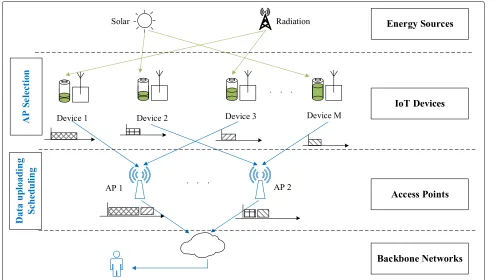
In this paper, we deal with these concerns by designing a three-layer network framework and scheduling the data uploading from two tiers, as shown in Fig.1. In the three-layer framework, the IoT devices with short-range wireless transmission capability belong to the bottom layer; the access points (APs) with wide-range transmission capabil-ity belong to the middle layer; and the traditional back-bone networks, such as the cellular base station or the cable-based computer networks, belong to the top layer. Within the framework, each IoT device accesses to an appropriate AP for data uploading. Each AP acts as a con-troller that schedules the data uploading of the accessing devices and ensures the AP’s spectrum efficiency. The main contributions of our work are as follows:
Fig. 1System model. The figure describes the considered system model and the problems we are solving
• In the first tier, we propose a scheduling algorithm where an emergency function is defined for each data uploading requirement by considering the freshness of the data, the data length, the data uploading period, and the energy state of the IoT device. Then, the priority of the data uploading requirements is decided according to their emergency functions.
• In the second tier, we propose an AP selection algorithm where each IoT device accesses to the AP that can provide the highest expected data uploading probability. It is proved that the AP selection process would eventually reach a stable state.
• A central slot utilization and also a distributive AP selection algorithm for IoT devices are proposed, to achieve the joint optimization on data uploading and energy harvesting (Table1).
The rest of this paper is organized as follows. In
Section 2, we summarize the related works on energy
harvesting and data uploading. In Section3, we describe the system model and formulate the data uploading
problem. In Section 4, we analyze the data
upload-ing of multiple IoT devices accessupload-ing to one identi-cal AP and propose a scheduling algorithm based on the urgency functions of the IoT devices. In Section 5, the AP selection problem is solved by designing a dis-tributive AP selection algorithm. The simulation results
are given in Section 6, and we concluded our work in
Section7.
2 Related work
Wireless energy harvesting (WEH) is critical for IoT devices due to their long-term deployment and self-sustainable operation features [6]. IoT devices with WEH capability can harvest energy from environmental sources such as vibration, solar, thermal, and wireless RF [7]. The harvested energy is converted to usable power by the RF-to-DC rectifier and the power management unit (PMU). Several design issues have been studied for WEH includ-ing circuit hardware design, multi-antenna-based WEH,
energy converting, and so on [3]. Moreover,
informa-tion disseminating algorithm [8–10], privacy-preserving scheme [11, 12], and dominating set discovering algo-rithm [13] have been proposed for better utilization of the harvested energy in energy harvesting networks.
to achieve a similar throughput as in [8]. However, these work mainly focus on the fairness among multiple users while sacrificing the system throughput to a certain extent. In order to maximize the system throughput, [15, 16] schedule some users for data transmission on certain frequency blocks at given time while arranging other users for energy harvesting. Ng et al. and Sun et al.
[17, 18] study the data uploading scheme that can
maximize the energy efficiency. By exploring non-linear fractional programming and Lagrange dual decomposition, an iterative algorithm is proposed to achieve better performance in average energy effi-ciency and system performance. However, all the abovementioned schemes are centralized that per-form well in small-scale network. With the increasing number of users in the network, the computation complexity of these centralized scheme will become intractable.
To accommodate with the data uploading requirements of the large number of users/devices, the multi-tier net-work structure has been proposed in [19–21] without considering the energy harvesting capabilities of the users. Devices are divided into groups, and a device is selected as the gateway/AP within each group. The devices inside the same group may transmit their data to the gateway/AP while the gateway/AP can merge the information of the group and decide the accessing strategy to decrease the data flow in the backbone networks and improve the spectrum efficiency.
Our work is more challenging than the aforementioned ones since we take both the large-scale property of the IoT network and the energy harvesting capability of the IoT devices into consideration when designing the data uploading scheme.
3 System model and problem formulation
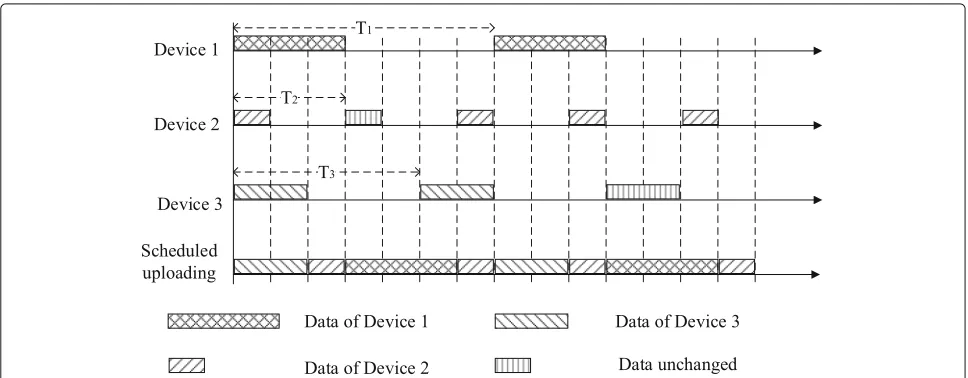
As shown in Fig.1, we consider a network consisting of three layers: the IoT devices, access points, and the back-bone infrastructures. The IoT devices are equipped with energy harvesting capabilities and can be deployed for different applications. Each device is equipped with short-range communication module for data uploading, and this module can support multiple technologies, such as WiFi, BLE4.0, and cognitive access. Each device can select a proper AP for data uploading according to its requirement and communication load. Each AP establishes one specific communication link to the backbone network. For exam-ple, AP 1 links to the Internet by wired connection and AP 2 links to cellular base station by NB-IoT. The main concern here lies in two aspects: how to schedule the data uploading of devices which select the identical AP, and how devices select the appropriate AP for data upload-ing among multiple APs. Without loss of generality, we make the following assumptions: First, the data uploading within an AP operates in a slotted manner (as TDMA). Multiple devices share the same spectrum band by using different time slots. Second, there exists a specific chan-nel for command control between devices and APs. The information about spectrum usage and slot scheduling is exchanged on this channel. An example of the data struc-ture of the devices and the scheduled uploading at AP is given in Fig.2.
Explicitly, we consider that there are M IoT devices
andN APs in a given area, which are denoted byM =
{1,· · ·,i,· · ·,M}andN = {1,· · ·,j,· · ·,N}, respectively. These IoT devices are deployed for different applications, thus have different data uploading demands. We charac-terize an IoT devicei,i ∈ Mwith the following parame-ters: the data volumesi, the data uploading periodti, and
the energy stateei. The data volume denotes how many slots are needed to upload its data through AP. The data uploading periodtidenotes the intervals for data acquire-ment, such as the environment monitoring, or system state detections. The energy stateei denotes the current energy of devicei, determining whether the data upload-ing can be performed. Further, we divide each device’s energy state intoK+1 states, from empty energy to full energy, and introduce a matrix for describing the energy harvesting process as energy state of device i changes from state k1 to state k2. For example, ξ0,0i means the probability that device i
does not acquire any energy and remains in empty energy andξ0,ikmeans the probability that deviceihas acquired
k unit energy from state 0. Note that, although these
devices may be equipped with identical energy harvesting module, they also have differenti due to different data sensing periods. Moreover,ionly represents the energy harvesting ability of devicei, but not the energy consump-tion of data sensing and transmission. Hence, the element ξi
k1,k2,k1>k2has zero probability.
We further denote the energy required for finishing data upload aseri. Devicei,i ∈ M withei ≥ eri can upload its data to an AP, and its energy becomes ei − eri. We define matrixHias an indicator whether data uploading is performed, devicei. Hence, we derive the energy transfer probabil-ity asiHito represent the sequential process of energy harvesting and data uploading.
Whether deviceiuploads its sensing data depends on
its acquired data and the uploading strategy. For saving energy, device iwould not upload its data if the current data that is unchanged refers to the last period. Similarly, device ican postpone its current uploading to the next period when it infers that the data acquired in the next period is unchanged or energy is below the thresholderi. Therefore, we model the data transition as a Markov chain and define the data transition matrix for deviceias
i=
Here,γmi,nrepresents the probability of transferring from state m,m ∈[ 1,Li] to state n,n ∈[ 1,Li]. Note that the dimension ofiis different referring to a specified sensing object.
The main issue is that how to satisfy these IoT devices’ data uploading requirements. We classify these devices into groups as M1,· · ·,Mj,· · ·,MN ,Mj ∩ Mk = φ,∀j,k ∈[ 1,N]. Here, Mj denotes the set of devices
uploading data through AP j and AP j needs to
prop-erly schedule the uploading requirements for achieving the spectrum efficiency. Taking the WiFi for an example, although there are 14 bands available in 2.4 GHz, only 1 band can be selected for a device at a given time. Thus, each device should work on an identical band. When scheduling, it is necessary to avoid collision when two devices are uploading their data simultaneously on the same slot through the same AP. When several devices have the identical data uploading period, we need to delay some of these devices and avoid possible collisions. In our model, the main problem is how to derive the optimal delay for devices, which is related to their energy state, data state, and so on. Hence, we incorporate depthκ as a metric for measuring the available remaining slots for data uploading. Therefore,κ = 0 means deviceidecides whether to upload its data based on its current data and energy state only. Similarly,κ =1 means deviceidecides whether to upload its data based on its current data and energy and also the possible data and energy in the next period. By incorporating depthκ, a portion of devices may have a data uploading slots more than one period, even larger than two periods, thus avoiding the potential col-lision in advance. Note that our proposed mechanism is different from the traditional CSMA mechanism, as users delay a random number of slots before the next transmis-sion. From a given time stampt = 0 to relatively large time stampt=T, we denote devicei’s data in each period sidering the possible uploading in the nextκperiods, the data uploading slots can be changed, such asdi2,jchanged from [ti+1, 2·t1] to [ti+1+ t, 2·t1+ t]. Hence,
between each other’s uploading from APj. Therefore, the optimization problem can be denoted as
max Therefore, this optimization problem needs an iterative process of two parts: devices select the proper AP for data uploading and the scheduling of data for devices which access the same AP. Thus, we first analyze the data upload-ing schedulupload-ing among devices under a given AP, then begin with the AP selection forMdevices.
4 Data uploading scheduling within one identical AP
In this section, we consider the case whenMj devices
decide to upload their data through APj. We skip the triv-ial case that only one device needs to upload its data for a given slot, then focus on the case when there are multiple devices, more than 2, that need to upload their data at the same time. Hence, APjneeds to figure out which device should be uploading first, and other devices wait for the next available slot and avoid possible collisions.
As for comparison, we first derive the collision probabil-ity ofMjdevices without scheduling. Taking an example of two devices, each with a data uploading period as three slots and the data volume is one slot, their data upload-ing probabilities are 0.3 and 0.8. It is apparent that their collision probability is 0.3*0.8/3. Hence, we begin with deriving the uploading probability for|Mj|devicesPSi,i∈
Mj by their energy transition matrixand data transi-tion matrix. As we mentioned before, the device would upload its data under conditions: enough energy, that is,
ei ≥ eri, and data changed compared with the previous period, that isdi = d−i 1. Therefore, we derive the data uploading probability of devicei,i ∈Mjas the following lemma.
Lemma 1The data uploading probability of device i is denoted as
ProofFirstly, we notice the independence of energy acquirement process and data transition process, and we have acquires energy from solar in each period, then decreases
eri by performing the data uploading; thus, we denote this process by i · Hi. Moreover, we derive the stationary probability over energy states as a solution ofπieiHi = πe
i. Hence, the probability of deviceiwith enough energy for data uploading is
, we derive the stationary probability ofLidata states by solvingπid=πid, then we have
Finally, by incorporating these two parts, we derive the conclusion.
As we derived devicei’s data uploading probabilityPSi, and the period si is given, we then derive the collision probability of|Mj|devices without scheduling for com-parison.
Proposition 1The collision probability of|Mj|devices without scheduling is
ProofWe begin with collision among any two devices. For devicem,n,∈ m,n ∈ Mj, and we denote the begin-ning slot ast = 1, then their uploading data may be col-luded whent=[sm,sn]·k,k=1, 2,· · ·; here, [·] means the least common multiple (LCM) of two variables. Therefore, the overall collisions over the whole set is
Pc(2devices)=
However, when we calculatePc(2devices), we count some of the collisions repeatedly, that is, when more than two devices’ data collude at the same time. Hence, we need to reduce these collision probabilities. Similarly, the overall collisions between every three devices can be denoted as
As the probabilityPc(3devices)is calculated three times when calculating Pc(2devices), we derive the modified collision probability as
Pc=Pc(2devices)−2·Pc(3devices) (13)
Also the collision between four and five devices may be counted repeatedly, and we omit these parts due to com-plexity and comparatively small than collision between two and three devices.
By data uploading scheduling, devices may postpone their data to following periods depending on the data tran-sition matrix and energy states. Hence, the main concern is how to sort the data uploading of these devices? Which device can upload in current slot and which devices must postpone their data uploading to following periods? For facilitating the scheduling process, we propose a single metric for each device, which is related to the following factors:
d−i 1represents the data uploading in the last period anddidenotes the data to be uploaded in the current period; the accurate value ofdi1,· · ·,dki,· · · is unknown, and we only infer whether they are different from the current datadiusing the data transition matrix.
• The energy sequenceei,e1i,· · ·:eiis the current energy state, ande1i,· · · represents the energy state in the following periods and can be inferred by energy transition matrix.
• The data uploading periodTi: we denote the remaining slots in the current period asni, then the available slots can beni+Tiif there is no data to be uploaded in the next period.
• The data lengthsi: it is apparent that devices with larger data volume would endure lower successful uploading than others without considering data
lengthsi. Thus, we may incorporate data lengthsias a factor for data uploading scheduling to balance the fairness among devices.
Based on these parameters above, we need to
derive the urgency function for devices in Mj as
Ui
Ti,ni,di−1,di,ei
. Depending on the available time slots and the depthκ, we have uploaded in the next period, then onlynislots can be used for uploading the current data; this can be classified into four cases:
1. The last period sensing datad−i 1was sent successfully, and also the data is unchanged in the current period, that isd−i 1=di. In this case, deviceineed not to participate in transmission competitions, thus denoteUi=0.
2. The sensing data satisfiesdi = d−i 1; thus, IoT device
i needs to transmit. The urgency function of device i
depends on the remaining slots for transmitting its sens-ing data. We analyze the situation in the followsens-ing cases:
(a) Deviceialso needs to transmit new data d1i in the next period; thus, we havee1i ≥ ereqi andd1i =di. Hence,
(b) Device i need not to transmit in the next period
but to transmit in the period following the next. Hence, we have Ui(ni +Ti) = Pe1i <ereqi ord1i =di· Pe2i ≥ereqi ,di2=di.
Similar to the derivation ofUi(ni),Ui(ni+Ti)above, we can deriveUi(ni+k·Ti),∀k=2,· · ·.
3. The last period sensing data di−1 is not transmit-ted successfully, and the data in the current period is unchanged or the energy is below the threshold; this case is the same as the case above.
the minimum energyereqi , the probability can be calcu-lated asKj=ereq
i ξ i
¯
ei,j. Based on the analysis above, we derive the expression ofUi(ni)as in Eq. (16). Eq. (14). Hence, we derive the urgency function of device
ias in Eq. (15).
5 AP selection among IoT devices
In this section, we deal with the AP selection problem for IoT devices. As we denoted before, the AP selection pro-cess is performed by IoT devices distributively. For each device, it will join the other APs once it can increase the data uploading probability. The main concern here is that how would a device know joining other APs can bring a larger successful data uploading probability. Although we aim to derive a distributive algorithm for AP selec-tion, some key information is also needed and broadcast to IoT devices. We list the main information needed for AP selection as follows:
• The slot utilization sequence1,· · ·,j,· · ·,Nof APj,j∈[ 1,N]. As for multiple devices that joined AP j for data uploading, AP j assigned the slots to a device with the highest utility of urgency function. Hence, APj has the accurate statics on slot utilization irrelevant to the data uploading competitions. Note that the slot utilizationEjis easy to derive and broadcast through control channels by APs
• The data uploading probabilityPisof device
i,i∈[ 1,M]. This probability can be derived by device i using energy harvesting matrix and also data transition matrix as in Lemma1
• The actual data uploading probabilityAsi of device
i,i∈[ 1,M]. This probability is derived by counting on the actual uploading data.
These parameters are the overall information needed for AP selection, the first one is derived by AP broadcasting, and the latter two are derived by devices. For devices and APs to derive these parameters accurately, the AP selec-tion should be operated periodically with a relative larger slots.
Basically, we need to find a metric for IoT devices, facil-itating their selection among APs. In order to reflect the actual slot usage for devices, the metric must be accurate and brief. Fortunately, the actual data uploading proba-bilityAsi,i ∈[ 1,M] can be used as a metric to measure the data uploading performance of APs. Suppose that
deviceiselects APjrandomly at the beginning, then per-form its data uploading through APj. After a certain time
Ts, each AP broadcasts its slot utilization probability as 1,· · ·,N. At the same time, data uploading probabil-ityPsi and actual data uploading probabilityAsi,jof device
i,i ∈ Mare derived by devicei. Before deviceiswitches to another APs, it must derive the expected actual data uploading probabilityA˜si,k,k∈[ 1,N] ,k=j.
Lemma 2The expected actual data uploading probabil-ityA˜si,k,k∈ {1,N},k=j is
ProofAs the transmission rate is different between APs, thus the number of slots for data uploading is different either. For APk,k = j, the number of slots is denoted as
si,k. Further, we consider that the devices access APkas a whole, with the data uploading probabilityk. Also, the uploading period is denoted as 1, that is, data would be uploaded in each slot. Suppose that deviceihas data to be uploaded in the current period, and the number of slots is
si, we consider the following cases:
• Case 1: devicei has data to be uploaded in the next period; thus, the remaining slots for data uploading is
Ti−si. Hence, we can derive the successful uploading probability as the product of case 1 and other devices do not upload at these slots, that is,Psi·(1−k)TiTi−si. • Case 2: devicei does not have data to be uploaded in
the next period but in next two periods; this case has the probability ofPis1−Pis. Also, the remaining slots for data uploading is2Ti−si. Hence, the overall probability isPis1−Pis·(1−k)2Ti2Ti−si.
• Casek : device i has only 1 data to be uploaded in k period, thus has the probability ofPsi1−Psik−1. Hence, the overall probability is
Psi1−Psik−1·(1−k)kTikTi−si.
Summarizing all the cases 1, 2,· · ·,k,· · ·, we can derive the expected actual data uploading probability as
Hence, we finish the proof.
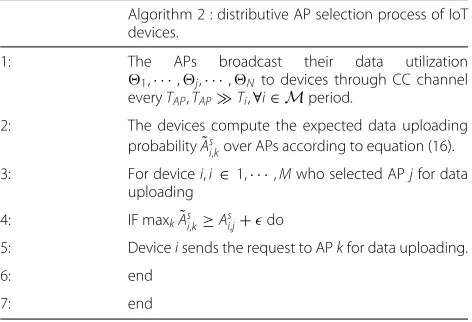
Therefore, deviceiwill calculate the data utilization vec-torA˜si,1,· · ·,A˜si,Nwhen APs broadcast their slot utilization 1,· · ·,N, except for its current selection, that is, APj. It is apparent that the best AP to be selected is maxkA˜si,k. We summarize the AP selection process as in Algorithm 2 (given in Table1). The variable is a minimal positive number, which avoids the ping-pong effect between AP selections.
Then, the next question arises, that is, whether this AP selection process would eventually reach a stable state, no any devices change their selected AP and switch to another one. We begin with the slot utilizationj of AP j. Considering that devices setMj= {1,· · ·,Mj}selected APjcurrently and have the actual data uploading proba-bility asAs1,j,· · ·,AsMj,j, thus we can derive that the slot uti-lizationjis a summation of data uploading probability of device setMj, that is,j=
Mj
i=1TisiPis. Hence, slot utiliza-tionjis a function of uploading periodTi, data volume si, and uploading probabilityPis, that is,j =g(Ti,si,Psi). As we denoted in data uploading scheduling inside AP above, each device acquires the uploading opportunity by sending its urgency function, no collision is derived, but some data can be delayed and eventually discarded when new data is acquired, thus bringing the decreasing in actual data uploading probability. Hence, we conclude that the functiong(·)hasg(·) ≥ 0,g(·) ≤ 0. Based on this analysis, we derive the following proposition:
Proposition 2The AP selection process leads to a stable state in finite rounds.
ProofConsider that the current AP selected by device
i is AP j, with actual data uploading probability as Ai,j. As the slot utilization vector broadcasting by AP is 1,· · ·,N, deviceiselects APkwith maxkA˜si,kfor data
Table 1AP selection process of IoT devices
Algorithm 2 : distributive AP selection process of IoT devices.
1: The APs broadcast their data utilization
1,· · ·,j,· · ·,Nto devices through CC channel everyTAP,TAPTi,∀i∈Mperiod.
2: The devices compute the expected data uploading
probabilityA˜si,kover APs according to equation (16).
3: For devicei,i∈1,· · ·,Mwho selected APjfor data uploading
4: IF maxkA˜si,k≥Asi,j+do
5: Deviceisends the request to APkfor data uploading.
6: end
7: end
uploading. It is apparent that deviceiwill increase its suc-cessful data uploading probability, that is,A˜si,k > Ai,j. We further denote the slot utilization of APjwithout device
iis¯jand the slot utilization of APkby joining devicei
As we defined before, the slot utilization is a function of data uploading load, that is,j =
Mj
i=1TisiPis,j ∈ N. Suppose that the current data uploading load in APj,kare
LjandLk, thus we havej=g(Lj),k=g(Lk). Moreover, indicates that deviceichanges its AP selection for increas-ing its own successful data uploadincreas-ing probability and also increases the overall slot utilization of both APs. However, the slot utilization of all APs, that is,jj, is finite, thus may achieve its maximization by finite rounds.
6 Results and discussions
Along with the two-tier data uploading process, the per-formance of slot scheduling inside AP and AP selection among IoT devices is verified in this section. In the slot scheduling process, we need to figure out, by using
pro-posed Algorithm 1 given in Table 2, whether the slot
utilization increases and all IoT devices increase their successful data uploading probabilities compared with the transitional contention-based mechanism. In the AP selection process, we need to figure out whether the selection process halts in finite rounds and if the itera-tive process may increase the slot utilization on all APs gradually.
6.1 Slot utilization inside AP
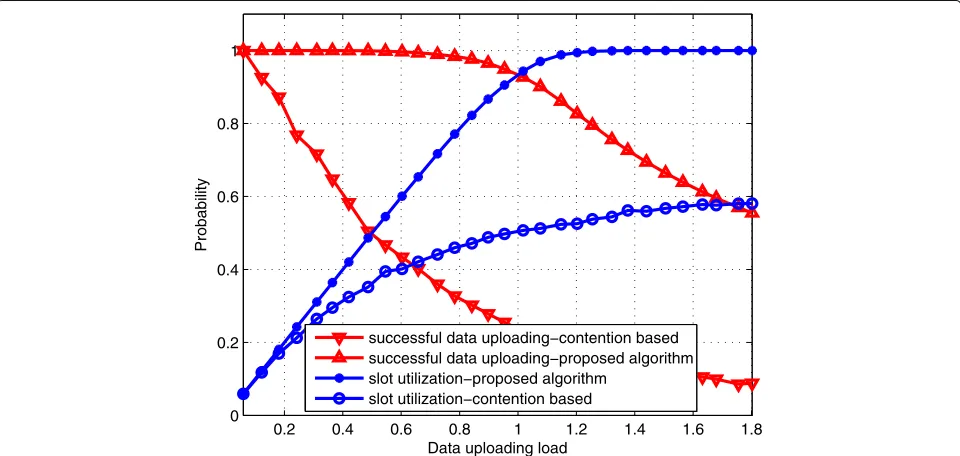
In this case, a set of IoT devicesMjselects an identical AP jfor data uploading. Firstly, we verify the performance of the proposed algorithm by gradually increasing the data uploading load. Given each IoT device has almost equal data load, that is, Pms
Tm ·sm ≈ Ps
n
Tn ·sn,∀m,n ∈ Mj.
Sup-pose that there is only 1 IoT device connected to AP j
Table 2Data uploading process of the proposed mechanism
Algorithm 1 : data uploading process of proposed mechanism.
1: The IoT devices broadcast their data transmission requests to AP through CC channel.
2: The AP decides whether devices’ requests can be approved according to equation (14).
3: while the current slot is idle, set asT=0do
4: The AP informs IoT devices for bids submission.
5: The IoT devices compute their bids by urgency functionGiand f(si,Ti)according to equation (7), then submit bidbito AP for devicesi∈M.
6: The AP selects the highest bid among devices, and the winning device begins its data transmission.
7: After the data uploading finished, setT=T+ ¯si, wheres¯iis the data length of winning device.
8: end
is set to 0.06, and the maximum load is 1.8 with 30 IoT devices, which is larger than the capacity of AP. As we depicted in the above red curve, the ratio of success-ful data uploading decreases with the variation on data uploading load. Even with data uploading load of 1.8, suc-cessful data uploading of our proposed algorithm achieves 0.58, much larger than 0.09 of the contention-based algo-rithm. Moreover, the above blue curve indicates that our proposed algorithm reaches almost 100% slot utilization, larger than 60% of the contention-based algorithm, which means that almost each slot is used for data upload-ing through AP. Besides, the above blue curve coincides
with the assumption in Section 5 that the slot utiliza-tion on AP is a convex funcutiliza-tion of the data uploading load.
Secondly, we focus on the successful data upload-ing probabilities of IoT devices individually instead of the overall performance. Consider that there are nine devices that selected this AP and are classified into three classes. Different class has unequal sensing data length and also transmission period, due to heterogeneous energy harvesting matrices and data transition matrices of IoT devices. By generating their data sequences and calculation, we list their parameters, such as uploading period, data volume, and data uploading probability as in Table3.
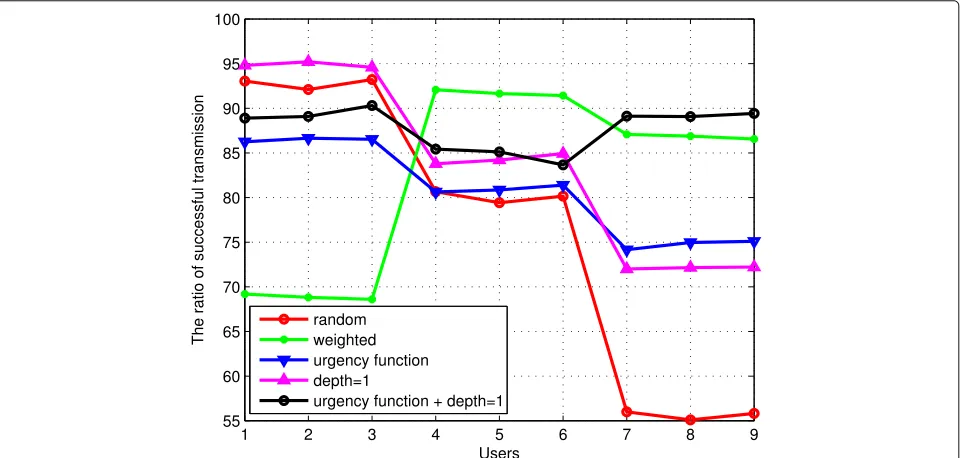
In Fig. 4, we compared the performance with
dif-ferent urgency functions. Note that we take random selection among nine devices for transmission as a bench-mark scheme for comparison, which is depicted as the red curve. We observe that the class C devices with short period time have the lowest successful transmis-sion rate, about 55%. If we take the simple method, by using the weighted vector, multiply the functionf(·)
only, as depicted in the green curve, the ratio of class C devices increases a lot by severely damaging the class A devices. Furthermore, we perform the simulations under
the urgency function but depth k = 0, and depthk =
1 only, and also the urgency function with depth k =
1. The results indicate that using urgency function and setting depthk = 1 achieve better performance and bal-ance among devices, with ratio above 85% for each class devices.
Table 3Parameters of nine IoT devices
Classes Period (slots) Data (slots) Ps
i
Class A 10 4 0.35
Class B 6 2 0.42
Class C 3 1 0.23
In Fig. 5, we compare the performance with different depthk. As expected, by considering the future data sens-ing and energy harvestsens-ing state, all devices increase their successful data transmission. However, further
incre-ments on depthkcannot bring obvious improvement in
performance, but increase the computation complexity. It
is apparent that the optimal depth is k = 1 under this
simulation scenario.
In Fig. 6, we compared the efficiency of slot usage
and data transmission under different urgency functions, where 1–7 in thex-axis represent cases listed as random selection, weighted,G(·)only, and urgency function with
k = 0, 1, 2, 3. We observed that the proposed
mecha-nism not only increases the successful data transmission, from 85% to above 90%, but also increases the ratio of slot usage. However, by different sensing period constraints, the slot usage cannot increase even by using higher depthk.
6.2 AP selection among IoT devices
In this subsection, we evaluate the performance on the AP selection algorithm. Specifically, we need to figure out whether the proposed algorithm leads to a stable state
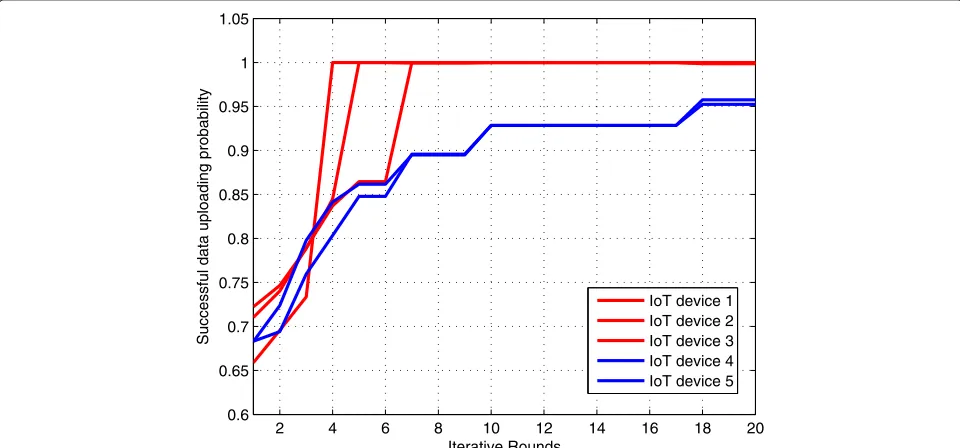
and if the overall successful data uploading probability increases along with the iterative process. In this case, we suppose that there are 20 IoT devices and 2 AP arranged in a given area. From the scratch, 20 IoT devices select AP 1 for data uploading and no device selects AP 2, then devices decide whether to switch to another AP in each round distributively after APs broadcast their current slot utilizations.
The slot utilization probabilities derived by 50 rounds are depicted in Fig.7. Here, the blue curve indicates that the slot utilization of AP 1 decreases due to the depar-ture of IoT devices. Meanwhile, the green curve increases as the number of devices gradually increased. Overall, the summation of slot utilization in both APs increases in the whole iterative rounds, which is coincided with the the-oretical analysis in Proposition 2. Besides, the selection of IoT devices on APs steadied in less than 20 rounds, which indicates that our proposed algorithm has a well-convergence performance.
In Fig.8, the successful data uploading probabilities of five devices out of these IoT devices are depicted. It is easy to find that the red curves indicate devices switched to AP 2 and the blue curves indicate devices persisted in AP 1. As AP 2 has less devices, thus users 1, 2, and 3 joined by increasing their successful data uploading probabilities directly to almost 1. Meanwhile, IoT devices which remain in AP 1 also increase their successful data uploading prob-abilities due to lower data uploading load. Hence, we conclude that the successful data uploading probabilities of IoT devices always increase during the iterative process.
Fig. 5Successful transmission of nine devices referring to differentk. The figure shows the successful transmission ratio when different depthkare used in the emergency function
7 Conclusions
In this work, we analyze the scenario that how to schedule the data uploading of multiple energy harvesting enabled IoT devices among multiple APs. Firstly, a multi-layer data uploading process is proposed, which devices access the proper AP for data uploading and APs relay devices’ data through different network access technologies. Secondly, a low-complexity slot allocation algorithm is proposed for
devices which select the identical AP; the urgency func-tion of devices ensures that the uploading period, data length, and remaining slots are considered and achieve the fairness among devices. Thirdly, a distributive AP selection algorithm is proposed and thus can achieve the stable selection among devices. Finally, the simulation results indicate that our proposed algorithms well balance the data uploading requirements and also afford multiple
Fig. 7The slot utilization of APs in 50 rounds. The figure shows the slot utilization of each AP and the total slot utilization of the existing two APs
access choices in heterogeneous networks with low cost and complexity.
8 Methods/experimental
In this paper, we designed a three-layer network frame-work and scheduled the data uploading from two tiers. In the first tier, we proposed a scheduling algorithm where an emergency function is defined for each data uploading requirement by considering the freshness of the data, the data length, the data uploading period, and
the energy state of the IoT device. Then, the priority of the data uploading requirements is decided according to their emergency functions. In the second tier, we pro-posed an AP selection algorithm where each IoT device accesses to the AP that can provide the highest expected data uploading probability. Experimental results were per-formed using MATLAB R2009b on Intel? Core i5 system. The requirement of uploading data and the harvested energy were all constructed by an appropriate MATLAB code.
Abbreviations
AP: Access point; IoT: Internet of Things; NB-IoT: Narrow band- Internet of Things; LORA: Long-range radio; WiFi: WIreless FIdelity; WEH: Wireless energy harvesting; RF: Radio frequency; DC: Direct current; PMU: Power management unit; MAC: Media access control; ISM: Industrial scientific medical; TDMA: Time division multiple access; CSMA/CA: Carrier sense multiple access/collision avoidance
Funding
The authors would like to thank the support from the Natural Science Foundation of China (61702056, 61602062), Educational Commission of JiangSu Province (17KJB520001), the Natural Science Foundation of JiangSu Province (BK20160410), the Provincial Key Laboratory for Computer Information Processing Technology, Soochow University (KJS1521, KJS1522), CERNET innovation project (NGII20160322).
Availability of data and materials
Data sharing is not applicable to this article as no datasets were generated or analyzed during the current study.
Authors’ contributions
GS and XX conceived the scenario to be considered and carried out the theoretical analysis. GS carried out the simulations. All authors contributed to writing this paper. All authors read and approved the final manuscript.
Competing interests
The authors declare that they have no competing interests.
Publisher’s Note
Springer Nature remains neutral with regard to jurisdictional claims in published maps and institutional affiliations.
Author details
1Changshu Institute of Technology, Hushan Road, Changshu, China. 2Provincial Key Laboratory for Computer Information Processing Technology,
Soochow University, Shizi Road, Suzhou, China.
Received: 24 October 2018 Accepted: 3 April 2019
References
1. M. R. Palattella, M. Dohler, A. Grieco, G. Rizzo, J. Torsner, T. Engel, L. Ladid, Internet of Things in the 5G era: enablers, architecture, and business models . IEEE J. Sel. Areas Commun.34(3), 510-527 (2016)
2. Z. Cai, X. Zheng, A Private and Efficient Mechanism for Data Uploading in Smart Cyber-Physical Systems. IEEE Trans. Netw. Sci. Eng., 1–1 (2018) 3. X. Lu, P. Wang, D. Niyato, D. I. Kim, Z. Han, Wireless networks with RF energy
harvesting: a contemporary survey. IEEE Commun. Surv. Tutor.17.2, 757-789 (2015)
4. T. Shi, S. Cheng, Z. Cai, Y. Li, J. Li, Exploring Connected Dominating Sets in Energy-Harvest Networks. IEEEACM Trans. Netw.25(3), 1803-1817 (2017) 5. Q. Chen, H. Gao, Z. Cai, L. Cheng, J. Li, inBook Energy-Collision Aware Data
Aggregation Scheduling for Energy Harvesting Sensor Networks. Energy-Collision Aware Data Aggregation Scheduling for Energy Harvesting Sensor Networks, (2018), pp. 117–125
6. K. Pouya, et al., Wireless energy harvesting for the Internet of Things. IEEE Commun. Mag.53(6), 102-108 (2015)
7. Y. Gang, C. K. Ho, Y. L. Guan, Dynamic resource allocation for
multiple-antenna wireless power transfer. IEEE Trans. Sig. Process.62(14), 3565-3577 (2014)
8. H. Ju, R. Zhang, Throughput maximization in wireless powered
communication networks. IEEE Trans. Wirel Commun.13(1), 418-428 (2014) 9. L. Liu, R. Zhang, K. Chua, Multi-Antenna Wireless Powered Communication
With Energy Beamforming. IEEE Trans. Commun.62(12), 4349–4361 (2014) 10. Q. Sun, et al., A low-complexity algorithm for throughput maximization in wireless powered communication networks. arXiv preprint arXiv:1403.3665 (2014)
11. Q. Gao, T. Jing, X. Xing, X. Cheng, Y. Huo, D. Chen,Simultaneous energy and information cooperation in MIMO cooperative cognitive radio systems. (IEEE Wireless Communications and Networking Conference (WCNC), New Orleans, 2015), pp. 351–356
12. Z. He, Z. Cai, Q. Han, W. Tong, L. Sun, Y. Li, An energy efficient privacy-preserving content sharing scheme in mobile social networks. Personal Ubiquit. Comput.20(5), 833-846 (2016)
13. T. Shi, S. Cheng, Z. Cai, L. Li, inThe 35th Annual IEEE International Conference on Computer Communications (INFOCOM 2016). Adaptive connected dominating set discovering algorithm in energy-harvest sensor networks 14. H. Ju, R. Zhang, User cooperation in wireless powered communication
networks. available online at arXiv:1403.7123
15. W. Wang, L. Li, Q. Sun, J. Jin, in2013 IEEE 78th Vehicular Technology Conference (VTC Fall). Power Allocation in Multiuser MIMO Systems for Simultaneous Wireless Information and Power Transfer (IEE, Las Vegas, 2013), pp. 1–5
16. K. Huang, E. Larsson, Simultaneous information and power transfer for broadband wireless systems. IEEE Trans. Sig. Process.61(23), 5972-5986 (2013)
17. D. W. K. Ng, E. S. Lo, R. Schober, inProc. IEEE WCNC, Shanghai, China. Energy-efficient resource allocation in multiuser OFDM systems with wireless information and power transfer, (2013), pp. 3823-3828
18. Q. Sun, L. Li, J. Mao, Simultaneous information and power transfer scheme for energy efficient MIMO systems. IEEE Commun. Lett.18(4), 600-603 (2014)
19. D. Niyato, D. I. Kim, P. Wang, L. Song, in2016 IEEE International Conference on Communications (ICC). A novel caching mechanism for Internet of Things (IoT) sensing service with energy harvesting, (Kuala Lumpur, 2016), pp. 1–6
20. J. Kim, J.-W. Lee, inProc. IEEE 3rd ICUFN Dalian, China. Energy adaptive MAC protocol for wireless sensor networks with RF energy transfer, (2011), pp. 89-94