R E S E A R C H
Open Access
A fast HEVC intra-coding algorithm based
on texture homogeneity and spatio-temporal
correlation
Xin Lu
1*, Chang Yu
1and Xuesong Jin
2Abstract
The high efficiency video coding (HEVC) standard supports a flexible coding tree unit (CTU) partitioning structure, and thus coding efficiency is improved significantly. However, the use of this technique inevitably results in greatly increased encoding complexity. In order to reduce the complexity of intra-coding, we propose a hybrid scheme consisting of fast coding unit (CU) size decision and fast prediction unit (PU) mode decision processes. An adaptive method is utilised to measure the homogeneity of video content thus avoiding unnecessary rate distortion (RD) evaluations. The depth range to be tested is narrowed based on the partitioning parameters of the spatially adjacent CUs and the temporally co-located CU. Furthermore, the mode correlation between neighbouring frames and between adjacent coding levels in the same quad-tree structure is taken into account to predict the most probable directional mode. The number of candidate PU modes is further decreased according to the Hadamard cost. Experimental results illustrate that our scheme achieves a significant reduction in computational complexity of HEVC intra-coding. Compared with the HM encoder, the encoding time is reduced by up to 71% with negligible
degradation in coding efficiency.
Keywords: HEVC, CU size decision, Prediction mode decision, Fast implementation
1 Introduction
With the increased demand for capturing and display-ing high- and ultra-high-definition videos, video coddisplay-ing standards with high compression efficiency are required to accommodate the increased video resolution and frame rate.
HEVC was developed by the Joint Collaborative Team on Video Coding (JCT-VC) [1] and follows the con-ventional block-based hybrid video coding framework as adopted in previous standards. In order to achieve good coding performance, a number of advanced coding tools are incorporated, including a flexible quad-tree coding block structure, and up to 35 intra-prediction directions for each PU. HEVC employs several new coding struc-tures, including CU, PU and transform unit (TU). A CU can be coded with various sizes, from the largest CU (LCU) size of 64×64 to the smallest CU (SCU) size of
*Correspondence:[email protected]
1School of Electronics and Information Engineering, Harbin Institute of Technology, No. 92 West Dazhi Street, Nangang District, Harbin, China, 150001 Full list of author information is available at the end of the article
8×8. Each CU can be recursively split into four smaller blocks. A CU can be further partitioned into PUs and TUs, and the partitioning is implemented in a recursive man-ner within a quad-tree hierarchy. In order to determine the best coding mode for each PU, all candidate modes are exhaustively examined by calculating the RD cost. These techniques lead to dramatically increased encoding com-plexity, and this makes the implementation of HEVC in real-time applications difficult.
As the number of candidate modes is increased sig-nificantly compared to previous standards, the CU size decision and the PU mode decision account for most of the overall encoding time. Therefore, when determin-ing the optimal prediction mode for a CU, an effective fast method to reduce the number of candidates in the rate distortion optimisation (RDO) process is desirable. In this study, our objective is to develop a computa-tional complexity reduction scheme specifically designed for HEVC intra-coding and provide efficient solutions for the CU size and coding mode decisions. The proposed scheme utilises the texture complexity of the current
LCU, the partitioning information of spatially neighbour-ing LCUs and the co-located CU in the previous frame to gradually narrow the CU depth range. The PU cod-ing mode dependencies between codcod-ing depth levels and between neighbouring frames are exploited to eliminate the unlikely candidate modes. In addition, the Hadamard cost is employed to reduce the mode candidates that need to be evaluated in the residual-quad-tree (RQT) process. Simulation results indicate that the proposed algorithm can greatly reduce the computational complexity without any significant penalty in coding efficiency.
The rest of this paper is organised as follows. Related work in the field of HEVC fast implementation is dis-cussed in the next section. Section 3 briefly introduces the intra-coding techniques in HEVC, and the proposed fast CU depth decision method is presented in Section4. Section 5 describes the proposed fast PU mode deci-sion algorithm, and Section 6 provides the structure of the overall fast algorithm. The simulation configuration is presented in Section7. The extensive experimental results are given in Section8, and the conclusions are drawn in Section9.
2 Related work
Many algorithms have been proposed to simplify the intra-coding process in HEVC. These are categorised into mainly three types: fast coding depth decision [2–8], fast prediction mode decision [9–19] and hybrid fast scheme [20–26]. Some typical algorithms in each category are described as follows:
• Fast coding depth decision:In [2], Min et al. suggested an early termination strategy for CU partitioning, in which the local and global edge complexities were exploited. Shen et al. [3] proposed a fast CU size decision scheme, where large CU sizes can be bypassed depending on the texture
homogeneity. In [4], a fast CU depth prediction method was proposed for HEVC screen content compression. The temporal correlation of co-located CUs was exploited to predict the most likely mode, and an adaptive search step approach was used to further accelerate the block matching process of intra block copy (IBC) mode.
• Fast prediction mode decision:The fast mode decision proposed by Gao [9] employed the spatial correlation between neighbouring blocks. In [10], a computational complexity reduction scheme for intra-coding was proposed by Jamali, where the edge property, spatial correlation between neighbouring PUs, and the classification of SATD costs were used. In [11], the edge direction information was exploited to define a reduced set of coding modes from which the best prediction mode is finally determined. In
[12], a scheme was suggested to reduce the encoding time for lossless intra-coding in HEVC. Sanchez et al. employed differential pulse coding to reduce the number of modes to be evaluated.
• Hybrid fast scheme:To accelerate the intra-coding process, the depth information of neighbouring CUs and the mode correlation between coding layers were employed in Shang’s work [20]. In [21], Zhang et al. suggested a fast intra-mode and CU size decision algorithm for HEVC, where a gradient-based method was proposed for the intra-mode decision, and the fast CU size decision was achieved by two linear support vector machines (SVMs). The algorithm proposed by Zhao [22] consisted of early termination of CU depth, and fast PU intra-mode decision and TU depth restriction, where the correlation of prediction modes between spatially neighbouring PUs was employed to speed up the PU mode decision. Lei et al. proposed a fast intra-prediction method for HEVC-based screen content coding in [23]. The CUs were first classified into two types, for each of which, different strategies were implemented to eliminate inappropriate candidate modes.
Although many approaches have been proposed for HEVC intra-coding, the inter-level and spatio-temporal correlations, as well as the texture information, have not been fully exploited. In addition, most existing algorithms only provide improvements to the encoding method after the rough mode decision (RMD) process. If the above two issues can be addressed, it is anticipated that the compu-tational requirements can be reduced further. Therefore, we propose a hybrid scheme consisting of fast CU size decision and fast PU mode decision. The scheme avoids the evaluation of unlikely partition sizes and prediction modes and skips the exhaustive examination at differ-ent coding depths. The main contributions can be sum-marised as follows: (1) The temporal correlation and the correlation between coding depth levels are jointly con-sidered to reduce the computational requirement; (2) the energy distribution property and the Hadamard cost are exploited to eliminate unlikely coding depth levels and candidate modes; (3) the coding processes both prior to RMD and after RMD are improved.
3 A brief overview of HEVC intra-coding decision
3.1 CU partition
Fig. 1Quad-tree partitioning structure of a CU
When encoding a video sequence, the first step is to seg-ment each frame into non-overlapping LCUs. A LCU of size 64× 64 can be split into four smaller CUs of size 32×32, each of which can be further divided recursively. The partition of a CU is terminated when the minimum CU size is reached. This quad-tree structure enables effi-cient intra-prediction for regions with widely different texture.
3.2 PU prediction mode
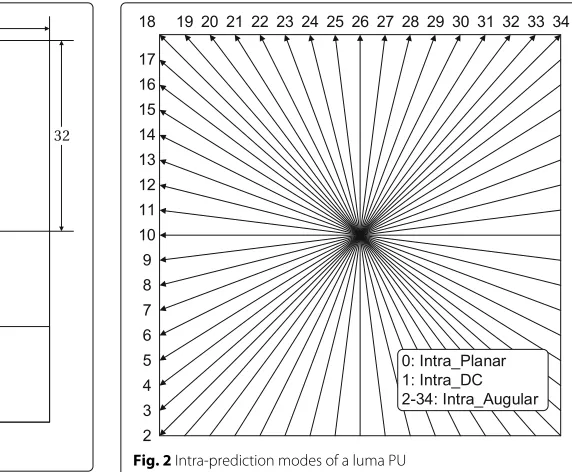
Five sizes of PU are supported in HEVC intra-coding: 64×64, 32×32, 16×16, 8×8 and 4×4. In order to accom-modate various textural features and obtain an accurate intra-prediction, HEVC offers up to 35 luma prediction modes, including DC, planar and 33 angular directional modes, as shown in Fig. 2. Planar mode is suitable for smooth regions with slow changes, while the DC mode is beneficial for areas representing homogeneous texture.
3.3 Intra-coding decision process
In HEVC, the best coding size and mode are determined by the following steps:
(1) Rough mode decision (RMD)
All 35 intra-prediction modes are investigated, based on the Hadamard cost, to construct the initial candidate list. This process can be described by Eq. (1):
HCOSTMODE=SATDMODE(ωk,ω˜k)+λ· ˜RMODE
SATDMODE(ωk,ω˜k)=
|H(ωk,ω˜k)|
/2
(1)
Fig. 2Intra-prediction modes of a luma PU
where HCOSTMODE represents the Hadamard cost;
SATDMODE indicates the sum of absolute Hadamard transformed differences (SATD);R˜MODEis the estimated bit consumption;λdenotes the Lagrangian multiplier;ωk
represents an original PU at time k and ω˜k is the cor-responding reconstructed PU; and H is the Hadamard transform.
(2) Combine with most probable mode (MPM)
The set of MPMs consists of the coding modes of adja-cent PUs located to the left and above of the current PU. If these modes have yet to be included in the current candidate list, they are inserted.
(3) RDO-based intra-coding decision
All the prediction modes in the candidate list are eval-uated in the RDO process. Finally, the mode which pro-duces the minimum RD cost is selected as the best coding mode.
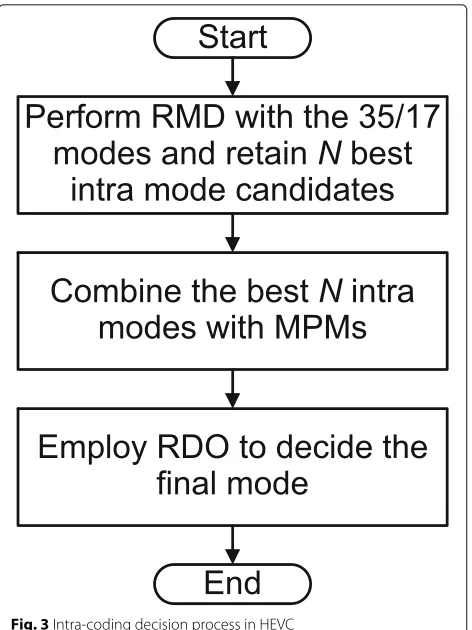
The flowchart in Fig.3illustrates the process of intra-mode decision in HEVC. It can be seen that, when per-forming the RMD in the intra-mode decision process, the Hadamard costs of all 35/17 prediction modes for each PU are calculated. This results in a large computational requirement, and the encoding time is thus significantly increased. Therefore, in order to reduce the complexity of HEVC encoders, efficient intra-mode decision algorithms become even more important.
4 Fast CU size decision
Fig. 3Intra-coding decision process in HEVC
the number of CUs of sizes 64×64, 32×32, 16×16 and 8×8 that require the calculation of the RD cost is 1, 4, 16 and 64, respectively. This is about 2.5 times more than that in H.264/AVC. It can be seen that a total number of 85 RD cost calculations is required for each LCU. This is a very time-consuming process and becomes a significant part of the computational complexity.
In practice, a number of unlikely CU sizes can be elim-inated in advance, and it is then unnecessary to calculate the RD costs for CUs of all possible partitioning sizes. In order to reduce the computational requirements and to speed up the intra-coding process, an efficient termina-tion and bypass strategy is desirable.
4.1 Energy distribution and textural complexity
The spatial homogeneity of a CU can be characterised by its energy distribution in the frequency domain. There-fore, we utilise the alternating current (AC) coefficients energy to evaluate the textural complexity of a LCU. For a homogeneous area of an image, the low-frequency com-ponents tend to contain the majority of the frequency domain energy, whereas for a region comprising rich detail, more DCT energy is distributed over other AC coefficients.
According to the principle of energy conservation, the AC coefficients energy (EAC) of asl×slCU is
mathemat-It should be noted that the maximum possible value,
Emax, of a CU’s AC energy can be determined in advance.
Emax is obtained from the CU comprising a checker-board pattern in which the intensity of every adjacent pixel sample is the allowable minimum (fmin) and maxi-mum (fmax) value alternately. Therefore, the formulation for calculatingEmaxof asl×slCU is
Consequently, we defineRCUas the criterion to assess the textural complexity of a CU, which is shown in Eq. (4).
RCU=
ln(EAC) ln(Emax)
(4)
In Eq. (4), bothEAC andEmaxare linearised by the natu-ral logarithm such that the range ofRCUcan be uniformly distributed.
The AC energy can be employed to measure the textural complexity of a LCU. Generally, a largeRCU value indi-cates that the LCU contains high detail, and smaller CU sizes at upper coding depth levels are more appropriate for these areas. On the contrary, homogeneous regions tend to generate smaller RCU values, and lower coding depth levels are more beneficial.
4.2 Adaptive dual-threshold scheme
In order to achieve early termination by skipping unlikely coding depth levels, an adaptive dual-threshold scheme is suggested. In the proposed algorithm, we employ two AC energy thresholds to determine the spatial homogeneity of a LCU.
When the value ofRCUexceeds an upper thresholdTU, rich spatial detail is represented in the LCU, and the evalu-ation of large CU sizes can be omitted. WhenRCUis below a lower thresholdTL, the LCU tends to contain low texture detail, and higher coding depth levels can be eliminated in advance.
balance between coding performance and computational complexity.
In our algorithm, the video sequence is categorised into two types: fast encoding frames and threshold updating frames (FUPDATE). The proposed fast CU size decision algorithm is incorporated in the fast encoding frames, and the threshold updating process is implemented in theFUPDATE frames. In eachFUPDATE frame, an exhaus-tive CU size decision is performed to determine the best coding depth level. When the encoding of eachFUPDATE frame is completed, theRCUvalues of all encoded LCUs are calculated and the coding depth level of each 4×4 block is stored. TheRCUvalues are subsequently arranged in ascending order [Rmin, ...,Rmax], and Rmed is the medianRCU.
The upper threshold TU is chosen from the set of [Rmed, ...,Rmax]. Each RCU value in the set of [Rmed, ...,Rmax] is considered as a candidate valueTUc of
TU. The error ratio (R) is used as the criterion by which to select the upper thresholdTU. For eachTUc, the value of
Rfor the LCUs which haveRCUvalues greater thanTUc is calculated as:
R=Ecnt/ (Ecnt+Ccnt) (5)
whereEcntdenotes the number of 4×4 blocks encoded using coding depth 0 in all the LCUs whoseRCU values are greater thanTUc, andCcntis the number of 4×4 blocks encoded using a coding depth of 1, 2, or 3.EcntandCcnt are computed as shown in Eq. (6).
Ecnt=
Ecnt if 1≤Di≤3
Ecnt+1 otherwise ,Ccnt=
Ccnt+1 if 1≤Di≤3
Ccnt otherwise
(6)
whereDidenotes the coding depth used by theith 4×4 block.TUc traverses from small to largeRCUvalues. This process terminates whenRreaches 0, and the currentTUc
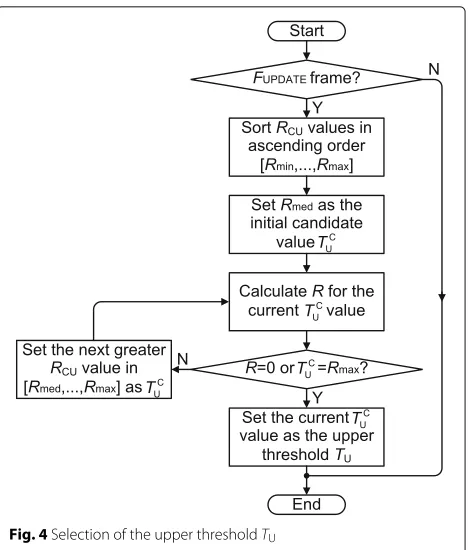
value is chosen as the upper thresholdTU. Each of the sub-sequent fast encoding frames uses thisTU value until it is updated in the nextFUPDATEframe. The algorithm for updating TU is presented in Fig. 4. The lower threshold
TLis determined in a similar way toTU, butTLis chosen from [Rmin, ...,Rmed).
4.3 Skipping and early termination of CU sizes
In order to skip unlikely depth levels, theRCU value of each LCU in fast encoding frames is compared with the upper thresholdTUand the lower thresholdTL. If theRCU value is greater thanTU, the current LCU is likely to be located in a region with high spatial detail. Therefore, the range of coding depth levels to be examined is set to [1,3], namely, the depth level 0 is skipped. For the LCUs that have anRCUvalue less thanTL, a depth range of [0, 2] is
Fig. 4Selection of the upper thresholdTU
used. Formally, the initial coding depth rangeDR0can be expressed as
DR0=[dL,dU]= ⎧ ⎨ ⎩
[0, 2] ifRCU<TL [1, 3] ifRCU>TU [0, 3] otherwise
(7)
wheredUanddL represent the maximum and minimum depth levels for the current LCU, respectively.
In addition to the AC energy, the spatial correlation is employed to further narrow the range of coding depth lev-els. As adjacent blocks generally contain similar textures, the best coding depth level of the current LCU is usu-ally strongly correlated to those of the coded neighbouring LCUs. If both the best depth levels of the above and left coded LCUs are not greater than 1, the range of coding depth levels to be examined is reduced to [dL,dU −1]. If both the above and left neighbours of the current LCU are coded using depth level 2 or 3, the depth range is narrowed to [dL + 1,dU]. Otherwise, the maximum and minimum depth levels for the current LCU remain unchanged. Therefore, the depth range DR1 is given as shown in Eq. (8).
DR1=[dL,dU]= ⎧ ⎨ ⎩
[dL,dU−1] ifdleft≤1,dabv≤1 [dL+1,dU] ifdleft>1,dabv>1 [dL,dU] otherwise
(8)
Due to the strong correlation between successive frames, the coding depth range of the current CU can be predicted by using the partitioning information of the co-located LCU in previously coded frames. If the best depth level of the corresponding LCU in the previous frame is greater thandL +1, the range of coding depth levels to be examined is reduced to [dL+1,dU]. If the best depth level of the corresponding LCU is less thandU −1, the range of coding depth levels to be examined is reduced to [dL,dU−1]. Otherwise, the maximum and minimum depth levels for the current LCU remain unchanged. The coding depth rangeDR2is determined as
DR2=[dL,dU]= ⎧ ⎨ ⎩
[dL,dU−1] ifdprev<dU−1 [dL+1,dU] ifdprev>dL+1 [dL,dU] otherwise
(9)
wheredprevdenotes the depth level of the co-located LCU in the previous frame.
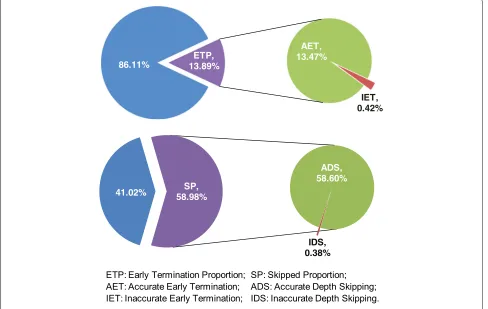
Empirical results from applying our fast CU size deci-sion algorithm are summarised in Fig. 5. The diagram shows the proportion of LCUs for which evaluation on depth level 0 is avoided (SP) and the proportion of LCUs for which early termination is achieved (ETP). The deci-sion accuracy, which indicates the percentage of identical
depth decisions generated from a partial evaluation as those generated from an exhaustive evaluation, is also pre-sented in Fig.5. It can be concluded that the evaluations on depth level 3 can be skipped in advance for a large proportion of LCUs, without affecting the accuracy of the decision-making process. Furthermore, coding depth level 0 can be skipped for the majority of LCUs without causing any noticeable decision-making errors.
5 Fast PU mode decision
HEVC supports up to 35 intra-prediction modes. The increased number of intra-prediction directions improves the encoding accuracy at the expense of a more com-plicated mode decision process. Consequently, there is a need to improve the intra-prediction mode decision process and thus reduce computational complexity. The method proposed in this section focuses primarily on the coding mode correlation between adjacent quad-tree levels and between temporally neighbouring frames.
5.1 Mode correlation between neighbouring quad-tree levels
In the quad-tree based coding structure, there exists a high-coding mode dependency between the upper and lower coding depth levels. Figure6illustrates the possible prediction modes of two neighbouring depth levels, where
Fig. 6PU modes at adjacent coding depth levels
BandSbrepresent the best and second best coding modes at depth leveli. Bn represents the best mode for the co-located PU at leveli+ 1. Figure7shows the possibility that
Bnis selected from various sets of coding modes whenB andSbare both directional modes. The statistical data was obtained from processing five video sequences.
Pdenotes the possibility thatBnis selected from the set {B,Sb,B−1,B+1,Sb−1,Sb+1, planar, DC, MPMs};
P1 thatBnis from {B, B−1,B+1}; P2 that Bn is from {Sb,Sb−1,Sb+1};P3 thatBnis a MPM; andP4 thatBn is the DC or planar mode. It can be seen from Fig.7that there is a high possibility thatBnbelongs to the mode set chosen forP. That means ifBandSbare both directional modes, the set of candidate modes forBncan be reduced to {B,Sb,B−1,B+1,Sb−1,Sb+1, planar, DC, MPMs}. If the candidate list contains only the most likely modes, the unnecessary computation of unlikely modes can be avoided. It should be noted that any duplicates existing in the overlap of the candidate lists should be removed, thus preventing repeated considerations for any given coding mode.
5.2 Improved candidate mode list
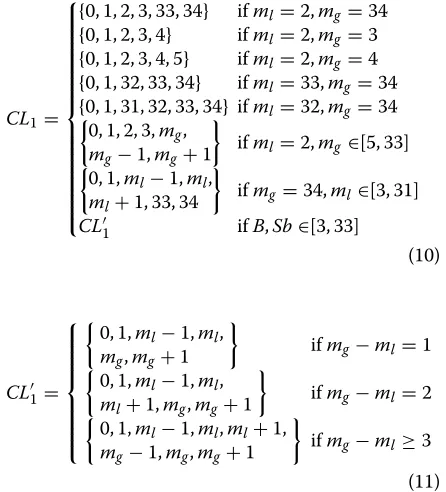
In our algorithm, the least possible prediction modes are not involved in the RMD process. If the current depth level is greater than 0, and bothBandSbof the co-located PU at the previous coding depth level are directional modes, the most likely coding mode for the current PU is predicted by exploiting the mode correlation between neighbouring depth levels in the quad-tree structure. For these PUs, a number of modes are selected from the 35 prediction modes to construct a candidate list CL1, as given in Eq. (10); otherwise, the mode information from temporally neighbouring PUs is utilised to construct the candidate list.
where 0 and 1 represent the planar mode and DC mode, respectively; the others indicate the directional modes;ml andmgare defined by Eq. (12).
ml=B,mg=Sb ifB≤Sb
ml=Sb,mg=B otherwise (12)
There also exists a strong temporal mode correlation between neighbouring frames. If the co-located PU in the previous frame is coded using a directional mode, the candidate list CL2 as shown in Eq. (13) is constructed; otherwise,CL3is employed, which is given by Eq. (14).
CL2=
wherePis the best coding mode of the co-located PU in the previous temporal frame.
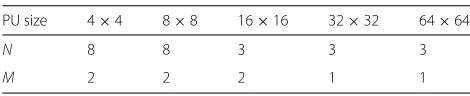
The prediction modes that remain in the candidate list are examined in the RMD process. The default HM imple-mentation retainsNmodes after RMD, whereas onlyM
(M<N) modes are retained in our algorithm. The values ofNandMare shown in Table1.
The RMD process is performed only once for the PUs which use CL1 or CL2 as the candidate mode list, and subsequently, theMmodes with the minimum Hadamard cost (HCOSTMODE) are selected. For PUs that employCL3 as the candidate list,Mmodes are selected through the first RMD process. The prediction modes next to an direc-tional mode that has been included in the retained M
modes are combined with the retainedMmodes to con-struct a new candidate mode listCL3. Subsequently, the prediction modes inCL3are evaluated in the second RMD process, and theMmodes with the minimum Hadamard cost are finally retained.
The proposed algorithm employsHCOSTMODEvalues to further eliminate the modes in the candidate list. Let
HCOSTMODEMin denote the minimum value ofHCOSTMODE. The HCOSTMODE value of each retained mode is eval-uated. If the HCOSTMODE value of a candidate mode is greater than 1.5×HCOSTMODEMin , this mode is deleted from the candidate list. If there is only one candidate mode left in the candidate list, this mode is determined as the best mode. If there is more than 1 remaining mode in the candidate list, the two modes with the minimum
HCOSTMODEvalues are evaluated in the RQT process.
6 Hybrid fast intra-coding algorithm
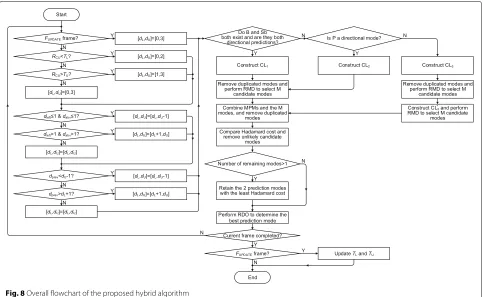
The two aforementioned algorithms are integrated to form a hybrid fast intra-coding scheme. The overall flowchart of the proposed fast intra-coding algorithm for HEVC is illustrated in Fig. 8. The algorithm can be described as follows:
Table 1Number of retained modes after RMD for various PU sizes
PU size 4×4 8×8 16×16 32×32 64×64
N 8 8 3 3 3
M 2 2 2 1 1
1. Check the type of the current frame. If it is aFUPDATE
frame, set the coding depth range[dL,dU]to [0, 3], and go to step11. Otherwise, go to step2;
2. Compare the current LCU’sRCUvalue withTL. If RCUis less thanTL, set[dL,dU]to [0,2], and go to
5. Check the depth levels of the left and above LCUs. If neither of them is greater than 1, set[dL,dU]to [dL,dU−1], and go to step8. Otherwise, go to step6;
6. Check the depth levels of the left and above LCUs. If they are both greater than 1, set[dL,dU]to
[dL+1,dU], and go to step8. Otherwise, go to step7;
7. Maintain the coding depth range unchanged at [dL,dU], and go to step8;
8. Check the depth leveldprevof the co-located LCU in
the previous frame. If it is less thandL−1, set [dL,dU]to[dL,dU−1], and go to step11. Otherwise, go to step9;
9. Check the depth leveldprevof the co-located LCU in
the previous frame. If it is greater thandU+1, set [dL,dU]to[dL+1,dU], and go to step11. Otherwise, go to step10;
10. Maintain the coding depth range unchanged at [dL,dU], and go to step11;
11. Perform fast intra-mode decision as follows:
11.1 Check the current coding depth, the best modeB and the second best mode Sb of the corresponding PU at the upper level. If the current depth level is not 0, and bothB and Sb are directional modes, go to step11.3. Otherwise, go to step11.2;
11.2 Check the best coding mode of the co-located PU in the previous frame. If it is a directional mode, go to step11.4. Otherwise, go to step
11.5;
11.3 ConstructCL1, and go to step11.6;
11.4 ConstructCL2, and go to step11.6;
11.5 ConstructCL3, and go to step11.6;
11.6 Remove the duplicated modes from the candidate list. Perform RMD and retainM prediction modes. For PUs that useCL3, go to step11.7. For PUs that useCL1orCL2, go to step11.8;
11.7 ConstructCL3, and perform RMD. RetainM candidate modes, and go to step11.8;
Fig. 8Overall flowchart of the proposed hybrid algorithm
HCOSTMODEvalue greater than 1.5×HCOSTMODEMin , and go to step11.9;
11.9 Check whether the number of remaining modes is greater than 1. If so, go to step
11.10. Otherwise, go to step11.11;
11.10 Retain the 2 prediction modes with the minimumHCOSTMODEvalues, and go to step
11.11;
11.11 Perform RQT to select the best coding mode, and go to step12;
12. Check whether the current frame has been
completely encoded. If so, go to step13. Otherwise, go to step1;
13. Check the type of the current frame. If it is aFUPDATE
frame, updateTLandTU. Otherwise, process the next frame.
7 Experimental configuration
To evaluate the performance of the proposed algorithms, all methods were implemented in the HEVC reference software HM 13.0 [28] with the all intra (AI) config-uration. Seventeen video sequences [29] with different spatial resolutions (QWVGA, WVGA, 720p, 1080p and WQXGA) were tested, with QP values of 22, 27, 32 and 37. The size of the CTU was fixed to 64 × 64, and the
maximum quad-tree depth was set to 4. The simulations were performed on the Microsoft Windows 7 operating system (64 bits) with an Inter Core i5-4590 3.30 GHz CPU and a 4 G RAM. Table2 presents some typical settings of the encoding parameters, and other parameters used in the simulations are those recommended by the JCT-VC in document JCTVC-K1100 [30].
In order to verify the effectiveness of the algorithms and to perform fair comparison with the standard HM imple-mentation and the fast algorithms recently proposed in [2,3,8–10,14,16,20,21], the performance is measured by the following parameters:
(1) The Bjφntegaard bit-rate (BDBR, %) and Bjφntegaard PSNR (BDPSNR, dB) as defined in [31];
Table 2Setting of encoding parameters
Parameter Value
MaxCUWidth 64
MaxCUHeight 64
MaxPartitionDepth 4
RDOQ True
AdaptiveQpSelection False
(2) The encoding time reduction (TR, %), which is calculated as
TR=(THM−TP)/THM×100%, (15)
whereTHMis the encoding time of the HM
implementation andTPis that of the proposed algorithm.
8 Results and discussion
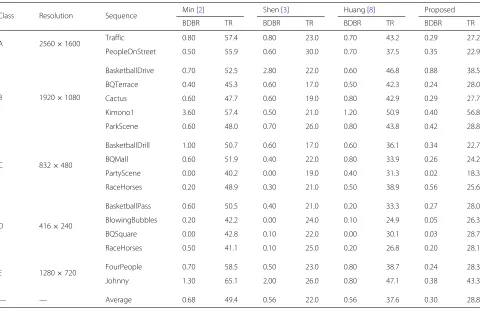
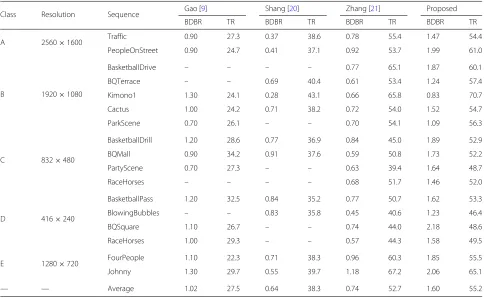
Tables 3 and 4 show the RD performance and encod-ing time reduction of the proposed fast CU size decision algorithm and the fast coding mode decision algorithm, respectively. Performance comparisons between the pro-posed hybrid fast intra-coding algorithm and three state-of-the-art methods are given in Table5. The simulation results for each sequence shown in Tables3,4and5are the average values for the given QP factors. The fast algo-rithms in [2,3,8–10,14,16,20,21] were developed based on different versions of HM. However, the intra-coding performance of these HM versions are very similar, as HEVC intra-coding changed very little between different versions [2,21]. Therefore, it is reasonable to suppose that it is fair to compare the methods under these different HM versions.
For the fast CU size decision algorithm, it can be seen from Table3that the encoding time is significantly
reduced, while incurring a negligible degradation in PSNR and an insignificant increment in bit rate. The simula-tion results show that our proposed algorithm achieves an average time saving of 29.61% relative to the original HM encoder, with a maximum of 56.77% in ‘Kimono1’ (1920×1080 pixels) and a minimum of 18.30% in ‘Par-tyScene’ (832×480 pixels). There is a negligible loss in coding efficiency, with 0–0.04 dB drop in PSNR or 0.02– 0.88% increase in bit rate. In addition to the HM imple-mentation, we also compared the proposed algorithm with the state-of-the-art fast CU depth decision scheme for HEVC [2,3,8]. A performance comparison with the algorithms proposed by Min, Shen and Huang is also pre-sented in Table3. Compared with Min’s method, although the proposed algorithm reduced encoding time less, bet-ter rate distortion performance was obtained. For the high-resolution sequence ‘Kimono1’ comprising high spa-tial detail, Min’s algorithm incurred an average increase in bit rate of 3.64%, which is significant. Therefore, the improved time reduction of Min’s algorithm was achieved at the expense of lower coding efficiency. However, our algorithm produces only a negligible increment in bit rate. Specifically, the increase in bit-rate was only 0.88% in the worst case. The degradation in coding efficiency can be regarded as negligible. Compared with Shen’s and Huang’s methods, similar comparative results can be observed. It
Table 3Comparison of the proposed fast CU size decision algorithm against the existing algorithms and HM 13.0
Class Resolution Sequence Min [2] Shen [3] Huang [8] Proposed
BDBR TR BDBR TR BDBR TR BDBR TR
A 2560×1600 Traffic 0.80 57.4 0.80 23.0 0.70 43.2 0.29 27.2 PeopleOnStreet 0.50 55.9 0.60 30.0 0.70 37.5 0.35 22.9
B 1920×1080
BasketballDrive 0.70 52.5 2.80 22.0 0.60 46.8 0.88 38.5
BQTerrace 0.40 45.3 0.60 17.0 0.50 42.3 0.24 28.0
Cactus 0.60 47.7 0.60 19.0 0.80 42.9 0.29 27.7
Kimono1 3.60 57.4 0.50 21.0 1.20 50.9 0.40 56.8
ParkScene 0.60 48.0 0.70 26.0 0.80 43.8 0.42 28.8
C 832×480
BasketballDrill 1.00 50.7 0.60 17.0 0.60 36.1 0.34 22.7
BQMall 0.60 51.9 0.40 22.0 0.80 33.9 0.26 24.2
PartyScene 0.00 40.2 0.00 19.0 0.40 31.3 0.02 18.3
RaceHorses 0.20 48.9 0.30 21.0 0.50 38.9 0.56 25.6
D 416×240
BasketballPass 0.60 50.5 0.40 21.0 0.20 33.3 0.27 28.0
BlowingBubbles 0.20 42.2 0.00 24.0 0.10 24.9 0.05 26.3
BQSquare 0.00 42.8 0.10 22.0 0.00 30.1 0.03 28.7
RaceHorses 0.50 41.1 0.10 25.0 0.20 26.8 0.20 28.1
E 1280×720 FourPeople 0.70 58.5 0.50 23.0 0.80 38.7 0.24 28.3 Johnny 1.30 65.1 2.00 26.0 0.80 47.1 0.38 43.3
Table 4Comparison of the proposed fast coding mode decision algorithm against the existing algorithms and HM 13.0
Class Resolution Sequence Jamali [10] Xiang [14] Chen [16] Proposed
BDBR TR BDBR TR BDBR TR BDBR TR
A 2560×1600 Traffic 0.95 35.4 0.33 25.0 0.88 24.0 1.39 36.0 PeopleOnStreet 1.00 34.1 0.45 26.0 1.07 24.0 1.85 50.6
B 1920×1080
BasketballDrive 2.17 38.4 0.41 25.0 1.73 23.7 1.15 39.3
BQTerrace 0.79 35.2 0.52 28.0 0.98 22.1 1.20 42.3
Kimono1 0.79 39.2 0.10 26.0 0.63 24.5 0.45 35.8
Cactus 1.34 36.1 0.41 23.0 1.37 23.7 1.42 37.7
ParkScene 0.87 37.5 0.37 24.0 0.41 19.8 0.79 38.9
C 832×480
BasketballDrill 0.80 33.1 0.54 25.0 1.53 31.3 1.79 39.0
BQMall 1.15 34.3 0.70 25.0 1.30 24.6 1.73 38.8
PartyScene 1.18 32.8 0.81 26.0 1.26 23.0 1.90 37.3
RaceHorses 0.72 34.7 0.39 22.0 0.86 30.8 1.06 36.4
D 416×240
BasketballPass 1.45 36.0 0.69 28.0 - - 1.65 36.7
BlowingBubbles 1.01 33.7 0.82 24.0 1.23 22.6 1.49 36.9
BQSquare 1.38 32.7 0.86 24.0 - - 2.45 37.4
RaceHorses 0.99 34.1 0.69 25.0 1.11 22.2 1.64 39.6
E 1280×720 FourPeople - - - 1.85 39.8
Johnny - - - - 1.83 33.7 1.87 40.2
— — Average 1.11 35.2 0.54 25.1 1.16 25.0 1.51 39.0
Table 5Comparison of the proposed hybrid algorithm against the existing algorithms and HM 13.0
Class Resolution Sequence Gao [9] Shang [20] Zhang [21] Proposed
BDBR TR BDBR TR BDBR TR BDBR TR
A 2560×1600 Traffic 0.90 27.3 0.37 38.6 0.78 55.4 1.47 54.4 PeopleOnStreet 0.90 24.7 0.41 37.1 0.92 53.7 1.99 61.0
B 1920×1080
BasketballDrive – – – – 0.77 65.1 1.87 60.1
BQTerrace – – 0.69 40.4 0.61 53.4 1.24 57.4
Kimono1 1.30 24.1 0.28 43.1 0.66 65.8 0.83 70.7
Cactus 1.00 24.2 0.71 38.2 0.72 54.0 1.52 54.7
ParkScene 0.70 26.1 – – 0.70 54.1 1.09 56.3
C 832×480
BasketballDrill 1.20 28.6 0.77 36.9 0.84 45.0 1.89 52.9
BQMall 0.90 34.2 0.91 37.6 0.59 50.8 1.73 52.2
PartyScene 0.70 27.3 – – 0.63 39.4 1.64 48.7
RaceHorses – – – – 0.68 51.7 1.46 52.0
D 416×240
BasketballPass 1.20 32.5 0.84 35.2 0.77 50.7 1.62 53.3
BlowingBubbles – – 0.83 35.8 0.45 40.6 1.23 46.4
BQSquare 1.10 26.7 – – 0.74 44.0 2.18 48.6
RaceHorses 1.00 29.3 – – 0.57 44.3 1.58 49.5
E 1280×720 FourPeople 1.10 22.3 0.71 38.3 0.96 60.3 1.85 55.5 Johnny 1.30 29.7 0.55 39.7 1.18 67.2 2.06 65.1
can be concluded that the proposed fast CU size decision algorithm reduced encoding time less, but higher cod-ing efficiency was maintained. Therefore, the selection of fast CU size decision algorithm depends on the specific application scenarios and the user’s requirements.
For the fast coding mode decision algorithm, Table 4 shows that the average time reduction is 38.98%, while BDBR increases by 1.51% and BDPSNR decreases by 0.09 dB. As shown in Table 4, our algorithm consis-tently results in a significant reduction in computational
a
c
b
d
e
complexity, while keeping nearly the same RD perfor-mance as that of the HM encoder. The experimental results indicate that the algorithm performs well for all types of video sequences. This result verifies that there exists strong mode correlation between coding depth lev-els and between neighbouring frames. Once the correla-tion is fully exploited, the unlikely coding modes can be skipped. The comparative results of the proposed algo-rithm and the fast mode decision algoalgo-rithm proposed by Jamili [10], Xiang [14] and Chen [16] are also included in Table4. It can be seen that our algorithm saves more than 3, 14 and 14% in average encoding time compared to Jamili’s, Xiang’s and Chen’s methods, while achieving very similar coding efficiency. Our proposed algorithm reduces more encoding time than the existing methods for all types of video sequence. Therefore, the proposed fast coding mode decision algorithm provides the best performance in terms of encoding time reduction.
Table 5 provides the simulation results of the pro-posed hybrid algorithm when compared with the original HM implementation and three state-of-the-art fast HEVC intra-coding algorithms, namely, those proposed by Gao [9], Shang [20] and Zhang [21]. It can be seen that the time reduction achieved by our algorithm is 55.24% on average. The maximum time reduction is 70.68% for the sequence of ‘Kimono1’, which contains significant detail. This is because the evaluation of unlikely depth levels is effectively avoided. On the other hand, the encoding time reduction is achieved by no more than a 2.18% increase in bit rate. Compared with Gao’, Shang’ and Zhang’s meth-ods, the proposed algorithm saves additional time of 28, 17 and 3% with similar rate distortion performance. It can be observed from Table5 that, although the coding efficiency of Zhang’s method is slightly higher than our algorithm, its time reduction is less. Therefore, the com-parative results demonstrate that our hybrid method out-performs the algorithms proposed by Gao and Shang and achieves a comparable performance to Zhang’s method. Specifically, when encoding low (416× 240 pixels) and medium (832×480 pixels) resolution video sequences, our algorithm consistently outperforms Zhang’s method in terms of encoding time reduction. When encoding high definition (HD, 1280×720 pixels), full HD (FHD, 1920× 1080 pixels) and 2K (2560×1600 pixels) video sequences, the relative coding performance is affected by the con-tent of the video test sequences. For video sequences that contain rich detail, such as ‘PeopleOnStreet’ and ‘Kimono1’, our algorithm shows better performance than Zhang’s. Therefore, the proposed algorithm provides a better choice for high resolution sequences containing complex detail.
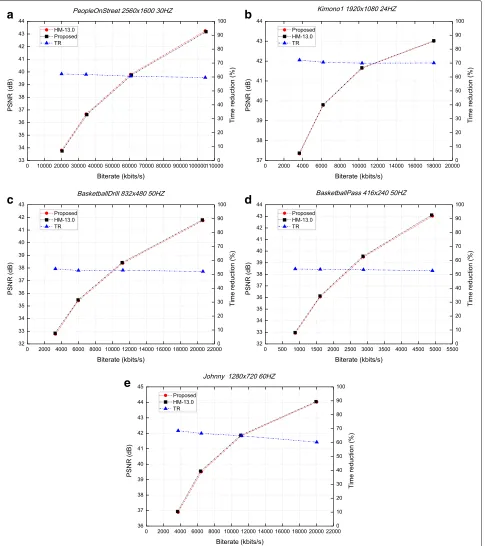
Figure9shows the RD curves for five video sequences with different spatial resolutions under a variety of QP factors. The corresponding time saving curves are also
presented on the same diagrams. It can be seen that the RD curves of the proposed hybrid algorithm almost over-lap with those of the HM encoder, which means the RD performance of the proposed algorithm is very similar to that of the HM benchmark. Therefore, there is nearly no quality loss under a wide range of bit rates. The time sav-ing curves show that the hybrid algorithm consistently achieves a time reduction of more than 46% for differ-ent video sequences. In summary, our proposed algorithm significantly reduces the encoding time with negligible effect on bit rate and picture quality.
9 Conclusions
This paper focused on developing a computational com-plexity reduction scheme for HEVC intra-coding. We combined a fast CU size decision algorithm and a fast intra-prediction mode decision algorithm to form a hybrid scheme. The proposed fast CU size decision algorithm employed the homogeneity of video content, the partitioning information of spatially adjacent coded PUs and temporally neighbouring frames to gradually narrow the depth range. In the fast mode decision algo-rithm, the coding mode correlation between coding depth levels was utilised to eliminate candidate modes in the candidate list, and the number of candidate modes was further reduced by evaluating the Hadamard cost of the remaining modes. The performance was compared with the original HEVC encoder as well as previously pro-posed complexity reduction schemes. Simulation results showed that the proposed algorithm outperformed exist-ing schemes, achievexist-ing up to 70.68% reduction in codexist-ing time, while barely degrading the picture quality and bit rate.
Abbreviations
AC: Alternating current; AI: All intra; BDBR: Bjφntegaard bitrate; BDPSNR: Bjφntegaard PSNR; CTU: Coding tree unit; CU: Coding unit; FHD: Full HD; HD: High definition; HEVC: High efficiency video coding; IBC: Intra block copy; JCT-VC: Joint collaborative team on video coding; LCU: Largest CU; MB: Macroblock; MPM: Most probable mode; PU: Prediction unit; RD: Rate distortion; RDO: Rate distortion optimisation; RMD: Rough mode decision; RQT: Residual-quad-tree; SCU: Smallest CU; SVM: Support vector machine; TU: Transform unit; TR: Time reduction
Acknowledgements
The authors would like to thank Professor Graham R. Martin in the Department of Computer Science at the University of Warwick for his very helpful suggestions. The authors also would like to thank the editor and anonymous reviewers for their valuable comments.
Funding
This work was supported by the National Natural Science Foundation of China (NSFC) under project no. 61401123, the Fundamental Research Funds for the Central Universities under grant no. HIT.NSRIF.201617 and the Harbin Science and Technology Bureau under project no. 2014RFQXJ166. The above funding bodies provided financial support only.
Availability of data and materials
Authors’ contributions
XL designed the algorithms and drafted the manuscript. CY performed the experiments and analysed the data. XJ reviewed and revised the whole paper. All authors read and approved the final manuscript.
Competing interests
The authors declare that they have no competing interests.
Publisher’s Note
Springer Nature remains neutral with regard to jurisdictional claims in published maps and institutional affiliations.
Author details
1School of Electronics and Information Engineering, Harbin Institute of
Technology, No. 92 West Dazhi Street, Nangang District, Harbin, China, 150001.2School of Computer and Information Engineering, Harbin University
of Commerce, No.1 Xuehai Street, Songbei District, Harbin, China, 150028.
Received: 13 January 2018 Accepted: 30 May 2018
References
1. G Sullivan, J Ohm, W Han, T Wiegand, Overview of the high efficiency video coding (HEVC) standard. IEEE Trans. Circuits Syst. Video Technol.
22(12), 1649–1668 (2012)
2. B Min, R Cheung, A fast CU size decision algorithm for the HEVC intra encoder. IEEE Trans. Circuits Syst. Video Technol.25(5), 892–896 (2015) 3. L Shen, Z Zhang, Z Liu, Effective CU size decision for HEVC intracoding.
IEEE Trans. Image Process.23(10), 4232–4241 (2014)
4. H Zhang, Q Zhou, N Shi, F Yang, X Feng, Z Ma, inProc IEEE Int Conf Acoust Speech Signal Proc. Fast intra mode decision and block matching for HEVC screen content compression (IEEE, Shanghai, China, 2016), pp. 1377–1381 5. L Shen, Z Liu, X Zhang, W Zhao, Z Zhang, An effective CU size decision
method for HEVC encoders. IEEE Trans. Multimedia.15(2), 465–470 (2013) 6. S Cho, M Kim, Fast CU splitting and pruning for suboptimal CU
partitioning in HEVC intra coding. IEEE Trans. Circuits Syst. Video Technol.
23(9), 1555–1564 (2013)
7. F Mu, L Song, X Yang, Z Luo, inProceedings of IEEE International Conference on Multimedia and Expo Workshops. Fast coding unit depth decision for HEVC (IEEE, Chengdu, China, 2014), pp. 1–6
8. X Huang, H Jia, K Wei, J Liu, C Zhu, Z Lv, D Xie, inProceedings of IEEE International Conference on Visual Communications and Image Processing. Fast algorithm of coding unit depth decision for HEVC intra coding (IEEE, Valletta, Malta, 2014), pp. 458–461
9. L Gao, S Dong, W Wang, R Wang, inProceedings of IEEE International Symposium on Circuits and Systems. Fast intra mode decision algorithm based on refinement in HEVC (IEEE, Lisbon, Portugal, 2015), pp. 517–520 10. M Jamali, S Coulombe, F Caron, inProceedings of Data Compression
Conference. Fast HEVC intra mode decision based on edge detection and SATD costs classification (IEEE, Snowbird, UT, USA, 2015), pp. 43–52 11. T Silva, L Agostini, L Cruz, inProceedings of European Signal Processing
Conference. Fast HEVC intra prediction mode decision based on edge direction information (IEEE, Bucharest, Romania, 2012), pp. 1214–1218 12. V Sanchez, inProceedings of IEEE Global Conference on Signal and
Information Processing. Fast intra-prediction for lossless coding of screen content in HEVC (IEEE, Orlando, FL, USA, 2015), pp. 1367–1371 13. X Lu, G Martin, Fast mode decision algorithm for the H.264/AVC scalable
video coding extension. IEEE Trans. Circuits Syst. Video Technol.23(5), 846–855 (2013)
14. W Xiang, C Cai, Z Wang, H Zeng, J Chen, inProceedings of Tenth International Conference on Signal-image Technology and Internet-based Systems. Fast intra mode decision for HEVC (IEEE, Marrakech, Morocco, 2014), pp. 283–288
15. S Na, W Lee, K Yoo, inProceedings of IEEE International Conference on Consumer Electronics. Edge-based fast mode decision algorithm for intra prediction in HEVC (IEEE, Las Vegas, NV, USA, 2014), pp. 11–14 16. G Chen, Z Liu, T Ikenaga, D Wang, inProceedings of IEEE International
Symposium on Circuits and Systems. Fast HEVC intra mode decision using matching edge detector and kernel density estimation alike histogram generation (IEEE, Beijing, China, 2013), pp. 53–56
17. S Lim, H Kim, Y Choi, S Yu, Fast intra-mode decision method based on DCT coefficients for H.264/AVC. Signal Image and Video Process.9(2), 481–489 (2015)
18. H Zhang, Z Ma, Fast intra mode decision for high efficiency video coding (HEVC). IEEE Trans. Circuits Syst. Video Technol.24(4), 660–668 (2014) 19. N Hu, E Yang, Fast mode selection for HEVC intra-frame coding with
entropy coding refinement based on a transparent composite model. IEEE Trans. Circuits Syst. Video Technol.25(9), 1521–1532 (2015) 20. X Shang, G Wang, T Fan, Y Li, inProceedings of IEEE International
Conference on Image Processing. Fast CU size decision and PU mode decision algorithm in HEVC intra coding (IEEE, Quebec City, QC, Canada, 2015), pp. 207–213
21. T Zhang, M Sun, D Zhao, W Gao, Fast intra-mode and CU size decision for HEVC. IEEE Trans Circuits Syst. Video Technol.27(8), 1714–1726 (2017) 22. L Zhao, X Fan, S Ma, D Zhao, Fast intra-encoding algorithm for high
efficiency video coding.Signal Process. Image Commun.29(9), 935–944 (2014)
23. J Lei, D Li, Z Pan, Z Sun, S Kwong, C Hou, Fast intra prediction based on content property analysis for low complexity HEVC-based screen content coding. IEEE Trans. Broadcasting.63(1), 48–58 (2017)
24. L Wang, W Siu, Novel adaptive algorithm for intra prediction with compromised modes skipping and signaling processes in HEVC. IEEE Trans. Circuits Syst. Video Technol.23(10), 1686–1694 (2013)
25. L Shen, Z Zhang, P An, Fast CU size decision and mode decision algorithm for HEVC intra coding. IEEE Trans. Consum. Electron.59(1), 207–213 (2013) 26. D Zhang, Y Chen, E Izquierdo, Fast intra mode decision for HEVC based on
texture characteristic from RMD and MPM. Proceedings of IEEE International Conference on Visual Communications and Image Processing, 510–513 (2014)
27. F Bossen, B Bross, K Suhring, D Flynn, HEVC complexity and
implementation analysis. IEEE Trans. Circuits Syst. Video Technol.22(12), 1685–1696 (2012)
28. H.265/HEVC reference software (HM 13.0) and manual.https://hevc.hhi. fraunhofer.de/svn/svn_HEVCSoftware. Accessed 03 Jan 2018
29. H.265/HEVC standard test video sequences.ftp://ftp.tnt.uni-hannover.de/ testsequences. Accessed 03 Jan 2018
30. F Bossen,Common test conditions and software reference configurations. JCT-VC, 11th Meeting. (JCT-VC, Shanghai, China, 2012). JCTVC-K1100 31. G Bjφntegaard,Calculation of average PSNR differences between RD-curves.