439 | P a g e
Effect of Different Current Density on Structural and
Mechanical Properties of Fe-Ni-Co Alloy Thin Films
K. Mohan Rangam Kadiresan
1, Dr.V. Senthil Kumar
21
Research Scholar, Department of Physics,
Karpagam Academy of Higher Education, Coimbatore-641021, TamilNadu, (India)
2
Associate Professor, Department of Physics,
Karpagam Academy of Higher Education, Coimbatore-641021, TamilNadu, (India)
ABSTRACT
This research work investigates the effect of current density on electroplated Fe-Ni-Co alloy thin films. Varying
current density between 2 mA/cm2 , 3 mA/cm2 and 4mA/cm2, the electroplated Fe-Ni-Co thin films were prepared
and morphological, structural, and mechanical characterization were analysed. The SEM micrographs of the
electrodeposited films w i t h d i f f e r e n t c u r r e n t d e n s i t y have n o micro- cracks and also the films have
uniform surface morphology. The predominant peaks in X-ray diffraction pattern reveal t h e crystalline
n a t u r e of the film and structure belonging to FCC. The hardness changes of thin films were analysed by VHT.
The electroplated Fe-Ni-Co thin films were strongly adherent to the substrate. The VHN result of Fe-Ni-Co thin
films shows that the Fe-Ni-Co thin films coated at high current density have highest hardness value.
Keywords: Thin films, Characterization, Electrodeposition, Crystalline Size, Temperature, X-ray
Diffraction, Micro Hardness, Surface Morphology
.
I INTRODUCTION
Electrodeposited nanocrystalline magnetic thin films are developed due to their potential applications in power
electronics, sensors, actuators and core material for writing elements in recording heads. This method offers several
practical advantages over more sophisticated vacuum deposition techniques in terms of cost and growth.
Electrodeposited Permalloy (Fe20Ni80) is the best known thin film alloy in magnetic thin film recording heads and
MEMS applications [3].The Fe- Ni alloys are the most versatile from all the known soft magnetic materials for
magnetic storage (1-6). The electrodeposition conditions such as physical conditions and chemical conditions
determine the microstructure (crystallite size, uniformity and adherence) which in turn influence the physical and
440 | P a g e
with NiFe alloy. Electrodeposited Permalloy [NiFe] is the best known thin film alloy in MEMS applications (13,
19). In this current investigation, the electrodeposition method is chosen for coating Fe-Ni-Co thin films. In this
present work, the effect of different current density on FeNiCo thin films are analysed. This paper summarizes the
synthesis and characterizations of electroplated FeNiCo thin films.
II EXPERIMENTAL PART
Details of chemicals used in the experiments, temperature and current density are shown in Table 1. Copper and
stainless steel substrates act as cathode and anode respectively in this investigation. Electrodeposition was carried
out by varying the current density (2,3,4 mA/cm2) at 30°C for 15 minutes. The pH value of the bath was
maintained to 6 by adding few drops of ammonia solution. The surface morphology of the Fe-Ni-Co thin films was
examined with the help of Scanning Electron Microscope. The film composition and structural characters of thin
films were measured by Energy-dispersive X-ray Spectroscopy and X-ray diffraction respectively. The hardness of
Fe-Ni-Co thin films was measured by Vickers Hardness Test.The thickness of the films were determined by cross
sectional view of SEM images.
Table 1. Electroplating bath details of FeNiCo thin films
S.No
Name of the Chemicals
(g/L)
Temperature (o C)
Current density
pH
1 Ferrous Sulphate 10
30 2, 3 and
4 mA/cm2
6
2 Nickel Sulphate 30
3 Cobalt Sulphate 15
4 Ammonium
Sulphate
40
5 Citric acid 10
6 Boric acid 10
III RESULTS AND DISCUSSION
3.1 Composition of Electrodeposited Thin Films
The EDAX data of thin films are shown in Table 2. EDAX result shows that the films obtained at higher current
density have high nickel content. The highest nickel content of 39.54 wt% was obtained for current density 4
mA/cm2. EDAX result shows that Ni content increases with increasing current density. The weight percentage of Co
441 | P a g e
Table 2: EDAX Analysis of Thin FilmsS. No Current Density mA/cm2
Co Wt%
Ni Wt%
Fe Wt%
1. 2 68.45 19.87 11.68
2 3 58.34 30.21 11.45
3 4 46.72 39.54 13.74
3.2 Morphological Observation
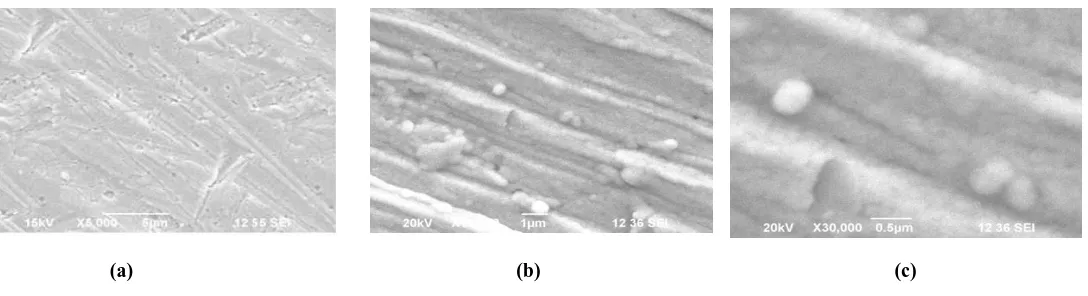
The surface morphology of the electroplated Fe-Ni-Co alloy thin films with different current density is analysed by
SEM pictures are shown in fig 1.The electroplated thin films are smooth and uniform. FeNiCo alloy thin films are
uniform, bright and crack free. It is concluded from SEM analysis that the deposition of thin films on the substrate is
uniform in nature.
(a) (b) (c)
Figure 1: SEM Images for Electrodeposited
Fe-Ni-CoThin Film for Different Current Density
(a) 2 (b) 3 (c) 4 mA/cm23.3 Structural Analysis
The crystal structure of the electro deposited Fe-Ni-Co alloy thin films was determined by XRD analysis. X- ray
diffraction patterns of Fe-Ni-Co films obtained with different current density are shown in fig 3. The presence of
sharp peaks in XRD pattern reveals that the films are crystalline in nature. The crystalline size of the deposits was
calculated from XRD using Scherrer’s formula
442 | P a g e
0 20 40 60 80 100
0 1000 2000 3000 4000 5000
(a)
(111)
(220) (200)
In
te
n
si
ty
(co
u
n
t)
Two Theata(degree)
0 20 40 60 80 100
0 1000 2000 3000 4000 5000 6000
7000 (c)
(220) (200)
(111)
In
te
n
si
ty
(co
u
n
ts)
Two theata(degree)
Where, θ is the Bragg’s angle, λ is the X-ray wavelength, β is the full width at half maximum intensity of the
diffraction peak located at 2θ. The XRD patterns of Fe -Ni-Co films reveal the existence of FCC phase with (111),
(200) and (220) diffraction peaks.
The result shows that the crystalline sizes of the Fe-Ni-Co deposits obtained by electrodeposition process are in the
nano scale and the average crystallite size is around 21 nm.
Fig.2 XRD Patterns of Fe-Ni-Co Thin films for Different Current Density
(a) 2 (b) 3 (c) 4 mA/cm
2The crystal size of Fe-Ni-Co alloy films is tabulated and shown in table 3.When the current density is increased, the
443 | P a g e
2.0 2.5 3.0 3.5 4.0
19 20 21 22 23 24
pa
rtic
le
si
ze
Current Density
Table.3: Structural characteristics of NiCoFe alloy thin films
S. No
Current Density mA/cm2
2Ɵ (deg)
d (A0)
Particle size, D
(nm)
Strain (10-3)
Dislocation density (1014 / m2)
1
2 43.310 1.5634 23.32 1.578 21.87
2 3 41.637 1.5430 20.18 1.673 19.13
3
4 43.187 1.2345 19.28 1.345 17.45
Figure 3. Crystalline Size as a function of Current density
3.4 Mechanical Properties
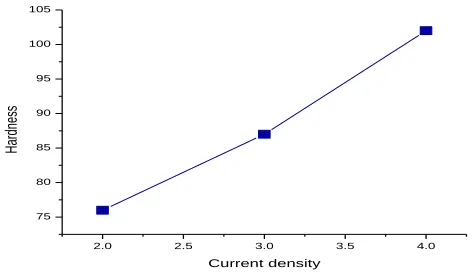
Hardness of Fe-Ni-Co films are examined by Vickers hardness tester (micro hardness tester). The results show that
the hardness increases with increasing current density.This effect occurs due to lower stress associated with
electrodeposited films. The hardness of Fe-Ni-Co thin films with different current density is shown in table 4.
Table.4: Mechanical Properties of electrodeposited Ni-Co-Fe thin films
S.No Current Density (mA/cm2) Vickers Hardness
(VHN)
1
2 76
2
3 87
444 | P a g e
2.0 2.5 3.0 3.5 4.0
75 80 85 90 95 100 105
H
ar
dn
es
s
Current density
Figure 4. Vickers Hardness as a function of current density
IV CONCLUSION
Electrodeposited Fe- Ni-Co thin films were prepared by varying the current density (2, 3,4 mA/cm2) at 30°C for
15 minutes. The crystalline size decreases with increasing current density. The thin films obtained with different
current density are uniform, bright and crack free. FCC was the dominant structure of Fe-Ni-Co alloy thin films.
Hardness increases with increasing current density. When current density was increased from 2 mA/cm2 to 4
mA/cm2, the particle size values decrease from 23.32 nm to 19.28 nm. This happens due to nano crystalline structure
and low film stress associated with Fe-Ni-Co alloy thin films.This article summaries the optimized operating
condition of electroplated bath and characteristics of Fe-Ni-Co. The Fe-Ni-Co thin films can be used in various
electronic devices, actuators and memory devices.
REFERENCES
1. Kannan, R, Ganesan, S,Selvakumari, ‘’Structural and Magnetic properties of electrodeposited NiFeWS thin
films’’, Optoelectronics and advanced materials-Rapid Communication 2012,3-4, 383-388.
2. Baskar.T, Rajni.K.S, “Effect of different Sulfur concentration on structural and magnetic properties of
electrodeposited NiCoS magnetic thin films”, International Journal of ChemTechResearch ,2016,5 ,317-324.
3. Cho H. J, Bhansali S. ,Ahn C. H., “Electroplated thick permanent magnet arrays with controlled direction of
magnetization for MEMS application”, Journal of Applied Physics, 2000,87, 6340- 6342.
4. Esther. P , Joseph Kennady.C., ‘’Effect of sodium tungstate on the properties of Electrodeposited nanocrystalline
Ni-Fe-W films’’, Journal of Non Oxide Glasses., 2010, 1, 35-44.
5. Kannan, R, Ganesan, S ,Selvakumari, TM ‘’Synthesis and characterization of nano crystalline NiFeWS thin films
in diammonium citrate bath’’, Digest journal of nanomaterials and biostructures, 2012,7, 1039-1050.
6.Baskar.T, Rajni.K.S, Kannan.R,“ Synthesis and Structural Characterization of electro deposited Nickel Cobalt
Tungsten alloy thin film at different temperature”, International Journal of Advance Research in Science and
445 | P a g e
7.Venkatachalam T., Ganesan S. and Sakthivel K., ‘Simulation for deposition of cadmium telluride thin films in hot
wall epitaxial system using Monte Carlo technique’, Journal of Physics D: Applied Physics Published at Institute
of Physics UK, 2006,39, 1650-1657.
8.Baskar.T, Rajni.K.S, Kannan.R, “Synthesis and Structural Characterization of electro deposited Nickel Ferrous
sulfide alloy thin film”, International Journal of Advanced Technology in Engineering and Science ,2, 509-514,
2014.
9.Venkatachalam T., Ganesan S., Velumani S. and Sakthivel K. (2008) ‘Band structure and optical properties of
CdTe and CdSn3Te4 thin films’, Journal of American Physical Society proceedings 2008, 1004, 273- 277.
10. Manjulavalli.T.E, Kannan.A.G, “Structural and optical properties of ZnS thin films prepared by chemical bath
deposition method”, International Journal of ChemTech Research 2015, 8, 396-402.
11. Baskar.T, Rajni.K.S, “Effect of bath temperature on structural and magnetic properties of electrodeposited
NiCoS magnetic thin films”, International Journal of ChemTech Research ,2015,8, 234-239
.
12. Thangaraj.N, Tamilarasan.K ,Sasikumar.D., “Effect of Phosphorous Acid on the Ferrous TungstenPhosphorous
Magnetic Thin Film”, International Journal of ChemTech Research 2014, 6, 384-390.
13.Ravindranadh.K, Sridhar Kumar.D,Durga Venkata Prasad,.K, Rao.M.C., “Luminescent Properties of Cu2+
Doped SnO2 Thin Films by Spray Pyrolysis”, International Journal of ChemTech Research 2016, 9, 598-603.
14. Kavitha.N, Manohar.P., “Magnetic and Dielectric studies of Ni-Co-Zn Ferrites synthesized by Nonconventional
combustion method”, International Journal of ChemTech Research 2015, 8, 308-315.
15. Rajni.K.S., “Studies on the Structural and Conduction mechanism (ac) in thermally Evaporated CdSe thin
films”, International Journal of ChemTech Research 2015, 7,1509-1515.
16. Pushpalatha.H.L, Ganesha.R
.,
“Growth and characterization of CdS thin films by photochemical and chemicalbath deposition”, International Journal of ChemTech Research 2015, 7, 185-189.
17. Iwasaki S., Nakamura Y., “An analysis for the magnetization mode for high density magnetic recording”,
Journal of Magnetism and Magnetic Materials., 1977, 200, 634-648.
18. Emerson R.N., Kennady C.J.,Ganesan S., “Effect of Organic additives on the Magnetic properties of
Electrodeposition of CoNiP Hard Magnetic Films”, Thin solid films, 2007,515, 3391-3396.
19.Baskar.T, Rajni.K.S, Kannan.R, “Synthesis and Structural Characterization of electro deposited Nickel Cobalt
Boron alloy thin film”, International Journal of Advance Research in Science and Engineering 3, 140-147, 2014
20. Chidambara Kumar K N, KhadeerBasha S K, Shakil Muhammad G, “X Ray line profile analysis of Mn doped
PbS thin films by Successive Ionic Layer Adsorption and Reaction Method”, International Journal of ChemTech
Research 2015, 7, 2257-2264.
21.Baskar.T, Rajni.K.S, Kannan.R, “Synthesis and Structural Characterization of electro deposited CoNiP alloy thin