Effective Use of Cloud Computing Under Mobile Cloud
Computing Environment
S. E.Tayde
1,
D.T.Dongare
21
Department of Computer Science S.S.S.K.R.Innani Mahavidyalaya Karanja (Lad)
Dist.Washim MS. (India)
2
Department of Physics, S.S.S.K.R.Innani Mahavidyalaya Karanja (Lad)
Dist.Washim MS. India.
ABSTRACT
Cloud computing in mobile has invoked a new wave of evolution in the rapidly developing mobile world. Mobile
Cloud Computing (MCC) is simply cloud computing in which at least some of the devices involved are mobile.
The mobile devices have evolved from mere devices that enabled voice calls only a few years back to smart
devices that enable the user to access value added services anytime, anywhere. MCC integrates cloud
computing into the mobile environment and overcomes obstacles related to performance, environment and
security. This paper is a brief introduction for mobile cloud which helps the cloud user to higher utilization.
Using mobile cloud user can access them cloud which increase its utilization.
Keywords- Areas in MCC, Cloud Computing, Issues in mobile cloud computing, Mobile
Computing.
I.INTRODUCTION
Cloud computing is emerging as one of the most important branch for providing seamless application on mobile devices. Cloud Computing has emerged as a phenomenon that represents the way by which IT services and functionality are charged for and delivered. NIST (National Institute of Standards and Technology, USA) definition from [1] September, 2011 released in its “Special Publication 800-145” of Cloud Computing is: “Cloud Computing is a model for enabling convenient, on-demand network access to a shared pool of configurable resources (e.g. networks, servers, storage, applications and services) that can rapidly be provisioned and released with minimal management effort or service provider interaction.” A more formal definition that encapsulates the key benefits of cloud computing from a business perspective as well as its unique features from a technological perspective [2] in their research paper is as follows: “It is an information technology service model where computing services (both hardware and software) are delivered on-demand to customers over a network in a self-service fashion, indecent of device and location. The resources required to provide the requisite quality-of service levels are shared, dynamically scalable, rapidly provisioned, virtualized and released with minimal service provider interaction”.
mobile, Voice Search, and some applications on an Android platform, Mobile Me from Apple, Live Mesh from Microsoft and Moto blur from Motorola, have been developed and served to users.
II. MOBILE CLOUD ARCHITECTURE
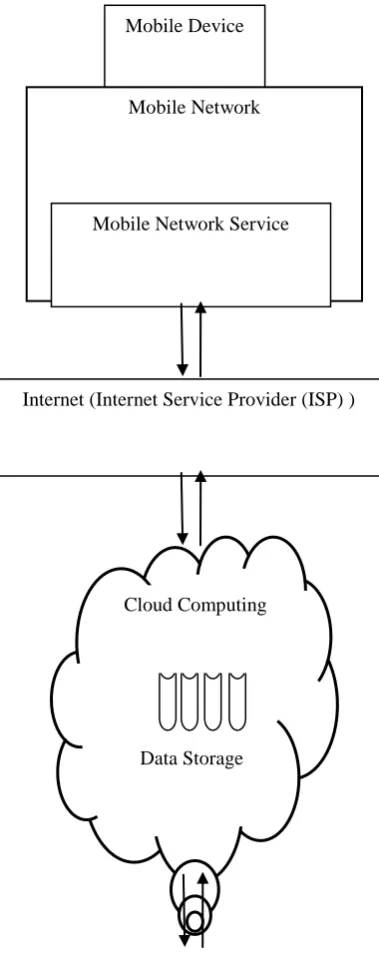
Delivering cloud services in a mobile environment brings numerous challenges and problems. Mobile devices cannot handle complicated applications due to their innate characters. In addition, it is impossible that a mobile device is always online, the offline solution of the device need be considered as well. The absence of standards, security and privacy, elastic mobile applications requirement may obstruct the development of Mobile Cloud Computing. Fig.1 1illustrate the architecture of mobile cloud computing and how they work.
Fig. 1. Architecture of Mobile Cloud Computing
Mobile Device
Mobile Network
Mobile Network Service
Internet (Internet Service Provider (ISP) )
III. IMPLEMENTING MOBILE CLOUD ENVIRONMENT ISSUES
There are several issues related to implementation of MCC. A few of them have been listed below:
3.1 Absence of standards
In spite of the various advantages of Cloud computing over the conventional computing techniques, there is no accepted open standard available. Portability and interoperability is also impossible between different Cloud computing Service Providers (CCSP). This prevents the service providers to widely deploy and quickly develop Cloud computing. Customers are reluctant to transform their current datacenters and IT resources to cloud platforms owing to a number of unsolved technical problems that exist in these platforms. Some of the problems existing due to a lack of open standards are the following:
Limited scalability: Owing to the rapid growth, none of the CCSPs can meet all the requirements of all the users.
Unreliable availability of a service: Dependence on a single CCSP‟s service can result in a bottleneck in the event of a breakdown of a service.
Service provider lock-in: Absence of portability makes it impossible for data and application transfer among CCSPs, consequently customer is locked to a CCSP.
Unable to deploy service over multiple CCSPs: Absence of interoperability makes it impossible for application to be scaled over multiple CCSPs. In view of the afore mentioned disadvantages [3] have introduced a solution called Open Cloud Computing Federation (OCCF) in , that solves the problems of interoperability and portability among various CCSPs. However, the move to a common cloud standard is impossible because most of the cloud computing firms have their own APIs and for setting those up lots of funds were spent. The OCCF thus lacks a practical realization mechanism. A possible approach is to have a Mobile Agent Based Open Cloud Computing Federation (MABOCCF) mechanism [4]
3.2 Access Schemes
MCC will be deployed in a heterogeneous access scenario in terms of Wireless Network Interfaces. Mobile nodes access the Cloud through different radio access technologies viz. GPRS, WLAN, LTE, WiMAX, CDMA2000, WCDMA etc. Mobile Cloud Computing requires the following features:
MCC requires an “always-on” connectivity for a low data rate cloud control signaling channel MCC requires an “on-demand” available wireless connectivity with a scalable link bandwidth MCC requires a network selection and use that takes energy-efficiency and costs into account Access management is a critical aspect of MCC. A possible solution is to use context and location information to optimize mobile access [5] . Deploying MCC utilizing the context information, such as device the mobile cloud server to locally optimize the access management can use locations, capabilities, and user profiles.
3.3 Security
the mobile devices as well. The threat detection services run on the mobile devices to combat these security threats, warrant intensive usage of resources, both in terms of computation and power. A possible solution is to move these detection services to the cloud. It saves the device CPU and memory requirements with increased bandwidth as the price to be paid. This approach has the following benefits: Better detection of malicious software. Reduced on-device resource consumption. Reduced on-device software complexity.
3.4 Elastic Application Models
As far as the end user is concerned, it does not matter how the service is provided. Cloud computing services are scalable, via dynamic provisioning of resources on a fine grained, self-service basis near real-time, without users having to engineer for peak loads. This requirement particularly manifests in Mobile Cloud Computing due to the intrinsic limitations of mobile devices. For example, the iPhone 4s is equipped with 800 MHz CPU, 512 MB RAM allowing about 8 hrs of talk time and 14.4 Mbps speed on HSDPA 4G network [6].Compared to today‟s PC and server platforms, these devices still cannot run compute-intensive applications. Thus, an elastic application model is required to solve the fundamental processing problem.
IV. CLOUD AND MOBILE CLOUD ENVIRONMENT
In order to get invasive environment for cloud computing in mobile applications we need to get across various stages of mobile infrastructure like Mobile device, Network, mobile Applications and Security.
4.1.Cloud Computing
„„Cloud computing refers to both the applications delivered as services over the Internet and the hardware and systems software in the datacenters that provide those services‟‟[7].A cluster of computer hardware and software that offer the services to the general public (probably for a price) makes up a „public cloud‟. Computing is therefore offered as a utility much like electricity, water, gas etc. Where you only pay peruse .For example, Amazon‟s Elastic cloud, Microsoft‟s Azure platform, Google‟s App Engine and Salesforce are some public clouds that are available today. However, cloud computing does not include „private clouds‟ which refer to data centers internal to an organization. Therefore, cloud computing can be defined as the aggregation of computing as a utility and software as a service. Virtualization of resources is a key requirement for a cloud provider—for it is needed by statistical multiplexing that is required for scalability of the cloud, and also to create the illusion of infinite resources to the cloud user [8] holds the view that „„different utility computing offerings will be distinguished based on the level of abstraction presented to the programmer and the level of management of the resources‟‟. To take an example from the existing cloud providers, an instance of Amazon‟s EC2 [9] is very much like a physical machine and gives the cloud user almost full control of the software stack with a thin API. This gives the user a lot of flexibility in coding; however it also means that Amazon has little automatic scalability and Fail over features. In contrast, Google‟s App Engine enforces an API on the user but offers impressive automatic scalability. Microsoft‟s Azure platform [10] is something in between the aforementioned providers by giving the user some choice in the language and offers somewhat automatic scaling and failover functions. Each of the aforementioned providers has different options for virtualizing computation, storage and communication.
Mobile cloud computing is defined as cloud computing extended by mobility based on mobile devices. It provide mobile users with data storage and processing services on a cloud computing platforms. There are several existing definitions of mobile cloud computing, and different research alludes to different concepts of the „mobile cloud‟:
4.2.1 Commonly, the term mobile cloud computing means to run an application such as Google‟s Gmail for Some Mobile6on a remote resource riches server (in this case ,Google servers) as display over to the remote server through 3G.other examples of this type are Facebook‟s location aware services, Twitter for mobile, mobile weather widgets etc.
4.2.2 Another approach is to consider other mobile devices themselves too as resource providers of the cloud making up a mobile peer-to-peer [11] network as in. Thus, the collective resources of the various mobile devices in the local vicinity, and other stationary devices too if available, will be utilized. This approach supports user mobility, and recognizes the potential of mobile clouds to do collective sensing as well. Peer- to-peer systems such as SATIN for mobile self-organizing exist, but these are based on component model systems rep-resenting systems made up of interoperable local components rather than offloading jobs to local mobile resources. This paper focuses primarily on this latter type of work.
4.2.3. Satyanarayanan et al.[12] present a new vision of mobile cloud computing. This approach where the mobile device offloads its workload to a local „cloudlet‟ comprised of several multi-core computers with connectivity to the remote cloud servers. PlugComputers8 can be considered good candidates for cloudlet servers because of their form factor, diversity and low power consumption. They have the same general architecture as a normal computer, but are less powerful, smaller, and less expensive, making them ideal for role small scale servers installed in the public infrastructure. These cloudlets would be situated in common areas such as coffee shops so that mobile devices can connect and function as a thin client to the cloudlet as opposed to a remote cloud server, which would present latency and bandwidth issues. Mobile cloud computing would also be based under the basic cloud computing concepts; there are certain requirements that need to be met in a cloud such as adaptability, scalability, availability and self-awareness.
These are also valid requirements for mobile cloud computing. For example, a mobile computing cloud also needs to be aware of its availability and quality of service and enable diverse mobile computing entities to dynamically plug themselves in, depending
V. CONCLUSION
REFERENCES
[1] Peter Mell, Tim Grance, The NIST definition of Cloud Computing, v15.
[2] Sean Marston, Zhi Li, Subhajyoti Bandyopadhyay, Juheng Zhang, Anand Ghalsasi, “Cloud Computing – The business perspective”, Decision Support Systems, Volume 51, Issue 1, Pages 176-189, 2011.
[3] B. Rochwerger, D. Breitgand, E. Levy, A. Galis, K. Nagin, L. Llorente, R. Montero, Y. Wolfsthal, E. Elmroth, J. Caceres, M. Ben-Yehuda, W. Emmerich, and F. Galan, “The RESERVOIR Model and Architecture,” for Open Federated Cloud Computing. IBM Journal of Research and Development,
53(4):Paper 4, 2009
[4] S. Chetan, G. Kumar, K. Dinesh, K. Mathew, and M. Abhimanyu, “Cloud computing for mobile world,” available at chetan ueuo.com
[5] A Klein, C. Mannweither, and H. Schottn, “Access schemes for mobile cloud computing,”Proc. 11th InH.
Conf. on mobile Data management (MDM 10), Kansas. MO, 2010, pp. 387-392.
[6] www.appleinsider.com
[7] B Hayes “cloud computing” communication of the ACM Vol.51 no. 7 PP 9-11 July 2008.
[8] M. Armbrust et al, “A view of cloud computing” EECS Department University of California,Berkeley. Technical report UCB/EEcs-2009-28,.
[9] Amazon Elastic Compute Cloud (Amazon EC2),http://aws.amazon.com/ec2/,2009.
[10] Microsoft azure[online] Available :http://www.microsoft.com/azure/
[11] Kang-Won Lee, Young-Bae Ko, and Thyaga Nandagopal. Load mitigation in cellular data networks by
peer data sharing over wlan channels. Computer Networks, 47(2):271-286,2005. ISSN 1389-1286.
DOI:10.1016/j.comneet.2004.07.009.
[12] M.Satyanarayan, P. Bahi, R. Caceres and N. Davies “The case for VM-based cloudlets in mobile