536 | P a g e
PROVIDING A SECURE GROUP COMMUNICATION
BY USING A NOVEL KEY TRANSFER PROTOCOL
AND BY GENERATING MULTIPLE SESSION KEYS
Dr. A.S.N. Chakravarthy
1
, Mr. T. Anjikumar
2
1Department of CSE, JNTUniversity, Kakinada, Andhra Pradesh, India
2
Department of CSE, SITAM College, Vizianagaram, Andhra Pradesh, India
ABSTRACT
Key transfer protocols rely on a mutually trusted key generation center (KGC) to select group keys and
transport group keys to all communication entities secretly. Most often, KGC encrypts group keys under another
secret key shared with each entity during registration and send to all the communication entities. But there is a
chance of knowing the group key by the hacker through cryptanalysis during transmission. The transmitted
group key is used to encrypt / decrypt different messages at the sender / receiver during a group communication.
But, chosen-plaintext attacks have been proposed when a single group key is used to encrypt / decrypt different
messages in a group. In this paper, we propose a novel key transfer protocol based on secret sharing scheme
that KGC can broadcast a set of key values to all the group members at once and only authorized group
members can recover the set of key values, thus providing confidentiality and authentication. We also propose a
method where the set of key values is used to generate multiple session keys which are used to encrypt / decrypt
different messages during group communication, which is secure under chosen-plaintext attacks.
Keywords : Authentication, Confidentiality, Key generation center, Key transfer protocol, Key
value, Session key.
I. INTRODUCTION
Now a days, group communication plays a major role in the society. Many emerging network applications (e.g.,
teleconference, information services, and so on) are based upon a group communication model. As a result,
securing group communication, i.e., providing confidentiality, authenticity, and integrity of messages delivered
between the group members, becomes a critical networking issue.
In order to provide confidentiality and authentication, one-time group key is needed to be shared among
communication entities to encrypt and authenticate messages. Thus, a key establishment protocol needs to
distribute one-time group key to all participating entities before exchanging communication messages.
Confidentiality and authentication should be provided for group key by the key establishment protocol. There
are two types of key establishment protocols according to [3]: key transfer protocols and key agreement
537 | P a g e
Key transfer protocols depends on a trusted key generation center (KGC) to select group keys and these groupkeys are transmitted to all the communication entities secretly. Generally, the group key is encrypted by KGC
under another secret key shared with each entity during registration. In key agreement protocols, the group key
is determined by all the communication entities in a group. Diffie-Hellman (DH) key agreement protocol [4] is
the most commonly used key agreement protocol.
In order to design group key distribution protocols, secret sharing has been used. There are two different
approaches using secret sharing: one assumes a trusted offline server active only at initialization [2], [5], [8], [1]
and the other assumes an online trusted server, called the key generation center, always active. The name of the
first type of approach is called as the key predistribution scheme. A trusted authority generates and distributes
secret pieces of information to all users offline in a key predistribution scheme. Users belonging to a privileged
subset can compute individually a group key common to this subset at the beginning of a conference. The main
disadvantage of this approach is that every user is required to store a large size of secrets. The second type of
approach requires an online server to be active [7]. This approach is similar to the model used in the IEEE
802.11i standard [6] that employs an online server to select a group key and transmit it to each group member.
However, the difference between this approach and the IEEE 802.11i is that, instead of encrypting the group
temporal key (GTK) using the key encryption key (KEK) from the authentication server to each mobile client
separately as specified in the IEEE 802.11i, the trusted KGC broadcasts group key information to all group
members at once. In this paper, we propose a novel key transfer protocol that provides confidentiality and
authentication for distributing the set of key values to all the communication entities. We also propose a method
where the set of key values is used to generate multiple session keys which are used to encrypt / decrypt
different messages, which is secure under chosen-plaintext attacks.
The rest of this paper is organized as follows: In Section 2, we provide the description of the existing system for
group communication. In Section 3, we provide the description of the proposed system for group
communication. The experimental results are shown in section 4. Finally, the paper is concluded in section 5.
II. EXISTING SYSTEM
In the existing system, group key transfer protocol relies on one trusted entity, KGC, to choose the key, which
is then transferred to each group member involved. Each user is required to register at KGC for subscribing the
key distribution service. The KGC keeps track of all registered users and remove any unsubscribed users.
During registration, KGC shares a secret with each user. In most key transfer protocols, KGC encrypts the
randomly selected group key under the secret key shared with each user during registration and sends the
ciphertext to each group member separately. An authenticated message checksum is attached with the
ciphertext to provide group key authenticity. In this approach, the confidentiality of group key is ensured using
any encryption algorithm which is computationally secure. The ciphertext received from the KGC is decrypted
by each group member by the secret key shared with each user during registration by KGC and obtains the
group key. This group key is used to encrypt / decrypt different messages at the sender / receiver during a group
communication. Even though it is a secure process for group communication, there are some issues present in
538 | P a g e
cryptanalysis during transmission of the group key from KGC to the communication entities. The second issueis that chosen-plaintext attacks have been proposed when a single group key is used to encrypt / decrypt
different messages in a group communication.
III. PROPOSED SYSTEM
In order to overcome the problems present in the existing system, we propose a novel key transfer protocol
based on secret sharing scheme that KGC can broadcast a set of key values to all the group members at once
and only authorized group members can recover the set of key values, thus providing confidentiality and
authentication. We also propose a method where the set of key values is used to generate multiple session keys
which are used to encrypt / decrypt different messages during group communication, which is secure under
chosen-plaintext attacks.
In the proposed system, the group communication process is divided into five phases. They are as follows.
3.1. INITIALIZATION OF KGC
The KGC randomly chooses two safe primes p and q (i.e., primes such that pt = p-1/2 and qt = q-1/2 are also
primes) and compute n = pq. n is made publicly known.
3.2. USER REGISTRATION
Each user is required to register at KGC for subscribing the key distribution service. The KGC keeps track of all
registered users and remove unsubscribed users. During registration, KGC shares a secret, (xi, yi), with each
user Ui, where xi, yi ε Z*n.
3.3. GENERATION AND DISTRIBUTION OF KEY VALUES
Upon receiving a group communication request from any user, KGC generates a set of key values K= {m, x, y,
c} that are used to compute multiple session keys which are used to encrypt / decrypt different messages during
group communication. KGC needs to distribute these key values to all group members in a secure and
authenticated manner. All communications between KGC and group members are in a broadcast channel.
Let us assume that a group consists of t members, {M1; M2;…; Mt}, and shared secrets are (xi, yi) for i = 1,…, t.
The key value generation and distribution process contains six steps.
Step 1: The initiator sends group communication request to KGC with a list of group members as {M1; M2;...;
Mt}.
Step 2: The KGC sends a group communication response by broadcasting the list of all participating members,
{M1; M2; . . . ; Mt}.
Step 3: A random challenge, Ri ε Z*n, is generated by each participating group member and is sent to KGC.
Step 4: KGC generates a set of key values K= {m, x, y, c} that are used to compute multiple session keys.
Step 5: For each key value “a” in the set K ( i.e. a ε K ), KGC generates an interpolated polynomial f(x) with
degree t to pass through (t +1) points, (0, a) and (xi, yi⨁Ri), for i = 1, . . . , t. KGC also computes t additional
points, Pi, for i =1,. . . , t, on f(x) and Auth =h(a,M1, . . . , Mt,R1, . . ..,Rt, P1, . . . , Pt), where h is a one-way hash
539 | P a g e
members. All computations are performed in Z*n.Step 6: For each group member, Mi, knowing the shared secret, (xi, yi⨁ Ri), and t additional public points, Pi,
for i = 1, . . . ,t, on f(x), is able to compute the polynomial f(x) and recover the key value a = f(0). Then, Mi
computes h(a, M1, . . . Mt,R1, . . ., Rt, P1, . . . , Pt) and checks whether this hash value is identical to Auth. If
these two values are identical, Mi authenticates that the key value is sent by KGC. In this way, each group
member, Mi, receives the set of key values K= {m, x, y, c} from KGC using the secret sharing scheme.
The following Fig. 3.1, illustrates the novel key transfer protocol for a group having 4 members, A, B, C, and
D.
STEP KGC USER
1 Group Communication Request { A,B,C,D} Initiator 2 Group Communication Response { A,B,C,D} A,B,C,D 3 RA RB RC RD A B C D 4
KGC generates a set of key values K=
{m, x, y, c} that are used to compute
multiple session keys.
5
For each a ε K, KGC computes f(x)
passing through (0,a),(XA,YA⨁RA),
(XB,YB⨁RB), (XC,YC⨁RC),
(XD,YD⨁RD). KGC also computes
P1,P2,P3, P4 on f(x) and Auth = h(a, A,
B, C, D, RA, RB, RC, RD, P1, P2, P3, P4 ).
Auth, P1, P2, P3, P4 A,B,C,D
6
Each participating user Mi
computes an interpolating
polynomial f(x) passing
through P1, P2, P3, P4 and
(Xi,Yi⨁Ri). Mi checks whether
Auth = h(a, A, B, C, D, RA, RB,
RC, RD, P1, P2, P3, P4 ).
540 | P a g e
3.4. GENERATION OF MULTIPLE SESSION KEYS
Each group member, Mi, receives the set of key values K= {m, x, y, c} from KGC using the secret sharing
scheme. The key values are passed to the key generation function which generates multiple session keys. The
equations that computes the session keys are x = mx + c → (1) ; z = y + x → (2) ; where z is the session key
computed from the four values m, x, y, c. The two equations are executed repeatedly for each message transfer
and the value of x during the last message transfer will be used for the computation of the new session key for
the next message transfer. The value of x varies for each message transfer whereas the values of m, c, y
remains constant.
3.5. GROUP COMMUNICATION USING MULTIPLE SESSION KEYS
Initially, all the group members compute the initial common session key. When any user wants to send the data,
he encrypts the message using the common session key and sends it to the receivers in the group. The receivers
in the group then decrypts the encrypted message using the common session key. After one message transfer, a
new common session key is computed by all group members and this key is used to transfer the next message.
In this way, new session key will be computed by the group members every time when a new message is to be
transferred. The main security goals achieved by our system are key freshness, key confidentiality and key
authentication.
IV. EXPERIMENTAL RESULTS
This experimental work is implemented in java and carried out on windows operating system.
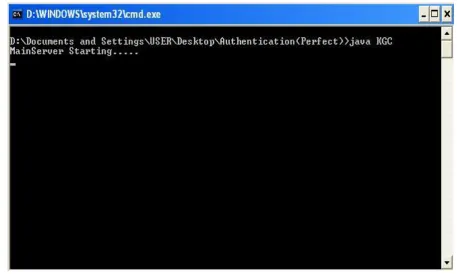
The following Fig. 4.1 shows the initialization of Key Generation Center (KGC) server.
541 | P a g e
The following Fig. 4.2 shows the registration of user A at KGC server.Fig. 4.2: Registration of user A at KGC server.
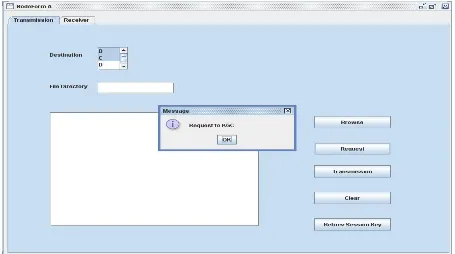
The following Fig. 4.3 shows user A sending group communication request to KGC server with a list of group
members as {A,B,C}.
542 | P a g e
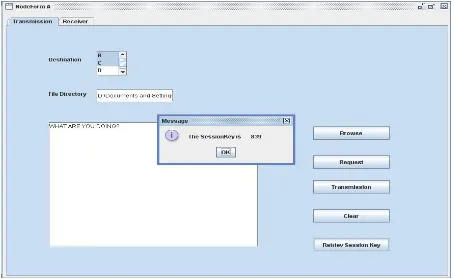
The following Fig. 4.4 shows user A encrypting the first message using the initial common session key andsending the data to the users B and C.
Fig. 4.4: Encryption of message using initial common session key.
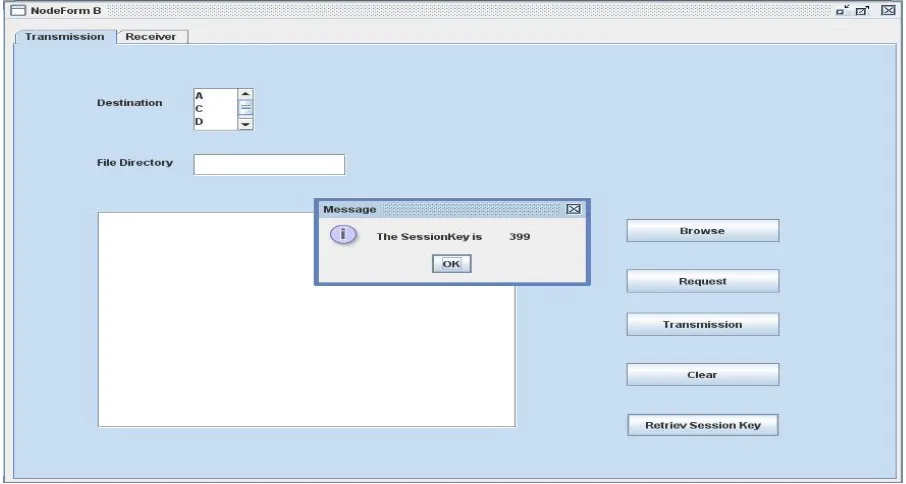
The following Fig. 4.5 shows user B decrypting the message sent by user A using the initial common session
key.
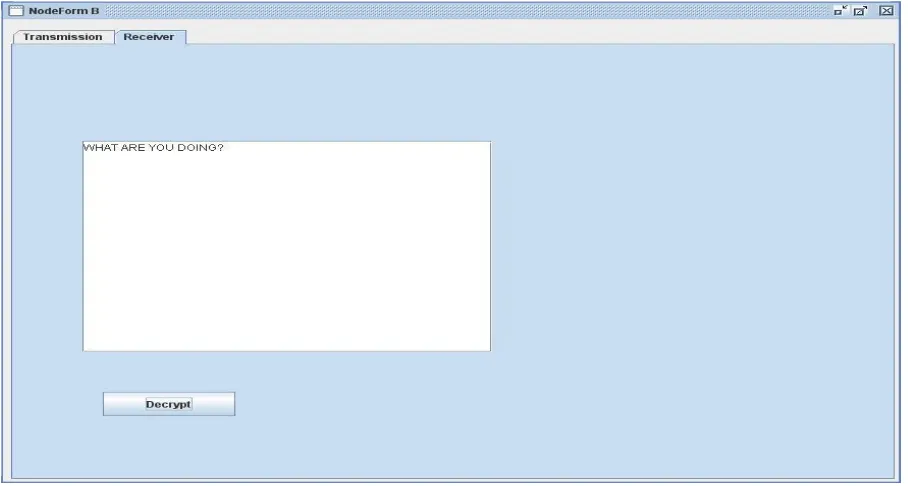
543 | P a g e
The following Fig. 4.6 shows the message obtained at user B after decryption.Fig. 4.6: The message obtained at user B after decryption.
The following Fig. 4.7 shows user A encrypting the second message using the new common session key and
sending the data to the users B and C.
544 | P a g e
The following Fig. 4.8 shows user B decrypting the message sent by user A using the new common session key.Fig. 4.8: Decryption of message using the new common session key.
The following Fig. 4.9 shows the message obtained at user B after decryption.
545 | P a g e
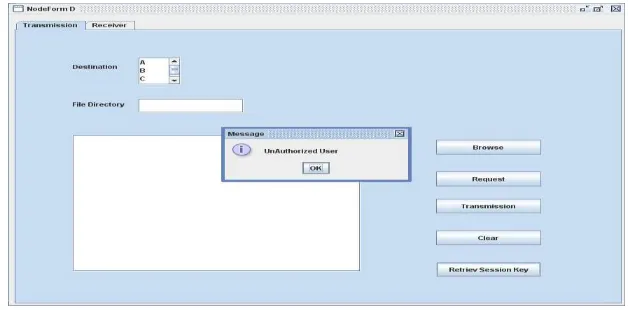
The following Fig. 4.10 shows the identification of user D as unauthorized user as it is not included in the groupfor communication by the user A.
Fig. 4.10: Identification of unauthorised user.
V. CONCLUSION
We have proposed a novel key transfer protocol based on secret sharing scheme. Every user needs to register at
the trusted KGC initially and preshare a secret with KGC. KGC broadcasts a set of key values to all group
members at once by using the key transfer protocol. Only authorized group members can recover the set of key
values and thus providing confidentiality and authentication. We have also proposed a method where the set of
key values is used to generate multiple session keys which are used to encrypt / decrypt different messages
during group communication, which is secure under chosen-plaintext attacks. The main security goals achieved
by our system are key freshness, key confidentiality and key authentication.
REFERENCES
[1] R. Blom, “An Optimal Class of Symmetric Key Generation Systems,” Proc. Eurocrypt ’84 Workshop
Advances in Cryptology, pp. 335-338, 1984.
[2] C. Blundo, A. De Santis, A. Herzberg, S. Kutten, U. Vaccaro, and M. Yung, “Perfectly Secure Key
Distribution for Dynamic Conferences,” Information and Computation, vol. 146, no. 1, pp. 1-23, Oct. 1998.
[3] C. Boyd, “On Key Agreement and Conference Key Agreement,” Proc. Second Australasian Conf.
Information Security and Privacy (ACISP ’97), pp. 294-302, 1997.
[4] W. Diffie and M.E. Hellman, “New Directions in Cryptography,” IEEE Trans. Information Theory, vol.
IT-22, no. 6, pp. 644-654, Nov. 1976.
[5] A. Fiat and M. Naor, “Broadcast Encryption,” Proc. 13th Ann. Int’l Cryptology Conf. Advances in
Cryptology (Crypto ’93), pp. 480-491, 1994.
[6] IEEE 802.11i-2004: Amendment 6: Medium Access Control (MAC) Security Enhancements, 2004.
[7] C. Laih, J. Lee, and L. Harn, “A New Threshold Scheme and Its Application in Designing the Conference
Key Distribution Cryptosystem,” Information Processing Letters, vol. 32, pp. 95-99, 1989.
[8] G. Saze, “Generation of Key Predistribution Schemes Using Secret Sharing Schemes,” Discrete Applied