A Forward-Reverse Brascamp-Lieb Inequality:
Entropic Duality and Gaussian Optimality
Jingbo Liu1*, Thomas A. Courtade2, Paul W. Cuff3, Sergio Verdú1
1 Department of Electrical Engineering, Princeton University, Princeton, NJ, 08544;
{jingbo,verdu}@princeton.edu
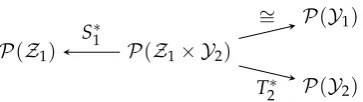
2 Department of Electrical Engineering and Computer Sciences, University of California, Berkeley, Berkeley,
CA, 94720-1770; [email protected] 3 Renaissance Technologies; [email protected]
* Correspondence: [email protected]
Abstract: Inspired by the forward and the reverse channels from the image-size characterization 1
problem in network information theory, we introduce a functional inequality which unifies 2
both the Brascamp-Lieb inequality and Barthe’s inequality, which is a reverse form of the 3
Brascamp-Lieb inequality. For Polish spaces, we prove its equivalent entropic formulation using 4
the Legendre-Fenchel duality theory. Capitalizing on the entropic formulation, we elaborate on a 5
“doubling trick” used by Lieb and Geng-Nair to prove the Gaussian optimality in this inequality for 6
the case of Gaussian reference measures. 7
Keywords: Brascamp-Lieb inequality; hypercontractivity; functional-entropic duality; Gaussian 8
optimality; network information theory; image size characterization 9
1. Introduction 10
The Brascamp-Lieb inequality and its reverse [1] concern the optimality of Gaussian functions in 11
a certain type of integral inequality.1These inequalities have been generalized in various ways since 12
their discovery, nearly 40 years ago. A modern formulation due to Barthe [5] may be stated as follows:2 13
Brascamp-Lieb Inequality and Its Reverse([5, Theorem 1]). Let E, E1, . . . , Embe Euclidean spaces, and Bi:E→Eibe linear maps. Let(ci)mi=1and D be positive real numbers. Then theBrascamp-Lieb inequality
Z m
∏
i=1fci
i (Bix)dx≤D m
∏
i=1Z
fi(xi)dxi ci
, (1)
for all nonnegative measurable functions fi on Ei, i = 1, . . . ,m, holds if and only if it holds whenever fi, i = 1, . . . ,m are centered Gaussian functions3. Similarly, for F a positive real number, thereverse Brascamp-Lieb inequality, also known asBarthe’s inequality4,
Z
sup
(yi): ∑mi=1ciB∗iyi=x
m
∏
i=1fci
i (yi)dx≥F m
∏
i=1Z
fi(yi)dyi ci
, (2)
for all nonnegative measurable functions fion Ei, i =1, . . . ,m, holds if and only if it holds for all centered 14
Gaussian functions. 15
1 Not to be confused with the “variance Brascamp-Lieb inequality” (cf. [2][3][4]), which generalizes the Poincaré inequality. 2 [5, Theorem 1] actually contains additional assumptions, which make the best constantsDandFpositive and finite, but are
not really necessary for the conclusion to hold ([5, Remark 1]).
3 A centered Gaussian function is of the formx7→exp(r−x>Ax), whereAis a positive semidefinite matrix andr∈
R.
4 B∗
i denotes the adjoint ofBi.
For surveys on the history of both the Brascamp-Lieb inequality and Barthe’s inequality and their applications, see e.g. [6][7]. The Brascamp-Lieb inequality can be seen as a generalization of several other inequalities, including Hölder’s inequality, the sharp Young inequality, the Loomis-Whitney inequality, the entropy power inequality (cf. [6] or the survey paper [8]), hypercontractivity and the logarithmic Sobolev inequality [9]. Furthermore, the Prékopa-Leindler inequality can be seen as a special case of the Barthe’s inequality. Due in part to their utility in establishing impossibility bounds, these functional inequalities have attracted a lot of attention in information theory [10][11][12][13][14][15][16][17], theoretical computer science [18][19][20][21][22], and statistics [23][24][25][26][27][28], to name only a small subset of the literature. Over the years, various proofs of these inequalities have been proposed [1][29][30][31]. Among these, Lieb’s elegant proof [29], which is very close to one of the techniques that will be used in this paper, employs a doubling trick that capitalizes on the rotational invariance property of the Gaussian function: if f is a one-dimensional Gaussian function, then
f(x)f(y) = f
x√−y 2
f
x√+y
2
. (3)
Since (1) and (2) have the same structure modulo the direction of the inequality, a common viewpoint is to consider (1) and (2) as dual inequalities. This viewpoint successfully captures the geometric aspects of (1) and (2). Indeed, it is known that
D·F=1 (4)
as long asD,F<∞[5]. Moreover, bothDandFare equal to 1 under Ball’sgeometric condition[32]:E1, . . . ,Emare dimension 1 and
m
∑
i=1ciBiB∗i =I (5)
is the identity matrix. While fruitful, this “dual” viewpoint does not fully explain the asymmetry 16
between the forward and the reverse inequalities: there is a sup in (2) but not in (1). 17
This paper explores a different viewpoint. In particular, we propose a single inequality that unifies 18
(1) and (2). Accordingly, we should reverse both sides of (2) to make the inequality sign consistent 19
with (1). To be concrete, let us first observe that (1) and (2) can be respectively restated in the following 20
more symmetrical forms (with changes of certain symbols): 21
• For all nonnegative functionsgand f1, . . . ,fmsuch that
g(x)≤ m
∏
i=1fjcj(Bjx), ∀x, (6)
we have
Z
Eg≤D m
∏
j=1Z
Ej
fj !cj
. (7)
• For all nonnegative measurable functionsg1, . . .gland f such that l
∏
i=1gbi
i (zi)≤ f( l
∑
i=1we have
l
∏
i=1Z
Ei
gi bi
≤D
Z
Ef. (9)
Note that in both cases, the optimal choice of one function (f org) can be explicitly computed from the constraints, hence the conventional formulations in (1) and (2). Generalizing further, we can consider the following problem: letX,Y1, . . . ,Ym,Z1, . . . ,Zlbe measurable spaces. Consider measurable maps φj:X → Yj, j = 1, . . . ,mandψ: X → Zi,i = 1, . . . ,l. Letb1, . . . ,bl andc1, . . . ,cmbe nonnegative real numbers. Letν1, . . . ,νl be measures on Z1, . . . ,Zl, andµ1, . . . ,µm be measures onY1, . . . ,Ym, respectively. What is the smallestD > 0 such that for all nonnegative f1, . . . ,fmonY1, . . .Ymand g1, . . . ,glonZ1, . . . ,Zl satisfying
l
∏
i=1gbi
i (ψi(x))≤ m
∏
j=1fjcj(φj(x)), ∀x, (10)
we have
l
∏
i=1Z
gidνi bi
≤D m
∏
j=1Z
fjdµj cj
? (11)
Except for special case ofl=1 (resp.m=1), it is generally not possible to deduce a simple expression 22
from (10) for the optimal choice ofgi(resp. fj) in terms of the rest of the functions. We will refer to (11) 23
as aforward-reverse Brascamp-Lieb inequality. 24
One of the motivations for considering multiple functions on both sides of (11) comes from 25
multiuser information theory: independently but almost simultaneously with the discovery of the 26
Brascamp-Lieb inequality in mathematical physics, in the late 1970s, information theorists including 27
Ahslwede, Gács and Körner [33][34] invented theimage-sizetechnique for proving strong converses 28
in source and channel networks. An image-size inequality is a characterization of the tradeoff of 29
the measures of certain sets connected by given random transformations (channels). Although not 30
the way treated in [33][34], an image-size inequality can essentially be obtained from a functional 31
inequality similar to (11) by taking the functions to be (roughly speaking) the indicator functions of 32
sets. In the case of (10), theforward channelsφ1, . . . ,φmand thereverse channelsψ1, . . . ,ψl degenerate 33
into deterministic functions. In this paper, motivated by information theoretic applications similar 34
to those of the image-size problems, we will consider further generalizations of (11) to the case 35
of random transformations. Since the functional inequality is not restricted to indicator functions, 36
it is strictly stronger than the corresponding image-size inequality. As a side remark, [35] uses 37
functional inequalities that are variants of (11) together with a reverse hypercontractivity machinery to 38
improve the image-size plus blowing-up machinery of [36], and shows that the non-indicator function 39
generalization is crucial for achieving the optimal scaling of the second-order rate expansion. 40
Of course, to justify the proposal of (11) we must also prove that (11) enjoys certain nice 41
mathematical properties; this is the main goal of the present paper. Specifically, we focus on two 42
aspects of (11): equivalent entropic formulation and Gaussian optimality. 43
In the mathematical literature (e.g. [31][37][38][33][39][40][41][42][43])) it is known that certain 44
integral inequalities are equivalent to inequalities involving relative entropies. In particular, Carlen, 45
Loss and Lieb [44] and Carlen and Cordero-Erausquin [31] proved that the Brascamp-Lieb inequality 46
is equivalent to the superadditivity of relative entropy. In this paper we prove that the forward-reverse 47
Brascamp-Lieb inequality (11) also has an entropic formulation, which turns out to be very close to 48
the rate region of certain multiuser information theory problems (but we will clarify the different in 49
the text). In fact, Ahlswede, Csiszár and Körner [36][34] essentially derived image-size inequalities 50
corresponding entropic inequality is more involved than the forward case considered in [31] beyond the 52
case of finiteX,Yj,Zi, and certain machineries from min-max theory appear necessary. In particular, 53
the proof involves a novel use of the Legendre-Fenchel duality theory. Next, we give a basic version of 54
our main result on the functional-entropic duality (more general versions will be given later).In order 55
to streamline its presentation, all formal definitions of notation are postponed to Section2. 56
Theorem 1(Dual formulation of forward-reverse Brascamp-Lieb inequality). Assume that 57
i) m and l are positive integers, d∈R,X is a compact metric space; 58
ii) bi ∈(0,∞),νiis a finite Borel measure on a Polish spaceZi, and QZi|X is a random transformation fromX 59
toZi, for each i=1, . . . ,l; 60
iii) cj ∈(0,∞),µjis a finite Borel measure on a Polish spaceYj, and QYj|Xis a random transformation from 61
X toYi, for each j=1, . . . ,m; 62
iv) For any (PZi)
l
i=1 such that ∑li=1D(PZikνi) < ∞, there exists PX such that PX → QZi|X → PZi, 63
i=1, . . . ,l and∑mj=1D(PYjkµj)<∞, where PX →QYj|X →PYj, j=1, . . . ,m. 64
Then the following two statements are equivalent: 65
1. If the nonnegative continuous functions(gi),(fj)are bounded away from0and satisfy l
∑
i=1biQZi|X(gi)≤
m
∑
j=1cjQYj|X(fj) (12)
then
l
∏
i=1Z
gidνi bi
≤exp(d) m
∏
j=1Z
fjdµj cj
(13)
2. For any(PZi)such that D(PZikνi)<∞5, i=1, . . . ,l, l
∑
i=1biD(PZikνi) +d≥infP X
m
∑
j=1cjD(PYjkµj) (14)
where PX →QYj|X →PYj, j= 1, . . . ,m, and the infimum is over PX such that PX → QZi|X →PZi, 66
i=1, . . . ,l. 67
Next, in a similar vein as the proverbial result that “Gaussian functions are optimal” for the 68
forwardor the reverse Brascamp-Lieb inequality, we show in this paper that Gaussian function 69
functions are also optimal for the forward-reverse Brascamp-Lieb inequality, particularized to the case 70
of Gaussian reference measures and linear maps. The proof scheme is based on rotational invariance 71
(3), which can be traced back in the functional setting to Lieb [29]. More specifically, we use a variant 72
for the entropic setting introduced by Geng and Nair [45], thereby taking advantage of the dual 73
formulation of Theorem1. 74
5 Of course, this assumption is not essential (if we adopt the convention that the infimum in (14) is+∞when it runs over an
Forward-reverse Brascamp-Lieb(13)
Forward part
Strong data processing inequality [33]
Reverse hypercontractivity with one negative parameter (115) Reverse part
Hypercontractivity (108) Reverse hypercontractivity with
positive parameters (111)
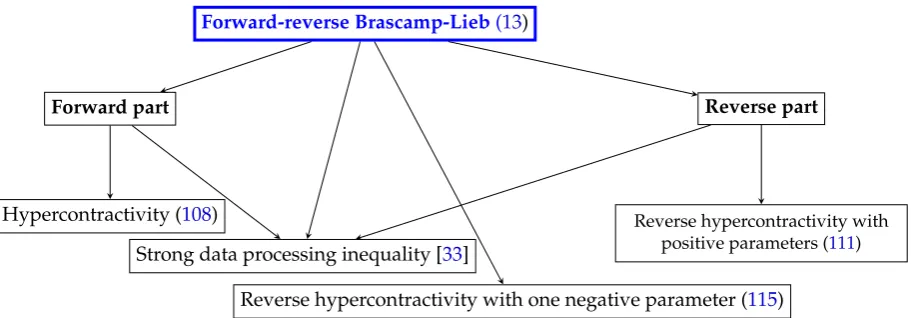
Figure 1. The forward-reverse Brascamp-Lieb inequality generalizes several other functional inequalities/information theoretic inequalities. For more discussions on these relations see the extended version [7].
Theorem 2. Consider b1, . . . ,bl,c1, . . . ,cm,D∈(0,∞). Let E1, . . . ,El,E1, . . . ,Embe Euclidean spaces, and letBji: Ei→Ejbe a linear map for each i∈ {1, . . . ,l}and j∈ {1, . . . ,m}. Then, for all continuous functions
fj:Ej →[0,+∞), gi: Ei→[0,∞)satisfying l
∏
i=1gbi
i (xi)≤ m
∏
j=1fjcj l
∑
i=1Bjixi !
, ∀x1, . . . ,xl, (15)
we have
l
∏
i=1Z
gi bi
≤D m
∏
j=1Z
fj cj
, (16)
if and only if for all centered Gaussian functions f1, . . . ,fm,g1, . . . ,glsatisfying(15), we have(16). 75
As mentioned, in the literature on the forward or the reverse Brascamp-Lieb inequalities, it is 76
known that a certain geometric condition (5) ensures that the best constant equals 1. Next, we also 77
identify a particular case where the best constant in theforward-reverseinequality equals 1: 78
Theorem 3. Let l be a positive integer, and let M := (mji)1≤j≤l,1≤i≤l be an orthogonal matrix. For any nonnegative continuous functions(fj)lj=1(gi)li=1onRsuch that
l
∏
i=1gi(xi)≤ l
∏
j=1fj l
∑
i=1mjixi !
, ∀xl ∈Rl, (17)
we have
l
∏
i=1 Zgi(x)dx≤ l
∏
i=1 Zfj(x)dx. (18)
The rest of the paper is organized as follows: Section2defines notation and reviews some basic 79
theory of convex duality. Section3proves Theorem1and also presents its extensions to the settings 80
of noncompact spaces or general reverse channels. Section4proves the Gaussian optimality in the 81
entropic formulation, under a certain “non-degenerate” assumption where the linear mapsBji’s are 82
argument in AppendixFlets the noise vanish, which, combined with the equivalence between the 84
functional and entropic formulations, establishes Theorem2and Theorem3. 85
2. Review of the Legendre-Fenchel Duality Theory 86
Our proof of the equivalence of the functional and the entropic inequalities uses the 87
Legendre-Fenchel duality theory, a topic from convex analysis. Before getting into that, a recap 88
of some basics on the duality of topological vector spaces seems appropriate. Unless otherwise 89
indicated, we assume Polish spaces and Borel measures6. Of course, this covers the cases of Euclidean 90
and discrete spaces (endowed with the Hamming metric, which induces the discrete topology, making 91
every function on the discrete set continuous), among others. Readers interested in discrete spaces 92
only may refer to the (much simpler) argument in [47] based on the KKT condition. 93
Notation1. LetX be a topological space. 94
• Cc(X)denotes the space of continuous functions onX with a compact support; 95
• C0(X)denotes the space of all continuous functions f onX that vanish at infinity (i.e. for any 96
e>0 there exists a compact setK ⊆ X such that|f(x)|<eforx∈ X \ K); 97
• Cb(X)denotes the space of bounded continuous functions onX; 98
• M(X)denotes the space of finite signed Borel measures onX; 99
• P(X)denotes the space of probability measures onX. 100
We considerCc,C0andCbas topological vector spaces, with the topology induced from the sup 101
norm. The following theorem, usually attributed to Riesz, Markov and Kakutani, is well-known in 102
functional analysis and can be found in, e.g. [48][49]. 103
Theorem 4(Riesz-Markov-Kakutani). IfX is a locally compact,σ-compact Polish space, the dual7of both 104
Cc(X)and C0(X)isM(X). 105
Remark1. The dual space ofCb(X)can be strictly larger thanM(X), since it also contains those linear 106
functionals that depend on the “limit at infinity” of a functionf ∈Cb(X)(originally defined for those 107
f that do have a limit at infinity, and then extended to the wholeCb(X)by the Hahn-Banach theorem; 108
see e.g. [48]). 109
Of course, anyµ∈ M(X)is a continuous linear functional onC0(X)orCc(X), given by f 7→
Z
fdµ (19)
where f is a function inC0(X)orCc(X). As is well known, Theorem4states that the converse is also true under mild regularity assumptions on the space. Thus, we can view measures as continuous linear functionals on a certain function space;8this justifies the shorthand notation
µ(f):= Z
fdµ (20)
which we employ in the rest of the paper. This viewpoint is the most natural for our setting since in 110
the proof of the equivalent formulation of the forward-reverse Brascamp-Lieb inequality we shall use 111
the Hahn-Banach theorem to show the existence of certain linear functionals. 112
6 A Polish space is a complete separable metric space. It enjoys several nice properties that we use heavily in this section,
including Prokhorov theorem and Riesz-Kakutani theorem (the latter is related to the fact that every Borel probability measure on a Polish space is inner regular, hence a Radon measure). Short introductions on the Polish space can be found in e.g. [37][46].
7 The dual of a topological vector space consists of all continuous linear functionals on that space, which is naturally also
topological vector space (with the weak∗topology).
8 In fact, some authors prefer to construct measure theory bydefininga measure as a linear functional on a suitable measure
Definition1. LetΛ: Cb(X) → (−∞,+∞] be a lower semicontinuous, proper convex function. Its Legendre-Fenchel transformΛ∗:Cb(X)∗ →(−∞,+∞]is given by
Λ∗(`):= sup u∈Cb(X)
[`(u)−Λ(u)]. (21)
Letνbe a nonnegative finite Borel measure on a Polish spaceX, and define the convex functional
onCb(X):
Λ(f):=logν(exp(f)) (22)
=log
Z
exp(f)dν. (23)
Then, note that the relative entropy has the following alternative definition: for anyµ∈ M(X),
D(µkν):= sup f∈Cb(X)
[µ(f)−Λ(f)] (24)
which agrees with the more familiar definitionD(µkν):=µ(logddµ
ν)whenνis a probability measure,
113
by the Donsker-Varadhan formula (c.f. [46, Lemma 6.2.13]). Ifµis not a probability measure, then 114
D(µkν)as defined in (24) is+∞. 115
Given a bounded linear operatorT:Cb(Y)→Cb(X), the dual operatorT∗:Cb(X)∗→Cb(Y)∗is defined in terms of
T∗µX:Cb(Y)→R;
f 7→µX(T f), (25)
for anyµX∈Cb(X)∗. SinceP(X)⊆ M(X)⊆Cb(X)∗,Tis said to be aconditional expectation operator 116
ifT∗P∈ P(Y)for anyP∈ P(X). The operatorT∗is defined as the dual of a conditional expectation 117
operatorT, and in a slight abuse of terminology, is said to be arandom transformationfromX toY. 118
For example, in the notation of Theorem1, ifg∈ Cb(Y)andQY|X is a random transformation 119
fromX toY, the quantityQY|X(g)is a function onX, defined by taking the conditional expectation. 120
Also, ifPX ∈ P(X), we writePX→QY|X →PYto indicate thatPY∈ P(Y)is the measure induced on 121
Y by applyingQY|XtoPX. 122
Remark 2. From the viewpoint of category theory (see for example [51][52]), Cb is a functor 123
from the category of topological spaces to the category of topological vector spaces, which is 124
contra-variant because for any continuous, φ: X → Y (morphism between topological spaces), 125
we haveCb(φ):Cb(Y)→Cb(X),u7→u◦f whereu◦φdenotes the composition of two continuous 126
functions, reversing the arrows in the maps (i.e. the morphisms). On the other hand,Mis a covariant 127
functor andM(φ):M(X) → M(Y),µ 7→ µ◦φ−1, whereµ◦φ−1(B) := µ(φ−1(B))for any Borel 128
measurableB ⊆ Y. “Duality” itself is a contra-variant functor between the category of topological 129
spaces (note the reversal of arrows in Fig.2). Moreover,Cb(X)∗ =M(X)andCb(φ)∗=M(φ)ifX 130
andY are compact metric spaces andφ:X → Y is continuous. Definition2can therefore be viewed 131
as the special case whereφis the projection map: 132
Definition2. Supposeφ:Z1× Z2→ Z1,(z1,z2)7→z1is the projection to the first coordinate. 133
• Cb(φ):Cb(Z1)→Cb(Z1× Z2)is called acanonical map, whose action is almost trivial: it sends a 134
function ofzito itself, but viewed as a function of(z1,z2). 135
• M(φ):M(Z1× Z2)→ M(Z1)is calledmarginalization, which simply takes a joint distribution 136
to a marginal distribution. 137
The Fenchel-Rockafellar duality (see [37, Theorem 1.9], or [53] in the case of finite dimensional 138
Theorem 5. Assume that A is a topological vector space whose dual is A∗. Let Θj: A → R∪ {+∞},
j=0, 1, . . . ,k, for some positive integer k. Suppose there exist some(uj)kj=1and u0:=−(u1+· · ·+uk)such that
Θj(uj)<∞, j=0, . . . ,k (26) andΘ0is upper semicontinuous at u0. Then
− inf `∈A∗
" k
∑
j=0Θ∗ j(`)
#
= inf u1,...,uk∈A
"
Θ0 −
k
∑
j=1uj !
+ k
∑
j=1Θj(uj) #
. (27)
For completeness, we provide a proof of this result, which is based on the Hahn-Banach theorem 140
(Theorem6) and is similar to the proof of [37, Theorem 1.9]. 141
Proof. Letm0be the right side of (27). The≤part of (27) follows trivially from the (weak) min-max inequality since
m0= inf u0,...,uk∈A
sup `∈A∗
( k
∑
j=0Θj(uj)−`( k
∑
j=0uj) )
(28)
≥ sup `∈A∗
inf u0,...,uk∈A
( k
∑
j=0Θj(uj)−`( k
∑
j=0uj) )
(29)
=− inf `∈A∗
" k
∑
j=0Θ∗ j(`)
#
. (30)
It remains to prove the≥part, and it suffices to assume without loss of generality thatm0>−∞. Note that (26) also implies thatm0<+∞. Define convex sets
Cj:={(u,r)∈ A×R: r>Θj(u)}, j=0, . . . ,k; (31)
B:={(0,m)∈A×R: m≤m0}. (32)
Observe that these are nonempty sets because of (26). AlsoC0has nonempty interior by the assumption thatΘ0is upper semicontinuous atu0. Thus, the Minkowski sum
C:=C0+· · ·+Ck (33) is a convex set with a nonempty interior. Moreover, C∪B = ∅. By the Hahn-Banach theorem (Theorem6), there exists(`,s)∈ A∗×Rsuch that
sm≤` k
∑
j=0uj !
+s k
∑
j=0rj. (34)
For anym ≤ m0and(uj,rj) ∈ Cj, j = 0, . . . ,k. From (32) we see (34) can only hold whens ≥ 0. Moreover, from (26) and the upper semicontinuity ofΘ0atu0we see the∑kj=0ujin (34) can take value in a neighbourhood of 0 ∈ A, hences 6= 0. Thus, by dividingson both sides of (34) and setting `← −`/s, we see that
m0≤ inf u0,...,uk∈A
" −`
k
∑
j=0uj !
+ k
∑
j=0Θj(uj) #
(35)
=− " k
∑
j=0Θ∗ j(`)
#
which establishes≥in (27). 142
Theorem 6(Hahn-Banach). Let C and B be convex, nonempty disjoint subsets of a topological vector space A. 143
1. If the interior of C is non-empty, then there exists`∈ A∗,`6=0such that sup
u∈B
`(u)≤ inf
u∈C`(u). (37)
2. If A is locally convex, B is compact, and C is closed, then there exists`∈ A∗such that sup
u∈B
`(u)< inf
u∈C`(u). (38)
Remark3. The assumption in Theorem6thatChas nonempty interior is only necessary in the infinite 144
dimensional case. However, even ifAin Theorem5is finite dimensional, the assumption in Theorem5
145
thatΘ0is upper semicontinuous atu0is still necessary, because this assumption was not only used in 146
applying Hahn-Banach, but also in concluding thats6=0 in (34). 147
3. The Entropic-Functional Duality 148
In this section we prove Theorem1and some of its generalizations. 149
3.1. CompactX 150
We first state a duality theorem for the case of compact spaces to streamline the proof. Later we 151
show that the argument can be extended to a particular non-compact case.9Our proof based on the 152
Legendre-Fenchel duality (Theorem5) was inspired by the proof of the Kantorovich duality in the 153
theory of optimal transportation (see [37, Chapter 1], where the idea was credited to Brenier). 154
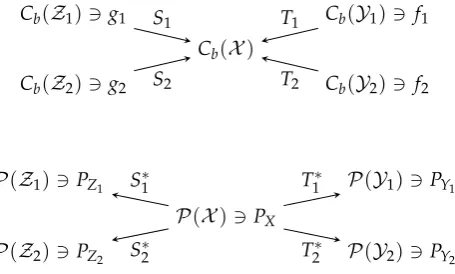
Recall from Section2that a random transformation (a mapping between probability measures) 155
is formally the dual of a conditional expectation operator. SupposePYj|X = T ∗
j, j = 1, . . . ,mand 156
PZi|X =S∗i,i=1, . . . ,l.
Cb(X) Cb(Z1)3g1
Cb(Z2)3g2
Cb(Y1)3 f1
Cb(Y2)3 f2 S1
S2
T1
T2
P(X)3PX P(Z1)3PZ1
P(Z2)3PZ2
P(Y1)3 PY1
P(Y2)3 PY2
S∗1
S∗2
T1∗
T2∗
Figure 2.Diagrams for Theorem1. 157
Proof of Theorem1. We can safely assumed=0 below without loss of generality (since otherwise 158
we can always substituteµ1←exp
d c1
µ1). 159
1)⇒2) This is the nontrivial direction which relies on certain (strong) min-max type results. In Theorem5, put10
Θ0:u∈Cb(X)7→ (
0 u≤0;
+∞ otherwise. (39)
Then,
Θ∗
0:π∈ M(X)7→ (
0 π≥0;
+∞ otherwise. (40)
For eachj=1, . . . ,m, set
Θj(u):=cjinf logµj exp 1 cjv
!!
(41)
where the infimum is overv∈Cb(Y)such thatu=Tjv; if there is no suchvthenΘj(u):= +∞ 160
as a convention. Observe that 161
• Θjis convex: indeed given arbitraryu0andu1, suppose thatv0andv1respectively achieve 162
the infimum in (41) foru0and u1 (if the infimum is not achievable, the argument still 163
goes through by the approximation and limit argument). Then for anyα ∈ [0, 1],vα := 164
(1−α)v0+αv1satisfiesuα=Tjvαwhereuα:= (1−α)u0+αu1. Thus, the convexity ofΘj 165
follows from the convexity of the functional in (23); 166
• Θj(u)>−∞for anyu∈Cb(X). Otherwise, for anyPXandPYj :=T ∗
jPXwe have D(PYjkµj) =sup
v
{PYj(v)−logµj(exp(v))} (42)
=sup v
{PX(Tjv)−logµj(exp(v))} (43)
= sup u∈Cb(X)
(
PX(u)− 1 cjΘj
(cju) )
(44)
= +∞ (45)
which contradicts the assumption that∑m
j=1cjD(PYjkµj)<∞in the theorem; 167
• From the steps (42)-(44), we seeΘ∗j(π) = cjD(Tj∗πkµj)for any π ∈ M(X), where the 168
definition ofD(·kµj)is extended using the Donsker-Varadhan formula (that is, it is infinite 169
when the argument is not a probability measure). 170
Finally, for the given(PZi)li=1, choose
Θm+1: u∈Cb(X)7→ (
∑l
i=1PZi(wi) ifu=∑
l
i=1Siwifor somewi∈Cb(Zi);
+∞ otherwise. (46)
Notice that 171
• Θm+1is convex; 172
• Θm+1is well-defined (that is, the choice of(wi)in (46) is inconsequential). Indeed if(wi)li=1 is such that∑l
i=1Siwi =0, then l
∑
i=1PZi(wi) = l
∑
i=1S∗iPX(wi) (47)
= l
∑
i=1PX(Siwi) (48)
=0, (49)
where PX is such thatS∗iPX = PZi,i = 1, . . . ,l, whose existence is guaranteed by the 173
assumption of the theorem. This also shows thatΘm+1>−∞. 174
•
Θ∗
m+1(π):=sup u
{π(u)−Θm+1(u)} (50)
= sup w1,...,wl
(
π l
∑
i=1Siwi !
− l
∑
i=1PZi(wi) )
(51)
= sup w1,...,wl
( l
∑
i=1S∗iπ(wi)− l
∑
i=1PZi(wi) )
(52)
= (
0 ifS∗iπ=PZi, i=1, . . . ,l;
+∞ otherwise. (53)
Invoking Theorem5(where theujin Theorem5can be chosen as the constant functionuj≡1, j=1, . . . ,m+1):
inf
π:π≥0,S∗iπ=PZi
m
∑
j=1cjD(Tj∗πkµj)
=− inf
vm,wl:∑m
j=1Tjvj+∑il=1Siwi≥0 "m
∑
j=1cjlogµj exp 1 cjvj
!! +
l
∑
i=1PZi(wi) #
(54)
wherevmdenotes the collection of the functionsv1, . . . ,vm, and similarly forwl. Note that the left side of (54) is exactly the right side of (14). For anye>0, choosevj∈ Cb(Yj),j=1, . . . ,m andwi ∈Cb(Zi),i=1, . . . ,lsuch that∑jm=1Tjvj+∑li=1Siwi ≥0 and
e− m
∑
j=1cjlogµj exp 1 cjvj
!! −
l
∑
i=1PZi(wi)> inf
π:π≥0,S∗iπ=PZi m
∑
j=1cjD(Tj∗πkµj) (55)
Now invoking (13) with fj :=expc1
jvj
,j=1, . . . ,mandgi :=exp−1 biwi
,i=1, . . . ,l, we upper bound the left side of (55) by
e− l
∑
i=1bilogνi(gi) + l
∑
i=1biPZi(loggi)≤e+ l
∑
i=1biD(PZikνi) (56)
where the last step follows by the Donsker-Varadhan formula. Therefore (14) is established since 175
2)⇒1) Sinceνiis finite andgiis bounded by assumption, we haveνi(gi)<∞,i=1, . . . ,l. Moreover (13) is trivially true whenνi(gi) =0 for somei, so we will assume below thatνi(gi)∈(0,∞)for eachi. DefinePZi by
dPZi dνi
= gi νi(gi)
, i=1, . . . ,l. (57)
Then for anye>0,
l
∑
i=1bilogνi(gi) = l
∑
i=1bi[PZi(loggi)−D(PZikνi)] (58)
< m
∑
j=1cjPYj(logfj) +e−
m
∑
j=1cjD(PYjkµj) (59)
≤e+ m
∑
j=1cjlogµj(fj) (60)
where 177
• (59) uses the Donsker-Varadhan formula, and we have chosenPX,PYj :=T ∗
jPX,j=1, . . . ,m such that
l
∑
i=1biD(PZikνi)>
m
∑
j=1cjD(PYjkµj)−e (61)
• (60) also follows from the Donsker-Varadhan formula. 178
The result follows sincee>0 can be arbitrary. 179
180
Remark4. Condition iv) in the theorem imposes a rather strong assumption on(Si): for simplicity, 181
consider the case where|X |,|Zi| < ∞. Then Condition iv) assumes that for any(PZi), there exists 182
PXsuch thatPZi =S∗iPX. This assumption is certainly satisfied when(Si)are induced by coordinate 183
projections; the case ofl=1 andPZ|Xbeing a reverse erasure channel gives a simple example where 184
PZ|Xis not a deterministic map. 185
Next we give a generalization of Theorem1which alleviates the restriction on(Si): 186
Theorem 7. Theorem1continues to hold if Condition iv) therein is weakened to the following: 187
• For any PXsuch that D(S∗iPXkνi)<∞, i=1, . . . ,l, there existsP˜Xsuch that S∗iP˜X =S∗iPXfor each i 188
and∑mj=1cjD(Tj∗PX˜ kµj)<∞for each j. 189
and the conclusion of the theorem will be replaced by the equivalence of the following two statements: 190
1. For any nonnegative continuous functions(gi),(fj)bounded away from0and such that l
∑
i=1biSiloggi≤ m
∑
j=1cjTjlogfj (62)
we have
inf
(g˜i): ∑li=1biSilog ˜gi≥∑li=1biSiloggi
l
∏
i=1νibi(gi˜)≤exp(d) m
∏
j=1µ cj
2. For any(PX)such that D(S∗iPXkνi)<∞, i=1, . . . ,l, l
∑
i=1biD(S∗iPXkνi) +d≥ inf ˜
PX:S∗iP˜X=S∗iPX
m
∑
j=1cjD(Tj∗P˜Xkµj). (64)
In AppendixAwe show that Theorem7indeed recovers Theorem1for the more restricted class 191
of random transformations. 192
Proof. Here we mention the parts of the proof that need to be changed: upon specifying(fj)and(gi) right after (55), we select(g˜i)such that
l
∑
i=1biSilog ˜gi ≥ l
∑
i=1biSiloggi (65)
l
∑
i=1bilogνi(g˜i)≤ m
∑
j=1cjlogµj(fj) +e. (66)
Then, in lieu of (67), we upper-bound the left side of (55) by
2e− l
∑
i=1bilogνi(g˜i) + l
∑
i=1biPZi(log ˜gi)≤2e+
l
∑
i=1biD(PZikνi) (67)
which establishes the 1)⇒2) part. For the other direction, for eachi∈ {1, 2, . . . ,l}define
Λi(u):= inf ˜
gi>0 :biSilog ˜gi=u
bilogνi(g˜i). (68)
Then following essentially the same proof as that ofΘjin (41), we see thatΛiis proper convex and
Λ∗
i(π) =biD(S∗iπkµj). (69) Moreover let
Λl+1(u):= (
0 ifu=−∑biSiloggi;
+∞ otherwise. (70)
ThenΛ∗l+1(π) =−∑biS∗iπ(loggi). Using the Legendre-Fenchel duality we see that for anye>0,
inf
(g˜i):∑li=1biSilog ˜gi≥∑li=1biSiloggi
l
∑
i=1bilogνi(gi˜)
= inf u1,...,ul+1
(
Θ0 −
l+1
∑
i=1ui !
+ l+1
∑
i=1Λi(ui) )
(71)
=sup
π
( −
l+1
∑
i=0Θ∗ i(π)
)
(72)
=sup
π≥0
( −
l+1
∑
i=1Θ∗ i(π)
)
(73)
=sup
π≥0
( l
∑
i=1biSi∗π(loggi)− l
∑
i=1biD(S∗iπkνi) )
(74)
≤ l
∑
i=1biS∗iPX(loggi)− l
∑
i=1≤ m
∑
j=1cjTj∗PX˜ (logfj)− m
∑
j=1cjD(Tj∗PX˜ kµj) +2e (76)
≤2e+ m
∑
j=1cjlogµj(fj) (77)
where 193
• To see (75) we note that the sup in (74) can be restricted toπwhich is a probability measure, since 194
otherwise the relative entropy terms in (74) are+∞by its definition via the Donsker-Varadhan 195
formula. Then we selectPXsuch that (75) holds. 196
• In (76), we have chosen ˜PXsuch that
Si∗PX˜ =S∗iPX, 1≤i≤l; (78) l
∑
i=1biD(S∗iPX)> m
∑
j=1cjD(Tj∗PX˜ kµj)−e, (79)
and then applied the assumption (62). The result follows sincee>0 can be arbitrary. 197
198
Remark5. The infimum in (14) is in fact achievable: For any(PZi), there exists aPXthat minimizes 199
∑m
j=1cjD(PYjkµj)subject to the constraintsS ∗
iPX =PZi,i=1, . . .m, wherePYj :=T ∗
jPX,j=1, . . . ,m. 200
Indeed, since the singleton{PZi}is weak∗-closed andS∗i is weak∗-continuous11, the setTl
i=1(Si∗)−1PZi 201
is weak∗-closed in M(X); hence its intersection withP(X) is weak∗-compact in P(X), because 202
P(X)is weak∗-compact by (a simple version for the setting of a compact underlying spaceX of) 203
the Prokhorov theorem [54]. Moreover, by the weak∗-lower semicontinuity ofD(·kµj)(easily seen 204
from the variational formula/Donsker-Varadhan formula of the relative entropy, cf. [55]) and the 205
weak∗-continuity ofTj∗,j=1, . . . ,m, we see that∑m
j=1cjD(Tj∗PXkµj)is weak∗-lower semicontinuous 206
inPX, and hence the existence of a minimizingPXis established. 207
Remark6. Abusing the terminology from min-max theory, Theorem1may be interpreted as a “strong 208
duality” result which establishes the equivalence of two optimization problems. The 1)⇒2) part is the 209
non-trivial direction which requires regularity on the spaces. In contrast, the 2)⇒1) direction can be 210
thought of as a “weak duality” which establishes only a partial relation but holds for more general 211
spaces. 212
3.2. NoncompactX 213
Our proof of 1)⇒2) in Theorem1makes use of the Hahn-Banach theorem, and hence relies 214
crucially on the fact that the measure space is the dual of the function space. Naively, one might want to 215
extend the the proof to the case oflocally compactX by consideringC0(X)instead ofCb(X), so that the 216
dual space is stillM(X). However, this would not work: consider the case whenX =Z1×, . . . ,×Zl 217
and eachSi is the canonical map. ThenΘm+1(u)as defined in (46) is+∞unlessu ≡ 0 (because 218
u ∈ C0(X) requires thatu vanishes at infinity), thusΘ∗m+1 ≡ 0. Luckily, we can still work with 219
Cb(X); in this case`∈Cb(X)∗may not be a measure, but we can decompose it into`=π+Rwhere 220
π∈ M(X)andRis a linear functional “supported at infinity”. Below we use the techniques in [37, 221
Chapter 1.3] to prove a particular extension of Theorem1to a non-compact case. 222
Theorem 8. Theorem1still holds if 223
• The assumption thatX is a compact metric space is relaxed to the assumption that it is a locally compact 224
andσ-compact Polish space; 225
• X =∏li=1Ziand Si:Cb(Zi)→Cb(X), i=1, . . . ,l are canonical maps (see Definition2). 226
Proof. The proof of the “weak duality” part 2)⇒1) still works in the noncompact case, so we only need to explain what changes need to be made in the proof of 1)⇒2) part. LetΘ0be defined as before, in (39). Then for any`∈Cb(X)∗,
Θ∗
0(`) =sup u≤0
`(u) (80)
which is 0 if`is nonnegative (in the sense that`(u)≥0 for everyu≥0), and+∞otherwise. This 227
means that when computing the infimum on the left side of (27), we only need to take into account of 228
those nonnegative`. 229
Next, letΘm+1be also defined as before. Then directly from the definition we have
Θ∗
m+1(`) = (
0 if`(∑iSiwi) =∑iPZi(wi), ∀wi∈Cb(Zi),i=1, . . .l;
+∞ otherwise. (81)
For any`∈C∗b(X). Generally, the condition in the first line of (81) does not imply that`is a measure. However, if`is also nonnegative, then using a technical result in [37, Lemma 1.25] we can further simplify:
Θ∗
m+1(`) = (
0 if`∈ M(X)andS∗i`=PZi, i=1, . . . ,l;
+∞ otherwise. (82)
This further shows that when we compute the left side of (27) the infimum can be taken over`which 230
is a coupling of(PZi). In particular, if`is a probability measure, thenΘ ∗
j(`) =cjD(Tj∗`kµj)still holds 231
with theΘjdefined in (41),j=1, . . . ,m. Thus the rest of the proof can proceed as before. 232
Remark7. The second assumption is made in order to achieve (82) in the proof. 233
4. Gaussian Optimality 234
Recall that the conventional Brascamp-Lieb inequality and its reverse ((1) and (2)) state that 235
centered Gaussian functions exhaust such inequalities, and in particular, verifying those inequalities is 236
reduced to a finite dimensional optimization problem (only the covariance matrices in these Gaussian 237
functions are to be optimized). In this section we show that similar results hold for the forward-reverse 238
Brascamp-Lieb inequality as well. Our proof uses the rotational invariance argument mentioned in 239
Section1. Since the forward-reverse Brascamp-Lieb inequality has dual representations (Theorem8), 240
in principle, the rotational invariance argument can be applied either to the functional representation 241
(as in Lieb’s paper [29]) or the entropic representation (as in Geng-Nair [45]). Here, we adopt the latter 242
approach. We first consider a certain “non-degenerate” case where the existence of an extremizer is 243
guaranteed. Then, Gaussian optimality in the general case follows by a limiting argument (AppendixF), 244
establishing Theorem2and Theorem3. 245
4.1. Non-Degenerate Forward Channels 246
This subsection focuses on the following case: 247
Assumption1. • Fix Lebesgue measures(µj)mj=1and Gaussian measures(νi)li=1onR; 248
• non-degenerate (Definition3below) linear Gaussian random transformation(PYj|X)
m
j=1(where 249
• (Si)li=1are induced by coordinate projections; 251
• positive(cj)and(bi). 252
Definition3. We say(QY1|X, . . . ,QYm|X)isnon-degenerateif eachQYj|X=0is annj-dimensional Gaussian 253
distribution with invertible covariance matrix. 254
Given Borel measuresPXionR,i=1, . . . ,l, define
F0((PXi)):=inf PX
m
∑
j=1cjD(PYjkµj)−
l
∑
i=1biD(PXikνi) (83)
where the infimum is over Borel measuresPXthat has(PXi)as marginals. Note that (83) is well-defined 255
since the first term cannot be+∞under the non-degenerate assumption, and the second term cannot 256
be−∞. The aim of this subsection is to prove the following: 257
Theorem 9. sup(P
Xi)F0((PXi)), where the supremum is over Borel measures PXionR, i=1, . . . ,l, is achieved 258
by some Gaussian(PXi)
l
i=1, in which case the infimum in(83)is achieved by some Gaussian PX. 259
Naturally, one would expect that Gaussian optimality can be established when(µj)mj=1and(νi)li=1 260
are either Gaussian or Lebesgue. We made the assumption that the former is Lebesgue and the latter is 261
Gaussian so that certain technical conditions can be justified more easily. More precisely, the following 262
observation shows that we can regularize the distributions by a second moment constraint for free: 263
Proposition 10. sup(P
Xi)F0((PXi))is finite and there existσ 2
i ∈(0,∞), i=1, . . . ,l such that it equals sup
(PXi):E[Xi2]≤σi2
F0((PXi)). (84)
Proof. when µj is Lebesgue and PYj|X is non-degenerate, D(PYjkµj) = −h(PYj) ≤ −h(PYj|X) is 264
bounded above (in terms of the variance of additive noise ofPYj|X). Moreover,D(PXikνi)≥0 whenνi 265
is Gaussian, so sup(P
Xi)F0((PXi))<∞. Further, choosing(PXi) = (νi)and using the covariance matrix 266
to lower bound the first term in (83) shows that sup(P
Xi)F0((PXi))>−∞. 267
To see (84), notice that
D(PXikνi) =D(PXikν 0
i) +E[ıνi0kνi(X)] (85)
=D(PXikν 0
i) +D(νi0kνi) (86)
≥D(νi0kνi) (87)
where ν0i is a Gaussian distribution with the same first and second moments as Xi ∼ PXi. Thus 268
D(PXikνi)is bounded below by some function of the second moment ofXiwhich tends to∞as the 269
second moment ofXitends to∞. Moreover, as argued in the preceding paragraph the first term in 270
(83) is bounded above by some constant depending only on(PYj|X). Thus, we can chooseσi2 > 0, 271
i = 1, . . . ,llarge enough such that ifE[Xi2] > σi2for some ofithen F0((PXi)) < sup(PXi)F0((PXi)), 272
irrespective of the choices ofPX1, . . . ,PXi−1,PXi+1, . . . ,PXl. Then theseσ1, . . . ,σlare as desired in the 273
proposition. 274
The non-degenerate assumption ensures that the supremum is achieved: 275
Proposition 11. Under Assumption1, 276
2. If(PYj|Xl)mj=1are non-degenerate (Definition3), then the supremum in(84)is achieved by some Borel 278
(PXi)il=1. 279
The proof of Proposition 11 is given in Section E. After taking care of the existence of the 280
extremizers, we get into the tensorization properties which are the crux of the proof: 281
Lemma 12. Fix(P
Xi(1)),(PX(i2)),(µj),(Tj),(cj)∈[0,∞)
m, and let S
jbe induced by coordinate projections. Then
inf P
X(1,2):S ∗⊗2
i PX(1,2)=PXi(1)×PX(i2)
m
∑
j=1cjD(P Yj(1,2)kµ
⊗2 j ) =
∑
t=1,2 m
∑
j=1cj inf
P X(t):S
∗
iPX(t)=P
X(it)
D(P
Yj(t)kµj) (88)
where for each j,
P
Yj(1,2):=T ∗⊗2
j PX(1,2) (89)
on the left side and
PY(t)
j
:=Tj∗⊗2PX(t) (90)
on the right side, t=1, 2. 282
Proof. We only need to prove the nontrivial≥part. For anyPX(1,2)on the left side, choosePX(t)on the
right side by marginalization. Then
D(PY(1,2)
j
kµ⊗2j )−
∑
tD(PY(t)
j
kµj) =I(Yj(1);Yj(2)) (91)
≥0 (92)
for eachj. 283
We are now ready to show the main result of this section. 284
Proof of Theorem9. 1. Assume that(PX(1)
i
)and(PX(2)
i
)are maximizers ofF0(possibly equal). Let PX1,2
i :
=P
X(i1)×PX(i2). Define
X+ := √1 2
X(1)+X(2); (93)
X− := √1 2
X(1)−X(2). (94)
Define(Yj+)and(Yj−)analogously. ThenYj+|{X+ =x+,X−=x−} ∼QYj|X=x+ is independent 285
ofx−andYj−|{X+=x+,X− =x−} ∼QYj|X=x−is independent ofx+. 286
2. Next we perform the same algebraic expansion as in the proof of tensorization:
2
∑
t=1F0
PX(t)
i l
i=1 !
= inf
P X(1,2):S
∗⊗2
j PX(1,2)=PX(j1,2)
∑
jcjD(PY(1,2)
j
kµ⊗2j )−
∑
ibiD(PX(1,2)
i
kνi⊗2) (95)
= inf
PX+X−:Sj∗⊗2PX+X−=PX+
j X−j
∑
jcjD(PYj+Yj−kµ ⊗2 j )−
∑
i
biD(PX+i X−i kν ⊗2 i )
≤ inf PX+X−:Sj∗⊗2PX+X−=PX+
j X − j
∑
j cjD(PY+
j kµj) +D(PYj−|X+kµj|PX
+) −
∑
i bi hD(PX+
i kνi) +D(PX
−
i |X
+
i kνi|PX
+ i ) i (97) ≤
∑
j cjD(PY?+
j
kµj) +D(PY?−
j |X+
kµj|PX?+)
−
∑
ibihD(PX?+
i
kνi) +D(PX?−
i |X+
kνi|PX?+)
i
(98)
=F0
PX?+
i l
i=1 + Z F0 PX?−
i |X+ l
i=1
dPX?+ (99)
≤ 2
∑
t=1F0
PX(t)
i l
i=1 !
(100)
where 287
• (95) uses Lemma12. 288
• (97) is because of the Markov chainYj+−X+−Yj−(for any coupling). 289
• In (98) we selected a particular instance of couplingPX+X−, constructed as follows: first we select an optimal couplingPX+ for given marginals(PX+
i ). Then, for anyx
+= (x+
i )li=1, let PX−|X+=x+ be an optimal coupling of(PX−
i |X
+
i =x
+
i ).
12 With this construction, it is apparent
thatXi+−X+−Xi−and hence D(PX−
i |X
+
i kνi|PX
+
i ) =D(PX−i |X+kνi|PX
+). (101)
• (99) is because in the above we have constructed the coupling optimally. 290
• (100) is because(PX(t)
i)maximizesF0,t=1, 2. 291
3. Thus in the expansions above, equalities are attained throughout. Using the differentiation technique as in the case of forward inequality, for almost all(bi),(cj), we have
D(PX−
i |X
+
i kνi|PX
+
i ) =D(PX
+
i kνi) (102)
=D(PX−
i kνi), ∀i (103)
where (103) is because by symmetry we can perform the algebraic expansions in a different way to 292
show that(PX−
i )is also a maximizer ofF0. ThenI(X
+
i ;X −
i ) =D(PX−i |Xi+kνi|PX+i )−D(PXi−kνi) = 293
0, which, combined with I(Xi(1);Xi(2)), shows that X(i1)andX(i2)are Gaussian with the same 294
covariance. Lastly, using Lemma12 and the doubling trick one can show that the optimal 295
coupling is also Gaussian. 296
297
4.2. A Geometric Forward-Reverse Brascamp-Lieb Inequality 298
In this section we give a sketch of the proof of Theorem3which is simple but certain ‘technicalities” 299
are not justified. A detailed proof is deferred to AppendixF. 300
Proof Sketch for Theorem3. By duality (Theorem8) it suffices to prove the corresponding entropic inequality. The Gaussian optimality result in Theorem9assumed Gaussian reference measures on the output and non-degenerate forward channels in order to simplify the proof of the existence of
12 For a justification that we can select optimal couplingP
minimizers; however, supposing that Gaussian optimality extends beyond those technical conditions, then we see that it suffices to prove that for any centered Gaussian(PXi),
l
∑
i=1h(PXi)≤sup PXl
l
∑
j=1h(PYj) (104)
where the supremum is over GaussianPXl with the marginalsPX1, . . . ,PXl, andYj :=∑li=1mjiXi. Let
ai :=E[Xi2]and choosePXl =∏li=1PXi, we see (104) holds if
l
∑
i=1logai≤ l
∑
j=1log l
∑
i=1m2jiai !
, ∀ai >0,i=1, . . . ,l, (105)
where(ai)are the eigenvalues and∑l i=1mjiai
l
i=1are the diagonal entries of the matrix
Mdiag(ai)1≤i≤lM>. (106) Therefore (105) holds.
301
5. Relation to Hypercontractivity and Its Reverses 302
As alluded before and illustrated by Figure1, the forward-reverse Brascamp-Lieb inequality 303
generalizes several other inequalities from functional analysis and information theory; A more 304
complete discussion on these relationships can be found in [7]. In this section, we focus on 305
hypercontractivity, and show how its three cases all follow from Theorem 1. Among these, the 306
case in Section5.3can be regarded as an instance of the forward-reverse inequality that cannot be 307
reduced to either the forward or the reverse inequality alone. It is also interesting to note that, from 308
the viewpoint of the forward-reverse Brascamp-Lieb inequality, in each of the three special cases there 309
ought to be three functions involved in the functional formulation; but the optimal choice of one 310
function can be computed from the other two. Therefore the conventional functional formulations 311
of the three cases of hypercontractivity involve only two functions, making it non-obvious to find a 312
unifying inequality. 313
5.1. Hypercontractivity 314
P(Y1× Y2) P(Z1)
P(Y1)
P(Y2) ∼
=
T1∗
T2∗
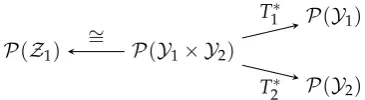
Figure 3.Diagram for hypercontractivity
Fix a joint probability distributionQY1Y2 and nonnegative continuous functionsF1andF2onY1
andY2, respectively, both bounded away from 0. In Theorem1, takel←1,m←2,b1←1,d ←0, f1←F
1
c1
1 , f2←F
1
c2
2 ,ν1←QY1Y2,µ1←QY1,µ2←QY2. Also, putZ1=X= (Y1,Y2), and letT1andT2
be the canonical maps (Definition2). The constraint (12) translates to
and the optimal choice ofg1is when the equality is achieved. We thus obtain the equivalence between13 kF1k1
c1kF2kc12 ≥E[F1(Y1)F2(Y2)], ∀F1∈ L
1
c1(Q
Y1),F2∈ L 1
c2(Q
Y2) (108)
and
∀PY1Y2, D(PY1Y2kQY1Y2)≥c1D(PY1kQY1) +c2D(PY2kQY2). (109)
This equivalence can also be obtained from Theorem1. By Hölder’s inequality, (108) is equivalent to 315
saying that the norm of the linear operator sendingF1∈ L
1
c1(QY
1)toE[F1(Y1)|Y2=·]∈ L 1 1−c2(QY
2)
316
does not exceed 1. The interesting case is1−1c
2 >
1
c1, hence the name hypercontractivity. The equivalent
317
formulation of hypercontractivity was shown in [41] using a different proof via the method of 318
types/typicality, which requires that|Y1|,|Y2|<∞. In contrast, the proof based on the nonnegativity 319
of relative entropy removes this constraint, allowing one to prove Nelson’s Gaussian hypercontractivity 320
from the information-theoretic formulation (see [7]). 321
5.2. Reverse Hypercontractivity (Positive Parameters14) 322
P(Z1× Z2) P(Z1)
P(Z2)
P(Y1) S∗1
S∗2
∼ =
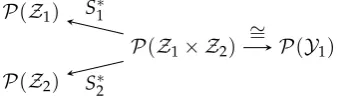
Figure 4.Diagram for reverse hypercontractivity
LetQZ1Z2 be a given joint probability distribution, and letG1andG2be nonnegative functions on
Z1andZ2, respectively, both bounded away from 0. In Theorem1, takel←2,m←1,c1←1,d←0, g1←G
1
b1
1 ,g2←G
1
b2
2 ,µ1←QZ1Z2,ν1←QZ1,ν2←QZ2. Also, putY1=X= (Z1,Z2), and letS1and
S2be the canonical maps (Definition2). Note that the constraint (12) translates to
f1(z1,z2)≥G1(z1)G2(z2), ∀z1,z2. (110) and the equality case yields the optimal choice of f1 for (13). By Theorem1we thus obtain the equivalence between
kG1k1
b1kG2kb12 ≤E[G1(Z1)G2(Z2)], ∀G1,G2 (111)
and
∀PZ1,PZ2,∃PZ1Z2, D(PZ1Z2kQZ1Z2)≤b1D(PZ1kQZ1) +b2D(PZ2kQZ2). (112)
Note that in this setup, ifZ1andZ2 are finite, then Condition iv) in Theorem1is equivalent to 323
QZ1Z2 QZ1×QZ2. The equivalent formulations of reverse hypercontractivity were observed in [56],
324
where the proof is based on the method of types. 325
13 By a standard dense-subspace argument, we see that it is inconsequential thatF
1andF2in (108) are not assumed to be
continuous nor bounded away from zero. It is also easy to see that the nonnegativity ofF1andF2is inconsequential for
(108).
14 By “positive parameters” we mean theb
5.3. Reverse Hypercontractivity (One Negative Parameter15) 326
P(Z1× Y2) P(Z1)
P(Y1)
P(Y2) S∗1
∼ =
T2∗
Figure 5.Diagram for reverse hypercontractivity with one negative parameter
In Theorem1, takel ←1,m←2,c1 ←1,d ←0. LetY1 = X= (Z1,Y2), and letS1andT2be the canonical maps (Definition2). Suppose thatQZ1Y2 is a given joint probability distribution, and
setµ1←QZ1Y2,ν1←QZ1,µ2←QY2 in Theorem1. Suppose thatFandGbe arbitrary nonnegative
continuous functions onY2andZ1, respectively, which are bounded away from 0. Takeg1←G
1
b1,
f2←F −1
c2. in Theorem1. The constraint (12) translates to
f1(z1,y2)≥G(z1)F(y2), ∀z1,y2. (113) Note that (13) translates to
kGk1
b1 ≤QY2Z1(f1)Q
c2
Y2(F
−1
c2) (114)
for allF,G, and f1satisfying (113). It suffices to verify (114) for the optimal choice f1=GF, so (114) is reduced to
kFk 1
−c2kGkb11 ≤E[F(Y2)G(Z1)], ∀F,G. (115)
By Theorem1, (115) is equivalent to
∀PZ1,∃PZ1Y2, D(PZ1Y2kQZ1Y2)≤b1D(PZ1kQZ1) + (−c2)D(PY2kQY2). (116)
Inequality (115) is called reverse hypercontractivity with a negative parameter in [42], where the 327
entropic version (116) is established for|Z1|,|Y2| < ∞using the method of types. Multiterminal 328
extensions of (115) and (116) (called reverse Brascamp-Lieb type inequality with negative parameters 329
in [42]) can also be recovered from Theorem1in the same fashion, i.e., we move all negative parameters 330
to the other side of the inequality so that all parameters become positive. 331
In summary, from the viewpoint of Theorem1, the results in Section5.1,5.2and5.3are degenerate 332
special cases, in the sense that in any of the three cases the optimal choice of one of the functions in (13) 333
can be explicitly expressed in terms of the other functions, hence this “hidden function” disappears in 334
(108), (111) or (115). 335
Acknowledgments: This work was supported in part by NSF Grants CCF-1528132, CCF-0939370 (Center for 336
Science of Information), CCF-1319299, CCF-1319304, CCF-1350595 and AFOSR FA9550-15-1-0180. Jingbo Liu 337
would like to thank Professor Elliott H. Lieb for teaching the Brascamp-Lieb inequality as well as some techniques 338
used in this paper in his graduate class. 339
Author Contributions:All the authors have contributed to the problem formulation, refinement, structuring or 340
editing of the paper. Most of the sections were written by Jingbo Liu. Parts of the sections on the existence of the 341
minimizer and the Gaussian optimality were written by Thomas Courtade. 342
Conflicts of Interest:The authors declare no conflict of interest. 343
15 By “one negative parameter” we mean theb
Appendix A. Recovering Theorem1from Theorem7as a Special Case 344
Assume thatPX →(PZi)is surjective. Let 1Zi denote the constant 1 function onZi. Define
C := (
(wi):wi∈Cb(Zi), l
∑
i=1inf zi
wi(zi)≥0 )
, (A1)
which is a closed convex cone inCb(Z1)× · · · ×Cb(Zl). Given(gi)we show that∑li=1biSilog ˜gi ≥ ∑l
i=1biSiloggiimplies
(bilog ˜gi−biloggi)li=1∈ C. (A2) Indeed, we can verify that the dual cone
C∗ := (
(πi): l
∑
i=1πi(wi)≥0,∀(wi)∈ C )
(A3)
=
λ(PZ1, . . . ,PZl):λ≥0 . (A4)
Under the surjectivity assumption, we see
l
∑
i=1πi(bilog ˜gi−biloggi)≥0, ∀(πi)∈ C∗. (A5)
Now if (A2) is not true, by the Hahn-Banach theorem (Theorem6) we findπi ∈ M(Zi),i=1, . . . ,l such that
l
∑
i=1πi(bilog ˜gi−biloggi)< inf
(wi)∈C
l
∑
i=1πi(wi) (A6)
so right side of (A6) is not−∞. SinceC is a cone containing the origin, the right side of (A6) hence 345
must be nonnegative, and we conclude that(πi)∈ C∗. But then (A6) contradicts (A5). 346
Appendix B. Existence of Weakly Convergent Couplings 347
Lemma 13. Suppose that for each i = 1, . . . ,l, PXi is a Borel measure onRand PX(ni) converges weakly to 348
some absolutely continuous (with respective to the Lebesgue measure) PXi as n →∞. If PXis a coupling of 349
(PXi)1≤i≤l, then, upon extraction of a subsequence, there exist couplings P
(n)
X for(P
(n)
Xi )1≤i≤l which converge 350
weakly to PXas n→∞. 351
Proof. For each integerk≥1, define the random variableWi[k] :=φk(Xi)whereφk:R→R∪ {e}is
the following “dyadic quantization function”:
φk: x7→ (
b2kxc |x| ≤k,x∈/2−k
Z;
e otherwise, (A7)
and letW[k] := (Wi[k])li=1. Denote byW[k] := {−k2k, . . . ,k2k−1,e}the set from whichW[k] i takes values. Note that sincePXi is assumed to be absolutely continuous, the set of “dyadic points” has measure zero:
PXi ∞
[
k=1 2−kZ
!
SincePX(n)
i →PXi weakly and the assumption in the preceding paragraph precluded any positive
mass on the quantization boundaries underPXi, for eachk≥1 there exists somen:=nklarge enough
such that
P(n) Wi[k](w)≥
1−1
k
P
Wi[k](w), (A9)
for eachiandw ∈ W[k]. Now define a coupling P(n)
W[k] compatible with the
P(n)
Wi[k] l
i=1
induced by
PX(n)
i l
i=1, as follows:
PW(n[)k]:=
1−1
k
PW[k]+kl−1
l
∏
i=1P(n)
Wi[k]−
1−1 k
PW[k]
i
. (A10)
Observe that (A10) is a well-defined probability measure because of (A9), and indeed has marginals
P(n) Wi[k]
l
i=1
. Moreover, by the triangle inequality we have the following bound on the total variation
distance
P
(n)
W[k]−PW[k]
≤
2
k. (A11)
Next, construct16 PX(n):
PX(n):=
∑
wl∈W[k]×···×W[k]P(n)
W[k]
wl
∏l i=1P
(n)
Wi[k](wi) l
∏
i=1PX(n)
i |φ−k1(wi). (A12)
Observe thatPX(n) defined in (A12) is compatible with the P(n)
W[k] defined in (A10), and indeed has
marginals(PX(n)
i )
l
i=1. Since n := nk can be made increasing ink, we have constructed the desired sequence(P(nk)
X )∞k=1converging weakly toPX. Indeed, for any bounded opendyadic cube17 A, using
(A11) and the assumption (A8), we conclude
lim inf k→∞ P
(nk)
X (A)≥PX(A). (A13)
Moreover, since bounded open dyadic cubes form a countable basis of the topology inRl, we see 352
(A13) actually holds for any open setA(by writingAas a countable union of dyadic cubes, using the 353
continuity of measure to pass to a finite disjoint union, and then apply (A13)), as desired. 354
Appendix C. Upper Semicontinuity of the Infimum 355
The following is a consequence of Lemma13. 356
16 We useP|
Ato denote the restriction of a probability measurePon measurable setA, that is,P|A(B):=P(A ∩ B)for any measurableB.
Corollary 14. Consider non-degenerate(PYj|X). For each n≥1, i=1, . . . ,l, P
(n)
Xi is a Borel measure onR,
whose second moment is bounded byσi2<∞. Assume that PX(n)
i converges to some absolutely continuous P
? Xi
for each i. Then
lim sup
n→∞ PX:S∗iinfPX=P
(n)
Xi
m
∑
j=1cjD(Tj∗PXkµj)≤ inf PX:Si∗PX=PXi?
m
∑
j=1cjD(Tj∗PXkµj). (A14)
Proof. By passing to a convergent subsequence, we may assume that the limit on the left side of (A14) exists. For any couplingP?
Xof(PX?i), by invoking Lemma13and passing to a subsequence, we find a
sequence of couplingsPX(n)of(PX(n)
i )that converges weakly toP
?
X. It is known that under a moment
constraint, the differential entropy of the output distribution of a non-degenerate Gaussian channel enjoys weak continuity in the input distribution (see e.g. [45, Proposition 18], [57, Theorem 7], or [58, Theorem 1, Theorem 2]). Thus
lim n→∞
m
∑
j=1cjD(Tj∗PX(n)kµj) = m
∑
j=1cjD(Tj∗PXkµj) (A15)
and (A14) follows sincePX?was arbitrarily chosen. 357
Appendix D. Weak Semicontinuity of Differential Entropy under a Moment Constraint 358
Lemma 15. Suppose(PXn)is a sequence of distributions onRdconverging weakly to PX?, and
E[XnX>n]Σ (A16)
for all n. Then
lim sup n→∞ h(Xn
)≤h(X?). (A17)
Remark8. The result fails without the condition (A16). Also, related results when the weak convergence 359
is replaced with pointwise convergence of density functions and certain additional constraints was 360
shown in [58, Theorem 1, Theorem 2] (see also the proof of [45, Theorem 5]). Those results are not 361
applicable here since the density functions ofXndo not converge pointwise. They are applicable for 362
the problems discussed in [45] because the density functions of the output of the Gaussian random 363
transformation enjoy many nice properties due to the smoothing effect of the “good kernel”. 364
Proof. It is well known that in metric spaces and for probability measures, the relative entropy is weakly lower semicontinuous (cf. [55]). This fact and a scaling argument immediately show that, for anyr>0,
lim sup
n→∞ h(Xn|kXnk ≤r)≤h(X
?|kX?k ≤r). (A18)
Letpn(r):=P[kXnk>r], then (A16) implies
E[XX>|kXnk>r]≤ 1
pn(r)Σ. (A19)
Therefore, since the Gaussian distribution maximizes differential entropy given a second moment upper bound, we have
h(Xn|kXnk>r)≤ 1 2log
(2π)de|Σ|