Journal of Multidisciplinary Healthcare 2019:12 31–42
Journal of Multidisciplinary Healthcare
Dove
press
submit your manuscript | www.dovepress.com 31
R a p i d C o M M u n i C at i o n
open access to scientific and medical research
Open Access Full Text Article
Kuskaya: a training program for collaboration and
innovation in global health
Michelle C Chan1
angela M Bayer1
Joseph R Zunt2
Magaly M Blas1
patricia J Garcia1
1School of public Health and
administration, universidad peruana Cayetano Heredia, Lima, peru; 2departments of neurology
and Global Health, university of Washington, Seattle, Wa, uSa
Abstract: To solve increasingly complex global health problems, health professionals must
collaborate with professionals in non-health-related fields. The Universidad Peruana Cayetano Heredia and University of Washington created the NIH-funded Kuskaya training program in response to the need for transformative global health training for talented graduates from all disciplines. Kuskaya is a 1-year, interdisciplinary training program that teaches Peruvian and US graduates critical skills related to public health research through the design and implementation of a collaborative research project in Peru. Between 2014 and 2018, the program has trained 33 fellows, of which one third were from non-health disciplines. The program is unique because it targets junior trainees from disciplines outside of the health field, the program’s curriculum is adapted to fit the fellows’ backgrounds and professional aspirations, and the structure of the program allows for collaboration within the cohort and encourages fellows to apply for additional funding and pursue advanced degrees. Lessons learned in designing the Kuskaya program include: 1) involving mentors in the fellow selection process, 2) involving fellows in existing lines of research to increase mentor involvement, 3) institutionalizing mentoring through regular works-in-progress meetings and providing mentoring materials, and 4) defining a core curriculum for all fellows while providing additional supplementary materials to meet each cohort’s needs, and evaluating their progress. Kuskaya provides an innovative model for bi-national, global health training to engage and provide a public health career pathway for all professionals.
Keywords: public health, international health, program design, education
Introduction
Globalization has produced a heightened awareness of problems affecting population health that require the expertise and collaboration of multiple disciplines to effectively implement change.1–3 Although solving these problems is difficult, the formation of
cross- and interdisciplinary collaborations between different disciplines, the private and public sectors as well as different levels of government, and thinking “outside of the box” can result in innovative tools, processes, and products to reduce the burden of disease throughout the world.4,5 A diverse range of professionals – from within and outside the
health professions – are often involved in global health projects, with the global agenda becoming more focused on the development and implementation of innovative technolo-gies such as point-of-care diagnostic tests6–8 or e-health.9–11 However, the literature rarely
mentions global health research training for non-health professionals – with the exception of biomedical informatics training.12–15 Global health training programs vary in objec-Correspondence: Michelle C Chan
School of public Health and administration, universidad peruana Cayetano Heredia, av. Honorio delgado 430, San Martín de porres, Lima, peru tel +51 1 319 0000 (extension 245406) Email [email protected]
Journal name: Journal of Multidisciplinary Healthcare Article Designation: Rapid Communication
Year: 2019 Volume: 12
Running head verso: Chan et al
Running head recto: Kuskaya: training program for innovation in global health DOI: http://dx.doi.org/10.2147/JMDH.S173165
Journal of Multidisciplinary Healthcare downloaded from https://www.dovepress.com/ by 118.70.13.36 on 24-Aug-2020
For personal use only.
Dovepress Chan et al
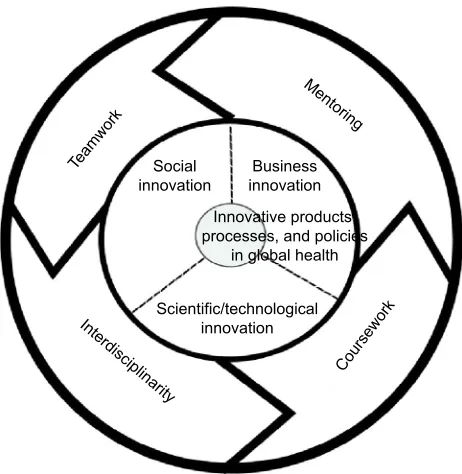
tives, size, duration, intensity, and quality; however, interest-ingly, both global health and innovation literature emphasize the concepts of interdisciplinarity and teamwork,16–22 as well
as mentoring23,24 – particularly in its practical application to
real-world, complex, and global problems (Figure 1). The question remains: How do we broaden global health training to integrate participants from other disciplines?
To this end, herein, we share the experience of an innova-tive global health training program for young professionals from both health and other disciplines that was developed and implemented by the School of Public Health and Administra-tion at the Universidad Peruana Cayetano Heredia (UPCH) in Lima, Peru, and the Department of Global Health at the University of Washington (UW) from 2013 to 2018. Kuskaya: an Interdisciplinary Training Program for Innovation in Global Health, supported by the Fogarty International Center of the US National Institutes of Health (NIH-Fogarty), offers an innovative, interdisciplinary, academic, and field-based program for talented graduates from health and non-health-related disciplines to think creatively about how to develop and implement interventions to address public health issues of critical importance for Peru and of strong relevance to other countries. Kuskaya means “working together” in Quechua – a native language of the Andes.
Prior global health training
initiatives between UW and UPCH
Prior global health training initiatives between the UW and UPCH formed the foundation of the Kuskaya program’s key components, including a strong base of faculty mentors at both institutions, intentional matching of fellow pairs to include at least one from each institution from complemen-tary disciplines, and efforts to continue promising lines of research over subsequent years through UPCH support. A Global Health Demonstration Program in Peru was awarded to UPCH by NIH-Fogarty and implemented between 2005 and 2012 at UPCH,22,25 which resulted in the development
of a 5-year Bachelor’s and Master’s degree in Public Health and Global Health.26 In 2010, the UW and UPCH received
a Framework Programs for Global Health Signature Inno-vations Initiative award funded by the American Recovery and Reinvestment Act. This award allowed us to pilot an interdisciplinary education, training, and mentoring program in Global Health leadership, policy, and management for postdoctoral fellows. Lessons learned from these research training initiatives were used to tailor a new program aimed to help build the next generation of global health leaders working together.
Fellow selection process
Fellowship applications were reviewed by the Fellow Selec-tion Committee, comprised of the Program Directors and Program Coordinator of the Kuskaya program, and two faculty members from the UPCH. Applications were scored according to the synergy and relevance of the proposed research to the existing lines of research; the likelihood of academic success; and soft skills including leadership, teamwork, and flexibility; the most promising candidates were invited to interview with the Committee.
On average, we accepted one out of nine candidates. In total, 33 fellows were selected over the course of the program and 36 fellowships were offered; three fellowships were extended for a second year for exceptional fellows (Table 1).
The Kuskaya training program
The goal of the NIH-Fogarty-funded Kuskaya training pro-gram was to develop a new generation of innovative leaders in global health who are capable of working collaboratively with interdisciplinary teams of colleagues from the South and North to frame problems and develop creative, innova-tive solutions through research. Between 2014 and 2018, the Program offered 12-month fellowships to US and Peruvian residents and citizens to design and implement a global health Figure 1 Framework for understanding shared key components related to the
development of innovations and global health training programs.
Notes: Global health and innovation literature emphasizes interdisciplinarity, teamwork, and mentoring as key components for a successful approach. Grand Challenges Canada developed the term integrated innovationstM to refer to the
coordinated application of scientific/technological, social, and business innovation
to develop solutions to complex challenges. this approach highlights the powerful
synergies realized by aligning all three to address a single challenge – specifically,
speaking to developing whole solutions for complex global health challenges.
Coursewor k
Teamwork
Mentoring
Interdisciplinarity
Social innovation
Business innovation
Innovative products, processes, and policies
in global health
Scientific/technological innovation
Journal of Multidisciplinary Healthcare downloaded from https://www.dovepress.com/ by 118.70.13.36 on 24-Aug-2020
Dovepress Kuskaya: training program for innovation in global health
research project in Peru. Fellow projects and experiences are summarized on the program website: www.kuskaya.org.
The Kuskaya training program is composed of four pri-mary academic activities: 1) courses, 2) a mentored research project, 3) monthly events and seminars, and 4) interdisci-plinary mentoring (Figure 2). To account for the diverse backgrounds and education levels of our trainees, flexibility was built into the training program through individual devel-opment plans, which were implemented during the program.
Courses
The Kuskaya courses are mandatory for all fellows and were implemented over the course of the fellowship. Intensive courses were placed at approximately months 1, 5, and 12 of the fellowship to combine both theoretical and practical learn-ing, and to allow fellows to focus on key, time-consuming moments during the research project, including independent review board (IRB) protocol submission, fieldwork, and manuscript writing.
advanced topics in global health
(Month 1)
Daily classes during the first month of training provided a theoretical background for diverse issues related to global health and relevant tools to address these issues, with a focus on Peru. Topics included: Introduction to Global Health, Peruvian Health Systems, Social Determinants of Health, Implementa-tion Research, Public Policy and Stakeholder Mapping, Social Business Models, Interculturality and Health, Qualitative and Quantitative Methods, Data Analysis, Epidemiology, Ethics in Research, and Leadership and Negotiation. In addition, this 1-month orientation included site visits to health establishments, public health organizations, and ongoing research projects.
Qualitative methods workshop (Month 5)
A 2-day workshop on qualitative methods was taught during Month 5 of the fellowship, when fellows were typically ana-lyzing their results. The workshop included a theoretical com-ponent and hands-on practice sessions in qualitative analysis.Table 1 Kuskaya fellowship call for applications for peruvian and uS candidates: the number of applications, candidates interviewed, and candidates accepted into the program
For cohort Number of Kuskaya applications Number of candidates interviewed Number of new candidates accepted
2014–2015 46 23 7 (15.2%)
2015–2016 72 28 11 (15.3%)
2016–2017 121 35 7 (5.8%)
2017–2018 88 31 8 (9.1%)
Figure 2 overview of the Kuskaya training program timeline.
Notes: The Kuskaya Training Program is composed of requisite and elective training opportunities, depending on the background and academic profile of the fellow. The mandatory components include courses, a year-long research project, seminars, and mentoring and check-in meetings. However, the Program has built in flexibility due to
the diverse backgrounds of our fellows. For instance, additional virtual coursework (including introduction to Epidemiology, introduction to Biostatistics, How to develop your Research proposal) is available for those who do not have a background in public health. in addition, the research project timeline varies depending on the project; some
fellows only submit an addendum whereas others submit an entire proposal and the length of time in the field varies as well. The monthly check-ins with the entire Kuskaya
team (directors, mentors, and fellows) and regular meetings with mentors serve as a control to ensure that projects are on track. Abbreviations: iRB, independent review board; upCH, universidad peruana Cayetano Heredia.
Months
Advanced topics in global health daily classes over 1 month
Courses
Research project
1 2 3 4 5 6 7 8 9 10 11 12
Events and seminars
Work on documents to present to IRB, literature review
Monthly innovations in global health seminars, end of the year symposium, and global health events hosted by UPCH during the year
Mentoring Monthly works in progress meetings with directors and mentors, and frequent regular meetings with mentors
Receive IRB approval
Supplemental courses according to individual development plans (personal and professional learning goals)
Qualitative methods workshop 2 days
Scientific writing
Data collection, fieldwork Data analysis Manuscriptwriting
Journal of Multidisciplinary Healthcare downloaded from https://www.dovepress.com/ by 118.70.13.36 on 24-Aug-2020
Dovepress Chan et al
Scientific writing (Month 12)
In addition to mentor support, a virtual course on scientific writing was offered during Month 12 of training, which helped to fortify and refine the writing skills of fellows and assist with drafting their research articles. The Kuskaya training program evolved to adapt to each specific cohort’s needs; the scientific writing course was added in the fourth year of Kuskaya.
Research project
Research projects were the cornerstone of the Kuskaya fel-lowship. Under the guidance of mentors, fellows worked in US–Peruvian teams to design, implement, and, often,
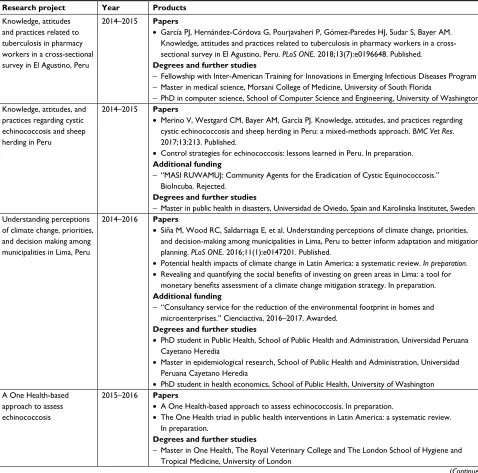
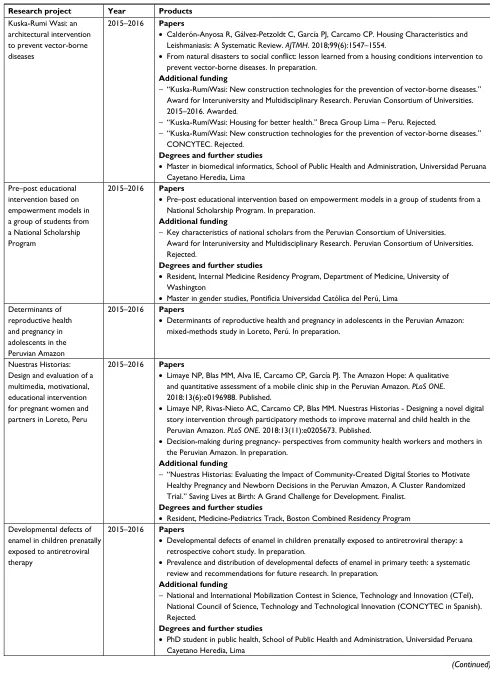
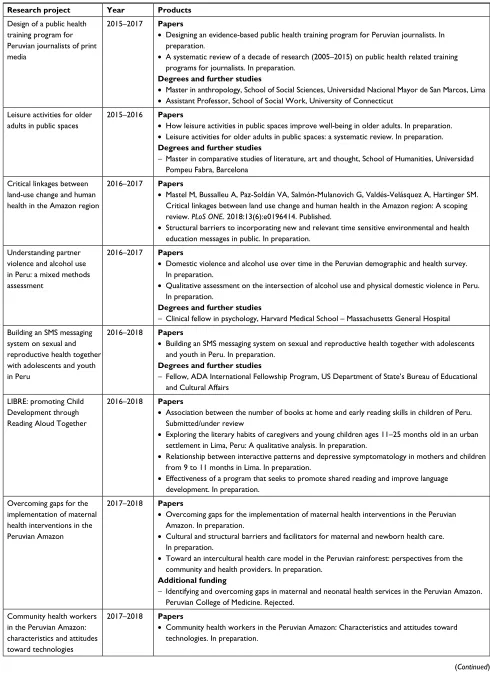
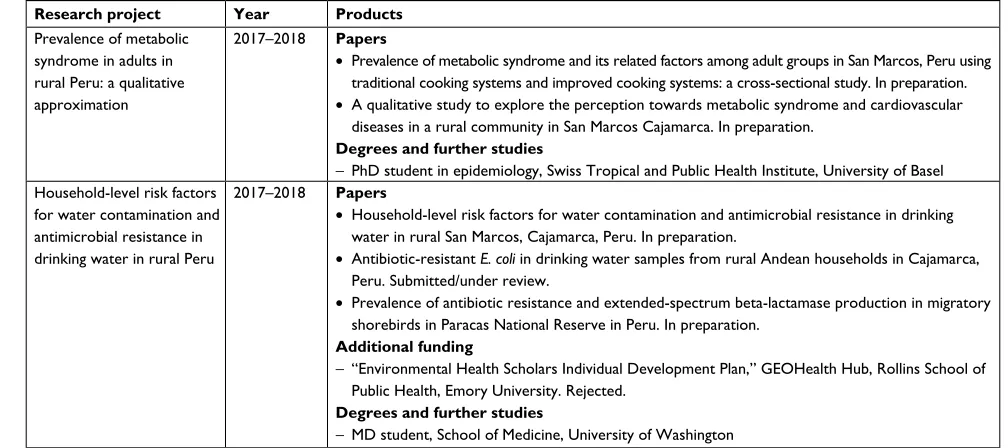
publish results from their projects over the 12 months of the fellowship. Research topics ranged from maternal and child health, neglected diseases, infectious diseases, land-use change and health, child development, domestic violence and alcohol use, architecture and health, and information and communication technologies. Table 2 includes a list of past and current research projects implemented by the fellows.
The training program and mentoring were crucial for successful implementation, as many of the Kuskaya fellows had little to no prior experience in research. Unlike many other training programs where trainees conduct analysis of secondary data, Kuskaya fellows were involved
Table 2 List of past and current research projects in the Kuskaya training program and corresponding articles, calls for proposals, and advanced degrees
Research project Year Products
Knowledge, attitudes and practices related to tuberculosis in pharmacy workers in a cross-sectional survey in El agustino, peru
2014–2015 Papers
• García pJ, Hernández-Córdova G, pourjavaheri p, Gómez-paredes HJ, Sudar S, Bayer aM. Knowledge, attitudes and practices related to tuberculosis in pharmacy workers in a cross-sectional survey in El agustino, peru. PLoS ONE. 2018;13(7):e0196648. published.
Degrees and further studies
- Fellowship with inter-american training for innovations in Emerging infectious diseases program - Master in medical science, Morsani College of Medicine, university of South Florida
- phd in computer science, School of Computer Science and Engineering, university of Washington Knowledge, attitudes, and
practices regarding cystic echinococcosis and sheep herding in peru
2014–2015 Papers
• Merino V, Westgard CM, Bayer aM, García pJ. Knowledge, attitudes, and practices regarding cystic echinococcosis and sheep herding in peru: a mixed-methods approach. BMC Vet Res. 2017;13:213. published.
• Control strategies for echinococcosis: lessons learned in peru. in preparation.
Additional funding
- “MaSi RuWaMuJ: Community agents for the Eradication of Cystic Equinococcosis.” Bioincuba. Rejected.
Degrees and further studies
- Master in public health in disasters, universidad de oviedo, Spain and Karolinska institutet, Sweden understanding perceptions
of climate change, priorities, and decision making among municipalities in Lima, peru
2014–2016 Papers
• Siña M, Wood RC, Saldarriaga E, et al. understanding perceptions of climate change, priorities, and decision-making among municipalities in Lima, peru to better inform adaptation and mitigation planning. PLoS ONE. 2016;11(1):e0147201. published.
• potential health impacts of climate change in Latin america: a systematic review. In preparation. • Revealing and quantifying the social benefits of investing on green areas in Lima: a tool for
monetary benefits assessment of a climate change mitigation strategy. In preparation.
Additional funding
- “Consultancy service for the reduction of the environmental footprint in homes and microenterprises.” Cienciactiva, 2016–2017. awarded.
Degrees and further studies
• phd student in public Health, School of public Health and administration, universidad peruana Cayetano Heredia
• Master in epidemiological research, School of public Health and administration, universidad peruana Cayetano Heredia
• phd student in health economics, School of public Health, university of Washington a one Health-based
approach to assess echinococcosis
2015–2016 Papers
• a one Health-based approach to assess echinococcosis. in preparation.
• the one Health triad in public health interventions in Latin america: a systematic review. in preparation.
Degrees and further studies
- Master in one Health, the Royal Veterinary College and the London School of Hygiene and tropical Medicine, university of London
Journal of Multidisciplinary Healthcare downloaded from https://www.dovepress.com/ by 118.70.13.36 on 24-Aug-2020
Dovepress Kuskaya: training program for innovation in global health
Table 2(Continued)
Research project Year Products
Kuska-Rumi Wasi: an architectural intervention to prevent vector-borne diseases
2015–2016 Papers
• Calderón-anyosa R, Gálvez-petzoldt C, García pJ, Carcamo Cp. Housing Characteristics and Leishmaniasis: a Systematic Review. AJTMH. 2018;99(6):1547–1554.
• From natural disasters to social conflict: lesson learned from a housing conditions intervention to
prevent vector-borne diseases. in preparation.
Additional funding
- “Kuska-RumiWasi: new construction technologies for the prevention of vector-borne diseases.” award for interuniversity and Multidisciplinary Research. peruvian Consortium of universities. 2015–2016. awarded.
- “Kuska-RumiWasi: Housing for better health.” Breca Group Lima – peru. Rejected.
- “Kuska-RumiWasi: new construction technologies for the prevention of vector-borne diseases.” ConCYtEC.Rejected.
Degrees and further studies
• Master in biomedical informatics, School of public Health and administration, universidad peruana Cayetano Heredia, Lima
pre–post educational intervention based on empowerment models in a group of students from a national Scholarship program
2015–2016 Papers
• pre–post educational intervention based on empowerment models in a group of students from a national Scholarship program. in preparation.
Additional funding
- Key characteristics of national scholars from the peruvian Consortium of universities. award for interuniversity and Multidisciplinary Research. peruvian Consortium of universities. Rejected.
Degrees and further studies
• Resident, internal Medicine Residency program, department of Medicine, university of Washington
• Master in gender studies, Pontificia Universidad Católica del Perú, Lima
determinants of reproductive health and pregnancy in adolescents in the peruvian amazon
2015–2016 Papers
• determinants of reproductive health and pregnancy in adolescents in the peruvian amazon:
mixed-methods study in Loreto, Perú. In preparation.
nuestras Historias: design and evaluation of a multimedia, motivational, educational intervention for pregnant women and partners in Loreto, peru
2015–2016 Papers
• Limaye np, Blas MM, alva iE, Carcamo Cp, García pJ. the amazon Hope: a qualitative and quantitative assessment of a mobile clinic ship in the peruvian amazon. PLoS ONE. 2018:13(6):e0196988. published.
• Limaye np, Rivas-nieto aC, Carcamo Cp, Blas MM. nuestras Historias - designing a novel digital story intervention through participatory methods to improve maternal and child health in the peruvian amazon. PLoS ONE. 2018:13(11):e0205673. published.
• decision-making during pregnancy- perspectives from community health workers and mothers in the peruvian amazon. in preparation.
Additional funding
- “nuestras Historias: Evaluating the impact of Community-Created digital Stories to Motivate Healthy pregnancy and newborn decisions in the peruvian amazon, a Cluster Randomized trial.” Saving Lives at Birth: a Grand Challenge for development. Finalist.
Degrees and further studies
• Resident, Medicine-pediatrics track, Boston Combined Residency program developmental defects of
enamel in children prenatally exposed to antiretroviral therapy
2015–2016 Papers
• developmental defects of enamel in children prenatally exposed to antiretroviral therapy: a retrospective cohort study. in preparation.
• prevalence and distribution of developmental defects of enamel in primary teeth: a systematic review and recommendations for future research. in preparation.
Additional funding
- national and international Mobilization Contest in Science, technology and innovation (Ctei), national Council of Science, technology and technological innovation (ConCYtEC in Spanish). Rejected.
Degrees and further studies
• phd student in public health, School of public Health and administration, universidad peruana Cayetano Heredia, Lima
(Continued)
Journal of Multidisciplinary Healthcare downloaded from https://www.dovepress.com/ by 118.70.13.36 on 24-Aug-2020
Dovepress Chan et al
Table 2(Continued)
Research project Year Products
design of a public health training program for peruvian journalists of print media
2015–2017 Papers
• designing an evidence-based public health training program for peruvian journalists.in preparation.
• a systematic review of a decade of research (2005–2015) on public health related training programs for journalists. in preparation.
Degrees and further studies
• Master in anthropology, School of Social Sciences, universidad nacional Mayor de San Marcos, Lima • assistant professor, School of Social Work, university of Connecticut
Leisure activities for older adults in public spaces
2015–2016 Papers
• How leisure activities in public spaces improve well-being in older adults. in preparation. • Leisure activities for older adults in public spaces: a systematic review. in preparation.
Degrees and further studies
- Master in comparative studies of literature, art and thought, School of Humanities, universidad pompeu Fabra, Barcelona
Critical linkages between land-use change and human health in the amazon region
2016–2017 Papers
• Mastel M, Bussalleu a, paz-Soldán Va, Salmón-Mulanovich G, Valdés-Velásquez a, Hartinger SM. Critical linkages between land use change and human health in the amazon region: a scoping review. PLoS ONE. 2018:13(6):e0196414. published.
• Structural barriers to incorporating new and relevant time sensitive environmental and health education messages in public. in preparation.
understanding partner violence and alcohol use in peru: a mixed methods assessment
2016–2017 Papers
• domestic violence and alcohol use over time in the peruvian demographic and health survey. in preparation.
• Qualitative assessment on the intersection of alcohol use and physical domestic violence in peru. in preparation.
Degrees and further studies
- Clinical fellow in psychology, Harvard Medical School – Massachusetts General Hospital Building an SMS messaging
system on sexual and reproductive health together with adolescents and youth in peru
2016–2018 Papers
• Building an SMS messaging system on sexual and reproductive health together with adolescents and youth in peru. in preparation.
Degrees and further studies
- Fellow, ada international Fellowship program, uS department of State’s Bureau of Educational and Cultural affairs
LiBRE: promoting Child development through Reading aloud together
2016–2018 Papers
• association between the number of books at home and early reading skills in children of peru.
Submitted/under review
• Exploring the literary habits of caregivers and young children ages 11–25 months old in an urban settlement in Lima, peru: a qualitative analysis. in preparation.
• Relationship between interactive patterns and depressive symptomatology in mothers and children from 9 to 11 months in Lima. in preparation.
• Effectiveness of a program that seeks to promote shared reading and improve language development. in preparation.
overcoming gaps for the implementation of maternal health interventions in the peruvian amazon
2017–2018 Papers
• overcoming gaps for the implementation of maternal health interventions in the peruvian amazon. in preparation.
• Cultural and structural barriers and facilitators for maternal and newborn health care. in preparation.
• toward an intercultural health care model in the peruvian rainforest: perspectives from the community and health providers. in preparation.
Additional funding
- identifying and overcoming gaps in maternal and neonatal health services in the peruvian amazon. peruvian College of Medicine. Rejected.
Community health workers in the peruvian amazon: characteristics and attitudes toward technologies
2017–2018 Papers
• Community health workers in the peruvian amazon: Characteristics and attitudes toward technologies. in preparation.
(Continued)
Journal of Multidisciplinary Healthcare downloaded from https://www.dovepress.com/ by 118.70.13.36 on 24-Aug-2020
Dovepress Kuskaya: training program for innovation in global health
Table 2(Continued)
Research project Year Products
prevalence of metabolic syndrome in adults in rural peru: a qualitative approximation
2017–2018 Papers
• prevalence of metabolic syndrome and its related factors among adult groups in San Marcos, peru using traditional cooking systems and improved cooking systems: a cross-sectional study. in preparation. • a qualitative study to explore the perception towards metabolic syndrome and cardiovascular
diseases in a rural community in San Marcos Cajamarca. in preparation.
Degrees and further studies
- phd student in epidemiology, Swiss tropical and public Health institute, university of Basel Household-level risk factors
for water contamination and antimicrobial resistance in drinking water in rural peru
2017–2018 Papers
• Household-level risk factors for water contamination and antimicrobial resistance in drinking water in rural San Marcos, Cajamarca, peru. in preparation.
• antibiotic-resistant E. coli in drinking water samples from rural andean households in Cajamarca,
Peru. Submitted/under review.
• prevalence of antibiotic resistance and extended-spectrum beta-lactamase production in migratory shorebirds in paracas national Reserve in peru. in preparation.
Additional funding
- “Environmental Health Scholars individual development plan,” GEoHealth Hub, Rollins School of public Health, Emory university. Rejected.
Degrees and further studies
- Md student, School of Medicine, university of Washington
in the entire research cycle from development of the proposal to fieldwork, data analysis, and publication. Fieldwork allowed fellows to develop a set of new skills – planning, development, validation and implementation of instruments, negotiation, and working with local community leaders – which would not have been included in a secondary data analysis.
Events and seminars
Every month, Kuskaya hosted the “Innovations in Global Health Seminars” featuring a variety of global health topics: Health Technologies, Mentoring in Research, Child Develop-ment, Innovations in Global Health, Research Integrity and Responsible Conduct of Research, Clinical Research, Mater-nal and Child Health, Neglected Diseases, Gender and Health, Health Situation Analysis, Health in Vulnerable Communities, HIV and Resource-Limited Settings, and Environmental Health. The Innovations in Global Health Seminars is an important part of the Kuskaya training program, and serves the purpose of introducing the fellows and broader community to key global health topics and experts as well as connecting them to the larger research community in Peru. Moreover, these events showcase the research themes being explored by the fellows. Furthermore, we invited other researchers funded through the NIH-Fogarty International Center to present their projects, thereby promoting interactions between different research groups in Peru. The seminars were open to the public.
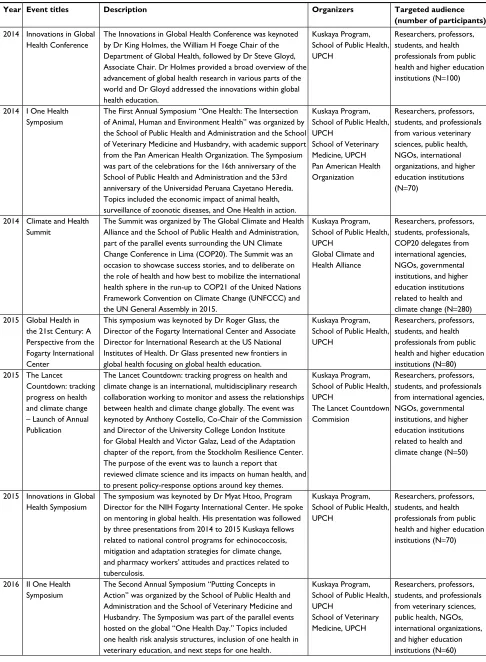
In addition, the Kuskaya training program organized symposiums or summits focused on research areas related to fellow research topics: climate change, One Health, and innovations in global health (Table 3).
Mentoring
Mentorship was a key component of the Kuskaya training program. Each Kuskaya research team had a mentorship team comprising two to four individuals who brought differ-ent, but complementary, strengths to the team and included individuals from US and international institutions. For each group, a “lead” mentor was identified who had the closest supervisory contact with the research team. Two months prior to the fellowship, fellows and their mentors discussed ideas for possible research projects through videoconferencing and, during the first week of training, fellows and mentors read through and signed a series of documents on mentoring, including a Mentoring Handbook, Compact Form, Encounter Form, and Checklist, which helped to establish expectations for the year. These expectations focused on personal and professional goals, frequency of meetings, and preferred mechanisms of communication. Mentors met with fellows at least twice each month and as frequently as several times a week, depending on fellow and project needs.
In addition, the Kuskaya research teams had monthly work-in-progress sessions with UW and UPCH Program directors and their mentors, during which they presented project advances and discussed the challenges they encountered.
Highlights from the Kuskaya
training program
The Kuskaya training program differed from other training programs in that it was “South-led,” interdisciplinary, and trained both health and non-health professionals.
Journal of Multidisciplinary Healthcare downloaded from https://www.dovepress.com/ by 118.70.13.36 on 24-Aug-2020
Dovepress Chan et al
Table 3 Conferences, symposiums, and summits organized by the Kuskaya program between 2014 and 2017
Year Event titles Description Organizers Targeted audience
(number of participants)
2014 innovations in Global Health Conference
the innovations in Global Health Conference was keynoted by dr King Holmes, the William H Foege Chair of the department of Global Health, followed by dr Steve Gloyd, associate Chair. dr Holmes provided a broad overview of the advancement of global health research in various parts of the world and dr Gloyd addressed the innovations within global health education.
Kuskaya program, School of public Health, upCH
Researchers, professors, students, and health professionals from public health and higher education institutions (n=100)
2014 i one Health Symposium
the First annual Symposium “one Health: the intersection of animal, Human and Environment Health” was organized by the School of public Health and administration and the School of Veterinary Medicine and Husbandry, with academic support from the pan american Health organization. the Symposium was part of the celebrations for the 16th anniversary of the School of public Health and administration and the 53rd anniversary of the universidad peruana Cayetano Heredia. topics included the economic impact of animal health, surveillance of zoonotic diseases, and one Health in action.
Kuskaya program, School of public Health, upCH
School of Veterinary Medicine, upCH pan american Health organization
Researchers, professors, students, and professionals from various veterinary sciences, public health, nGos, international organizations, and higher education institutions (n=70)
2014 Climate and Health Summit
the Summit was organized by the Global Climate and Health alliance and the School of public Health and administration, part of the parallel events surrounding the un Climate Change Conference in Lima (Cop20). the Summit was an occasion to showcase success stories, and to deliberate on the role of health and how best to mobilize the international health sphere in the run-up to Cop21 of the united nations Framework Convention on Climate Change (unFCCC) and the un General assembly in 2015.
Kuskaya program, School of public Health, upCH
Global Climate and Health alliance
Researchers, professors, students, professionals, Cop20 delegates from international agencies, nGos, governmental institutions, and higher education institutions related to health and climate change (n=280) 2015 Global Health in
the 21st Century: a perspective from the Fogarty international Center
this symposium was keynoted by dr Roger Glass, the director of the Fogarty international Center and associate director for international Research at the uS national institutes of Health. dr Glass presented new frontiers in global health focusing on global health education.
Kuskaya program, School of public Health, upCH
Researchers, professors, students, and health professionals from public health and higher education institutions (n=80) 2015 the Lancet
Countdown: tracking progress on health and climate change – Launch of annual publication
the Lancet Countdown: tracking progress on health and climate change is an international, multidisciplinary research collaboration working to monitor and assess the relationships between health and climate change globally. the event was keynoted by anthony Costello, Co-Chair of the Commission and director of the university College London institute for Global Health and Victor Galaz, Lead of the adaptation chapter of the report, from the Stockholm Resilience Center. the purpose of the event was to launch a report that reviewed climate science and its impacts on human health, and to present policy-response options around key themes.
Kuskaya program, School of public Health, upCH
the Lancet Countdown Commision
Researchers, professors, students, and professionals from international agencies, nGos, governmental institutions, and higher education institutions related to health and climate change (n=50)
2015 innovations in Global Health Symposium
the symposium was keynoted by dr Myat Htoo, program director for the niH Fogarty international Center. He spoke on mentoring in global health. His presentation was followed by three presentations from 2014 to 2015 Kuskaya fellows related to national control programs for echinococcosis, mitigation and adaptation strategies for climate change, and pharmacy workers’ attitudes and practices related to tuberculosis.
Kuskaya program, School of public Health, upCH
Researchers, professors, students, and health professionals from public health and higher education institutions (n=70)
2016 ii one Health Symposium
the Second annual Symposium “putting Concepts in action” was organized by the School of public Health and administration and the School of Veterinary Medicine and Husbandry. the Symposium was part of the parallel events hosted on the global “one Health day.” topics included one health risk analysis structures, inclusion of one health in veterinary education, and next steps for one health.
Kuskaya program, School of public Health, upCH
School of Veterinary Medicine, upCH
Researchers, professors, students, and professionals from veterinary sciences, public health, nGos, international organizations, and higher education institutions (n=60)
Journal of Multidisciplinary Healthcare downloaded from https://www.dovepress.com/ by 118.70.13.36 on 24-Aug-2020
Dovepress Kuskaya: training program for innovation in global health
Table 3(Continued)
Date Event title Description Organizers Targeted audience
(number of participants)
2016 the Lancet Countdown: tracking progress on health and climate change Workshop
the Lancet Countdown: tracking progress on health and climate change is an international, multidisciplinary research collaboration working to monitor and assess the relationships between health and climate change globally. this event serves
to capture the region’s and, specifically, Peru’s response to
climate change, focusing on health resilience and adaptation as
well as health co-benefits of mitigation.
Kuskaya program, School of public Health, upCH
the Lancet Countdown Commision
Researchers, professors, students, and professionals from international agencies, nGos, governmental institutions, and higher education institutions related to health and climate change (n=60) 2017 innovations in Global
Health Symposium
the symposium was keynoted by dr Kevin Bialy, niH Fogarty
International Center’s International Health Program Officer
for the Western Hemisphere. He spoke on addressing global health problems from the perspective of applied anthropology. His presentation was followed by three presentations from 2016 to 2017 Kuskaya fellows related to child development, domestic violence and alcohol use, and climate change and health.
Kuskaya program, School of public Health, upCH
Researchers, professors, students, and health professionals from public health and higher education institutions (n=80)
Abbreviations: nGos, nongovernmental organizations; upCH, universidad peruana Cayetano Heredia.
primary awardee from an low- and
middle-income country
Of the 35 grants awarded through the NIH-Fogarty’s Frame-work Programs for Global Health Innovation (FRAME Innovation), only three were awarded to non-US institutions, including the Kuskaya training program. In addition, of the current 10 FRAME Innovation grants, Kuskaya is the only grant awarded to a non-US institution. The implications of having a foreign institution as primary awardee include: lower salary requirements, which resulted in a higher number of fellows trained; and potentially more sustainable lines of research defined by the local, non-US institution.
Fellow characteristics: junior trainees
from disciplines outside of traditional
health disciplines
Fellows typically apply to this program to acquire skills in global health research either before or after obtaining a termi-nal degree (eg, PhD, MD, DVM, MBA, MSEng). Fellows came from a wide variety of disciplines, one third of which were unrelated to health (Table 4). From 2014 to 2018, we trained 33 fellows, with fellows almost equally distributed between undergraduate- and graduate-level individuals: 12 bachelors (nine Peruvian, three US), ten masters (five Peruvian, five US), three PhD students (all US), seven professional doctorates (all Peruvians), and one postdoctoral fellow (Peruvian).
In Peru, it is still uncommon for people to pursue graduate studies. However, the Kuskaya fellowship not only provided an opportunity for talented graduates from other disciplines to become involved in a rigorous training program in public health research, but also connected fellows to other
research-ers from US and Peruvian higher education institutions. This resulted in 17 (51.5%) of our fellows pursuing advanced degrees or further studies in health science or public health during and after the Kuskaya fellowship.
Extending research training for
exceptional fellows
Unlike other programs that end after a year, the Kuskaya fel-lowship allowed exceptional fellows to extend their training. Productive fellows were eligible to apply for an additional year of stipend and research support. If selected, they were also required to serve as a junior mentor to the incoming cohort, thereby benefitting both the program and the
indi-Table 4 Background of Kuskaya fellows: health related and non-health-related disciplines
Health-related disciplines
Number of fellows
Non-health-related disciplines
Number of fellows
Medicine 5 Communications 2
public health 4 architecture 1
psychology 3 anthropology 1
Veterinary medicine
2 Computer science 1
Health administration
2 Economics 1
Environmental health
2 Electronic engineering 1
nursing 2 Environmental chemistry 1
dentistry 1 Environmental science 1
Law 1
public policy 1
Sociology 1
total 21 12
Journal of Multidisciplinary Healthcare downloaded from https://www.dovepress.com/ by 118.70.13.36 on 24-Aug-2020
Dovepress Chan et al
vidual by building mentoring skills during the second year and providing additional support for incoming teams.
identifying fellows from diverse
disciplines: “diamonds in the rough”
To broaden recruitment across other disciplines, we engaged in intensive recruitment during a 4-month period each year to disseminate the Kuskaya call for applications to a diverse group of higher education institutions, professional accredita-tion instituaccredita-tions (eg, the Peruvian College of Medicine), and governmental institutions in Peru and the US. In November of each year, emails, letters, and flyers were sent to 17–45 institutions in Lima and outside the capital, inviting students and staff to apply to the Kuskaya fellowship. Furthermore, other institutions helped to disseminate the fellowship by posting physical flyers on campus and electronic flyers on websites and social media sites, which resulted in 25–43 posts on institutional websites and social media including the Peruvian Ministry of Health, Ministry of Education, National Council of Science, Technology and Technological Innova-tion, and professional associations (Association of Engineers of Peru, Peruvian College of Medicine, Peruvian College of Veterinary Medicine) and various universities.
interdisciplinary training and
collaboration beyond teams
The goal of Kuskaya was to develop a new generation of innovative leaders in global health and integrate knowledge to find solutions for global health problems through a cross-cultural, interdisciplinary problem-solving-based research experience. Except for the Ghana-Michigan Postdoctoral and Research Trainee Network-Investing in Innovation award to the University of Michigan,27 the other eight Frameworks
awards focused on infectious diseases and clinical research. Due to the interdisciplinary nature of the program, more experienced fellows were able to make important contribu-tions to other projects as well as collaborate outside of their research team. For example, an economist and a veterinarian from different research groups decided to submit a proposal together in response to the “Bright Ideas” Request for Pro-posals (Ideas Audaces in Spanish) offered by the National Council of Science, Technology and Technological Innovation (CONCYTEC in Spanish).
pilot grants leading to additional funding
and degrees
The Kuskaya program provided seed funding for interdisci-plinary pilot projects in global health. Fellows were
encour-aged to expand upon existing pilot projects and apply to additional funding sources.
The Kuskaya program has successfully nurtured trainees from diverse backgrounds to be independent researchers in public health. One example is Mariella Siña, a 2014 cohort Kuskaya fellow with a background in chemical engineering; she applied for funding from CONCYTEC for a proposal entitled “Implementing eco-efficient measures in households in Lima to reduce the environmental footprint” and was funded $50,000 USD. Renzo Calderón and Camila Gálvez, a physician and an architect, respectively, from the 2015–2016 cohort, were awarded funding for their proposal “Kuska-RumiWasi: New construction technologies for the prevention of vector-borne diseases” by the Peruvian Consortium of Universities. Neha Limaye, a 2016 cohort fellow, was a final-ist in the call for “Saving Lives at Birth: A Grand Challenge for Development” with her application “Nuestras Historias: Evaluating the Impact of Community-Created Digital Stories to Motivate Healthy Pregnancy and Newborn Decisions in the Peruvian Amazon, A Cluster Randomized Trial.” This project received the “Best Practice in Public Management” award at a national competition in 2017.
Lessons learned and
recommendations
Furthermore, it is important to discuss some of the chal-lenges and lessons learned during the implementation of Kuskaya.
time constraints for completing an
original research project within a year
A year is quite short to implement an original project from scratch and in global health. Delays are to be expected, such as backlogs of IRB protocol reviews. The Kuskaya program encouraged fellows to communicate with their fellow pairs and mentoring team for 2 months before the official start date, which helped fellows to define a topic and review the literature before the US fellows arrived in Peru. Moreover, the program relied heavily on directors and mentors to help set a realistic timeframe and project scope in order to suc-cessfully complete the project within a year.Finding the right mentors
Because some research projects involved new lines of research previously unexplored at both institutions, it was difficult, sometimes, to find the “right” mentors – that is, mentors who had expertise in the subject area, experience and disposition, and availability to guide the research group.
Journal of Multidisciplinary Healthcare downloaded from https://www.dovepress.com/ by 118.70.13.36 on 24-Aug-2020
Dovepress Kuskaya: training program for innovation in global health
Investing effort to train new mentors and discuss the expecta-tions and role of mentorship within our instituexpecta-tions was vital to establishing successful interdisciplinary mentoring teams.
Creating a flexible training program
The criteria for Kuskaya fellows included completion of a bachelor’s degree, some prior experience in research, and being a good fit with the research project and mentoring team. However, the call for fellows was disseminated to many disciplines – law, engineering, health sciences, humanities, social science, architecture, economics, and communica-tion – which meant that, each year, the cohort profile dif-fered vastly in academic experience and level of education, professional experience, and diversity of disciplines. The program was designed to be flexible: providing a common foundation of basic knowledge in public health during the 1-month orientation and three supplemental intensive vir-tual courses for those who lacked public health training: 1) Introduction to Epidemiology, 2) How to Develop a Research Proposal, and 3) Introduction to Biostatistics, which were taken by one third of the fellows. In addition, the program implemented additional workshops throughout the fellow-ship year according to where fellows were in the research cycle. While the core components of the Kuskaya training program were maintained during all four years, however, the program added supplemental content to meet the academic and research needs of each individual cohort.
ability to evaluate impact in
meaningful ways
The program provided both academic coursework and hands-on training in implementing research projects; however, it was important to define measures of a successful training program. We decided to include traditional indicators, such as publica-tions, success at obtaining additional funding, and evidence of professional development (new positions or degrees), which are tracked up to 20 years after involvement in the program.
The Kuskaya program has contributed to the body of scientific knowledge in various disciplines and public health as well as to professional development for trainees across public health and other disciplines. Very few of the fellows had publications before entering the program. Table 2 lists grant proposals submitted and graduate programs completed by the Kuskaya fellows; 12 of our fellows submitted grants, and another three were awarded additional funding. In addi-tion, eight fellows are currently enrolled in a master’s or doctoral program, five completed a graduate program, two are in a residency program, and three have completed other fellowships.
Conclusion
Kuskaya: An Interdisciplinary Training Program for Inno-vation in Global Health represents an innovative and suc-cessful South-driven framework for global health training. Junior trainees from diverse disciplines conducted research in US–Peru pairs to develop and implement meaningful projects in Peru. Over the course of the year, they were guided by mentors, connected to research communities, and learned to collaborate with governmental institutions. Through participation in interactive and didactic courses, they acquired traditional skills in global health research and “soft skills” in leadership and negotiation. Overall, Kuskaya provided an innovative model for engaging, training, and inspiring young professionals from health and non-health-related disciplines to work together to address grand chal-lenges in global health.
Acknowledgments
Research reported in this publication was supported by the Fogarty International Center of the National Institutes of Health under Kuskaya: an Interdisciplinary Training Program for Innovation in Global Health (award number D43TW009375). The content is solely the responsibility of the authors and does not necessarily represent the official views of the National Institutes of Health.
Disclosure
The authors report no conflicts of interest in this work.
References
1. Collins PY, Patel V, Joestl SS, et al. Grand challenges in global mental health. Nature. 2011;475(7354):27–30.
2. Daar AS, Singer PA, Persad DL, et al. Grand challenges in chronic non-communicable diseases. Nature. 2007;450(7169):494–496. 3. Varmus H, Klausner R, Zerhouni E, Acharya T, Daar AS, Singer
PA. Public health. Grand Challenges in Global Health. Science. 2003;302(5644):398–399.
4. Rittel HWJ, Webber MM. Dilemmas in a general theory of planning.
Policy Sci. 1973;4(2):155–169.
5. Conklin J. Wicked problems and social complexity. In: Conklin J, editor. Dialogue Mapping: Building Shared Understanding of Wicked Problems. Chichester: John Wiley & Sons Ltd.; 2006:3–40.
6. Hu J, Wang S, Wang L, et al. Advances in paper-based point-of-care diagnostics. Biosens Bioelectron. 2014;54:585–597.
7. Myers FB, Lee LP. Innovations in optical microfluidic technologies for point-of-care diagnostics. Lab Chip. 2008;8(12):2015–2031. 8. Yager P, Domingo GJ, Gerdes J. Point-of-care diagnostics for global
health. Annu Rev Biomed Eng. 2008;10:107–144.
9. Bernabe-Ortiz A, Curioso WH, Gonzales MA, et al. Handheld comput-ers for self-administered sensitive data collection: a comparative study in Peru. BMC Med Inform Decis Mak. 2008;8(1):11.
10. Gerber T, Olazabal V, Brown K, Pablos-Mendez A. An agenda for action on global e-health. Health Aff. 2010;29(2):233–236.
11. Lewis T, Synowiec C, Lagomarsino G, Schweitzer J. E-health in low- and middle-income countries: findings from the Center for Health Market Innovations. Bull World Health Organ. 2012;90(5):332–340.
Journal of Multidisciplinary Healthcare downloaded from https://www.dovepress.com/ by 118.70.13.36 on 24-Aug-2020
Dovepress
Journal of Multidisciplinary Healthcare
Publish your work in this journal
Submit your manuscript here: https://www.dovepress.com/journal-of-multidisciplinary-healthcare-journal The Journal of Multidisciplinary Healthcare is an international,
peer-reviewed open-access journal that aims to represent and publish research in healthcare areas delivered by practitioners of different disciplines. This includes studies and reviews conducted by multidisciplinary teams as well as research which evaluates the results or conduct of such teams or health
care processes in general. The journal covers a very wide range of areas and welcomes submissions from practitioners at all levels, from all over the world. The manuscript management system is completely online and includes a very quick and fair peer-review system. Visit http://www.dovepress.com/ testimonials.php to read real quotes from published authors.
Dove
press
Chan et al
12. Blas MM, Curioso WH, Garcia PJ, et al. Training the biomedical infor-matics workforce in Latin America: results of a needs assessment. BMJ Open. 2011;1(2):e000233.
13. Curioso WH, Hansen JR, Centurion-Lara A, et al. Evaluation of a joint Bioinformatics and Medical Informatics international course in Peru.
BMC Med Educ. 2008;8:1.
14. Curioso WH, Fuller S, Garcia PJ, Holmes KK, Kimball AM. Ten years of international collaboration in biomedical informatics and beyond: the AMAUTA program in Peru. J Am Med Inform Assoc. 2010;17(4):477–480.
15. Kimball AM, Curioso WH, Arima Y, et al. Developing capacity in health informatics in a resource poor setting: lessons from Peru. Hum Resour Health. 2009;7(1):80.
16. Frenk J, Chen L, Bhutta ZA, et al. Health professionals for a new century: transforming education to strengthen health systems in an interdependent world. Lancet. 2010;376(9756):1923–1958.
17. García PJ. Repensando la educación de los profesionales de salud del siglo XXI: cambios y acciones en un mundo global. [Rethinking the education of XXI century health professionals: changes and actions in a global world. Rev Peru Med Exp Salud Publica. 2011;28(2):390–399. Spanish.
18. Choi BCK, Pak AWP. Multidisciplinarity, interdisciplinarity and transdisciplinarity in health research, services, education and policy: 1. Definitions, objectives, and evidence of effectiveness. Clin Invest Med. 2006;29(6):351–364.
19. Finch TH, Chae SR, Shafaee MN, et al. Role of students in global health delivery. Mt Sinai J Med. 2011;78(3):373–381.
20. Rowson M, Willott C, Hughes R, et al. Conceptualising global health: theoretical issues and their relevance for teaching. Global Health. 2012;8(1):36.
21. Grand Challenges Canada/Grand Défis Canada, “Integrated Innovation”. 2010. Available from: https://www.grandchallenges.ca/wp-content/ uploads/2015/11/integratedinnovation_EN.pdf. Accessed December 11, 2018.
22. Curioso WH, Lazo-Escalante M, Gotuzzo E, et al. Entrenando a la nueva generación de estudiantes en salud global en una universidad peruana. [Training the new generation of students in global health at a Peruvian university]. Rev Peru Med Exp Salud Publica. 2008;25(3):269–273. Spanish.
23. Shah SK, Nodell B, Montano SM, Behrens C, Zunt JR. Clinical research and global health: mentoring the next generation of health care students.
Glob Public Health. 2011;6(3):234–246.
24. Cho DB, Cole D, Simiyu K, Luong W, Neufeld V. Mentoring, training and support to global health innovators: a scoping review. Glob J Health Sci. 2013;5(5):162.
25. Garcia PJ, Curioso WH, Lazo-Escalante M, Gilman RH, Gotuzzo E. Global health training is not only a developed-country duty. J Public Health Policy. 2009;30(2):250–252.
26. Garcia P, Armstrong R, Zaman MH. Models of education in medicine, public health, and engineering. Science. 2014;345(6202):1281–1283. 27. Calys-Tagoe BNL, Clarke E, Robins T, Basu N. A comparison of
licensed and un-licensed artisanal and small-scale gold miners (ASGM) in terms of socio-demographics, work profiles, and injury rates. BMC Public Health. 2017;17(1):862.
Journal of Multidisciplinary Healthcare downloaded from https://www.dovepress.com/ by 118.70.13.36 on 24-Aug-2020