Projected shell model for Gamow-Teller transitions in heavy,
de-formed nuclei
Long-Jun Wang1, Yang Sun1,2,3,4,a, Zao-Chun Gao3,4, and Surja Kiran Ghorui1
1Department of Physics and Astronomy, Shanghai Jiao Tong University, Shanghai 200240, China
2Collaborative Innovation Center of IFSA (CICIFSA), Shanghai Jiao Tong University, Shanghai 200240,
China
3China Institute of Atomic Energy, P.O. Box 275(18), Beijing 102413, China
4State Key Laboratory of Theoretical Physics, Institute of Theoretical Physics, Chinese Academy of
Sci-ences, Beijing 100190, China
Abstract.Calculations of Gamow-Teller (GT) transition rates for heavy, deformed nu-clei, which are useful input for nuclear astrophysics studies, are usually done with the quasiparticle random-phase approximation. We propose a shell-model method by apply-ing the Projected Shell Model (PSM) based on deformed bases. With this method, it is possible to perform a state-by-state calculation for nuclear matrix elements forβ-decay and electron-capture in heavy nuclei. Takingβ−decay from168Dy to168Ho as an example,
we show that the known experimental B(GT) from the ground state of the mother nucleus to the low-lying states of the daughter nucleus could be well described. Moreover, strong transitions to high-lying states are predicted to occur, which may considerably enhance the total decay rates once these nuclei are exposed to hot stellar environments.
1 Introduction
The knowledge on weak interaction processes is important not only for nuclear and particle physics, but also for nuclear astrophysics [1–5]. For example, to constrain the neutrino mass from the neutri-noless double beta decay experiments, one needs to calculate nuclear matrix elements of the Gamow-Teller (GT) transition strengths,B(GT), between the ground states of the mother and daughter nu-cleus as accurately as possible [6, 7]. On the other hand,β-decay rates are indispensable nuclear inputs for understanding the nucleosynthesis processes such as thes-process, ther-process, and the r p-process. It has been suggested that information of the nuclei involved in these processes plays a crucial role for determination of the GT transitions [5]. Moreover,B(GT) of electron-capture reaction for highly-excited states of medium-heavy and heavy nuclei are an important ingredient to model the late evolution of stars and the core-collapse supernovae [5, 8, 9, 12].
GT transitions can be studied by two kind of experimental methods, theβ-decay experiments and the Charge-Exchange (CE) reactions [13]. Theβ-decay experiments have a simple physical mecha-nism and can provide high energy-resolution data, but the excitation energy of the study is limited by theQ-value which varies from less than one MeV close to the stability line to about 10 MeV when
going far from the stability. The other limitation ofβ-decay experiments is that most nuclei undergo eitherβ+orβ−decay, but not both. For example, most neutron-rich nuclei could only undergoβ− de-cay, while the electron-captures of neutron-rich nuclei in theβ+direction are crucial for core-collapse supernova modeling. On the other hand, the charge-exchange reactions, which are mediated by the strong force, could be used for extractingB(GT) since they connect the same initial and final states as
β-decay [14]. CE reactions could make transitions both in theβ−direction, such as the (p,n), (3He, t) and (6Li, 6He) reactions, and in theβ+direction, such as the (n, p), (d, 2He), (t, 3He) and (7Li, 7Be) reactions. Another advantage of using CE to probe GT transition strengths is that it allows access to higher excitation energy since it is not limited by theQ-value. However, taking the CE reactions in theβ+direction as example, the (n, p) reaction that has the simplest reaction mechanism suffers from poor energy-resolution (∼1 MeV). The (d, 2He) reaction can reach a resolution of 100-200 keV, but the reaction mechanism is complex and only a few examples from early experiments were reported [15, 16]. Although the reaction mechanism of the (t, 3He) reaction with resolution of 250-400 keV has been well studied, it is still impossible to measure accurately GT strengths of all states for many nuclei that are involved in the nuclear networks. Therefore, despite of the experimental advances, one has to rely heavily on the theoretically-calculated GT strength distributions.
Theoretically, two kinds of nuclear models are most commonly used for calculations of GT tran-sition rates: the quasiparticle random-phase approximation (QRPA) and the (spherical) shell model (SM) [5, 9, 17]. The QRPA begins with some (self-consistent) mean-field models, and the residual correlations among nucleons are considered by one-particle-one-hole (1p−1h) excitations within the model space. In QRPA, however, the calculated nuclear states are usually not angular-momentum states and the higher-order correlations among nucleons are neglected. On the other hand, the shell model, which diagonalizes the matrix of an effective Hamiltonian in a chosen model space spanned by the Slater determinants of valence nucleons, can treat explicitly two-body correlations among them. It has been suggested that the shell model is the preferable method for GT transition calculations for the nuclear astrophysical purpose [5, 18, 19]. In fact, successful description of nuclear ground states, energy spectra at moderate excitations, and electromagnetic and GT transitions among these states, could be obtained by the shell-model diagonalization method. For example, the nuclear wave func-tions in the fullsd-shell model space obtained by Wildenthal and Brown were applied to calculate the GT transition rates for thesd-shell nuclei [20–22]. Later, Langanke and Martínez-Pinedo made the shell-model GT rates available also for thep f-shell nuclei [23].
Despite the great success of the shell model description in spectra and transitions for light and some medium-heavy nuclei (the nuclei up to the mass-60 region), some problems still exist in modern shell-model calculations. First, in most cases, the model space is spanned by a single harmonic-oscillator shell, which means that it can not calculate forbidden transitions since such transitions occur between different harmonic-oscillator shells with different parities. Second, it is well known that the shell model suffers from the unavoidable problem of dimension explosion when treating heavier nuclei. This unfortunately excludes shell-model applications to the heavy, deformed mass regions. Finally, shell-model calculations for the GT transitions for highly-excited nuclear states have usually been applied with an assumption based on the Brink-Axel hypothesis [10, 11], which has however been found recently to be invalid at low and moderate initial excitation energies [12].
In this regard, we recognize the fact that except for a few lying in the vicinity of shell closures, most nuclei in the nuclear chart are deformed. This naturally suggests for shell model calculations to use a deformed basis to incorporate the physics in large systems. Using a deformed basis to perform shell-model calculations is the philosophy that the Projected Shell Model (PSM) follows [24, 25].
The PSM was established in the 1990’s [24] and has been successfully applied to descriptions for low-lying spectra and the corresponding electromagnetic transitions, for example, for superdeformed nuclei [26], superheavy nuclei [27], proton-rich nuclei [28], and neutron-rich nuclei [29–31]. To com-pare with methods in the QRPA approach, the PSM has well-defined wave functions in the laboratory framework with good angular momentum. To compare with conventional spherical shell models, the PSM does not have the limitation in the size of nuclei to be applied. An initial attempt for the PSM to calculate GT transitions was reported in Ref. [32]. The work has recently been extended to odd-mass systems, which will be reported elsewhere [33]. Systematical applications of the method to the actual problems mentioned above have been planned. Before a detailed description of the work, let us sum-marize a few attractive features in the PSM approach, which may be relevant for many astrophysical applications.
(i) The PSM begins with solutions from deformed mean-field models and ends up with shell-model diagonalization in the laboratory frame like the spherical shell model. Therefore, the PSM bridges the two groups of important nuclear structure models, namely, the deformed mean-field approach and the conventional shell model, and takes the advantages of both. On the one hand, as a shell model method, the PSM can be applied to study any (super-) heavy, (super-) deformed nuclei without a size limitation. On the other hand, unlike the mean-field models, the PSM wave functions contain correlations beyond the mean fields and the states are written in the laboratory frame having definite quantum numbers such as angular-momentum, particle-number, and parity.
(ii) Since the PSM employs deformed bases, the dimension of the shell-model diagonalization is small (usually about 102 ∼104). Therefore, state-by-state evaluations of nuclear matrix elements for GT transition are computationally feasible for heavy, deformed nuclei. Besides, GT transitions for highly-excited states are calculated directly with the resulting wave functions from diagonalization and the shell-model computation can be much facilitated by employing the modern Pfaffian algorithm [34–38]. Therefore, no approximations such as the Brink-Axel hypothesis are needed for highly-excited states. This feature is important because GT transition rates of highly highly-excited states of heavy nuclei are crucial nuclear inputs for many astrophysical processes.
(iii) The calculation of forbidden transitions involves nuclear transitions between different har-monic oscillator shells and thus requires multishell model spaces. Such calculations are not feasible for most of the conventional shell models working in one-major shell bases. The PSM is a multishell shell model. This feature is desired particularly when forbidden transitions are dominated.
(iv) Nuclear isomeric states play special roles in nuclear physics and astrophysics [39]. The rela-tively long half-lives of these isomers could change significantly the elemental abundances produced in nucleosynthesis. In some cases, an isomer with long lifetime can change the paths of reaction and lead to a different set of elemental abundances [40]. The PSM has been shown to be a successful model for describing nuclear isomers [41–44].
2 Theoretical Framework
The PSM works with the following scheme. It begins with the deformed Nilsson single particle basis [45], with pairing correlations incorporated into the basis by a BCS calculation for the Nilsson states. The Nilsson-BCS calculation defines a deformed quasiparticle (qp) basis. The the angular-momentum (and if necessary, also particle-number, parity) projection is performed on the qp basis to form a shell mdoel space in the laboratory frame. Finally a two-body Hamiltonian is diagonalized in this projected space [24]. Three (four) major harmonic-oscillator shells are usually taken into account in calculations of energy spectra and electromagnetical transitions for heavy (superheavy and superdeformed) nuclei for both neutrons and protons. Let us usea†ν,a†π (aν,aπ) to denote neutron and proton qp creation (annihilation) operators associated with the deformed qp vacuum|Φ. The multi-qp configurations are given for even-even and odd-odd nuclei as follows:
e-e:|Φ, a†νia†νj|Φ, a†πiaπj†|Φ, a†νia†νja†πka†πl|Φ,
o-o:a†νia†πj|Φ. (1)
It is noted that the PSM works with multiple harmonic-oscillator shells for both neutrons and protons. That is to say, the indicesν(for neutrons) andπ(for protons) in Eq. (1) are general; for example, a 2-qp state can be of positive parity if both quasiparticlesiand jare from the majorN-shells that differ inN byΔN = 0,2, . . . ,or of negative parity ifiand jare from thoseN-shells that differ by
ΔN=1,3, . . ..
The PSM wave function is a linear combination of the projected states
|Ψω I M=
Kκ
fIKωκPˆIMK|Φκ, (2)
where|Φκis theκ-th qp-state in Eq. (1). ˆPI
MK is the angular momentum projection operator [46]
ˆ
PIMK =2I+1 8π2
dΩDIMK(Ω) ˆR(Ω), (3)
withDIMK being theD-function [47], ˆRthe rotation operator, andΩthe Euler angles. fIKωκ in (2) are obtained by solving the eigenvalue equation:
Kκ
HKκ,KI κ−EωINKκ,KI κ
fIKω
κ =0, (4)
whereHI
Kκ,KκandNKκ,KI κare respectively the projected matrix elements of the Hamiltonian and the norm
HKκ,KI κ =Φκ|HˆPˆIKK|Φκ, NKκ,KI κ=Φκ|PˆIKK|Φκ. (5)
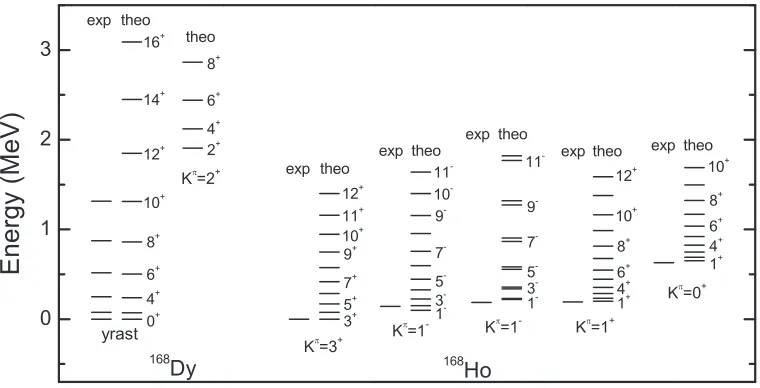
Figure 1.The calculated energy levels of168Dy and168Ho, as compared with the experimental data taken from
Ref. [56].
The PSM Hamiltonian in the present work consists of the separable forces
ˆ
H=Hˆ0+HˆQP+HˆGT, (6)
which represent different kinds of correlations among valence nucleons. It has the single-particle terms ˆH0, the quadrupole+pairing force ˆHQP, and the Gamow-Teller force of the charge-exchange terms ˆHGT. Hˆ0 is the spherical single-particle term including properly the spin-orbit force. The second force, ˆHQP, contains three terms [24]
ˆ HQP =−
1 2χQQ
μ
ˆ
Q†2μQˆ2μ−GMPˆ†Pˆ−GQ
μ
ˆ
P†2μPˆ2μ, (7)
which correspond to the quadrupole-quadrupole interaction, the monopole-pairing interaction, and the quadrupole-pairing interactions, respectively. The quadrupole+pairing force has been known to take care of basic correlations in nuclear structure, and it has been shown [48] that these interactions simu-late the essence of the most important correlations in nuclei, so that any realistic forces have to contain at least these basic components implicitly in order to work successfully in the structure calculations. The strength of the quadrupole-quadrupole termχQQis determined in a self-consistent manner so that it would give the empirical deformation of the basis as predicted in mean-field calculations [24]. The monopole-pairing strength is taken to be the formGM =[G1∓G2(N−Z)/A]/A, where “+” (“−”) is for protons (neutrons), andN,Z, andAare the neutron number, proton number, and mass number, respectively.G1andG2are the coupling constants adjusted to yield the experimental odd-even stag-gering of nuclear binding energy in the corresponding nuclear mass region. In this paper, we adopted G1 =20.12 andG2=13.13 as in Ref. [25]. The quadrupole-pairing strength is taken, as usual, to be about 20% ofGMfor rare-earth nuclei [24, 25]. It has been shown in many previous publications that
The last force, ˆHGTin Eq. (6), is the Gamow-Teller two-body force
ˆ
HGT= +2χGT
μ
ˆ
β− 1μ(−1)
μβˆ+ 1−μ
−2κGT
μ
ˆ
Γ−
1μ(−1)μΓˆ+1−μ. (8)
This is a charge-dependent separable interaction with both particle-hole (ph) and particle-particle (pp) channels, which act between protons and neutrons. Such type of force has been used by many authors in the study of single- and double-βdecay [17, 49–52]. The ph and pp interactions are repulsive and attractive, respectively, if we take positive values for the strength parametersχGTandκGT. The pp interaction, which was introduced originally by Kuz’min and Soloviev [49], is a neutron-proton pairing force in theJπ =1+channel. In this work, we adopt the interaction strengths as those in Ref. [49]
χGT=23/A, κGT=7.5/A. (9)
The one-body operators in Eq. (8) are as follows
ˆ
β− 1μ=
π,ν
π|σμτ−|νc†πcν, βˆ+1μ=(−)μ( ˆβ−1−μ)†, (10)
ˆ
Γ− 1μ=
π,ν
π|σμτ−|νc†πc†¯ν, Γˆ+1μ=(−)μ( ˆΓ−1−μ)†. (11)
whereσand τare the Pauli spin operator and the isospin operator, respectively. It is mentioned here that the Hamiltonian in Eq. (6) may need to be extended when specific transition processes are studied. For example, the spin-dipole force would be necessary when calculating first-forbidden transitions [50].
The probability of Gamow-Teller transition from an initial stateωof spinIito a final stateωof
spinIf is defined as
B(GT,Iiω→Iωf)= 2If +1 2Ii+1
Ψω
Ifβˆ
±Ψω Ii
2,
(12)
which corresponds to experimentalB(GT) values measured directly by the CE reactions or indirectly by theβ-decay experiments through
f t= 6163.4 gA gV
2 effB(GT)
, (13)
wheref tis the comparative half-life, and the coupling constants [53] are adopted as
gA
gV
eff =0.74
gA
gV
, gA
gV =−
1.26. (14)
In the present calculation, we assume the axial symmetry in the deformed basis for the mother and daughter nuclei. ThenDI
Figure 2. (Color online) The calculated GT transition strength for theβ−decay of168Dy as a function of the
excitation energies for168Ho, as compared with the data extracted from Ref. [56]. See the text for details.
reduce to one. The following symmetry relations
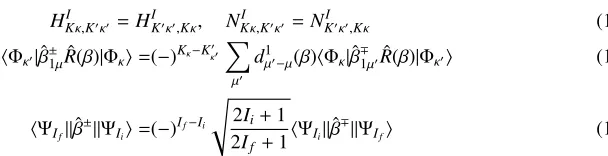
HKκ,KI κ=HIKκ,Kκ, NKκ,KI κ=NKIκ,Kκ (15) Φκ|βˆ±1μRˆ(β)|Φκ=(−)Kκ−Kκ
μ
dμ1−μ(β)Φκ|βˆ∓1μRˆ(β)|Φκ (16)
ΨIfβˆ±ΨIi=(−)If−Ii 2Ii+1
2If+1
ΨIiβˆ∓ΨI
f (17)
together with the Ikeda sum-rule can then be used for testing the codes and checking numerical cor-rectness [32].
3 Results and Discussion
The standard Nilsson scheme [45] is used for generating the deformed basis. In the present work, the Nilsson parameters to generate the basis are taken from Refs. [54, 55]. Three major shells,N=3,4,5 (N = 4,5,6), are adopted for protons (neutrons). The quadrupole and hexadecapole deformation parameters are taken asε2 = 0.275, ε4 = 0.070 for 168Dy andε2 = 0.275, ε4 = 0.030 for168Ho, respectively.
of these two 1−states are nicely reproduced. The configuration of the lower 1−state is found to be
ν1/2−[521]⊗π3/2+[411] andKπ =1−, while the higher one isν1/2−[521]⊗π1/2+[411] andKπ=1−. Three rotational bands based on the g.s. and the two 1−states are shown Fig. 1, and a strong signature dependence is found for the higher 1−band.
Experimentally, GT transitions from the g.s. of168Dy to two 1+states of168Ho have been mea-sured [56]. The lower positive-parity 1+state at 192 keV is a 108-ns isomer. It is seen from Fig. 1 that the energies of both 1+states in168Ho are reproduced well. The configuration of the lower 1+state is found to beν5/2−[512]⊗π7/2−[523] andKπ =1+, while that of the higher isν7/2+[633]⊗π7/2+[404] andKπ =0−. Thus the above results indicate that the present PSM calculation can describe the rele-vant low-lying levels of the mother and daughter nucleus reasonably well.
Figure 2 shows the calculated GT transition strengthB(GT) of theβ−decay from168Dy to168Ho. B(GT) of the yrast band (states in theKπ =0+band) and the excited 2+ band for168Dy are shown in the upper and lower plots, respectively, as a function of excitation energies of168Ho. The known experimentalB(GT) values from the g.s. of168Dy to the two 1+states of168Ho are extracted from Ref. [56] by using Eq. (13), and shown in Fig. 2 for comparison. It is seen that the PSM can reproduce the data with the correct order of magnitude. In addition, a strong GT transition is predicted at about 2 MeV. As seen from Fig. 2(a), the calculation predicts many small GT strengths up to 5 MeV, beyond which states are truncated out from the present configuration space in Eq. (1). Clearly, more transitions should exist in the highly-excited region if one enlarges the configuration space by including multi-qp states.
Little about GT transitions from excited states is known experimentally, because excited states decay normally through electromagnetic transitions. However, in stellar environments, nuclei are exposed to high temperatures, and thermally-populated excitedi-th state in nuclei would have a certain population probability according to the Boltzmann factor and the statistical weight
pi=
(2Ii+1)e−Ei/kT
m(2Im+1)e−Em/kT
. (18)
The GT transition information from excited states thus becomes important in stellar environments. Figure 2(b) shows the calculatedB(GT) rates from the first 2+state (the first excited state in the yrast band) of168Dy. Larger fragmentation of theB(GT) is seen when compared with the rates of the g.s., which is partly due to the larger state-space (i.e., nuclear states with nonzero angular momentum contain different varieties of theKconfigurations) and the corresponding configuration mixture. The same situation happens for the first 4+state (the second excited state in the yrast band), as seen from the plot (c). In this plot, the GT strengths seem to peak at about 3 MeV. Again, the disappearance of the strength at higher excitation energies is due to the truncation effect.
From the above discussion it could be concluded that the GT strength distributions depend sensi-tively on the size of the state-space (i.e. configuration mixture). In the lower row of the plots in Fig. 2, we show the calculated GT transition rates from theKπ=2+2-qp band of the mother nucleus168Dy. As seen from Fig. 2(d), the GT strength from the 2+state of the 2+band has a similar distribution pattern with the one of the first 2+state of the yrast band in Fig. 2(b), but is by about two orders of magnitude weaker (Note the different scales between Fig. 2(b) and (d)). Even more fragmented, but weak GT transitions from the 4+state of the 2+band are predicted, as seen in Fig. 2(e).
4 Summary and future works
basis of the PSM is constructed by superimposing angular-momentum-projected multi-quasiparticle (qp) configurations, and nuclear wave functions are obtained by diagonalizing the two-body interac-tions in these projected states. We have shown that with this method, it is then possible to perform a state-by-state calculation of the nuclear matrix elements forβ-decay in heavy, deformed nuclei. We have takenβ−decay of168Dy to168Ho as an example, and shown that the PSM can well describe the spectrum of the relevant nuclei, and can reproduce the available experimentalB(GT) from the ground state of the mother nucleus to the low-lying states of the daughter nucleus. Furthermore, comparably strong GT transitions form the excited states are predicted to occur. The GT transitions from excited states have been found to be sensitively dependent of the size of model space. Thus the configuration mixture is very important for predictingB(GT) of excited states.
Since the distribution of GT transition depends on the model space, higher-order qp excitation modes are being considered in our model, which requires enlargement of our shell-model space by including higher-order multi-qp states in the configuration space. Particle-number projection for re-moving possible spurious states associated with particle number violation of the BCS method, as well as the spin-dipole force for calculating the first-forbidden GT transitions are also planned as future works.
Acknowledgements
Research at SJTU was supported by the National Natural Science Foundation of China (Nos. 11575112, 11135005), by the 973 Program of China (No. 2013CB834401), and by the Open Project Program of the State Key Laboratory of Theoretical Physics, Institute of Theoretical Physics, Chinese Academy of Sciences, China (No. Y5KF141CJ1).
References
[1] G. M. Fuller, W. A. Fowler, and M. J. Newman, Astrophys. J. Suppl.42, 447 (1980). [2] G. M. Fuller, W. A. Fowler, and M. J. Newman, Astrophys. J.252, 715 (1982). [3] G. M. Fuller, W. A. Fowler, and M. J. Newman, Astrophys. J. Suppl.48, 279 (1982). [4] G. M. Fuller, W. A. Fowler, and M. J. Newman, Astrophys. J.293, 1 (1985). [5] K. Langanke and G. Martínez-pinedo, Rev. Mod. Phys.75, 819 (2003). [6] F. T. Avignone III, S. R. Elliott and J. Engel, Rev. Mod. Phys.80, 481 (2008). [7] C. J. Guesset al., Phys. Rev. C83, 064318 (2011).
[8] H.-Th. Janka, K. Langanke, A. Marek, G. Martínez-Pinedo, B. Müller, Phys. Rep.442, 38 (2007). [9] A. L. Coleet al., Phys. Rev. C86, 015809 (2012).
[10] D. M. Brink, Ph.D. thesis, Oxford University, 1955. [11] P. Axel, Phys. Rev.126, 671 (1962).
[12] G. W. Misch, G. M. Fuller, and B. A. Brown, Phys. Rev. C90, 065808 (2014). [13] Y. Fujita, B. Rubio, and W. Gelletly, Prog. Part. Nucl. Phys.66, 549 (2011). [14] F. Osterfeld, Rev. Mod. Phys.,64, 491 (1992).
[15] N. Ryezayevaet al., Phys. Lett. B639, 623 (2006). [16] S. Rakerset al., NIM A481, 253 (2002).
[17] P. Sarriguren, Phys. Rev. C87, 045801 (2013).
[18] E. Caurier, G. Martínez-Pinedo, F. Nowacki, A. Poves and A. P. Zuker, Rev. Mod. Phys.77, 427 (2005).
[20] B. H. Wildenthal, Prog. Part. Nucl. Phys.11, 5 (1984).
[21] B. A. Brown and B. H. Wildenthal, At. Data Nucl. Data Tables33, 347 (1985). [22] T. Odaet al., At. Data Nucl. Data Tables56, 231 (1994).
[23] K. Langanke and G. Martínez-Pinedo, At. Data Nucl. Data Tables79, 1 (2001). [24] K. Hara and Y. Sun, Int. J. Mod. Phys. E4, 637 (1995).
[25] Y. Sun and D. H. Feng, Phys. Rep.264, 375 (1996).
[26] Y. Sun, J.-y. Zhang, and M. Guidry, Phys. Rev. Lett.78, 2321 (1997). [27] F. Al-Khudair, G.-L. Long, and Y. Sun, Phys. Rev. C79, 034320 (2009). [28] B.-A. Bian, Y. Sun, and Y.-C. Yang, Phys. Rev. C89, 014317 (2014).
[29] Y.-C. Yang, Y. Sun, S.-J. Zhu, M. Guidry, and C.-L. Wu, J. Phys. G: Nucl. Part. Phys.37085110 (2010).
[30] Y.-X. Liu, Y. Sun, X.-H. Zhou, Y.-H. Zhang, S.-Y. Yu, Y.-C. Yang, and H. Jin, Nucl. Phys. A
858, 11 (2011).
[31] Y. Sun, Y.-C. Yang, H. Jin, K. Kaneko, and S. Tazaki, Phys. Rev. C85, 054307 (2012). [32] Z.-C. Gao, Y. Sun, and Y.-S. Chen, Phys. Rev. C74, 054303 (2006).
[33] L.-J. Wang and Y. Sun, to be published.
[34] L. M. Robledo, Phys. Rev. C79, 021302(R) (2009).
[35] G. F. Bertsch and L. M. Robledo, Phys. Rev. Lett.108, 042505 (2012). [36] T. Mizusaki, M. Oi, F. Q. Chen, and Y. Sun, Phys. Lett. B725, 175 (2013). [37] Q.-L. Hu, Z.-C. Gao, and Y. S. Chen, Phys. Lett. B734, 162 (2014).
[38] L.-J. Wang, F.-Q. Chen, T. Mizusaki, M. Oi, and Y. Sun, Phys. Rev. C90, 011303(R) (2014). [39] A. Aprahamian and Y. Sun, Nature Phys.1, 81 (2005).
[40] Y. Sun, M. Wiescher, A. Aprahamian, and J. Fisker, Nucl. Phys. A758, 765 (2005).
[41] Y. Sun, X.-R. Zhou, G.-L. Long, E.-G. Zhao, and P. M. Walker, Phys. Lett. B589, 83 (2004). [42] Y. Sun, M. Wiescher, A. Aprahamian, and J. Fisker, AIP Conf. Proc.819, 196 (2006). [43] Y. Sun, AIP Conf. Proc.819, 30 (2006).
[44] R.-D. Herzberget al., Nature442, 896 (2006). [45] S. G. Nilssonet al., Nucl. Phys. A131, 1 (1969).
[46] P. Ring and P. Schuck,The nuclear many-body problem(Springer Verlag, Berlin, 2004). [47] D. A. Varshalovich, A. N. Moskalev, and V. K. Khersonskii,Quantum theory of angular
mo-mentum(World Scientific, Sigapore, 1988).
[48] M. Dufour and A. P. Zuker, Phys. Rev. C54, 1641 (1996). [49] V. A. Kuz’min and V. G. Soloviev, Nucl. Phys. A486, 118 (1988).
[50] H. Homma, E. Bender, M. Hirsch, K. Muto, H. V. Klapdor-Kleingrothaus, and T. Oda, Phys. Rev. C54, 2972 (1996).
[51] J. Suhonen and O. Civitarese, Phys. Rep.300, 123 (1998). [52] O. Morenoet al., Prog. Part. Nucl. Phys.57, 254 (2006).
[53] K. Langanke and G. Martínez-Pinedo, Nucl. Phys. A673, 481 (2000). [54] F. Dickmann and K. Dietrich, Z. Phys.263, 211 (1973).