On Generalized Pentanacci and Gaussian Generalized Pentanacci Numbers
Yüksel Soykan
Department of Mathematics, Art and Science Faculty, Zonguldak Bülent Ecevit University,
67100, Zonguldak, Turkey e-mail: [email protected]
Abstract. In this paper, we present Binet’s formulas, generating functions, and the summation formulas for generalized Pentanacci numbers, and as special cases, we investigate Pentanacci and Pentanacci-Lucas
numbers with their properties. Also, we de…ne Gaussian generalized Pentanacci numbers and as special
cases, we investigate Gaussian Pentanacci and Gaussian Pentanacci-Lucas numbers with their properties.
Moreover, we give some identities for these numbers. Furthermore, we present matrix formulations of
generalized Pentanacci numbers and Gaussian generalized Pentanacci numbers.
2010 Mathematics Subject Classi…cation. 11B37, 11B39, 11B83.
Keywords. Pentanacci numbers, Gaussian generalized Pentanacci numbers, Gaussian Pentanacci num-bers, Gaussian Pentanacci-Lucas numbers.
1. Introduction and Preliminaries
In this work, we investigate generalized Pentanacci numbers and give properties of Pentanacci and
Pentanacci-Lucas numbers as special cases. We also de…ne Gaussian generalized Pentanacci numbers and
give properties of Gaussian Pentanacci and Gaussian Pentanacci-Lucas numbers as special cases. First, in
this section, we present some background about generalized Pentanacci numbers.
There have been so many studies of the sequences of numbers in the literature which are de…ned
recur-sively. Two of these type of sequences are the sequences of Pentanacci and Pentanacci-Lucas which are special
case of generalized Pentanacci numbers. A generalized Pentanacci sequencefVngn 0=fVn(V0; V1; V2; V3; V4)gn 0
is de…ned by the …fth-order recurrence relations
(1.1) Vn =Vn 1+Vn 2+Vn 3+Vn 4+Vn 5;
with the initial valuesV0=c0; V1=c1; V2=c2; V3=c3; V4=c4 not all being zero. 1
The sequencefVngn 0 can be extended to negative subscripts by de…ning
V n= V (n 1) V (n 2) V (n 3) V (n 4)+V (n 5)
forn= 1;2;3; :::: Therefore, recurrence (1.1) holds for all integern:
The …rst few generalized Pentanacci numbers with positive subscript and negative subscript are given
in the following Table 1:
Table 1. A few generalized Pentanacci numbers
n Vn V n
0 c0 c0
1 c1 c0 c1 c2 c3+c4
2 c2 2c3 c4
3 c3 2c2 c3
4 c4 2c1 c2
5 c0+c1+c2+c3+c4 2c0 c1
6 c0+ 2c1+ 2c2+ 2c3+ 2c4 3c0 2c1 2c2 2c3+ 2c4 7 2c0+ 3c1+ 4c2+ 4c3+ 4c4 c0+c1+c2+ 5c3 3c4 8 4c0+ 6c1+ 7c2+ 8c3+ 8c4 4c2 4c3+c4 9 8c0+ 12c1+ 14c2+ 15c3+ 16c4 4c1 4c2+c3 10 16c0+ 24c1+ 28c2+ 30c3+ 31c4 4c0 4c1+c2
We consider two special cases of Vn : Vn(0;1;1;2;4) = Pn is the sequence of Pentanacci numbers (sequenceA001591in [20]) andVn(5;1;3;7;15) =Qnis the sequence of Pentanacci-Lucas numbers (A074048 in [20]). In other words, Pentanacci sequencefPngn 0and Pentanacci-Lucas sequencefQngn 0 are de…ned
by the …fth-order recurrence relations
(1.2) Pn =Pn 1+Pn 2+Pn 3+Pn 4+Pn 5; P0= 0; P1= 1; P2= 1; P3= 2; P4= 4
and
(1.3) Qn=Qn 1+Qn 2+Qn 3+Qn 4+Qn 5; Q0= 5; Q1= 1; Q2= 3; Q3= 7; Q4= 15
respectively. Pentanacci sequence has been studied by many authors, see for example [14], [15], [19].
Next, we present the …rst few values of the Pentanacci and Pentanacci-Lucas numbers with positive and
negative subscripts in the following Table 2:
Table 2. A few Pentanacci and Pentanacci-Lucas Numbers
n 10 9 8 7 6 5 4 3 2 1 0 1 2 3 4 5 6 7 8 9 10
Pn 3 2 0 0 0 1 1 0 0 0 0 1 1 2 4 8 16 31 61 120 236
For all integers n; usual Pentanacci and Pentanacci-Lucas numbers can be expressed using Binet’s formulas
Pn =
n+3
( )( )( )( )+
n+3
( )( )( )( )
+
n+3
( )( )( )( )+
n+3
( )( )( )( )+
n+3
( )( )( )( )
(see Theorem 2.2) or
(1.4) Pn=
1 6 10
n 1+ 1
6 10
n 1+ 1
6 10
n 1+ 1
6 10
n 1+ 1
6 10
n 1
(see for example [5])
and
Qn = n+ n+ n+ n+ n
respectively, where ; ; ; and are the roots of the equation
(1.5) x5 x4 x3 x2 x 1 = 0:
Moreover, the approximate value of ; ; ; and are given by
= 1:965 9
= 0:678 35 + 0:458 54i
= 0:678 35 0:458 54i
= 0:195 38 + 0:848 85i
= 0:195 38 0:848 85i:
In fact, there are no solutions of the characteristic equation (1.5) in terms of radicals, see [27].
Note that we have the following identities:
+ + + + = 1;
+ + + + + + + + + = 1;
+ + + + + + + + + = 1;
+ + + + = 1
= 1:
2. Properties of Generalized Pentanacci Numbers
In this section, we present Binet’s formulas, generating functions, and the summation formulas for
generalized Pentanacci numbers.
First, we give the ordinary generating function P1 n=0
Lemma 2.1. Suppose that fVn(x) =
1
P
n=0
Vnxn is the ordinary generating function of the generalized Pentanacci sequence fVngn 0:ThenfVn(x)is given by
(2.1)
fVn(x) =
V0+ (V1 V0)x+ (V2 V1 V0)x2+ (V3 V2 V1 V0)x3+ (V4 V3 V2 V1 V0)x4 1 x x2 x3 x4 x5 :
Proof. Using (1.1) and some calculation, we obtain
fVn(x) xfVn(x) x
2f
Vn(x) x
3f
Vn(x) x
4f
Vn(x) x
5f
Vn(x)
= V0+ (V1 V0)x+ (V2 V1 V0)x2+ (V3 V2 V1 V0)x3+ (V4 V3 V2 V1 V0)x4
which gives (2.1).
The previous Lemma gives the following results as particular examples: generating function of the
Pentanacci sequencePn is
(2.2) fPn(x) =
1
X
n=0
Pnxn=
x
1 x x2 x3 x4 x5
and generating function of the Pentanacci-Lucas sequenceQn is
(2.3) fQn(x) =
1
X
n=0
Qnxn=
5 4x 3x2 2x3 x4 1 x x2 x3 x4 x5.
We next …nd Binet formula of Pentanacci numbers by the use of generating function forPn:
Theorem 2.2. (Binet formula of Pentanacci numbers)
Pn =
n+3
( )( )( )( )+
n+3
( )( )( )( )
(2.4)
+
n+3
( )( )( )( )+
n+3
( )( )( )( )
+
n+3
( )( )( )( ):
Proof. Let
h(x) = 1 x x2 x3 x4 x5:
Then for some ; ; ; and ;we write
h(x) = (1 x)(1 x)(1 x)(1 x)(1 x)
i.e.,
(2.5) 1 x x2 x3 x4 x5= (1 x)(1 x)(1 x)(1 x)(1 x)
Hence 1;1;1;1 ve 1 are the roots ofh(x):This gives ; ; ; and as the roots of
h(1 x) = 1
1 x
1 x2
1 x3
1 x4
This impliesx5 x4 x3 x2 x 1 = 0:Now, by (2.2) and (2.5), it follows that
fPn(x) =
1
X
n=0
Pnxn=
x
(1 x)(1 x)(1 x)(1 x)(1 x):
Then we write
(2.6) x
(1 x)(1 x)(1 x)(1 x)(1 x) = A (1 x)+
B (1 x)+
C (1 x)+
D (1 x)+
E (1 x):
So
x = A(1 x)(1 x)(1 x)(1 x) +B(1 x)(1 x)(1 x)(1 x)
+C(1 x)(1 x)(1 x)(1 x) +D(1 x)(1 x)(1 x)(1 x)
+E(1 x)(1 x)(1 x)(1 x):
If we consider x= 1; we get 1 = A(1 )(1 )(1 )(1 ): This givesA = ( )( )(3 )( ):
Similarly, we obtain
B =
3
( )( )( )( ); C=
3
( )( )( )( );
D =
3
( )( )( )( ); E=
3
( )( )( )( ):
Thus (2.6) can be written as
fPn(x) =A(1 x)
1+B(1 x) 1+C(1 x) 1+D(1 x) 1+E(1 x) 1:
This gives
fPn(x) = A
1
X
n=0
nxn+BX1 n=0
nxn+CX1 n=0
nxn+DX1 n=0
nxn+EX1 n=0
nxn
=
1
X
n=0
(A n+B n+C n+D n+E n)xn:
Using the values ofA; B; C; DandE we get
fPn(x) =
1
X
n=0
Pnxn= 1
X
n=0 (
3
( )( )( )( )
+
n+3
( )( )( )( )+
3
( )( )( )( )
+
3
( )( )( )( )+
3
( )( )( )( ))x
n
Therefore, comparing coe¢ cients on both sides of the above equality, we get (2.4).
Next, we give an identity related with generalized Pentanacci numbers and Pentanacci numbers.
Theorem 2.3. Forn 0 andm 0; the following identity holds: (2.7)
Proof. We prove the identity by induction onm:Ifm= 0then
Vn=P 4Vn+ (P 4+P 5)Vn+1+ (P 4+P 5+P 6)Vn+2+ (P 4+P 5+P 6+P 7)Vn+3+P 3Vn+4
which is true becauseP 3= 0; P 4= 1; P 5 = 1; P 6= 0; P 7 = 0. Assume that the equaliy holds for
allm k:Form=k+ 1;we have
V(k+1)+n = Vn+k+Vn+k 1+Vn+k 2+Vn+k 3+Vn+k 4
= (Pk 4Vn+ (Pk 4+Pk 5)Vn+1+ (Pk 4+Pk 5+Pk 6)Vn+2
+(Pk 4+Pk 5+Pk 6+Pk 7)Vn+3+Pk 3Vn+4)
+(Pk 5Vn+ (Pk 5+Pk 6)Vn+1+ (Pk 5+Pk 6+Pk 7)Vn+2
+(Pk 5+Pk 6+Pk 7+Pk 8)Vn+3+Pk 4Vn+4)
+(Pk 6Vn+ (Pk 6+Pk 7)Vn+1+ (Pk 6+Pk 7+Pk 8)Vn+2
+(Pk 6+Pk 7+Pk 8+Pk 9)Vn+3+Pk 5Vn+4)
+(Pk 7Vn+ (Pk 7+Pk 8)Vn+1+ (Pk 7+Pk 8+Pk 9)Vn+2
+(Pk 7+Pk 8+Pk 9+Pk 10)Vn+3+Pk 6Vn+4)
+(Pk 8Vn+ (Pk 8+Pk 9)Vn+1+ (Pk 8+Pk 9+Pk 10)Vn+2
+(Pk 8+Pk 9+Pk 10+Pk 11)Vn+3+Pk 7Vn+4)
= (Pk 3Vn+ (Pk 3+Pk 4)Vn+1+ (Pk 3+Pk 4+Pk 5)Vn+2
+(Pk 3+Pk 4+Pk 5+Pk 6)Vn+3+Pk 2Vn+4)
= P(k+1) 4Vn+ (P(k+1) 4+P(k+1) 5)Vn+1+ (P(k+1) 4+P(k+1) 5+P(k+1) 6)Vn+2
+(P(k+1) 4+P(k+1) 5+P(k+1) 6+P(k+1) 7)Vn+3+P(k+1) 3Vn+4
By induction onm;this proves (2.7).
The previous Theorem gives the following results as particular examples: Forn 0andm 0;we have (takingVn=Pn)
Pm+n =Pm 4Pn+(Pm 4+Pm 5)Pn+1+(Pm 4+Pm 5+Pm 6)Pn+2+(Pm 4+Pm 5+Pm 6+Pm 7)Pn+3+Pm 3Pn+4
and (takingVn=Qn)
Qm+n=Pm 4Qn+(Pm 4+Pm 5)Qn+1+(Pm 4+Pm 5+Pm 6)Qn+2+(Pm 4+Pm 5+Pm 6+Pm 7)Qn+3+Pm 3Qn+4:
Next we present the Binet’s formula of the generalized Pentanacci sequence.
Lemma 2.4. The Binet’s formula of the generalized Pentanacci sequencefVngis given as
Proof. Taken= 0and then replacenwithmin Theorem 2.3.
For another proof of the Lemma 2.4, see [19]. This Lemma is also a special case of a work on thenth
k-generalized Fibonacci number (which is also calledk-step Fibonacci number) in [2, Theorem 2.2].
Corollary2.5. The Binet’s formula of the generalized Pentanacci sequencefVng is given as
Vn=A1 n 8+A2 n 8+A3 n 8+A4 n 8+A5 n 8
where
A1 =
1 6 10(V4
4+ (V
0+V1+V2+V3) 3+ (V1+V2+V3) 2+ (V2+V3) +V3);
A2 =
1 6 10(V4
4+ (V
0+V1+V2+V3) 3+ (V1+V2+V3) 2+ (V2+V3) +V3);
A3 =
1 6 10(V4
4+ (V
0+V1+V2+V3) 3+ (V1+V2+V3) 2+ (V2+V3) +V3);
A4 =
1 6 10(V4
4+ (V
0+V1+V2+V3) 3+ (V1+V2+V3) 2+ (V2+V3) +V3);
A5 =
1 6 10(V4
4+ (V
0+V1+V2+V3) 3+ (V1+V2+V3) 2+ (V2+V3) +V3):
Proof. The proof follows from Lemma 2.4 and (1.4).
In fact, Corollary 2.5 is a special case of a result in [2, Remark 2.3].
The following Theorem present some summation formulas of generalized Pentanacci numbers.
Theorem 2.6. Forn 1 we have the following summing formulas:
(a): (Sum of the generalized Pentanacci numbers) n
X
k=1 Vk=
1
4(Vn+4 Vn+2 2Vn+1+Vn V4+V2+ 2V1 V0)
(b): Pnk=1V2k+1= 81(3V2n+2+ 4V2n+1+V2n+ 2V2n 1 V2n 2 3V4+ 4V3 V2 2V1+V0) (c): Pnk=1V2k= 81( V2n+2+ 4V2n+1+ 5V2n+ 2V2n 1+ 3V2n 2+V4 4V3+ 3V2 2V1 3V0):
Proof.
(a): Using the recurrence relation
Vn =Vn 1+Vn 2+Vn 3+Vn 4+Vn 5
i.e.
we obtain
V0 = V5 V4 V3 V2 V1
V1 = V6 V5 V4 V3 V2
V2 = V7 V6 V5 V4 V3
V3 = V8 V7 V6 V5 V4
V4 = V9 V8 V7 V6 V5
.. .
Vn 5 = Vn Vn 1 Vn 2 Vn 3 Vn 4
Vn 4 = Vn+1 Vn Vn 1 Vn 2 Vn 3
Vn 3 = Vn+2 Vn+1 Vn Vn 1 Vn 2
Vn 2 = Vn+3 Vn+2 Vn+1 Vn Vn 1
Vn 1 = Vn+4 Vn+3 Vn+2 Vn+1 Vn
Vn = Vn+5 Vn+4 Vn+3 Vn+2 Vn+1:
If we add the equations by side by, we get
V0+
n
X
k=1
Vk = V4 V3 V2 V1+
n
X
k=1 Vk
!
+ V3+V2+V1
n
X
k=1 Vk
!
+ V2+V1
n
X
k=1 Vk
! + V1
n
X
k=1 Vk
! +
n
X
k=1 Vk
!
3Vn+1 2Vn+2 Vn+3+Vn+5
= 3Vn+1 2Vn+2 Vn+3+Vn+5+ ( V4+V2+ 2V1) 3
n
X
k=1 Vk
and then
4
n
X
k=1
Vk=Vn+5 Vn+3 2Vn+2 3Vn+1 V4+V2+ 2V1 V0:
It follows that
n
X
k=1 Vk =
1
4(Vn+5 Vn+3 2Vn+2 3Vn+1 V4+V2+ 2V1 V0)
= 1
4((Vn+4+Vn+3+Vn+2+Vn+1+Vn) Vn+3 2Vn+2 3Vn+1 V4+V2+ 2V1 V0)
= 1
(b): When we use (3.1), we obtain the following equalities:
Vk = Vk 1+Vk 2+Vk 3+Vk 4+Vk 5
V4 = V3+V2+V1+V0+V 1
V6 = V5+V4+V3+V2+V1
V8 = V7+V6+V5+V4+V3
V10 = V9+V8+V7+V6+V5
.. .
V2n = V2n 1+V2n 2+V2n 3+V2n 4+V2n 5
V2n+2 = V2n+1+V2n+V2n 1+V2n 2+V2n 3:
If we rearrange the above equalities, we obtain
V3 = V4 V2 V1 V0 V 1
V5 = V6 V4 V3 V2 V1
V7 = V8 V6 V5 V4 V3
V9 = V10 V8 V7 V6 V5
V11 = V12 V10 V9 V8 V7
V13 = V14 V12 V11 V10 V9
V15 = V16 V14 V13 V12 V11
.. .
V2n 1 = V2n V2n 2 V2n 3 V2n 4 V2n 5
V2n+1 = V2n+2 V2n V2n 1 V2n 2 V2n 3:
Now, if we add the above equations by side by, we get (as a I. Method)
n
X
k=1
V2k+1 = V 1 V0 V2+ ( V1 V3 V5 V7 ::: V2n 1)
2Xn 2
k=1 Vk
!
+V2n+2
= V 1 V0 V2+ V2n+1 V1
n
X
k=1 V2k+1
! 2n 2 X
k=1 Vk
!
+V2n+2
and then, using (a), we obtain
n
X
k=1
V2k+1= 1
Note that, as an alternative method (II. Method), the following equality can be used:
n
X
k=1
V2k+1 = V2+V2n+2+
n
X
k=1 V2k
! +
n
X
k=1 V2k
!
+ V1+V2n+1
n
X
k=1 V2k+1
!
+ V0+V2n n
X
k=1 V2k
!
+ V 1 V1+V2n 1+V2n+1
n
X
k=1 V2k+1
! :
(c): (c) follows from (a), (b) and the equality n
X
k=1 V2k=
2Xn+1
k=1 Vk
n
X
k=1
V2k+1 V1:
This completes the proof.
All the listed identities in Theorem 2.6 may be proved by induction, but that method of proof gives no
clue about their discovery.
As special cases of the above Theorem, we have the following two Corollaries. First one present some
summing formulas of Pentanacci numbers.
Corollary2.7. Forn 1we have the following formulas:
(a): (Sum of the Pentanacci numbers) n
X
k=1 Pk=
1
4(Pn+4 Pn+2 2Pn+1+Pn 1)
(b): Pnk=1P2k+1= 18(3P2n+2+ 4P2n+1+P2n+ 2P2n 1 P2n 2 7) (c): Pnk=1P2k= 18( P2n+2+ 4P2n+1+ 5P2n+ 2P2n 1+ 3P2n 2 3):
Second Corollary gives some summing formulas of Pentanacci-Lucas numbers.
Corollary2.8. Forn 1we have the following formulas:
(a): (Sum of the Pentanacci-Lucas numbers) n
X
k=1 Qk=
1
4(Qn+4 Qn+2 2Qn+1+Qn 15)
(b): Pnk=1Q2k+1= 18(3Q2n+2+ 4Q2n+1+Q2n+ 2Q2n 1 Q2n 2 17) (c): Pnk=1Q2k= 18( Q2n+2+ 4Q2n+1+ 5Q2n+ 2Q2n 1+ 3Q2n 2 21):
Sometimes, we need to start summing from zero, such as when dealing with Pentanacci quaternions,
sedenions, etc. We can state Theorem 2.6 in the following form.
Theorem 2.9. Forn 0; we have the following formulas:
(a): Pnk=0Vk =14(Vn+4 Vn+2 2Vn+1+Vn V4+V2+ 2V1+ 3V0);
As special cases of above Theorem, we have the following two Corollaries. First one present some
summation formulas of Pentanacci numbers.
Corollary2.10. Forn 0;we have the following formulas:
(a): Pnk=0Pk =14(Pn+4 Pn+2 2Pn+1+Pn 1)
(b): Pnk=0P2k+1= 18(3P2n+2+ 4P2n+1+P2n+ 2P2n 1 P2n 2+ 1) (c): Pnk=0P2k= 18( P2n+2+ 4P2n+1+ 5P2n+ 2P2n 1+ 3P2n 2 3):
Next Corollary gives some summation formulas of Pentanacci-Lucas numbers.
Corollary2.11. Forn 0;we have the following formulas:
(a): Pnk=0Qk= 14(Qn+4 Qn+2 2Qn+1+Qn+ 5)
(b): Pnk=0Q2k+1= 18(3Q2n+2+ 4Q2n+1+Q2n+ 2Q2n 1 Q2n 2 9) (c): Pnk=0Q2k= 18( Q2n+2+ 4Q2n+1+ 5Q2n+ 2Q2n 1+ 3Q2n 2+ 19):
3. Gaussian Generalized Pentanacci Numbers
In this section, we introduce Gaussian generalized Pentanacci numbers and present Binet’s formulas,
generating functions, and the summation formulas for Gaussian generalized Pentanacci numbers.
First we recall Gaussian integers. A Gaussian integerz is a complex number whose real and imaginary parts are both integers, i.e.,z =a+ib; a; b2Z. These numbers is denoted by Z[i]. For more information about this kind of integers, see the work of Fraleigh [6].
If we use together sequences of integers de…ned recursively and Gaussian type integers, we obtain a new
sequences of complex numbers such as Gaussian Fibonacci, Gaussian Lucas, Gaussian Pell, Gaussian
Pell-Lucas and Gaussian Jacobsthal numbers; Gaussian Padovan and Gaussian Pell-Padovan numbers; Gaussian
Tribonacci numbers.
In 1963, Horadam [11] introduced the concept of complex Fibonacci number called as the Gaussian
Fibonacci number. Pethe [17] de…ned the complex Tribonacci numbers at Gaussian integers, see also [7].
There are other several studies dedicated to these sequences of Gaussian numbers such as the works in [1],
[3], [4], [8], [9], [10], [12], [13], [16], [21], [22], [24], [25], [26], among others.
Gaussian generalized Pentanacci numbersfGVngn 0=fGVn(GV0; GV1; GV2; GV3; GV4)gn 0are de…ned
by
(3.1) GVn=GVn 1+GVn 2+GVn 3+GVn 4+GVn 5;
with the initial conditions
GV0 = c0+ ( c0 c1 c2 c3+c4)i; GV1=c1+c0i; GV2=c2+c1i;
not all being zero. The sequencesfGVngn 0can be extended to negative subscripts by de…ning
GV n= GV (n 1) GV (n 2) GV (n 3) GV (n 4)+GV (n 5)
forn= 1;2;3; :::. Therefore, recurrence (3.1) hold for all integern: Note that forn 0
(3.2) GVn=Vn+iVn 1
and
GV n =V n+iV n 1
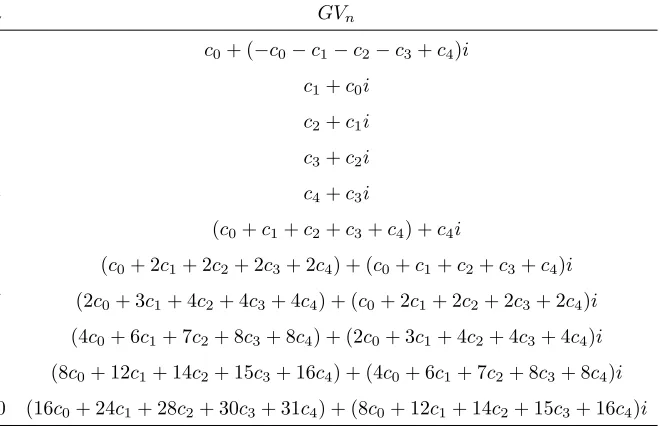
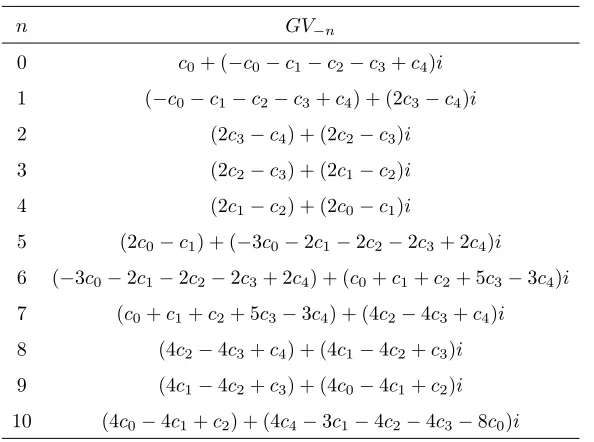
The …rst few generalized Gaussian Pentanacci numbers with positive subscript and negative subscript
are given in the following Table 3 and Table 4:
Table 3. A few Gaussian generalized Pentanacci numbers with positive subscript
n GVn
0 c0+ ( c0 c1 c2 c3+c4)i 1 c1+c0i
2 c2+c1i 3 c3+c2i 4 c4+c3i
5 (c0+c1+c2+c3+c4) +c4i
6 (c0+ 2c1+ 2c2+ 2c3+ 2c4) + (c0+c1+c2+c3+c4)i 7 (2c0+ 3c1+ 4c2+ 4c3+ 4c4) + (c0+ 2c1+ 2c2+ 2c3+ 2c4)i 8 (4c0+ 6c1+ 7c2+ 8c3+ 8c4) + (2c0+ 3c1+ 4c2+ 4c3+ 4c4)i 9 (8c0+ 12c1+ 14c2+ 15c3+ 16c4) + (4c0+ 6c1+ 7c2+ 8c3+ 8c4)i 10 (16c0+ 24c1+ 28c2+ 30c3+ 31c4) + (8c0+ 12c1+ 14c2+ 15c3+ 16c4)i
n GV n
0 c0+ ( c0 c1 c2 c3+c4)i 1 ( c0 c1 c2 c3+c4) + (2c3 c4)i 2 (2c3 c4) + (2c2 c3)i 3 (2c2 c3) + (2c1 c2)i 4 (2c1 c2) + (2c0 c1)i
5 (2c0 c1) + ( 3c0 2c1 2c2 2c3+ 2c4)i
6 ( 3c0 2c1 2c2 2c3+ 2c4) + (c0+c1+c2+ 5c3 3c4)i 7 (c0+c1+c2+ 5c3 3c4) + (4c2 4c3+c4)i 8 (4c2 4c3+c4) + (4c1 4c2+c3)i 9 (4c1 4c2+c3) + (4c0 4c1+c2)i 10 (4c0 4c1+c2) + (4c4 3c1 4c2 4c3 8c0)i
We consider two special cases ofGVn :GVn(0;1;1 +i;2 +i;4 + 2i) =GPn is the sequence of Gaussian Pentanacci numbers andGVn(5 i;1+5i;3+i;7+3i;15+7i) =GQnis the sequence of Gaussian Pentanacci-Lucas numbers. We formally de…ne them as follows:
Gaussian Pentanacci numbers are de…ned by
(3.3) GPn=GPn 1+GPn 2+GPn 3+GPn 4+GPn 5;
with the initial conditions
GP0= 0; GP1= 1; GP2= 1 +i; GP3= 2 +i; GP4= 4 + 2i
and Gaussian Pentanacci-Lucas numbers are de…ned by
(3.4) GQn=GQn 1+GQn 2+GQn 3+GQn 4+GQn 5
with the initial conditions
GQ0= 5 i; GQ1= 1 + 5i; GQ2= 3 +i; GQ3= 7 + 3i; GQ4= 15 + 7i:
Note that forn 0
GPn=Mn+iMn 1; GQn =Rn+iRn 1
and
GP n=M n+iM n 1; GQ n=R n+iR n 1:
Next, we present the …rst few values of the Gaussian Pentanacci and Pentanacci-Lucas numbers with
positive and negative subscripts in the following Table 4:
n 0 1 2 3 4 5 6 7 8 9 GPn 0 1 1 +i 2 +i 4 + 2i 8 + 4i 16 + 8i 31 + 16i 61 + 31i 120 + 61i
GP n 0 0 0 i 1 i 1 0 0 2i 2 3i
GQn 5 i 1 + 5i 3 +i 7 + 3i 15 + 7i 31 + 15i 57 + 31i 113 + 57i 223 + 113i 439 + 223i
GQ n 5 i 1 i 1 i 1 i 1 + 9i 9 7i 7 i 1 i 1 i 1 + 19i
The following Theorem presents the generating function fGVn(x) =
1
P
n=0
GV xn of Gaussian generalized Pentanacci numbersGVn.
Theorem 3.1. The generating function of Gaussian generalized Pentanacci numbers is given as
(3.5) fGVn(x) =
GV0+ (GV1 GV0)x+ (GV2 GV1 GV0)x2+ (GV3 GV2 GV1 GV0)x3 +(GV4 GV3 GV2 GV1 GV0)x4
1 x x2 x3 x4 x5 :
Proof. Using (3.1) and some calculation, we obtain
fGVn(x) xfGVn(x) x
2f
GVn(x) x
3f
GVn(x) x
4f
GVn(x) x
5f
GVn(x)
= GV0+ (GV1 GV0)x+ (GV2 GV1 GV0)x2+ (GV3 GV2 GV1 GV0)x3
+(GV4 GV3 GV2 GV1 GV0)x4
which gives (3.5).
The previous Theorem gives the following results as particular examples: the generating function of
Gaussian Pentanacci numbers is
(3.6) fGPn(x) =
x+ix2
1 x x2 x3 x4 x5
and the generating function of Gaussian Pentanacci-Lucas numbers is
(3.7) fGQn(x) =
5 i (4 6i)x (3 + 3i)x2 (2 + 2i)x3 (1 +i)x4 1 x x2 x3 x4 x5 :
We now present the Binet formula for the Gaussian generalized Pentanacci numbers.
Theorem 3.2. The Binet formula for the Gaussian generalized Pentanacci numbers is
GVn = A1 n 8+A2 n 8+A3 n 8+A4 n 8+A5 n 8
+i A1 n 9+A2 n 9+A3 n 9+A4 n 9+A5 n 9
whereA1; A2; A3; A4 andA5 are as in Corollary 2.5.
The previous Theorem gives the following results as particular examples: the Binet formula for the
Gaussian Pentanacci numbers is
GPn = (
n+3
( )( )( )( )+
n+3
( )( )( )( )+
n+3
( )( )( )( )
+
n+3
( )( )( )( )+
n+3
( )( )( )( ))
+i(
n+2
( )( )( )( )+
n+2
( )( )( )( )+
n+2
( )( )( )( )
+
n+2
( )( )( )( )+
n+2
( )( )( )( ))
or
GPn =
1 6 10
n 1+ 1
6 10
n 1+ 1
6 10
n 1+ 1
6 10
n 1+ 1
6 10
n 1
+i 1 6 10
n 2+ 1
6 10
n 2+ 1
6 10
n 2+ 1
6 10
n 2+ 1
6 10
n 2
and the Binet formula for the Gaussian Pentanacci-Lucas numbers is
GQn = ( n+ n+ n+ n+ n) +i n 1+ n 1+ n 1+ n 1+ n 1 :
The following Theorem present some summation formulas of Gaussian generalized Pentanacci numbers.
Theorem 3.3. Forn 1 we have the following formulas:
(a): (Sum of the Gaussian generalized Pentanacci numbers) n
X
k=1 GVk=
1
4(GVn+4 GVn+2 2GVn+1+GVn GV4+GV2+ 2GV1 GV0)
(b): Pnk=1GV2k+1= 18(3GV2n+2+ 4GV2n+1+GV2n+ 2GV2n 1 GV2n 2 3GV4+ 4GV3 GV2 2GV1+GV0)
(c): Pnk=1GV2k = 18( GV2n+2+ 4GV2n+1+ 5GV2n+ 2GV2n 1+ 3GV2n 2+GV4 4GV3+ 3GV2 2GV1 3GV0):
Proof. (a), (b) and (c) can be proved exactly as in the proof of Theorem 2.6.
As special cases of the above Theorem, we have the following two Corollaries. First one present
summa-tion formulas of Gaussian Pentanacci numbers.
Corollary3.4. Forn 1we have the following formulas:
(a): (Sum of the Gaussian Pentanacci numbers) n
X
k=1 GPk =
1
4(GPn+4 GPn+2 2GPn+1+GPn 1 i)
Second Corollary gives summation formulas of Gaussian Pentanacci-Lucas numbers.
Corollary3.5. Forn 1we have the following formulas:
(a): (Sum of the Gaussian Pentanacci-Lucas numbers) n
X
k=1 GQk=
1
4(GQn+4 GQn+2 2GQn+1+GQn 15 + 5i)
(b): Pnk=1GQ2k+1= 18(3GQ2n+2+ 4GQ2n+1+GQ2n+ 2GQ2n 1 GQ2n 2 17 21i) (c): Pnk=1GQ2k= 18( GQ2n+2+ 4GQ2n+1+ 5GQ2n+ 2GQ2n 1+ 3GQ2n 2 21 9i):
4. Basic Relations and Simson Formulas
In this section, we obtain some identities of Pentanacci numbers and Pentanacci-Lucas numbers and
some identities of Gaussian Pentanacci numbers and Gaussian Pentanacci-Lucas numbers. Moreover, we
present Simson formulas of these numbers.
First, we can give a few basic relations betweenfPngand fQng.
Theorem 4.1. The following equalities are true:
Qn = Pn+3+ 7Pn+1 2Pn Pn 1;
(4.1)
Qn = Pn+2+ 6Pn+1 3Pn 2Pn 1 Pn 2;
(4.2)
Qn = 3Pn+4 7Pn+2 9Pn 8Pn 1 4Pn 2;
(4.3)
Q2n+1 = 287Pn+2 286Pn+1 281Pn 264Pn 1 213Pn 2;
(4.4)
and
1198Pn = 27Qn+3+ 18Qn+2+ 3Qn+1 22Qn+ 136Qn 1;
(4.5)
1198Pn = 45Qn+3 15Qn+1 40Qn+ 118Qn 1 18Qn 2:
(4.6)
Proof. Note that the last six identities hold for all integersn:For example, to show (4.1), writing
Qn=aPn+3+bPn+2+cPn+1+dPn+ePn 1
and solving the system of equations
Q0 = aP3+bP2+cP1+dP0+eP 1
Q1 = aP4+bP3+cP2+dP1+eP0
Q2 = aP5+bP4+cP3+dP2+eP1
Q3 = aP6+bP5+cP4+dP3+eP2
Q4 = aP7+bP6+cP5+dP4+eP3
We present a few basic relations betweenfGPngandfGQng.
Theorem 4.2. The following equalities are true:
GQn = GPn+3+ 7GPn+1 2GPn GPn 1;
(4.7)
GQn = GPn+2+ 6GPn+1 3GPn 2GPn 1 GPn 2;
(4.8)
GQn = 3GPn+4 7GPn+2 9GPn 8GPn 1 4GPn 2;
(4.9)
GQ2n+1 = 287GPn+2 286GPn+1 281GPn 264GPn 1 213GPn 2;
(4.10)
and
1198GPn = 27GQn+3+ 18GQn+2+ 3GQn+1 22GQn+ 136GQn 1;
(4.11)
1198GPn = 45GQn+3 15GQn+1 40GQn+ 118GQn 1 18GQn 2:
(4.12)
Proof. Note that the last six identities hold for all integersn:For example, to show (4.7), writing
GQn =aGPn+3+bGPn+2+cGPn+1+dGPn+eGPn 1
and solving the system of equations
GQ0 = aGP3+bGP2+cGP1+dGP0+eGP 1
GQ1 = aGP4+bGP3+cGP2+dGP1+eGP0
GQ2 = aGP5+bGP4+cGP3+dGP2+eGP1
GQ3 = aGP6+bGP5+cGP4+dGP3+eGP2
GQ4 = aGP7+bGP6+cGP5+dGP4+eGP3
we …nd that a = 1; b = 0; c = 7; d = 2; e = 1: Or using the relations GPn = Pn+iPn 1, GQn =
Qn+iQn 1and identityQn= Pn+3+ 7Pn+1 2Pn Pn 1(see Theorem 4.1) we obtain the identity (4.7).
In fact, note that
GQn = Qn+iQn 1
= ( Pn+3+ 7Pn+1 2Pn Pn 1) +i( Pn+2+ 7Pn 2Pn 1 Pn 2)
= (Pn+3+iPn+2) + 7(Pn+1+iPn) 2(Pn+iPn 1) (Pn 1+iPn 2)
= GPn+3+ 7GPn+1 2GPn GPn 1:
The other equalities can be proved similarly.
We can also give a few basic relations betweenfGQng andfPng.
GQn = (5 i)Pn+1 (4 6i)Pn (3 + 3i)Pn 1 (2 + 2i)Pn 2 (1 +i)Pn 3;
(4.13)
GQn+4 = (15 + 7i)Pn+1+ (16 + 8i)Pn+ (11 + 9i)Pn 1+ (10 + 4i)Pn 2+ (7 + 3i)Pn 3:
We present an identity related with Gaussian generalized Pentanacci numbers and Pentanacci numbers.
Theorem 4.3. Forn 0 andm 0; the following identity holds:
GVm+n = Pm 4GVn+ (Pm 4+Pm 5)GVn+1+ (Pm 4+Pm 5+Pm 6)GVn+2
(4.15)
+(Pm 4+Pm 5+Pm 6+Pm 7)GVn+3+Pm 3GVn+4
(4.16)
Proof. The identity (4.15) can be proved by induction onmas in Theorem 2.3.
The previous Theorem gives the following results as particular examples: Forn 0andm 0;we have (takingGVn =GPn)
GPm+n = Pm 4GPn+ (Pm 4+Pm 5)GPn+1+ (Pm 4+Pm 5+Pm 6)GPn+2
+(Pm 4+Pm 5+Pm 6+Pm 7)GPn+3+Pm 3GPn+4
and (takingGVn =GQn)
GQm+n = Pm 4GQn+ (Pm 4+Pm 5)GQn+1+ (Pm 4+Pm 5+Pm 6)GQn+2
+(Pm 4+Pm 5+Pm 6+Pm 7)GQn+3+Pm 3GQn+4:
One of the oldest and best known identities for the Fibonacci sequencefFng is
Fn+1Fn 1 Fn2= ( 1)n
which was derived …rst by R. Simson in 1753 [18]. This can be written in the form
Fn+1 Fn
Fn Fn 1
= ( 1)n
and called as Simson or Cassini formula (Identity). The following Theorem gives generalization of this result
to generalized Pentanacci numbers.
Theorem 4.4. (Simson’s formula of generalized Pentanacci numbers) For all integersn; we have
(4.17)
Vn+4 Vn+3 Vn+2 Vn+1 Vn
Vn+3 Vn+2 Vn+1 Vn Vn 1 Vn+2 Vn+1 Vn Vn 1 Vn 2 Vn+1 Vn Vn 1 Vn 2 Vn 3 Vn Vn 1 Vn 2 Vn 3 Vn 4
=
V4 V3 V2 V1 V0 V3 V2 V1 V0 V 1 V2 V1 V0 V 1 V 2 V1 V0 V 1 V 2 V 3 V0 V 1 V 2 V 3 V 4
:
Proof. (4.17) is given in Soykan [23].
(a): (Simson’s formula of Pentanacci numbers)
Pn+4 Pn+3 Pn+2 Pn+1 Pn
Pn+3 Pn+2 Pn+1 Pn Pn 1 Pn+2 Pn+1 Pn Pn 1 Pn 2 Pn+1 Pn Pn 1 Pn 2 Pn 3 Pn Pn 1 Pn 2 Pn 3 Pn 4
= 1;
(b): (Simpson’s formula of Pentanacci-Lucas numbers)
Qn+4 Qn+3 Qn+2 Qn+1 Qn
Qn+3 Qn+2 Qn+1 Qn Qn 1 Qn+2 Qn+1 Qn Qn 1 Qn 2 Qn+1 Qn Qn 1 Qn 2 Qn 3 Qn Qn 1 Qn 2 Qn 3 Qn 4
= 9584:
Note that Simson’s formula of Gaussian Pentanacci numbers is
GPn+4 GPn+3 GPn+2 GPn+1 GPn
GPn+3 GPn+2 GPn+1 GPn GPn 1 GPn+2 GPn+1 GPn GPn 1 GPn 2 GPn+1 GPn GPn 1 GPn 2 GPn 3 GPn GPn 1 GPn 2 GPn 3 GPn 4
= 1 +i;
and Simson’s formula of Gaussian Pentanacci-Lucas numbers is
GQn+4 GQn+3 GQn+2 GQn+1 GQn
GQn+3 GQn+2 GQn+1 GQn GQn 1 GQn+2 GQn+1 GQn GQn 1 GQn 2 GQn+1 GQn GQn 1 GQn 2 GQn 3 GQn GQn 1 GQn 2 GQn 3 GQn 4
= 9584 + 9584i:
5. Matrix Formulations of Vn and GVn
In this section, we present some matrix formulation of generalized Pentanacci numbers and Gaussian
generalized Pentanacci numbers.
We de…ne the square matrixAof order5 as:
A= 0 B B B B B B B B B @
1 1 1 1 1 1 0 0 0 0 0 1 0 0 0 0 0 1 0 0 0 0 0 1 0
such thatdetA= 1:Induction proof may be used to establish
An= 0 B B B B B B B B B @
Pn+1 Pn+Pn 1+Pn 2+Pn 3 Pn+Pn 1+Pn 2 Pn+Pn 1 Pn
Pn Pn 1+Pn 2+Pn 3+Pn 4 Pn 1+Pn 2+Pn 3 Pn 1+Pn 2 Pn 1 Pn 1 Pn 2+Pn 3+Pn 4+Pn 5 Pn 2+Pn 3+Pn 4 Pn 2+Pn 3 Pn 2 Pn 2 Pn 3+Pn 4+Pn 5+Pn 6 Pn 3+Pn 4+Pn 5 Pn 3+Pn 4 Pn 3 Pn 3 Pn 4+Pn 5+Pn 6+Pn 7 Pn 4+Pn 5+Pn 6 Pn 4+Pn 5 Pn 4
1 C C C C C C C C C A
Matrix formulation ofPn andQn can be given as
(5.1) 0 B B B B B B B B B @
Pn+4 Pn+3 Pn+2 Pn+1 Pn 1 C C C C C C C C C A = 0 B B B B B B B B B @
1 1 1 1 1 1 0 0 0 0 0 1 0 0 0 0 0 1 0 0 0 0 0 1 0
1 C C C C C C C C C A n0 B B B B B B B B B @ P4 P3 P2 P1 P0 1 C C C C C C C C C A and (5.2) 0 B B B B B B B B B @
Qn+4 Qn+3 Qn+2 Qn+1 Qn 1 C C C C C C C C C A = 0 B B B B B B B B B @
1 1 1 1 1 1 0 0 0 0 0 1 0 0 0 0 0 1 0 0 0 0 0 1 0
1 C C C C C C C C C A n0 B B B B B B B B B @ Q4 Q3 Q2 Q1 Q0 1 C C C C C C C C C A :
Induction proofs may be used to establish the matrix formulationsPnandQn. Similarly, matrix formulation ofVn can be given as
0 B B B B B B B B B @
Vn+4 Vn+3 Vn+2 Vn+1 Vn 1 C C C C C C C C C A = 0 B B B B B B B B B @
1 1 1 1 1 1 0 0 0 0 0 1 0 0 0 0 0 1 0 0 0 0 0 1 0
Consider the matricesNP; EP de…ned by as follows:
NP =
0 B B B B B B B B B @
4 + 2i 2 +i 1 +i 1 0 2 +i 1 +i 1 0 0 1 +i 1 0 0 0 1 0 0 0 i 0 0 0 i 1 i
1 C C C C C C C C C A ;
EP =
0 B B B B B B B B B @
GPn+4 GPn+3 GPn+2 GPn+1 GPn
GPn+3 GPn+2 GPn+1 GPn GPn 1 GPn+2 GPn+1 GPn GPn 1 GPn 2 GPn+1 GPn GPn 1 GPn 2 GPn 3 GPn GPn 1 GPn 2 GPn 3 GPn 4
1 C C C C C C C C C A :
Next Theorem presents the relations betweenAn; N
P and EP:
Theorem 5.1. Forn 4; we have
AnNP =EP:
Proof. Using the relations
GPn = Pn+iPn 1;
GPn+4 = Pn+4+iPn+3= (4 + 2i)Pn+1+ (4 + 2i)Pn+ (4 + 2i)Pn 1+ (3 + 2i)Pn 2+ (2 +i)Pn 3;
GPn+3 = (2 +i)Pn+1+ (2 +i)Pn+ (2 +i)Pn 1+ (2 +i)Pn 2+ (1 +i)Pn 3;
we getAnNP =EP:
Above Theorem can be proved by mathematical induction as well.
Consider the matricesNQ; EQ de…ned by as follows:
NQ =
0 B B B B B B B B B @
15 + 7i 7 + 3i 3 +i 1 + 5i 5 i 7 + 3i 3 +i 1 + 5i 5 i 1 i
3 +i 1 + 5i 5 i 1 i 1 i 1 + 5i 5 i 1 i 1 i 1 i 5 i 1 i 1 i 1 i 1 + 9i
1 C C C C C C C C C A
EQ =
0 B B B B B B B B B @
GQn+4 GQn+3 GQn+2 GQn+1 GQn
GQn+3 GQn+2 GQn+1 GQn GQn 1 GQn+2 GQn+1 GQn GQn 1 GQn 2 GQn+1 GQn GQn 1 GQn 2 GQn 3 GQn GQn 1 GQn 2 GQn 3 GQn 4
1 C C C C C C C C C A :
Theorem 5.2. We have
AnNQ=EQ:
Proof. The proof requires some lengthy calculation, so we omit it.
The previous Theorem, also, can be proved by mathematical induction.
6. Conclusions
In the section 1, we present some background about generalized Pentanacci numbers.
In the section 2, we present Binet’s formulas, generating functions, and the summation formulas
for generalized Pentanacci numbers.
In the section 3, …rst we recall Gaussian integers and then we de…ne Gaussian generalized Pentanacci
numbers and as special cases, we investigate Gaussian Pentanacci and Gaussian Pentanacci-Lucas
numbers, with their properties such as the generating functions, Binet’s formulas and sums formulas
of these Gaussian numbers.
In the section 4, we obtain some identities of Pentanacci numbers and Pentanacci-Lucas numbers
and some identities of Gaussian Pentanacci numbers and Gaussian Pentanacci-Lucas numbers.
Furthermore, we present Simson formulas of those numbers.
In the section 5, we give some matrix formulation of generalized Pentanacci numbers and Gaussian
generalized Pentanacci numbers.
References
[1] Asci M., Gurel E., Gaussian Jacobsthal and Gaussian Jacobsthal Polynomials, Notes on Number Theory and Discrete
Mathematics, Vol.19, pp.25-36, 2013.
[2] Bacani, J. B., Rabago, J. F. T., On Generalized Fibonacci Numbers, Applied Mathematical Sciences, 9 (25), 3611-3622,
2015.
[3] Berzsenyi G., Gaussian Fibonacci Numbers, Fibonacci Quart., Vol.15(3), pp.233-236, 1977.
[4] Catarino, P., and Campos, H., A note on Gaussian Modi…ed Pell numbers, Journal of Information & Optimization Sciences,
Vol. 39, No. 6, pp. 1363–1371, 2018.
[5] G. P. Dresden G. P., Du, Z., A Simpli…ed Binet Formula for k-Generalized Fibonacci Numbers, J. Integer Seq. 17, art.
14.4.7, 9 pp., 2014.
[6] Fraleigh J.B., A First Course In Abstract Algebra, (2nd ed.), Addison-Wesley, Reading, ISBN 0-201-01984-1, 1976.
[7] E. Gurel, k-Order Gaussian Fibonacci and k-Order Gaussian Lucas Recurrence Relations, Ph.D Thesis, Pamukkale
Uni-versity Institute of Science Mathematics, Denizli, Turkey (2015).
[8] Halici S., Öz S., On some Gaussian Pell and Pell-Lucas numbers, Ordu University Science and Technology Journal, Vol.6(1),
pp.8-18, 2016.
[9] Halici S., Öz S., On Gaussian Pell Polynomials and Their Some Properties, Palestine Journal of Mathematics, Vol 7(1),
251-256, 2018.
[10] Harman C. J., Complex Fibonacci Numbers, Fibonacci Quart., Vol.19(1), pp. 82-86, 1981.
[11] Horadam, A. F., Complex Fibonacci Numbers and Fibonacci quaternions, Amer. Math. Monthly 70, 289–291, 1963.
[13] Pethe S., Horadam A.F., Generalised Gaussian Fibonacci numbers, Bull. Austral. Math. Soc., Vol.33, pp.37-48, 1986.
[14] Melham, R. S., Some Analogs of the IdentityF2
n+Fn2+1=F22n+1, Fibonacci Quarterly, 305-311, 1999.
[15] Natividad, L. R., On Solving Fibonacci-Like Sequences of Fourth, Fifth and Sixth Order, International Journal of
Mathe-matics and Computing, 3 (2), 2013.
[16] Pethe S., Horadam A.F., Generalised Gaussian Lucas Primordial numbers, Fibonacci Quart., pp. 20-30, 1988.
[17] Pethe, S., Some Identities for Tribonacci Sequences, The Fibonacci Quarterly, 26, 144-151, 1988.
[18] Simson. R., An Explanation of an Obscure Passage in Albrecht Girard’s Commentary upon Simon Stevin’s Works,
Philo-sophical Transactions of the Royal Society 48.1, 368-377, 1753.
[19] Rathore, G.P.S., Sikhwal, O., Choudhary, R., Formula for …nding nth Term of Fibonacci-Like Sequence of Higher Order,
International Journal of Mathematics And its Applications, 4 (2-D), 75-80, 2016.
[20] Sloane, N.J.A., The on-line encyclopedia of integer sequences, http://oeis.org/
[21] Soykan, Y., Ta¸sdemir, E., Okumu¸s, ·I., Göcen, M., Gaussian Generalized Tribonacci Numbers, Journal of Progressive
Research in Mathematics(JPRM), 14 (2), 2373-2387, 2018.
[22] Soykan, Y., Gaussian Generalized Tetranacci Numbers, Journal of Advances in Mathematics and Computer Science, 31(3):
1-21, Article no.JAMCS.48063, 2019.
[23] Soykan, Y., Simson Identity of Generalized m-step Fibonacci Numbers, arXiv:1903.01313v1 [math.NT], 2019.
[24] Ta¸sc¬, D., and Acar, H., Gaussian Pentanacci Numbers, Communications in Mathematics ans Applications, 8 (3), 379–386,
2017.
[25] Ta¸sc¬, D., and Acar, H., Gaussian Padovan and Gaussian Pell-Padovan Numbers, Commun. Fac. Sci. Ank. Ser. A1 Math.
Stat., Volume 67, Number 2, pp. 82-88, 2018.
[26] Yagmur, T., and Karaaslan, N., Gaussian Modi…ed Pell Sequence and Gaussian Modi…ed Pell Polynomial, Aksaray
Uni-versity Journal of Science and Engineering, Volume 2, Issue 1, pp. 63-72, 2018.