SATYA PRAKASH
Department of Biology, University of Rochester, Rochester, N e w York 14627
Manuscript received February 1, 1973
ABSTRACT
Study of allozyme variation in D. busckii a t thirty loci gives the proportion of polymorphic loci = .I66 and the proportion of loci heterozygous per indi- vidual = .OM. D. busckii has a narrower seasonal and food niche than the other domestic species D. melanogaster which has more allozyme variation. It is suggested that the low gene variation in D. busckii might be due to adaptation of this species to a narrow niche.
D R O S O P H Z L A busckii is the only known species of subgenus Dorsilopha in the genus Drosophila. The species is widely distributed in the world and is found in association with domestic habitats of man. The metaphase chromosome karyotype of the species consists of two large autosomal V’s and a rodlike X . Paracentric inversions are found in the X , the second and the third chromosome of this species, and have been described by KRIVSHENKO (1963). The frequency
of the inverted chromosomes in this species, however, is low. In the X chromo- some 6.5% of the chromosomes have an inversion I-P and 93.5% of the chro- mosomes have the standard sequence. The frequency of the inverted third chromosomes is only 0.18%. The second chromosome is most variable with sex
complex paracentric inversions; however, the total frequency of all inverted second chromosomes is about 7%. In other words, while nine different inversions have been described in the species, the frequency of all these inversions is low. In all chromosomes the standard arrangement is very common in all populations and quantitatively this species has a low amount of inversion polymorphism. Collection records of various investigators (published in D.I.S. 1964-1972) from different areas of the world-U.S., Mexico, Colombia, Netherlands, Spain, India, etc.-using different fruits such as bananas, cantaloupes, oranges, tomatoes as baits, show that D. melanogaster is usually the most dominant domestic species and D. busckii is a rare species. Collection records of
PATTERSON
(1943) show that the seasonal niche breadth ofD.
busckii is very narrow in comparison toD.
melanogaster. During collections in Austin, Texas, from July 1938 to May 1941D.
melanogaster and D. simulans were recorded every month; D. busckiiwas recorded mainly in the spring months of March, April and May. From these data LEVINS (1968) calculates the seasonal niche breadth of D. busckii as 3.21 and that of D. melanogaster and D . simulans as 9.58. In addition D. busckii is a
difficult species to raise in the laboratory; it does not breed well on most standard Drosophila media. The available evidence suggests strongly that the niche breadths of the three domestic Drosophila species are in the order:
D.
mrlano- gaster>
D.
simulans>
D.
busckii (see TANTAWY and MALLAH 1961 for com- parison of niche breadths ofD.
melanogaster andD.
simulans).
We have examined gene variation at 30 electrophoretic loci of
D.
busckii strains from different parts of the world. We find that the proportion of polymorphic loci inD.
busckii is 0.166 and the proportion of loci heterozygous per individual is 0.044.D.
busckii is the least polymorphic species of Drosophila thus far examined.MATERIALS A N D METHODS
Populations studied
A. Wild strains: 46 wild strains originating from various countries were studied. These strains had been maintained in mass cultures by DR. J. KRIVSHENKO for a period of two to ten years and were provided to us for this study. We examined the following number of strains from different places: U.S.: New York (7), Pennsylvania (4), Hawaii (3), California (3), Washington (2),
Virginia (2), Minnesota ( I ) , Montana ( I ) , Puerto Rico (1) ; Canada (4), Brazil (6), Argentina
(2),Peru ( I ) , Chile ( I ) , Holland ( 2 ) , Japan (2),Australia ( I ) , Italy (2).
B. Fifty freshly-collected wild strains from Englewood, New Jersey, U.S.A., and seven freshly collected strains from St. Louis, Missouri, U.S.A., were studied.
C. Balanced inversion stocks: A total of 57 balanced inversion stocks of the second chromo- some were examined for association of the Leucine aminopeptidase locus with the second chro- mosome gene arrangements. These strains were obtained from DR. J. KRIVSHENEO. The balanced inversion strains included the following inversion derived from samples obtained from different parts of the world-the number of strains studied are given in parenthesis: 2SP (8), 2P (18),
2R01 (21), 2R02 (IO).
Enzyme assays
Several monomorphic loci in D. busckii which are highly polymorphic in other Drosophila species were studied in both acrylamide and starch gels and in different buffer systems. The esterases were studied in acrylamide gels using 0.1 M Trisborate Edta buffer pH9 and in starch gels using POULIK’S discontinuous buff er system. The xanthine dehydrogenase was studied in both starch and acrylamide gels in 0.1 M Trisborate Edta buffer pH9 system. The alcohol dehydro- genases were studied in starch gels using POULIK’S discontinuous buffer and in 0.1 M Trisborate Edta buffer pH9.
AcryZumide gels: Assay methods f o r larval proteins, leucine aminopeptidase, octanol dehydro- genase, a glycerophosphate dehydrogenase, xanthine dehydrogenase, malic dehydrogenase, and esterase in acrylamide gels have been described in PRAKASH, LEWONTIN and HUBBY (1969).
Starch gels. Starch was obtained from Cannaught Laboratories, Toronto; esterases, acetalde- hyde oxidase, and alcohol dehydrogenase were studied in 16% starch gels. Electrophoresis was performed at 300 volts f o r 3% hours using POULIK’S discontinuous buffer system. Staining of esterases and acetaldehyde oxidase was done as described in PRAKASH, LEWONTIN and HUBBY
(1969), except that benzaldehyde was used instead of acetaldehyde for acetaldehyde oxidase assay. Malic dehydrogenase, xanthine dehydrogenase, fumerase and adenylate kinase were studied in 12% starch gels. 0.1 M Trisborate Edta pH9 buffer was used in the gels and in buffer com- partments. Electrophoresis was performed at 500 volts for 4 hours.
Agar gels: The hexokinases were studied in 0.8% agar gels with 80 mg. glucose/l50 d.
D.
and enzymes are described in PRAKASH, LEWONTIN and HUBBY (1969) and PRAKASH (1973). Strain analysis: Three to five individuals were studied for all assays except leucine amino- peptidase. This enzyme was studied in the 46 wild strains and in the balanced inversion stocks; only five strains from Englewood, N.J. were studied for this assay. W e have studied a t least 90 genomes of wild laboratory strain, 100 genomes of freshly collected Englewood, N.J. strains and 14 genomes of freshly collected St. Louis, MO. strains.
RESULTS
Of the 30 loci examined, we find polymorphism in five loci-Leucine amino- peptidase (LAP), Larval proteins Pt8 and PtiO, Malic dehydrogenase 1 ( M D H I ) and Acetaldehyde oxidase (A.oz). The rest of the 25 loci are monomorphic. These loci are: larval proteins-Ptl, 2, 6, 7, 11, 12, 13; Esterases-Est I , 2, 3 ;
Amylase; Xanthine dehydrogenase; Octanol dehydrogenase; Alcohol dehydro- genase 1 and 2; Tetrazolium oxidase 7 and 8; Adenylate kinase; M D H 2; Fumarase; a! Glycerophosphate dehydrogenase; Hexokinases 1, 2,3, 6.
Chromosome location of polymorphic loci
Balanced lethal stocks of the second chromosome, polymorphic for two LAP alleles, were examined for associations of LAP genotypes with morphological mutant markers. STA/2Pf strain, where ST is the standard chromosome and 2P is the inverted chromosome, produces only 2P+/2P+ and 2P+/STA flies since STA/STA homozygotes are lethal. All 2P+/2P+ flies were homozygous LAP 1.07/1.07 and 2P+/STA flies were LAP 1.0/1.07. Similarly, PtlO was found to be associated with the second chromosome. From crosses involving STA/2P+ strain, which was homozygous A.oz 1.0/1.0 to a wild strain homozy- gous for A.oz .90/.90, it was found that A.ox locus is also located on the second chromosoime. MDH-1 locus is present on the third chromosome. The genetics of Pt8 has not been worked out; from segregation results in strains it is a n autosomal locus.
Table I gives the frequencies of alleles at four of the five polymorphic loci. There is no difference in allele frequencies at these loci between wild laboratory strains from different parts of the world and the strains from Englewood, N.J.
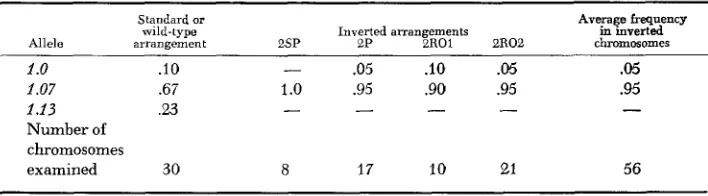
The strains from St. Louis, MO. show lack of rare alleles a t the Pt8, PtlO, and A.oz loci, which is most probably due to the small number of genomes studied from this population. At the Pt8, PtlO and A.oz loci the frequency of the major allele is 95% or greater. On the other hand the allele frequencies are inter- mediate at the M D H (Table IC) and the LAP loci (Table 2).
Table 2 gives the allele frequencies at the LAP locus in the standard and the four inverted arrangements of the second chromosome-2SP, 2P, 2R01
,
and 2R02. No LAP 1.13 was found in any of the 56 inversion chromosomes; this allele is 23% in the standard arrangement. The average heterozygosity at the LAP locus in the ST/ST, ST/Inv and Inv/Inv karyotypes is 0.48,0.357 and .095,TABLE 1
Frequencies of alleles at polymorphic loci in wild laboratory strains originating from different parts of the world-Englewood, New Jersey, US. and St. Louis Missouri, U.S. s t r a m
St. Louis Missouri' Wild EnglmO4
Allele laboratory strains New Jersey
.98 1.0
1.0 1.02
1.0 1.5
.90 1.0
A Pt-8
Chromosome location not known
.05 .04
.95 .96
B Pt-10 Chromosome I1
.95 .99
.05 .01
C
Malic dehydrogenase Chromosome I11
.50 .53
.50 .47
D
Acetaldehyde oxidase Chromosome I1
.07 .03
.93 .97
-
1 .o1
.o
-
.57 .43
-
1.0
LAP 1.07) ; since in their crosses one allele showed heterosis with the F and the
S alleles (our designation LAP 1.13 and LAP 1.0 respectively) and the other M allele did not. These results can be explained easily by the association of LAP alleles with the second chromosome gene arrangements. The M allele located in the inversion chromosome will show heterosis with all three alleles S,
M y F,
of the standard chromosome, since these individuals are inversion heterokaryotypes, whereas the M allele of the standard chromosome will be expected to show little if any heterosis with the S and the F alleles of the standard chromosome, since these individuals are ST/ST homokaryotypes.TABLE 2
Association of alleles at the LAP locus with the standard and uarious other gene arrangements in the second chromosome
Standard or Average frequency wild-type Inverted arrangements in inverted Allele arrangement 2SP 2P 2R01 2RO2 chromosomes 1.0 .IO
-
.05 .IO .E .05 1.07 .67 1.o
.95 .90 .95 .95 1.13 .23Number of
chromosomes
examined 30 8 17 10 21 56
busckii 75
DISCUSSION
The statistics for the magnitude of polymorphism in
D.
busckii are as follows: Proportion of polymorphic loci 5/30 = 16.6% and proportion of loci heterozy- gous per individual =4.4%.
Such low polymorphism inD.
busckii is not due to examination of a limited sample of strains. We have examined freshly collected strains from two widely separated localities in the U.S. and other strains origi- nating from all over the world. All of the strains, regardless of their population origin, are fixed for the same allele at the monomorphic loci; the allele frequen- cies at the polymorphic loci are also similar in different populations.The two possible explanations, which are not mutually exclusive, for the low variation in
D.
busckii are as follows: (1) This species went through a drastic reduction in population size due to some unfavorable environmental conditions; random drift and inbreeding caused the fixation of one allele at most loci; the species has now spread worldwide in association with domestic habitats of homo sapiens. The presence of six different complex paracentric inversions can be explained as due to recombination between the standard and the 2 R 0 2 inversion.(2) The low level of polymorphism in
D.
busckii is related to the narrow seasonal and food niche of this species. The allozyme variation is adaptive; species which are adapted to diverse ecological and environmental conditions can maintain more polymorphism than species adapted to narrow range of environments. Because of close association ofD.
melanogaster,D.
simulans andD.
busckii with domestic habitats of man a somewhat meaningful comparison of seasonal and food niche of these species seems possible. As has been described in the introduc- tion, the seasonal and food niche width ofD.
busckii is smaller thanD.
melano- gmter andD.
simulans. The levels of polymorphism in these species are given below.Proportion Average
Number of of loci hetero-
Species Populations loci studied polymorphic zygosity
D.
meZanogaster* Katsunuma, Japan 19 .42 .12D.
simulans* Austin, Texas 18 .44 .10D.
busckii several 30 .166 .044*
from KOJIMA, GILLESPIE and TOBARI (1970)The relationship between levels of polymorphism and niche width in these Drosophila species can be taken as suggestive that allozyme polymorphisms pro- vide adaptation to environmental heterogeneity. We have observed clinal varia- tion in allele frequencies at most of the polymorphic loci in
D.
robusta, which suggests that environmental factors influence the allozyme variation. The clinal variation in allele frequencies inD.
robusta occurs even within an inversion type( PRAKASH 1973; PRAKASH and LEVITAN 1973).
LITERATURE CITED
JOHNSON, F. M., C. G. KANAPI, R. H. RICHARIBON and R. K. SAKAI, 1967 Isozyme variability in species of the genus Drosophila. I. A multiple allelic isozyme system in Drosophila buck%:
Inheritance and general considerations. Biochem. Genet. 1 : 3 5 4 .
KOJIMA, K., J. GILLISPIE and Y. N. TOBARI, 1970 A profile of Drosophila species enzymes assayed by electrophoresis. 1. Number of alleles, heterozygosities, and linkage disequilibrium in glucose metabolizing systems and some other enzymes. Biochem. Genet. 4: 627-638. KRIVSHENKO, J. D., 1963 The Chromosomal polymorphism of Drosophila busckii in natural
populations. Genetics 4.8: 1239-1258.
LEVINS, R., 1968 Evolution in changing environments. Princeton University Press, Princeton,
N.J.
PATTERSON, J. T., 1943 Studies in the genetics of Drosophila. 111. The Drosophilidae of the southwest. Univ. of Texas publ. 4313.
PAVAN, C., A. R. CORDEIRO, N. DOBZHANSKY, TH. DOBZHANSKY, C. MALOGOLOWKIN, B. SPASSKY and M. WEDEL, 1951 Concealed genic variability in Brazilian Drosophila willistoni.
Genetics 36: 13-30.
Patterns of gene variation in central and marginal populations of Drosophila robusta. Genetics 75: 571-576.
Associations of alleles of the Esterase-1 locus with gene arrangements of the left a r m of second chromosome in Drosophila robusta. Genetics 75:
571-576.
PRAKASH, S., R. C. LEWONTIN and J. L. HUBBY, 1969 A molecular approach to the study of genic heterozygosity in natural populations. IV. Patterns of genic variation in central, marginal, and isolated populations of Drosophila pseudoobscura. Genetics 61 : 841-858.
SHAW, C. R. and R. PRASAD, 1970 Starch gel electrophoresis of enzymes-A compilation of recipes. Biochem. Genet. 4: 297-320.
TANTAWY, A. D. and G. S. MALLAH, 1961 Studies on natural populations of Drosophila. I. Heat resistance and geographic variation in Drosophila melanogaster and D. simularts. Evol. 15:
1-14.
Corresponding editor: R. C. LEWONTIN
PRAKASH, S., 1973