Authenticated Key Exchange and Key Encapsulation
Without Random Oracles
Tatsuaki Okamoto
NTT, 3-9-11 Midori-cho, Musashino-shi, Tokyo, 180-8585 Japan December 26, 2007
Abstract. This paper1 presents a new paradigm to realize cryptographic primi-tives such as authenticated key exchange and key encapsulation without random oracles under three assumptions: the decisional Diffie-Hellman (DDH) assump-tion, target collision resistant (TCR) hash functions and a class of pseudo-random functions (PRFs),πPRFs, PRFs with pairwise-independent random sources. We propose a (PKI-based) two-pass authenticated key exchange (AKE) protocol that is comparably as efficient as the existing most efficient protocols like MQV and that is secure without random oracles (under these assumptions). Our protocol is shown to be secure in the (currently) strongest security definition, the extended Canetti-Krawczyk (eCK) security definition introduced by LaMacchia, Lauter and Mityagin. We also show that a variant of the Kurosawa-Desmedt key encap-sulation mechanism (KEM) using aπPRF is CCA-secure under the three assump-tions. This scheme is secure in a stronger security notion, the chosen public-key and ciphertext attack (CPCA) security, with using a generalized TCR (GTCR) hash function in place of a TCR hash function. The proposed schemes in this paper are validity-check-free and the implication is that combining them with validity-check-free symmetric encryption (DEM) will yield validity-check-free (e.g., MAC-free) CCA-secure hybrid encryption.
1
Introduction
The most common paradigm to design practical public-key cryptosystems secure in the standard model is to combine a trapdoor function (e.g., Diffie-Hellman) and target collision resistance (TCR) hash functions, where the security is proven under a trapdoor function assumption (e.g., DDH) and the TCR hash function assumption [1, 3, 9].
This paper introduces a new paradigm to design practical public-key cryptosys-tems, where a class of pseudo-random functions (PRFs),πPRFs, PRFs with pairwise-independent random sources, is employed in addition to a trapdoor function (DH) and target collision resistant (TCR) hash function.
The concept of a PRF was introduced by Goldreich, Goldwasser and Micali [5], and has been shown to exist if and only if a one-way function exists [5, 6]. Therefore, the existence of a pseudo-random function is one of the weakest assumptions, and it is one of the most fundamental primitives in cryptography.
1
Since a target collision resistant (TCR) hash function (and the slightly more general concept, a universal one-way hash function) have also been shown to exist if and only if a one-way function exists [14, 16], TCR hash function and PRF are the same level of (the most) fundamental primitives in cryptography.
In practice, a well-designed efficient hash function can be assumed to be a TCR hash function, and such a hash function with a random seed as a part of the input (or a keyed hash function) can be assumed to be a PRF. Although the existence of aπPRF is a stronger assumption than that of a PRF, a well-designed efficient hash function with a random seed as a part of the input (or a keyed hash function) is also expected to be a
πPRF (with an index).
Authenticated key exchange (AKE) protocols have been extensively studied to en-hance the security of the Diffie-Hellman (DH) key exchange protocol, which was pro-posed in 1976, because the DH protocol is not secure against the man-in-the-middle attack [2, 8, 10–13, 17].
This paper presents a (PKI-based) two-pass AKE protocol that offers the following properties:
1. its efficiency is comparable to those of MQV [11], HMQV [8] and CMQV [17] (our scheme’s message size for one party is that of MQV plus the size of three group el-ements, and the computational complexity for a session of our scheme is around 4.3 group exponentiations, while that of MQV is around 2.2 group exponentiations), 2. the model for its security proof is not the random oracle model under the three
assumptions (DDH, TCR hash function and πPRF), while the existing efficient two-pass AKE protocols such as HMQV, NAXOS and CMQV are secure in the random oracle model,
3. its underlying security definition is (currently) the strongest one, the extended Canetti-Krawczyk (eCK) security definition introduced by LaMacchia, Lauter and Mitya-gin [10],
4. its security proof reduction efficiency is better than those of previous protocols in the random oracle model.
This paper also proposes a CCA-secure key encapsulation mechanism (KEM) under these assumptions (DDH, TCR hash function and πPRF), which is a variant of the Kurosawa-Desmedt KEM [9].
This scheme is secure in a stronger security notion, the chosen public-key and ci-phertext attack (CPCA) security, with using a generalized TCR (GTCR) hash function in place of a TCR hash functions, where an adversary for the CPCA security, given a target public keypk∗and ciphertextc∗, is allowed to query a pair of public keypkand ciphertextcto the decryption oracle, which answers the adversary with the decrypted result of cby the secret key of pk. The CPCA security seems closely related to the security notion, complete non-malleability, introduced by Fischlin [4].
2
Preliminaries
2.1 Notations
Nis the set of natural numbers andRis the set of real numbers.⊥denotes a null string. A functionf :N →Ris negligible ink, if for every constantc >0, there exists integernsuch thatf(k)< k−cfor allk > n. Hereafter, we often usef(k)< ǫ(k)to mean thatf is negligible ink.
WhenAis a probabilistic machine or algorithm,A(x)denotes the random variable ofA’s output on inputx. Then,y ←R A(x)denotes thaty is randomly selected from
A(x)according to its distribution. Whenais a value,A(x)→adenotes the event that
Aoutputsaon inputx. WhenAis a set,y ←U Adenotes thatyis uniformly selected fromA. WhenAis a value,y←Adenotes thatyis set asA.
In this paper, we consider that the underlying machines are uniform Turing ma-chines. But it is easy to extend our results to non-uniform Turing mama-chines.
2.2 The DDH Assumption
Letkbe a security parameter andGbe a group with security parameterk, where the
order of Gis primep and|p| = k. Let {G}k be the set of group Gwith security
parameterk.
For allk∈Nwe define the setsDandRas follows:
D(k)← {(G, g1, g2, gx1, gx2) | G← {U G}k,(g1, g2)←U G2, x←U Zp}
R(k)← {(G, g1, g2, y1, y2) | G← {U G}k,(g1, g2, y1, y2)←UG4}.
LetAbe a probabilistic polynomial-time machine. For allk∈N, we define the DDH
advantage ofAas
AdvDDHA(k)← | Pr[A(1k, ρ)→1 | ρ U
←D(k)] −Pr[A(1k, ρ)→1 | ρ←UR(k)]|.
The DDH assumption for{G}k∈Nis: For any probabilistic polynomial-time adversary A,AdvDDHA(k)is negligible ink.
2.3 Pseudo-Random Function (PRF)
The concept of a pseudo-random function (PRF) is defined in [5] by Goldreich, Gold-wasser and Micali.
Letk ∈ N be a security parameter. A pseudo-random function (PRF) familyF
associated with{Seedk}k∈N,{Domk}k∈Nand{Rngk}k∈Nspecifies two items: – A family of random seeds{Seedk}k∈N.
– A family of pseudo-random functions indexed byk,Σ ←R Seedk,σ U
← Σ,D ←R
Domk, andR R
← Rngk, where each such functionFk,Σ,D,Rσ maps an element of
Dto an element ofR. There must exist a deterministic polynomial-time algorithm that on input1k,σ∈Σandρ∈ D, outputsFk,Σ,D,R
LetAObe a probabilistic polynomial-time machine with oracle access toO. For all
k, we define
AdvPRFF,A(k)← |Pr[AF(1k,D,R)→1]−Pr[ARF(1k,D,R)→1]|,
whereΣ←R Seedk,σ U
←Σ,D←R Domk,R R
←Rngk,F ←Fk,Σ,D,Rσ , andRF :D → Ris a truly random function (∀ρ∈ D RF(ρ)← RU ).
Fis a pseudo-random function (PRF) family if for any probabilistic polynomial-time adversaryA,AdvPRFF,A(k)is negligible ink.
2.4 Pseudo-Random Function with Pairwise-Independent Random Sources (πPRF)
Here, we introduce a specific class of PRFs,πPRFs.
Letk∈Nbe a security parameter andFbe a PRF family associated with{Seedk}k∈N,
{Domk}k∈Nand{Rngk}k∈N.
We then define aπPRF family forF. LetΣ ←R Seedk,D
R
← Domk,R R
← Rngk, andRF : D → Ris a truly random function (∀ρ∈ D RF(ρ)← RU ).
LetXΣ be a set of random variables (distributions) over Σ, and IΣ be a set of indices regardingΣsuch that there exists a deterministic polynomial-time algorithm,
fΣ :IΣ →XΣ, that on inputi∈IΣ, outputsσi∈XΣ.
Let(σi0, σi1, . . . , σit(k))be random variables indexed by(IΣ, fΣ), whereij ∈IΣ
(j = 0,1, . . . , t(k)) andt(k)is a polynomial ofk. Letσi0 be pairwisely independent
from other variables,σi1, . . . , σit(k), and each variable be uniformly distributed overΣ.
That is, for any pair of(σi0, σij) (j = 1, . . . , t(k)), for any(x, y) ∈ Σ
2,Pr[σ
i0 → x ∧ σij →y] = Pr[σi0 →x]·Pr[σij →y] = 1/|Σ|
2.
Let AF,IΣ be a probabilistic polynomial-time machine A that queries q
j ∈ D along withij ∈ IΣ to oracle(F, IΣ)and is replied with Fk,Σ,D,Rσj (qj)for eachj =
0,1, . . . , t(k), where(σ0, . . . , σt(k))
R
←(σi0, . . . , σit(k))in oracle(F, IΣ).
LetARF,IΣ be the same asAF,IΣexceptFk,Σ,D,R
σ0 (q0)is replaced byRF(q0).
For allk, we define
AdvπPRFF,IΣ,A(k)← |Pr[A
F,IΣ(1k,D,R)→1]−Pr[ARF,IΣ(1k,D,R)→1]|.
Fis aπPRF family with index{(IΣ, fΣ)}Σ∈Seedk,k∈Nif for any probabilistic
polynomial-time adversaryA,AdvπPRFF,IΣ,A(k)is negligible ink.
Letkbe a security parameter andGbe a group with security parameterk, where the order ofGis primepand|p|=k. LetΣ←G. Then(IG, fG)is specified by
IG← {(V, W, d)|(V, W, d)∈G2×Zp},
XG← {σ(V,W,d) | σ(V,W,d)←Vr1+dr2W ∧ (V, W, d)∈G2×Zp ∧ (r1, r2)
U
←Z2
p},
fG:IG→XG and fG: (V, W, d)7→σ(V,W,d).
If d 6= d′, V 6= 1 and V′ 6= 1, then two random variables,σ
(V,W,d) ∈ XG
and σ(V′,W′,d′) ∈ XG, are pairwisely independent, and each one is uniformly
dis-tributed overG, whereas three random variables,σ(V,W,d) ∈ XG,σ(V′,W′,d′) ∈ XG
andσ(V′′,W′′,d′′)∈XG, are not independent.
In the experiment of definingAdvπPRFF,IG,A(k),A
F,IG queries q
j ∈ D along with(Vj, Wj, dj) ∈ IG to oracle(F, IG) and is replied withFk,Σ,D,Rσj (qj) for each j = 0,1, . . . , t(k), where(σ0, . . . , σt(k))
R
←(σ(V0,W0,d0), . . . , σ(Vt(k),Wt(k),dt(k)))and
the random selection of(σ0, . . . , σt(k))is due to the uniform selection of(r1, r2)
U
←Z2p
in oracle(F, IG).
Hereafter, this index,(IG, fG), is shortly expressed byIG ← {(V, W, d)|(V, W, d)∈
G2×Zp}andfG: (V, W, d)7→Vr1+dr2W with(r
1, r2)
U
←Z2
p.
2.5 Target Collision Resistant (TCR) Hash Function
Letk ∈ N be a security parameter. A target collision resistant (TCR) hash function familyHassociated with{Domk}k∈Nand{Rngk}k∈Nspecifies two items:
– A family of key spaces indexed byk. Each such key space is a probability space on bit strings denoted byKHk. There must exist a probabilistic polynomial-time algorithm whose output distribution on input1kis equal toKH
k.
– A family of hash functions indexed byk,h ←R KHk,(D1,D2) ← D
R
← Domk, andR←R Rngk, where each such function Hk,D,Rh maps an element ofD1to an
element of R, where D1 ← {ρ | ρ
R
← D1}. There must exist a deterministic
polynomial-time algorithm that on input1k,handρ∈ D
1, outputsHk,D,Rh (ρ).
LetAbe a probabilistic polynomial-time machine. For allk, we define
AdvTCRH,A(k)←
Pr[ρ∈ D1∧ρ6=ρ∗∧Hk,D,Rh (ρ) =H k,D,R h (ρ
∗) | ρ R
← A(1k, ρ∗, δ∗, h,D,R)],
where (D1,D2) ← D
R
← Domk,R R
← Rngk,(ρ∗, δ∗) ←R (D
1,D2)andh
R
← KHk.
His a target collision resistance (TCR) hash function family if for any probabilistic polynomial-time adversaryA,AdvTCRH,A(k)is negligible ink.
Remark: An example of a TCR hash function,Hk,DH,RH
h , to be employed in Section 4.1 is:h←R KHk,DH←(D1,D2),D1←G4,D2←Z4p,RH←Zp,(z, w, C1, C2)
U
← D1(
R
← D1),(x1, x2, y1, y2)
U
← D2(
R
← D2) withz←g1x1g
x2
2 andw←g
y1
1 g
y2
2 .
2.6 PKI-Based Authenticated Key Exchange (AKE) and the Extended Canetti-Krawczyk (eCK) Security Definition
This section outlines the extended Canetti-Krawczyk (eCK) security definition for two pass PKI-based authenticated key exchange (AKE) protocols that was introduced by LaMacchia, Lauter and Mityagin [10], and follows the description in [17].
In the eCK definition, we suppose there arenparties which are modeled as proba-bilistic polynomial-time Turing machines. We assume that some agreement on the com-mon parameters in the AKE protocol has been made acom-mong the parties before starting the protocol. The mechanism by which these parameters are selected is out of scope of the AKE protocol and the (eCK) security model.
Each party has a static public-private key pair together with a certificate that binds the public key to that party.Aˆ(Bˆ) denotes the static public keyA(B) of partyA(B) together with a certificate. We do not assume that the certifying authority (CA) requires parties to prove possession of their static private keys, but we require that the CA verifies that the static public key of a party belongs to the domain of public keys.
Here, two parties exchange static public keysA, Band ephemeral public keysX, Y; the session key is obtained by combiningA, B, X, Y and possibly session identities. A party A can be activated to execute an instance of the protocol called a session. Activation is made via an incoming message that has one of the following forms:( ˆA,Bˆ)
or ( ˆB,A, Xˆ ). IfA was activated with( ˆA,Bˆ), thenA is called the session initiator, otherwise the session responder. Session initiatorAcreates ephemeral public-private key pair,(X, x)and sends( ˆB,A, Xˆ )to session responderB.Bthen creates ephemeral public-private key pair,(Y, y)and sends( ˆA,B, X, Yˆ )toA.
The session of initiatorAwith responderBis identified via session identifier( ˆA,B, X, Yˆ ), whereAis said the owner of the session, andBthe peer of the session. The session of responderBwith initiatorAis identified as( ˆB,A, Y, Xˆ ), whereBis the owner, and
Ais the peer. Session( ˆB,A, Y, Xˆ )is said a matching session of( ˆA,B, X, Yˆ ). We say that a session is completed if its owner computes a session key.
The adversaryMis modeled as a probabilistic polynomial-time Turing machine and controls all communications. Parties submit outgoing messages to the adversary, who makes decisions about their delivery. The adversary presents parties with incoming messages viaSend(message), thereby controlling the activation of sessions. In order to capture possible leakage of private information, adversaryMis allowed the following queries:
– EphemeralKeyReveal(sid) The adversary obtains the ephemeral private key asso-ciated with sessionsid.
– SessionKeyReveal(sid) The adversary obtains the session key for session sid, provided that the session holds a session key.
– EstablishParty(pid) This query allows the adversary to register a static public key on behalf of a party. In this way the adversary totally controls that party.
If a partypidis established byEstablishParty(pid)query issued by adversaryM, then we call the party dishonest. If a party is not dishonest, we call the party honest.
The aim of adversaryMis to distinguish a session key from a random key. For-mally, the adversary is allowed to make a special queryTest(sid∗), wheresid∗is called the target session. The adversary is then given with equal probability either the session key,K∗, held bysid∗
or a random key,R∗← {U 0,1}|K∗|
. The adversary wins the game if he guesses correctly whether the key is random or not. To define the game, we need the notion of fresh session as follows:
Definition 1. (fresh session) Letsidbe the session identifier of a completed session, owned by an honest party Awith peerB, who is also honest. Letsidbe the session identifier of the matching session ofsid, if it exists. Define sessionsidto be “fresh” if none of the following conditions hold:
– Missues aSessionKeyReveal(sid)query or aSessionKeyReveal(sid)query (ifsid
exists),
– sidexists andMmakes either of the following queries: bothStaticKeyReveal(A)andEphemeralKeyReveal(sid), or bothStaticKeyReveal(B)andEphemeralKeyReveal(sid),
– siddoes not exist andMmakes either of the following queries: bothStaticKeyReveal(A)andEphemeralKeyReveal(sid), or
StaticKeyReveal(B).
We are now ready to present the eCK security notion.
Definition 2. (eCK security) LetK∗be a session key of the target sessionsid∗ that should be “fresh”,R∗← {U 0,1}|K∗|
, andb∗← {U 0,1}. As a reply toTest(sid∗)query by
M,K∗is given toMifb∗= 0;R∗is given otherwise. FinallyMoutputsb∈ {0,1}. We define
AdvAKEM(k)← |Pr[b=b∗]−1/2|.
A key exchange protocol is secure if the following conditions hold:
– If two honest parties complete matching sessions, then they both compute the same
session key (or both output indication of protocol failure).
– For any probabilistic polynomial-time adversaryM,AdvAKEM(k)is negligible ink.
2.7 Key-Encapsulation Mechanism (KEM)
A key encapsulation mechanism (KEM) scheme is the triple of algorithms,Σ= (K,E,D), where
1. K, the key generation algorithm, is a probabilistic polynomial time (PPT) algorithm that takes a security parameterk∈N(provided in unary) and returns a pair(pk, sk)
of matching public and secret keys.
2. E, the key encryption algorithm, is a PPT algorithm that takes as input public key
pkand outputs a key/ciphertext pair(K∗, C∗).
3. D, the decryption algorithm, is a deterministic polynomial time algorithm that takes as input secret keyskand ciphertextC∗, and outputs keyK∗or⊥(⊥means that the ciphertext is invalid).
We require that for all(pk, sk)output by key generation algorithmK and for all (K∗, C∗) output by key encryption algorithmE(pk),D(sk, C∗) =K∗holds. Here, the length of the key,|K∗|, is specified byl(k), wherekis the security parameter.
LetAbe an adversary. The attack game is defined in terms of an interactive com-putation between adversaryAand its challenger,C. The challengerC responds to the oracle queries made byA. We now describe the attack game (IND-CCA2 game) used to define security against adaptive chosen ciphertext attacks (IND-CCA2).
1. The challengerCgenerates a pair of keys,(pk, sk)←R K(1k)and givespk to ad-versaryA.
2. Repeat the following procedureq1(k)times, fori= 1, . . . , q1(k), whereq1(·)is a
polynomial.Asubmits stringCito a decryption oracle,DO(inC), andDOreturns
Dsk(Ci)toA.
3. Asubmits the encryption query toC. The encryption oracle,EO, inCselectsb∗ U
← {0,1}and computes(C∗, K∗)←E(pk)and returns(C∗, K∗)toAifb∗ = 0and
(C∗, R∗)ifb∗= 1, whereR∗← {U 0,1}|K∗|
(C∗is called “target ciphertext”). 4. Repeat the following procedureq2(k)times, forj=q1(k) + 1, . . . , q1(k) +q2(k),
whereq2(·)is a polynomial.Asubmits stringCjto a decryption oracle,DO(inC), subject only to the restriction that a submitted textCj is not identical toC∗.DO returnsDsk(Cj)toA.
5. Aoutputsb∈ {0,1}.
We define the IND-CCA2 advantage ofA,AdvKEMIND-CCA2A (k)← |Pr[b=b∗]−
1/2|in the above attack game.
We say that a KEM scheme is IND-CCA2-secure (secure against adaptive chosen ciphertext attacks) if for any probabilistic polynomial-time (PPT) adversaryA,
AdvKEMIND-CCA2
A (k)is negligible ink.
3
The Proposed AKE Protocol
3.1 Protocol
Letk ∈ Nbe a security parameter, G ← {U G}k be a group with security parameter
k, and (g1, g2)
U
TCR hash function family, Fˆ andF˜ be PRF families, and Fbe a πPRF family with index{(IG, fG)}G∈{G}k,k∈N, where IG ← {(V, W, d) | (V, W, d) ∈ G
2×Z
p}and
fG: (V, W, d)7→Vr1+dr2W with(r
1, r2)
U
←Z2
p.
(G, g1, g2),H,F,˜FandˆFare the system parameters common among all users of the proposed AKE protocol (althoughF˜andFˆcan be set privately by each party). We assume that the system parameters are selected by a trusted third party.
PartyA’s static private key is(a0, a1, a2, a3, a4)
U
←(Zp)5andA’s static public key isA1 ← g1a1ga22,A2 ← g1a3ga24, and hA
R
← KHk that indexes a TCR hash function
HA←Hk,DhAH,RH,
Similarly, PartyB’s static private key is(b0, b1, b2, b3, b4)
U
←(Zp)5 andB’s static public key isB1 ← gb11g2b2,B2 ←gb13g2b4, andhB
R
← KHk that indexes a TCR hash functionHB ←Hk,DhBH,RH.
As forHk,DH,RH
hB ,DH ← (D1,D2),D1 ← (Πk)
2×G7,D
2 ← Z9p,RH ← Zp and(certA, A1, A2,certB, B1, B2, Y1, Y2, Y3)
R
← D1, whereΠk denotes the space of possible certificates,certA (resp.,certB) are certificates of(A1, A2)(resp.,(B1, B2)),
and(A1, A2, B1, B2, Y1, Y2, Y3)
U
← G7. And,(a1, a2, a3, a4, b1, b2, b3, b4, y3)
U
← Z9
p
(← DR 2), whereA1 ←ga11g2a2, A2 ←g1a3ga24,B1 ←g1b1gb22, B2 ←g1b3gb24andY3 ←
gy3
1 .
Aand B setπPRF and PRFs F ← Fk,ΣF,DF,RF, F˜ ← ˜
Fk,Σ˜F,D˜F,R˜F andFˆ ← ˆ
Fk,ΣˆF,DˆF,RˆF, whereΣ
F ←G,DF ←(Πk)2×G10,RF ← {0,1}k,ΣF˜ ←Zp,D˜F ←
{0,1}k,R
˜
F←(Zp)2,ΣˆF← {0,1} k,D
ˆ
F← {0,1}
k, andR
ˆ
F←(Zp)
2.
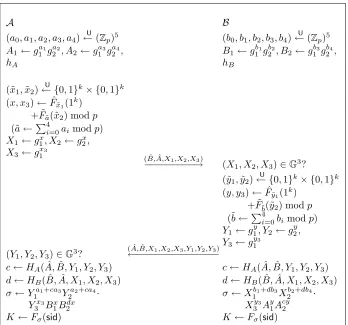
To establish a session key with partyB, partyAperforms the following procedure. 1. Select an ephemeral private key(˜x1,x˜2)
U
← {0,1}k× {0,1}k. 2. Compute ˜a ← P4
i=0ai modp,(x, x3) ← Fˆx˜1(1
k) + ˜F
˜
a(˜x2) modp(as
two-dimensional vectors) and the ephemeral public key(X1 ←g1x, X2 ←g2x, X3 ←
gx3
1 ). Note that the value of (x, x3) (and˜a) is only computed in a computation
process of the ephemeral public key from ephemeral and static private keys. 3. Erase(x, x3)and the whole computation history of the ephemeral public key.
4. Send( ˆB,A, Xˆ 1, X2, X3)toB.
Upon receiving( ˆB,A, Xˆ 1, X2, X3), partyBverifies that(X1, X2, X3)∈G3. If so,
perform the following procedure.
1. Select an ephemeral private key(˜y1,y˜2)
U
← {0,1}k× {0,1}k. 2. Compute ˜b ← P4
i=0bi modp, (y, y3) ← Fˆy˜1(1
k) + ˜F
˜
b(˜y2) modp (as two-dimensional vectors) and the ephemeral public key(Y1 ← g1y, Y2 ← g2y, Y3 ←
gy3
1 ).
3. Erase(y, y3)and the whole computation history of the ephemeral public key.
4. Send( ˆA,B, Xˆ 1, X2, X3, Y1, Y2, Y3)toA.
Upon receiving( ˆA,B, Xˆ 1, X2, X3, Y1, Y2, Y3), partyAchecks if he sent( ˆB,A, Xˆ 1, X2, X3)
To compute the session key,AcomputesσA←Y1a1+ca3Ya2 +ca4
2 Y3x3B1xB2dx, and
BcomputesσB←X1b1+db3X2b2+db4X3y3Ay1Acy2 , wherec←HA( ˆA,B, Yˆ 1, Y2, Y3)and
d←HB( ˆB,A, Xˆ 1, X2, X3).
If they are correctly computed,σ←σA(=σB). The session key isK←Fσ(sid), wheresid←( ˆA,B, Xˆ 1, X2, X3, Y1, Y2, Y3).
A B
(a0, a1, a2, a3, a4)
U
←(Zp)5 (b0, b1, b2, b3, b4)←U (Zp)5
A1←ga11g2a2, A2←g1a3ga24, B1←g1b1gb22, B2←g1b3gb24,
hA hB
(˜x1,x˜2)
U
← {0,1}k× {0,1}k
(x, x3)←Fˆx˜1(1
k)
+ ˜F˜a(˜x2) modp
(˜a←P4
i=0aimodp)
X1←gx1, X2←g2x,
X3←gx13 ( ˆB,A,Xˆ 1,X2,X3)
−−−−−−−−−→ (X1, X2, X3)∈G3?
(˜y1,y˜2)
U
← {0,1}k× {0,1}k
(y, y3)←Fˆy˜1(1
k)
+ ˜F˜b(˜y2) modp
(˜b←P4
i=0bimodp)
Y1←gy1, Y2←gy2,
Y3←gy13
(Y1, Y2, Y3)∈G3?
( ˆA,B,Xˆ 1,X2,X3,Y1,Y2,Y3) ←−−−−−−−−−−−−−−−
c←HA( ˆA,B, Yˆ 1, Y2, Y3) c←HA( ˆA,B, Yˆ 1, Y2, Y3)
d←HB( ˆB,A, Xˆ 1, X2, X3) d←HB( ˆB,A, Xˆ 1, X2, X3)
σ←Ya1+ca3
1 Ya2 +ca4
2 · σ←Xb1
+db3
1 Xb2 +db4
2 ·
Yx3
3 B1xB2dx X
y3
3 A
y
1A
cy
2
K←Fσ(sid) K←Fσ(sid)
Here,sid←( ˆA,B, Xˆ 1, X2, X3, Y1, Y2, Y3), and(A1, A2, B1, B2)∈G4is confirmed
indirectly through the certificates.
3.2 Security
Theorem 1. The proposed AKE protocol is secure (in the sense of Definition 2) if the
DDH assumption holds for {G}k∈N, His a TCR hash function family,F˜ and Fˆ are PRF families, andFis aπPRF family with index{(IG, fG)}G∈{G}k,k∈N, whereIG ← {(V, W, d)|(V, W, d)∈G2×Zp}andfG: (V, W, d)7→Vr1+dr2W with(r
1, r2)
U
←
Z2
p.
Proof. It is obvious that the first condition of Definition 2 holds.
We will prove that the second condition of Definition 2 holds under the assumptions. Letsid∗be the target session chosen by adversaryM,Abe the owner of the session
sid∗andBbe the peer. Letsid∗be( ˆA,B, Xˆ ∗
1, X2∗, X3∗, Y1∗, Y2∗, Y3∗), whereAˆincludes
(A1,A2),Bˆ includes (B1,,B2),A1 ← ga
∗
1
1 g
a∗
2
2 ,A2 ← ga
∗
3
1 g
a∗
4
2 ,B1 ← gb
∗
1
1 g
b∗
2
2 ,B2 ←
gb∗3
1 g
b∗
4
2 ,X1∗←gx
∗
1 , X2∗←gx
∗
2 , X3∗ ←g
x∗
3
1 Y1∗←gy
∗
1 , Y2∗←gy
∗
2 , Y3∗←g
y∗
3
1 .
We will evaluate the advantage,AdvAKEM(k), in the following two disjoint cases (which cover the whole):
– Case 1: there exists a matching session,sid∗, of target sessionsid∗,
– Case 2: there exists no matching session of target sessionsid∗.
Case 1:
To evaluateAdvAKEM[1] 0 (k)
in Case 1, whereM[1]0 is an adversary in Case 1, we
consider five games,G[1]
0 ,G [1] 1 ,G
[1] 2 ,G
[1] 3 ,G
[1]
4 as follows:
GameG[1]
0 . This is the original eCK game with adversaryM [1]
0 in Case 1 to define
AdvAKEM[1] 0 (k)
.
GameG[1]
1 . This is a local eCK game with an adversaryM [1]
1 that is is reduced from
gameG[1]
0 with adversaryM [1]
0 . In the local eCK game in Case 1,M [1]
1 activates
only two parties (sayAandB) (except dishonest parties) and only two sessions, the target session and the matching session (say( ˆA,B, Xˆ ∗
1, X2∗, X3∗, Y1∗, Y2∗, Y3∗)
and( ˆB,A, Yˆ ∗
1, Y2∗, Y3∗, X1∗, X2∗, X3∗)) (except sessions with dishonest parties).
GameG[1]2 . We modify gameG[1]1 to gameG[1]2 by changing PRFsF˜a˜∗,F˜˜b∗,Fˆx˜∗1and
ˆ
Fy˜∗
1 of the target and matching sessions to random functions. GameG[1]
3 . We modify gameG [1]
2 to gameG [1]
3 by changing the value of(Y3∗)x
∗
3 =
(X∗
3)y
∗
3 to a random elementδ←UG.
GameG[1]4 . We modify gameG[1]3 to gameG[1]4 by changing PRFFσ∗ to a random function. Note that the requirement of PRF forFσ∗ is sufficient here (πPRF is not necessary).
LetAdv[1]0 be the eCK advantage ofM[1]0 in gameG[1]
0 (i.e.,AdvAKEM(k)in Case 1). LetAdv[1]i (i= 1,2,3,4) be the eCK advantage ofM[1]1 in gameG[1]
Claim 1. For any adversaryM[1]0 in gameG[1]
0 and any (correctly set-up) local eCK
game G[1]
1 , there exists an adversary,M [1]
1 , for the local eCK game, and a machine
M[1]2 whose running times are at most that ofM[1]0 , such that
Adv[1]0 <4n(k)2s(k)·Adv[1]
1 +s(k)·AdvPRF˜F,M[1]2 (k)
whereM[1]0 activates at mosts(k)sessions.
Proof. Let’s suppose thatM[1]0 activates at mostn(k)honest parties. Given an
adver-saryM[1]0 in gameG [1]
0 and a (correctly set-up) local eCK game with two parties, (A
andB), we constructM[1]1 as follows: First,M1[1]randomly establishes(n(k)−2) hon-est parties correctly in addition toAandB.M[1]1 then simulates the eCK game for the
n(k)honest parties (includingAandB) withM[1]0 .M[1]1 randomly guesses the target session whose owner and peer areAandB.
M[1]1 ’s simulation is executed as follows:
1. M[1]1 selectsα←(α1, α2)
U
← {0,1}2. Intuitively,α
1 =‘0’ meansM[1]1 ’s guess
thatM[1]0 issues no ephemeral key reveal query onAfor the guessed target session, andα1 =‘1’ means the opposite.α2 =‘0’ meansM[1]1 ’s guess thatM
[1] 0 issues
no ephemeral key reveal query onBfor the matching session of the guessed target session, andα2 =‘1’ means the opposite. Due to the conditions of a target
ses-sion (or a fresh sesses-sion), ifM[1]0 issues an ephemeral key reveal query for a target
session,M[1]0 cannot issue the static key reveal query on the owner of the target
session.
2. Ifαis ‘00’,M[1]1 issues static key reveal queries onAandBin the beginning of the game, and then starts the simulation of the eCK game withM[1]0 .
In the simulation,
(a) M[1]1 simulates the sessions of the established(n(k)−2)honest parties
cor-rectly.
(b) If a session ofAorBis not the guessed target session nor the matching session,
M[1]1 correctly simulates the session (i.e. selects an ephemeral private key and
computes ephemeral public key correctly by using the static and ephemeral private keys).
(c) If a session ofAor Bis the guessed target session or the matching session, execute the local eCK game.
IfM[1]1 ’s guess is incorrect (i.e.,M [1]
0 does not select the guessed target session
as the target session orM[1]0 issues an ephemeral key reveal query for the guessed
target or the matching session),M[1]1 aborts this game (gameG [1] 1 ).
3. Ifαis ‘01’,M[1]1 issues a static key reveal query onAin the beginning of the game,
and then starts the simulation of the eCK game withM[1]0 .
In the simulation,
(b) If a session ofAis not the guessed target session,M[1]1 correctly simulates the session (i.e. selects an ephemeral private key and computes ephemeral public key correctly by using the static and ephemeral private keys).
(c) If a session ofBis not the matching session of the guessed target session,M[1]1
selects(y, y3)
U
←Z2pand computesY1←gy1,Y2←gy2andY3←g1y3.
(d) If a session ofAor Bis the guessed target session or the matching session, execute the local eCK game.
IfM[1]1 ’s guess is incorrect (i.e.,M [1]
0 does not select the guessed target session
orM[1]0 does not issue an ephemeral key reveal query for the matching session or
issues an ephemeral key reveal query for the guessed target session),M[1]1 aborts
this game.
4. Ifαis ‘10’,M[1]1 issues a static key reveal query onBin the beginning of the game,
and then starts the simulation of the eCK game withM[1]0 . In the simulation,
(a) M[1]1 simulates the sessions of the established(n(k)−2)honest parties
cor-rectly.
(b) If a session of B is not the matching session of the guessed target session,
M[1]1 correctly simulates the session (i.e. selects an ephemeral private key and
computes ephemeral public key correctly by using the static and ephemeral private keys).
(c) If a session ofAis not the guessed target session,M[1]1 selects(x, x3)
U
←Z2
p and computesX1←gx1,X2←gx2 andX3←g1x3.
(d) If a session ofAor Bis the guessed target session or the matching session, execute the local eCK game.
IfM[1]1 ’s guess is incorrect (i.e.,M[1]0 does not select the guessed target session or
M[1]0 does not issue an ephemeral key reveal query for the guessed target session or issues an ephemeral key reveal query for the matching session),M[1]1 aborts this
game.
5. Ifαis ‘11’,M[1]1 starts the simulation of the eCK game withM [1] 0 .
In the simulation,
(a) M[1]1 simulates the sessions of the established(n(k)−2)honest parties cor-rectly.
(b) If a session ofAorBis not the guessed target session nor the matching session,
M[1]1 selects(x, x3)
U
←Z2pand computesX1←g1x,X2 ←gx2 andX3←g1x3
(or selects(y, y3)
U
←Z2
pand computesY1←gy1,Y2←gy2andY3←g1y3).
(c) If a session ofAor Bis the guessed target session or the matching session, execute the local eCK game.
6. M[1]1 finally outputs the output ofM[1]0 , unlessM[1]1 aborts the game. IfM[1]1 ’s guess (on the target session andα) is correct andα= 00,M
[1]
1 ’s
advan-tage in this simulation is exactly equivalent toM[1]0 ’s advantage in gameG [1] 0 .
IfM[1]1 ’s guess (on the target session andα) is correct andα∈ {01,10,11}, the
difference betweenM[1]1 ’s advantage in this simulation andM [1]
0 ’s advantage in game
G[1]
We now assume a PRF security test environment for˜F, where adversaryM[1]2 is allowed to access to two oracles, which are( ˜Fδ1,F˜δ2)((δ1, δ2)
U
←Z2p) or two random functions(RF1, RF2).
We then constructM[1]2 as follows:M [1]
2 simulates the sessions ofAandB
cor-rectly except the computation of F˜˜a andF˜b˜ of A andB, where in place of M[1]1 ’s
selecting(x, x3)
U
←Z2
pand/or(y, y3)
U
←Z2
p(in cases ofα∈ {01,10,11}),M
[1] 2 sends
the related queries to the oracles. FinallyM[1]2 outputs 1 iffM [1]
1 correctly guessesb∗
(i.e.,M[1]1 ’s outputbis equivalent tob∗in (Definition 2 of) gameG [1] 0 ).
If the oracles are( ˜Fδ1,F˜δ2), then the simulation with the oracle queries is equivalent
to gameG[1]0 , since the distribution of˜a∗and˜b∗are independent and uniform overZ p. Otherwise, it is equivalent toM[1]1 ’s simulation described above under the condition thatM[1]1 ’s guess is correct. The number of calls to the oracles is bounded bys(k)in all cases ofα∈ {01,10,11}, So, applying the hybrid argument, (whereM[1]2 sets up thei-th step of the hybrid argument fori= 1, . . . , s(k)), we obtain
|Adv[1]0 −Adv [1]
1 [CorrGuess]|< s(k)·AdvPRF˜F,M[1]2 (k),
whereAdv[1]1 [CorrGuess]is the advantageAdv[1]1 under the condition thatM[1]1 ’s guess is correct.
Since the probability thatM[1]1 ’s guess on the target session is correct is at least
1/(n(k)2s(k))and the probability thatM[1]
1 ’s guess is correct onαis 1/4,
1/(4n(k)2s(k))·(Adv[1]0 −s(k)·AdvPRF˜F,M[1]2 (k))<Adv
[1] 1 .
Claim 2. There exists a probabilistic machineM[1]3 , whose running time is at most that ofM[1]0 , such that
|Adv[1]1 −Adv[1]2 | ≤2·max{AdvPRF˜F,M[1]3 (k),AdvPRFˆF,M [1] 3 (k)}.
Proof. We now assume PRF security test environments for˜FandˆF, where adversary
M[1]3 is allowed to access to four oracles, which are(˜Fδ1,˜Fδ2,Fˆξ1,ˆFξ2)((δ1, δ2)
U
←Z2p,
(ξ1, ξ2)
U
← {0,1}2k) or four random functions(RF
1, RF2, RF3, RF4).
We constructM[1]3 as follows:M [1]
3 sets up the parameters of gameG [1] 1 for two
parties,AandB, and the target and matching sessions correctly and simulates the game with adversaryM[1]1 except the computation of˜Fa˜∗(˜x∗2),˜F˜b∗(˜y
∗
2),ˆFx˜∗
1(1
k)andˆF
˜
y∗
1(1
k), whereM[1]3 accesses to the oracles and sets the returned values as the function values.
FinallyM[1]3 outputs 1 iffM [1]
1 correctly guessesb∗(i.e.,M [1]
1 ’s outputbis equivalent
If the oracle isF˜ andˆF, the simulation is equivalent to gameG[1]
1 . Otherwise, the
simulation is equivalent to gameG[1]
2 .
Since both the static and ephemeral keys of the target (matching) session are not revealed at the same time, we obtain
|Adv[1]1 −Adv[1]2 | ≤2·max{AdvPRF˜F,M[1]3 (k),AdvPRFˆF,M[1]3 (k)}.
Claim 3. There exists a probabilistic machineM[1]4 , whose running time is at most that ofM[1]0 , such that
|Adv[1]2 −Adv[1]3 |=AdvDDHM[1] 4 (k).
Proof. Given a DDH problemρ ←(G, U, V, W, Z), whereρ←U D(k)orρ←U R(k),
we construct its adversaryM[1]4 usingM [1]
1 in gameG [1]
2 as follows:
M[1]4 sets up the parameters of gameG [1]
2 for two parties,AandB, correctly and
simulates the game with adversary M[1]1 except the computation ofg1, X3∗, Y3∗ and
(Y∗
3)x
∗
3(= (X∗
3)y
∗
3).
For the computation,M[1]4 setsg1 ← U,X3∗ ← V,Y3∗ ← W, and setsZ as the
specified value of(Y∗
3)x
∗
3(= (X∗
3)y
∗
3). (Note that the simulation of the other values can
be perfectly executed with usingg1, X3∗, Y3∗and(Y3∗)x
∗
3(= (X∗
3)y
∗
3).)
FinallyM[1]4 outputs 1 iffM[1]1 correctly guessesb∗(i.e.,M[1]
1 ’s outputbis
equiv-alent tob∗in (Definition 2 of) gameG[1] 2 ).
Ifρ←UD(k), the advantage ofM[1]1 in this simulation is equivalent to that in game
G[1]2 ,Adv[1]2 . Otherwise, the advantage ofM [1]
1 in this simulation is equivalent to that
in gameG[1]
3 ,Adv [1] 3 .
Therefore,|Adv[1]2 −Adv[1]3 |=AdvDDHM[1]
4 (k).
Claim 4. There exists a probabilistic machineM[1]5 , whose running time is at most that ofM[1]0 , such that
|Adv[1]3 −Adv[1]4 | ≤AdvPRFF,M[1]5 (k).
Proof. Given a PRF security test environment forF, where an adversary is allowed to access an oracle,Fγ (γ
U
←G) or a random functionRF, and tries to distinguish them,
we construct its adversaryM[1]5 usingM [1]
1 in gameG [1]
3 as follows:
M[1]5 sets up the parameters of gameG [1]
3 for two parties,AandB, correctly and
whereM[1]5 sendssid∗ to the oracle and sets the value returned from the oracle asK. FinallyM[1]5 outputs 1 iffM[1]1 correctly guessesb∗(i.e.,M[1]
1 ’s outputbis equivalent
tob∗in (Definition 2 of) gameG[1] 3 ).
If the oracle isFγ, the returned value from the oracle is perfectly indistinguishable from that ofFσ∗(sid), since the value ofσ∗in gameG
[1]
3 is uniform and independent.
Then, the advantage ofM[1]1 in this simulation is equivalent to that in gameG [1] 3 ,Adv
[1] 3 .
Otherwise, the advantage ofM[1]1 in this simulation is equivalent to that in gameG [1] 4 ,
Adv[1]4 .
Therefore,|Adv[1]3 −Adv [1]
4 | ≤AdvPRFF,M[1]5 (k).
Summing up Claims 1 to 4 and from the fact thatAdv[1]4 = 0, we obtain the follow-ing claim,
Claim 5. Let’s suppose Case 1 occurs. For any adversary M[1]0 in the eCK game (Definition 2), there exist probabilistic machines,M[1]2 ,M[1]3 ,M[1]4 andM[1]5 , whose running times are at most that ofM[1]0 , such that
AdvAKEM[1]
0 (k) <4n(k)
2s(k)·(2·max{AdvPRF ˜
F,M[1]3 (k),AdvPRFˆF,M [1] 3 (k)}
+AdvDDHM[1]
4 (k) +AdvPRFF,M [1]
5 (k)) +s(k)·AdvPRF˜F,M [1] 2 (k).
Case 2:
Next, we will evaluateAdvAKEM[2] 0 (k)
in Case 2, whereM[2]0 is an adversary in Case 2. Recall thatsid∗is the target session chosen by adversaryM[2]0 ,Ais the owner
of the sessionsid∗andBis the peer. Letsid∗be( ˆA,B, Xˆ ∗
1, X2∗, X3∗, Y1∗, Y2∗, Y3∗).
In Case 2,Bis a honest party, but does not own a session that is matching to session
sid∗. Due to the conditions of a fresh session (i.e., restrictions onsid∗),M[2]0 cannot
issue a static key reveal query onB, butM[2]0 (or a dishonest party) can establish a
ses-sion,sidi ←( ˆC(i),B, Xˆ
(i) 1 , X
(i) 2 , X
(i) 3 , Y
(i) 1 , Y
(i) 2 , Y
(i)
3 ), withBthat is not equivalent
to sessionsid∗(i.e.,( ˆA,B, Xˆ ∗
1, X2∗, X3∗, Y1∗, Y2∗, Y3∗)6= ( ˆC(i),B, Xˆ (i) 1 , X
(i) 2 , X
(i) 3 , Y
(i) 1 ,
Y2(i), Y (i)
3 )) and can issue a session key reveal query on sessionsidi, fori= 1, . . . , t(k). Here we have the following two disjoint cases:
(a) ( ˆA,B, Xˆ ∗
1, X2∗, X3∗)6= ( ˆC(i),B, Xˆ (i) 1 , X
(i) 2 , X
(i) 3 ),
(b) ( ˆA,B, Xˆ ∗
1, X2∗, X3∗) = ( ˆC(i),B, Xˆ (i) 1 , X
(i) 2 , X
(i)
3 )and(Y1∗, Y2∗, Y3∗)6= (Y (i) 1 , Y
(i) 2 , Y
(i) 3 ).
We will then give the proof (of Case 2) in case (a), but omit that in case (b), since if case (b) occurs, we can apply the same argument (to prove the pairwise-independence ofσ∗andσ
i) in case (b) for(A1, A2), (honestly generated)(Y1(i), Y (i) 2 ), (M
[2] 0 ’s
out-put) (Y∗
1, Y2∗) and HA( ˆA,B, Yˆ 1(i), Y (i) 2 , Y
(i)
3 ) 6= HA( ˆA,B, Yˆ 1∗, Y2∗, Y3∗) as that in
case (a) for(B1, B2), (honestly generated)(X1∗, X2∗), (M [2]
0 ’s output)(X (i) 1 , X
(i) 2 )and
HB( ˆB,A, Xˆ 1∗, X2∗, X3∗) =6 HB( ˆB,Cˆ(i), X1(i), X (i) 2 , X
(i)
3 ), that will be described
We consider seven games,G[2]
0 ,G [2] 1 ,G
[2] 2 ,G
[2] 3 ,G
[2] 4 ,G
[2] 5 andG
[2]
6 , as follows:
GameG[2]0 . This is the original eCK game with adversaryM[2]0 to defineAdvAKEM[2]0 (k) in Case 2.
GameG[2]1 . This is a local eCK game with adversaryM[2]1 that is reduced from the
original eCK game with adversaryM[2]0 . In the local eCK game in Case 2,M [2] 1
activates only two parties (e.g.,AandB) (except dishonest parties) and the tar-get session (e.g.,( ˆA,B, Xˆ ∗
1, X2∗, X3∗, Y1∗, Y2∗, Y3∗)) (except the other sessions with
dishonest parties).
GameG[2]2 . We modify gameG[2]1 to gameG[2]2 by changing PRFsF˜a˜∗,F˜˜b∗,Fˆx˜∗1and
ˆ
Fy˜(i) 1
(i= 1, . . . , t(k)) to random functions.
GameG[2]
3 . We modify gameG [2]
2 to gameG [2]
3 by changing the value ofBx
∗
1 Bd
∗x∗
2
(in the computation process ofσ∗←(Y∗
1)a
∗
1+c∗a∗3(Y∗
2)a
∗
2+c∗a∗4(Y∗
3)x
∗
3Bx∗
1 Bd
∗x∗
2 )
to(X∗
1)b
∗
1+d∗b∗3(X∗
2)b
∗
2+d∗b∗4. This change is purely conceptual.
GameG[2]4 . We modify game G[2]3 to gameG[2]4 by changing DH tuple(G, g1, g2,
X∗
1, X2∗)
U
←D(k)to a random tuple(G, g1, g2, X∗
1, X2∗)
U
←R(k).
GameG[2]
5 . We modify game G [2]
4 to game G [2]
5 by adding a special rejection rule
in gameG[2]
5 , such that gameG [2]
5 aborts ifM [2]
1 (dishonest partyC) establishes
a session with B, sidi ← ( ˆC(i),B, Xˆ
(i) 1 , X
(i) 2 , X
(i) 3 , Y
(i) 1 , Y
(i) 2 , Y
(i)
3 ), issues a
session key query on the session,HB( ˆB,A, Xˆ 1∗, X2∗, X3∗) = HB( ˆB,Cˆ(i), X
(i) 1 ,
X2(i), X (i)
3 )and( ˆB,A, Xˆ 1∗, X2∗, X3∗)6= ( ˆB,Cˆ(i), X (i) 1 , X
(i) 2 , X
(i)
3 )occur. As
men-tioned above, we assume that( ˆB,A, Xˆ ∗
1, X2∗, X3∗) 6= ( ˆB,Cˆ(i), X (i) 1 , X
(i) 2 , X
(i) 3 )
occurs (case (a)).
GameG[2]
6 . We modify gameG [2]
5 to gameG [2]
6 by changing a πPRF of the target
session,Fσ∗, to a random function.
LetAdv[2]0 be the eCK advantage ofM[2]0 in gameG[2]
0 (i.e.,AdvAKEM[2](k)in
Case 2). LetAdv[2]i (i= 1,2,3,4,5,6) be the eCK advantage ofM[2]1 in gameG[2]
i . We now proceed to evaluate the differences between pairs of the advantages.
Claim 6. For an adversary M[2]0 in game G [2]
0 and a (correctly set-up) local eCK
game, there exists an adversary,M[2]1 , for the local eCK game, and a machineM [2] 2
whose running times are at most that ofM[2]0 , such that
Adv[2]0 <2n(k)2s(k)·Adv[2]1 +s(k)·AdvPRF˜F,M[2]2 (k)
whereM[2]0 activates at mosts(k)sessions.
Proof. The proof of this claim is similar to that of Claim 1. The only difference is for
M[2]1 ’s (andM [1]
1 ’s) guess onα. In Case 1,Bowns the matching session of the target
We then obtain
1/(2n(k)2s(k))·(Adv[2]
0 −s(k)·AdvPRFF˜,M[2]2 (k))<Adv
[2] 1 .
The proof of the following claim is also similar to that of Claim 2.
Claim 7. There exists a probabilistic machineM[2]3 , whose running time is at most
that ofM[2]0 , such that
|Adv[2]1 −Adv[2]2 | ≤2s(k)·max{AdvPRF˜F,M[2]3 (k),AdvPRFFˆ,M[2]3 (k)}.
Claim 8.
Adv[2]2 =Adv[2]3
This is clear since the change is purely conceptual.
Claim 9. There exists a probabilistic machineM[2]4 , whose running time is at most
that ofM[2]0 , such that
|Adv[2]3 −Adv[2]4 |=AdvDDHM[2] 4 (k).
Proof. Given a DDH problemρ ←(G, U, V, W, Z), whereρ←U D(k)orρ←U R(k), we construct its adversaryM[2]4 usingM[2]1 in gameG[2]
3 as follows:
M[2]4 sets up the parameters of gameG [2]
3 for two parties,AandB, correctly and
simulates the game with adversaryM[2]1 except the computation ofg1, g2, X1∗, X2∗.
For the computation,M[2]4 sets g1 ← U,g2 ← V,X1∗ ← W, and X2∗ ← Z.
(Note that the simulation of the other values can be perfectly executed with using
g1, g2, X1∗, X2∗. Especially,σ∗←(Y1∗)a
∗
1+c∗a∗3(Y∗
2)a
∗
2+c∗a∗4(Y∗
3)x
∗
3(X∗
1)b
∗
1+d∗b∗3(X∗
2)b
∗
2+d∗b∗4
can be computed from the private keys that M[2]4 sets up, (a∗1, a∗2, a∗3, a∗4), x∗3 and
(b∗
1, b∗2, b∗3, b∗4), as well as adversaryM [2]
1 ’s ephemeral public key,(Y1∗, Y2∗, Y3∗), and
(X∗
1, X2∗).)
FinallyM[2]4 outputs 1 iffM [2]
1 correctly guessesb∗(i.e.,M [2]
1 ’s outputbis
equiv-alent tob∗in (Definition 2 of) gameG[2] 3 ).
Ifρ←UD(k), the advantage ofM[2]1 in this simulation is equivalent to that in game
G[2]3 ,Adv[2]3 . Otherwise, the advantage ofM [2]
1 in this simulation is equivalent to that
in gameG[2]4 ,Adv[2]4 .
Therefore,|Adv[2]3 −Adv[2]4 |=AdvDDHM[2]
Claim 10. There exists a probabilistic machineM[2]5 , whose running time is at most that ofM[2]0 , such that
|Adv[2]4 −Adv[2]5 | ≤AdvTCRM[2] 5 (k).
Proof. LethB R
←KHk,DH ←(D1,D2),D1←(Πk)2×G7,D2←Z9p,RH ←Zp,
(ρ∗, δ∗) ← DR
H,ρ∗ ← ( ˆB,A, Xˆ 1∗, X2∗, X3∗),δ∗ ← (b∗1, b∗2, b∗3, b∗4, a∗1, a∗2, a∗3, a∗4, x∗3).
Given a TCR hash function problem(ρ∗, δ∗, h
B,DH,RH), we construct its adversary
M[2]5 usingM [2]
1 in gameG [2]
4 as follows:
M[2]5 simulates gameG [2]
4 with adversaryM [2]
1 with setting(B1, B2, A1, A2)as
the static public key ofBandAof the target session and setting(X∗
1, X2∗, X3∗)as the
ephemeral public key ofA, where the related private keys,(b∗
1, b∗2, b∗3, b∗4, a∗1, a∗2, a∗3, a∗4, x∗3)
are employed byM[2]5 in the simulation.
Since the distribution of(X∗
1, X2∗)is equivalent to those of game G [2]
4 (e.g., the
ephemeral public key of the target session,(X∗
1, X2∗), is uniformly distributed onG2in
gameG[2]
4 ). Therefore simulation of gameG [2] 4 byM
[2]
5 is perfect.
IfM[2]1 issues a session key query on sessionsidi←( ˆC(i),B, Xˆ
(i) 1 , X
(i) 2 , X
(i) 3 , Y
(i) 1 ,
Y2(i), Y (i)
3 )withHB( ˆB,A, Xˆ 1∗, X2∗, X3∗) =HB( ˆB,Cˆ(i), X
(i) 1 , X
(i) 2 , X
(i)
3 )in this
sim-ulation, M[2]5 outputs ( ˆB,Cˆ(i), X (i) 1 , X
(i) 2 , X
(i)
3 ). Thus, M [2]
5 breaks the TCR hash
function associated with {DH}k∈N and {RH}k∈N, if game G
[2]
5 applies the special
rejection rule and aborts. We then obtain
|Adv[2]4 −Adv[2]5 | ≤AdvTCRM[2] 5 (k).
Claim 11. There exists a probabilistic machineM[2]6 , whose running time is at most that ofM[2]0 , such that
|Adv[2]6 −Adv[2]5 |<AdvπPRFF,I
G,M
[2]
6 (k) + 4/p.
Proof. Let sidi ← ( ˆC(i),B, Xˆ
(i) 1 , X
(i) 2 , X
(i) 3 , Y
(i) 1 , Y
(i) 2 , Y
(i)
3 ) (i = 1, . . . , t(k))be
sessions withBon which M[2]1 issues session key queries, whereC(i) is a dishonest
party established byM[2]1 . LetKi←Fσi(sidi), whereσi ←(X
(i) 1 )b
∗
1+dib∗3(X(i)
2 )b
∗
2+dib∗4
(X3(i))y
(i) 3 (C(i)
1 )y
(i)
(C2(i))ciy
(i)
,ci←HC(i)(sidi)anddi←HB(sidi). Let the target session of gameG[2]
5 besid
∗←( ˆA,B, Xˆ ∗
1, X2∗, X3∗, Y1∗, Y2∗, Y3∗)and
the session key ofsid∗ beK∗ ← F
σ∗(sid∗), whereσ∗ ← (X1∗)b ∗
1+d∗b∗3(X∗
2)b
∗
2+d∗b∗4
(Y∗
3)x
∗
3 (Y∗
1)a
∗
1+c∗a∗3(Y∗
2)a
∗
2+c∗a∗4,c∗←H
A(sid∗)andd∗←HB(sid∗).
Case (i): (G, g1, g2, X(i)
1 , X (i)
2 )∈D(k). That is, there existsx∈Zpsuch thatX1(i)=
gx
1, X (i) 2 =g2x.
Case (ii): (G, g1, g2, X1(i), X2(i))6∈D(k). We say(G, g1, g2, X∗
1, X2∗)∈ GoodKey, if(G, g1, g2, X1∗, X2∗)6∈D(k)andg1 6=
1, g26= 1, g16=g2. Since the parameter is uniformly selected fromR(k)in gameG[2]5 ,
it occurs with probability at least(1−4/p). Hereafter, we assume that(G, g1, g2, X1∗, X2∗)∈ GoodKeyoccurs in gameG[2]
5 . Note that all games to be investigated here are modified
from gameG[2]
5 with preserving the distribution of(G, g1, g2, X1∗, X2∗).
(B1, B2, σ∗, σi)are expressed by the following equations:
logg1B1≡b
∗
1+ηb∗2 (mod p)
logg1B2≡b
∗
3+ηb∗4 (mod p)
logg1σ∗≡x∗
1(b∗1+d∗b∗3) +ηx∗2(b∗2+d∗b∗4) +δ (mod p)
logg1σi≡x(b
∗
1+dib∗3) +ηx(b2∗+dib∗4) +γ (modp).
whereg2=gη1,X1∗=g
x∗
1
1 ,X2∗=g
x∗
2
1 ,(Y3∗)x
∗
3(Y∗
1)a
∗
1+c∗a∗3(Y∗
2)a
∗
2+c∗a∗4 =gδ
1X (i) 1 =
gx
1,X (i)
2 =gx1 and(X (i) 3 )y
(i) 3 (C(i)
1 )y
(i)
(C2(i))ciy
(i)
=gγ1.
If Case (i) occurs, the value ofσi is (information theoretically) independent from
σ∗for anyi= 1, . . . , t(k), since
logg1σi−γ≡x(b
∗
1+ηb∗2) +xdi(b∗3+ηb∗4) (modp)
is linearly dependent tologg1B1andlogg1B2, whilelogg1σ
∗is linearly independent from logg1B1 andlogg1B2. (Actually, given sidi, the value of σi is uniquely
deter-mined, but, givensid∗, the value ofσ∗is still uniformly distributed inGif(b∗
2, b∗4)
U
←
Z2
p.)
Hence, hereafter we consider the case that Case (ii) occurs for alli= 1, . . . , t(k). Then, we will show the following proposition:
Proposition 1. Let assume that(G, g1, g2, X1∗, X2∗)∈GoodKey. Then, given(sid∗,sid1,
. . . ,sidt(k)),σ∗ andσi are pairwisely independent for anyi = 1, . . . , t(k), and each
one is uniformly distributed overG, when(b∗
2, b∗4)
U
←Z2p.
Proof. First, we consider the relation betweensid∗ andsidi (i = 1, . . . , t(k)). So we investigate the following matrix:
1 η 0 0
0 0 1 η
x∗
1ηx∗2d∗x∗1ηd∗x∗2
x1ηx2dix1 ηdix2
, (1)
whereX1(i)=gx1
1 andX (i) 2 =g
x2
This matrix (1) is regular if and only if
η2(x∗
2−x∗1)(x2−x1)(d∗−di)6≡0 (modp). (2)
η6= 0andx∗
2−x∗16= 0, since we assume that(G, g1, g2, X1∗, X2∗)∈GoodKey, i.e.,
(G, g1, g2, X1∗, X2∗)6∈D(k)andg1= 16 , g2 6= 1, g1 6=g2. In gameG[2]5 ,d∗−di 6= 0 by the special rejection rule, andx2−x16= 0in Case (ii).
Therefore, this matrix (1) is regular. Then, given (sid∗,sidi), the value of(σi, σ∗)is uniformly distributed overG2when(b∗
2, b∗4)
U
←Z2p.
We can then construct an adversaryM[2]6 forπPRFFwith index{(IG, fG)}G∈{G}k,k∈N,
by usingM[2]1 in gameG [2]
5 as follows, whereIG← {(V, W, d)|(V, W, d)∈G2×Zp} andfG: (V, W, d)7→Vr1+dr2W with(r
1, r2)
U
←Z2p:
Given theπPRF security experiment forF,M[2]6 sets up the parameters of game
G[2]5 such that
G← {U G}k, g1←U G, η←UZp, g2←gη
1,
(a∗1, a∗2, a∗3, a∗4)
U
←(Zp)4, A1←ga∗1
1 g
a∗
2
2 , A2←ga
∗
3
1 g
a∗
4
2 ,
(β1, β2)
U
←(Zp)2, B1←gβ1
1 , B2←gβ12,
(x∗1, x∗2, x∗3)
U
←(Zp)2(x∗16=x∗2), X1∗←gx∗1
1 , X2∗←g
x∗
2
2 , X3∗←g
x∗
3
2
(y(i), y3(i))
U
←(Zp), Y(i)
1 =g
y(i)
1 , Y (i) 2 =g
y(i)
2 , Y (i) 3 =g
y(i)3
1
c∗←HA( ˆA, Y1∗, Y2∗), d∗←HB( ˆB, X1∗, X2∗)
ci←HC( ˆC(i), Y1(i), Y (i)
2 ), di←HB( ˆB, X1(i), X (i) 2 ),
V∗←X∗
2/(X1∗)η, W∗←(X1∗)β1+d
∗β2
(Y∗
3)x
∗
3(Y∗
1)a
∗
1+c∗a∗3(Y∗
2)a
∗
2+c∗a∗4, Vi←X2(i)/(X
(i)
1 )η, Wi←(X1(i))β1+diβ2(X (i) 3 )y
(i) 3 (C(i)
1 )y
(i)
(C2(i))ciy(i)
(i= 1, . . . , t(k)).
Under this setting of the parameters,M[2]6 can perfectly simulate the sessions,sid∗
andsidi, withM[2]1 except the computation ofσ∗andσi, fori= 1, . . . , t(k).
We now set(r1, r2)←(b∗2, b∗4), and apply the index,IG← {(V, W, d)|(V, W, d)∈
G2×Zp}andfG: (V, W, d)7→Vr1+dr2W. Then,σ
σifori= 1, . . . , t(k), because
σ(V∗,W∗,d∗)= (V∗)r1+d
∗r2
W∗
= (X2∗)b
∗
2/(X∗
1)ηb
∗
2·(X∗
2)d
∗b∗
4/(X∗
1)ηd
∗b∗
4 ·(X∗
1)β1+d
∗β
2·(Y∗
3)x
∗
3(Y∗
1)a
∗
1+c∗a∗3(Y∗
2)a
∗
2+c∗a∗4
= (X1∗)b
∗
1+d∗b∗3(X∗
2)b
∗
2+d∗b∗4·(Y∗
3)x
∗
3(Y∗
1)a
∗
1+c∗a∗3(Y∗
2)a
∗
2+c∗a∗4
=σ∗,
σ(Vi,Wi,di)=V
r1+dir2
i Wi
= (X2(i))b
∗
2/(X(i)
1 )ηb
∗
2·(X(i)
2 )dib
∗
4/(X(i)
1 )ηdib
∗
4·(X(i)
1 )β1+diβ2(X (i) 3 )y
(i) 3 (C(i)
1 )y
(i)
(C2(i))ciy
(i)
= (X1(i))b
∗
1+dib∗3(X(i)
2 )b
∗
2+dib∗4·(X(i)
3 )y
(i) 3 (C(i)
1 )y
(i)
(C2(i))ciy
(i) ,
=σi,
whereb∗
1≡β1−ηb∗2 (mod p), andb∗3≡β2−ηb∗4 (modp). Here note thatσ(V∗,W∗,d∗)=
σ∗andσ
(Vi,Wi,di)=σifori= 1, . . . , t(k)hold simultaneously for any selected value
of(b∗
2, b∗4)inZ2p.
M[2]6 simulates gameG[2]
5 with adversaryM [2]
1 except the computation ofK∗ ←
Fσ∗(sid∗)andKi←Fσi(sidi)(i= 1, . . . , t(k)), whereM
[2]
6 gives index(V∗, W∗, d∗)
and(Vi, Wi, di)(i= 1, . . . , t(k)) to the oracle(F, IG)in the experiment of theπPRF security definition (in Section 2.4) and sets the values returned from the oracle asK∗ andKi (i = 1, . . . , t(k)). FinallyM
[2]
6 outputs 1 iffM [2]
1 correctly guessesb∗ (i.e.,
M[2]1 ’s outputbis equivalent tob∗in (Definition 2 of) gameG [2] 5 ).
If the oracle is forAF,IG, the above-mentioned simulation is the same as gameG[2]
5
and the advantage ofM[2]1 in this simulation is equivalent to that in gameG[2]
5 ,Adv [2] 5 .
If the oracle is forARF,IΣ, the simulation is the same as gameG[2]
6 , and the advantage
ofM[2]1 in this simulation is equivalent to that in gameG[2]
6 ,Adv [2] 6 .
From Proposition 1, ifGoodCoinoccurs,(σ∗, σ
i)are pairwisely independent for
i= 1, . . . , t(k).
SincePr[¬GoodCoin]<4/p, we then obtain
|Adv[2]6 −Adv[2]5 |<AdvπPRFF,IG,M[2]
6 (k) + 4/p.
(3)
SinceAdv[2]6 = 0, by summing up Claims 6 to 11, we obtain the following claim,
Claim 12. Let’s suppose Case 2 occurs. For any adversary M[2]0 in the eCK game
(Definition 2), there exist probabilistic machines,M[2]2 ,M [2] 3 ,M
[2] 4 ,M
[2]
5 and M [2] 6 ,
whose running times are at most that ofM[2]0 , such that
AdvAKEM[2]
0 (k)<2n(k)
2s(k)·(2s(k)·max{AdvPRF ˜
F,M[2]3 (k),AdvPRFˆF,M[2]3 (k)}+
AdvDDHM[2]
4 (k) +AdvTCRM [2]
5 (k) +AdvπPRFF,IG,M
[2]
4
The Proposed KEM Scheme
4.1 Scheme
In this section, we present a CCA secure KEM scheme.
Letk ∈ Nbe a security parameter, and letG ← {U G}k be a group with security parameterk, where the order ofGis primepand|p|=k.
LetHbe a TCR hash function family, andFbe aπPRF family with index{(IG, fG)}G∈{G}k,k∈N,
whereIG ← {(V, W, d) | (V, W, d) ∈ G2×Zp} andfG : (V, W, d) 7→ Vr1+dr2W
with(r1, r2)
U
←Z2
p.
Secret Key: The secret key issk←(x1, x2, y1, y2)
U
←Z4
p.
Public Key: g1
U
← G,g2
U
← G,z ← gx1
1 g
x2
2 ,w ← g
y1
1 g
y2
2 ,H ← H
k,DH,RH
h and
F←Fk,ΣF,DF,RF.
Here,h←R KHk,DH ←(D1,D2),D1←G4,D2←Z4p,RH ←Zp,(z, w, C1, C2)
U
← D1(
R
← D1),(x1, x2, y1, y2)
U
← D2 (
R
← D2) withz ←gx11g
x2
2 andw ← g
y1
1 g
y2
2 ,
ΣF←G,DF← {pk} ×G2(pkis a possible public-key value) andRF← {0,1}k. The public key ispk←(G, g1, g2, z, w, H, F).
Encryption: Chooser←U Zpand compute
C1←g1r,
C2←g2r,
d←H(z, w, C1, C2)
σ←zrwrd
K←Fσ(pk, C1, C2).
(C1, C2)is a ciphertext, andKis the secret key to be shared.
Decryption: Given(z, w, C1, C2), check whether
(z, w, C1, C2)∈G4.
If it holds, compute
d←H(z, w, C1, C2)
σ←Cx1+dy1
1 Cx2 +dy2
2
K←Fσ(pk, C1, C2).
Remark: Even if d ← H(z, w, C1, C2)is replaced by d ← H(C1, C2), the CCA
security of the proposed KEM is preserved, and then the underlying TCR hash function
Hk,DH,RH
h can be the standard one (with no extra input,(x1, x2, y1, y2)
R
← D2, to an