SUBSTRATE-PREFERENCE POLYMORPHISM AT AN
ESTERASE LOCUS O F DROSOPHZLA MOJAVENSZS
E. ZOUROS’ A N D
w.
VAN DELDENDepartment of Genetics, The University of Groningen Kerklaan 30, 9751 NN Haren ( G . N . ) , The Netherlands
Manuscript received August 24,1981 Revised copy accepted October 31, 1981
ABSTRACT
In a larval esterase of Drosophila mojauensis there are alleles whose prod- ucts preferentially hydrolyze a-naphthyl esters, whereas the majority of the alleles hydrolyze preferentially P-naphthyl esters. In a collection of labora- tory stocks a alleles have a frequency of 15%. Three different mobilities of a alleles were discovered, suggesting a polymorphism rather than a single mutation event. If substrate-preference polymorphisms are common among “multiple-substrate’’ enzymes (category I1 of GILLESPIE and LANGLEY 1974), allozyme variation at these enzyme loci may well be maintained by balancing selection.
I T
is a well-established phenomenon that natural populations contain large amounts of genetic variability at a large fraction of their enzyme loci. A large amount of this variability can be detected electrophoretically ( LEWONTIN 1974) j but recent studies have shown that the allelic variants may differ in manyother aspects, such as specific catalytic activity or functional stability under a variety of conditions (see, for example, DAY, HILLIER and CLARKE 1974a; MILLER, PEARCY and BERGER 1975; LOUKAS, VERGINI and KRIMBAS 1981), regulation of expression (GIBSON 1972; DAY, HILLIER and CLARKE 1974b; CHOV-
NICK et al. 1976), ability to form multimers (COBBS 1976), post-transcriptional modification, or coenzyme-binding ability ( FINNERTY and JOHNSON 1979). Some of these differences are sensitive enough to be used t o uncover variation which cannot be detected by routine electrophoresis ( SINGH, LEWONTIN and
FELTON 1976).
One type of variation that has not been shown among allozymes is specificity €or different substrates of alleles at the same locus. Yet this is a type of variation usually envisaged in hypotheses purporting to explain the maintenance of enzyme polymorphisms in populations. The best-known of these hypotheses is the one by GILLESPIE and LANGLEY (1974). who have drawn a distinction be- tween “single-substrate” and “multiple-substrate’’ enzyme loci. Enzymes of the first category (Group I) recognize only one substrate, which is usually the intracellular product of another enzymatic reaction. Selection is expected to establish a single best allele for this substrate, whose quantity may also be under
the organism’s genetic control. Enzymes of the second category (Group 11) recognize a variety of chemically-related substances as substrates; these sub- strates may be of external origin to the organism; and their availability may not be under the organism’s control. Polymorphism can easily be established at group
I1
loci, especially if it could be shown that the various allelic forms take preferentially one substrate over another, or have maximal catalytic activities for different substrates.SINGH (1976) has attempted to discover just such a type of variation at the alcohol dehydrogenase loci of Drosophila pseudoobscura. He examined eight such loci, of which three were polymorphic. Although there were marked differ- ences in the substrate specificities of enzymes coded by different loci, SINGH could find no differences in the specificities of enzymes coded by different alleles at the same locus. On the basis of these findings he suggested that substrate specific differences exist only between isozyme loci, and that a substantial frac- tion of allelic variation in group 11 loci may indeed be selectively neutral. Here we report a clear case of differential substrate preference among enzymes coded by various alleles of an esterase locus of Drosophila mojavensis.
MATERIALS AND METHODS
The Drosophila mojavensis stocks used in this study were established as multifemale lines from collections made between 1971 and 1977. Each line was maintained in the laboratory as a mass culture. There i s no way of knowing how many “wild” chromosomes were in each line at the time of its establishment, nor is there any way of knowing how many of the original chromosomes are lost during culture in the laboratory. W e will conservatively assume that there is only one original chromosome left i n each line, except if the line is segregating for electrophoretically-detectable variants, i n which case the original chromosomes are assumed to be as many as are the variants. Eighteen stocks of D. moiavensis race B and one stock of D. moiavensis race A were surveyed (see ZOUROS 1973 for a description of the races of D. moiauen- sis). I n addition, seven stocks of D. arizonensis, a close relative of D. moiauensis, were also surveyed. Nine stocks of D. moiauensis B and two stocks of D . arizonensis were found to segre- gate each for two Est-# electromorphs. T h e other stocks contained one electromorph. Thus, a con- servative estimate of chromosomes sampled is 37: 27 for D. moiavensis B, 1 for D. mojauensis A , and 9 for D. arizonensis.
Esterase allozymes were separated on a polyacrylamide gel as described in PRAKASH, LEWON- TIN and HUBBY (1969). Third instar larvae were used for these assays. After electrophoresis, the gel was incubated in 0.5 boric acid for half a n hour, then rinsed and developed in the fol- lowing solution: 100 ml of phosphate buffer pH 6 . 4 (1.75 x 1 0 - 2 ~ Na,HPO, and 4.39 X ~G-*M KH,PO,). 5 0 m g Fast Blue BB salt, 1 m l of 0.1 M MgCl,, 1 m l of 0.1 M MnCl,, 1 m l of 0.1 M NsCl, and 2 ml of 50% acetone into which there were resolved 30 m g of substrate and 30 m g of substrate ,B. The substrates used were a-naphthyl acetate, a-naphthyl propionate, a-naphthyl butyrate, and their p analogs. An ,a substrate was used i n combination with any one of the ,B substrates; all nine combinations were tested. After 1 ‘/z hours of development i n room tempera- ture the gel was rinsed and fixed in 1 : 5: 5 mixture of acetic acid, methanol and water.
RESULTS
SUBSTRATE-PREFERENCE POLYMORPHISM 309
Three polymorphisms are reported in these papers: esterase 2 ( E s t - 2 )
,
esterase4
( E s t - 4 ) , and esterase5
(Est-5). All bands stain brown when at-naphthyl acetate is used as substrate, and purple when @-naphthyl acetate is used as substrate, and Fast Blue BB is the coupling agent. When both substrates are used simul- taneously, Est-2 bands stain brown, and Est-4 and Est-5 bands stain purple. On this basis, Est-2 is classified as a n esterase, whereas Est-4 and Est-5 as /3 esterases. This classification has long been in use (i.e., NARISE, 1973). Brown coloration also appears when a-naphthyl propionate or a-naphthyl butyrate are used as substrates, and purple coloration appears when the @ analogs of these esters are used.Est-4 and Est-5 probably represent a gene duplication (ZOUROS,
E.,
W. V A NDELDEN,
R.
ODENSE andH.
VAN DIJK, unpublished results). In the process ofstudying this duplication, it was observed that in gels stained with both a- and &naphthyl acetates, certain electromorphs of Est-4 produce a brown band instead of the purple band characteristic of
p
esterases. This prompted a detailed survey of allD.
mojavensis andD.
arizonensis stocks a t o w disposal, with the results shown in Table I . In these tests an cy and a @ substrates were used, and since wetested three different a and three different @ substrates, there were nine substrate combinations. W e observed that in all cases the substrate preferences depended on the position of the acid residue on the naphthyl ring (position a or P ) , and not
on the residue itself.
TABLE 1
Substrate preferences of electrophoretic alleles of Est-4 in laboratory stocks of
Drosophila mojavensis and Drosophila arizonensis
Number of atocks Electmphoretic mobility Substrate specificity' possessing the allele
77 82 a6 88
se
100 100 I 02 102 1o.F 86 98 100 1 04P P P P P P P P
P
P P a a CYD. mojavensis U
2 1 3 2 2 8 1 2 2 4
D. inojavensis A 1
D. arizonensis
3
1
4
a: preferential hydrolysis of a-naphthyl acetate, a-naphthyl propionate or a-naphthyl
P : preferential hydrolysis of ,@-naphthyl acetate, @-naphthyl propionate or P-naphthyl butyrate;
Among the minimum number of 37 original chromosomes sampled, four car- ried a n cy allele at the Est-4 locus. All four were found in Drosophila mojauensis
B:
the 82a allele was discovered in the Los Planes (LP) stock originated from the southern part of Baja California; the I O O a was found in stock A-426 from near Muleg&, Baja California; one 102a was found in stock A-713 from the island of San Esteban, and another in stock A-506 from the island of Tiburon, both in the Gulf of California (see Figure 1 in ZOUROS and D’ENTREMONT 1980 for the geo- graphical origins of these stocks). Through pair matings homozygous lines for the a alleles were established from each stock. Following are some observationsobtained so far from these lines.
1. Formal genetics showed that the (Y bands are allelic to Est-4
fl
bands, as well as to each other. Table 2 gives the results from one cross involving two alpha alleles (82. andlooa)
and two beta alleles (86P and 104.0).monomers to form active dimers; when the dimerization is with a &3 monomer, the color of the hybrid band is a n intermediate between purple and brown.
3 . The age-specific and tissue-specific expression profiles of a alleles are the
same as those of
fl
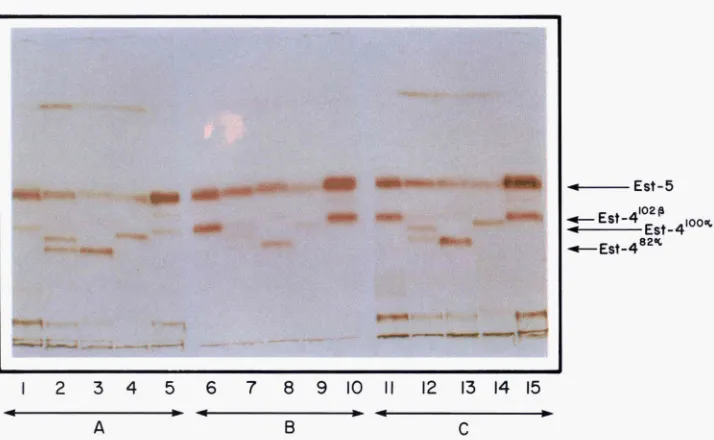
alleles. Est-4 activity can be first detected when the larva enters the third instar, and reaches its peak two to four hours before pupation; it dimin- ishes rapidly thereafter and it does not reappear in the adult stage. The highest concentration of esterase 4 occurs i n the larval carcass; low levels of activity can be detected in the hemolymph and the fat body.Figure 1 demonstrates the polymorphism. Three alleles of Est-4-1 02@, 82a
and 1 0 0 e c a n be seen under varied conditions of staining. The OPNM x LP F,
hybrid illustrates the allelic state of the a and
J3
bands. The weaker bands be-tween Est-4 and Est-5 are dimers between Est-4 and Est-5 products. The inten- sities of these bands are much weaker when compared to bands produced by intra-allelic dimerization.
These observations establish that, at the Est-4 locus, there is variation for sub- strate preference. The fact that the four alleles with altered preference were dis- covered in stocks that had originated in different localities, together with the fact that the four alleles fall in three distinct electrophoretic classes exclude the
2. cy monomers dimerize normally with other
fl
orTABLE 2
Crosses showing the allelism of alpha and beta b a d s
1 . Est-4 (82a/82a) x Est-4 (lOO~/lOO~)
F,: Est-4 (82a/lOOa)
2. Est-4 (868/868) x Est-4 (104fi/104P)
F,: Est-4 (86P/104B)
3. Est-4 (82a/iOOa) x Est-4 (86P/10@) F,: Est-4 (82a/86B) 28
SUBSTRATE-PREFERENCE POLYMORPHISM 31
1
I
Est-5t E ~ t - 4 " ~ ~
c--Est-4"" -Est-482'
I 2 3 4 5 6 7 8 9 1 0 II 12 1 3 1 4 1 5
*
b * ).I mA 6 C
FIGURE l.--Esterase profiles of D . mojauensis larvae from four different stocks and from one cross between two of these stocks. Eight 3rd instar larvae were ground together and spun, and
three wells of the gel were loaded with equal amounts of supernatant. The gel was then divided in three parts. Part A (wells I to 5) was stained with a-naphthyl acetate, part B (wells 6 to 10) was stained with 8-naphthyl acetate, and part C (wells 11 to 15) was stained with Q- and &naphthyl acetate. Wells 1, 6 and 11: stock OPNM; wells 2, 7 and 12: F, from cross OPNM x LP; wells 3, 8, and 13: stock LP; wells 4, 9, and 14: stock A426; wells 5, 10 and 15: stock A506.4. Stock OPNM is -Est-4"J2P, stock LP is Est-920, stock A426 is Est-410"~, and stock A506.4 is Est-4102P. Bands between Est-4 and Est-5 are products of interlocus dimerization.
[The public cast of this figure was supported in part by Galton and Mendel Memorial Fund.]
possibility of a single recent mutation of a transient nature. Rather, it appears that this is a true polymorphism with a crude estimate of the frequency of a
bands of 4/27 2 0.15. Previous studies of Est-$ variation (ZOUROS, 1973; ZOUROS and
JOHNSON
1976) failed to detect this polymorphism because in these studies one type of substrate was used for the staining of gels. The alternative hypothe- sis that a alleles represent mutations that arose independently in the laboratoryand were subsequently selected under the laboratory conditions appears less likely, but it cannot be dismissed.
DISCUSSION
are tested, the allozyme that gives the highest score €or one substrate also does so
for almost all other substrates (SINGH 1976; DRANFORD and BEARDMORE 1979). A serious limitation of these studies (and of this one) is that compensatory and homeostatic mechanisms may exist in organisms which smooth out the physio- logical impact of interallelic differences seen in in uitro experiments ( BARGIELLO
and GROSSFIELD 1979). For at least one enzyme, the A D H of Drosophila melano- gaster, there is convincing evidence that in uitro catalytic activities are good pre- dictors of outcomes of competition experiments (VAN DELDEN, KAMPING and V AN
DIJK 1975; VAN DELDEN, BOEREMA and KAMPING 1978.)
If one allozyme is always more efficient than a n y other in the use of a n y given substrate, it is difficult to see how the variation of multiple substrate loci can be selectively maintained. This has led SINGH (1976) to speculate that the most efficient solution to the multiple substrate problem is gene duplication and subsequent diversification of the substrate specificities of the resulting isozyme loci. MYERS (1978) has theorized that this will be the expected strategy if the substrate supplies are constant and predictable, whereas allozymic variation (with substrate specificities) will be expected if the supplies are variable or unpredictable.
One way that allelic variation can be maintained in the face of a single most efficient allele is when high rates of turnover of a certain substrate are occasion- ally disadvantageous to the organism, or when the catalytically most efficient allozyme is also m . x e thermoliable. Both situations have been shown to occur in the ADH of Drosophila melanogaster (MORGAN 1975; DAY, HILLIER and CLARKE 1974). Another, more obvious, way occurs when different allozymes have differ- ent substrate preferences. Here we report a clear case of the latter type.
Because of its nature, one would expect this type of polymorphism i o be a n obvious target of balancing selection. Also, this polymorphism is different from other types (such as electrophoretic or heat-sensitivity polymorphisms) in that it probably resulted from mutations a t the active center of the enzyme molecule. As such, it is expected to be under strong selective constraints; its mere presence in natural populations may signify the operation of selection at the molecular level.
However, the interpretation of balancing selection, although appealing, appears premature for several reasons, of which the most obvious are listed below.
1 . W e do not know how widespread this type of polymorphism is. I n our search for it we exploited the fact that when the hydrolyzed products of a- a n d
p -
naphthyl esters are coupled with certain dyes they produce precipitates of differ- ent colors. This simple assay cannot be applied to most other multiple-substrate enzymes. Therefore, substrate-preference may exist i n other enzyme systems but has not yet been detected because of lack of a n appropriate technique. Our survey of the same stocks of Drosophila mojauensis failed to reveal a n y substrate- specific variants a t Est-5 or Est-2, both of which are electrophoretically polymorphic.
S U B S T R A T E - P R E F E R E N C E POLYMORPHISM 313
the substrate specificity we have observed is relevant to the organism. We have already mentioned that E s t 4 occurs i n the third instar larva and early pupa, and then it is mostly concentrated in the carcass; it does not occur in the digestive system. Hence, it is less likely that it is exposed to external substrates; but this cannot be excluded, nor can one overlook the possibility that esterases are exposed to a variety of internally-produced substrates.
3. It may be argued that the organism has more than one esterase locus whose products may equally well serve the same metabolic needs. Under such condi- tions, mutations that reduce or alter the metabolic efficiency of one locus may well be tolerated for long periods of time. However, the larval esterases of D .
mojauensis have distinctly different tissue expressions, so it is difficult to see how one of them might substitute for the physiological function of the other.
I n conclusion, the demonstration of a substrate-preference polymorphism pro- vides empirical justification for one of the assumptions of the hypothesis that multiple substrate enzyme polymorphisms are maintained by balancing selection. The manifestation of the selection itself is not established.
This work was completed when the authors were the recipients of a NATO research grant. E. Z. expresses his gratitude to the staff of the Genetics Department of the University of Groningen for their hospitality.
L I T E R A T U R E CITED
BARGIELLO, T. and J. GROSSFIELD, 1979 Biochemical polymorphism: the unit of selection and the hypothesis of conditional neutrality. BioSystems 11 : 183-192.
CHOVNICK, A., W. GELBART, M. MCCARRON, B. OSMOND, E. P. CANDIDO and D. L. BAILLIE,
1976 Organization of the rosy locus in Drosophila melanogaster. Evidence far a control element adjacent to the xanthine dehydrogenase structural element. Genetics 84: 233-255.
COBFJS, G., 1976 Polymorphism far dimerizing ability at the esterase-5 locus in Drosophila pseudoobscura. Genetics 82: 53-62.
DANFORD, N. D. and J. A. BEARDMORE, 1979 Biochemical properties of esterase 6 in Drosophila melanogaster Biachem. Genet. 17: 1-22.
D.AY, T. H., P. C. HILLIER and B. CLARKE, 1974a Properties of genetically polymorphic iso-
zymes of alcohol dehydrogenase in Drosophila melanogaster Biochem. Genet. 11 : 141-153.
-, The relative quantities and catalytic activities of enzymes produced by alleles at the alcohol dehydrogenase locus in Drosophila melanogaster. Biochem. Genet. 11 :
Post-translational modification as a potential explanation of high levels of enzyme polymorphism: Xanthine dehydrogenase and aldehyde oxidase in Drosophila melanogaster. Genetics 91 : 695-722.
Properties of the two common electrophoretic variants of phosphoglucomutase in Drosophila melanogaster. Biochem. Genet. 17: 825-836.
Differences in the number of molecules produced by two allelic electro- phoretic enzyme variants in Drosophila melanogaster. Experimentia 28 : 975.
A general model to account for enzyme variation in natural populations. Genetics 75 : 837-848.
Alkaline phosphatase of Drosophila melanogaster. Biochem. Genet. 10: 20-38.
1974b
155-165.
FINNERTY, V. and G. JOHNSON, 1979
FUCCI, L., L. GAUDIO, R. RAO, A. SPANC) and M. CARFAGNA, 1979
GIBSON, J. B., 1972
GILLESPIE, J. A. and C. H. LANGLEY, 1974
LEWONTIN, R. C., 1974
LOUKAS, M., Y. VERGINI and C. B. KRIMBAS, 1981
The Genetic Basis of Evolutionary Change. Columbia Univ. Press, New York.
The genetics of Drosophila subobscura populations. XVII. Further genic heterogeneity within electromorphs by urea denaturation and the effect of the increased genic variability on linkage disequilibrium studies. Genetics 97: 424-441.
Polymorphism at the a-glycerophosphate dehydrogenase locus of Drosophila melunogaster. I. Properties of adult allozymes. Biochem. Genet. 13: 175-188.
MILLER, S., R. W. PEARCY and E. BERGER, 1975
MORGAN, P., 1975 Selection acting directly on an enzyme polymorphism. Heredity 35: 124- 127.
MYERS, J., 1978 Isozymes: alternate forms of protein adaptation? Can. J. Genet. Cytol. 20: 187-192.
NARISE, S., 1973 Esterase isozymes of Drosophila uirilis: purification and properties of ,a and /3 esterase isozymes. Japan, J. Genet. 48: 119-132. ~ , 1979 Biochemical differences
between cytoplasmic malate dehydrogenase allozymes of Drosophila uirilis. Biachem. Genet. 17: 433-444.
A molecular approach to the study of genic heterozygosity IV. Patterns of genic variations in central, marginal and isolated populations of Drosophila pseudoobscura. Genetics 61 : 841-858.
Substrate-specific enzyme variation in natural populations of Drosophila pseudoobscura. Genetics 72 : 837-526.
Genetic heterogeneity within eleztro- phoretic “alleles” of xanthine dehydrogenase in Drosophila pseudoobscura Genetics 84:
Selection and the alcohol dehydro- genase locus in Drosophila melanogaster. Experientia 31 : 418-420.
The alcohol dehydrogenase poly- morphism in populations of Drosophila melanogaster. I. Selection in different environ- ments. Genetics 90: 161-191.
VIGUE, C. L. and F. M. JOHNSON, 1973 Isozyme variability in species of the genus Drosophila VI. Frequency-property-environment relationships of allelic alcohol dehydrogenases in D. melanogaster. Biochem. Genet. 9: 213-227.
Genic differentiation associated with the early stages of speciation in the mulleri subgroup of Drosophila. Evolution 27: 601-621.
Linkage disequilibrium between functionally related en- zyme loci of Drosophila moiauensis. Can. J. Genet. Cytol. 18: 245-254.
Sexual isolation among populations of Drosophila mojauensis: response to pressure from a related species. Evolution 34: 241-430.
Corresponding Editor: J. K. KIDWELL
PF~AKASH, S., R. C. LEWONTIN and J. L. HUBBY, 1969
SINGH, R. S., 1976
SINGH, R. S., R. C. LEWONTIN and A. A. FELTON, 1976
609-629.
VAN DELDEN, W., A . KAMPING, and H. VAN DIJK, 1975
VAN DELDEN, W., A. C. BOEREMA and A. KAMPING, 1978
ZOUROS, E., 1973
ZDUROS, E., and W. JOHNSON, 1976