Concurrently Non-Malleable Zero Knowledge
in the Authenticated Public-Key Model
Yi Deng†, Giovanni Di Crescenzo§, Dongdai Lin‡ † ‡The state key laboratory of information security,Institute of software,
Chinese Academy of sciences, Beijing, 100080, China
§Telcordia Technologies, Piscataway, NJ, USA
Email:{ydeng,ddlin}@is.iscas.ac.cn , [email protected]
First version: May 30, 2006 Updated: September 8, 2006
Abstract
We consider a type of zero-knowledge protocols that are of interest for their practical applications within net-works like the Internet: efficient zero-knowledge arguments of knowledge that remain secure against concurrent man-in-the-middle attacks. As negative results in the area of concurrent non-malleable zero-knowledge imply that protocols in the standard setting (i.e., under no setup assumptions) can only be given for trivial languages, researchers have studied such protocols in models with setup assumptions, such as the common reference string (CRS) model. This model assumes that a reference string is honestly created at the beginning of all interactions and later available to all parties (an assumption that is satisfied, for instance, in the presence of a trusted party).
A growing area of research in Cryptography is that of reducing the setup assumptions under which certain cryptographic protocols can be realized. In an effort to reduce the setup assumptions required for efficient zero-knowledge arguments of zero-knowledge that remain secure against concurrent man-in-the-middle attacks, we con-sider a model, which we call the Authenticated Public-Key (APK) model. The APK model seems to significantly reduce the setup assumptions made by the CRS model (as no trusted party or honest execution of a centralized algorithm are required), and can be seen as a slightly stronger variation of the Bare Public-Key (BPK) model from [8, 30], and a weaker variation of the registered public-key model used in [3]. We then define and study man-in-the-middle attacks in the APK model. Our main result is a constant-round concurrent non-malleable zero-knowledge argument of knowledge for any polynomial-time relation (associated to a language inN P), under the (minimal) assumption of the existence of a one-way function family. We also show time-efficient instantiations of our protocol, in which the transformation from a 3-round honest-verifier zero-knowledge ar-gument of knowledge to a 4-round concurrently non-malleable zero-knowledge arar-gument of knowledge for the same relation incurs onlyO(1)(precisely, asmallconstant) additional modular exponentiations, based on known number-theoretic assumptions. Furthermore, the APK model is motivated by the consideration of some man-in-the-middle attacks in models with setup assumptions that had not been considered previously and might be of independent interest.
We also note a negative result with respect to further reducing the setup assumptions of our protocol to those in the (unauthenticated) BPK model, by showing that concurrently non-malleable zero-knowledge arguments of knowledge in the BPK model are only possible for trivial languages.
Keywords:Zero-Knowledge Protocols, Concurrently Non-Malleability, Public-Key Models
1 Introduction
protocols are often deployed in distributed and asynchronous networks like the Internet, the research on these protocols is moving towards extending the security properties of (stand-alone) zero-knowledge protocols to models with multiple parties, asynchronous message delivery, and adversarial modification to exchanged messages.
In particular, the notion of concurrent zero-knowledge, first studied by [18], extends the zero-knowledge se-curity notion to the case where multiple concurrent executions of the same protocol take place and a malicious adversary may control the scheduling of the messages and corrupt multiple provers or verifiers in order to vio-late the soundness or zero-knowledge properties (respectively). Unfortunately, concurrent zero-knowledge with black-box simulation requires a logarithmic number of rounds for languages outsideBPP [9] and therefore their round-complexity is not efficient. In the Common Reference String model, in [11] it is showed that 3-round and time-efficient concurrent zero knowledge can be achieved. Surprisingly, using non-black-box techniques, Barak [1] constructed a constant round non-black-box bounded concurrent zero knowledge protocol whose time-complexity however is not efficient.
The concept of non-malleable zero knowledge was put forward in [17]. The issue of malleability arises in the so-called man-in-the-middle setting, in which the adversary plays the role of the verifier in several proofs (left inter-actions) and at the same time acts as the prover in some other proofs (right interinter-actions), having full control over the scheduling of the messages between parties. The serious problem in such scenario is that the information obtained from left interactions may help the adversary to cheat the verifier in one of the right interactions (malleability). A zero-knowledge protocol is considered non-malleable if it is immune against such problem. In [17], the authors give aO(logn)-round non-malleable concurrent zero-knowledge protocol in which the adversary interacts with only one prover. Achieving non-malleability non-interactively in the common random string model was studied in [12] and [37]. In [2], a constant-round coin-tossing protocol assuming the existence of hash functions that are collision-resistant against subexponential-time adversaries was presented, which can be used to transform non-malleable non-interactive zero-knowledge in the shared random string model into interactive non-malleable zero-knowledge in the plain model. A new constant-round non-malleable ZK with minimum assumptions was present in [34], but it failed to be extended to the concurrent model. Note that in [2] and [34] non-black-box techniques were used, and thus the resulting protocols are very inefficient. As showed in [29], it is impossible to achieve concurrent non-malleability without set-up assumption. Several works on this issue show the feasibility to achieve concur-rent non-malleability efficiently in the common reference string model. In [20] Garay et al. defined the so-called Ω-protocol, a variant of Σ-protocol with straight line extractor, and then they show a technique to transform the Ω-protocol to a concurrently non-malleable ZK protocol. Gennaro [21] introduced multi-trapdoor commitments and presented a very efficient ZK protocol enjoying concurrent non-malleability.
A growing area of research in Cryptography is that of reducing the setup assumptions under which certain cryptographic protocols can be realized. In an effort to reduce the setup assumptions required for efficient zero-knowledge arguments of zero-knowledge that remain secure against concurrent man-in-the-middle attacks, we study the concurrent non-malleability in a weak model with very relaxed set-up assumption, the Bare Public-Key (BPK) model of [8]. Comparing with some previous model such as common reference string model and the preprocessing model considered, for instance, in [14], this model seems to significantly reduce the set-up assumptions: It just assumes that each verifier deposits a public keypkin a public file before any interaction with the prover begins, with no need of trusted parties. Since its introduction, many papers focusing on resettable zero knowledge in this model appeared in recent years, but they do not address man-in-the-middle attacks. More specifically, we consider a new variation of this model, which we call the Authenticated Public-Key (APK) model. The APK model is a stronger variation of the BPK model from [8, 30], and can also be seen as a weaker variation of the registered public-key (RPK) model used in [3], and still seems to significantly reduce the setup assumptions made by the RPK or CRS models (as no trusted party or honest execution of a centralized algorithm are required; see detailed discussion in Section 2).
concurrently non-malleability ZK in APK model based on one-way functions. This is our main result. In particular, we construct a 5-round concurrently non-malleable zero-knowledge argument of knowledge for any polynomial-time relation (associated to anN P language), under the (minimal) assumption of the existence of a one-way function family.
round-optimal and time-efficient instantiations in APK model based on specific number-theoretic assumptions. We also show two efficient instantiations of our protocol, in which the transformation from a 3-round honest-verifier zero-knowledge argument of knowledge to a 4-round concurrently non-malleable zero-knowledge argument of knowledge incurs onlyO(1)(asmall constant) additional modular exponentiations, based on known number-theoretic assumptions.
Negative results in BPK model. We note a negative result with respect to further reducing the setup assump-tions of our protocol to the BPK model, by showing that concurrently non-malleable zero-knowledge arguments of knowledge in the (unauthenticated) BPK model are only possible for trivial languages. This shows that the setup assumption behind our main result is essentially optimal.
Our study of the APK model is also partially motivated by the consideration of some man-in-the-middle attacks in models with setup assumptions that had apparently not been considered previously and might be of independent interest. Specifically, we allow a man-in-the-middle to modify not only the communication between two parties (i.e., a prover and a verifier), but also between a party (prover or verifier) and the site of the common setup information, being this a public file with several public keys, a common reference string, etc. (as access to common setup information is itself realized as a communication exchange between the party and the setup information’s site).
Comparison with the recent work [33].Very recently, Ostrovsky, Persiano, Visconti introduced the notion of con-current non-malleable witness indistinguishability and implemented a concon-currently non-malleable zero knowledge protocol and realized ZK argument of knowledge under general concurrent composition in BPK model. This seems to contradict our impossibility results. However, we argue that the term ”BPK” in their paper is actually identical to ours ”APK” model: We make the same requirement on BPK model that once the public file is published, the whole file can not be modified by adversary. We think such requirement must involve in authenticated channel in the man-in-the-middle setting if we allow adversaries to control all communication that takes place in the proof stage (including the prover’s access to the public file) as considered in this paper. This is the only reason we call the new model ”APK” model.
Ignoring the above artificial difference, we note that, compared to OPV’s construction for concurrently non-malleable ZK argument, Our construction is far more efficient because we use only black-box technique, and is based on more general intractability assumption (existence of one-way functions). Furthermore, based on some specific number-theoretic assumptions, We can also instantiate our protocol very efficiently: the transformation from a 3-round honest-verifier zero-knowledge argument of knowledge to a 4-round (optimal) concurrently non-malleable zero-knowledge argument of knowledge for the same relation incurs only asmall constant additional modular exponentiations.
We also note that Ostrovsky et al. address more general issues, e.g., ZK under general concurrent composition, which we do not study here.
2 Definitions
In this section we define the authenticated public-key (APK) model for zero-knowledge protocols, and define con-currently non-malleable zero-knowledge arguments in this model. We also recall the background tools of commit-ment schemes, signature schemes andΣ-protocols, that will be used in our main construction.
public key on a public file; and a proof stage, in which provers and verifiers interact and have access to the previously created public file. The term ‘bare’ in the name of the model refers to the fact that, contrarily to other models, such as the public-key infrastructure model, no certification of the public keys is required. In this model, the authors (and several other papers) presented constant-round resettable zero-knowledge arguments for any language inN P, under appropriate complexity assumptions. In this paper we would like to construct zero-knowledge arguments of knowledge that remain so even under man-in-the-middle attacks. To this purpose, we consider a slightly stronger version of the BPK model, which we call the authenticated public-key (APK) model. Briefly speaking, the APK model only augments the BPK model in that during the proof stage, the provers are guaranteed to have access to the same public file that was determined at the end of the preprocessing stage. This happens regardless of any adversarial activity such as man-in-the-middle attacks (in other words, adversaries in the middle between any prover and the public file’s site are prevented to alter the prover’s reading of this file). Formally, the authenticated public-key model (APK model) makes the following assumptions.
1. There are two types of entities: provers and verifiers, and the entire interaction between them can be divided into two stages; the first stage is calledpreprocessing stage and only needs to be run by verifiers; at the end of the preprocessing stage, theproof stagestarts, where any pair of prover and verifier can interact. All algorithms have access to a public file. Provers, verifiers and the public file are defined below.
2. Thepublic file, structured as a collection of records, is empty at the beginning and can be modified by the ver-ifiers during the preprocessing stage; the version of the public fileF obtained at the end of the preprocessing stage will be used during the proof stage.
3. An (honest) proverP is an interactive deterministic polynomial-time algorithm that operates in the proof stage, on input a security parameter1n, ann-bit stringx ∈ L, an auxiliary inputw, a public fileF
p and a
random taperp, whereLis a language inN P.
4. An (honest)verifierV is a pair of deterministic polynomial-time algorithms(V1, V2), whereV1 operates in
the preprocessing stage andV2 operates in the proof stage. On input a security parameter1n and a random
taperv1, V1 generates a key pair (pk, sk) and storespkin the public file. On input pk, sk, ann-bit string
xand a random taperv2, the interactive algorithmV2 performs the interactive protocol with a prover, and
outputs ”acceptx” or ”rejectx” at the end of this protocol.
5. There is an authenticated channel between a prover and the public file site. Thus for any prover it holds that Fp =F.
Remarks. The only difference between the above formal definition and the formal definition of the BPK model from [8, 30] is in item 5, which implies that the public file used by all provers cannot be different from the public file obtained at the end of the preprocessing phase. We note however that all previous papers in the BPK model (starting with [8, 30]) did not study man-in-the-middle attacks, but mostly focused on questions related to concurrent or resettable variants of soundness or zero-knowledge properties. When considering man-in-the-middle attacks, as we do in this paper, we need to consider adversaries that can control all communication that takes place in the proof stage (including the prover’s access to the public file) and invoke many different provers in the left interactions (these provers are not aware of the existence of each other). Although not explicitly stated, a similar constraint on the public file has to implicitly hold for each verifier; specifically, first recall that verifiers are defined in two stages; then note that each verifier’s proof stage activation uses the same public file (or, more precisely, the same pair (pk, sk)) generated by the same verifier’s preprocessing stage activation. In other words, each verifier is already assumed to ‘remember’ (at least part of) the public file between the two stages in the BPK model, and the APK model could be realized by further assuming that also each prover is assumed to remember the (entire) public file between the two stages (thus obviously realizing authenticated access as access to private memory).
APK model, note that each party in the RPK model can keep state information, such as the content of the entire public file between the preprocessing stage and the proof stage, and therefore authenticated access to the public file is obviously guaranteed by a party accessing its own state information.) In the APK model, however, it is not required that the provers publish a public key and no trusted party is necessary in the preprocessing/registering stage. The model in [3] was used to study secure function evaluation protocols with universal composability properties, where the authors’ goal was that of presenting such protocols under setup assumptions weaker than those in the common reference string model. Analogously, in this paper we present concurrently non-malleable arguments in the APK model, under setup assumptions weaker than those in the CRS model (although the goals addressed and techniques used are very different). We remind readers that if the man-in-the-middle adversary is allowed to control the honest party’s access to the common random string, the CRS model also should assume an authenticated channel between all parties and the site where the common reference string is available (so that all parties have a secure access to the common reference string).
Concurrently Non-Malleable Arguments of Knowledge in the APK Model.We start with some basic definitions and then define the requirements of completeness, concurrent zero-knowledge, extraction, and view simulatability. We say that functionf(n)isnegligibleif for every polynomialq(n)there exists a positive integern0such that
for alln ≥ n0, it holds that f(n) ≤ 1/q(n). IfLis a language inN P, we define theassociated relation as the
relationRL ={(x, w)|x ∈L;wis a witness for ‘x ∈L’}. Conversely, letRbe a relation. We define thedomain
ofRas the language domR ={x| ∃wsuch that(x, w) ∈ R}. IfRis a polynomial-time relation (i.e., a relation for which there exists a polynomial-time algorithm deciding whether an input pair belongs to it), we define the associated languageLRas the domain ofR. The definition of classN P implies that for every languageLinN P,
its associated relationRLis polynomial-time.
Completeness and Concurrent Zero-knowledge.The definition of completeness and concurrent zero-knowledge of argument systems in the APK model are immediate adaptations of the analogous definitions in the BPK model, which, in turn, are adaptations of the analogous definitions in the standard model.
Definition 2.1 LetLbe a languageLinN P and letRLbe its associated relation; also, letP andV be a prover
and a verifier, respectively, in the APK model.
We say that pair(P, V)satisfies thecompletenessrequirement if, after public fileF has been generated during the preprocessing phase, whereF contains pair (pk, sk) generated byV1, for all n-bit stringsx ∈ L and anyw
such that(x, w) ∈ RL, the probability that in the proof stageV interacting withP on inputy, outputs “reject” is negligible inn.
We say that pair(P, V)satisfies theconcurrent (black-box) zero-knowledgerequirement if there exists a prob-abilistic polynomial-time algorithmS such that for any probabilistic polynomial-time algorithmV∗, for any poly-nomialss,t, for anyxi ∈ L, the length ofxi isn,i= 1, ..., s(n),V∗runs in at mostt(n)steps and the following
two distributions are indistinguishable:
1. the output ofV∗that firstly generatesFwiths(n)entries and interacts concurrently withs2instances of the
honest prover: P(xi, wi, pkj, F),1 ≤i, j ≤s(n), where each instance uses an independent random string,
wiis a witness forxi ∈L, andpkj is thej-th entry registered byV inF.
2. the output ofSwith on inputx1, ...xs(n).
plays the role of a prover. The total number of left and right sessions is at mosts(n), wherenis a security parameter (also set to be equal to the length of the instances of the proved statements).
More formally,A’s attack is executed as follows:
• Preprocessing stage:Atakes as inputs1nand a random stringrand registers a polynomial number of public
keys (we denote this polynomial ast). All honest verifiers register their public keys (for the sake of simplicity of notation, we also assume the number of the honest verifier’s public keys are at mostt(n)). The public keys registered byAand all honest verifiers form a public fileF.
• Proof stage: Acontinues its execution by takingF as additional input, and may start a polynomial number of left interactions or right interactions (for the sake of simplicity of notation, we assume that this number is at mosts(n)).
At any time during this stageAcan do one of the following four actions:
1) deliver toV a message for an already started right session; 2) deliver toP a message for an already started left session; 3) start a new left session, by choosing a new statement ‘yj ∈ L’, a public key pkj fromF
(which was previously generated by either a honest verifier or even byAitself), and a proverP, and send a special message ‘Start left session with inputsyj, pkj’ toP, who is given as additional inputwi such that
RL(yj, wj) = 1and has access to the (not modified) public fileF; 4) start a new right session, by choosing
a new statement ‘xi ∈ L’, a verifierV and a public keypkifromF which was previously generated byV,
and send a special message ‘Start right session with inputsxi, pki’ toV, who is given as additional input the
secret keyskiassociated withpki, and a new random string as random tape; 5) output a special ‘end attack’
symbol, where we assume that this symbol is returned within time polynomial inn.
In all cases, the proverP’s (or verifierV’s) reply (if any) toA’s message is immediately delivered toA.
The adversary’s goal is that of completing a right session for which the verifier accepts even if the adversary does not know a witness for the associated statement.
Let trright(y) (resp., trlef t(x)) be the transcript of an session generated by A and V (resp., A andP) on common inputx(resp.,y) under one public key adaptively chosen byA, that was previously registered by a verifier V on the public fileF. Also, we denote byλ← Λ(x, y, . . .)the process of running the probabilistic algorithmΛ on input(x, y, . . .), and obtainingλas output.
We consider the probability thatV accepts the statement ‘xi ∈ L’ in a right session and the transcript of this
interaction is different from any transcript in the left interactions. This probability is denoted aspi
A(xi)and can be formally defined as equal to:
P rob[(pk, sk)←V(1n);AP1(y1),...Ps(ys),V1(x1),...Vs(xs)(pk, x
i), V(pk, sk, xi)] = 1∧trright(xi)∈/ Q]
WhereV is one of the verifiers V0
is, the statements y1, ..., ys, x1, ..., xi, ..., xs are adaptively chosen by A, and
Q={trlef t(yj) : 1≤j≤s}.
To define the extraction requirement, we note that the extractor acts in two phases: first, it interacts with the adversaryA, by returning an ‘extended’ transcriptextrright(xi)related to a particular right session. Specifically,
extrright(xi) contains all messages exchanged between Aand the extractor within a particular right interaction
where the statement ‘xi∈L’ is being proved. (Note that this is an extended version oftrright(xi)as it may include
messages exchanged across different executions of the same session due to multiple rewindings ofAdone by the extractor.) Second, a predicateρtries to extract a witness fromextrright(xi), and is successful wheneverpiA(xi)
the separation results in the BPK model of [30]; in this latter paper, messages from other sessions may be used as witnesses for the current session.
We are finally ready to define the two requirements of extraction and simulatability ofA’s view, and we can then define concurrently non-malleable zero knowledge argument of knowledge in the APK model.
Definition 2.2 LetLbe a languageLinN P and letRLbe its associated relation; letP andV be a prover and a verifier, respectively, in the APK model, and letµ:N→[0,1]be a function (knowledge error).
We say that pair (P, V) is a(black-box) concurrently non-malleable zero knowledge argument of knowledge (with knowledge errorµ) for relationRLif it satisfies the following requirements:
1. Completeness and Concurrent Zero Knowledge, as in Definition 2.1.
2. Extraction: For every polynomial sand every probabilistic polynomial-time man-in-the-middle adversary
Athat engages in at most s sessions in each part of interactions (left or right interactions), there exists a probabilistic polynomial time knowledge extractorE and a polynomial-time predicate ρ, such that for alli, 1≤i≤s, ifpi
A(xi)> µ(n)thenE, with access toA, returnsextrright(xi)andρ(xi, pk, extrright)returns
wisuch that(xi, wi)∈RLwith probability differing frompiA(xi)−µ(n)only by a negligible amount.
3. Simulatability ofA’s View: There exists a probabilistic polynomial-time simulator M = [MP,Mv]such
thatA’s viewView[A, P, V]in the real man-in-the-middle setting is computational indistinguishable from the viewView[A,MP,MV]simulated byM. Here,View[A, X, Y]is formally defined as the sequence ofA’s random coins, all common inputs and public keys, and the transcripts of all left and right interactions betweenAand any provers or verifiers executed using algorithmsXandY, respectively.
Background tools. We recall definitions of known tools, as commitment schemes, signatures, andΣ-protocols, which will be useful in our main construction.
Commitment schemes.A commitment scheme is a two-phase two-party (the senderSand the receiverR) interactive protocol with the following properties: 1) correctness: at the end of the second phase,Robtains the value commit-ted bySduring the first phase; 2) hiding: commitment keys associated to two committed values are computationally indistinguishable by every probabilistic polynomial-time (possibly malicious)R∗; 3) binding: after having com-mitted to a valuemduring the first phase, any probabilistic polynomial-time (possibly malicious) senderS∗cannot open this commitment to another valuem0 6=mexcept with negligible probability. We will mainly use commitment schemes where the first phase consists of 2 messages: one preliminary message sent byR, and one message sent by S; and the second phase consists of 1 message sent byS. Such schemes can be constructed assuming the existence of any one-way function families (using the scheme from [31] and the result from [27]) or under number-theoretic assumptions (e.g., the scheme from [35]). Assuming the existence of one-way permutation families, a well-known construction of a commitment scheme (see, e.g. [22]) can be given where the first phase only consists of a single message fromS.
Signature schemes. A signature scheme is a triplet,(KG, Sig, V er), of probabilistic polynomial-time algorithms. KGis the key-generation algorithm that on input the security parameter1ngenerates a key pair(sig k, ver k). On
input the signing keysig k and a massage malgorithmSig outputs a signatureσ form, i.e, σ=Sig(sig k, m). Given (ver k), a message m and a string σ0, algorithm V er outputs 1 if σ0 is a valid signature for m, i.e, V er(ver k, σ0, m) = 1, otherwise outputs 0.
We will use two properties of many signature schemes in the literature.
We consider signature schemes that satisfyexistential unforgeability against adaptive chosen message attack (first defined in [25]). The security of such schemes is formalized in a scenario in which an adversary requests the signing oracle for signatures on a polynomial (in the security parametern) numbers(n)of messages at its choice. If for all polynomialsthere is no probabilistic polynomial-time adversary which forges a valid signature on a message different from all messages he queried, we say that the signature scheme is secure against adaptive chosen message attack. As showed in [36], One-way functions are sufficient for this type of signature.
Σ-protocols.These protocols are defined as 3-round public-coin proofs of knowledge with some nice properties: 1) special soundness.Let(a, e, z)be the three messages exchanged by proverP and verifierV in a session. From any statementxand any pair of accepting transcripts(a, e, z)and(a, e0, z0)wheree6=e0, one can efficiently compute wsuch that(x, w)∈R. 2)Special honest-verifier zero-knowledge:given the second messageeand the statement x, we can compute an accepting transcript of form(a, e, z)that is computational indistinguishable from the real transcript betweenP and the honestV.
Many known efficient protocols, such as those in [26] and [38], areΣ-protocols. Furthermore, there is a Σ-protocol for the language of Hamiltonian Graphs [7], assuming that one-way permutation families exists; if the commitment scheme used by the protocol in [7] is implemented using the scheme in [31] from any pseudo-random generator family, then the assumption can be reduced to the existence of one-way function families, at the cost of adding one preliminary message from the verifier. (See previous discussion about construction of commitment schemes.) We will refer to this modified protocol as a4-roundΣ-protocol, and we will use the fact that any language inN P admits a 4-roundΣ-protocol under the existence of any one-way function family (or under an appropriate number-theoretic assumption), or aΣ-protocol under the existence of any one-way permutation family. We will also usepartially-witness-independentΣ-protocols, where only the last message in these protocols depends on the witness of the proved statement, while all other messages only depend on (an upper bound on) the length of any such witness. ManyΣ-protocols (including [7] for all ofN P) are partially-witness-independent.
Interestingly, Σ-protocols can be composed to proving the OR of atomic statements, as shown in [13, 10]. Specifically, given two protocols Σ0,Σ1 for two relationships R0, R1, respectively, we can construct a ΣOR
-protocol for the following relationship efficiently: ROR = ((x0, x1), y) : (x0, y)∈R0or(x1, y)∈R1, as follows.
Let(xb, y)∈Rbandyis the private input ofP.P computesabaccording the protocolΣbusing(xb, y).Pchooses
e1−b and feeds the simulatorM guaranteed byΣ1−bwithe1−b, x1−b, runs it and gets the output(a1−b, e1−b, z1−b). Psendsab,a1−btoV in first step. In second step,V pickserandomly and sends it toP. Last,Psetseb=e⊕e1−b,
and computes the last messagezbto the challengeebusingxb, yas witness according the protocolΣb. P sendseb,
e1−b,zb)ande1−b,z1−btoV.V checkse=eb⊕e1−b, and the two transcripts(ab, eb, zb)and(a1−b, e1−b, z1−b)are accepting. The resulting protocol turns out to be witness indistinguishable: the verifier can not tell which witness the prover used from a transcript of a session.
In our construction the verifier executes a ΣOR-protocol to prove the knowledge of one of the secret keys
corresponding to his public key. Furthermore, as required in [16], we need apartial-witness-independenceproperty from this protocol: the message sent at its first round should have distribution independent from any witness for the statement to be proved. We can obtain such a protocol using [38], [13].
3 Constant-Round Concurrently Non-Malleable Zero-Knowledge Arguments of
Knowledge in the APK Model
Theorem 3.1 LetL be a language in N P, letRL be the associated polynomial-time relation, and assume that
there exists aΣ-protocol forRL. In the APK model, if there exist one-way function families, then there exists a constant-round (black-box) concurrently non-malleable zero-knowledge argument of knowledge forRL.
An important consequence of this theorem is that under the existence of one-way function families, we obtain a constant-round (black-box) concurrently non-malleable zero-knowledge argument of knowledge forRL, for any
languageLinN P.
Remarks on complexity assumptions, round and time efficiency.We note that the complexity assumption sufficient for our transformation is the weakest possible as it is also necessary for non-trivial relations, due to one of the many consequences of the main result in [28]. The above statement for our main result focuses on strongest generality with respect to complexity assumptions and neglects round-optimality and time-efficiency of prover and verifier. However, we note that our transformation takes 5 rounds when implemented using arbitrary one-way function fam-ilies, and can be implemented in only 4 rounds (which is optimal, due to a result in [23]), when implemented using one-way permutation families (see also discussion at the end of Section 2 for the assumptions and rounds required to implementΣ-protocols for N P-complete languages). Furthermore, we note that time-efficient instantiations of our transformation, which incur onlyO(1)(asmall constant) additional modular exponentiations, are possible under appropriate number-theoretic intractability assumptions, as we show in Section 3.1.
Informal description of the difficulties solved by our transformation. The natural starting point for our transfor-mation is the concurrently non-malleable zero-knowledge argument of knowledge in the CRS model from [20]. Informally speaking, this protocol goes as follows: the prover first generates a key pair(sk0, vk0) of a one-time strong signature scheme, then sendsvk0 and proves (using aΣ
OR-protocolΠp) that either he knows a witness for
the statement to be proved or he knows a valid signature ofvk0 under a signature verification key vk from the common reference string. In the last step, the prover signs on the whole transcript of this session usingsk0 and sends the signature to the verifier. Furthermore, the simulator for this protocol uses its knowledge of the secret key associated with the signature verification keyvkin the common reference string.
A first way to adjust this protocol so that it might work in the APK model is as follows. Instead of takingvk from the reference string (which is not available in the APK model), we require the verifier to choosevk, and to give to the prover a witness-indistinguishable proof that the verifier knows the secret keysk associated with vk (note that omitting this latter proof might make it easier for cheating verifiers to violate the zero-knowledge requirement). Unfortunately, several standard attempts to present a proof for this protocol actually fail, one major problem being in the fact that an algorithm trying to use a cheating prover to break the signature scheme seems to need itself knowledge of the signature secret key in order to be able to use the cheating prover’s power. (This does not lead to a contradiction of the security of the signature scheme.)
A second adjustment to this protocol is as follows: the verifier chooses two signature verification keysvk0, vk1
(rather than one), and proves knowledge of at least one of the two associated secret keys to the prover. Analogously, the prover proves knowledge either of a witness for the statement to be proved or of a valid signature ofvk0 under any one of the two signature verification keysvk0, vk1. Unfortunately, even after this additional fix we cannot rule
out malleability interactions between the verifier’s and the prover’s subproofs in this protocol. (A similar situation was detailed in [16], where a specific message schedule was given, and it was showed that a malicious prover could use this schedule and malleability attacks to elude extraction attempts. Unfortunately, a fix based on the solution to this problem proposed by [16] would result in an inefficient protocol that would requireO(1)exponentiations for every bit of the security parameter.
Our final fix is that of asking the prover to commit to a random string and prove the knowledge of either a witness for the statement to be proved or a valid signature ofvk0 under one of the two signature verification keysvk0, vk1, where this signature is equal to the value that the prover committed to. We will show that with
The protocol(P, V)
Security parameter:1n.
Common input: the public file F, n-bit string x ∈ L, an index i that specifies the i-th entry
pki = (ver k0, ver k1) in F, where (ver k0, ver k1) are two verification keys of two signature schemes (KG0, Sig0, V er0)and(KG1, Sig1, V er1)that are both secure against adaptive chosen message attack.
The Prover’s private input: a witnesswforx∈L.
V’s Private input: a secret key sk (sk is one of the signing keys corresponding to (ver k0, ver k1), i.e,
sk=sig k0orsig k1.
P Step 0:
compute and send toV the first message of a 4-round and partially-witness-independentΣOR
-protocolΠvin whichV will prove knowledge ofskthat is one of the signing keys(sig k0, sig k1); V Step 1:
compute and send toP the second message of the 4-roundΣOR-protocolΠv; compute and send
toPthe first messagef of a 4-roundΣOR-protocolΠpin whichPwill prove toV that it knows a
witness for statementx∈Lor the decommitment(r, s)forC, wheresis a valid signature ofvk0
corresponding toV er0orV er1; P Step 1:
1. generate a key pair(sk0, vk0)for a one-time strong signature scheme(KG0, Sig0, V er0);
2. choose a random stringsof the length of a signature; pick a random stringrand compute the commitment keyC=COM(s, r);
3. compute and send toV the second messageaof the 4-roundΣOR-protocolΠp;
4. sendvk0,C,aand a random string (i.e., the challenge of theΣ-protocol) as the third message ofΠ
vtoP;
V Step 2:
1. compute the fourth message of protocolΠvaccording to the challenge sent byPinP Step 1;
send this message toP;
2. send a random challengeeof protocolΠptoP;
P Step 2:
check whether the transcript of protocolΠvis accepting; if so, compute the last messagezof
pro-tocolΠp; lettrandenote the transcript of above interaction (i.e, the whole sequence of messages
sent between parties, includingz); compute the signatureδ=Sig0(sk0, tran)and sendz,δtoV; V Step 3: accept if and only if(f, a, e, z)is an accepting transcript ofΠpandV er0(vk0, δ, tran) = 1.
Figure 1: The concurrently non-malleable ZK argument of knowledge in the APK model.
O(1)additional exponentiations) and only usinggeneral complexity assumptions, such as the existence of one-way function families for the 5-round variant and of one-way permutation families for the 4-round variant. On the other hand, as we allow the man-in-the-middle adversary to register its own public keys, the analysis of security is more involved: our proof of the extraction property of this protocol makes a novel combined use of concurrent scheduling analysis and signature-based simulation arguments.
proof of theorem 3.1. The proofs for the properties of completeness and concurrent zero-knowledge of our protocol are very similar to proofs given in other papers (see, e.g. [20, 16, 39]), and we omit them here for the sake of space. Instead, in the rest of this section we focus on the most interesting property of extraction. (The property simulatability ofA’s viewfollows directly from the proof of extraction).
i, 1 ≤ i ≤ s, if pi
A(xi)is not negligible, thenE, with access toA, returnsextrright(xi)andρ(xi, pk, extrright) returnswisuch that(xi, wi)∈RLwith probability differing frompi
A(xi)only by a negligible amount.
Without loss of generality, we can assume thatA interacts with only one honest verifier V (that is, all right interactions use this specificV’s public key), and interacts with many provers under any public keys chosen by
Afrom the public fileF (the extension to the general case with right interactions with multiple honest verifiers is straightforward). Then we can assume thatAengages in at mostsleft interactions and makesV accept at the end of thei-th right session on input statementxi ∈Lwith a probabilitypiA(xi)that is not negligible, and the transcript
of this session is different from any transcript in the left interactions. For suchA, we construct an extractorEand a polynomial-time predicate that satisfy the extraction requirement in Definition 2.2. The extractorEis active in both stages: the preprocessing stage and the proof stage.
The extractor in the preprocessing stage.On input the security parameter1n,Egenerates two key pairs(sig k
0, ver k0)
and(sig k1, ver k1)for the signature scheme secure against adaptive chosen message attack; then, it registers the
public keypk= (ver k0, ver k1)on the public file and keepssig kbas its secret key (it also storessig k1−b, which will be important for the extractor to successfully extract a witness), wherebis a random bit selected byE. ThenE
runsA’s key generation algorithm and gets its outputs, i.e., a polynomial number of public keys thatAregisters on the public file during the preprocessing stage. At the end of this stage, all parties are assumed to obtain the (same) public file.
The extractor in the proof stage. We first explain informally a high-level view of algorithmE in this phase. First of all, upon receiving in a left interaction an accepting conversation of a subprotocolΠv whereA plays as the
prover withinΠv,Eextracts the secret key associated to this execution ofΠv. Every single one of these extractions
is successful due to the extraction properties of the Σ-protocol Πv. We note here that A’s success with high probability to complete executions ofΠv does not mean thatA actually knows the secret keys corresponding to
those public keys it chooses, as he may learn from right sessions to prove that he knows these secret keys; still, if the probability ofA’ success is high,Ecan extract these secret keys (this is why we can use ‘potentially malleable’ proofs of knowledge as subprotocolΠv). Moreover, all these extractions can be successfully performed by multiple
rewindings as in the extractor used in many other papers (e.g., the main protocol in [14]), and since there are at most a polynomial number of such secret keys, the expected number of rewindings is polynomial and this entire process takes at most expected polynomial time. These secret keys allowEto successfully simulate both the prover in the left interactions (as using a secret key it is possible to compute in polynomial time a witness for the statement proved using subprotocolΠp) and the verifier in the right interactions (assig kbis itself a witness for the statement proved using subprotocolΠv) with A during the proof stage. A correct simulation of the interaction with Ais
necessary forE to later perform one more extraction in correspondence of thei-th right session, and thus obtain the desired witness. The hard part is then to prove thatEactually obtains a witness forRL, rather than a signature thatAsomehow was able to obtain by some malleability attack; this proofs uses the properties of all three tools of commitments, signatures and partially-witness-independentΣ-protocols, and is detailed later.
We now proceed more formally with the description ofEin the proof stage, by describingE’s instructions with respect to each message type sent byA:
1. upon receivingstart left session with inputsy(the statement to be proven),pkfromA:Estarts a left interaction with inputsy, pk0, playing as the prover in ‘Pstep 0’ (thus sending the first message of the 4-roundΣ-protocol Πv).
2. upon receivingstart right session on inputx, pkfromA: along with this request,E also receives fromAthe message computed according to ‘Pstep 0’; thenE computes a message as in ‘V step 1’ and sends it toA; 3. upon receiving a message generated as in ‘V step 1’ (left interaction) on input y, pk0: if the secret key
computesc=COM(sig, r)by choosing a random stringr, and finally executes the protocolΠpusing the
witness(sig, r); in the latter case (secret keysig kα, associated with a public key generated byAduring the preprocessing stage, has been already extracted), the protocolΠp is executed as in the previous case by
usingsig kαto computes a witness;
4. upon receiving a message generated as in‘Pstep 1’ (right interaction) on inputx, pk:Esends toAa message computed as in ‘V step 2’; here, the witness used by E to successfully complete the subprotocolΠv is the
secret keysig kbthatEgenerated in the preprocessing stage;
5. upon receiving a message generated as in‘V step 2’ (left interaction) on inputy, pk0: E checks whether the obtained transcript of subprotocolΠv is accepting andpk0 6= pk; if so, it runs the extractor associated with
theΣ-protocolΠv to extract the secret keysig kαassociated withpk0; once this extraction is completed,E
rewindsAuntil right before the message generated in ‘P step 1’ is sent toA, and runs a modified version of ‘P step 1’, where the modification is exactly as done in item 3 above;
6. upon receiving a message generated as in‘P step 2’ (right interaction) on inputx, pk: Echecks whether the transcript of subprotocolΠpin this right session is accepting; if so, it runs the extractor (using the rewinding
technique) for theΣ-protocolΠp, returns the entire conversationextrright(x)betweenAand the extractor
for theΣ-protocolΠpand halts.
The predicateρis simply defined as the algorithm that, on inputxi, pk, extrright(xi)(with respect to theith right
session), writesextrright(xi) as a pair of conversations of the 4-roundΣ-protocol Πp; if both conversations are
accepting,ρcan compute a witness for ‘xi∈L’, by using the properties of the extractor forΣ-protocols.
We start by noting some facts about the above construction ofE, ρand later prove that they satisfy Definition 2.2. First of all, we note thatE successfully simulatesA’s view in the right interactions; this can be seen by noting that in items 2 and 4 ofE’s construction, the next message forAis generated identically as inV’s algorithm.
Furthermore, we note that E’s simulation of A’s view in the left interactions only differs from A’s view in a real execution ofA’s attack in the following: instead of the witness wi for yi ∈ L, the secret key is used to
compute a signature that is the witness used in subprotocolΠp. We will show that this difference is computationally
indistinguishable byA, or otherwise we can useAto violate the witness-indistinguishability ofΠv or the binding
property of the commitment scheme used. To prove this, we construct a non-uniform hybrid simulator taking as input all these secret keys and all the witnesses of statements in the left interactions, which computes commitments exactly asE does and executesΠpusing the same witness of the statement used by the honest prover. It is easy to
see that the transcript generated by the hybrid simulator is indistinguishable from both the one in real interactions and the one generated in the extraction. Now we can claim thatE, running in expected polynomial time, can output a valid witnessw0with probability negligibly close topiA(xi). Then, ifEextract the witnessw0successfully, one of
the following two events must occur:
Event 1:(xi, w0)∈RL;
Event 2: w0 = (sig0, r),c=COM(sig0, r))andsig0is a valid signature ofvk0 corresponding tover k0 or
ver k1.
If we prove that Event 2 occurs with negligible probability, the proof of Theorem 3.1 is complete. Then, in the rest of the proof we concentrate on proving that event 2 occurs with negligible probability, or otherwise we can contradict at least one of these three properties: the unforgeability of the signature scheme, the binding of the commitment scheme, or the witness-indistinguishability of theΣ-protocol used.
We start by assuming (towards contradiction) that the probability that Event 2 occurs is not negligible, and we construct a non-uniform algorithm B with access to a signing oracle that plays similarly to the extractor E and attempts to violate the security against adaptive chosen message attack of scheme(KG1−b, Sig1−b, V er1−b).
The non-uniform algorithmBis given access to the signing oracle of the signature scheme (KG1−b,Sig1−b, V er1−b), taking as auxiliary inputpk = (ver k0, ver k1, sig kb)generated by the extractorE, invokes the
adver-saryA, feeds it with the public key(ver k0, ver k1)and works in exactly the same way as E. Note that in this
interactions andBflips a bitj 6= b,Bcan obtain the signature on a verification keyvk0 of the one-time signature scheme (generated by itself) by querying the signing oracle of(KG1−b, Sig1−b, V er1−b). We then denote asw0
B the witness extracted byBat the end of its execution, and asvkB0 the public key associated to thei-th right interac-tion, the latter being defined as the interaction whereBis successful in rewinding the adversaryA, obtaining two different transcript ofΠp, and thus computingw0
B.
Note thatEandBimplicitly define two extraction procedures, to which we will hereon refer asExtEandExtB. We note thatA’s view is the same in bothExtE andExtB, and therefore event 2 occurs inExtB with exactly the same probability as that of Event 2 occurring inExtE.
The proof continues with the following two claims.
Claim 1. Letpbe the probability that Event 2 occurs inExtB, andq be the probability that the algorithmB
outputs a signaturesig0
B(contained inw0B) such that(V er1−b(ver k1−b,sig0B, vk0B) = 1. Ifpis non-negligible, then so isq.
Assume, towards contradiction, that Claim 1 is false; that is, p is non-negligible, and q is negligible. We now show that this contradicts either the witness indistinguishability ofΠv or the computational binding of the
commitment schemeCOM.
We first note that during the above extraction proceduresExtB andExtE, the view ofAin the left interactions is independent ofb(Note that in the executions of a left session under the public keypk,E orBrandomly choose one of two secret keys associated withpk and use this secret key to compute a witness). If the probability q is negligible, this implies that ifB always uses the witness sig kb to executeΠv during the extraction (i.e, ExtB),
Balways outputs a signature corresponding tover kb except with negligible probability. Letl be the number of right sessions1 executed before the end of sessioni; by standard hybrid arguments, there must bej ∈ {1, ..., i}
such that if B uses the witness sig kb to execute Πv in jth right session, it will output a valid signature under
ver kbwith probability at least(p−q)/l(note that the probability that it outputs a valid signature underver k1−b is still negligible). It is easy to see that if thej-th proof (i.e., thejth execution of πv) in the right interactions has been completed before ‘P Step 1’ in the i-th right session, Acan be used to break the property of witness indistinguishability ofΠv (it distinguished which witness used in thejth proof) because during the extraction we
do not rewinds thejth right proof2. If thej-th proof in the right session completed after the P Step 1 in the
i-th session, we can construct a non-uniform algorii-thmB0 to break the computational binding of the commitment schemeCOM.
The non-uniform algorithmB0takes as auxiliary input(ver k
0, ver k1, sig k0, sig k1)(with input both signing
keys), feedsAwith the public key(ver k0, ver k1)and runsA’s key generation algorithm to get all public keys of
A. Then it performs the following extraction:
1. Simulation: acts exactly likeE in left simulation in extraction. For the simulation in right interactions, B0 picks a random bitband usessig kb as witness in all right proofs (i.e., the right executions of Πv) until it
received the messageainP Step 1 in thei-th right session (Letf be the first message ofΠpin this session). After receiveda,B0continues independently in the two following games;
2. Game 0: B0usessig k0as witness in all right proofs (including thejth proof) that completed afterP Step 1
in theith right session to end the whole extraction. AfterB0obtains a accepting transcript(f, a, e
0, z0)ofΠp
in thei-th right session, it rewinds to the point of beginning ofV Step 2 ini-th session in the right interactions
1WhenBrewindsAto get his secret keys during the left extraction inExtB,Amay rewindBin right interactions and this may result in
some new right sessions. The ”right sessions” mentioned here do NOT include this kind of right sessions (generated during left extractions).
2Indeed, thejth (right) proof may be rewound byAdue to left extraction (in order to get the adversary’s secret key). However, we note
and replays this step by sending another random challengee0
0 6=e0until he gets another accepting transcript
f, a, e0
0, z00 ofΠp.
3. Game 1: repeats Rewinding Game 0 twice and obtains two accepting transcript(f, a, e1, z1)and(f, a, e01, z01)
ofΠp, but in this gameB0usessig k
1as witness in all right proofs (including thejth proof) that completed
afterPStep 1 in theith right session to end the whole extraction. Since theΠvispartial-witness-independent,
and note that a proof that completed afterP Step 1 in theith right session meansAhas seen at most the first message ofV (i.e., V step 1) in that proof, soB0 can choose different witness to complete those right proofs afterAsent the first messageaofΠp(P Step 1) in theith right session.
Note that the message a sent by A in the ith right session contains a commitment C and a verification key vk0 of a one-time strong signature scheme. Clearly, with probability negligibly close to p2, B will output two
valid witnessw0
0 = (sig00, r0) andw10 = (sig01, r1) from the above two games such that the following holds:
sig0
0 =Sig0(sig k0, vk0),sig01 =Sig1(sig k1, vk0),c=COM(sig00, r0))andc =COM(sig01, r1)). This
contradicts the computational-binding property of the schemeCOM.
In sum, if the event 2 occurs inExtEwith a non-negligibly probabilityp, the algorithmBcan output a signature sig0
B ofvkB0 such that(V er1−b(ver k1−b,sig0B, vk0B) = 1with a non-negligible probability. IfBdid not query the signing oracle on the messagevk0
B, it breaks the scheme(KG1−b, Sig1−b, V er1−b).
Claim 2. vk0
Bis different from any verification key of the one-time strong signature scheme(KG0, Sig0, V er0) generated byBin the left interactions.
Assume otherwise,vk0
B appeared in the transcript of jth left session for some1 ≤ j ≤ s, which we denote withtrlef tj andtrlef tj = (tranj, δj)according to our notation. Lettrrighti = (trani, δi)be the accepting transcript
in theith left session beforeBrewinds. Then, we haveV er0(vk0
B, tranj, δj) = 1,V er0(vk0B, trani, δi) = 1and trjlef t6=tri
lef t(according to the definition 3), thus one the following two cases must occur: 1)tranj 6=trani, this
meansA produced a valid signature on a different message; 2)δj 6= δi, this meansAproduced a valid different
signature (on a possibly different message). It is clear that in both casesAviolates the security requirements of a one-time strong signature scheme.¤
3.1 Efficient Instantiations of Our Transformation
We present two efficient instantiations based on Pedersen’s commitment scheme (based on DL assumption)[35] and Elgamal commitment scheme (based on DDH assumption) respectively. For the signature schemes, we employ the Boneh and Boyen’s short signature scheme (based on Strong DH Assumption)[6] and the one-time strong signature scheme in [19]. We first note that when we make the assumptions underlying these specific schemes, our protocols Πp andΠv can be reduced into 3-round protocols, andΠv still enjoys the partially-witness-independent property.
We now briefly recall these schemes.
The Boneh and Boyen’s scheme.This scheme is based on bilinear map and its security relies on the strong Diffie-Hellman Assumption. LetG1 andG2are two cyclic groups of prime orderqwith generatorsg1,g2respectively,ψ
is an efficiently computable isomorphismψ :G2 → G1withψ(g2) = g1. We say(G1, G2)are bilinear groups if
there exist a groupGT, an isomorphismψdefined above, and a bilinear map²:G1×G2 → GT such that for all
u∈G1,v∈G2 anda, b∈Z,²(ua, vb) =²(u, v)aband²(g1, g2)6= 1.
The signature scheme operates as follows: 1)Key generation algorithmKG.Pick a random generatorg2←R
G2 and set g1 = ψ(g2). Pick random x, y ←R Z∗q, and compute u ← g2x ∈ G2 and v ← gy2 ∈ G2. Also
compute z ← ²(g1, g2) ∈ GT. The verification key is (g1, g2, u, v, z), the signing key is (x, y). 2)Signing
algorithmSig. Given a signing keyx, y ∈ Z∗
q and a messagem ∈ Z∗q, pick a randomr ←R Z∗q and compute
σ←g11/(x+m+yr) ∈G1. Here1/(x+m+yr)is computed moduloq. In the unlikely event thatx+m+yr = 0
key(g1, g2, u, v, z), a messagem∈Z∗q, and a signature(σ, r), verify²(σ, u·gm2 ·vr) =z, if this is the case, output
valid, otherwise outputinvalid.
Pedersen’s commitment scheme. Letp,q be two primes such thatp = 2q+ 1,|q|=n, wherenis the security parameter, and letGqdenote the subgroup ofZ∗pwith orderqin which the DL problem is hard andgis a generator
of the subgroup. To commit a value, the receiver chooses a random numbersx∈Zqfirst (this results in the verifier sending this random value inV step 1 in the protocol depicted in figure 1), computingh=gx, and sendshto the sender. Then the senderS commits to a valueyas follows: it randomly chooses r ∈ Zq, computingC = gyhr,
sendCto the receiver. To decommit a commitmentC, the sender deliversyandr. The binding property of this commitment scheme lies in DL assumption on the subgroupGq. We note that this scheme enjoys perfect-hiding
property: the distribution of the commitments is indistinguishable for all powerful receiverR∗.
Elgamal commitment scheme. It is a basic application of Elgamal encryption scheme. Let p, q, g, Gq as
de-scribed above, but in this scheme we assumes that the DDH problem in Gq is hard. To commit a value y, the
senderS chooses a random numbersx ∈ Zqand computesh =gx(note that the sender choosesxitself and the
committing stage does not require interaction), then it commits to a valueyas follows: it randomly choosesr∈Zq,
computingC= (gr, gyhr), sendCto the receiver. To decommit a commitmentc, the sender deliversyandr. The hiding property of this commitment scheme lies in DDH assumption on the subgroupGq, and this scheme enjoys
perfect-binding property: it is impossible to open a commitmentCin different way for all powerful receiverS∗. In the following specific instantiations, we use the same primeq in both the Boneh and Boyen’s scheme and the commitment schemes, therefore the length of the each part of the signature(σ, r)isdlog2qc. Letdσcbe the integer representation ofσ, clearlydσcis inZqwhich is the message space of the Pedersen’s scheme. We assume
without loss of generality that the length of the public keyvk0 of the efficient one-time strong signature scheme is
dlog2qc, the message size required by the the Boneh and Boyen’s scheme (in fact, we can sign arbitrary message by hashing it first without loss of security, see [6]).
It is easy to instantiate the protocolΠv in which the verifier prove the knowledge of the secret key of the The Boneh and Boyen’s signature scheme by using the well-known proof of knowledge of one out of two discrete logarithms. Now, consider the following two statements, where the common input consists of a commitment keyC, signature verification keys generated according to the key-generation algorithm of the Boneh and Boyen’s schemes and a messagem(i.e, the verification key of the one time signature scheme):
1. There exist σ, r such that C = COM(σ, r) andσ is a valid signature of m under one of two signature verification keys, according to Boneh and Boyen’s signature verification algorithm.
2. There existσ,rsuch thatC=COM(σ, r)andσis a valid signature ofmunder a given signature verification key, according to Boneh and Boyen’s signature scheme.
We observe that if we can design an efficientΣ-protocol for statement 2, then we can apply the OR-composition technique discussed in Appendix??, and obtain an efficientΣ-protocol for statement 1. Therefore, we focus on giving an efficient instantiation of aΣ-protocol for statement 1. (We stress that the Σ-protocol for statement 2 based on El Gamal’s commitment scheme satisfies only special honest-verifiercomputationalzero-knowledge, and so does the correspondingΣ-protocol for the statement 1.)
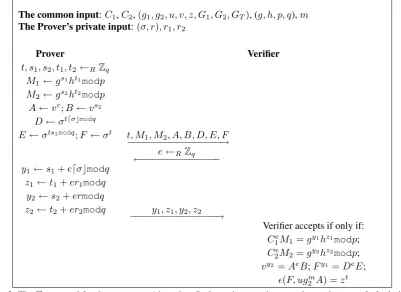
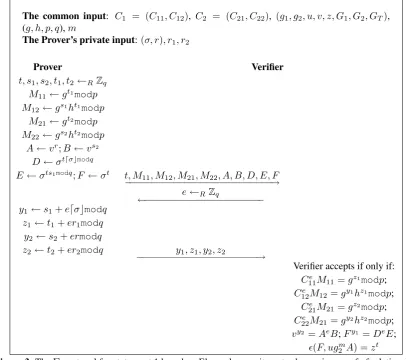
The Σ-protocols for the statement 1 based on Pedersen’s commitment scheme and the Elgamal commitment scheme are depicted in Figure 2 and Figure 3, respectively. The common input consists of two commitmentsC1, C2 to the signature(dσc, r)(whereC1 is a commitment todσcandC2is a commitment tor), the verification key
(g1, g2, u, v, z)of the Boneh and Boyen’s scheme, parametersg, h, p, qof Pedersen’s scheme and messagem.
are properly randomized). Then the prover sends three specific elementB,DandEwhose purpose is to show that the signature determined byF andV matches the value committed to in the commitment.
For clarity of description, we omit specifying the groups over which the exponentiations are performed, as they are clear from the context.
The common input:C1,C2,(g1, g2, u, v, z, G1, G2, GT), (g, h, p, q),m
The Prover’s private input:(σ, r), r1, r2
Prover Verifier
t, s1, s2, t1, t2←RZq
M1←gs1ht1modp
M2←gs2ht2modp
A←vr;B ←vs2 D←σtdσcmodq
E←σts1modq;F ←σt t, M
1, M2, A, B, D, E, F −−−−−−−−−−−−−−−−−→
e←RZq
←−−−−−−−−−−−−−−−
y1←s1+edσcmodq
z1←t1+er1modq
y2←s2+ermodq
z2←t2+er2modq y1, z1, y2, z2 −−−−−−−−−−−−−−−−→
Verifier accepts if only if:
Ce
1M1=gy1hz1modp;
Ce
2M2=gy2hz2modp;
vy2=AeB;Fy1 =DeE; ²(F, ugm
2 A) =zt
Figure 2.TheΣ-protocol for the statement 1 based on Pedersen’s commitment scheme, i.e., proof of relationship {((C1, C2, g1, g2, u, v, z, g, h, p, q, m); (σ, r, r1, r2))|C1=gdσchr1∧C2=grhr2∧²(σ, ug2mvr) =z}.
For theΣ-protocol based on Pedersen’s commitment scheme, it is easy to see that we can compute the witness from two different transcripts(a, e, z)anda, e0, z0of two executions of above protocol. Special honest-verifier zero-knowledge is also clear: given a challengee, a simulator randomly choosess←RZ∗qand computesσ←g1s∈G1,
pickst ←R Zq, y1 ←R Zq, y2 ←R Zq,z1 ←R Zq andz2 ←R Zq; then, it computesM1 ← gy1hz1C1−emodp,
M2 ← gy2hz2C2−emodp,F ← σt∈ G1,D ← σtdσcmodq ∈ G1,E ← DeF−y1 ∈ G1,A ← u−1g−2mg21/s ∈G2,
B ←vy2A−e∈G
2, and it is easy to check that the ”transcript” generated in this way is with the same distribution
of the real execution. Note that the Boneh and Boyen’s scheme requires(x+m+yr) ∈Z∗
q, and this is why the
simulator can randomly choosesfromZ∗q.