Security Analysis of Voice-over-IP Protocols
Prateek Gupta
VMWare, Inc.
Vitaly Shmatikov
The University of Texas at Austin
Abstract
The transmission of voice communications as datagram packets over IP networks, commonly known as Voice-over-IP (VoVoice-over-IP) telephony, is rapidly gaining wide acceptance. With private phone conversations being conducted on in-secure public networks, security of VoIP communications is increasingly important. We present a structured secu-rity analysis of the VoIP protocol stack, which consists of signaling (SIP), session description (SDP), key establish-ment (SDES, MIKEY, and ZRTP) and secure media trans-port (SRTP) protocols. Using a combination of manual and tool-supported formal analysis, we uncover several design flaws and attacks, most of which are caused by subtle incon-sistencies between the assumptions that protocols at differ-ent layers of the VoIP stack make about each other.
The most serious attack is a replay attack on SDES, which causes SRTP to repeat the keystream used for media encryption, thus completely breaking transport-layer secu-rity. We also demonstrate a man-in-the-middle attack on ZRTP, which allows the attacker to convince the commu-nicating parties that they have lost their shared secret. If they are using VoIP devices without displays and thus can-not execute the “human authentication” procedure, they are forced to communicate insecurely, or not communicate at all,i.e., this becomes a denial of service attack. Finally, we show that the key derivation process used in MIKEY cannot be used to prove security of the derived key in the standard cryptographic model for secure key exchange.
1
Introduction
Achieving end-to-end security in a voice-over-IP (VoIP) session is a challenging task. VoIP session establishment involves a jumble of different protocols, all of which must inter-operate correctly and securely. Our objective in this paper is to present a structured analysis of protocol inter-operation in the VoIP stack, and to demonstrate how even a subtle mismatch between the assumptions made by a pro-tocol at one layer about the propro-tocol at another layer can lead to catastrophic security breaches, including complete
removal of transport-layer encryption.
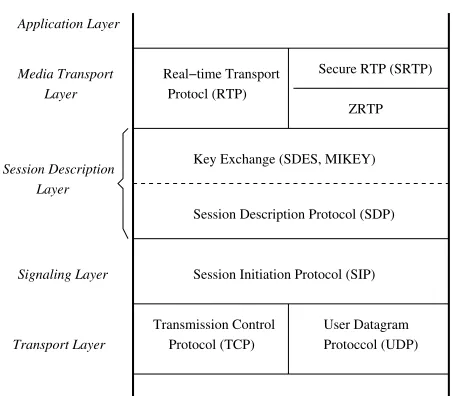
The VoIP protocol stack is shown in figure 1. For the purposes of our analysis, we will divide it into four layers:
signaling,session description,key exchangeandsecure me-dia (data) transport. This division is quite natural, since each layer is typically implemented by a separate protocol.
Signaling is an application-layer (from the viewpoint of the underlying communication network) control mech-anism used for creating, modifying and terminating VoIP sessions with one or more participants. Signaling protocols include Session Initiation Protocol (SIP) [27], H.323 and MGCP. Session description protocols such as SDP [20] are used for initiating multimedia and other sessions, and often include key exchange as a sub-protocol.
Key exchange protocols are intended to provide a cryp-tographically secure way of establishing secret session keys between two or more participants in an untrusted envi-ronment. This is the fundamental building block in se-cure session establishment. Security of the media transport layer—the layer in which the actual voice datagrams are transmitted—depends on the secrecy of session keys and
authenticationof session participants. Since the established key is typically used in a symmetric encryption scheme, key secrecy requires that nobody other than the legitimate ses-sion participants be able to distinguish it from a random bit-string. Authentication requires that, after the key exchange protocol successfully completes, the participants’ respec-tive views of sent and received messages mustmatch(e.g., see the notion of “matching conversations” in [8]). Key ex-change protocols for VoIP sessions include SDP’s Security DEscriptions for Media Streams (SDES) [1], Multimedia Internet KEYing (MIKEY) [2] and ZRTP [31]. We will an-alyze all three in this paper.
Real−time Transport Protocl (RTP)
Secure RTP (SRTP)
Session Description Protocol (SDP)
Session Initiation Protocol (SIP)
Transmission Control Protocol (TCP)
User Datagram Protoccol (UDP) Key Exchange (SDES, MIKEY)
ZRTP Media Transport
Layer
Signaling Layer
Transport Layer Layer
Application Layer
Session Description
Figure 1. Voice-over-IP protocol stack
will be detected by the recipient. An example of a secure media transport protocol used on VoIP communications is Secure Real-time Transport Protocol (SRTP) [6], which is a profile of Real-time Transport Protocol (RTP) [28].
Our contributions. We analyze security of VoIP protocols at all layers of the VoIP stack. In particular, we focus on the inter-operation between protocols at different layers. A protocol may be secure when executed in isolation, but the composition of protocols in different layers may be inse-cure. Moreover, a protocol may make assumptions about another protocol that the latter does not satisfy.
• We show how to cause the transport-layer SRTP pro-tocol to repeat the keystream used for datagram en-cryption. This enables the attacker to obtain thexor
of plaintext datagrams or even to completely decrypt them. The SRTP keystream is generated by using AES in a stream cipher-like mode. The AES key is gen-erated by applying a pseudo-random function (PRF) to the session key. SRTP, however, does not add any session-specific randomness to the PRF seed. Instead, SRTP assumes that the key exchange protocol, exe-cuted as part of RTP session establishment, will en-sure that session keys never repeat. Unfortunately, S/MIME-protected SDES, which is one of the key ex-change protocols that may be executed prior to SRTP, does not provide any replay protection. As we show, a network-based attacker can replay an old SDES key establishment message, which will cause SRTP to re-peat the keystream that it used before, with devastating consequences. This attack is confirmed by our analysis of thelibsrtpimplementation.
• We show an attack on the ZRTP key exchange proto-col that allows the attacker to convince ZRTP session participants that they have lost their shared secret. ZID values, which are used by ZRTP participants to retrieve previously established shared secrets, arenot authenti-cated as part of ZRTP. Therefore, an attacker can ini-tiate a session with some partyA under the guise of another partyB, with whomApreviously established a shared secret. As part of session establishment,A is supposed to verify thatBknows their shared secret. If the attacker deliberately chooses values that cause verification to fail, A will decide—following ZRTP specification—that B has “forgotten” the shared se-cret.
The ZRTP specification explicitly says that the proto-col may proceed even if the set of shared secrets is empty, in which case the attacker ends up sharing a key withAwho thinks she shares this key withB. Even if the participants stop the protocol after losing their shared secrets, but are using VoIP devices without dis-plays, they cannot confirm the computed key by voice and must stop communicating. In this case, the attack becomes a simple and effective denial of service. Our analysis of ZRTP is supported by the AVISPA formal analysis tool [3].
• We show several minor weaknesses and potential vul-nerabilities to denial of service in other protocols. We also observe that the key derived as the result of MIKEY key exchange cannot be used in a stan-dard cryptographic proof of key exchange security (e.g., [12]). Key secrecy requires that the key be in-distinguishable from a random bitstring. In MIKEY, however, the joint Diffie-Hellman value derived as the result of the protocol is used directly as the key. Membership in many Diffie-Hellman groups is easily checkable, thus this valuecanbe distinguished from a random bitstring. Moreover, even hashing the Diffie-Hellman value does not allow the formal proof of secu-rity to go through in this case, since the hash function does not take any random inputs apart from the Diffie-Hellman value and cannot be viewed as a randomness extractor in the proof. (This observation does not im-mediately lead to any attacks.)
lessons for the design and analysis of security protocols in general.
The rest of the paper is organized as follows. In sec-tion 2, we describe the protocols, focusing on SIP (signal-ing), SDES, ZRTP and MIKEY (key exchange), and SRTP (transport). In section 3, we describe the attacks and vulner-abilities that we discovered. Related work is in section 4, conclusions are in section 5.
2
Protocols
2.1
Signaling: SIP
Session Initiation Protocol (SIP) [27] is an application-layer signaling protocol used for creating, modifying and terminating sessions with one or more participants. A SIP network consists of the following entities: end points, a
proxy and/orredirect server, location server, and a regis-trar. End points orUser Agents(UA) represent phone de-vices or software modems. SIP users are not bound to spe-cific devices; they register themselves with the registrar and use a special form of address resolution to identify other users. SIP user identification is based on a special type of Uniform Resource Identifier (URI) called SIP URI, simi-lar to email addresses. A location server stores the address bindings of users when they register themselves with the registrar.
SIP servers can operate in aproxy modeorredirect mode. In the proxy mode, the server intercepts messages from the end points, inspects their To: field, contacts the location server to resolve the username into an address and forwards the message to the appropriate end point or another server. SIP also supportsforking proxies, which receive a single re-quest and forward it to multiple recipients (as we show in section 3.1, this makes SIP potentially vulnerable to denial of service attacks). In the redirect mode, the only differ-ence is that instead of forwarding the packet along the ac-tual route, the redirect server returns the address to the end points and the onus of transmitting the packets is placed on the end points.
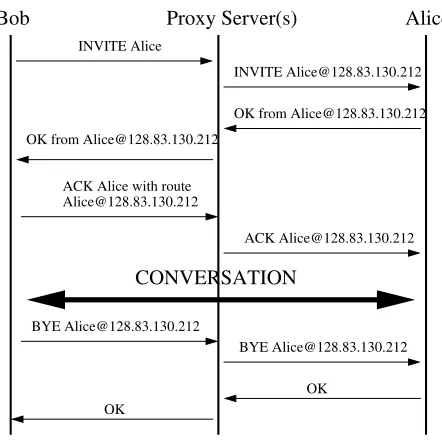
SIP uses a HTTP-like request-response mechanism for initiating a two-way communication session. The protocol itself is modeled on the three-way TCP handshake. Figure 2 shows a SIP connection setup with an intermediate proxy server between the end points. In order to set up a connec-tion between Alice’s and Bob’s UAs, Alice’s SIP URI is first resolved into the IP address of the UA under which Alice is currently registered. SIP address resolution and routing is usually not done by the UA itself, but rather delegated to the proxy server for the UA’s domain. In our example, Bob’s proxy will make a DNS lookup to determine the address of Alice’s proxy server. During the setup process,
communi-Proxy Server(s) Alice
CONVERSATION INVITE Alice
OK OK
INVITE [email protected]
OK from [email protected]
OK from [email protected]
ACK Alice with route [email protected]
BYE [email protected] Bob
Figure 2. SIP protocol exchange
cation details are negotiated between UAs using the Session Description Protocol (SDP), described in section 2.2.
To place a call to Alice, Bob’s UA sends an INVITE re-quest to the proxy server containing SDP info, which is then forwarded to Alice’s UA, possibly via her proxy server (af-ter address resolution by Bob’s proxy). If Alice wants to talk to Bob, she sends an OK message back to Bob contain-ing her SDP preferences. Bob then responds with an ACK. Media exchange takes place directly between Alice’s and Bob’s respective UAs. From the network security point of view, this implies that both hops must be secured on a hop-by-hop basis, and the direct path must be secured as well.
SIP messages can be transported over a TCP stream, pro-vided the packet size is smaller than the Maximum Trans-mission Unit (MTU), or embedded into UDP datagram packets. Therefore, security mechanisms used to encrypt and authenticate multimedia streams must support UDP as a transport layer protocol. This requirement excludes sev-eral popular security mechanisms such as the TCP-based Transport Layer Security (TLS) [15]. SIP also presents challenges for firewalls and Network Address Translators (NATs), but those are outside the scope of this paper.
2.2
Session description: SDP
Session Description Protocol (SDP) is a format for de-scribing multimedia session parameters for the purpose of session announcement, session invitation, and so on. We omit the details, which can be found in [20]. A multimedia
consist of multiple media streams. A session announcement consists of a session level description (details that apply to all media streams) and, optionally, several media-level de-scriptions. Because SDP is purely a format specification, it is independent of the transport layer and may be carried, for example, by SIP.
2.3
Key exchange:
SDES, ZRTP, and
MIKEY
Unlike session initiation and description, key exchange is a fundamentalsecurity mechanism. Therefore, we de-scribe the key exchange protocols specific to VoIP in more detail. It is essential to understand what security guaran-tees they provide, because, as we show below, a mismatch between the expectations of the transport-layer protocol and the security properties actually ensured by the key exchange protocol can be a source of serious vulnerabilities.
SDES. SDES [1] is the key transport extension of the SDP protocol. It provides a way to signal and negotiate cryptographic key(s) and other session parameters for me-dia streams in general, and for SRTP in particular. The
cryptoattribute for SRTP is defined as: a = crypto :
tagcrypto − suitekey − params[session − params]. The most important component iskey−params, which specifies one or more cryptographic keys askey− method:key−info. The only method supported for key exchange isinline :, which specifies that the key it-self must be included in plaintext. In other words, the key is embedded directly in the SDP attachment of a SIP message. Therefore, protection of the key depends solely on SIP.
SIP security mechanisms are described in detail in ap-pendix A. For our purposes, it is enough to observe that transport-layer protection in SIP can be done using either TLS [15] (if the transport layer is TCP), or S/MIME [25]. The use of TLS is deprecated because TLS does not provide end-to-end protection over a chain of proxies. Moreover, it assumes that the next hop in the SIP proxy chain is trusted. S/MIME, by contrast, provides end-to-end confidentiality and authentication for SDP payload encoded as MIME [18]. Note that S/MIME doesnot provide any replay protec-tion. Hence, if S/MIME is used to protect SDP payload (which includes the key in plaintext), then the application must provide a separate defense against replay attacks. In general, most applications have limited replay protection because it requires state maintenance and/or loose clock synchronization. In section 3.2, we will show how the at-tacker can exploit the lack of replay protection in S/MIME-protected SDES to completely break security of an SRTP session.
ZRTP. ZRTP [31] describes an extension header for Real-time Transport Protocol (RTP) to establish a session key for SRTP sessions using authenticated Diffie-Hellman key
exchange. An implementation of ZRTP is available as Zfone [30]. The main distinguishing feature of ZRTP is that it does not require prior shared secrets or the existence of a separate public-key infrastructure (PKI). This is an impor-tant consideration since it eliminates the need for a trusted certificate server.
Because Diffie-Hellman (DH) key exchange is malleable and does not provide protection against man-in-the-middle attacks, ZRTP uses a Short Authentication String (SAS), which is essentially a cryptographic hash of two Diffie-Hellman values, for key confirmation. The communicating parties confirm the established key verbally over the phone, by looking at their respective phone displays and reading the displayed SAS values to each other. After that, they rely on key chaining: the shared Diffie-Hellman secrets cached from the previous sessions are used to authenticate the cur-rent session.
Bob
F1
F2
F3
F4
F5
F6
F7
F8
F9
F10
HELLO(ver,cid,hash,cipher,pkt,sas,Alice’s ZID)
HELLOACK
HELLOACK
Bob acts as the initiator
COMMIT(Bob’s ZID,hash,cipher,pkt,hvi)
DHPART1(pvr,rs1IDr,rs2IDr,sigsIDr,srtpsIDr,other_IDr)
DHPART2(pvi,rs1IDi,rs2IDi,sigsIDi,srtpsIDi,other_IDi)
Alice and Bob generate SRTP session keys and salt SRTP begins
CONFIRM1(plaintext,sasflag,hmac)
CONFIRM2(plaintext,sasflag,hmac) HELLO(ver,cid,hash,cipher,pkt,sas,Bob’s ZID)
RTP session
CONFIRM2ACK
Alice
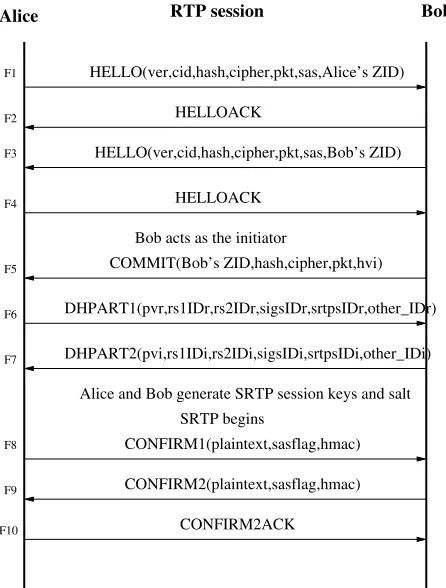
Figure 3. Establishment of SRTP session key using ZRTP
HEL-LOACK messages are optional and an end point can directly initiate a ZRTP session by sending a COMMIT message. The sender of the COMMIT message (Bob in our example) is called theinitiator, Alice is theresponder.
We describe the Diffie-Hellman exchange in some de-tail, focusing only on the relevant message fields and omit-ting the rest. In the COMMIT message, hash,cipher
andpktdescribe the hash, encryption and public key al-gorithms, respectively, chosen by Bob from the intersec-tion of algorithms in the sent and received HELLO mes-sages. Bob chooses a random exponentsviand computes the value pvi = gsvi mod p, where g (generator of the Diffie-Hellman groupG) andpare determined by thepkt
value. hvi, called the hash commitment, is the hash of the Diffie-Hellman value generated by Bob, concatenated with
hash,cipher,pktandsasfrom Alice’s HELLO message. Upon receipt of the COMMIT message, responder Alice generates her own Diffie-Hellman secretsvrand computes the corresponding public valuepvr. Each secret already shared between Alice and Bob has an ID, which is theHMAC
of the string “Responder” computed using this secret as the key. Alice uses Bob’s ZID to retrieve their shared se-cretsrs1andrs2. Bob’s behavior in response to Alice’s DHPART1 message is similar.
Upon receipt of the DHPART2 message, Alice checks that Bob’s public DH value is not equal to1orp−1. (RFC states that this check thwarts man-in-the-middle attacks. In section 3, however, we will describe how an attacker can successfully launch a man-in-the-middle attack against the protocol without the participants ever detecting it.) If the check succeeds, Alice computes the hash of the received value and checks whether it matches hvireceived in the COMMIT message. If not, Alice terminates the protocol. Otherwise, she stores the shared secret IDs received from the DHPART2 message as setA.
Alice then computes the set of shared secret IDs that she
expectsto receive from Bob. For each secret, its ID is com-puted asHMACof the string “Initiator”, keyed with the secret itself. LetBbe the set of these expected IDs. Alice then computes the intersection of setsAandB. Secrets cor-responding to the IDs in the intersection are stored as setD, sorted in the ascending order. The specification explicitly allows this set of shared secrets to be empty [31, p.12].
The final session key is computed as the hash of the joint Diffie-Hellman secret concatenated with the set D
of shared secrets. Finally, cached shared secrets rs1
and rs2 are updated as rs2 = rs1 and rs1 = HMAC(session key,“known plaintext”)on both sides. The master key and the salt for the SRTP session are computed asHMACof known plaintexts using the new session key.
Multimedia Internet KEYing. MIKEY [2] is another key exchange protocol for SRTP. It can operate in three different modes: pre-shared key with key transport, public key with
key transport, public key with authenticated Diffie-Hellman (DH) key exchange. A later extension provides for a DH exchange in the pre-shared key mode [16]. These modes are described in detail in appendix B.
An advantage of MIKEY is that it allows the key to be negotiated as part of the SDP payload during the session setup phase in SIP. Thus, it requires no extra communica-tion overhead. An obvious disadvantage of MIKEY is that it requires either prior shared secrets, or a separate PKI, with all attendant problems such as certificate dispersal, revoca-tion, and so on.
For the purposes of our analysis, we focus on the Diffie-Hellman mode of MIKEY, described in detail in ap-pendix B. In this mode, the initiator and the responder ex-change their respective Diffie-Hellman valuesgxi andgxr.
Both values are signed to ensure authentication. The de-rived key isgxi.xr.
2.4
Secure transport layer: SRTP
VoIP datagrams are usually transported using the Real-time Transport Protocol (RTP). SRTP [6] is a profile of RTP which aims to provide confidentiality, message authentica-tion, and replay protection to RTP data and control traffic. SRTP uses a singlemaster keyto derive keying material via a cryptographically secure hash function.
In SRTP, a cryptographic context refers to the crypto-graphic state information maintained by the sender and re-ceiver for the media stream. This includes the master key, session keys, identifiers for encryption and message authen-tication algorithms, lifetime of session keys, and a rollover counter (ROC).
Each RTP packet consists of a 16-bit sequence num-ber (SEQ) which is monotonically increasing. The rollover counter is maintained by the receiver and is incremented by1every time the sequence number wraps around. For a multicast stream with multiple senders, a synchronization source identifier (SSRC) uniquely identifies a sender within a session. A cryptographic context for SRTP is identified by the triple (SSRC, destination network address, destina-tion port).
For data encryption, SRTP uses a single cipher, Ad-vanced Encryption Standard (AES), in one of the follow-ing two modes: (i) Segmented Integer Counter mode, or (ii) f-8 mode. The input to AES is the triple (key,SSRC,SEQ), where “key” is the encryption key (explained below), SSRC is the synchronization source identifier and SEQ is the se-quence number of the packet. Instead of using AES as a block cipher, SRTP uses it as if it were a stream cipher and encrypts datagrams by xor’ing them with the output of AES applied to (key,SSRC,SEQ).
and authentication session keys from the master key, master salt and the packet sequence number. The sequence num-ber of the packet is chosen by the sender. Both master key and master salt are derived deterministicallyby applying HMAC, keyed with the material received during the key ex-change protocol, to a known plaintext (as defined by the key exchange protocol). As we show in section 3.2, the deter-minism of key derivation is a fatal flaw since it makes an unwarranted assumption about the key exchange protocol used to create the master key.
Session key derivation involves an 8-bitlabel, master saltms, the key derivation rate, as determined by the cryp-tographic context, and the index (48-bit ROC||SEQ). Let|| denote string concatenation. Letx= (label||r)xor ms,
whereris the integer quotient obtained by dividing the in-dex by the key derivation rate. Letmkdenote the master key
andPRF(k,x)denote a pseudorandom function family such that for the secret random keyk, givenm-bitx, the output is ann-bit string computationally indistinguishable from a truly randomn-bit string. The session keys are generated asPRF(mk,x), using different labels for encryption, authen-tication and salting keys, respectively.
An important point to note is that there isno receiver-generated randomness in the session key derivation pro-cess. This will allow us to break the protocol because se-curity of the stream cipher-like encryption used in SRTP depends critically on the keystream never repeating. This is emphasized several times in the SRTP specification [6], which warns about the dangers of “two-time pad” (a collo-quial term for keystream reuse).
For the keystream never to repeat, the PRF output (used as input into AES) must never repeat, because the other inputs into AES—SSRC and SEQ—are not required to be globally unique and can repeat from session to session (SSRC must be unique within a session, but may and will repeat from session to session if the same sender is in-volved). Moreover, both values are public and can be eaves-dropped by the attacker. This means that thePRF input must be unique for every session.
Therefore, the master key and master salt must be unique in each session. Indeed, according to the SRTP specifica-tion, “a master key MUST NOT be shared among different RTP sessions.” Recall that both the master key and mas-ter salt are derived demas-terministically from the key mamas-terial received during the key exchange protocol. If the attacker ever succeeds in tricking an SRTP session into re-using pre-viously used key material, the master key will repeat. In section 3.2, we will describe how the attacker can force a VoIP server implementing SRTP in conjunction with SDES key exchange to repeat the master key, completely breaking the transport-layer encryption of the data stream.
3
Attacks and Vulnerabilities
3.1
Attacks on SIP
Denial of service. A denial of service attack focuses on rendering a network of service unavailable, usually by di-recting a high volume of traffic towards the service thereby denying it to legitimate clients. A distributed denial of ser-vice allows a single network user to cause multiple network hosts to flood the target host.
SIP architecture makes it particularly easy to launch a distributed denial of service attack. An attacker can put the victim’s IP address into a spoofedRouter header re-quest, and send it to forking proxies, who will greatly am-plify the number of messages returned to the victim.
Reflectionis an another way to stage a denial of service attack. An attacker can send spoofed requests to a large number of SIP elements and proxies, putting the victim’s IP address into the source field. Each of the recipients will generate a response, overwhelming the victim.
A limited protection against spoofed SIP requests can be provided by IPsec, but end-to-end IPsec is challenging to deploy in a typical VoIP environment where end points are dynamic, and it is not clear from the specification how SIP inter-operates with IPsec (see appendix A).
Another important vulnerability in SIP is that BYE re-quests to terminate sessions are not authenticated since they are not acknowledged. Instead, a BYE request is implic-itly authenticated if it is received from the same network element (on the same path) as a previous INVITE. A third-party attacker can thus observe the parameters of an eaves-dropped INVITE message, and then insert a BYE request into the session. Once the BYE request is received by the target, the session would be torn down permanently. Simi-lar attacks can be launched on re-INVITE messages used to change session parameters.
A wide variety of denial of service attacks also become possible if registration requests are not properly authenti-cated and authorized by registrars. If a malicious user is able to de-register some or all other users in the network and register his own device on their behalf, he can easily deny access to any of those users/services. Attackers can also try to deplete storage resources of the registrar by cre-ating a huge number of bindings.
Authentication. Authentication is particularly difficult to achieve in SIP, since there are a number of intermediate el-ements such as proxies which possibly modify the contents of a message before it reaches the desired destination. All such intermediate elements must be trusted.
impersonate a party authorized to change contacts on behalf of a user, he can arbitrarily modify the address-of-record bindings for the associatedToaddress. Since SIP authenti-cation relies implicitly on the authenticity of the server and intermediate proxies, the attacker who is able to success-fully impersonate a server or a proxy can do arbitrary dam-age including denying service to the client or launching a (distributed) denial of service attack. This requires the exis-tence of some methodology for the client to authenticate the server and/or the proxy. Unfortunately, no such mechanism is specified in the SIP RFC.
3.2
Attack on SDES/SRTP
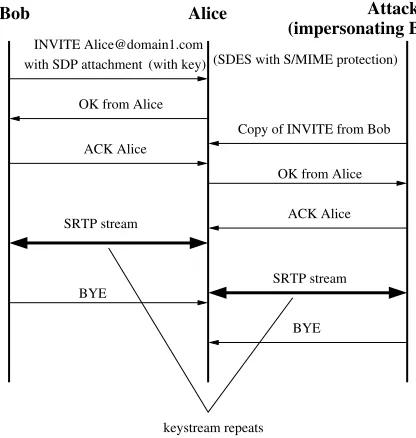
Figure 4 shows an attack on SRTP when used in com-bination with SDES key exchange. Suppose two legiti-mate users, Alice and Bob, previously carried out a success-ful VoIP session, which the attacker was able to passively eavesdrop, without learning the session key and thus not being able to decrypt the data streams. Suppose Bob was the initiator in this session, and SDES was used to trans-port SRTP key material. To provide confidentiality for the SDES message, S/MIME was used to encrypt the payload. S/MIME, in general, is preferred over TLS for protecting SDP messages because (i) S/MIME provides end-to-end in-tegrity and confidentiality protection, and (ii) S/MIME does not require the intermediate proxies to be trusted.
S/MIME does not provide any anti-replay protection. After the original session has been torn down, the attacker can replay Bob’s original INVITE message to Alice, con-taining an S/MIME-encrypted SDP attachment with the SDES key transfer message. (Fig. 4 shows the sessions running concurrently, but the attack need not be adaptive; one session can be executed after the other.) Since Alice does not maintain any state for SDP, she will not be able to detect the replay. Using the old session’s key material as her HMAC key, she will derive exactly the same mas-ter key and masmas-ter salt as in the original session. Since SSRC and sequence number are the same, the resulting sion encryption key will be the same as in the previous ses-sion, and the keystream generated by applying AES to the (key,SSRC,SEQ) triple will be the same as in the original session.
Encryption in SRTP is simply thexorof the data stream with the keystream. If Alice now sends a datagram in the new session that she thinks she is establishing with Bob, the attacker can xor the encrypted data stream with the data stream he eavesdropped in the original session. The keystream will cancel out, and the result will be thexorof two data streams.
If the data streams contain enough redundancy or the at-tacker can guess parts of either stream, he will be able to completely or partially reconstruct the data of both streams.
keystream repeats OK from Alice
OK from Alice
ACK Alice SRTP stream
SRTP stream BYE
INVITE [email protected] (with key) with SDP attachment
Copy of INVITE from Bob ACK Alice
BYE
Alice Bob
(SDES with S/MIME protection)
(impersonating Bob) Attacker
Figure 4. Attack on SRTP using SDES key ex-change
In any case, encryption has been completely removed, and the attacker obtains a bitwisexorof two payloads. Since VoIP datagrams are highly redundant, and the payloads of at least the initial datagrams are very predictable (e.g., most phone conversations start with a “Hello”, whose digital en-coding can be predicted, even accounting for variations in accent and pronunciation), this should be considered a com-plete security breach. Detailed analysis of redundancy in network packets and the implications for stream cipher se-curity can be found in [23].
Our attack is similar in spirit to the famous attack on 802.11b WEP [11], which also allowed the attacker to ob-tain anxorof wireless packets. In the case of WEP, the keystream was re-used due to exhaustion of initialization vectors for the stream cipher.
We emphasize that our attack on SDES/SRTP is not a theoretical exercise. We testedlibsrtp, an open-source implementation of SRTP, and confirmed that it generates the same master key if the same key material is supplied by the key exchange protocol, and the replay of an S/MIME-protected message will result in exactly the same key mate-rial being supplied to the SRTP implementation.
re-use. Among the automatic key management protocols compatible with SRTP are MIKEY, SDES, and ZRTP.
Even though MIKEY was specifically designed as the key exchange protocol for SRTP, many VoIP implementa-tions use SDES instead. As of April 2007, products that rely on the SDES/SRTP combination include software PBX (Private Branch Exchange) frompbxnsip, VoIP session border controllers and SIP firewalls from Covergence and Ingate Systems, and the eyeBeam software phone from CounterPath.
While MIKEY contains built-in anti-replay protection and thus appears suitable for establishing SRTP keys, our analysis demonstrates that SDES is not. Some SRTP im-plementations may take additional measures to prevent key re-use, but thelibsrtpimplementation relies completely (and disastrously) on the key exchange protocol to ensure freshness of the key material.
To prevent keystream re-use, SRTP responder should use its own fresh randomness as part of the key derivation pro-cess, e.g., as input to HMAC used in session key deriva-tion. This randomness need not be secret. It can be publicly communicated to the sender as part of SRTP session estab-lishment to ensure that the sender derives the same set of session keys.
Overall, SRTP is a well-designed protocol, and there are good practical reasons why AES in counter mode has been chosen as the keystream generator in SRTP [7]. Neverthe-less, we believe that our analysis contains an important les-son for the designers of other protocols that use stream-like ciphers in counter modes. As the authors of SRTP re-iterate several times in the protocol specification, it is critical that the counter never repeat. For the protocol to be secure, however, AES key/salt combinations must be unique even across multiple sessions. In SRTP, this responsibility is im-plicitlydelegated to the key exchange protocol. Even the SRTP FAQ says only that keys “can be provided via sig-naling, and can be expressed using the SDP Security De-scriptions (if the signaling is cryptographically protected) or MIKEY [. . . ]” [7]. Unfortunately, cryptographic protec-tion in the absence of replay protecprotec-tion is not enough to guarantee uniqueness of the keys across multiple sessions, resulting in a potentially vulnerable combination of key ex-change and stream cipher.
3.3
Attacks on ZRTP
Denial of service. ZRTP is potentially vulnerable to denial of service attacks caused by attackers simply sending spu-rious HELLO messages to end points. In response to each HELLO, a ZRTP endpoint creates a half-open connection, and keeps its parameters in memory. Eventually, it will run out of storage or memory, and subsequent requests from le-gitimate clients will be refused.
Authentication. The main advantage of ZRTP is that it avoids the need for global trust associated with a public-key infrastructure. ZRTP aims to achieve this with the help of Short Authentication String (SAS), which is essentially a (keyed) cryptographic hash of Diffie-Hellman values along with other pre-shared secrets. After shared secrets have been used for authentication in one session, they are up-dated as described in section 2.3 and kept by the participants for authentication in the next session.
To authenticate the party on the other end of a VoIP ses-sion, the SAS value is read aloud over the voice connection. However, authentication based on SAS requires that some sort of GUI or display be available to the user. This is a serious problem for many secure VoIP devices,e.g., those that implement VoIP via a local network proxy and lack a display. Therefore, we will focus upon security of ZRTP in the situation where the user cannot explicitly verify SAS over the voice connection.
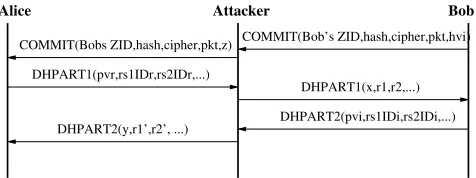
Authentication in ZRTP is based on the assumption that, in order to launch a successful man-in-the-middle attack on a pair of participants who already conducted several ses-sions, the attacker must be present on every session start-ing from the very first one. The reasonstart-ing goes as follows. Each ZRTP user retains shared secrets rs1andrs2 (see section 2.3) for users with whom he previously communi-cated. When initiating a new session, the user sends his ZID, which is used by the recipient to retrieve the set of shared secrets associated with this ZID. The session key is computed by hashing the joint Diffie-Hellman value con-catenated with the shared secrets. Therefore, even if the DH exchange is compromised, the attacker still cannot compute the session key because he does not know the shared secrets. Because the shared secrets are re-computed after each ses-sion, the attacker must be present in every session starting from the very first one, in which there was no shared secret. Unfortunately, this reasoning is fallacious. The main problem with the protocol is that ZIDs, which are used by recipients to look up shared secrets, are not authenticated early enough in the protocol exchange. Consider a passive attacker who eavesdrops on a session between Alice and Bob and learns Bob’s ZID. He then stages a man-in-the-middle attack as shown in figure 5.
The attacker chooses random exponentsx,yand com-putesx=gx mod pandy=gy mod p, respectively. zis the hash ofxconcatenated with the set of algorithms chosen by Bob for the ZRTP session. The attacker also replaces all shared-secret IDs with random numbers. When Alice re-ceives the DHPART2 message from Bob, she retrieves the set of secrets that she shares with Bob and computes the set of expected IDs. Since the attacker has replaced all IDs with random numbers, they will not match.
DHPART1(pvr,rs1IDr,rs2IDr,...)
COMMIT(Bobs ZID,hash,cipher,pkt,z) COMMIT(Bob’s ZID,hash,cipher,pkt,hvi)
Alice Attacker Bob
DHPART2(pvi,rs1IDi,rs2IDi,...) DHPART2(y,r1’,r2’, ...)
DHPART1(x,r1,r2,...)
Figure 5. A man in the middle attack on the ZRTP protocol
is calculated by hashing the concatenation of the Diffie-Hellman shared secret (DHSS) followed by the (possibly empty) set of shared secrets that are actually shared be-tween the initiator and responder” [31, p.12]. The specifica-tion doesnotrequire Alice to stop the protocol, and instead instructs her to compute the joint Diffie-Hellman value as
ysvrmod p(=gy.svrmod p). The session key is now com-puted as the hash of the joint Diffie-Hellman valuealone be-cause Alice believes that she doesn’t have any shared secrets with Bob anymore. Similarly, Bob computes the session key as the hash of the Diffie-Hellman valuegx.svimod p. The attacker knows both values. Therefore, he can com-pute SRTP master key and salt, and completely break SRTP encryption.
An informal discussion in the preamble to the proto-col specification does say that “If we ever lose this cached shared secret, it is no longer available for authentication of DH exchanges, so we would have to do a new SAS proce-dure and start over with a new cached shared secret” [31, p.3]. First, this is inconsistent with the actual specification, which permits the set of shared secrets to be empty during key derivation (see above). Second, it is not at all clear how to implement this, since the preamble goes on to say that “SAS is easiest to implement when a GUI or some sort of display is available, which raises the question of what to do when no display is available. We envision some prod-ucts that implement secure VoIP via a local network proxy, which lacks a display in many cases.”
Even if Alice stops communicating with Bob when the set of shared secrets is empty (and we emphasize once again that this isnotwhat the specification prescribes), this attack turns into a very effective denial of service, which allows the attacker to break off any session conducted between VoIP devices without displays. In general, the claim in the specification that the attacker is forced to solve multi-ple problems, such as “stealing a shared secret from one of the parties, being present on the very first session and ev-ery subsequent session to carry out an active MitM attack, and solving the discrete log problem,” does not appear to be
borne out.
It is not clear whether the problem can be solved at all. In the absence of either PKI, or pre-shared secrets, or de-vice support for “out-of-band” key confirmation by reading key hashes to each other, it is hard to see how the parties can carry out an authenticated key exchange. At the very least, the specification of ZRTP should not allow the key exchange to go forward when the set of shared secrets is empty.
Formal analysis of ZRTP in AVISPA. To support our analysis of ZRTP, we constructed a formal model of the protocol in the High Level Protocol Specification Lan-guage HLPSL [13] and used the automated AVISPA model checker [3] to carry out formal analysis.
Formal verification of ZRTP with AVISPA presents an interesting challenge because the model must capture the “multi-session” nature of authentication in ZRTP. Authen-tication in a ZRTP session depends on information ex-changed inprevioussessions. HLPSL, however, does not allow state to be retained across sessions.
To get our model to work, we had to assume that, for a given session, initiator and responder agree on the value of their shared secrets at the start of the session. This allows us to model the protocol by passing the shared secrets as argu-ments to the role specification of the initiator and responder roles. Also, we assume that there are no other shared se-crets between the participants. The protocol specification in HLPSL is given in appendix C. We only model the relevant fields in message bodies. To simplify presentation, we show the specification in the “Alice-Bob” notation:
Init→Resp:H(gx)
Init←Resp:gy,rs1IDr,rs2IDr|Diffie-Hellman exchange
Init→Resp:gx,rs1IDi,rs2IDi
Init←Resp:MAC(K,c1)|K is shared key Init→Resp:MAC(K,c2)|Authentication part
Here K is the shared session key calculated as de-scribed in section 2.3, H() is a cryptographic hash func-tion and MAC(k,text) is a keyed message authentica-tion code computed overtextusing authentication keyk.
rs1IDi,rs2IDi(rs1IDr,rs2IDr)are the keyed HMACs of the strings “Initiator” and “Responder” computed using the shared secretsrs1,rs2, respectively. c1,c2are public constants.
The attack on authentication described above was suc-cessfully discovered by the AVISPA tool. The attack is shown in appendix D.
3.4
Analysis of MIKEY
Secrecy. The goal of a cryptographically secure key ex-change protocol is to establish a session key which is indis-tinguishable from a random bitstring by anyone other than the participants [12]. It is easy to see that MIKEY does not satisfy this requirement when executed in the Diffie-Hellman mode. The shared key is derived as gxi.xr, i.e.,
the joint Diffie-Hellman value is used directly as the key. In many Diffie-Hellman groups,e.g., in the group of squares modulo a large prime, testing group membership is not a computationally hard problem: it is sufficient to compute the Jacobi symbol. Therefore, it is easy to tell the differ-ence between a random bitstring and the key.
This does not necessarily lead to any exploitable weak-nesses, although it does preclude a rigorous proof of secu-rity from going through. Moreover, encryption schemes in which the derived key is intended to be used typically re-quire that the key be indistinguishable from a random value. This is yet another example of how assumptions made by one layer of the VoIP protocol stack (transport layer in this case) are not met by another layer (key exchange layer in this case).
But wouldn’t the joint Diffie-Hellman derived in MIKEY have to be hashed anyway before it can actually be used as a key? Yes, but this is not enough. A simple appli-cation of a deterministic hash function to the joint Diffie-Hellman value doesnotprovably produce an output which is indistinguishable from random. By contrast, in protocols like TLS [15] and IKE [21], the key is derived by hash-ing the Diffie-Hellman value together with some (authen-ticated) random valuesgenerated by one or both partici-pants. This use of randomness in key derivation, absent in MIKEY, is essential for the cryptographic proof of security to go through.
There is a simple, standard solution. To derive a key from the joint Diffie-Hellman value, MIKEY participants should follow the approach used in TLS and IKE, and use arandomness extractor,e.g., a universal hash function [24] with public randomness generated by one or both partici-pants.
Finally, we observe that MIKEY in the pre-shared key mode (see appendix B) obviously doesn’t satisfy perfect forward secrecy because the compromise of the pre-shared secret leads to the compromise of all previous sessions.
Denial of service. MIKEY offers very limited protection against denial of service attacks. In the public-key DH mode, the responder only performs CPU-intensive modu-lar exponentiation after verifying the message digest of the
initiator’s message. The attacker can still flood the respon-der with multiple copies of the same message or messages containing an incorrect digest. This will cause the respon-der to perform a large number digest verifications and may exhaust memory resources.
4
Related work
The two VoIP protocols that have attracted most atten-tion in the research literature are SIP and Skype. SIP, in particular, has been the subject of several comprehensive studies [22, 26, 19, 29]. All of them focused solely on the signaling layer. Skype, which is a closed-end system based on a proprietary peer-to-peer protocol, has been the sub-ject of several analyses [9, 5] and reverse engineering at-tempts [10].
To the best of our knowledge, the VoIP protocol stack, including key exchange and transport layer security proto-cols, has not been analyzed before in its entirety. We’d like to emphasize the need to analyze not only the individual layers in isolation, but also the assumptions and guarantees made by the layers when interacting with each other. As our study shows, “misunderstandings” between protocols at dif-ferent layers is a common source of security vulnerabilities. We hope that this work will serve as the first step towards developing a comprehensive security assessment of the en-tire VoIP protocol stack.
5
Conclusions
We have presented a structured security analysis of the entire Voice-over-IP protocol stack, including signal-ing protocols such as SIP, key exchange protocols such as SDES, ZRTP and MIKEY, and transport-layer security pro-tocols such as SRTP. Our analysis uncovered several serious vulnerabilities. The first is a replay attack on SDES key ex-change which causes SRTP to use the same keystream in multiple sessions, thus allowing the attacker to remove en-cryption from SRTP-protected data streams. The second is an attack on ZRTP caused by unauthenticated user IDs, which allows the attacker to disable authentication mecha-nisms and either trick a ZRTP participant into establishing a shared key with the attacker, or cause the protocol to ter-minate prematurely. The third is a “certificational” issue: due to the lack of proper randomness extraction in MIKEY key derivation, MIKEY cannot be proved cryptographically secure.
security. When these assumptions are not justified—such as the assumption made by SRTP that the key exchange proto-col always ensures freshness of the key material—the result is a security vulnerability.
Much attention has been devoted to the development of formal protocol analysis methods that provide composi-tionalsecurity guarantees (e.g., see [4, 14]). An interesting topic of future research is whether attacks that exploit “mis-understandings” between protocol layers can be discovered automatically by analyzing protocol specifications. This re-quires formal tools that are capable of inferring and model-ing inter-protocol assumptions such as “protocol A assumes that the key provided by protocol B will be fresh in every session.”
Acknowledgements.This material is based upon work sup-ported by the National Science Foundations under grants CNS-0509033 and IIS-0534198, and by the Department of Defense under Contract No. H98230-05-C-1650.
References
[1] F. Andreasen, M. Baugher, and D. Wing. Session
De-scription Protocol (SDP) Security DeDe-scriptions for Media Streams. IETF RFC 4568, July 2006.
[2] J. Arkko, E. Carrara, F. Lindholm, M. Naslund, and K. Nor-rman. MIKEY: Multimedia Internet KEYing. IETF RFC 3830, August 2004.
[3] AVISPA. The AVISPA project. http://www.
avispa-project.org, 2006.
[4] M. Backes, B. Pfitzmann, and M. Waidner. A composable cryptographic library with nested operations. InProc. 10th ACM Conference on Computer and Communications Secu-rity (CCS), pages 220–230. ACM, 2003.
[5] S. Baset and H. Schulzrinne. An analysis of the Skype peer-to-peer Internet telephony protocol. InProc. 25th Annual Joint Conference of the IEEE Computer and Communica-tions Societies (INFOCOM). IEEE, 2006.
[6] M. Baugher, D. McGrew, M. Naslund, E. Carrara, and
K. Norrman. The Secure Real-time Transport Protocol
(SRTP). IETF RFC 3711, March 2004.
[7] M. Baugher, D. McGrew, M. Naslund, and K. Norrman.
Se-cure RTP Frequently Asked Questions. http://srtp.
sourceforge.net/faq.html, October 2005. [8] M. Bellare and P. Rogaway. Entity authentication and key
distribution. InProc. Advances in Cryptology – CRYPTO 1993, volume 773 ofLNCS, pages 232–249. Springer, 1993.
[9] T. Berson. Skype security evaluation. http://www.
anagram.com/berson/abskyeval.html, October 2005.
[10] P. Biondi and F. Desclaux. Silver needle in the Skype.
http://blackhat.com/presentations/ bh-europe-06/bh-eu-06-biondi/bh-eu-06% -biondi-up.pdf, March 2006.
[11] N. Borisov, I. Goldberg, and D. Wagner. Intercepting mo-bile communications: the insecurity of 802.11. InProc. 7th Annual Conference on Mobile Computing and Networking (MOBICOM), pages 180–189. ACM, 2001.
[12] R. Canetti and H. Krawczyk. Analysis of key-exchange pro-tocols and their use for building secure channels. InProc. Advances in Cryptology - EUROCRYPT 2001, volume 2045 ofLNCS, pages 453–474. Springer, 2001.
[13] Y. Chevalier, L. Compagna, J. Cuellar, P. H. Drielsma, J. Mantovani, S. M¨odersheim, and L. Vigneron. A high level protocol specification language for industrial security-sensitive protocols. InProc. Workshop on Specification and Automated Processing of Security Requirements (SAPS), 2004.
[14] A. Datta, A. Derek, J. Mitchell, and D. Pavlovic. A deriva-tion system and composideriva-tional logic for security protocols.
J. Computer Security, 13(3):423–482, 2005.
[15] T. Dierks and C. Allen. The TLS Protocol Version 1.0. IETF RFC 2246, January 1999.
[16] M. Euchner. HMAC-Authenticated Diffie-Hellman for
Mul-timedia Internet KEYing (MIKEY). IETF RFC 4650,
September 2006.
[17] J. Franks, P. Hallam-Baker, J. Hostetler, S. Lawrence, P. Leach, A. Luotonen, and L. Stewart. HTTP Authenti-cation: Basic and Digest Access Authentication. IETF RFC 2617, June 1999.
[18] J. Galvin, S. Murphy, S. Crocker, and N. Freed.
Se-curity Multiparts for MIME: Multipart/Signed and Multi-part/Encrypted. IETF RFC 1847, October 1995.
[19] D. Geneiatakis, G. Kambourakis, T. Dagiuklas, C. Lambri-noudakis, and S. Gritzalis. SIP security mechanisms: A state-of-the-art review. InProc. 5th International Network Conference (INC), pages 147–155. ACM, 2005.
[20] M. Handley and V. Jacobson. SDP: Session Description Pro-tocol. IETF RFC 2327, April 1998.
[21] D. Harkins and D. Carrel. The Internet Key Exchange (IKE). IETF RFC 2409, November 2006.
[22] D. R. Kuhn, T. Walsh, and S. Fries. Security considerations for Voice Over IP systems. NIST SP 800-58, January 2005. [23] D. McGrew and S. Fluhrer. Attacks on additive encryption of redundant plaintext and implications on internet security. InProc. 7th Annual International Workshop on Selected Ar-eas in Cryptography (SAC), volume 2012 ofLNCS, pages 14–28. Springer, 2000.
[24] M. Naor and M. Yung. Universal one-way hash functions and their cryptographic applications. InProc. 22nd Annual ACM Symposium on Theory of Computing (STOC), pages 427–437. ACM, 1990.
[25] B. Ramsdell. S/MIME Version 3 Message Specification. IETF RFC 2633, June 1999.
[26] J. Rosenberg and H. Schulzrinne. SIP traversal through res-idential and enterprise NATs and firewalls.http://www. jdrosen.net/sip_entfw.html, July 2001. [27] J. Rosenberg, H. Schulzrinne, G. Camarillo, A. Johnston,
J. Peterson, R. Sparks, M. Handley, and E. Schooler. SIP: Session Initiation Protocol. IETF RFC 3261, June 2002. [28] H. Schulzrinne, S. Casner, R. Frederick, and V.
Jacob-son. RTP: A Transport Protocol for Real-Time Applications. IETF RFC 3550, July 2003.
[29] D. Sisalem, S. Ehlert, D. Geneiatakis, G. Kambourakis, T. Dagiuklas, J. Markl, M. Rokos, O. Botron, J. Ro-driguez, and J. Liu. Towards a secure and reliable VoIP
infrastructure. http://www.snocer.org/Paper/
[30] Zfone. The Zfone Project. http://zfoneproject. com/, 2006.
[31] P. Zimmermann. ZRTP: Extensions to RTP
for Diffie-Hellman Key Agreement for SRTP.
http://www1.tools.ietf.org/html/ draft-zimmermann-avt-zrtp-01, March 2006.
A
SIP security mechanisms
SIP security mechanisms can be broadly divided into those devoted to authentication, data integrity, and confi-dentiality.
Authentication. SIP supports HTTP basic authentication
andHTTP digest authentication[17]. HTTP basic authenti-cation requires username and matching password to be sent in plaintext as part of the HTTP header request. This has serious security risks, and HTTP basic authentication has been deprecated in SIP version 2 (SIPv2) [27].
HTTP digest authentication is based on a simple challenge-response paradigm. The digest authentication scheme challenges the remote user with a randomnonce. A valid response consists of an MD5 or SHA-1digestof the secret password, the nonce value and some other pa-rameters including the requested URI. Although HTTP di-gest authentication improves upon the basic authentication by not sending the password in the clear, it is still prone to offline dictionary attacks based on intercepted hash values if short or weak passwords are used. The digest authentication scheme is also prone to computational denial-of-service at-tacks since it requires the challenger to compute the digest for any received hash value.
Confidentiality. SIP itself does not provide confidential-ity for media data. SIP messages include MIME bodies and the MTME standard provides mechanisms for ensuring data integrity and confidentiality [18]. SIP may use Secure MIME (S/MIME) [25] for distribution of certificates, au-thentication, confidentiality and data integrity. Distribution of S/MIME certificates, however, requires the existence of a trusted server. Authenticating MIME payloads is not a problem since each end point has its own private signing key and certificates may be forwarded along with the sig-nature. Confidentiality, on the other hand, poses a serious problem since it requires prior knowledge of the recipient’s public key. This key must be fetched from a central author-ity or obtained from a peer via special SIP messages. To be able to protect SIP headers as well, tunneling of SIP mes-sages inside MIME bodies is supported. Tunnelled packets may be large, and it is suggested to use TCP as the transport layer protocol to avoid problems with UDP fragmentation.
Another option is to use secure SIP (SIPS) URI, which is very similar to secure http (https) and employs Transport Layer Security (SSL/TLS). Since we wish to protect SIP headers and each hop may add routing information to the
SIP message header, protection is on a hop-by-hop basis along each segment of the path. The use of TLS also re-quires the use of TCP as a transport protocol and depends on the existence of a PKI infrastructure.
The third option is IPsec. IPsec provides two mecha-nisms for authentication and, in the case of ESP, confiden-tiality: Authentication Header (AH) and Encapsulating Se-curity Payload (ESP). Since each proxy server on the path may add or change information in the SIP header, both ESP and AH must be applied on a hop-by-hop basis. IPsec secu-rity mechanisms can also be established on a permanent ba-sis between the end points without active involvement of the UAs themselves. SIP RFC does not specify which IPsec ser-vice may be used or how key management is realized. One commonly accepted key establishment protocol for IPsec Internet Key Exchange (IKE) [21]. IKE may be used with pre-shared secrets or PKI infrastructure. Since the UAs are mostly dynamic, IKE Main Mode will not work with pre-shared secrets and IKE Aggressive Mode is fraught with problems such as man in the middle attacks, offline dictio-nary attacks,etc..
Data integrity. For data integrity, either S/MIME or SIPS URI or IPsec may be used.
B
Modes of MIKEY
Before describing the three modes of MIKEY, we need some notation.Data security protocolis the security proto-col, such as SRTP, used to protect the media session. Data security association (Data SA) comprises the session key (TEK) and a set of parameters. Crypto session (CS) is a uni- or bi-directional media stream. A crypto session is protected by a unique instance of a data security protocol. Each crypto session has a unique identifier known as the CS ID.Crypto session bundle(CSB) is a set of crypto ses-sions which derive their session keys (TEKs) from a com-mon TGK and a set of security parameters. CSB ID is a unique identifier for the crypto session bundle.Traffic Gen-erating Key(TGK) is a bitstring agreed upon by two or more parties associated with a CSB. One or more TEKs can be derived from the TGK and the unique crypto session ID.
- Pre-Shared Key Transfer. In this mode, the key is generated by the initiator and transferred to the re-sponder. The message is integrity-protected using a keyed MAC and encrypted. The respective keys are derived from the shared secret s and a random value using a cryptographically secure hash function. Let
IDi and IDr be the identities of the initiator and
and authentication key (Authk) from the shared se-cret s, SP is a set of security policies and KEMAC = E(Encrk,{TGK})||MAC.E(key,text)denotes the encryp-tion oftextwith the encryption keykeyand||denotes string concatenation. MACis a keyed message authenti-cation code computed over the entire messagem using the authentication keyAuthk. It is assumed thatTGKis a chosen uniformly at random by the initiator. For mutual authentication, the initiator may request the responder to send a verification message which includes the message headerHDR, timestampT, the initiator and responder iden-titiesIDi,IDr, respectively, and a MAC.
- Public Key Transfer. As in the pre-shared key mode, the initiator’s message transfers or more TGKs and set of me-dia session security parameters the responder. The initia-tor’s message is
m:=HDR,T,RAND,[IDi|CERTi],[IDr],{SP},KEMAC,PKE,SIGNi
HereCERTistands for the initiator’s certificate. In this mode, the encryption and authentication keys are derived from anenvelope key(Envk) chosen by the initiator at ran-dom. PKEis the encryption ofEnvk under the respon-der’s public key. Note that this requires prior knowledge of the responder’s (properly certified) public key. SIGNi
is a signature over the entire messagemusing the initia-tor’s private signing key. As in the pre-shared key mode, the initiator may request a verification message from the responder.
- Public Key with Diffie-Hellman Exchange. LetGdenote a large cyclic multiplicative group with generatorg. Au-thenticated Diffie-Hellman key exchange is shown below:
Init→Resp: HDR,T,RAND,[IDi|CERTi],SP,DHi,SIGNi Init←Resp: HDR,T,[IDr|CERTr],IDi,DHr,DHi,SIGNr
HereDHi,DHrstand forgxiandgxr, wherexi,xrare
ran-domly chosen by the initiator and responder, respectively. The derived key isgxi.xr. DH group parameters are
cho-sen by the initiator and signaled to the responder.
C
Formalization of ZRTP in HLPSL
role zrtp_Init (A,B: agent, G: nat,
Hash: hash_func, RS1,RS2: nat, Snd,Rcv: channel(dy)) played_by A
def=
local State : nat,
X : text,
DH, T : nat,
K : symmetric_key,
ID : nat,
Confirm1 : nat,
Confirm2 : nat,
EY : nat,
RS1IDr,RS2IDr : nat,
C,Init,Resp : nat
const sec_k1 : protocol_id
init State := 0 /\ ID := 1 /\ Confirm1 := 2 /\ Confirm2 := 3 /\ Init := 4 /\ Resp := 5
transition 1. State = 0
/\ Rcv(start) =|>
State’ := 1 /\ X’ := new()
/\ Snd(Init.Hash(exp(G,X’))) 2. State = 1
/\ Rcv(EY’.RS1IDr’.RS2IDr’) /\ not(RS1IDr’ = Hash(RS1.Resp)) /\ not(RS2IDr’ = Hash(RS2.Resp)) =|>
State’ := 2
/\ Snd(exp(G,X).Hash(RS1.Init).Hash(RS2.Init)) /\ DH’ := exp(EY’,X)
/\ K’ := Hash(Hash(DH’)) 3. State = 1
/\ Rcv(EY’.RS1IDr’.RS2IDr’) /\ RS1IDr’ = Hash(RS1.Resp) /\ not(RS2IDr’ = Hash(RS2.Resp)) =|>
State’ := 2
/\ Snd(exp(G,X).Hash(RS1.Init).Hash(RS2.Init)) /\ DH’ := exp(EY’,X)
/\ K’ := Hash(Hash(DH’).RS1) 4. State = 1
/\ Rcv(EY’.RS1IDr’.RS2IDr’) /\ not(RS1IDr’ = Hash(RS1.Resp)) /\ RS2IDr’ = Hash(RS2.Resp) =|>
State’ := 2
/\ Snd(exp(G,X).Hash(RS1.Init).Hash(RS2.Init)) /\ DH’ := exp(EY’,X)
/\ K’ := Hash(Hash(DH’).RS2) 5. State = 1
/\ Rcv(EY’.RS1IDr’.RS2IDr’) /\ RS1IDr’ = Hash(RS1.Resp) /\ RS2IDr’ = Hash(RS2.Resp) =|>
State’ := 2
/\ Snd(exp(G,X).Hash(RS1.Init).Hash(RS2.Init)) /\ DH’ := exp(EY’,X)
/\ K’ := Hash(Hash(DH’).RS1.RS2) 6. State = 2
/\ Rcv(C’)
/\ C’ = Hash(K.Confirm2) =|>
State’ := 3 /\ RS2’ := RS1 /\ RS1’ := Hash(K.ID) /\ Snd(Hash(K.Confirm1)) /\ secret(K,sec_k1,{A,B})
/\ witness(A,B,na,Hash(K.Confirm1)) /\ request(A,B,nb,C’)
end role
——————————————————————————————-role zrtp_Resp (A,B: agent, G: nat,
Hash: hash_func, RS1,RS2: nat, Snd,Rcv: channel(dy)) played_by B
def=
local State : nat,
Y : text,
DH, T : nat,
K : symmetric_key,
ID : nat,
Confirm1 : nat,
Confirm2 : nat,
EX : nat,
RS1IDi,RS2IDi : nat, C,Init,Resp : nat
const sec_k2 : protocol_id
init State := 0 /\ ID := 1 /\ Confirm1 := 2 /\ Confirm2 := 3 /\ Init := 4 /\ Resp := 5
transition 1. State = 0
/\ Rcv(Init.HVI’) =|>
State’ := 1 /\ Y’ := new()
/\ Snd(exp(G,Y’).Hash(RS1.Resp).Hash(RS2.Resp)) 2. State = 1
/\ Rcv(EX’,RS1IDi’,RS2IDi’) /\ not(RS1IDi’ = Hash(RS1.Init)) /\ not(RS2IDi’ = Hash(RS2.Init)) /\ HVI = Hash(EX’)
=|> State’ := 2
/\ DH’ := exp(EX’,Y) /\ K’ := Hash(Hash(DH’)) /\ Snd(Hash(K’.Confirm2))
/\ witness(B,A,nb,Hash(K’.Confirm2)) 3. State = 1
/\ Rcv(EX’,RS1IDi’,RS2IDi’) /\ RS1IDi’ = Hash(RS1.Init) /\ not(RS2IDi’ = Hash(RS2.Init)) /\ HVI = Hash(EX’)
=|> State’ := 2
/\ DH’ := exp(EX’,Y)
/\ K’ := Hash(Hash(DH’).RS1) /\ Snd(Hash(K’.Confirm2))
/\ witness(B,A,nb,Hash(K’.Confirm2)) 4. State = 1
/\ Rcv(EX’,RS1IDi’,RS2IDi’) /\ not(RS1IDi’ = Hash(RS1.Init)) /\ RS2IDi’ = Hash(RS2.Init) /\ HVI = Hash(EX’)
=|> State’ := 2
/\ DH’ := exp(EX’,Y)
/\ K’ := Hash(Hash(DH’).RS2) /\ Snd(Hash(K’.Confirm2))
/\ witness(B,A,nb,Hash(K’.Confirm2)) 5. State = 1
/\ Rcv(EX’,RS1IDi’,RS2IDi’) /\ RS1IDi’ = Hash(RS1.Init) /\ RS2IDi’ = Hash(RS2.Init) /\ HVI = Hash(EX’)
=|> State’ := 2
/\ DH’ := exp(EX’,Y)
/\ K’ := Hash(Hash(DH’).RS1.RS2) /\ Snd(Hash(K’.Confirm2))
/\ witness(B,A,nb,Hash(K’.Confirm2)) 6. State = 2
/\ Rcv(C’)
/\ C’ = Hash(K.Confirm1) =|>
State’ := 3 /\ RS2’ := RS1 /\ RS1’ := Hash(K.ID) /\ secret(K,sec_k2,{A,B}) /\ request(B,A,na,C’) end role
——————————————————————————————-role session(A,B: agent,
G: nat, H: hash_func, RS1, RS2: nat) def=
local SA, RA, SB, RB: channel (dy)
composition
zrtp_Init(A,B,G,H,RS1,RS2,SA,RA) /\ zrtp_Resp(A,B,G,H,RS1,RS2,SB,RB)
end role
——————————————————————————————-role environment() def=
const a, b : agent, rs1,rs2 : nat, na, nb : protocol_id,
g : nat,
h : hash_func
intruder_knowledge={a,b,g,h}
composition
session(a,b,g,h,rs1,rs2) /\ session(b,a,g,h,rs1,rs2)
end role
——————————————————————————————-goal
% Confidentiality secrecy_of sec_k1, sec_k2
% Message authentication authentication_on na
% Message authentication authentication_on nb
end goal
——————————————————————————————-environment()
NOTE: We useHashinstead ofHMACsince AVISPA does not support keyed MAC’s.
D
AVISPA trace of ZRTP attack
SUMMARY UNSAFE
DETAILS ATTACK_FOUND UNTYPED_MODEL
PROTOCOL ./ZRTP.if
GOAL
Authentication attack on (b,a,nb,
{{{exp(g,n19(Y)*n37(X))}_h.rs1.rs2}_h.3}_h)
BACKEND CL-AtSe
STATISTICS
Analysed : 451 states Reachable : 115 states Translation: 0.21 seconds Computation: 0.25 seconds
ATTACK TRACE i -> (a,3): start
i -> (a,3): EY(2).RS1IDr(2).RS2IDr(2) & RS2IDr(2)<>{rs2.5}_Hash(2); RS1IDr(2)<>{rs1.5}_Hash(2); (a,3) -> i: exp(g,n1(X)).{rs1.4}_h.{rs2.4}_h
i -> (a,7): 4.{EX(68)}_h
(a,7) -> i: exp(g,n55(Y)).{rs1.5}_h.{rs2.5}_h
i -> (a,7): EX(68)
(a,7) -> i: {{{exp(EX(68),n55(Y))}_h.rs1.rs2}_h.3}_h & Witness(a,b,nb,
{{{exp(EX(68),n55(Y))}_h.rs1.rs2}_h.3}_h);
i -> (b,6): start
(b,6) -> i: 4.{exp(g,n37(X))}_h
i -> (b,4): 4.{exp(g,n37(X))}_h
(b,4) -> i: exp(g,n19(Y)).{rs1.5}_h.{rs2.5}_h
i -> (b,6): exp(g,n19(Y)).{rs1.5}_h.{rs2.5}_h (b,6) -> i: exp(g,n37(X)).{rs1.4}_h.{rs2.4}_h
i -> (b,4): exp(g,n37(X))
(b,4) -> i: {{{exp(g,n19(Y)*n37(X))}_h.rs1.rs2}_h.3}_h & Witness(b,a,nb,
{{{exp(g,n19(Y)*n37(X))}_h.rs1.rs2}_h.3}_h);
i -> (b,6): {{{exp(g,n37(X)*n19(Y))}_h.rs1.rs2}_h.3}_h (b,6) -> i: {{{exp(g,n37(X)*n19(Y))}_h.rs1.rs2}_h.2}_h
& Secret({{exp(g,n37(X)*n19(Y))}_h.rs1.rs2}_h,set_119); & Witness(b,a,na,
{{{exp(g,n37(X)*n19(Y))}_h.rs1.rs2}_h.2}_h); & Request(b,a,nb,