A Key Establishment IP-Core for Ubiquitous Computing
Markus Volkmer and Sebastian Wallner
Hamburg University of Technology,
Department of Computer Engineering VI, D-21073 Hamburg, Germany
[email protected], [email protected]
Abstract
A most critical and complex issue with regard to con-strained devices in the ubiquitous and pervasive comput-ing settcomput-ing is secure key exchange. The restrictions moti-vate the investigation and discussion of alternative solu-tions. We suggest a low hardware-complexity solution for authenticated symmetric key exchange, using a Tree Parity Machine Rekeying Architecture. An authenticated key ex-change is formulated from within the tree parity machine interaction concept and requires only few transmissions. It averts a Man-In-The-Middle attack and the currently known attacks on the non-numbertheoretic on principle. A key ex-change can be performed within a few milliseconds, given typical limited bandwidth wireless communication chan-nels. A flexible rekeying functionality enables the exploita-tion of the achievable key exchange rates. Characteristics of a standard-cell ASIC design realization as IP-core in
-CMOS technology are evaluated.
1. Introduction
In ubiquitous and pervasive computing scenarios, key exchange and entity authentication is of major importance with regard to security. Given a lack of infrastructure, ap-proaches needing a central authority, like a trust center or another third trusted party securely providing public keys as e.g. in ID-based cryptosystems, are penalized.
Handheld devices, smartcards, mobiles or other wireless communication devices require security concepts to be de-veloped, in order have privacy and (commercially) exploit the use of such devices [1]. An extreme example is given by the RFID-industry, that should have a particular interest be-cause the secrecy of data is directly linked to the commer-cial prosperity of their products.
In ubiquitous and pervasive computing applications, such as sensor networks, RFID-systems or Near Field Com-munication (NFC), the devices in use as nodes of the net-work can impose severe size limitations and power
con-sumption constraints. Consequently, the available size for additional cryptographic hardware components is also lim-ited [14, 16]. Cryptographic methods with appropriate computational efficiency, that also consider a certain mes-sage or protocol overhead, are inevitable.
The exchange of a common secret key over a public channel is dominated by methods based on number theory such as RSA. Computational security is based on the diffi-culty of the discrete logarithm problem as in El Gamal [2], which is considered as difficult as the factorization problem of a product of long prime numbers as in RSA [12]. Such asymmetric algorithms need to perform a lot of computa-tional intensive arithmetics on typically limited embedded microcontrollers in the ubiquitous and pervasive comput-ing settcomput-ing. Threshold cryptography is still computationally intensive and a distributed certificate authority does not ad-dress the resource limitations of devices.
The state-of-the-art, regarding applications in general embedded systems, is represented by Elliptic Curve
Cryp-tography and the generalization to Hyper-Elliptic Curves
(see e.g. [11]). Without a reduction of the security, these representations allow to reduce the size of the numbers to calculate with. Yet, more complex expressions need to be calculated. Often, a necessary tradeoff between the level of security and the available resources or computation time has to be faced. Seeking and investigating alternative ap-proaches thus remains a challenge for research.
In this paper we suggest to discuss and investigate a hardware-friendly algorithm for secure symmetric key ex-change by synchronization of so-called Tree Parity
Ma-chines [4]. We extend the proposed concept to an
2. Key Exchange by Tree Parity Machines
A symmetric key exchange method based on the fast syn-chronization of two identically structured interacting Tree Parity Machines (TPMs) was proposed by Kinzel and Kan-ter [4, 6]. The principle does not involve large numbers and principles from number theory, however, Shamir et al. con-ferred to this interaction over multiple rounds as a
grad-ual type of Diffie-Hellman [7]. Even more related, secret
key agreement based on interaction over a public insecure channel is discussed under information theoretic aspects by Maurer [8].
The particular tree structure has non-overlapping binary inputs, discrete weights and a single binary output as de-picted in Fig. 1a. Their interaction protocol for key
ex-x21 x2N xK1 xKN
x1N 11 x w1j A/B w2j A/B OA/B 1
yA/B y
2 A/B y K A/B σ( )Σ σ( )Σ σ( )Σ Π Kj A/B w (a) x TPM x O TPM O A B A B (b)
Figure 1. (a) Tree Parity Machine (TPM). (b) Exchange of outputs for mutual learning.
change is realized by a mutual adaptation process between the two parties and , not involving large numbers and
methods from number theory.
In the following, we describe the implemented parallel-weights version using hebbian learning (cf. [4, 7]). Weights are identical in both TPMs after synchronization. The no-tation denotes equivalent operations for the parties
and . A single or denotes an operation which is
spe-cific to one of the parties. The TPM (see Fig. 1a) consists of hidden units ( ) in a single hidden-layer
with non-overlapping inputs (the tree structure) and a sin-gle unit in the output-layer. Each hidden unit receives dif-ferent inputs (
), leading to an input field of
size . The vector-components are random variables
with zero mean and unit variance. The output "!
$#%
, given bounded weights & ')( *+ !-, # ,/.1032
(from input unit
to hidden unit
) and common random inputs4
')(
5!
$#%
, is calculated by a parity function
of the signs of summations:
6 5798;:7<1= > ? @BA1CED @ 8;:<F= > ? @BAGCIH JLK M N A1C$O @ N 8;:<QP @N
8;:<SR T (1)
The common random inputs can also be kept secret be-tween the parties, yielding authentication (see Section 3).
U
is a party-specific modified sign-function, that defines an agreement between the two parties on an opposite sign in case of a sumV
'
W
2
of zero.
The so-called bit package variant was chosen for imple-mentation (cf. [4]). Due to an reduction of (physical) out-put exchanges by an order of magnitude down to around a dozen packages, it is advantageous for practical commu-nication channels with a certain protocol overhead. Par-ties and start with an individual randomly generated
initial weight vector & ')(
XY – their secret. After a set
of Z\[
presented inputs, where Z denotes the size of
the bit package, the corresponding Z TPM outputs (bits)
]57^S are exchanged over the public channel in one
package (see Fig. 1b). The Z sequences of hidden states
_ 5 ' ` "! $#%
are stored for the subsequent learn-ing process. A hebbian learnlearn-ing rule is applied to adapt the weights, using theZ outputs andZ sequences of hidden
states. They are changed only on an agreement aFSLb
]c on the parties’ outputs. Furthermore, only weights
of those hidden units are changed, that agree with this out-put (]57^Sdb
_ ' ): O @N 8;:7<^e= O @N 8;:Gfhgi<Qj 6 ^8;:7<kP @N 8;:7<GT (2)
Updated weights are bound to stay in the maximum range+
!-,
#
,d.F032
by reflection onto the boundary values. In iterating the above procedure, each component of the weight vectors performs a random walk with reflect-ing boundaries. This implies a trajectory in a weight space of Sl
,hm
7no points. Two corresponding components in
&p ')(
and&p ')(
receive the same random component of
the common input vector4 ')(
S. After each bounding
oper-ation, the distance between the components is successively reduced to zero. Synchrony is achieved when both parties have learned to produce each other’s outputs. They remain synchronized (see learning rule Eq. 2) and continue to pro-duce the same outputs on every commonly given input. This effect in particular leads to common weight-vectors in both TPMs in each of the following iterations. These weights have never been communicated between the two parties and can be used as a common time-dependent key for encryp-tion and decrypencryp-tion respectively.
A practical test for synchrony is defined by testing on successive equal outputs in a sufficiently large number of iterations qFrts , such that equal outputs by chance are
3. Security and Entity Authentication
For the key exchange protocol without entity authenti-cation, eavesdropping attacks have concurrently been pro-posed by Shamir et al. [7] and Kanter, Kinzel et al. [10, 3, 5]. The prevalent definition of a successful attack is having
an
percent average overlap with the coefficients of one party, when parties and are already synchronous and
thus successfully finished the key exchange and the commu-nication. The overlap&99B&p is averaged over all
summation units. The authors chose this definition, because of the strong fluctuations observed in the success probabil-ity. The attacks in [7, 10, 3, 5] can all be made arbitrar-ily costly and thus can practically be defeated by simply increasing the parameter
,
. The security increases propor-tional to
,
while the probability of a successful attack de-creases exponentially with
,
[10]. The approach is thus re-garded computationally secure with respect to these attacks for sufficiently large
,
[13, 5].
The latest attack, which does not seem to be affected by an increase of
,
(but still by an increase of ) uses
sev-eral coordinated and communicating TPMs [5]. A success-ful attack according to the definition given above could be achieved with a probability of 0.5. The success probabil-ity of achieving a 99 percent average overlap drops down to 0.25. However, an attacker does not know, which of the
E components of the coefficients (the key) are correct.
In currently used symmetric encryption algorithms, the flip-ping of a single bit only already leads to a complete failure in decryption. Due to the only partial knowledge of an at-tacker on the final key, an added or included privacy ampli-fication through hashing can further significantly decrease this knowledge and increase the secrecy of the final key (compare e.g. [8]) and also the security of the trajectory mode. It increases the entropy of the keys and destroys par-tial knowledge an attacker might have gained on the key from the known attacks.
Note that all of the existing attacks refer to a non-authenticated key exchange, in which also Man-in-the-middle attacks are possible. Given an appropriate mech-anism for entity authentication, e.g. as explained in the following, and the application of a privacy amplifica-tion step, an appropriate level of security is provided at least for some applications in embedded security.
The structure of the network, the involved computations producing the output 5 S (Eq. 1), the adaptation-rule
(Eq. 2) and especially the common inputs4 ' (
are
pub-lic in the original formulation. The only secrets involved are the different initial weights&
')(
S X of the two parties. If
they were not secret, the resulting keys could simply be cal-culated (by an adversary), because all further computations are completely deterministic. An extension to include au-thentication into the key exchange protocol is derived from
the observation, that two parties and which do not have
the same input vectors
4 b4 S (3)
cannot synchronize. Note, that the aim of the two-party-system is to learn each other’s outputs on commonly given inputs. Lacking common inputs, the two parties are try-ing to learn completely different mapptry-ings between inputs
4 and outputs 5cS. Consequently, the two parties
cannot synchronize, there will not be time-dependent equal weights&57c and thus no exchange of a key. This again
is exactly the service one would want to restrict only to au-thorized parties by employing any other explicit authentica-tion using some common informaauthentica-tion.
For demonstration we consider the distance at time
between two weight-vectors as their normalized sum of
absolute differences. We observe the development of dis-tance &p^
#
&pdS \+ Q#
.
over time for different off-sets (
4 ^ b 4 c
m
#
) in the
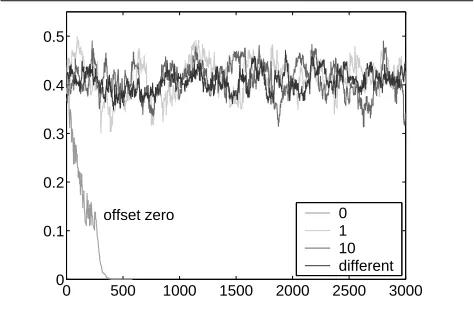
(pseudo-random) sequence and for completely different input-sequences. Fig. 2 depicts, that the distance between two
par-0 500 1000 1500 2000 2500 3000 0
0.1 0.2 0.3 0.4 0.5
0 1 10 different offset zero
Figure 2. Distance vs. the number of
iterations for different offsets in the inputs.
ties that do not possess the same inputs remains fluctuating and never decreases towards zero. We also investigated dif-ferent offsets with the same qualitative outcome. Two par-ties with completely different inputs (although not realis-tic given a concrete and publicly known Linear Feedback Shift Registers (LFSR) as pseudo random number genera-tor) show the same qualitative behavior. Two parties having the same inputs (offset zero) soon decrease their distance and synchronize.
The random walks with reflecting boundaries performed by the weights in the iterative process now make uncorre-lated moves and moves in the wrong direction. Two cor-responding components &
')(
S and&p ')(
different random component4 ')(
of their (differing)
in-put vectors (cf. Eq. 1). The distance between the compo-nents is thus no longer successively reduced to zero after each bounding operation and the two parties diverge.
The non-synchronization in the case of no common in-puts, therefore enables us to incorporate authentication by keeping the common (pseudo-random) inputs 41
se-cret between the two parties in addition to their individual secret (random) initial weights& 5SXB. There arel
!
possible common inputs as second initial secrets, which is a large enough practical amount for the parameters as chosen in [4] that makes brute force attacks computationally very expensive. Even more, a Man-In-The-Middle attack and the currently known attacks [7, 6] all using TPMs are averted on principal by this entity authentication, because it suppresses the necessary synchronization. It is important to note, that such a second secret in this symmetric principle does not represent any principal disadvantage, because a basic com-mon information is always also necessary in other authenti-cation protocols (cf. [9]) and is already necessary to avert a Man-In-The-Middle attack alone.
4. TPM Rekeying Architectures
With respect to a hardware implementation (see [15] for more details), note that only signs and bounded inte-gers are processed within the algorithm. The result of the outer product in Eq. 1 can be realized without multiplica-tion. The product within the sum is only changing the sign of the weight. Thus, the most complex structure to be im-plemented is an adder. The branches are only based on a test for the sign or a test on equality to zero, also easily done in hardware.
Furthermore, only sign-operations and additions are present in the learning rule (Eq. 2), well suited for a hard-ware implementation. The amount of registers needed for storage increases in the bit package variant, finally impos-ing a tradeoff area vs. speed. Equal (pseudo-)random inputs are realized by equally initialized LFSR or a Cyclic Re-dundancy Code (CRC). Different (secret) initial weights can either be fixed (device-specific), or they can be pro-vided by an additional application-specific device or by a thermal noise device. The synchronization criterion basi-cally comprises a counter.
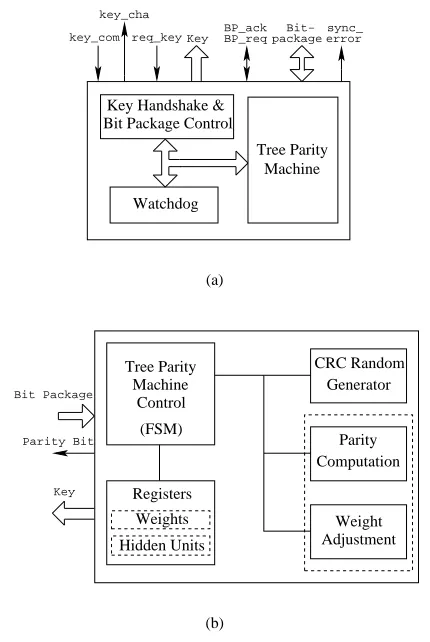
The Tree Parity Machine Rekeying Architectures (TPM-RAs) [15] are functionally separated into two main struc-tures. One structure essentially comprises the Key Hand-shake and Bit Package Control. The other structure contains the TPM Unit and its control state machine. As described in Section 2, we implemented the bit package generaliza-tion of the protocol (cf. [4]). The overall structure of the TPMRAs is shown in Fig. 3a. It consists of three functional blocks: a Key Handshake and Bit Package Control, the TPM
key_com key_cha
Key
req_key error
sync_ package
Bit− BP_req BP_ack
Bit Package Control Key Handshake &
Tree Parity Machine Watchdog
(a)
Key Parity Bit Bit Package
Weights Hidden Units
Registers Tree Parity
Machine Control (FSM)
Generator CRC Random
Parity Computation
Weight Adjustment
(b)
Figure 3. (a) Basic TPM Rekeying Architec-ture. (b) Internal structure of the TPM Unit.
unit and a Watchdog timer. The Watchdog timer supervises the number of interactions needed for a key-exchange be-tween two parties. If there is no synchronization within a specific time (remember that the synchronization time is distributed), a signal (sync error) indicates a synchro-nization error. It is programmable for variable average syn-chronization times subject to the chosen TPM structure.
(Bit Package). The bit package exchange process uses a simple request/acknowledge handshake protocol (BP ack, BP req).
The TPM unit comprises the logic for the TPM struc-ture, such as the logic for calculating the parity bits as ex-plained in Section 2. It consists of the TPM control, a CRC-generator, a Parity Computation unit and a Weight Adjust-ment unit. A register bank holds the data for the hidden unit and the weights of the network as shown in Fig. 3b. The TPM control is realized as simple finite state machine (FSM) which executes the initialization of the TPM and the learning process with the bit package from the other party. The Parity Computation unit calculates the summation and the parity bit (Eq. 1). The weight adjustment unit accom-plishes the learning rule (Eq. 2). The CRC random gener-ator generates the pseudo random bits for the inputs of the TPM. It is initialized by a vector which is equal for both par-ties. For the purpose of entity authentication, only the initial value would have to be kept secret.
5. Results and Evaluation
We employ parameterizable serial and semi-parallel TPM Rekeying Architectures as designed in [15]. In the serial architecture, the hidden-unit summation is per-formed by Time Devision Multiple Access (TDMA) of an
,
-bit adder, while the semi-parallel form uses TDMA of six
,
-bit adders in parallel. A standard cell ASIC pro-totype realization was build to verify the suitability of the TPMRA as IP-Core in devices with limited re-sources in the ubiquitous and pervasive computing set-ting. The underlying process was a
six-layer CMOS process with
supply voltage based on the UMC
li-brary.
The linear complexity of the protocol scales with the size
of the TPM structure, which defines the size i
,
of the key. We chose b , a maximal b and
,
b ,
leading to a key size of up to
bit. The details of the TPMRA implementations (key length, serial or semi/fully-parallel realization) must be chosen with respect to the tar-get environment, including the used parameters, the timing, the available channel capacity and the available chip-area, of course. As already investigated in [15], the area (Fig. 4a) of the TPMRA realizations scales approximately linear due to the linear complexity of the adders and ranges around one square-millimeter for the investigated key sizes. Note, that most of the area is consumed by the bit packaging, be-cause of the necessary storage of the inputs for the adaption (see Section 4).
Here we additionally established the throughput (i.e. keys per second) for the serial TPMRA subject to the av-erage synchronization time of 400 iterations in Fig. 4b. Four real communication channels and their bandwidths
0.4 0.6 0.8 1 1.2 1.4 1.6
84 156 228 300 588
0.43 0.54
0.67 0.81
1.45
0.49 0.65
0.82 0.98
1.66 Semi-parallel TPMRA
0.4 0.6 0.8 1 1.2 1.4 1.6
84 156 228 300 588
0.43 0.54
0.67 0.81
1.45
0.49 0.65
0.82 0.98
1.66 Semi-parallel TPMRA
Serial TPMRA
(a) Chip-area[ ] vs. key length[]
100 1000 10000 100000
84 156 228 300 588
127 126 126NFC, 106 kbps126 125 292
Bluetooth, 723 kbps
292 291 290 290
WLAN, 54000 kbps 6879 6263 5925 5501
4350 PCI, 1056000 kbps
(32 bit burst mode) 42551
26558 21742
16863
9281
(b) Average key exchange rate[ ] vs. key length[]
Figure 4. Post-synthesis results for chip-area (logic) vs. key length (a) and (b) average key exchange rate vs. key length.
Thus, the slope of the WLAN throughput characteristic is significantly higher than for Bluetooth and NFC. As ex-pected, the influence of the channel bandwidth significantly determines the performance of the key exchange protocol. Obviously, the bottleneck is the underlying communication-bus. Given a high-speed communication channel, the pro-posed key exchange and rekeying in the
-range allows us to use rather weak encryption algorithms (cf. Section 3), as the security may rely on fast rekeying and the short key lifetimes. Of course, sophisticated encryption algorithms like AES or 3-DES can also be used.
6. Summary and Outlook
In the context of ubiquitous and pervasive computing and its special restrictions we promote the discussion of alterna-tive security solutions. A method for authenticated symmet-ric key exchange for devices with severely limited resources based on Tree Parity Machine Rekeying Architectures [15] was suggested.
The silicon area of the used architectures lie within a square-millimeter and allow to exchange keys of practical sizes within milliseconds. The proposed exchange also al-lows for efficient rekeying schemes and short key lifetimes. The authenticated exchange of one 588 bit key on aver-age demands to transmit 400 bit in 13 Bit Packaver-ages of 32 bit each. An implementation in general embedded systems can be done with only small overhead. Thus we suggest it as an IP-core for (wireless) computing devices of lim-ited resources and even more in moderate security scenar-ios. The currently known attacks are successful only with a certain probability and all refer to a non-authenticated key exchange. The proposed entity authentication defeats these attacks on principle.
A future fully serial realization of the architecture will use TDMA of a single hidden unit. This further decreases the silicon area consumption but at the cost of an increase in necessary cycles for one output bit. This is a favorable de-sign given low-bandwidth communication channels. Secure group communication in a broadcast or multicast and thus key exchange between multiple parties is also possible us-ing several strategies currently under investigation. An ef-ficient authentication and key management is needed here, due to frequent key exchanges on join or leave actions. The integration into concrete devices and its practical evaluation is also subject to future work.
References
[1] R. Anderson. Protecting embedded systems – the next ten years (invited talk). In Proc. of the 3rd International
Workshop on Cryptographic Hardware and Embedded Sys-tems, CHES 2001, volume 2162 of LNCS, pages 1–2, Paris,
France, May 14-16, 2001. Springer Verlag.
[2] T. E. Gamal. A public key cryptosystem and a signature scheme based on discrete logarithms. IEEE Transactions on
Information Theory, IT-31(4):469–472, 1985.
[3] I. Kanter and W. Kinzel. Neural cryptography. In Proc. of
the 9th International Conference on Neural Information Pro-cessing, Singapore, Nov. 2002.
[4] I. Kanter, W. Kinzel, and E. Kanter. Secure exchange of information by synchronization of neural networks.
Euro-physics Letters, 57(1):141–147, 2002.
[5] I. Kanter, W. Kinzel, L. Shacham, E. Klein, and R. Mislo-vaty. Cooperrating attackers in neural cryptography. Phys
Rev. E, 69(066137), 2004.
[6] E. Klein, R. Mislovaty, I. Kanter, A. Ruttor, and W. Kinzel. Synchronization of neural networks by mutual learning and its application to cryptography. In Proc. of Neural
Informa-tion Processing Systems 2004 (NIPS 2004), Whistler, British
Columbia, Canada, Dec. 14-16 2004.
[7] A. Klimov, A. Mityagin, and A. Shamir. Analysis of neu-ral cryptography. In Proc. of AsiaCrypt 2002, volume 2501 of LNCS, pages 288–298, Queenstown, New Zealand, De-cember 1-5 2002. Springer Verlag.
[8] U. Maurer. Secret key agreement by public discussion. IEEE
Transactions on Information Theory, 39(3):733–742, 1993.
[9] A. J. Menezes, P. C. van Oorschot, and S. A. Vanstone.
Handbook of Applied Cryptography. CRC Press, 5th
edi-tion, 2001.
[10] R. Mislovaty, Y. Perchenok, I. Kanter, and W. Kinzel. Secure key-exchange protocol with an absence of injective func-tions. Phys. Rev. E, 66(066102), 2002.
[11] J. Pelzl, T. Wollinger, and C. Paar. Low cost security: Ex-plicit formulae for genus-4 hyperelliptic curves. In 10th
Annual Workshop on Selected Areas in Cryptography (SAC 2003). Springer Verlag, 2003.
[12] R. Rivest, A. Shamir, and L. Adleman. A method for obtain-ing digital signatures and public key cryptosystems.
Com-munications of the ACM, 21(2):120–126, feb 1978.
[13] M. Rosen-Zvi, E. Klein, I. Kanter, and W. Kinzel. Mutual learning in a tree parity machine and its application to cryp-tography. Phys. Rev. E., 66(066135), 2002.
[14] F. Stajano. Security in pervasive computing. In Proc. of the
1st International Conference on Security in Pervasive Com-puting (SPC 2003), volume 2802 of LNCS, page 1. Springer
Verlag, 2003.
[15] M. Volkmer and S. Wallner. Tree parity machine rekeying architectures. IEEE Transactions on Computers, 54(4):421– 427, Apr. 2005.
[16] T. Wollinger, J. Guajardo, and C. Paar. Cryptography in embedded systems: An overview. In Proc. of the
Embed-ded World 2003 Exhibition and Conference, pages 735–744,