ASSORTATIVE MATING BASED ON PHENOTYPE: 11.
TWO AUTOSOMAL ALLELES WITHOUT DOMINANCE SAMUEL KARLIN AND FRANCESCO M. SCUDO*
Department of Mathematics, Stanford University, Stanford, California and
Department of Genetics, Stanford University
N the preceding paper ( SCUDO and KARLIN 1969), several one-locus models for
I
assortment based on the phenotypes with complete dominance were analyzed. Complete dominance is common for assortment on traits like color and pattern. Some cases are known, however, where some mating choice is based on chromatic traits determined by a single locus with other forms of interaction (SHEPPARD1952). Assortment is also known to occur for other morphological and behavioral traits. The genetics of such traits is, however, not well developed up to the present time.
This paper will be mainly concerned with assortment based on a pair of alleles where the heterozygote can be distinguished from both homozygotes. As in the first paper, we delimit a model by specifying the effects of a tendency to assort on the individual reproductive behavior and the fertility. We further restrict OUT consideration to the Gase in which the preference is manifested only in one sex. In most cases it does not matter which sex assorts but, for definiteness (reflecting the most common case in nature), the female is stipulated to be the assorting sex. Paralleling the development of the preceding paper, we shall be mainly inter- ested in the direct evolutionary effects of assortment; the production of gene substitutions or the maintenance of partial genetic isolation between two p p u l a - tions. In contrast to the case of dominance, assortment for autosomal traits with- out dominance can also produce stable polymorphisms.
Formulation of the Models
We consider first a particula case in which the heterozygote behaves differ- ently from both homozygotes. To account for assortment in a general formulation would involve six parameters. Corresponding to each genotype it would be necessary to prescribe the fractions of individuals who refuse to mate with the other two genotypes.
Instead of examining the model in its most general form we assume that individuals assort only on the basis of the genotype being different. In other words, assorting individuals would just prefer a pa’artner of their own genotype. The propensity for assortment for the three genotypes, AA, AA’ and A’A’ is described by the parameters CY,
p
and y, respectively: That is, a fraction OL of the females of genotypeA A
“tend to” mate with their own kind while the complementary* Fellow of the International Laboratory of Genetics and Biophysics, Pavia Section, Pavia, Italy.
500 S. K A R L I N A N D F. M. S C U D 0
fraction mates at random. Similarly for
p
and y . The frequencies ob the genotypes in therzth
generation will be denoted byX,,
Y , and Z,, respectively, and gen- erally byX,
Y,
and 2.As in the preceding paper, our models attempt to take into account factors like the availability of proper mates, the timing of mating, the relative contributions of the assorting and nonassorting individuals to the next generation, the chance of encounter, and the ability of males to fertilize different numbers of females. The first two models apply to animals forming permanent bonds whose popu- lations have a n effective 1 : 1 sex ratio. If assorting occurs first and laaer all remain- ing females (with frequencies (I-a)
X,
(1-p)
Y
and (1-y) Z of the AA, AA' and A'A' kinds, respectively) pair at random, we obtain the frequencies of mating types and recursion relations as given in Table 1. Analogously to 'the case of dominance, two contrasting assumptions can be made concerning the relative fertilities of the assorting and the random-mating females. The first, (Case l ) ,introduced earlier by O'DONALD ( 1960), assumes that there is no impairment of fertility in assorting versus random-mating individuals. For the second, we assume that the delay in mating reduces the average relative fertility of the random mat- ing females to
R*
= 1 - a x -pY
-
yZ (Case 2 ) .An alternative model to account for the effects of die timing postulates that females practicing random mating pair earlier than the assorting females. Con- sequently, the following fractions of male and female individuals are available for assortative pair bonding:
genotypes available males assorting females
AA
X(aX
+
pY
+
y Z )iYX
AA'
Y
( a x+
J3Y+
y Z ) PYA'A' Z ( a X
+
pY
+
y Z ) Y ZTABLE 1
Population array and recursion formulae in the case of permanent pairs and 1:1 sex ratio. Assorting occurs prior to random mating
Frequencies
Mating types Assorting Random mating
A A X A A CUX [ (1 -4 XI 2 / R
A A x A A ' 2(1--(U)X. (I--p)Y/R
AA x A'A' 2(1--0l)X. (I-Y)Z/R
AA'xAA' BY ((1--PI Y)Z/R
AA' x A'A' 2 (1 --p) Y . (1 -Y) Z/R
A'A' x A'A' YZ [ (1 -Y) ZI 2 / R Recursion relations connecting genotype frequencies in successive generations.
NX' = CUX
+
NY'= % P Y + ~ [ ( ~ - c u ) X + '/z (1--P)Yl [(l-Y)z+ ?h (1--P)YI/R NZ' = YZ 4- % PY
+
[(l-Y)Z4-
'/e (1-P)YI2/RpY
+
[ ( I - - c K ) X+
'/z (I-~)Y]*/R (1.1) (1.2) (1.3) whereCase I : no difference in fertility
Case 2: the average fertility of random mating females reduces to R*, R = R * ; N = l ( R * = 1 -
cux
- pY - YZ).ASSORTATIVE M A T I N G WITHOUT D O M I N A N C E 501
TABLE 2
As in Table 1 but assortment occurs after random mating
For simplicity the symmetrical case a = y is considered. When a = y
>
p, and proper partners are available only to the fraction f = a ( I-Y)+
p Y of the assorting AA and AA’ females.The remaining ones do not contribute to the following generation.
Frequencies
Mating type Random mating Assorting
AA x AA (1 -a) x2
AA x AA‘ (2-a+) XY
AA x A’A’ ( I - a ) 2XY
A A X M ( 1 - 4 ) y 2
M X A A (2-a--p) ZY
A A ’
x
AA‘ (I-a) 2 2f = a(1-Y)
,+
p YN = 1
-
(a-+) Y (I-Y)( :)
y ( 2’;)
(2.1) Y4
N x ’ = x f + - p + ( l - a ) x
x+-
+(I+)-x+-
Y
4
N Z ‘ = Z f + - / 3 + (1-a) 2
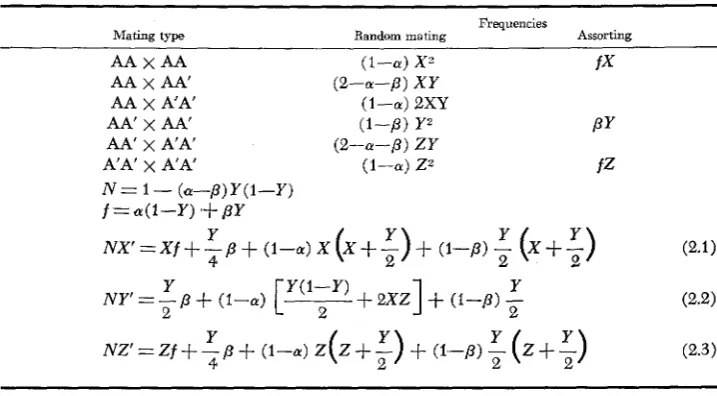
Assorting continues until all possible pairs of phenotypically alike individuals are formed while those remaining do not contribute to the next generation. All the AA I a s s d n g females will be fertilized if and only if aX
I
X ( d + p Y + y Z ) or equivalently a 5 ( p Y + y Z ) / ( Y + Z ) ; corresponding relations apply for the other two genotypes.We &all confine attention to the simpler symmetrical case in which ~r = y . We
find that if a = y
>
B
all AA’ assorting females can pair while proper male partners will be available only to a fraction f = a(1-Y)+
pY of the assortingAA and A’A’ females. The remaining
( N - P )
Y (1- - Y ) females will not contribute to the next generation. Verification of the entries of Table 2 should now be clear. In the case a = y<
,B analogous pationale and justifications lead to the quantities and recursion relations connecting genotype frequencies displayed in Table 3 .Table
4
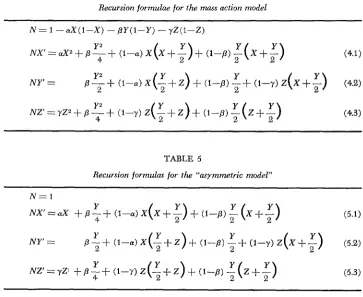
gives the relevant formulae for the “mass action” case, which accounts for the “opportunity of encounter” in a scattered population. The chance of a given type of mating is assumed to be proportional to the product of the densities of the two kinds of individuals which can perform the mating. In this model, as in the next one, no effect of assoment on the timing of mating has been explicitly considered.Finally we may account for some excess of males by the ‘‘asymmetric model’’ (Table 5 ) , which assumes that the tendency to assort does not appreciably reduce the average fertility of females. The limitations implicit in this model have been
5 02 S. KARLIN A N D F. M. SCUD0 TABLE 3
As in Table 2, but for a = y
<
/3In this case f = a ( 1-Y)
'+
PY is the fraction of heterozygous assorting females for which a proper partner is availableFrequencies
Assorting
Mating type Random mating
-
A A X A A (I-a) x2
ax
A A X A A ' (1-a)XY
+
(1--p) XYAA
x
A'A (1-a) 2 x zAA'
x
A A (1--PI y 2 f YAA'
x
A'A (I-a) ZY+
( 1 - p ) ZYA'A
x
AA' (I-a) 2 2 aZN = 1
-
(P-a) Y ( 1 - Y ) where f = ~ ( 1 - Y )+
p YY 4
NX'=cuX+f-+(I--a)X (3.1)
Y Y Y
Y 4
NY'= f,+ (1-01)
[%
(l--Y)+L!XZ]+ (1-8)-
2 (3.2)(3.3) N Z ' = a Z + f - +
TABLE 4
Recursion formulae for the mass action model
N = l -aX(l--X) -PpY(l-Y) - y Z ( I - Z )
TABLE 5
Recursion formulas for the "asymmetric model"
N = l
Y Y Y
(5.1)
Y Y
NY' = P,+ ( l - - a ) X ( ; + Z ) + ( 1 - - p ) - + ( l - y ) Z 2
N Z ' = Y Z : +P,+ ( l - Y ) Z
+
( l - p ) - ( z + - ) Y Y2 2 (5.3)
ASSORTATIVE MATING WITHOUT DOMINANCE 503 RESULTS
I.
Model
of TableI:
In the first model, where no reduction in fertility occurs among the random-mating females (Case 1 in Table1)
it is easily verified that the gene frequency, pn = 1-
qn =Xi
+
Y,J2 = X ,+
Y0/2 = p is invariant over time. Using this fact, the analysis of the system (1.1) to (1.3) reduces to the study of the single recursion relationLet Y , = g(,) ( Y ) where g(,) (.) is the nth iterate of g ( )
.
It can be proved, that Yn converges at a geometric rate to the unique root in ( O J ) ,p,
of the quadratic equation g(Y )
-
Y = 0. ObviouslyP
generates a family of equilibria depending on the initial gene frequency, po.When an appropriate reduction in fertility is assumed for the mndom-mating females (Case 2 ) gene frequencies are no longer invariant ovev time. At first we restrict om discussion to the special clase (Y =y. Symmetry considerations suggest that the quantity
X
-
Z is the molst convenient for analysis; its recursion rela-iton is
1
-(I-.)
(I--R*) 1-
R* (I-R*)X’
-
2’ =( X - 2 )
whereR* = I -aX-/3Y-yz (1.5)It follows that the magnitude of these differences decreases when a
<
p;
andincreases if (Y
>
8.
It is easy to verify that the recursion relations connecting genotype frequencies admit a single polymorphic equilibrium
where is the unique root in (0,l) of the equation
((Y-/3)”3+
(a-p>
(1 -,a+;>5
Y’
The global stability properties of the system (1 .I )-( 1.3) (Case 2 ) , can be ascer- tained with the following results:
i) When a
<
/3
for any nontrivial initial values,X,,
Yo and 2 0 , the genotypefrequencies at the nth generation, X,, Y , and 2, converge as n
+
00 to the stablepolymorphic equilibrium (1.6) at a geometric rate.
504 S. KARLIN A N D F. M. SCUD0
n
+
CO,
at a geometric rate; when X ,>
2, convergence occurs to the pure A statealso at a geometric rate. Thus the boundary between the domains of attraction of the two trivial solutions is the straight line X = 2. Starting from a point on this
line, X , = Z,, convergence takes place to the unstable polymorphic equilibrium (1.6).
iii) When a 2 ~ 3 =y, 2, - XI = 2, - X , = C so that 2, -
X ,
is invariant over time; the associated family of equilibria is completely determined by a and C.The complete time-dependent behavior can be worked out in terms of a single recursion.
A complete analysis in the general case is not feasible; however the local stabil- ity structure of the trivial equilibria probably reflects an accurate qualitative picture of the global properties of the system (1.1 )
-
(1.3),
(Case 2). It turns out that the pure A state ( X = 1, Y = 2 = 0) is stable if(1 -a(l--cu)}2- (1 -a(l-a)} { y + - +
P
(l-a:)(l-J3)}2
(1.8) When a! = y a limle algebra reveals that this inequality is equivalent to a
>
p ,
as it should be. Similarly, the pure A’ state will be locally stable if+++y(l-a)(l-J3)
--
P
(1-4 (1-y)> o
2J3
(1 - Y ( l - Y ~ } ‘ - (1 -Y(l-Y)}
{-cu+T
(1-y) (1-8))(1.9)
.rp
P
+ T + a ( l - y )
(1-8)
--
2 (1-a)(l-y)> o
Thus the following stability situations can occur in the general case:i)
If
both (1 .8) and (1.9) ‘are strictly satisfied an interior unstable polymorph- ism exists and either A or A’ will be fixed according to the initial frequencies. ii) If the reverse of both inequalities ( 1 .8) and (1.9) is strictly satisfied, then for any nontrivial initial frequencies convergence will take place to a stable poly- morphic solution.iii) If (1.8) is strictly satisfied and the opposite inequality of (1.9) holds, then no interior polymorphism exists and for any nontrivial initial set of frequencies convergence towards fixation of A will take place.
iv) If the opposite of (1 .8) is strictly satisfied and (1.9) holds, then no interior equilibrium exists and only the pure A’ ‘state is stable.
11. Model of Tables 2 and 3: Consider now the model for permanent bonding, when nonassorting females mate first. Two situations need to be distinguished according to whether the number of AA’ assorting females exceeds the desired number of available males or vice versa. In the latter case (a: = y
<
8,
Table 3 ),
manipulation of the recursion relations yields
8-ff
y1
--
2 X’-
2’ = ( X - 2 )ASSORTATIVE M A T I N G W I T H O U T D O M I N A N C E 505
which implies that
X - 2
is strictly increasing in magnitude if and only ifY
<
x.
But
Y Y Y
y {a+(p-a)Y}
+
( 1 7 % ) {F ( I - Y )+
2x21+
( I - P )
and therefore, since 4x2 5 (1 -Y) 2, we have
Y
I-Y Y2 2
Y' 5 1 - ( p a ) Y ( l - Y )
=
f ( Y )-jj { a + ( p a ) Y }
+
(I-a)-+
(1-p)-
for all Y in ( 0 , l ) . In this interval, f ( Y ) is monotonically increasing. I t follows that the frequency of heterozygotes after n generations, Y,, satisfies
Y , 5 f ( , ) (Yo)
From the general t h e o r y of iteration of functions it oan be inferred that f ( l z ) ( Y ) converges, as n
+
ca,
to the unique solutionI:
in (0, I of .the equation(2.6)
( p a ) Y 3 - - 3 (&?-a) Y 2 f ( 1 - a + q
Y
- T = o
1-a2 2
Direct examination of this equation verifies that
P
<
1/2;
therefore, for n suffi- ciently large we will haveY ,
<
1/2
which implies that ultimately IX, - Z,J will be continualIy increasing.Thus for a = y
<
p
fixations are the only stable equilibria and the domains of attraction of the trivial equilibria are separated by the straight line X = 2. More precisely,i)
IfX,>Z,ihenX,+
l,Y,+
O'andZ,+ O a s n + ca;ifX,>Z,thenX,+
O,Y,+ OandZ,+ I a s n - a;The approach of Y , to 0 is geometrically fast at the rate 1
-
p/2; convergence of X , and 2, to their limits occurs at a faster rate.5)
IfX ,
= 2, then Y,+4
andX ,
= 2,-+
( 1 - k ) / 2 at the geometric rateIn the case a = 7
>
(Table 2 ) the analysis is analogous to that of the modeli)
i r h
I.
associated with Table 3 ; the conclusions are as follows:
If
X,
>
2, thenX,
+
1, Y ,+
0 and 2, -+ 0 as n 9 00 ; i f X , > Z , ~ e n X , + O , Y , + O a n d Z , - + I a s n - c a ; convergence of Y , being geometrically fast at %he rate 1-
a/2.solution in ( 0 , l ) of theequation
ii) If X , = 2, then Y ,
+
?*,
X , = 2,-+
(1-?*)/2 where?*
i s the uniqueI-a 2
(a-&?) Y 3 - (.-/I) YZ+ (1-+) Y - - - - 0
506 S. KARLIN A N D F. M. S C U D 0
Thus, in contrast to the first model, the present model yields the same qualitative result as in the case of partial assortative mating for dominant traits: a n unstable polymorphism exists independently of the relative magnitude of a = y f
8.
A
local analysis for the stability of the nontrivial solutions in the general case a f y leads to inequalities on the parameters which determine the existence of the unique unstable polymorphism.
For ease of exposition in the mass action model of Table 4, we restrict ourselves to the special case =y. W e find the unique interior equilibrium
(4.4)
where
?
can be computed as the unique solution in (0,l) of the equation (2@+a) Y3 - 3PYZ+
(Pf2-2a)Y - ( 1 7 ) = 0 (4.5)It can be shown that, regardless of the comparative magnitudes of a and
p ,
theequilibrium (4.4) is always locally unstable. If X , > Z,, fixation of the pure A
state takes place at a geometric rate; if X ,
<
2, convergence toA'
occurs at a geometric rate.The analysis of the asymmetric model in Table 5 can be carried out in the general case. There results at most one nontrivial equilibrium, given by
A ( L f y - a ) ( y - P ) (2--a+) A (LSy-CL) ( L f a - y ) (2-a-y)
X =
,
Y =L ( L ( 4 - a - y ) - ( y - a ) Z } L { L (4-a-y )-(I-")
zl
A (L+a-y)
(a-8)
(2-Y-P)Z =
L ( L ( 4 - a - y ) - ( y - a ) Z } (5.4) where
L = (1-a) ( Y - P )
+
(1-u)(.-PI
( 5 . 5 )( L S y - a ) ( L f a - y )
>
0 ( 5 . 6 ) The point ( 5 . 4 ) is an admissible set of frequencies if and only ifThe stability behavior of the system can be summarized as follows: i) The pure A state is locally stable if and only if
L f a - y
>
0.L f y - a
>
0.ii) The pure A' state is locally stable if and only if
iii) The polymorphic equilibrium is valid if (5.6) is satisfied and is stable if and only i f
L f y - a
<
0 and L f a - y<
0,
convergence taking place at a geometric rate; it is unstable if these inequalities are strictly reversed.
Some particularizations of this model are w o l d mentioning:
ASSORTATIVE M A T I N G W I T H O U T D O M I N A N C E 507
follows that fixation of A is the only stable condition; if y
>
,8>
a, then there is fixation in A’.ii)
In
the symmetric case a = y< B
the interior equilibrium simplifies toX = 2 = 1/2 (2--a), Y = ( 1 -a)
/
( 2-a) which is independent ofIp
and globally stable, convergence taking place again at a geometric rate.iii) Whencu=y > ~ t h e e q u i l i b r i m k = k = 1/2(2--(u),
P =
(1-a)/(2-a)is unstable and the domains of ‘amaction of the fixations are separated by the straight line
X
= 2.VARIOUS E X T E N S I O N S
As mentioned before the general case of assortment without complete domi- nance could be specified by 6 parameters and then the analysis becomes exceed- ingly cumbersome. Other meaningful specifications in terms of three parameters are possible. One such is obtained by assuming “sex symmetry” in the choice as in the following table:
9 9 AA AA‘ A’A‘
8 8
AA 1 1-8 1 -E
AA’ 1-8 1 1-7
A‘A‘ 1 - E 1-7 1
where, as usual, 0 5 8
<
1, 0 5 E<
1, 0 5 7<
1. Plainly stated, AA’ females “dislike” AA males as much as AA females dislike AA’ males, and this is meas- ured by a fraction 6 of females tending to avoid such matings.The relevant formulae for the mass action model are given in Table 7. Com- parison with Table 4 shows that the two systems differ only in the definition of the parameters. Thus 6 is converted into 4 by the substitution
2 6 = a + P , 2 ~ = a + y and 2 7 = @ + y .
We shall now formulate another class of models applying to animal populations in which &e duration of courtship is sufficiently long and Where &e begmning of courtship is well synchronized.
As a rough representation of such mating systems we can a s s m e that a first round of “encounters” occurs simultaneously and at random. Then a fraction of females will tenninate the courts1Kip with males olf different phenotype at some stage before copulation. (A similar situation has been observed in some gulls
(GRIFFITH SMITS 1967) .) With the gene interaction intraduced above, this will occur for a proportion of X (6Y
4-
E Z ) AA females,Y
( 8 X+
7 2 ) AA’ females andZ (
E X
4-
7 Y ) A’A’ females. A class of models arises by miaking assumptions on thetypes of mating and the average fertility of such females.
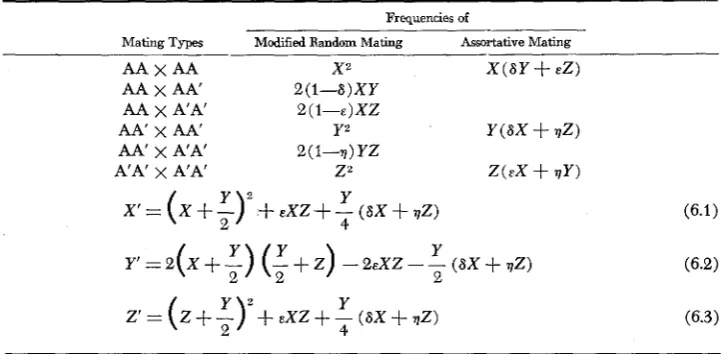
Assuming, for instance, that the ”mining females will be fertilized by males of the same genotype, with no loss in fertility, we derive the entries in Table 6.
508 S . KARLIN A N D F. M. SCUD0
TABLE 6
Model for a population in which part of the pairs, formed at random, break of7 before copulation Asymmetric Case
Frequencies of
Mating Types Modified Random Mating Assortative Mating
A A x A A X 2 X ( 8 Y
+
EZ)A A X A A 2(1--6)XY
A A X A A 2 ( 1 - € ) X Z
A A ' X A A ' Y2 Y
(ax
+
AA' x A A ' 2 ( 1--11) Y Z
A'A' x AA' 2 2 Z(FX
+
SY)a = /? = y. Using &is relation the system d u c e s to a single recursion relation
(I-&) = u ( Y ) .
8 f q - 2 E 6 1-P
yf Y 2 -
{T
(1+C)+
+
(1%)-
E } Y+
___4 2
Iteration yields that Y , = U ( , ) ( Y o ) converges to the unique root in ( O , l ) ,
?,
ofthe equation u ( Y )
-
Y = 0. This root depends on the initial frequencies only through C, thereby generating a family of equilibria. Although gene frequencies are not invariant over time, the equilibria span a curve of neutral type. This case is thus of little evolutionary consequence.A simple alternative to the assumption that all assorting females mate with the preferred phenotype, with no loss in fertility, would be that they do nut contribute at ell to the next generation. This gives the "mass action" model in Table 7 which is formally the same as the mass action model of Table 4.
TABLE 7
Mass action model in the case of a generic "sex symmetrical" interaction
N X ' = ( x + ; ) 2 - S x Y
NY' = 2 ( X
+
f ) (f
+
z)
-zExz
-
S X Y - ,,YZ(7.1)
(7.2)
ASSORTATIVE M A T I N G WITHOUT DOMINANCE 509 DISCUSSION A N D CONCLUSIONS
In
this paper we deduced some of &e consequences of partial assomtive mating based on the phenotypes of a n autosomal pair where gene interactions other than complete dominance are involved. This case would entail, in the most general formulation, six parameters.A
simplified version with three parameters is ob- tained by assuming that the females (males) of a genotype equally dislike those of a different genotype. The analogs of the models previously studied for the case of dolminance have been examined. We underscore the principal conclusions with special emphasis on contrasting the results for the no dominance and domi- nance analogs of all the models.We
discuss first the two models for permanent bonding in animals having a1 :I sex ratio at miaturity. As in &e case of dominance, when individuals practic- ing assortment mate prior to those mating at random we obtain a neutral family of equilibria if the relative fertility of the random-mating females is not affected. However, if fertility is affected by the timing of matings the resulting ultimate changes of genotype frequencies do not exclusively produce one or the other fixation as in the case of dominance. In fact, if the intensity of assorting in the heterozygote is large enough compared to the tendency for assortment in both homozygotes, a stable polymorphism will result. When both homozygotes assort with the same intensity, the condition for polymorphic stability is simply that of a larger assortment intensity in the heterozygote. This result is analogous to overdominance in the case of natural selection.
Consider the second alternative for permanent bonding, i.e., assorting occurs after random mating and all “mismatched” females do not contribute to the next generation. Now the results are qualitatively much the same as for dominance; either one of the fixations is the only stable situation or Ian unstable polymorphism exists and both fixations are stable. Thus, timing is more crucial in the case of no dominance than i n that of dominance.
When assortment affects only the chance of encounter in a scattered population (mass action moldel) we get the same qualitative result as i n the case of domi- nance, i.e., always an unstable polymorphism. The asymmetric model, account- ing for some excess of males, has the same properties as the first case of permanent pairs; a stable polymorphism will result if the assorting intensity in heterozygotes is large enough compared to the assorting intensity in both homozygotes.
W e can conclude that, barring very unlikely circumstances (like exact equality of all assorting parameters, etc.) assorting for traits without dominance will pro- duce, as f o r dominant ones, some significant evolutionary effects. The type of POS- sible equilibria differs from the dominant case in that stable polymorphisms can be established.
A
further analogy of assortment with natural selection is that fixation (initial increase) of dorlninant alleles occurs at an algebraic rate, while in the absence of dominance a geometric rate is the rule.510 S. K A R L I N A N D F. M. S C U D 0
A new class of models arises by assuming that la first attempt at pairing, lasting for some time, occurs at random. A fraction of the females will reject partners of unlike phenotype at some later stages of courtship, prior to copulation. Specific models will h e n result by making assumptions on the type of mating and the f e d i t y of the remaining females. When they are applied to the “sex symmetric77 case they give a neutral solution in the asymmetric case.
We are indebted to Mr. M. FELDMAN for several constructive suggestions on the manuscript. We also owe a number of improvements in the manuscript to Dr. C. MATESSI and Mr. S. JAYAKAR, to Professors J. CROW and M. LERNER. Research was supported in part under Grant NIH 10462 and Contract N0014-67-A-0112-0015 at Stanford University, Stanford, California.
SUMMARY
The models of the preceding paper are examined in the context of assortment for an autosmal pair of genes without dominance. While the most general formula- tion would involve six parameters, two specifioations involving only three para- meters have been considered. In striking contrast to the case of dominance, for some circumstances of the parameters and depending on the meahanism of fertili- zation, stable polymorphisms can result even for autosomal traits. The effect of assortment in these cases is somewhat similar to that of overdominance in the case of natural selection.-Another class of models is studied where we assume that a first attempt to pair wcurs at r a n d m and then some of the pairing between indi- viduals of different phenotypes disassociates at a later stage prior to copulation.
LITERATURE CITED
GRIFFITH SMITS, N., 1967
@DONALD, P., 1960 Assortative mating in a population in which two alleles are segregating
SCUM, F. M. and S. KARLIN, 1969 Assortative mating based on phenotype: I. Two alleles with
SHEPPARD, P. M,. 1952 A note on non-random mating in the moth, Panazia dominula. Heredity Visual isolation in gulls. Sci. American 217: 94-105.
Heredity 15: 389-396.
dominance. Genetics 53: 479-498.