ERRORS IN THE ELIMINATION OF X CHROMOSOMES
IN
SCIARA OCELLARIS
LYRIA MORI AND A. L. P. PERONDINI
Departamenlo de Biologia, Uniuersidade de SE0 P a l o , C. P. 21462, SE0 Paulo, 05421, Brazil
Manuscript received June 28, 1979 Revised copy received November 7,1979
ABSTRACT
It was previously assumed that the X-linked recessive mutation, sepia, induced errors in X-chromosome elimination during early embryogenesis of
Sciam ocellaris. The results obtained in the present analysis corroborate this assumption and permit a further classification of the type of error this muta- tion induces. Among 85,244 individuals analyzed, three kinds of aberrant flies were identified: mosaics (0.01 %), gynandromorphs (0.42%) and pheno- typically exceptional individuals (0.25%). The origin of these abnormal flies could be ascribed to errors in selective elimination of X chromosomes that occur in male meiosis or during the early cleavages of the zygote nuclei. This last kind of error could be classified into three types: (a) error in number,
(b) error i n type, and (c) error in number and type of X chromosome elimi- nated. Evidence is provided indicating that sepia has no direct effect on the X chromosome; it has a maternal influence and exerts its effect only in the heterozygous condition.
HE genetic system of the sciarid flies is based on a complex mechanism of chromosome elimination operative at two stages of development: during early embryogenesis when the sex of the individual is specified, and during spermatogenesis when the chromosomes are selectively imprinted (reviews in METI. 1938; P.4VAN, DA CUNHA and SANDERS 1975; BROWN and CHANDRA 1977). The normal behavior of the chromosomes in Sciuru ocellaris is shown diagram- matically in Figure 1. The embryo starts its development with two sets of auto- somes and three X chromosomes, two of which are sister chromatids of paternal origin (METZ 1934). During the 5th to 9th divisions of the zygotic nuclei, one o r two paternal X chromosomes are eliminated in the somatic cells of embryos destined to be females and males, respectively (DUBOIS 1932; 1933). In the g e m cells of both sexes, only one paternal X chromosome is eliminated, and this process occurs later in the development of the embryo (DUBOIS 1933; BERRY
1941 j RIEFFEL and CROUSE 1966).
Some species of Sciaridae possess, besides the regular set of chromosomes, one o r more L chromosomes limited to the germ cells. They are eliminated from the somatic cells of the embryo before the X chromosomes (DUBOIS 1933). Other species, like S. ocelZaris, do not possess this type of chromosome (METZ and LAWRENCE 1938).
664
L. MORI A N D A. L. P. PERONDINI9
soma-
X- elimination in embryogenesis
FIGURE 1.-Diagram of normal chromosome history of Sciara ocellaris. In this and in the following figures, m and p denote the maternal and paternal origins of the chromosomes.
The first meiotic division in male gametogenesis is peculiar in the sense that the paternally derived genome is eliminated in a small bud of cytoplasm. In the second division, both
X
chromosome chromatids move precociously to one pole, followed by one chromatid of each autosome. This set of chromosomes will be included in the functional spermatid. The other autosomal chromatids are elimi- nated in the same bud of cytoplasm into which the paternally derived chromo- somes were eliminated in the first division (METZ, MOSES andHOPE
1926;BASILE
1970; AMABIS,REINACH
and ANDREWS 1979). Errors in these X-chromo- some elimination mechanisms seem to occur in several species of sciarid flies leading tc the production of gynandromorphs and phenotypically exceptional individuals (DUBOIS 1932; METZ and LAWRENCE 1938; METZ 1938; DAVIDHEISER 1943; CROUSE, BROWN and MUNFORD 1971).CHROMOSOME E L I M I N A T I O N IN SCIARA 665 MATERIALS A N D M E T H O D S
Description of the wild type and sepia strains of Sciara ocellaris used in the present study, as well as the methods of maintenance of the flies in the laboratory, are given in MORI, DESSEN and PERONDINI (1979).
For the present analysis, single-pair matings were made using flies either homozygous or heterozygous for the wild-type and sepia alleles.
Salivary gland polytene chromosomes from each of 50 wild-type and sepia homozygous and heterozygous females were prepared by the standard orcein-squash technique on late fourth- instar larva.
The genotype of the somatic tissues of the females will be designated by two symbols, the first of which indicates the X chromosome of maternal origin (Xm+, or +,X,, for example). For males, which have an X,O constitution in the soma, the X chromosome of paternal origin, which is present in the germ cells, but will be eliminated in the first meiotic division and, hence, will not be transmitted to the next generation, is indicated by brackets, Xm(Xp). The initial genotype of the embryos, before the elimination of
X
chromosomes has taken place, is indicated by three symbols: the first designates the maternally derived X chromosome and the other two the X chromosomes of paternal origin ( X m X , X p ) .The adult flies in the progeny of the single-pair matings were individually examined under the stereomicroscope for phenotypic mosaicism. Drawings were made for each observed mosaic fly, which permitted furthey analysis.
RESULTS
The number and type of matings, the number of individuals and frequencies of abnormals in the progenies, from the present analysis, are summarized in Table 1. The abnormal individuals found could be classified into three categories. The first included flies that exhibited an homogeneous phenotype, either sepia or wild type, but that were not expected to appear in a given cross according to
TABLE 1
Number of phenotypically abnormal individuals observed in the progenies of
several types of matings involving the gene sepia Progenies
Pair matings Abnormals
Type Female Male' N Zygotes Nt Mos. Gyn. dxcp.
1
+/+
2
+/+
3 . s / s 4 s
/+
5 +/s
6 +/s
7
+/+
8 s / s
66 181 50 88 80 8 110 100
+ s s
+ s s s
++
+++
s++
+++
s
++
+++
s
++
+++
s s s
8,266 20,399 7,651 6,860 5,705 5,832
60 68
541 15,739
8,160
5,485
0 14 1 4 s $
1 14 6 4 - 8
0 0 0
2 107 0
0 0 0
0 0 0
0 0 0
0 0 0
0 0 0
0 28 91s$,5s/s9
37 O 2s/so
* The X chromosome of paternal origin present in male's germ line cells, but which is not
t
N refers to the number of each kind of zygote and was infered from the analysis of the$ Mos. = mosaics; Gyn. = Gynandromorphs; Excp. = Exceptionals. transmitted to the next generation is indicated in parentheses.
666 L. MORI A N D A. L. P. P E R O N D I N I
the accepted gcnctic mechanism of the sciarid flies. These phenotypically excep- tional individuals appeared in several typcs of crosses (1, 2, 3 and 6) with a mean frequency of 0.25% (Table 1). This is probably an underestimate of the actual frequency of this kind of abnormality becaus?, if those flies had been produced in crosses involving heterozygous females (type 4 and 5 ) or in the crosses homogamic for wild-type and sepia flies (type 7 and 8), they would not have been distinguished from the normal flies produced in those progenies. The 11 8 phenotypically exceptional adults recovered. both males and females, were mated to wild-type flies derived from the stock, but not one progeny was obtained. The second and third categories comprise abnnrmal individuals in which the body shows a mixture of sepia and wild-type phenotypes. Taking into considera- tion the anatomical sexual differences (external genitalia and smaller wings in the male) and the color that these structures exhibit, the sex-chromosome con- stitution of the sepia and wild-type tissue could be ascertained. The abnormals could be classified as gynandromorph< and mosaics, which appeared. respec- tively, with mean frequencies of 0.42 and 0.01%. In the gyandromorphs, the sepia phenotype was associated with male structures ( X O ) and the wild-type phenotype with female tissues ( X X )
.
In the mosaics, the sepia and the wild-type phenotypes occured in structures with similar Sex-chromosome constitution. AS shown in Table 1, gynandromorphs were detected only among heterozygous flies. This can not be due to the eventual “homozygous gynandromorphs” escaping detection because of having homogeneous coloration. since the anatomi- cal differences in the genitalia and si7e of the wings, which were evaluated in all flies. would reveal their condition, at least in a number of cases.Among the 200 gynandromorphs detected among 47,383 heterozygous flies, 59 could be classified considering only the genitalia and wings. However. none was detccted among the 37,861 homozygous individuals. The significance of
these differences was estimated by the test of BROSS (in DIEM and LENTNER 1968) because we were dealing with very low frequencies. Since the test can not be applied when one has zero as an observed value. we took the number of gynandromorph among the homozygous zygotes as 1 instead of 0. In this way, the test underestimates the actual values. The calculated relative increase in frequency of gynandromorph was 46.14 and the lower and upper 99% confi- dence limits of this frequency were 5.01 and 7,988.62. Considering that these values are underestimates, the test showed that the observed differences in the appearance of gynandromorphs among the heterozygous and homozygous zygotes are highly significant, since the lower limit is greater than zero.
As can also be seen in Table 1, the heterozygous zygotes have a different “kind of cytoplasm” bccause they were produced by four type of parental females: s / + , +/s,
+/+
and s/s. The significance of the differences i n the frequency of abnormalities among these zygotes having different cytoplasm (or mother genotypes) is given in Table 2. These results can be expressed asCHROMOSOME ELIMINATION IN SCIARA 667
TABLE 2
Confidence limits and significance (test of Bross) of the relative increase in frequency of
abnormalities among heterozygous zygotes produced b y female parents hauing different genotypes
Pnimjse Re1 a t i ve incrense 99% Confidence limits
conipsnson in frequency (lower) (upper) Significance
e .
..
..
1.6866 0.7109 3.3405
1.9423 1.1446 3.1708
- 9 s / s 2.8894 1.1738 6.7794
9 +/s
-
9+/+
0.0958 -0.3254 0.7851 n.s.- 0 s / s 0.4485 -0.2912 2.0801 n.s. 9 + / + - 0 s / s 0.321 9 -0.2539 1.5856 n.s. 9 s / + - P +/s
-
9+/+
n.s. = These cases were nonsignificant a t the 5% level.
Cytological analysis of the polytene chromosomes of
+/+,
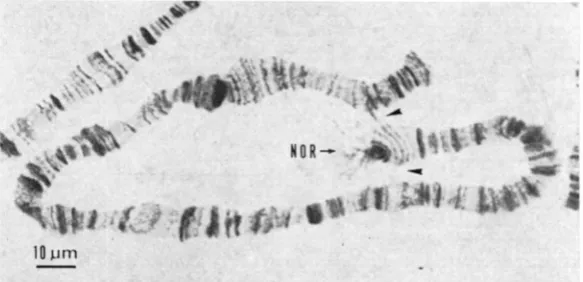
+/s and s/s female larvae showed that no differences in gross chromosome structure or in the single- band type of structural variation common in this species (METZ 1937; PAVAN and PERONDINI 1967; PERONDINI and DESSEN 1969) were detected in the X'
when compared to the X chromosome bearing the wild-type allele (Figure 2).DISCUSSION
Production of gynandromorphs and mosaics seems to be of general occurrence among animals, albeit at low frequency (STERN 1968, NESBITT and GARTLER 1971). When special genic or chromosomal mechnaisms are present, the fre- quency of mosaicism can be considerably higher (HALL, GELBART and KANKEL 1976).
Occurrence of abnormal individuals in the Sciaridae has been ascribed to
FIGURE 2 . S a l i v a r y gland polytene chromosomc of an heterozygous female larvae showing
668 L. MORI AND A. L. P. PERONDINI
deviations in the mechanism of chromosome elimination in early embryogenesis. This same interpretation is being applied in the present work. However, the present analysis permitted a further distinction in the type of error in the X- chromosome elimination mechanism, as will be discussed below.
Errors in male meiosis
This type of error was detected by the appearance of some exceptional indi- viduals in the progeny of heterozygous females crossed to wild-type males, but which have a paternal X chromosome bearing the sepia allele in the germ tissue (cross type 6 in Table 1). Since the male does not transmit the paternal set of chromosomes (METZ 1938), the progenies of these matings should be composed of wild-type females and sepia and wild-type males. Besides these expected indi- viduals, two homozygous sepia females were also found (0.1 7 % ) . This value is probably underestimated because other exceptionals might have been produced, but were phenotypically indistinguishable from the expected progenies of these crosses. The origin of these exceptional females can be explained by assuming that the paternal male transmitted his paternally derived
X
chromosome bearing the sepia allele instead of the maternally derivedX +
chromosome, as shown in Figure 3.CHROMOSOME ELIMINATION IN SCIARA 669
Elimination errors in emly embryogenesis
The occurrence of other exceptional individuals and gynandromorphs and mosaics can be explained by errors in the process of X-chromosome elimination that occurred during the early divisions of the zygotic nuclei. In this category, three classes of errors could be distinguished according to the number and type of
X
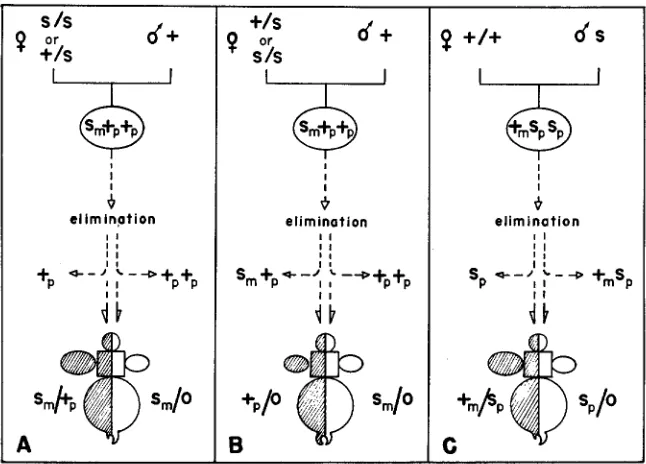
chromosomes that were eliminated.Quantitative errors: This type of error includes the gynandromorphs result- ing from the elimination of a single paternal X chromosome in some of the blasto- derm nuclei and of two paternal X chromosomes in the other nuclei. Elimination was correct in the sense that only paternally derived X chromosomes were elimi- nated. The errors are characterized only by the number of X chromosomes that were eliminated, resulting in a X O / X X mixture in the body (Figure 4A).
These numerical errors occurred in crosses of wild males with sepia females (type 3 cross), with a frequency of 0.25%, as well in matings of heterozygous females, with a mean frequency of 1.09%.
It
should be noted that the s/+ females produced a larger fraction of gynandromorphs (1.56%) than did the +/s females (0.63%), a fact that we had observed before(MORI,
DESSEN
and PERONDINI 1979).Qualitative errors: These errors led to the production of exceptionals. In type
d +
s
/s
9
a s
4
el i m inption
I 1 I , I 1 I 1
+P a - - ’ \ - + + + 1 1 P P
i i
d +
+/S
?
2 s
.;
sm+p*-’l :-“+p+p
d b
elimination I 1 I 1
1 1 I I
1 1
0
+/+
d S-+
I
6
e l i m i n a t i o n I 1
I 1
I i 1 1
sp
*-’
1 1 L - + +mspi
b
FIGURE 4.-Interpretative diagrams as to the origin of the gynandromorphs and mosaics
through errors in X-chromosome elimination in early embryogenesis. (A) corresponds to errors
in the number, (B) in the type, and (C) in number and type of X chromosomes that were eliminated. The gynandromorphs represented in (A) and (C) were drawn as the bilateral type although, in general, each side of the body was composed of a mixture of wild-type and sepia
6 70 L. MORI A N D A. L. P. P E R O N D I N I
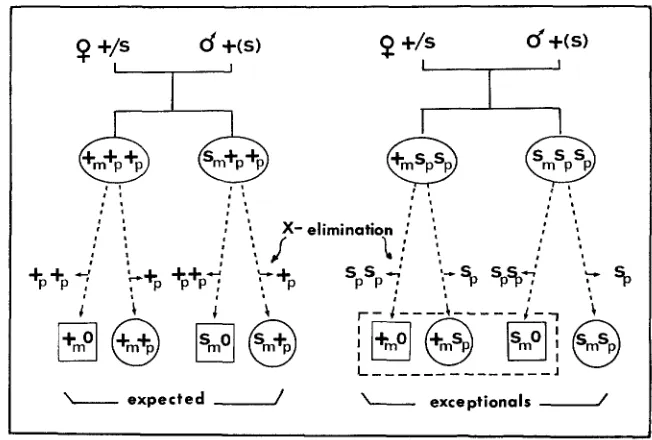
1 and 2 crosses (Table l ) , 0.37% of the males and 0.02% of the females ex- hibited the sepia phenotype, which was not expected in these crosses (Figure 5). In these exceptional flies, retention of the paternally derived X" chromosomes occurred although, in each individual (male or female), the number of X
chromosomes eliminated was correct. This same kind of error, i.e., retention of the paternal X chromosome, occurred in zygotes produced in type 3 crosses, where 0.1 1
% wild-type males were observed (Figure
5 ) .The wrong elimination of X chromosomes also produced phenotypic mosaics, distinguished from the gynandromorphs by the fact that they are composed of tissues having the same sex-chromosomal constitution. I n a given mosaic fly, the number of eliminated X chromosomes must have been the same in every nucleus of the embryo but, in some tissues, the paternal X chromosome was maintained instead of the maternal one (Figure 4B). These mosaics occurred with a frequency of 0.01%. Four of five mosaics produced in crosses type 3, 4
and
5
(Table 1) were diagnosed as male individuals through the analysis of the genitalia and the size of the wings. However. they were bilateral mosaics, one side being sepia and the other wild type, but with both sides having an X O con- stitution. The kind of mosaicism of the other individual could not be ascertained. Quantitatiue errors associated with qualitatiue errors: In this case, the errors in elimination produce gynandromorphs that are different from those describedA Cross type 1 a n d 2 : B: Cross type 3:
@
;
; ;'..
;' ; 5
'.
:
1 '\63
, I "
J
, I \
I f t
, I
I I 1 '
, , I '
I ' X- e I i mina t ion
correc,t , incorrect
\
,+rrec/ i n c k e c t1 '% \
$ *
+
P P , '+
-'+
P ; -1 \P Sm+pSpSP
7'
SP7'
r + m7
+mSpI \
i'
I
H &
& @
& &
&j
U U
expected except ionals expected except iona I
FIGURE 5.-Diagrams showing the origin of exceptional individuals through errors in X
chromosome elimination in early embryogenesis. The incorrect process refers to elimination of a maternally derived X in some embryos. It should be noted that, in this case, the wrong elimi- nation must have occurred i n every nucleus of the embryo. When the biased elimination occurs
CHROMOSOME ELIMINATION I N SCIARA 671 above by the fact that, i n the XO tissue, the paternally derived X chromosome was maintained (Figure 4C). These gynandromorphs were produced in crosses between wild-type homozygous females and sepia males (type 1 and 2 crosses) and occurred with a frequency of 0.15
%.
CONCLUSIONS
Although the cytological aspects of chromosome elimination in male meiosis and early embryonic mitotic divisions were not studied in the present work, the phenotypic expression of sepia in the off spring of different types of crosses pro- vided support for the interpretation that the abnormal individuals found in S.
ocellaris were produced by errors in the mechanisms of X- chromosome elimination.
According to
DAVIDHEISER
( 1943),
these errors are of normal occurrence i n sciarid flies; the mutant gene involved in the analysis simply makes evident the mistakes i n X-chromosome elimination. The results obtained by MORI, DESSEN and PERONDINI (1979), using the mutant sepia in Sciara ocdlaris, are a t vari- ance with this hypothesis. Evidence was provided indicating that sepia induced a high frequency of gynandromorphism. These initial observations are supported by the results of the present analysis, which shows an exclusive production of gynandromorphs by the heterozygous zygotes and indicates that the sepia allele is, indeed, related to errors in X-chromosome elimination in S. ocellaris. I t cannot be ascertained from the experiments described here whether sepia actually in- duces or enhances a phenomenon that occurs at a very low frequency i n these flies. The present results also add to the observation that sepia interferes not only with the process of chromosome elimination in early embryogenesis, but also with the related mechanism that occurs during male meiosis.The way sepia exerts its effects is still unknown. As we indicated before (MORI, DESSEN and PERONDINI 1979), this effect is not directly on the chromo- some because either the Xs or the X + chromosome was eliminated. The presence of sepia causes no change in the chromosome, as judged by the cytological analysis of polytene chromosomes, that could be responsible for its mode of action. Whatever this process may be, it has a marked effect through the cytoplasm of the egg, since the frequency of abnormals among the heterozygous zygotes is correlated to the genotype of the female parent, with homozygous females pro- ducing fewer abnormalities than heterozygous ones. These data suggest that sepia has some effect on the "imprinting" mechanism present in the egg cyto- plasm that regulates X-chromosome elimination i n early embryogenesis of sciarid flies (CROUSE 1960; CROUSE, BROWN and MUNFORD 1971). This putative impairment induced by sepia can, apparently, be rescued by a normal wild-type set of X chromosomes in the nucleus of the zygote, since no abnormalities were observed among the
+++
zygotes produced by heterozygous females. This is in line with the known facts that rescue of an altered or missing cytoplasmic factor is possible when the element acts during a developmental stage later than oogene- sis (see SCHNEIDERMAN 1976).6 72 L. MORI A N D A. L. P. P E R O N D I N I
when heterozygous or why the frequency of abnormalities is higher among the offspring of s/+ females than of +/s ones. The only apparent difference between these females is related to the origin o i the X s chromosome. In the former, the
X s
chromosome is female-derived, while in the latter it is paternally derived.This fact would suggest that the effect of sepia is higher when the
Xs
chromosome does not pass through male meiosis and, hence, does not receive an “imprint” that enables it to be properly recognized and eliminated in early embryogenesis (CROUSE 1960, 1966). Thus, it can be hypothesized that the effect of sepia can be enhanced by maternal selection of the X s chromosome, Experiments to test this hypothesis are currently under way.We thank C. PAVAN for critically reading the manuscript and FundacFio de Amparo B Pesquisa do Estado de S l o Paulo (74/0012) and Conselho Nacional de Desenvolvimento Cientifico e
Technol6gico (CNPq-PIG-SIP/CH-OOI) for financial support. W e also would like to thank FAPESP (Biol. 70/1422) and Empresa Brasileria de Pesquisa Agropecuiria for the fellowship given to the senior author.
LITERATURE CITED
AMABIS, J. M., F. REINACH and N. ANDREWS, 1979 Spermatogenesis in Trichosia pubescens
(Diptera: Sciaridae). J. Cell. Science 63: 199-213.
BASILE, R., 1970 Spermatogenesis in Rhynchosciara angelae Nonato and Pavan, 1951. Rev. Brasil. Biol. 30: 29-38.
BERRY, R. G., 1941 Chromosome behavior in the germ cells and development of the gonads in
Sciara ocellaris. J. Morphol. 68: 547-583.
BROWN, S. W. and H. S. CHANDRA, 1977 Chromosome imprinting and the differential regula- tion of homologous chromosomes. pp. 109-1 89. In: Cell Biology-Gemtics Mechanisms of
Cells, Vol. 1. Edited by G. LESTER and D. M. PRESCOTT. Academic Press, New York, London. CROUSE, H. V., 1960 The controlling element in sex chromosome behavior in Sciara. Genetics 45: 1a9-1443. --, 1966 An inducible change in state on the chromosomes of Sciara:
its effects on the genetic components of the X. Chromosoma (Berl.) 18: 230-253.
L-chromosome inheritance and the problem of chromosome “imprinting” in Sciara (Sciaridae, Diptera). Chromosoma (Berl.) 34:
324-339.
DAVIDHEJSER, B., 1943 Inheritance of the X chromosome in exceptional males of Sciara ocellaris
(Diptera). Genetics 28: 193-199.
DIEM, K. and C. LENTNER, 1968 Wissenschaftliche Tabellen. 7th Edition. J. R. Geigy S.A., Basel. DUBOIS, A. M., 1932 A contribution t o the embryology of Sciara (Diptera), J. Morphol. 54: 161-192. -, 1933 Chromosome behavior during cleavage i n the eggs of Sciara coprophila (Diptera) in the relation to the problem of sex determination. Z. Zellf. U. mickr. Anat. 19: 596-615.
Mosaic systems. pp. 2.65314. In: Genetics and Biology of Drosophila, Vol. la. Edited by E. NOVITSKI and M. ASHBURNER. Academic Press, London.
Evidence indicating that in Sciara the sperm regularly transmits two sister sex chromosomes. Proc. Natl. Acad. Sci. U.S. 20: 31-36.
-
, 1935 Structure of the salivary gland chromosomes in Sciara. J. Heredity 26: 176-188.-
, 1937 Small deficiencies and the problem of genetic units in the giant chromosomes. Genetics 22: 543- 556.-.
1938 Chromosome behavior, inheritance and sex determination i n Sciara.Amer. Nat. 72 : 485-520.
CROUSE, H. V., A. BROWN and B. C. MUNFORD, 1971
HALL, J. C., W. M. GELBART and D. R. KANKEL, 1976
CHROMOSOME E L I M I N A T I O N IN SCIARA 673
METZ, C. W. and E. G. LAWRENCE, 1938 Preliminary observations on Sciara hybrids. J. Heredity
ME=, C. W., M. MOSES and E. HOPE, 1926 Chromosome behavior and genetic behavior in
Sciara. I. Chromosome behavior in spermatocyte divisions. Z. ind. Abstammgs. Vererbsl.
MORI, L., E. M. D. DESSEN and A. L. P. PERONDINI, 1979 A gene that modifies the sex-ratio in a bisexual strain of Sciara ocellaris. Heredity 4 2 : 353-357.
NESBITT, M. N. and S. M. GARTLER, 1971 The applications of genetic mosaicism to develop- mental problems. Ann. Rev. Genetics 5: 143-161.
PAVAN, C., A. B. da CUNHA and P. SANDERS, 1975 Rhynchosciara. pp. 207-256. In: Handbook
of Genetics, Vol. 9. Edited by R. C. KING. Plenum Press, New York and London.
PAVAN, C. and A. L. P. PERONDINI, 1967 Heterozygous puffs and bands in Sciara ocellaris
Comstock (1 882). Exp. Cell Res. 48 : 202-206.
PERONDINI, A. L. P. and E. M. B. DESSEN, 1969 Heterozygous puffs in Sciara ocellaris. Genet- ics 61 (supl.): 251-260.
RIEFFEL, S. M. and H. V. CROUSE, 1966 The elimination and differentiation of chromosomes in the germ line of Sciara. Chromosoma (Berl.) 19 : 231-276.
SCHNEIDERMAN, H. A., 1976 New ways to probe pattern formation and determination in insects. pp. 3-34. In: Insect Development, 8th Symp. Royal Entomological Society. Edited by P. A. LAWRENCE. Blackwell Scient. Publ., London.
Genetic Mosaics and Other Essays. Harvard University Press, Cambridge, Mass.
Corresponding editor: S. WOLFF 29: 179-186.
42: 237-270.