An extended abstract of this paper appears in ISOC Network and Distributed System Security Symposium (NDSS), February 2006. This is the full version.
Key Regression: Enabling Efficient Key Distribution
for Secure Distributed Storage
Kevin Fu∗ Seny Kamara† Tadayoshi Kohno‡
November 30, 2005
Abstract
The Plutus file system introduced the notion ofkey rotation as a means to derive a sequence of temporally-related keys from the most recent key. In this paper we show that, despite natural intuition to the contrary, key rotation schemes cannot generically be used to key other crypto-graphic objects; in fact, keying an encryption scheme with the output of a key rotation scheme can yield a composite system that is insecure. To address these shortcomings, we introduce a new cryptographic object called a key regression scheme, and we propose three constructions that are provably secure under standard cryptographic assumptions. We implement key regres-sion in a secure file system and empirically show that key regresregres-sion can significantly reduce the bandwidth requirements of a content publisher under realistic workloads using lazy revoca-tion. Our experiments also serve as the first empirical evaluation of either a key rotation or key regression scheme.
Keywords: Key regression, key rotation, lazy revocation, key distribution, content distribution network, hash chain, security proofs.
∗Department of Computer Science, 140 Governors Drive, University of Massachusetts, Amherst, MA 01003-9264,
USA. E-Mail: [email protected]. URL:http://www.cs.umass.edu/~kevinfu/. Supported in part by Project Oxygen and an Intel Fellowship. This research was performed while at The Johns Hopkins University and MIT.
†Department of Computer Science, The Johns Hopkins University, 3400 N. Charles Street, Baltimore, MD
21218, USA. E-Mail: [email protected]. URL:http://www.cs.jhu.edu/~seny/. Supported by a Bell Labs Graduate Research Fellowship.
‡Department of Computer Science & Engineering, University of California at San Diego, 9500 Gilman Drive,
Contents
1 Introduction 3
1.1 Overview of contributions . . . 3
1.2 Related work . . . 5
2 Notation 6 3 Problems with key rotation 6 4 Key Regression 8 4.1 Syntax and correctness requirements . . . 9
4.2 Security goal . . . 10
5 Our preferred constructions 11 5.1 The KR-SHA1construction . . . 11
5.2 The KR-AESconstruction . . . 12
5.3 The KR-RSAconstruction . . . 12
5.4 Discussion . . . 13
6 Key regression from FSPRGs 13 6.1 Forward-secure pseudorandom generators . . . 14
6.2 An FSPRG-based key regression scheme . . . 14
7 Key regression from standard PRGs 17 7.1 FSPRGs from pseudorandom bit generators . . . 17
7.2 A PRG-based key regression scheme . . . 18
8 The security of KR-AES 19 9 The security of KR-SHA1 21 10 The security of KR-RSA 24 10.1 Security of KR-RSAunder oneKeyderO oracle query . . . 25
10.2 Security under one KeyderO oracle query implies security under many . . . 27
10.3 The security of KR-RSAunder multipleKeyderO oracle queries . . . 30
11 Performance of key regression in access-controlled content distribution 30 11.1 Hypothesis and methodology . . . 31
11.2 Microbenchmarks . . . 32
11.3 Secure content distribution on untrusted storage . . . 33
1
Introduction
Content distribution networks (CDNs) such as Akamai [3], BitTorrent [15], and Coral [21] enable content publishers with low-bandwidth connections to make single-writer, many-reader content available at high throughput. When a CDN is untrusted and the content publisher cannot rely on the network to enforce proper access control, the content publisher can achieve access control by encrypting the content and distributing the cryptographic keys to legitimate users [23, 26, 31, 33, 40, 43]. Under the lazy revocation model for access control [23, 33], following the eviction of a user from the set of members, the content publisher will encrypt future content with a new cryptographic key and will, upon request, distribute that new key to all remaining and future members. The content publisher does not immediately re-encrypt all pre-existing content since the evicted member could have already cached that content.
The content publisher can use the CDN to distribute the encrypted content, but without the aid of a trusted server, the content publisher must distribute all the cryptographic keys to mem-bers directly. To prevent the publisher’s connection from becoming a bottleneck, the Plutus file system [33] introduced a new cryptographic object called a key rotation scheme. Plutus uses the symmetric key Ki to encrypt content during the i-th time period, e.g., before the i-th eviction. If
a user becomes a member during thei-th time period, then Plutus gives that member thei-th key Ki. From [33], the critical properties of a key rotation scheme are that given the i-th key Ki it
is (1) easy to compute the keys Kj for all previous time periods j < i, but (2) computationally
infeasible to compute the keys Kl for future time periodsl > i. Property (1) enables the content
publisher to transfer only a single small key Ki to new members wishing to access all current and
past content, rather than the potentially large set of keys {K1, K2, . . . , Ki}; this property reduces
the bandwidth requirements on the content publisher. Property (2) is intended to prevent a mem-ber evicted during thei-th time period from accessing (learning the contents of) content encrypted during thel-th time period,l > i.
1.1 Overview of contributions
In this work we uncover a design flaw with the definition of a key rotation scheme. To address the deficiencies with key rotation, we introduce a new cryptographic object called akey regression scheme. We present RSA-based, SHA1-based, and AES-based key regression schemes. We imple-ment and analyze the performance of key regression in the context of a secure file system. The following paragraphs summarize our contributions in more detail.
Negative results on key rotation. We begin by presenting a design flaw with the definition of key rotation: for any realistic key rotation scheme, even though a member evicted during the i-th time periodcannot predict (except with negligible probability) subsequent keysKl,l > i, the
evicted member can distinguish subsequent keys Kl from random. The lack of pseudorandomness
follows from the fact that if an evicted member is given the real key Kl, then by definition (i.e.,
by property (1)) the evicted member can recover the real key Ki; but given a random key instead
of Kl, the evicted member will with high probability recover a key Ki0 6= Ki. The difference
Figure 1: Key regression overview; stpi and stmi respectively represent the i-th publisher and
member states.
scheme) result in a system that fails to provide even a weak form of privacy.1
Fixing key rotation with key regression. While the above counter example does not imply that all systems employing key rotation will fail just as drastically, it does motivate finding a key rotation-like object that still achieves property (1) (or something similar) but (property (20)) produces future keys that are pseudorandom to evicted members (as opposed to just unpredictable). Assuming the new object achieves pseudorandomness, one could use it as a black box to key other cryptographic constructs without worrying about the resulting system failing as drastically as the one described above. A key regression scheme is such a key rotation-like object.
To describe key regression, we must enact a paradigm shift: rather than give a new member the i-th key Ki directly, the content publisher would give the member a member state stmi. From the
member state, the member could derive the encryption keyKifor thei-th time period, as well as all
previous member states stmj,j < i. By transitivity, a member given thei-th member state could
also derive all previous keysKj. By separating the member states from the keys, we can build key
regression schemes where the keysKl,l > i, are pseudorandom to evicted members possessing only
thei-th member state stmi. Intuitively, the trick that we use in our constructions to make the keys
Klpseudorandom is to ensure that given bothKl andstmi, it is still computationally infeasible for
the evicted member to compute thel-th member statestml. Viewed another way, there is no path
from Kl to stmi in Figure 1 and vice-versa.
Our constructions. We refer to our three preferred key regression schemes asKR-RSA,KR-SHA1, and KR-AES. Rather than rely solely on potentially error-prone heuristic methods for analyzing the security of our constructions, we prove under reasonable assumptions that all three are secure key regression schemes. Our security proofs use the reduction-based provable security approach pioneered by Goldwasser and Micali [28] and lifted to the concrete setting by Bellare, Kilian, and Rogaway [8]. For KR-RSA, our proof is based on the assumption that RSA is one-way. For the proof of both KR-RSA and KR-SHA1, we assume that SHA1 is a random oracle [9]. For the proof of KR-AES, we assume that AES is a secure pseudorandom permutation [8, 36].
Implementation and evaluation. We integrated key regression into a secure file system to mea-sure the performance characteristics of key regression in a real application. Our meamea-surements show that key regression can significantly reduce the bandwidth requirements of a publisher distributing
1
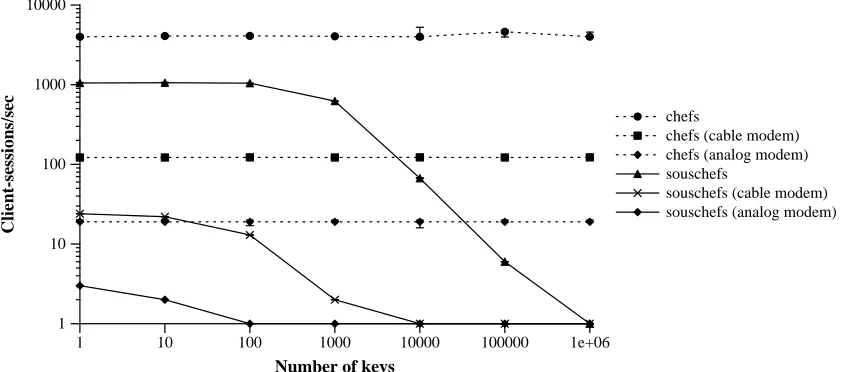
decryption keys to members. On a simulated cable modem, a publisher using key regression can distribute 1 000 keys to 181 clients/sec whereas without key regression the cable modem limits the publisher to 20 clients/sec. The significant gain in throughput conservation comes at no observable cost to client latency, even though key regression requires more client-side computation. Our mea-surements show that key regression actually reduces client latency in cases of highly dynamic group membership. Our study represents the first empirical measurements of either a key regression or key rotation scheme.
Contrary to conventional wisdom, on our testbed we find that KR-AES can perform more than four times as many unwinds/sec than KR-SHA1. Our measurements can assist developers in selecting the most appropriate key regression scheme for particular applications.
Applications. Key regression benefits publishers of popular content who have limited bandwidth to their trusted servers, or who may not always be online, but who can use an untrusted CDN to distribute encrypted content at high throughput. Our experimental results show that a publisher using key regression on a low-bandwidth connection can serve more clients than the strawman ap-proach of having the publisher distribute all keys{K1, K2, . . . , Ki}directly to members. Moreover,
our experimental results suggest that key regression can be significantly better than the strawman approach when i is large, as might be the case if the publisher has a high membership turnover rate. Such a publisher might be an individual, a startup, or a cooperative with popular content but with few network resources. The possibilities for such content range from blogs and amateur press to operating systems and various forms of multimedia. To elaborate on one such form of content, operating systems, Mandriva Linux currently uses the BitTorrent CDN to distribute its latest Linux distributions to its Mandriva Club members [38]. Mandriva controls access to these distributions by only releasing the.torrentfiles to its members. Using key regression and encryp-tion for access control, Mandriva could exercise finer-grained access control over its distribuencryp-tions, allowing members through time period i to access all versions of the operating system including patches, minor revisions and new applications added through time period i, but no additions to the operating system after thei-th time period.2
Versions. An extended abstract of this paper appears in the proceedings of the 2006ISOC Network and Distributed System Security Symposium (NDSS)[25]. This is the full version, a copy of which is available at the IACR Cryptology ePrint Archive as report 2005/303 (http://eprint.iacr.org/). Part of this work also appears as Chapter 4 of [23].
1.2 Related work
The key rotation scheme in Plutus [33] inspired our research in key regression. Bellare and Yee [11] introduce the notion of a forward-secure pseudorandom bit generator (FSPRG). One can roughly view forward-secure pseudorandom bit generation as the mirror image of key regression. Whereas a key regression scheme is designed to prevent an evicted member in possession of stmi from
distinguishingsubsequent encryption keys Kl,l > i, from random, a FSPRG is designed to prevent
an adversary who learns the state of the FSPRG at some point in time from distinguishingprevious outputs of the FSPRG from random. In our security proof for KR-AES, we make the relationship between key regression and FSPRGs concrete by first proving that one can build a secure key regression scheme from any secure FSPRG by essentially running the FSPRG backwards. Abdalla
2
and Bellare formally analyze methods for rekeying symmetric encryption schemes [1], and one of their constructions is a FSPRG.
As pointed out by Boneh et al. [14], one possible mechanism for distributing updated content encryption keys for a secure file system is to use a broadcast encryption scheme [18, 19, 20, 41]. Indeed, one of the main challenges faced by an encrypted file system is the distribution of the encryption keys to the remaining (not evicted) set of users, and broadcast encryption provides an ideal solution. We note, however, that key distribution is orthogonal to the specific problem addressed by key regression; a key regression scheme is a key generation algorithm as opposed to a keydistribution algorithm. Key regression simply assumes the existence of a secure distribution channel, of which broadcast encryption is one possible instantiation. Self-healing key distribution with revocation [51] protocols are resilient even when broadcasts are lost on the network. One can view key regression as having the self-healing property in perpetuity.
In concurrent work, and also motivated by the key rotation scheme in Plutus [33], Backes, Cachin, and Oprea formalize the notion of key-updating for lazy revocation schemes [6] and con-sider the composition of key-updating for lazy revocation schemes with other cryptographic ob-jects [5]. The notion of a key-updating for lazy revocation scheme in [6] is essentially identical to our notion of a key regression scheme. Using our parlance, in [6] they also propose several ways of building key regression schemes; one of their proposals is identical to our KR-PRG construction (Construction 7.3), and another proposal is a natural extension of our construction KR-RSA-RO
(Construction 10.1). Although we remark on the existence of a tree-based key regression scheme in Section 5, [6] take the idea of a tree-based key regression scheme further by formally defining and proving the security of a slightly different tree-based construction. In [6] the authors also observe that one can use the keys output by a key regression scheme as the randomness source for thesetup
algorithm of a (possibly different) key regression scheme; this observation enables the composition of multiple key regression schemes.
2
Notation
Ifxand yare strings, then|x|denotes the length ofxin bits and xky denotes their concatenation. Ifx and y are two variables, we usex←y to denote the assignment of the value ofy to x. IfY is a set, we denote the selection of a random element inY and its assignment to xas x←$ Y. Iff is a deterministic (resp., randomized) function, then x←f(y) (resp.,x←$ f(y)) denotes the process of runningf on input y and assigning the result to x. We use the special symbol ⊥to denote an error.
We use AESK(M) to denote the process of running the AES block cipher with keyK on input
block M. We use SHA1(M) to denote the process of running the SHA1 hash function on input M. An RSA [44] key generator for some security parameterk is a randomized algorithmKrsa that
returns a triple (N, e, d). Since our analyses are in the concrete setting, we write (N, e, d) ← K$ rsa
rather than (N, e, d) ← K$ rsa(k). The modulusN is the product of two distinct odd primesp, q such
that 2k−1 ≤N < 2k; the encryption exponente∈ Z∗
ϕ(N) and the decryption exponent d∈ Z∗ϕ(N)
are such that ed≡1 modϕ(N), whereϕ(N) = (p−1)(q−1). Section 10 describes what it means for an RSA key generator to be one-way.
3
Problems with key rotation
Alg. setup
(N, e, d)← K$ rsa; K $ ←Z∗N
pk← hN, ei; sk← hK, N, di
Return (pk,sk)
Alg. wndkey(sk=hK, N, di) K0←KdmodN
sk0← hK0, N, di
Return (K,sk0)
Alg. unwndkey(K,pk =hN, ei) Return KemodN
Figure 2: The Plutus key rotation scheme;Krsa is an RSA key generator.
Alg. setup
KMW $
← {0,1}160; pk←ε Fori=MWdownto 2 do
Ki−1 ←SHA1(Ki)
sk← h1, K1, . . . , KMWi
Return (pk,sk)
Alg. wndkey(sk=hi, K1, . . . , KMWi)
If i >MW return (⊥,sk)
sk0 ← hi+ 1, K1, . . . , KMWi
Return (Ki,sk0)
Alg. unwndkey(K,pk) // ignore pk
K0 ←SHA1(K)
Return K0
Figure 3: A hash chain-based key rotation scheme.
Shenhav, and Wool also observe [42], one familiar with hash chains [35] and S/KEY [30] might design the key rotation scheme in Figure 3. Such a scheme is more efficient than the scheme in Figure 2, but is limited because it can only produce MW (“max wind”) keys, where MW is a parameter chosen by the implementor or at configuration time. A content publisher runs thesetup
algorithm to initialize a key rotation scheme; the result is public informationpk for all users and a secret sk1 for the content publisher. The content publisher invokes wndkey(ski) to obtain the key
Ki and a new secretski+1. Any user in possession ofKi,i >1, andpkcan invokeunwndkey(Ki,pk)
to obtain Ki−1. Informally, the desired security property of a key rotation scheme is that, given
only Ki and pk, it should be computationally infeasible for an evicted member (the adversary) to
compute Kl, for any l > i. The Plutus construction in Figure 2 has this property under the RSA
one-wayness assumption (defined in Section 10), and the construction in Figure 3 has this property if one replaces SHA1 with a random oracle [9].
The problem. In Section 1 we observed that thel-th key output by a key rotation scheme cannot be pseudorandom, i.e., will be distinguishable from a random string, to an ex-member in possession of the keyKi for some previous time periodi < l.3 We consider the following example to emphasize
how this lack of pseudorandomness might impact the security of a real system that combines a key rotation scheme and a symmetric encryption scheme as a black box.
For our example, we first present a key rotation scheme KOand an encryption schemeSE that individually satisfy their respective security goals (unpredictability for the key rotation scheme and IND-CPA privacy [7] for the symmetric encryption scheme). To build KO, we start with a secure key rotation schemeKO;KOoutputs keys twice as long asKO. TheKOwinding algorithm
wndkey invokes KO’s winding algorithm to obtain a key K; wndkey then returns KkK as its key. On input a key KkK, unwndkey invokes KO’s unwinding algorithm with input K to obtain a
3
Technically, there may be pathological examples where thel-th key is pseudorandom to a member given thei-th
key, but these examples seem to have other problems of their own. For example, consider a key rotation scheme like the one in Figure 3, but where SHA1 is replaced with a function mapping all inputs to some constant string
C, e.g., the all 0 key. Now set MW = 2, i = 1, and l = 2. In this pathological example K2 is clearly random
key K0; unwndkey then returnsK0kK0 as its key. If the keys output by wndkey are unpredictable
to evicted members, then so must be the keys output by wndkey. To build SE, we start with a secure symmetric encryption scheme SE; SE uses keys that are twice as long as SE. The SE
encryption and decryption algorithms take the keyK, split it into two halves K=L1kL2, and run
the respective algorithms of SE with key L1⊕L2. If the key K is random, then the key L1⊕L2
is random andSE runs theSE encryption algorithm with a uniformly selected random key. This means that SE satisfies the standard IND-CPA security goal if SE does.
Despite the individual security of both KOand SE, when the keys output byKO are used to key SE, SE will always run SE with the all-zero key; i.e., the content publisher will encrypt all content under the same constant key. An adversary can thus trivially compromise the privacy of all encrypted data, including data encrypted during time periodsl > i after being evicted. Although the construction ofKOandSE may seem somewhat contrived (though we hope less contrived than some other possible counter examples), this example shows that combining a key rotation scheme and an encryption scheme may have undesirable consequences and, therefore, that it is not wise to use (even a secure) key rotation scheme as a black box to directly key other cryptographic objects.
4
Key Regression
The negative result in Section 3 motivates our quest to find a new cryptographic object, similar to key rotation, but for which the keys generated at time periods l > i are pseudorandom to any adversary evicted at time i. Here we formalize such an object: a key regression scheme. Following the reduction-based practice-oriented provable security approach [8, 28], our formalisms involve carefully defining the syntax, correctness requirements, and security goal of a key regression scheme. These formalisms enable us to, in Sections 8–10, prove that our preferred constructions are secure under reasonable assumptions. We desire provable security over solely ad hoc analyses since, under ad hoc methods alone, one can never be completely convinced that a cryptographic construction is secure even if one assumes that the underlying components (e.g., block ciphers, hash functions, RSA) are secure.
Overview of key regression. Figure 1 gives an abstract overview of a key regression scheme. The content publisher has content publisher states stpi from which it derives future publisher and member states. When using a key regression scheme, instead of giving a new member thei-th key Ki, the content publisher would give the member the i-th member state stmi. As the arrows in
Figure 1 suggest, given stmi, a member can efficiently compute all previous member states and the
keys K1, . . . , Ki. Although it would be possible for an ex-member to distinguish future member
states stml, l > i, from random (the ex-member would extend our observation on the lack of
pseudorandomness in key rotation schemes), because there is no efficient path between the future keys Kl and the ex-member’s last member state stmi, it is possible for a key regression scheme to
produce future keysKl that are pseudorandom (indistinguishable from random). We present some
such constructions in Section 5.
On an alternative: Use key rotation carefully. Figure 1 might suggest an alternative approach for fixing the problems with key rotation. Instead of using the keysKi from a key rotation scheme
to directly key other cryptographic objects, use a function of Ki, like SHA1(Ki), instead. If one
models SHA1 as a random oracle and if the key rotation scheme produces unpredictable future keys Kl, then it might seem reasonable to conclude that an ex-member given Ki should not be
able to distinguish future values SHA1(Kl), l > i, from random. While this reasoning may be
for several reasons. First, we believe that it is unreasonable to assume that every engineer will know to or remember to use the hash function. Further, even if the engineer knew to hash the keys, the engineer might not realize that simply computing SHA1(Kl) may not work with all key
rotation schemes, which means that the engineer cannot use a key rotation scheme as a black box. For example, while SHA1(Kl) would work for the scheme in Figure 2, it would cause problems
for the scheme in Figure 3. We choose to consider a new cryptographic object, key regression, because we desire a cryptographic object that is not as prone to accidental misuse. Additionally, by focusing attention on a new cryptographic object, we allow ourselves greater flexibility in how we construct objects that meet our requirements. For example, one of our preferred constructions (KR-AES, Construction 5.2) does not use a hash function and is therefore secure in the standard model instead of the random oracle model; see also KR-FSPRG (Construction 6.1) and KR-PRG
(Construction 7.3).
4.1 Syntax and correctness requirements
Syntax. Here we formally define the syntax of a key regression schemeKR= (setup,wind,unwind,
keyder). LetH be a random oracle; for notational consistency, all four algorithms are given access to the random oracle, though the algorithms for some constructions may not use the random oracle in their computations. Viastp←$ setupH, the randomized setup algorithm returns a publisher state. Via (stp0,stm) $
← windH(stp), the randomized winding algorithm takes a publisher state stp and returns a pair of publisher and member states or the error code (⊥,⊥). Viastm0 ←unwindH(stm) the deterministic unwinding algorithm takes a member state stm and returns a member state or the error code ⊥. Via K ← keyderH(stm) the deterministic key derivation algorithm takes a member state stm and returns a key K ∈ DK, where DK is the derived key space for KR. Let
MW ∈ {1,2, . . .} ∪ {∞} denote the maximum number of derived keys that KR is designed to produce. We do not define the behavior of the algorithms when input the error code⊥.
Correctness. Our first correctness criterion for a key regression scheme is that the firstMWtimes that wind is invoked, it always outputs valid member states, i.e., the outputs are never ⊥. Our second correctness requirement ensures that if stmi is the i-th member state output by wind, and
ifi >1, then from stmi, one can derive all previous member states stmj, 0< j < i. Formally, let
stp0←$ setup and, fori= 1,2, . . ., let (stpi,stmi) $
←windH(stpi−1). For eachi∈ {1,2, . . . ,MW}, we require that stmi6=⊥and that, for i≥2,unwindH(stmi) =stmi−1.
Remarks. Although we allow wind to be randomized, the wind algorithms in all of our construc-tions are deterministic. We allow wind to return (⊥,⊥) since we only require that wind return non-error states for its first MW invocations. We use the pair (⊥,⊥), rather than simply ⊥, to denote an error from wind since doing so makes our pseudocode cleaner. We allow unwind to return ⊥ since the behavior of unwind may be undefined when input the first member state. A construction may use multiple random oracles, but since one can always obtain multiple random oracles from a single random oracle [9], our definitions assume just one. It is straightforward to modify our syntax, correctness requirements, and (subsequent) security definition to accommodate key regression schemes for which the random oracle depends on the output ofsetup. We stress that
4.2 Security goal
For security, we desire that if a member (adversary) is evicted during the i-th time period, then the adversary will not be able to distinguish the keys derived from any subsequent member state
stml,l > i, from randomly selected keys. Definition 4.1 captures this goal as follows. We allow the
adversary to obtain as many member states as it wishes (via a WindO oracle). The WindO oracle returns only a member state rather than both a member and publisher state. Once the adversary is evicted, its goal is to break the pseudorandomness of subsequently derived keys. To model this, we allow the adversary to query a key derivation oracleKeyderO. The key derivation oracle will either return real derived keys (via internal calls to wind and keyder) or random keys. The adversary’s goal is to guess whether theKeyderO oracle’s responses are real derived keys or random keys. Definition 4.1 [Security for key regression schemes.] LetKR= (setup,wind,unwind,keyder) be a key regression scheme. LetAbe an adversary. Consider the experimentsExpkr-b
KR,A,b∈ {0,1},
and the oracles WindO and KeyderOb below. The adversary runs in two stages, member and
non-member, and returns a bit. Experiment ExpkrKR-b,A
Pick random oracle H i←0
stp←$ setupH
st← A$ WindO,H(member)
b0 $
← AKeyderOb,H(non-member,st)
Return b0
Oracle WindO
i←i+ 1 Ifi >MWthen
return⊥
(stp,stm)←$ windH(stp) Return stm
Oracle KeyderOb
i←i+ 1
Ifi >MWthen return⊥
(stp,stm)←$ windH(stp) Ifb= 1 then
K ←keyderH(stm) Ifb= 0 then
K ←$ DK
Return K The KR-advantage of A in breaking the security ofKR is defined as
AdvkrKR,A= Pr h
ExpkrKR-1,A= 1 i
−PrhExpkrKR-0,A= 1 i
.
Under the concrete security approach [8], we say that KR is KR-secure if for any adversary A
attacking KR with resources (running time, size of code, number of oracle queries) limited to “practical” amounts, the KR-advantage of Ais “small.”
Remarks. Since the publisher is in charge of winding and is not supposed to invoke the winding algorithm more than the prescribed maximum number of times, MW, the WindO and KeyderO
oracles in our security definition only respond to the first MW queries from the adversary. Alter-natively, we could remove the conditional check for i > MW in the pseudocode for WindO and
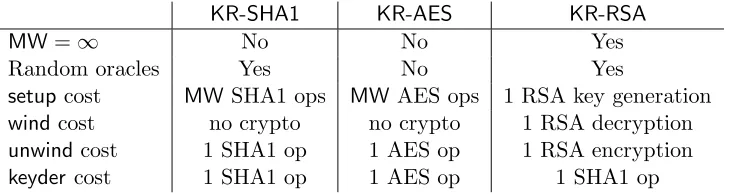
KR-SHA1 KR-AES KR-RSA
MW=∞ No No Yes
Random oracles Yes No Yes
setup cost MWSHA1 ops MW AES ops 1 RSA key generation
windcost no crypto no crypto 1 RSA decryption
unwindcost 1 SHA1 op 1 AES op 1 RSA encryption
keyder cost 1 SHA1 op 1 AES op 1 SHA1 op
Table 1: Our preferred constructions. There are ways of implementing these constructions with differentwindcosts. The “random oracles” line refers to whether our security proof is in the random oracle model or not.
of future keys means that a content publisher can use the keys output by a secure key regression scheme to key other cryptographic objects like symmetric encryption schemes [7] and MACs [8]; as [1, 11] do for rekeying schemes and FSPRGs, [5] makes this reasoning formal for key regression schemes.
5
Our preferred constructions
We are now in a position to describe our three preferred key regression schemes,KR-SHA1,KR-AES
and KR-RSA. Table 1 summarizes some of their main properties. KR-SHA1 is a derivative of the key rotation scheme in Figure 3 andKR-RSAis a derivative of the Plutus key rotation scheme in Figure 2. The primary differences between the new key regression schemes KR-SHA1and KR-RSA
and the original key rotation schemes are the addition of the new, SHA1-based keyder algorithms and the adjusting of terminology (e.g., member states in these key regression schemes correspond to keys in the original key rotation schemes). KR-AES is new but is based on one of Bellare and Yee’s forward-secure pseudorandom bit generators (FSPRGs) [11].
5.1 The KR-SHA1 construction
Construction 5.1 details ourKR-SHA1construction. In the construction of KR-SHA1, we prepend the string 08to the input to SHA1 inkeyderto ensure that the inputs to SHA1 never collide between thekeyder andunwind algorithms; note that thestm variable always denotes a 160-bit string. Construction 5.1 [KR-SHA1.] The key regression schemeKR-SHA1= (setup,wind,unwind,keyder) is defined as follows. MWis a positive integer and a parameter of the construction.
Alg. setup stmMW
$
← {0,1}160
Fori=MWdownto 2 do
stmi−1←unwind(stmi)
stp← h1,stm1, . . . ,stmMWi
Return stp
Alg. wind(stp)
If stp=⊥then return (⊥,⊥) Parse stpashi,stm1, . . . ,stmMWi
If i >MW return (⊥,⊥)
stp0 ← hi+ 1,stm
1, . . . ,stmMWi
Return (stp0,stmi)
Alg. unwind(stm)
stm0 ←SHA1(stm) Returnstm0
Alg. keyder(stm) K←SHA1(08kstm) ReturnK
In practice we assume that the MW might be some reasonable value like 220. We give a proof of
security for KR-SHA1 in Section 9. In our proof of security we view the application of SHA1(·) in unwind as one random oracle and the application of SHA1(08k·) in keyder as another random oracle. The proof of security for KR-SHA1is thus in the random oracle model [9].
5.2 The KR-AES construction
Our next preferred construction, KR-AES, uses the AES block cipher and is provably secure in the standard model, meaning without random oracles but assuming that AES is a secure pseudorandom permutation [8, 36].
Construction 5.2 [KR-AES.] The key regression scheme KR-AES= (setup,wind,unwind,keyder) is defined as follows. MWis a positive integer and a parameter of the construction.
Alg. setup stmMW
$
← {0,1}128
Fori=MWdownto 2 do
stmi−1 ←unwind(stmi)
stp← h1,stm1, . . . ,stmMWi
Returnstp
Alg. wind(stp)
Ifstp=⊥then return (⊥,⊥) Parse stpashi,stm1, . . . ,stmMWi
Ifi >MWreturn (⊥,⊥)
stp0← hi+ 1,stm1, . . . ,stmMWi
Return (stp0,stm i)
Alg. unwind(stm)
stm0←AESstm(0128)
Return stm0 Alg. keyder(stm)
K ←AESstm(1128)
Return K The derived key space forKR-AESisDK={0,1}128.
As withKR-SHA1, we assume that theMWmight be some reasonable value like 220. We prove the security of KR-AESin stages. We first show how to build a secure key regression scheme from any forward-secure pseudorandom bit generator (FSPRG) [11]; we call our construction KR-FSPRG. We then recall one of Bellare and Yee’s [11] methods (FSPRG-PRG) for building secure FSPRGs from standard pseudorandom bit generators (PRGs) [11, 12, 54]. Instantiating KR-FSPRG with
FSPRG-PRG yields a secure PRG-based key regression scheme that we call KR-PRG. KR-AES
is then an instantiation of KR-PRG with a PRG that, on input a 128-bit string stm, outputs AESstm(0128)kAESstm(1128). Since the constructionsKR-FSPRGandKR-PRGhave multiple possible
instantiations, we consider them to be of independent interest. Details in Sections 6 through 8. Remark. On can also viewKR-SHA1 as an instantiation of KR-PRGwith a PRG (in the random oracle model) that, on input a string stm ∈ {0,1}160, outputs SHA1(stm)kSHA1(08kstm). In
Section 9 we prove KR-SHA1 directly, rather than by instantiating KR-PRG, in order to obtain tighter bounds.
5.3 The KR-RSA construction
Our final preferred construction,KR-RSAderives from the key rotation scheme in Figure 2. KR-RSA
differs from KR-SHA1 andKR-AESin that MW=∞, meaning that a content provider can invoke the KR-RSA winding algorithm an unbounded number of times without violating the correctness properties of key regression schemes. This ability is particularly useful because it means that an implementor need not fix MW to some finite value at implementation or configuration time. Nevertheless, our security proof in Section 10 suggest that in practice a content publisher should limit the number of times it invokes wind to some reasonable value. As another motivation for
KR-RSA, we note that if MW is large, then maintaining the publisher states for KR-SHA1 and
Construction 5.3 [KR-RSA.] The key regression schemeKR-RSA= (setup,wind,unwind,keyder) is defined as follows. Let Krsa be an RSA key generator for some security parameter k and let
m: Z2k → {0,1}k denote the standard big-endian encoding of the integers in Z2k to k-bit strings.
Alg. setup
(N, e, d)← K$ rsa
S←$ Z∗N
stp← hN, e, d, Si
Returnstp
Alg. wind(stp)
ParsestpashN, e, d, Si
S0←SdmodN
stp0 ← hN, e, d, S0i
stm← hN, e, Si
Return (stp0,stm)
Alg. unwind(stm) Parse stmashN, e, Si
S0 ←SemodN; stm0 ← hN, e, S0i
Return stm0
Alg. keyder(stm)
Parse stmashN, e, Si; K←SHA1(m(S)) Return K
The derived key space for KR-RSAis DK ={0,1}160. In our experiments, we set k = 1 024, and Krsa returnse= 3 as the RSA public exponent.
The proof of security for KR-RSA is in Section 10. The proof is in the random oracle model and assumes that the RSA key generator is one-way; we define one-wayness in Section 10.
5.4 Discussion
Alternate constructions. BesidesKR-SHA1,KR-AES, andKR-RSA, there are numerous possible ways to build key regression schemes, some of which are simple variants of the more general con-structions that we present in subsequent sections (KR-FSPRG,KR-PRG,KR-RO, andKR-RSA-RO). Using advanced tree-based schemes [4, 6, 37, 39], a publisher could give access to any contiguous sequence of keys using only a logarithmic number of nodes from a key tree. We do not consider key trees here because one of our primary design goals is to minimize the size of the member states that the content publisher must transmit to members. For instance, it is desirable to have constant-sized metadata in file systems.
On the use of SHA1. We completed the bulk of our research prior to Wang, Yin, and Yu [52] showing how to find collisions in SHA1 faster than brute force. The result of Wang, Yin, and Yu raises the question of whether one should continue to use SHA1 in real constructions, including
KR-SHA1 and KR-RSA. This concern is well justified, particularly because other researchers [32, 34] have shown how to extend certain types of collision-finding attacks against hash functions to break cryptosystems that, at first glance, appear to depend only on a weaker property of the underlying hash function (like second-preimage resistance) and therefore initially appear to be immune to collision-finding attacks. Still, we currently suspect that our constructions will resist immediate extensions to collision-finding attacks against SHA1, particularly because the content publisher is the entity responsible for determining the inputs to SHA1 and, under our model, the content publisher would not wish to intentionally compromise the pseudorandomness of its keys. Alternatively, one could replace the use of SHA1 in our constructions with another hash function, perhaps a hash function that behaves like a random oracle assuming that the underlying compression function is a random oracle [16].
6
Key regression from FSPRGs
see Construction 6.1. Since there are multiple possible ways to instantiate KR-FSPRG, we believe thatKR-FSPRGmay be of independent interest. Moreover, our result in this section suggests that future work in forward-secure pseudorandom bit generators could have useful applications to key regression schemes.
6.1 Forward-secure pseudorandom generators
Bellare and Yee [11] define stateful pseudorandom bit generators and describe what it means for a stateful pseudorandom bit generator to be secure. Intuitively a stateful PRG is forward-secure if even adversaries that are given the generator’s current state cannot distinguish previous outputs from random.
Syntax. A stateful PRG consists of two algorithms: SBG = (seed,next). The randomized setup algorithm returns an initial state; we write this asstg ←$ seed. The deterministic next step algorithm takes a state as input and returns a new state and an output from OutSpSBG, or the pair (⊥,⊥); we write this as (stg0, K) ← next(stg). We require that the set OutSpSBG is efficiently samplable.
MaxLenSBG ∈ {1,2, . . .}∪{∞}denotes the maximum number of output blocks thatSBG is designed
to produce from a correctness (not security) perspective.
Correctness. The correctness requirement for stateful PRGs is as follows: letstg0←$ seedand, for i= 1,2, . . ., let (stgi, Ki)
$
←next(stgi−1). We require that for i≤MaxLenSBG, (stgi, Ki)6= (⊥,⊥).
Security. Let SBG = (seed,next) be a stateful bit generator. Let A be an adversary. Consider the experiments ExpfsprgSBG,-Ab,b ∈ {0,1}, and the oracles NextOb below. The adversary runs in two
stages: findand guess.
Experiment ExpfsprgSBG,-Ab
stg←$ seed
st← A$ NextOb(find)
b0 $
← A(guess,stg,st) Returnb0
OracleNextOb
(stg, K)←next(stg)
Ifb= 0 thenK ←$ OutSpSBG
Return K
The FSPRG-advantage of Ain breaking the security of SBG is defined as AdvfsprgSBG,A = PrhExpfsprgSBG,-A1 = 1i−PrhExpfsprgSBG,-A0 = 1i.
Under the concrete security approach, the scheme SBG is said to beFSPRG-secure if the FSPRG-advantage of all adversariesA using reasonable resources is “small.”
6.2 An FSPRG-based key regression scheme
We define KR-FSPRGin Construction 6.1 below. At a high level, one can view KR-FSPRG’s setup
algorithm as running the FSPRGSBG backward, meaning setup runsseed and the output of seed
becomes KR-FSPRG’s MW-th member state. From the MW-th member state, setup invokes next
to obtain the (MW−1)-st member state; setup continues in this manner until deriving the 1-st member state. The setup algorithm then outputs a content publisher state stp consisting of an indexi, initially 1, and theMWmember states. Thewindalgorithm, on input a publisher statestp
with index i≤MW, outputs thei-th member state in the vector and outputs a revised publisher state stp0 with index i+ 1. On input a member state stm, the wind and keyder algorithms both invoke next on stm to obtain a pair (stm0, K); wind then outputs the revised member state stm0
Construction 6.1 [KR-FSPRG.] Given a stateful generator SBG= (seed,next), we can construct a key regression scheme KR-FSPRG= (setup,wind,unwind,keyder) as follows. MW≤MaxLenSBG is
a positive integer and a parameter of the construction. Alg. setup
stgMW ←$ seed
Fori=MWdownto 2 do (stgi−1, Ki−1)←next(stgi)
stp← h1,stg1, . . . ,stgMWi
Returnstp
Alg. wind(stp) If stp=⊥ then
return (⊥,⊥) Parse stpas
hi,stg1, . . . ,stgMWi
If i >MW return (⊥,⊥)
stp0 ←
hi+ 1,stg1, . . . ,stgMWi
Return (stp0,stg i)
Alg. unwind(stm) (stm0, K)←next(stm) Returnstm0
Alg. keyder(stm) (stm0, K)←next(stm)
ReturnK
The derived key space forKR-FSPRGisDK=OutSpSBG.
In order forsetup andwindto be “efficient,” we assume that MWhas some “reasonable” value like 220; in the asymptotic setting we would require thatMWbe polynomial in some security parameter. Security. The theorem below states that if SBG is a secure forward-secure pseudorandom bit generator (i.e., is FSPRG-secure), then the resulting key regression scheme KR-FSPRGbuilt from
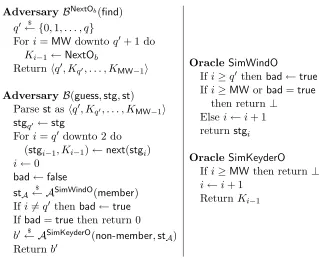
SBGvia Construction 6.1 will be secure (i.e., KR-secure). Specifically, Theorem 6.2 says that given an adversaryAagainstKR-FSPRG, one can construct an adversaryBagainstSBG such thatBuses reasonable resources (if A does and if MW is small) and Equation (1) in the theorem statement holds; q is the minimum of MW and the maximum number of wind and key derivation oracle queries that A makes. These properties imply security for KR-FSPRG since, if SBG is FSPRG-secure and ifA uses reasonable resources, thenAdvfsprgSBG,B and q must both be small, which means thatAdvkrKR,A, the advantage ofA in attacking KR-FSPRG, must be small as well.
Theorem 6.2 IfSBGis FSPRG-secure, thenKRbuilt fromSBGviaKR-FSPRG(Construction 6.1) is KR-secure. Concretely, given an adversary A attacking KR, we can construct an adversary B
attacking SBG such that
AdvkrKR,A ≤(q+ 1)·AdvfsprgSBG,B (1)
whereq is the minimum ofMWand the maximum number of wind and key derivation oracle queries that Amakes. Adversary B makes up toMWqueries to its oracle and uses within a small constant factor of the other resources of A plus the time to run the setup algorithm.
Intuitively, Theorem 6.2 follows from the fact that KR-FSPRGruns SBG backward, which means that if an adversaryAagainstKR-FSPRGin possession of the firstimember states can distinguish a key Kl, l > i, from random, then an adversaryB against SBG in possession of the (MW−i)-th
state output ofnextcould distinguish the (MW−l)-th key output ofnextfrom random. The actual proof involves B guessing the number ofWindO oracle queries thatAwill make. Details below. Proof of Theorem 6.2: The adversary B is shown in Figure 4. The main idea is that if B
Adversary BNextOb(find) q0 $
← {0,1, . . . , q}
For i=MW downtoq0+ 1 do
Ki−1 ←NextOb
Return hq0, K
q0, . . . , KMW−1i
Adversary B(guess,stg,st) Parse st ashq0, Kq0, . . . , KMW−1i
stgq0 ←stg
For i=q0 downto 2 do (stgi−1, Ki−1)←next(stgi)
i←0
bad←false stA
$
← ASimWindO(member)
If i6=q0 thenbad←true
If bad=true then return 0
b0 ← A$ SimKeyderO(non-member,stA)
Return b0
Oracle SimWindO
Ifi≥q0 thenbad←true
Ifi≥MW orbad=true
then return⊥
Elsei←i+ 1 returnstgi
Oracle SimKeyderO
Ifi≥MW then return⊥
i←i+ 1 Return Ki−1
Figure 4: The adversary Bin the proof of Theorem 6.2.
Formally, we claim that
PrhExpkrKR-1,A= 1i = (q+ 1)·PrhExpfsprgSBG,-B1 = 1i (2) PrhExpkrKR-0,A= 1i = (q+ 1)·PrhExpfsprgSBG,-A0 = 1i, (3) from which it follows that
AdvkrKR,A = PrhExpkrKR-1,A= 1i−PrhExpkrKR-0,A= 1i
= (q+ 1)·PrhExpfsprgSBG,-B1 = 1i−PrhExpfsprgSBG,-A0 = 1i
≤ (q+ 1)·AdvfsprgSBG,B as desired.
It remains to justify Equation (2), Equation (3), and the resources ofB. LetE1 andE0 respectively
denote the events that B sets bad to true in the experiments ExpSBGfsprg,-B1 and ExpfsprgSBG,-A0, i.e., when
respectively denote probabilities over ExpfsprgSBG,-B1 and ExpfsprgSBG,-A0. We now claim that PrhExpkrKR-1,A= 1i = PrhExpfsprgSBG,-B1 = 1 | E1
i
(4) = PrhExpfsprgSBG,-B1 = 1∧ E1
i
· 1
Pr1E1
(5) = (q+ 1)·PrhExpfsprgSBG,-B1 = 1∧ E1
i
(6) = (q+ 1)·PrhExpSBGfsprg,-B1= 1∧ E1
i
+ PrhExpfsprgSBG,-B1= 1∧ E1
i (7) = (q+ 1)·PrhExpfsprgSBG,-B1 = 1i.
Equation (4) is true because when the event E1 does not occur, i.e., whenB correctly guesses the
number of wind oracle queries that A will make, thenB in ExpfsprgSBG,-B1 runs A exactly as A would be run in ExpkrKR-1,A. Equation (5) follows from conditioning off Pr1
E1
and Equation (6) is true because B chooses q0 from q+ 1 possible values and therefore Pr1E1 = 1/(q + 1). To justify
Equation (7), note that PrhExpfsprgSBG,-B1 = 1∧ E1
i
= 0 sinceB always returns 0 whenever it fails to correctly guess the number of wind oracle queries thatA will make. This justifies Equation (2). To justify Equation (3), note that
PrhExpkrKR-0,A= 1i = PrhExpfsprgSBG,-B0= 1 | E0
i
since when the event E0 does not occur, B in ExpfsprgSBG,-B0 runs A exactly as A would be run
in ExpkrKR-0,A. The remaining justification for Equation (3) is analogous to our justification of Equation (2) above.
The resources for B is within a small constant factor of the resources for A except that B must execute the setup algorithm itself, which involves querying its oracle up toMWtimes.
7
Key regression from standard PRGs
We proceed by showing how to build secure key regression schemes from standard (not forward-secure) pseudorandom bit generators; we call our PRG-based constructionKR-PRG. Our approach capitalizes on a method from Bellare and Yee [11] for building FSPRGs from standard PRGs; we recall the Bellare-Yee method in Section 7.1. As with KR-FSPRGfrom Section 6, we believe that
KR-PRG will be of independent interest.
7.1 FSPRGs from pseudorandom bit generators
Pseudorandom bit generators. A pseudorandom bit generator (PRG) [11, 12, 54] is a function G: {0,1}k → {0,1}k+l that takes as input ak-bit seed and returns a string that is longer than the
seed bylbits, k, l≥1. The standard security notion for a PRG is as follows. If Ais an adversary, we let
A PRG-based FSPRG.Bellare and Yee [11] show how to construct an FSPRG from a standard PRG. We dub their schemeFSPRG-PRGand recall it in Construction 7.1 below. TheFSPRG-PRG’s
seed algorithm selects a randomk-bit initial seed. The nextalgorithm, on input ak-bit string stg, computes the (k+l)-bit stringG(stg) and outputs the first kbits of G(stg) as the next state and the remaining lbits as the key.
Construction 7.1 [FSPRG-PRG, Construction 2.2 of [11].] Given a PRG G : {0,1}k → {0,1}k+l we can construct a FSPRGSBG = (seed,next) as shown below
Alg. seed stg0← {$ 0,1}k
returnstg0
Alg. next(stgi) r ←$ G(stgi)
stgi+1 ← firstk bits ofr K ← last lbits of r return (stgi+1, K) The output space of SBG is OutSpSBG={0,1}l and MaxLen
SBG=∞.
The following lemma comes from Bellare and Yee [11] except that we treat q as a parameter of the adversary and we allow the trivial case that q = 0. Lemma 7.2 states that if G is a secure PRG, then the stateful bit generator FSPRG-PRG built from G via Construction 7.1 will also be secure. Specifically, if G is a secure PRG, thenAdvprgG,B must be small for all adversaries B using reasonable resources. Further, if an adversary A against FSPRG-PRG uses reasonable resources, then the number of oracle queriesqthat it makes must also be small andBmust also use reasonable resources. These properties, coupled with Equation (8), means that the advantage of all adversaries
A against FSPRG-PRG that use reasonable resources must be small; i.e., FSPRG-PRG must be FSPRG-secure.
Lemma 7.2 [Theorem 2.3 of [11].] Let G:{0,1}k → {0,1}k+l be a PRG, and let SBG be the
FSPRG built using G according to Construction 7.1. Given an adversary A attacking SBG that makes at most q queries to its oracle, we can construct an adversary B such that
AdvfsprgSBG,A≤2q·AdvprgG,B (8)
where B uses within a small constant factor of the resources of adversary A and computesGup to q times.
7.2 A PRG-based key regression scheme
CombiningKR-FSPRGand FSPRG-PRG in the natural way yields a key regression scheme that we call KR-PRG. For concreteness we describe KR-PRG in detail below.
Construction 7.3 [KR-PRG.] LetG: {0,1}k → {0,1}k+l be a pseudorandom bit generator. We
can construct a key regression scheme KR-PRG = (setup,wind,unwind,keyder) from G as follows.
MWis a positive integer and a parameter of the construction. Alg. setup
stmMW $
← {0,1}k
Fori=MWdownto 2 do
stmi−1 ←unwind(stmi)
stp← h1,stm1, . . . ,stmMWi
Returnstp
Alg. wind(stp)
Ifstp=⊥then return (⊥,⊥) Parse stpas
hi,stm1, . . . ,stmMWi
Ifi >MWreturn (⊥,⊥)
stp0← hi+ 1,stm1, . . . ,stmMWi
Return (stp0,stmi)
Alg. unwind(stm) x←G(stm)
stm0 ← firstk bits ofx
Return stm0
Alg. keyder(stm) x←G(stm)
The derived key space forKR-PRGis DK={0,1}l.
In order forsetup andwindto be “efficient,” we assume that MWhas some “reasonable” value like 220; in the asymptotic setting we would require thatMWbe polynomial in some security parameter. Security. The theorem below states that if Gis a secure PRG, then the resulting key regression scheme KR-PRG built from G via Construction 7.3 will be KR-secure. Specifically, Theorem 7.4 says that given an adversaryAagainstKR-PRGthat uses reasonable resources, and assuming that
MW is small, one can construct an adversary B against G such that B uses reasonable resources and Equation (9) in the theorem statement holds; q is the minimum of MW and the maximum number of wind and key derivation oracle queries that A makes. These properties imply security forKR-PRGsince, if G is PRG-secure and since Auses reasonable resources, AdvprgG,B and q must both be small, which means that AdvkrKR,A, the advantage of A in attacking KR-PRG, must be
small as well.
Theorem 7.4 If G: {0,1}k→ {0,1}k+l is a secure PRG, then the key regression schemeKR built
from Gvia KR-PRG(Construction 7.3) is KR-secure. Concretely, given an adversary A attacking
KR, we can construct an adversaryB attacking G such that
AdvkrKR,A ≤ 2·(q+ 1)2·AdvprgG,B (9) where q is the minimum of MW and the maximum number of queries A makes to its WindO and
KeyderO oracles. Adversary B uses within a small constant factor of the resources of A, plus the time to compute setup and G MW times.
Proof of Theorem 7.4: Construction 7.3 is exactly Construction 6.1 built from the forward secure pseudorandom bit generator defined by Construction 7.1. The theorem statement therefore follows from Theorem 6.2 and Lemma 7.2.
8
The security of
KR
-
AES
Having shown how to construct secure key regression schemes from secure pseudorandom bit generators (KR-PRG and Construction 7.3), we are now able to prove the security of KR-AES
(Construction 5.2) by observing that KR-AES is exactly KR-PRG with k = l = 128 and with the PRGGdefined asG(X) = AESX(0128)kAESX(1128) for allX∈ {0,1}128. Before stating our formal
result for KR-AES, we first recall the standard notion of a pseudorandom permutation [8, 36]. Pseudorandom permutations. Let E: {0,1}k × {0,1}l → {0,1}l be a block cipher and let
Perm(l) denote the set of all permutations on {0,1}l. IfAis an adversary with access to an oracle,
we let
AdvprpE,A = PrhK ← {$ 0,1}k : AEK(·)
= 1i−Prhg←$ Perm(l) : Ag(·)= 1i
denote thePRP-advantage ofAin attackingE. Under the concrete security approach,E is said to be a “secure PRP” if the PRP-advantage of all adversariesAusing reasonable resources is “small.” InstantiatingKR-AESfromKR-PRG. As noted above, it is straightforward to instantiateKR-AES
from KR-PRG. Numerous other instantiations exist, e.g., to use a block cipher E with k > l, one might define G as G(X) = EX(α1)kEX(α2)k. . . where α1, α2, . . . are distinct l-bit strings.
Since KR-AESis one of our preferred constructions, we state the following theorem specifically for
security proof forKR-AESis in the standard model and assumes that AES is a secure pseudorandom permutation.
Theorem 8.1 If AES is a secure PRP, thenKR-AES(Construction 5.2) is KR-secure. Concretely, given an adversary AattackingKR-AES, we can construct an adversary B attacking AES such that
AdvkrKR,A ≤ 2·(q+ 1)2·
AdvprpAES,B+ 2
−128 (10)
where q is the minimum of MW and the maximum number of queries A makes to its WindO and
KeyderO oracles. Adversary B makes 2 oracle queries and uses within a small constant factor of the resources of A, plus the time to compute setup and AES 2MW times.
We interpret Theorem 8.1 as follows. Suppose A is an adversary against KR-AES that uses rea-sonable resources, and in particular makes at most a rearea-sonable number of queries q to its wind and key derivation oracles. Then we can construct an adversary B against AES that also uses reasonable resources when MW is small. Because of the resource restrictions on B and under the assumption that AES is a secure PRP, it follows that AdvprpAES,B must be small. If both q and AdvprpAES,B are small, then by Equation (10) AdvkrKR,A must also be small, meaning that KR-AES
must be KR-secure.
As a concrete example of the bound in Theorem 8.1, consider the case where MW and q are both 220. Then Equation (10) becomes
AdvkrKR,A ≤ 242·AdvprpAES,B+ 2 −86,
which means that unless A exploits a property of AES itself, A will not be able to break the security of KR-AES with probability better than 2−86. Since it is widely believed that AES is
secure, Theorem 8.1 tells us that it is reasonable to assume that KR-AES is secure for reasonable choices of MW.
To prove Theorem 8.1 we use Theorem 7.4, the relationship betweenKR-AESandKR-PRG, and the fact that the functionGdefined asG(X) = AESX(0128)kAESX(1128),X∈ {0,1}128, is a secure
PRG if AES is a secure PRP. Details follow.
Proof of Theorem 8.1: To instantiateKR-AESfrom Construction 7.3, we set k=l= 128 and, for any X∈ {0,1}128, we defineGasG(X) = AES
X(0128)kAESX(1128).
We first claim that, given an adversary Battacking G, we can construct an adversary C attacking AES such that
AdvprgG,B ≤ AdvprpAES,C+ 2−128 (11)
and C makes two oracle queries and uses within a small constant factor of the resources of B. Theorem 8.1 follows from this claim and Theorem 7.4.
We now justify our claim above. Let Func(l, l) denote the set of all functions from{0,1}l to{0,1}l.
Let C be a PRP adversary that runsB with inputf(0128)kf(1128), wheref: {0,1}128 → {0,1}128
isC’s oracle. Adversary C then returns the same bit thatB returns. Note that
PrhK ← {$ 0,1}128; x←G(K) : B(x) = 1i = PrhK ← {$ 0,1}128 : CAESK(·) = 1i since, when C’s oracle is AESK(·), C runs B with input AESK(0128)kAESK(1128), for a randomly
Addi-tionally,
Prhx← {$ 0,1}256 : B(x) = 1i = Prhg←$ Func(128,128) : Cg(·) = 1i
since, when C’s oracle is a random function from {0,1}128 to {0,1}128, it runs B with a random 256-bit string.
Expanding the definition ofAdvprgG,B and substituting the above equalities, we have
AdvG,prgB = PrhK ← {$ 0,1}128; x←G(K) : B(x) = 1i−Prhx← {$ 0,1}256 : B(x) = 1i = PrhK ← {$ 0,1}128 : CAESK(·)
= 1i−Prhg←$ Func(128,128) : Cg(·) = 1i . If we subtract and add Prhg←$ Perm(128) : Cg(·)= 1iand apply the definition ofAdvprp
AES,C, we
get
AdvprgG,B = PrhK ← {$ 0,1}128 : CAESK(·)= 1 i
−Prhg←$ Perm(128) : Cg(·)= 1i +Prhg←$ Perm(128) : Cg(·)= 1i−Prhg←$ Func(128,128) : Cg(·)= 1i = AdvprpAES,C
+Prhg←$ Perm(128) : Cg(·)= 1i−Prhg←$ Func(128,128) : Cg(·)= 1i . Using the standard PRF/PRP switching result from [8], re-proven in [10, 48], and the fact thatC
makes only two oracle queries, the above simplifies to Equation (11), completing the proof.
9
The security of
KR
-
SHA1
Although we derived KR-SHA1 from the key rotation scheme in Figure 3, we find that one can also view KR-SHA1 as an instantiation of KR-PRG with k = l = 160 and G defined as G(X) = SHA1(X)kSHA1(08kX) for all X ∈ {0,1}160. If we view SHA1 as a random oracle, then G is a
secure PRG in the random oracle model, and we can use this observation and Theorem 7.4 to prove the security of KR-SHA1 in the random oracle model.
Here we give a direct proof of security for KR-SHA1 in order to obtain a tighter bound. The tightness issue with usingKR-PRGand Theorem 7.4 to prove the security of KR-SHA1rests in the fact that the advantage of an adversary in attacking Gin the random oracle model must be upper bounded by a function of the number of random oracle queries that the adversary makes, and this function will percolate through the bound in Theorem 7.4.
In what follows we view SHA1(·) inKR-SHA1’sunwindalgorithm and SHA1(08k·) inKR-SHA1’s
keyder algorithm as two different random oracles. Construction 9.1,KR-RO, makes this generaliza-tion of KR-SHA1 concrete. We choose not to model SHA1(·) and SHA1(08k·) as a single random
oracle because we do not wish to restrict our analysis to the case wherekeydermust prefix its inputs to the random oracle with the zero byte.
Construction 9.1 [KR-RO.] Let H1: {0,1}k → {0,1}k and H2: {0,1}k → {0,1}l be random
oracles. We can construct a key regression scheme KR-RO= (setup,wind,unwind,keyder) from H1
Alg. setupH1,H2
stmMW $
← {0,1}k
For i=MW downto 2 do
stmi−1 ←unwindH1,H2(stmi)
stp← h1,stm1, . . . ,stmMWi
Return stp
Alg. windH1,H2(stp)
If stp=⊥then return (⊥,⊥) Parse stpas
hi,stm1, . . . ,stmMWi
If i >MW return (⊥,⊥)
stp0 ← hi+ 1,stm1, . . . ,stmMWi
Return (stp0,stm i)
Alg. unwindH1,H2
(stm)
stm0 ←H1(stm)
Returnstm0
Alg. keyderH1,H2
(stm) K←H2(stm)
ReturnK The derived key space forKR-ROisDK={0,1}l.
In order forsetup andwindto be “efficient,” we assume that MWhas some “reasonable” value like 220; in the asymptotic setting we would require thatMWbe polynomial in some security parameter.
The following theorem states that Construction 9.1 is secure in the random oracle model for adversaries that make a reasonable number of queries to their random oracles.
Theorem 9.2 The key regression scheme in Construction 9.1 is secure in the random oracle model. Formally, letH1: {0,1}k → {0,1}k andH2: {0,1}k → {0,1}l be random oracles and letKRbe the
key regression scheme built fromH1, H2 via KR-RO(Construction 9.1). Then for any adversary A
we have that
AdvkrKR,A ≤ (MW) 2
2k+1 +
q·MW
2k−MW−q , (12)
where q is the maximum number of queries total that adversary A makes to itsH1 andH2 random
oracles.
As a concrete example of the bound in Theorem 9.2, consider the case where MW = 220 and an adversary A makes at most q = 240 queries to its random oracles. Then Equation (12) tells us
that the advantage of A in attacking KR-RO is upper bounded by 2−98. Although SHA1 is not a random oracle, Theorem 9.2 gives us confidence that KR-SHA1 may provide a reasonable level of security in practice; see Section 5 for additional discussion.
We prove Theorem 9.2 below, but remark that we could simplify the proof if, instead of defining
KR-ROas in Construction 9.1, we include the indicesiin the member states, and hence in the inputs to H1 and H2. We choose to omit the indices ifrom the member states inKR-RObecause we view
KR-ROand KR-SHA1as closer to what developers might wish to implement in practice.
Proof of Theorem 9.2: Consider the experiments ExpkrKR-1,A and ExpKRkr-0,A. Letstm1,stm2, . . . ,
stmMW denote the member states as computed by setup, and let w0 denote the variable number
of WindO oracle queries that A made in its member stage. Let E1 be the event in ExpkrKR-1,A
that w0 ≤ MW −1 and that A queries either its H
1 or H2 random oracles with some string
x∈ {stmw0+1, . . . ,stmMW}. LetE0 be the event in ExpKRkr-0,A thatw0 ≤MW−1 and thatAqueries
either its H1 or H2 random oracles with some string x ∈ {stmw0+1, . . . ,stmMW}. Let F1 be the
event in ExpkrKR-1,A that there exist two distinct indices i, j ∈ {1, . . . ,MW} such that stmi =stmj
and let F0 be the event inExpkrKR-0,A that there exist two distinct indices i, j ∈ {1, . . . ,MW} such
thatstmi=stmj.
We claim that
AdvKRkr ,A ≤ PrhExpKRkr-1,A= 1∧ F1
i
+ PrhExpkrKR-1,A= 1∧ E1∧ F1
i
, (13) that
PrhExpkrKR-1,A= 1∧ F1
i
≤ (MW) 2
and that
PrhExpkrKR-1,A= 1∧ E1∧ F1
i
≤ q·MW
2k−MW−q , (15)
from which the inequality in the theorem statement follows.
To justify Equation (13), let Pr1[·] and Pr0[·] denote the probabilities overExpKRkr-1,AandExpkrKR-0,A,
respectively. From Definition 4.1, we have AdvkrKR,A = Pr
h
ExpkrKR-1,A = 1 i
−PrhExpkrKR-0,A= 1 i
= PrhExpkrKR-1,A = 1∧ F1
i
+ PrhExpkrKR-1,A= 1∧ E1∧ F1
i
+PrhExpkrKR-1,A= 1∧ E1∧ F1
i
−PrhExpkrKR-0,A= 1∧ F0
i
−PrhExpkrKR-0,A= 1∧ E0∧ F0
i
−PrhExpkrKR-0,A= 1∧ E0∧ F0
i
≤ PrhExpkrKR-1,A = 1∧ F1
i
+ PrhExpkrKR-1,A= 1∧ E1∧ F1
i
+PrhExpkrKR-1,A= 1∧ E1∧ F1
i
−PrhExpkrKR-0,A= 1∧ E0∧ F0
i
. (16) By conditioning,
PrhExpkrKR-1,A= 1∧ E1∧ F1
i
= PrhExpkrKR-1,A= 1 | E1∧ F1
i
·Pr1E1∧ F1
and
PrhExpkrKR-0,A = 1∧ E0∧ F0
i
= PrhExpkrKR-0,A= 1 | E0∧ F0
i
·Pr0E0∧ F0.
Prior to the adversary causing the eventsE1∨F1andE0∨F0to occur in their respective experiments, A’s view is identical in both experiments, meaning that
Pr1E1∧ F1= Pr0E0∧ F0.
Similarly, if the events do not occur, then the outcome ofExpkrKR-1,A andExpkrKR-0,A will be the same since the output of a random oracle is random if the input is unknown; i.e., the response to A’s key derivation oracle query in thenon-member stage will be random in both cases and therefore
PrhExpkrKR-1,A= 1 | E1∧ F1
i
= PrhExpkrKR-0,A = 1 | E0∧ F0
i .
Consequently,
PrhExpkrKR-1,A= 1∧ E1∧ F1
i
= PrhExpkrKR-0,A= 1∧ E0∧ F0
i .
Combining the above equation with Equation (16) gives Equation (13). Returning to Equation (14), we first note that
PrhExpkrKR-1,A = 1∧ F1
i
≤ Pr1[F1].
If we consider the eventF1, we note that thesetup algorithm selects the pointsstmMW,stmMW−1,
stmMW−2, and so on, uniformly at random from{0,1}kuntil a collision occurs. Since this is exactly
the standard birthday paradox [8], we can upper bound Pr1[F1] as
Pr1[F1] ≤
(MW)2
Equation (14) follows.
To justify Equation (15), we begin by noting that PrhExpkrKR-1,A = 1∧ E1∧ F1
i
≤ Pr1E1 | F1·Pr1F1 ≤ Pr1E1 | F1 .
Consider the adversaryA inExpkrKR-1,A and assume thatF1 does not occur. Consider any snapshot
of the entire state of ExpkrKR-1,A before A causes E1 to occur, and let q0 denote the number of H1
andH2 oracle queries thatAhas made prior to the snapshot being taken. Then the member states
stmw0+1, . . . ,stmMW are restricted only in that they are distinct strings from {0,1}k and that none
of the strings are from{stm1, . . . ,stmw0} or the set ofA’s q0 queries to its random oracles; i.e., the
member states thatA obtained in its memberstage and the responses from the KeyderO oracle do not reveal additional information to the adversary. This means that if the adversary’s next oracle query after this snapshot is to one of its random oracles, and if that input for that oracle query is some string x, then the probability that x ∈ {stmw0+1, . . . ,stmMW}, i.e., the probability that A’s
oracle query would causeE1 to occur, is at most (MW−w0)/(2k−(w0+q0))≤MW/(2k−MW−q0).
Summing over all ofA’s q random oracle queries and taking an upper bound, we have Pr1E1 | F1 ≤
q·MW
2k−MW−q ,
which completes the proof.
We remark that in addition to viewing KR-SHA1 as an instantiation of KR-PRG, one could view
KR-AES as an instantiation of KR-RO with k = l = 128 and, for all X ∈ {0,1}128, with H1(X)
defined as AESX(0128) andH2(X) defined as AESX(1128); Diffie and Hellman suggest using a block
cipher as a hash function in this manner in [17]. We choose to prove the security ofKR-AESdirectly in Section 8, rather than instantiate KR-RO, because we desire a proof of security for KR-AESin the standard model.
10
The security of
KR
-
RSA
In our proof of security for KR-RSA we view the use of SHA1 in keyder as a random oracle. Construction 10.1,KR-RSA-RO, makes this generalization concrete.
Construction 10.1 [KR-RSA-RO.] Given an RSA key generatorKrsafor some security parameter
kand a random oracle H: Z2k → {0,1}l, we can construct a key regression schemeKR-RSA-RO= (setup,wind,unwind,keyder) as shown below, where MW=∞.
Alg. setupH
(N, e, d)← K$ rsa
S ←$ Z∗N
stp← hN, e, d, Si
Return stp
Alg. windH(stp)
Parse stpashN, e, d, Si
S0 ←SdmodN
stp0 ← hN, e, d, S0i
stm← hN, e, Si
Return (stp0,stm)
Alg. unwindH(stm) Parsestm ashN, e, Si
S0 ←SemodN
stm0 ← hN, e, S0i
Return stm0
Alg. keyderH(stm) Parsestm ashN, e, Si