Common Tactical Concepts
and Graphic Control Measures
In war, obscurity and confusion are normal. Late, exaggerated or misleading information, surprise situations, and counterorders are to be expected.
Infantry in Battle, 1939
The tactician must understand the common tactical concepts and defini-tions used by the military profession in the conduct of offensive and de-fensive operations. This chapter introduces the doctrinal hierarchy that forms the framework by which this manual is organized. The concepts and terms in this chapter are common to most operations. This manual discusses those concepts and terms specific to a type or form of operations in the corresponding chapter. For example, Chapter 4 discusses the objec-tive as a control measure.
DOCTRINAL
HIERARCHY
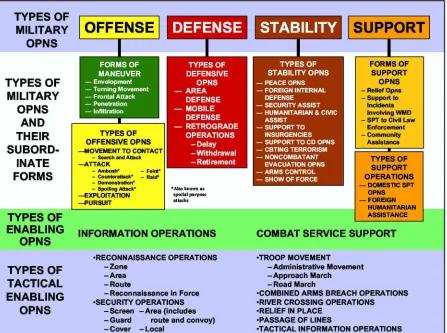
2-1. Figure 2-1 on page 2-2 shows the doctrinal hierarchy and relationship
between the types and subordinate forms of operations. While an operation's
CONTENTS
Doctri nal Hierarchy ..2-1
The Operational Framework 2-3
Principles of War 2-3
Tenets of Army Operations 2-4
The Factors of METT-TC 2-4
Elements of Operational Design 2-4 Battlefield Operating Systems 2-5
Basic Tactical Concepts 2-5
Combined Arms 2-6
Decisively Engaged 2-6
Defeat in Detail 2-7
Flanks 2-7
Maneuver ..2-8
Mutual Support 2-8
Operation ..2-8
Piecemeal Commitment 2-9
Reconstitution ..2-9
Rules of Engagement 2-9
Supporting Distance 2-10
Supporting Range ..2-10
Tactical Mobility 2-10
Basic Tactical Graphic Control
Measures 2-10
Air Corridor 2-11
Area of Operations and Boundaries.. 2-12
Assembly Areas 2-18
Checkpoint 2-19
Contact Point 2-20
Critical Friendly Zone 2-20
Direct Fire Control Measures 2-20 Deep, Close, and Rear Areas 2-24 Fire Support Coordination
Measures 2-26
Fire Support Targets 2-31
Forward Line of Own Troops 2-32
Line of Contact 2-32
Names Area of Interest 2-33
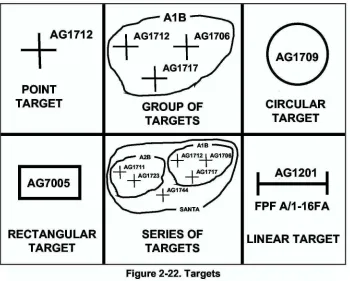
Obstacle Control Measures 2-33
Phase Line 2-37
Position Area of Artillery 2-37
Route 2-38
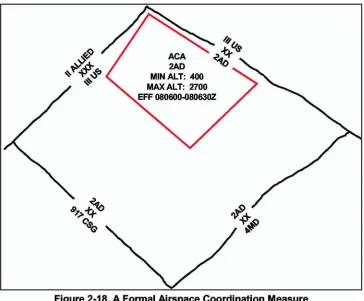
TYPES OF MILITARY OPNS TYPES OF MILITARY OPNS AND THEIR SUBORD-INATE FORMS TYPES OF ENABLING OPNS TYPES OF TACTICAL ENABLING OPNS
predominant characteristic labels it as an offensive, defensive, stability, or
support operation, different units involved in that operation may be
con-ducting different types and subordinate forms of operations, and often
transition rapidly from one type or subordinate form to another. The
commander rapidly shifts from one type or form of operation to another to
continually keep the enemy off balance while positioning his forces for
maximum effectiveness. Flexibility in transitioning contributes to a
successful operation. A good tactician chooses the right combinations of
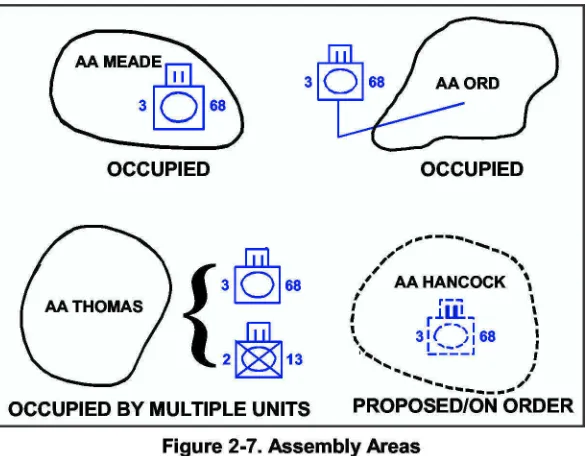
combined arms to place the enemy at the maximum disadvantage.
DEFENSE
STABILITY
TYPES OF
OFFENSIVE OPNS
-MOVEMENT TO CONTACT
-Search and Attack -ATTACK
- Ambush'" - Feint'" - Counterattack'" - Raid* - Demonstration'" -Spoiling Attack'" -EXPLOITATION -PURSUIT
FORMS OF SUPPORT
OPNS -Relief Opns
-Support to Incidents Involving WMD
-SPT to Civil Law Enforcement
-Community Assistance
"'Also known as special purpose attacks
TYPES OF SUPPORT OPERATIONS
- DOMESTICSPT OPNS
- FOREIGN HUMANITARIAN
-ASSISTANCE
INFORMATION OPERATIONS COMBAT SERVICE SUPPORT
-RECONNAISSANCE OPERATIONS
-Zone
- Area -Route
-Reconnaissance in Force -SECURITY OPERATIONS
-Screen -Area (includes - Guard route and convoy)
-Cover -local
-TROOP MOVEMENT -Administrative Movement -Approach March - Road March
-COMBINED ARMS BREACH OPERATIONS -RIVER CROSSING OPERATIONS -RELIEF IN PLACE
-PASSAGE OF LINES
-TACTICAL INFORMATION OPERATIONS
Figure 2-1. Doctrinal Hierarchy of Operations
2-2. The commander conducts tactical enabling operations to assist the
plan-ning, preparation, and execution of any of the four types of military
opera-tions (offense, defense, stability, and support). Tactical enabling operations are never decisive operations in the context of offensive and defensive
opera-tions; they are either shaping or sustaining operations. Part N of this
man-ual discusses tactical enabling operations that are not the subject of a
sepa-rate field manual. The commander uses tactical enabling operations to help
2-3. This hierarchy does not describe discrete, mutually exclusive operations. All tactical missions can contain elements of several different types and
sub-ordinate forms. For example, an attacking commander may have one
subordi-nate conducting an envelopment, with another subordinate conducting a
frontal attack to fIx the enemy. The enveloping force usually attacks once the
direct-pressure force makes a movement to contact while repeatedly
attacking to keep pressure on the fleeing enemy. The encircling force uses an
envelopment to conduct a series of attacks to destroy or clear enemy forces in its path on the way to its blocking position. Once it occupies the blocking posi-tion, the unit may transition to a defense as it blocks the retreat of the fleeing enemy force.
THE OPERATIONAL FRAMEWORK
2-4. The operational framework consists of the arrangement of friendly forces
and resources in time, space, and purpose with respect to each other and the
enemy or situation. It consists of the area of operations, battlespace, and the
battlefIeld organization (FM 3-0). The framework establishes an area of
geo-graphic and operational responsibility for commanders and provides a way
for them to visualize how they will employ forces against the enemy. Army
commanders design an operational framework to accomplish their mission by
defIning and arranging its three components. The commander uses the
opera-tional framework to focus combat power. Combat power is the total means of
destructive and/or disruptive force which a military unit/formation can apply against the opponent at a given time (JP 1-02).
2-5. As part of the military decision making process, the commander
visual-izes his battlespace and determines how to arrange his forces. The battlefield
organization is the allocation of forces in the area of operations by purpose. It consists of three all-encompassing categories of operations: decisive, shaping,
and sustaining (FM 3-0). Purpose unifIes all elements of the battlefIeld
organization by providing the common focus for all actions. The commander
organizes his forces according to purpose by determining whether each unit's
operation will be decisive, shaping, or sustaining. Those decisions form the
basis of his concept of operations. He describes the area of operations (AO) in
terms of deep, close, and rear areas when the factors ofMETT-TC require the
use of a spatial reference. FM 3-0 explains the operational framework and
battlefIeld organization.
PRINCIPLES
OF WAR
2-6. The nine principles of war defIned in FM 3-0 provide general guidance
for conducting war and military operations other than war at the strategic,
operational, and tactical levels. They are fundamental truths governing
combat operations. The principles are the enduring bedrock of Army doctrine.
First published in 1923 as general principles in Field Service Regulations
United States Army, they have stood the tests of analysis, experimentation, and practice. They are not a checklist and their degree of application varies
with the situation. Blind adherence to these principles does not guarantee
TENETS OF ARMY OPERATIONS
2-7. The tenets of Army operations-initiative, agility, depth, synchronization, and
versatility-build on the principles of war. They further
de-scribe the characteristics of successful
opera-tions. While they do not guarantee success, their absence risks failure. FM 3-0 defines the tenets.
THE FACTORS OF METT-TC
2-8. The six factors of METT-TC-mission,
enemy, terrain and weather, troops and support
available, time available, and civil
considera-tions-describe the unique situation in which a
tactician executes the science and art of tactics. An analysis of the factors of METT-TC is critical
during the military decision making process. The
METT-TC analytical framework is useful in
as-sessing operations planning, preparing, and
exe-cuting. The tactician considers these six factors for any type of operation. Their impact on an op-eration will differ, but each must be considered as factors during the commander's visualization process. That consideration involves both the sci-ence and art of tactics. For example, terrain and
weather effects on movement rates and fuel
con-sumption are quantifiable and, therefore, part of
the science of war. Terrain and weather effects
on soldier morale are not totally quantifiable and are part of the art of war. FM 6-0 provides a
de-tailed discussion of the factors of METT
-
TC.ELEMENTS
OF OPERATIONAL
DESIGN
2-9. A major operation begins with a design-an
idea that guides the conduct (plan, prepare,
exe-cute, and assess) of the operation. The
opera-tional design provides a conceptual linkage of
ends, ways, and means. The elements of
opera-tional design are tools to aid the commander in
visualizing major operations and shaping his
in-tent. They help the commander clarify and refine
his vision by providing a framework for him to
describe the operation in terms of task and
purpose. FM 3-0 defines each of these elements.
Their utility diminishes with each succeeding
tactical echelon. What is envisioned as a decisive
point by the land component commander
becomes a clearly delineated objective for a
battalion task force.
Principles of War
.
Objective.
Offensive.
Mass
.
Economy of force.
Maneuver
.
Unityof command.
Security.
Surprise.
SimplicityTenets
of Army
Operations
.
Initiative.
Agility.
Depth.
Synchronization.
Versatility Factors of METT -TC.
Mission.
Enemy.
Terrain and weather.
Troops and supportavailable
.
Time available.
Civil considerationsElements of
Operational
Design
.
End state and military conditions.
Center of gravity.
Decisive points andobjectives
.
Lines of operation.
Culminating point.
Operational reach,approach, and pauses
.
Simultaneous andsequential operations
.
Linear and nonlinearBATTLEFIELD
OPERATING
SYSTEMS
2-10. There are seven battlefield operating
systems (BaS). The seven BaS definitions
from FM 7-15
are-.
The intelligence system is the activityto generate knowledge of and products
portraying the enemy and the
environmental features required by a
command planning, preparing, and
executing operations.
.
The maneuver system is the movementof forces to achieve a position of
advantage with respect to enemy
forces. This system includes the employment of forces on the battlefield
in combination with direct fire or fire potential. This system also
includes the conduct of tactical tasks associated with force projection.
.
The fire support system encompasses the collective and coordinated useof target-acquisition data, indirect-fire weapons, fixed-wing aircraft,
offensive information operations, and other lethal and nonlethal means
against targets located throughout an AO.
.
The air defense system is the employment of all active measuresdesigned to nullify or reduce the effectiveness of attack by hostile
aircraft and missiles after they are airborne.
.
The mobility, countermobility, and survivability system..
Mobility operations preserve the freedom of maneuver of friendly forces..
Countermobility operations deny mobility to enemy forces..
Survivability operations protect friendly forces from the effects of enemy weapon systems..
The combat service support system is the support and services providedto sustain forces during war and military operations other than war.
.
The command and control system includes all collective tasksasso-ciated with supporting the exercise of authority and direction by a
properly designated commander over assigned and available forces in
the accomplishment of the mission.
The BaS provide the Army a common taxonomy of critical tactical activities.
They provide the commander and his staff a means of assessing the planning,
preparation, and execution of an operation in discrete subsets.
Battlefield Operating
Systems
.
Intelligence.
Maneuver.
Fire support.
Air defense.
Mobility/countermobility/survivability
.
Combat service support.
Command and controlBASIC TACTICAL CONCEPTS
2-11. The following paragraphs contain basic tactical concepts common to
both offensive and defensive operations. They are listed in alphabetical order,
not in order of importance. These concepts, along with the principles of war,
tenets of Army operations, factors of METT-TC, estimates, input from other
commanders, and the commander's experience and judgment allow him to
COMBINED ARMS
2-12. Combined arms is the synchronized or simultaneous application of
several arms-such as infantry, armor, artillery, engineers, air defense, and
aviation-to achieve an effect on the enemy that is greater than if each arm
was used against the enemy separately or in sequence (FM 3-0). Weapons and
units are more effective when they operate in concert. No single action,
weapon, branch, or arm of service generates sufficient power to achieve the
effects required to dominate an opponent.
2-13. Combined arms is more than the combat arms working together. Each
branch of the Army provides unique capabilities that complement the other
branches. A combined arms team consists of two or more arms supporting one
another. The commander takes his available combat, combat support (CS),
and combat service support (CSS) elements and forms them into a combined
arms team focused on mission accomplishment. The proper combination of
actions and systems by the combined arms team is the essence of combined
arms. The use of combined arms provides complementary and reinforcing
ef-fects and may have asymmetrical effects on an enemy force. (See FM 3-0 for
more information on symmetrical and asymmetrical effects.)
2-14. Armor, attack helicopter, and infantry units are normally the nucleus
of the combined arms team. However, emerging capabilities allow the
com-mander to use any combat arms unit, such as artillery and aviation, to form
that nucleus. The commander uses his combat arms forces in different
combi-nations to provide flexibility in conducting different types of operations in
varied terrain. For example, a commander may have his infantry lead in
mountains and cities when moving dismounted, while his armor leads in open
terrain. Attack helicopters can deliver large quantities of precision munitions
throughout the AO. A commander can conduct decisive operations using field
artillery Multiple Launch Rocket Systems (MLRS) and cannons augmented
by the effects of fixed-wing aviation, given the correct conditions. Air defense
artillery destroys enemy aerial assets to assist the free movement of the
friendly force. Engineers enhance the friendly force's mobility, degrade the
enemy's mobility, and assist in providing for survivability of the friendly
force. Combat support and CSS members of the combined arms team support
the combined arms nucleus by combining capabilities in an appropriate
manner to support and sustain the combined arms force.
DECISIVE ENGAGEMENT
2-15. A decisive engagement is an engagement in which a unit is considered
fully committed and cannot maneuver or extricate itself. In the absence of
outside assistance, the action must be fought to a conclusion and either won
or lost with the forces at hand (JP 1-02). The unit's mission is what usually
results in the acceptance of decisive engagement rather than the unit's
physical ability to extricate itself. For example, a unit might become
decisively engaged to hold key terrain, defeat a specific enemy force, or secure
a specific objective. Less common is a defender's decisive engagement as a
DEFEAT IN DETAIL
2-16. Defeat in detail is achieved by concentrating overwhelming
combat power against separate parts of a force rather than defeating
the entire force at once. A smaller force can use this technique to achieve
success against a larger enemy. Defeat in detail can occur sequentially
(de-feat of separate elements one at a time in succession). For example, a
com-mander can mass overwhelming combat power effects against an enemy
element outside the supporting distance of the rest of the enemy force. This
allows the commander to destroy the targeted enemy element before it can be
effectively reinforced.
2-18. An assailable {lank
is exposed to attack or
envelopment. It usually
re-sults from the terrain, the
weakness of forces, technical
capability of the opponent
(vertical envelopment), or a
gap between adjacent units.
If one flank rests on highly
restrictive terrain and the
other flank is on open
ter-rain, the latter is
immedi-ately recognized as the
as-sailable flank for a heavy
ground force. The flank on
the restrictive terrain may Figure 2-3. Flanks of an Armor-Heavy Team
be assailable for a light Moving in an Echelon Right Formation
force. Sufficient room must exist for the attacking force to maneuver for the
flank to be assailable. A unit may not have an assailable flank if both flanks FLANKS
2-17. Flanks are the right
or left limits of a unit. For
a stationary unit, they are
designated in terms of an
enemy's actual or expected
location. (See Figure 2-2.)
For a moving unit, they are
defined by the direction of
movement. (See Figure 2-3.)
The commanders tries to
deny the enemy
opportuni-ties to engage his flanks be-cause a force cannot
concen-trate as much direct fire on
the flanks as it can to the
front. Commanders seek to
engage enemy flanks for the
same reason.
t
BEMYLDCAl10N
1EAM LEFTRAN<
02J
I
Figure 2-2. Flanks of a Stationary Unit
n
: M- '. I-rI
\\
II ~
~I TEAM ~ nLEFTFLANK~ j §
J
DIRECTION OF
MOVEMENT
TEAM
RIGHT FLANK
.
~
j j }q
--n
n
trllink into other forces. When a commander has an assailable flank, he may
at-tempt to refuse it by using various techniques, such as supplementary
posi-tions.
2-19. A flanking position is a geographical location on the flank of a
force from which effective fires can be placed on that flank. An
attack-ing commander maneuvers to occupy flanking positions against a defending
force to place destructive fires directly against enemy vulnerabilities. A
defending commander maneuvers to occupy flanking positions on the flanks
of a hostile route of advance for the same reason. A flanking position that an
advancing enemy can readily avoid has little value to the defender unless the
enemy does not realize it is occupied.
MANEUVER
2-20. Maneuver is the employment of forces on the battlefield through
move-ment in combination with fire, or fire potential, to achieve a position of
ad-vantage in respect to the enemy in order to accomplish the mission (JP 1-02).
Maneuver creates and exposes enemy vulnerabilities to the massed effects of
friendly combat power. A commander employs his elements of combat power
in symmetrical and asymmetrical ways so as to attain positional advantage
over an enemy and be capable of applying those massed effects.
MUTUAL SUPPORT
2-21. Mutual support is that support which units render to each other
against an enemy because of their assigned tasks, their position relative to
each other and to the enemy, and their inherent capabilities (JP 1-02).
Mu-tual support exists between two or more positions when they support one
another by direct or indirect fire, thus preventing the enemy from attacking
one position without being fired on from one or more adjacent positions. That same relationship applies to units moving with relation to each other, except
they can maneuver to obtain positional advantage to achieve that support. It
is normally associated with fire and movement (maneuver), although it can
also relate to the provision of es and ess.
2-22. In the defense, the commander selects tactical positions to achieve the
maximum degree of mutual support. Mutual support increases the strength
of defensive positions, prevents the enemy from attempting to defeat the
at-tacking friendly forces in detail, and helps prevent infiltration. In the offense,
the commander maneuvers his forces to ensure a similar degree of support
between attacking elements.
OPERATION
2-23. An operation is a military action or the carrying out of a strategic,
tactical, service, training, or administrative military mission (JP 1-02). It
includes the process of planning, preparing, executing, and assessing those
offensive, defensive, stability, and support operations needed to gain the
objectives of any engagement, battle, major action, or campaign. It also
includes activities that enable the performance of full spectrum operations,
PIECEMEAL COMMITMENT
2-24. Piecemeal commitment is the immediate employment of units in
combat as they become available instead of waiting for larger
ag-gregations of units to ensure mass, or the unsynchronized
employ-ment of available forces so that their combat power is not employed
effectively. Piecemeal commitment subjects the smaller committed forces to
defeat in detail and prevents the massing and synchronizing of combat power
with following combat and CS elements. However, piecemeal commitment
may be advantageous to maintain momentum and to retain or exploit the
ini-tiative. A commander may require piecemeal commitment of a unit to
rein-force a faltering operation, especially if the commitment of small units
pro-vide all of the combat power needed to avert disaster. The "pile-on" technique
associated with search and attack operations employs the piecemeal
commit-ment of troops. (See Chapter 5 for a discussion of search and attack
opera-tions.)
RECONSTITUITON
2-25. Reconstitution is those actions that commanders plan and implement to
restore units to a desired level of combat effectiveness commensurate with
mission requirements and available resources. Reconstitution operations
include regeneration and reorganization (FM 4-100.9). Reconstitution is a
total process. It is not solely a CSS operation, though CSS plays an integral
role. The commander conducts reconstitution when one of his subordinate
units becomes combat ineffective or when he can raise its combat
effec-tiveness closer to the desired level by shifting available resources. Besides normal support actions, reconstitution may
include-.
Removing the unit from combat..
Assessing it with external assets..
Reestablishing the chain of command..
Training the unit for future operations..
Reestablishing unit cohesion.2-26. Reconstitution transcends normal day-to-day force sustainment actions.
However, it uses existing systems and units to do so. No resources exist solely to perform reconstitution. (See FM 4-100.9.)
RULES OF ENGAGEMENT
2-27. Rules of engagement (ROE) are directives issued by competent military
authority which delineate the circumstances and limitations under which
United States forces will initiate and/or continue combat engagement with
other forces encountered (JP 1-02). Operational requirements, policy, and law
define the commander's ROE. Rules of engagement impact on how a
com-mander conducts his operations in all four types of military operations by im-posing political, practical, operational, and legal limitations on his actions.
They may extend to criteria for initiating engagements with certain weapon
systems, such as employing unobserved indirect fires within the echelon rear
area, or reacting to an attack. They always recognize the right of self-defense
and the commander's right and obligation to protect assigned personnel.
Operational level commanders modify those standing ROE as necessary In
response to the factors ofMETT-TC.
SUPPORTING DISTANCE
2-28. Supporting distance is the distance between two units that can be
traveled in time for one to come to the aid of the other. For small units, it is
the distance between two units that can be covered effectively by their fires
(FM 3-0). Supporting distance is a factor of combat power, dispositions,
com-munications capability, and tactical mobility of friendly and enemy forces.
SUPPORTING RANGE
2-29. Supporting range is the distance one unit may be geographically
separated from a second unit, yet remain within the maximum range of the
second unit's indirect fire weapons systems. (FM 3-0). Major factors that
af-fect supporting range are terrain relief, the range of the supporting unit's
weapon systems, and their locations in relation to the supported unit's
posi-tion.
TACTICAL MOBILITY
2-30. Tactical mobility is the ability to move rapidly from one part of
the battlefield to another, relative to the enemy. Tactical mobility is a
function of cross-country mobility, firepower, and protection. The terrain, soil
conditions, and weather affect cross-country mobility. Heavy ground
maneu-ver units have good tactical mobility-except in restrictive terrain-combined
with firepower and protection. They can move on the battlefield against most
enemy forces unless faced with an enemy who can defeat their protection and
cannot be suppressed by friendly fires. Light ground maneuver units have a
tactical mobility advantage against enemy heavy forces in restrictive terrain,
but limited firepower and protection. Army aviation maneuver units have
good tactical mobility in most types of terrain, good firepower, but limited
protection. Extreme weather conditions can restrict the tactical mobility of
Army aviation units.
BASIC TACTICAL GRAPHIC
CONTROL MEASURES
2-31. This section establishes basic tactical graphic control measures common
to offensive and defensive operations. The appropriate chapters of this
man-ual discuss those graphic control measures that apply to only one type of
mili-tary operation. For example, Chapter 3 discusses the objective as a basic
of-fensive control measure since an objective is a graphic control measure that
applies only to offensive operations. These graphics apply to both automated
and hand-drawn graphic displays or overlays. This section portrays control
measures for use on situation maps, overlays, and annotated aerial
photo-graphs. They are also the standard for all simulations, to include those used in live, virtual, and constructive environments.
2-32. Units conducting tactical operations must have clearly defined tasks
and responsibilities. The commander uses control measures to establish
speci-fic responsibilities that prevent units from impeding one another and impose
something to happen) or restrictive
(which limits how something is
done). Control measures may be
graphical, such as boundaries, or
procedural, such as target
engage-ment priorities. A commander
should establish only the minimum
control measures necessary to
pro-vide essential coordination and
de-confliction between units. Control
measures must not unduly restrict
subordinates in accomplishing their
missions. The commander removes
restrictive control measures as soon
as possible. FM 1-02 discusses the
rules for drawing control measures
on overlays and maps.
2-33. Well-conceived control
meas-ures facilitate the conduct of
cur-rent and future operations. The
commander adjusts his control
measures as necessary to maintain
synchronization and ensure mission
accomplishment as the tactical situation evolves. He balances the risk of
in-troducing additional friction into the operation with the benefits gained by
changing them if all of his subordinate elements do not receive the new
con-trol measures when contemplating changes to previously established control
measures.
Basic Tactical Graphic
Control Measures
.
Air corridor and air control points.
Area of operations and boundaries.
Assembly areas.
Checkpoint.
Contact point.
Critical friendly zones.
Direct fire control measures.
Deep, close, and rear areas.
Engagement area.
Fire support coordination measures.
Fire support targets.
Forward line of own troops.
Line of contact.
Named area of interest.
Obstacle control measures.
Phase lines.
Position areas for artillery.
Routes.
Targeted area of interest2-34. Control measures apply to all forces: combat, CS, and CSS. The
com-mander ensures all higher-echelon control measures, such as phase lines
(PLs) and checkpoints, are incorporated into his graphic control measures.
When he reports to higher headquarters, he references only the control
meas-ures established by that headquarters.
AIR CORRIDOR AND AIR CONTROL POINTS
2-35. An air corridor is a restricted air route of travel specified for use by
friendly aircraft and established for the purpose of preventing friendly
aircraft from being fired on by friendly forces (JP 1-02). It is used to deconflict
artillery firing positions with aviation traffic. Low-level transit routes,
minimum-risk routes, standard use army aircraft flight routes, and UA V
routes are types of air corridors. An air corridor always includes air control points. An air control point (ACP) is an easily identifiable point on the terrain or an electronic navigational aid used to provide necessary control during air
movement. ACPs are generally designated at each point where the flight
route or air corridor makes a definite change in direction and at any other
point deemed necessary for timing or control of the operation (FM 3-52).
(Figure 2-4 onpage 2-12 depicts a generic air corridor and ACPs. See FM 3-52
AREA OF OPERATIONS AND BOUNDARIES
2-36. An AO is the basic
control measure for all
types of operations. An
area of operations is an
op-erational area defined by
the joint force commander for land and naval forces.
Areas of operations do not
typically encompass the
entire operational area of
the joint force commander, but should be large enough
for component
command-ers to accomplish their
missions and protect their forces (JP 1-02). The joint force land component
commander (JFLCC) or the Army service component command (ASCC)
commander will in turn assign their subordinates their own AOs. Those
subordinates will further assign their subordinates AOs down to the battalion
or company level based on the factors of METT-TC. A unit assigned an AO,
the owning unit, may not change control measures imposed by a higher
headquarters within their AO. However, it may establish additional control
measures to coordinate and synchronize its operations. Name: BIRDMAN Width: 200m Min Alt: 50ft AGL Max Alt: 500ft AGL
Figure 2-4. Generic Air Corridor
2-37. Assigning an AO to a
subordi-nate headquarters maximizes
decen-tralized execution by empowering
subordinate commanders to use their
own initiative to accomplish their
assigned missions. This encourages
the use of mission command. (See FM 6-0 for a discussion of mission
com-mand.) At the same time it adds the responsibilities listed in Paragraph 2-40
below to the lower headquarters. Conversely, failure to designate subordinate
AOs maximizes centralized execution and limits the subordinates' tactical
options. The latter choice should be made only when mandated by the factors
of METT-TC. For example, a brigade commander responsible for blocking an
enemy advance along a single avenue of approach may assign his subordinate
battalions battle positions to support a brigade engagement area (EA) instead
of subdividing his AO and the avenue of approach into battalion AOs.
2-38. A higher headquarters designates an AO using boundaries. It normally
assigns an AO to a maneuver unit, but it may also assign one to CS or CSS
units. Having an AO assigned both restricts and facilitates the movement of
units and use of fires. It restricts units not assigned responsibility for the AO from moving through the AO. It also restricts outside units from firing into or allowing the effects of its fires to affect the AO. Both of these restrictions can be relaxed through coordination with the owning unit. It facilitates the move-ment and fires of the unit assigned responsibility for, or owning, the AO. The
assigned AO must encompass enough terrain for the commander to
accom-plish his mission and protect his forces.
An avenue of approach is
the air or ground route
leading to an objective (or
key terrain in its path) that
2-39. Ideally, the AO is smaller than the commander's area of influence. An area of influence is a geographical area wherein a commander is directly
cap-able of influencing operations by maneuver or fire support systems normally
under the commander's command or control (JP 1-02). If the commander's
area of influence is smaller than his AO, he must consider his options for
ex-tending the size of his area of influence. His options include the following
techniques:
.
Changing the geographical dispositions of his current systems toin-crease the size of his area of influence and ensure coverage of key
areas, installations, and systems.
.
Requesting additional assets..
Requesting boundary adjustments to reduce the size of his AO..
Accepting the increased risk associated with being unable to providesecurity throughout the AO.
.
Moving his area of influence by phases to sequentially encompass theentire AO.
2-40. All units assigned an AO have the following responsibilities:
.
Terrain management..
Movement control..
Fires..
Security.Selected echelons have an additional responsibility to provide airspace
com-mand and control.
Terrain Management
2-41. The commander assigned an AO is responsible for terrain management
within its boundaries. A higher headquarters may dictate that another unit
position itself within a subordinate unit's AO, but the commander assigned
the AO retains final approval authority for the exact placement. This ensures
the unit commander controlling the AO knows what units are in his AO and
where they are located so that he can deconflict operations, control
move-ment, and prevent fratricide. Only the owning commander assigns
subordi-nate unit boundaries within the AO.
Movement Control
2-42. Units may not move across boundaries into another unit's AO without
receiving clearance from the unit owning the AO. Once assigned an AO, the
owning unit controls movement throughout the AO. The designation,
mainte-nance, route security, and control of movement along routes within an AO are
the responsibility of the owning unit unless the higher echelon's coordinating
instructions direct otherwise. The commander may designate movement
routes as open, supervised, dispatch, reserved, or prohibited. Each route's
designation varies based on the factors of METT-TC. FM 4-01.30 discusses
Fires
2-43. Within its AO, the owning unit may employ any direct or indirect fire
system without receiving further clearance from superior headquarters.
There are three exceptions: The first and most common is that a unit may not
use munitions within its own AO without receiving appropriate clearance if
the effects of those munitions extend beyond its AO. For example, if a unit
wants to use smoke, its effects cannot cross boundaries into another AO
unless cleared with the adjacent owning unit. Second, higher headquarters
may explicitly restrict the use of certain munitions within an AO or parts of
an AO, such as long-duration scatterable mines. Third, higher headquarters
may impose a restrictive fire support coordinating measure (FSCM) within an
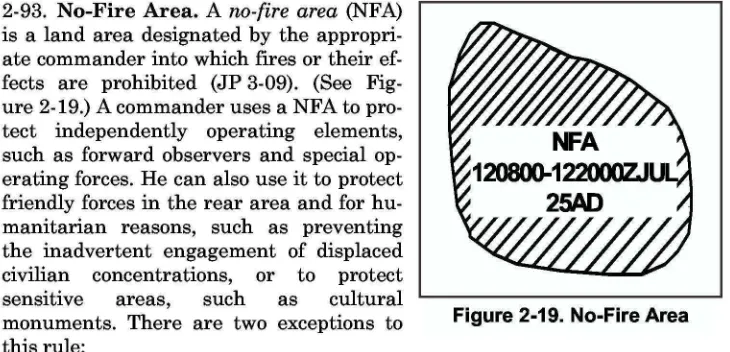
AO to protect some asset or facility, such as a no-fire area around a camp
housing dislocated civilians. These FSCM tend to be linear in nature in a
con-tiguous AO while they are more likely areas in a nonconcon-tiguous AO.
2-44. The commander may not employ indirect fires across boundaries
with-out receiving clearance from the unit into whose AO the fires will impact. He
may employ direct fires across boundaries without clearance at specific point targets that are clearly and positively identified as enemy.
Security
2-45. The security of all units operating within the AO is the responsibility of
the owning commander. This fact does not require that commander to
con-duct area security operations throughout his AO. (See Chapter 12 for a
dis-cussion of area security responsibilities.) He must prevent surprise and
pro-vide the amount of time necessary for all units located within the AO to
effectively respond to enemy actions by employing security forces around
those units. If the commander cannot or chooses not to provide security
throughout his AO, he must clearly inform all concerned individuals of when,
where, and under what conditions he is not going to exercise this function.
The commander generally depicts these locations using permissive FSCM.
Each unit commander remains responsible for his unit's local security.
Airspace Command and Control
2-46. Army airspace command and control (A2C2) are those actions that
en-sure the synchronized use of airspace and enhanced command and control of
forces using airspace (FM 3-52). The ground maneuver commander manages
the airspace below the coordinating altitude, using procedural control
meas-ures and positive control measures implemented by his air traffic service
or-ganization. Corps and divisions are the echelons that routinely have A2C2
responsibilities, although a commander may provide the resources to
accom-plish this function to a brigade operating independently.
2-47. Communications, standardized procedures, and liaison normally
pro-vide the commander with his required connectivity with the theater airspace
control authority. The commander ensures reliable communications through
his area communications network. He supervises airspace activities through
standardized procedures to prevent real-time conflicts among the various
air-space users while achieving the necessary flexibility to ensure the greatest
that liaison capability with the airspace control authority (ACA). (See
FM 3-52 and JP 3-52 for additional information regarding airspace control
doctrine.)
2-48. The vertical dimension, or airspace, of the AO is inherently permissive
because all branches and services require the use of airspace. There are
pro-cedural and positive airspace control measures (ACM) available to
synchro-nize military operations in the airspace above the AO. Among the procedural
ACM is the coordinating altitude, which separates fIxed- and rotary-wing
air-craft by determining an altitude below which fIxed-wing aircraft will
norm-ally not fly and above which rotary-wing aircraft will normally not fly. It
al-lows the ground commander to use the airspace above his AO for his organic
aviation assets to complement ground maneuver forces, but it is not a
bound-ary for which he has responsibility. The ACA, normally the joint force air
component commander, must establish the coordinating altitude, promulgate
it through the airspace control plan, address it in the airspace control order, and include a buffer zone for small altitude deviations. Coordinating altitudes
are permissive ACM.
Boundaries
2-49. A boundary is a line that delineates surface areas for the purpose of
facilitating coordination and deconfliction of operations between adjacent
units, formations, or areas (JP 0-2). The commander uses graphic control
measures to defIne the limits of an AO and, as such, establish ground forces'
responsibilities. He uses ACM to control the vertical dimension. The
com-mander bases his subordinates' boundaries on clearly defIned terrain
fea-tures. This requirement is less important if all units in the AO have precision navigation capabilities. Boundaries should not split roads, rivers, or railways.
Responsibility for an avenue of approach and key terrain should belong to
only one unit. The commander adjusts his boundaries as necessary in
re-sponse to the evolving tactical situation. Any areas not delegated to a subord-inate remain the responsibility of the commander.
Contiguous and Noncontiguous AOs
2-50. A commander has a contiguous AD when all of his subordinate
forces' areas of operations share one or more common boundaries. A
commander has a noncontiguous AD when one or more of his
sub-ordinate forces' areas of operations do not share a common
bound-ary. The intervening area between noncontiguous AOs remains the
respon-sibility of the higher headquarters. The commander can choose to organize
his AO so that his subordinates have contiguous or noncontiguous areas of
operations.
2-51. The forward boundary of an echelon is primarily designated to divide
responsibilities between it and its next higher echelon. Decisive or shaping
operations directed against enemy forces beyond an echelon's forward
bound-ary are the responsibility of the next higher echelon. The higher echelon
headquarters normally assigns the lower echelon a forward boundary based
on the higher echelon's scheme of maneuver. The ability to acquire and attack
targets in the area between the forward boundary of its subordinates and the
boundary. For example, if a division assigns a forward boundary to a brigade,
then the division conducts operations beyond the brigade's forward boundary.
That area between the brigade's forward boundary and the division's forward
boundary is the division's deep area. The rear boundary defines the rearward
limits of the unit's area. It usually also defines the start of the next echelon's
rear area. Lateral boundaries extend from the rear boundary to the unit's
forward boundary. (See Figure 2-5.)
CORPS FORWARD BOUNDARY
xxx
CORPS LATERAL BOUIIDARIES
CORPS DEEP AREA
DlVlSlQNFORWARDBOUNDARIES
BRIGADE SECURITY AREAS
i
r
DMSlOO LATERAL---.
BOUIIDARIES
~
~
x--1-.x
~
II~
DlVlSlOO
RESERVE
DIVISION REAR AREA
XX
FEBA
CORPS CLOSE
AREA
CORPS
REAR BOUNDARY
j
CORPS ~AREAFigure 2-5. Corps with Contiguous Areas of Operations
2-52. The commander bases his decision to establish contiguous AOs on his
analysis of the factors of METT-TC. Units with contiguous AOs are normally
within supporting distance of one another and may be within supporting
range. Other reasons why a commander establishes contiguous AOs
include-.
Limited size of the AO in relation to the number of friendly forces..
Decisive points in close physical proximity to each other..
Political boundaries or enemy force concentrations require establishingcontiguous AOs.
.
Reduced risk of being defeated in detail because of an incompleteop-erational picture or when the friendly force is significantly
outnum-bered.
.
Greater concentration of combat power along a single avenue of2-53. A noncontiguous AO does not have distinctive forward, rear, and lateral
boundaries. It is established by a boundary that encloses the entire area.
Subordinate boundaries will be continuous, 360-degree arcs that closely
ap-proximate the subordinate unit's area of influence. For example, the
com-mander would normally place a noncontiguous brigade boundary at the limit
of observed fires for its security forces. Because noncontiguous boundaries
must provide all-around security, they generally allow for less concentration
of combat power along a single axis. A brigade, division, or corps commander
who establishes noncontiguous AOs for his subordinates still designates an
echelon rear area. Battle positions are not AOs since a unit is not restricted
from operating outside its battle position. A commander who deploys his
sub-ordinates into battle positions is not conducting noncontiguous operations.
Chapter 8 defines a battle position.
2-54. Operations directed against enemy forces and systems outside a
non-contiguous AO are the responsibility of the organization that owns that
loca-tion. For example, in Figure 2-6 the middle enemy division is the corps'
re-sponsibility since it is not within either of the corps' two divisions' AOs.
Figure 2-6. Corps with Noncontiguous Areas of Operations
2-55. The commander bases his decision to establish noncontiguous AOs on his analysis of the factors of METT
-
TC. There is a risk associated withestab-lishing noncontiguous AOs since units with noncontiguous AOs are normally
out of supporting range from each other. Overcoming this risk places a
pre-mium on situational understanding and tactical mobility. Reasons why a
commander establishes noncontiguous AOs
include-.
Encompassing key and decisive terrain within his area of influencewhen he has limited numbers of friendly forces for the size of the AO.
Key terrain is any locality, or area, the seizure or retention of
Decisive terrain, when present, is key terrain whose seizure and retention is mandatory for successful mission accomplish-ment.
.
Comparative weakness of the enemy means that subordinates do nothave to remain within supporting range or distance of one another and
can take advantage of superior situational understanding and tactical
mobility.
.
Enemy concentrated in dispersed areas requires a correspondingcon-centration of friendly forces.
.
Existence of large contaminated areas within his AO.2-56. Using noncontiguous AOs place a premium on the use of innovative
means to conduct sustaining operations, including aerial resupply. A
com-mander whose subordinates have noncontiguous AOs has three basic choices
for establishing intermittent ground lines of communications (LOCs) with his
subordinates:
.
Assign a subordinate the mission of providing convoy security for eachconvoy. For the situation depicted in Figure 2-7, the corps could assign
the corps military police brigade the mission of providing convoy
security for critical ground convoys traveling between the corps rear
area and each division's rear area.
.
Assign a subordinate the mission of providing route security for eachsustainment route. For the situation depicted in Figure 2-7 the corps
could assign the corps armored cavalry regiment an AO that extends
four kilometers on either side of LOCs LEWIS and CLARK. The
regi-ment would be assigned the mission of route security within that AO
for the period required for sustainment convoys to travel to and from
the two subordinate divisions.
.
Assume risk by having the corps support command run convoys withonly their organic self-defense capabilities, while assigning another
unit the mission of responding to enemy contacts beyond a convoy's
self-defense capability.
ASSEMBLY AREAS
2-57. An assembly area (AA) is an area a unit occupies to prepare for
an operation. Ideally, an assembly area
provides-.
Concealment from air and ground observation..
Cover from direct fire..
Space for dispersion; separate each AA by enough distance from otherAAs to preclude mutual interference.
.
Adequate entrances, exits, and internal routes..
Good drainage and soil conditions that can sustain the movement of theunit's vehicles and individual soldiers.
.
Terrain masking of electromagnetic signatures..
Terrain allowing observation of ground and air avenues into the AA..
Sanctuary from enemy medium-range artillery fires because of itsCHECKPOINT
2-58. The commander assigns each unit its own AA. In Figure 2-7, the
ex-ample of multiple units occupying one AA is a graphical shortcut taken when
the map scale would make depiction of multiple assembly areas unreadable.
In reality, the commander would subdivide AA Thomas into two smaller AAs,
one for each unit. A unit AA is normally within the AO of another unit. An
AA area is usually treated as a noncontiguous AO. This means that a unit has
the same responsibilities within its assigned AA as it has for any other AO.
OCCUPIED OCCUPIED
{
3~6821J13
t1' """ ,~
"',
,
'\
,/
AA HANCOCK\
I
r--
,
:
rlUL~
"
31(.~): 68
:
~4Irt L~~-J,
"~ I
"' ".,1
OCCUPIED BY MULTIPLE UNITS PROPOSED/ON ORDER
Figure 2-7. Assembly Areas
2-59. The proper location of AAs contributes significantly to both security and flexibility. It should facilitate future operations so movement to subsequent
positions can take place smoothly and quickly by concealed routes. Because of
their smaller signature, light units can use AAs closer to the enemy than
heavy units without excessive risk of enemy detection. The tactical mobility of
heavy units allows them to occupy AAs at a greater distance from the line of
departure (LD) than light units.
2-60. A checkpoint is a predetermined
point on the ground used tocontrol
move-ment, tactical maneuver, and orientation.
Units can also use a checkpoint as a fire control
measure in lieu of the preferred control
meas-ure, a target reference point. Checkpoints are
useful for orientation. Units may use
check-points to supplement or as substitutes for phase lines (PLs). They are also used in the conduct of
CSS. Figure 2-8 depicts Checkpoint 13.
CP13
CONTACT POINT
2-61. A contact point is an easily
identi-fiable point on the terrain where two or
more ground units are required to make
physical contact. A commander establishes a
contact point where a PL crosses a lateral
boundary or on other identifiable terrain as a
technique to ensure coordination between two
units. He provides a date-time group to
indicate when to make that physical contact.
Figure 2-9 depicts Contact Point 8.
2-62. The mutual higher commander of two moving units normally
desig-nates the location of contact points and times of contact. When one unit is
sta-tionary, its commander normally designates the location of the contact point
and the meeting time, and transmits this information to the commander of
the moving unit.
071830Z
FEB02
8
Figure 2-9. Contact Point 8
CRITICAL FRIENDLY ZONE
2-63. A critical friendly zone (CFZ) is an area, usually a friendly unit
or location, that the maneuver commander designates as critical to
the protection of an asset whose loss would seriously jeopardize the
mission. The exact size and shape of the CFZ reflects the technical
charac-teristics of the sensor coverage and varies in accordance with the terrain.
There is no specific graphic for a CFZ. The designation of a CFZ requires the
availability of a target acquisition sensor to cover that area and fire support
weapon systems to conduct counterfire. The supporting field artillery unit's
automated fire support system is tied to that sensor to place the location of a
weapon firing into the CFZ ahead of all other targets in priority for
counterfire. This results in an immediate call for fire unless the system
operator manually overrides the automated request for fire. (For additional
information on the employment of a CFZ, see FM 3-09.12.)
DIRECT FIRE CONTROL MEASURES
2-64. The small unit commander communicates to his subordinates the
manner, method, and time to initiate, shift, and mass fires, and when to
dis-engage by using direct fire control measures. The commander should control
his unit's fires so he can direct the engagement of enemy systems to gain the
greatest effect. The commander uses intelligence preparation of the
battle-field (IPB) and reconnaissance to determine the most advantageous way to
use direct fire control measures to mass the effects on the enemy and reduce
fratricide from direct fire systems. He must understand the characteristics of
weapon systems and available munitions (such as the danger to unprotected
soldiers when tanks fire discarding sabot ammunition over their heads or
near them). Direct fire control measures defined in this manual include
engagement criteria, engagement priorities, sectors of fire, and target
reference points. Platoon and company maneuver manuals address other
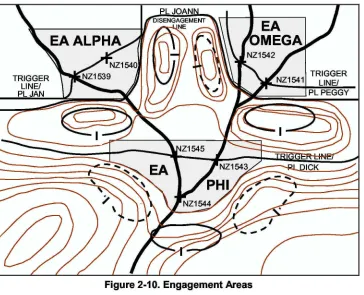
Engagement Area
2-65. An engagement area (EA) is an area where the commander
in-tends to contain and destroy an enemy force with the massed effects
of all available weapons and supporting systems. This includes organic
direct fire systems and supporting systems, such as close air support.
Fig-ure 2-10 depicts several EAs used within the context of a battalion defense.
The commander determines the size and shape of the EA by the relatively
un-obstructed intervisibility from the weapon systems in their firing positions
and the maximum range of those weapons. The commander designates EAs
to cover each enemy avenue of approach into his position. He also can use
them to designate known or suspected enemy locations. Once the commander
selects his EA, he arrays his forces in positions to concentrate overwhelming
effects into these areas. He routinely subdivides his EA into smaller EAs for
his subordinates using one or more target reference points or by prominent
terrain features. The commander assigns sectors of fires to subordinates to
prevent fratricide, but responsibility for an avenue of approach or key terrain
is never split. These sectors normally do not affect friendly maneuver.
Com-manders of units up to battalion task force size normally use this control
measure.
TRIGGER LINE! PLJAN
Figure 2-10. Engagement Areas
Engagement Criteria
2-66. Engagement criteria are protocols that specify those
circum-stances for initiating engagement with an enemy force. They may be
restrictive or permissive. For example, a company commander could tell his
within its EA before initiating fire. Another example is a battalion
command-er telling one of his company commanders not to engage an approaching
en-emy unit until it commits itself to an avenue of approach. The commander
establishes his engagement criteria in the direct fire plan. Commanders and
leaders of small tactical units use engagement criteria in conjunction with
engagement priorities and other direct fire control measures to mass fires
and control fire distribution.
Engagement Priority
2-67. Engagement priority specifies the order in which the unit
en-gages enemy systems or functions. The commander assigns engagement
priorities based on the type or level of threat at different ranges to match
organic weapon systems capabilities against enemy vulnerabilities.
Engage-ment priorities are situationally dependent. The commander uses
engage-ment priorities to distribute fires rapidly and effectively. Subordinate
ele-ments can have different engagement priorities. For example, the commander
establishes his engagement priorities so that his M2 Bradley fighting vehicles
engage enemy infantry fighting vehicles or armored personnel carriers while
his M1 Abrams tanks engage enemy tanks. Normally, units engage the most
dangerous targets first, followed by targets in depth.
Sector of Fire
2-68. A sector of fire is that
area assigned to a unit, a
crew-served weapon, or an
individual weapon within
which it will engage targets
as they appear in
accord-ance with established
en-gagement priorities. (See
Figure 2-11.) Battalions and
smaller echelons primarily use
this direct fire control measure.
Each sector of fire can extend
from a firing position to the
maximum engagement range of
the weapon, or it can be an enclosed area at a distance from the firing
position. To increase the commander's ability to concentrate fires in a certain
area, he should assign each unit or weapon system a primary sector of fire
and a secondary sector of fire. The primary sector of fire is that area in which the assigned unit, individual, or crew-served weapon is initially responsible
for engaging and defeating the enemy. Fire shifts to the secondary sector, on
order, when there are no targets in the primary sector, or when the
commander needs to cover the movement of another friendly element. This
secondary sector of fire should correspond to another element's primary
sector of fire to obtain mutual support. Subordinate commanders may impose
additional fire control measures as required.
SECONDARY
":~o:,~
:~;"
,.".'
" ,
SECTORS OF FIRE EXTENDING FROM FIRING POSITION
Target Reference Point
2-69. A target reference point (TRP) is an
easily recognizable point on the ground,
such as a building or a road junction, used
in conjunction with engagement areas and
sectors of fire to initiate, distribute, and
control fires. A TRP may be a natural terrain
feature, a manmade artifact, such as a building,
or a marker emplaced by the unit. Maneuver
leaders at battalion and below designate TRPs to
define unit or individual sectors of fire and ob- Figure 2-12.
servation, usually within an EA. A TRP can also Target Reference Point
designate the center of an area where the
com-mander plans to rapidly distribute or converge fires. A task force commander
designates TRPs for his company teams. Company commanders designate
TRPs for their platoons, sections, and, in some cases, individual weapons.
Platoon leaders or subordinate leaders may designate additional TRPs for
their elements as necessary to control direct and indirect fires. The echelon fire support officer can also designate TRPs as indirect fire targets by using
the standard target symbol with letters and numbers. Figure 2-12 depicts the
symbol for TRP 032.
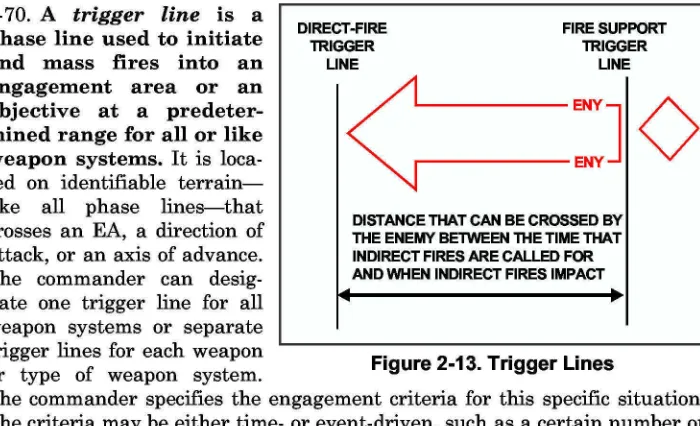
2-70. A trigger line is a
phase line used to initiate
and mass fires into an
engagement area or an
objective at a
predeter-mined range for all or like
weapon systems. It is
loca-ted on identifiable
terrain-like all phase lines-that
crosses an EA, a direction of
attack, or an axis of advance.
The commander can
desig-nate one trigger line for all
weapon systems or separate
trigger lines for each weapon
or type of weapon system.
The commander specifies the engagement criteria for this specific situation.
The criteria may be either time- or event-driven, such as a certain number or
certain types of vehicles to cross the trigger line before initiating engagement.
He may reserve to himself the authority to initiate engagement by firing his
own weapon or giving the command to fire.
2-71. The commander designates a PL as the trigger line for his fire support
systems. He bases the trigger line's location on the factors of METT-TC,
including such variables as the time of flight for artillery shells, positioning of the guns, and the existence of quick-fire links. Its location varies from
situa-tion to situasitua-tion. Its position reflects the distance that the enemy force is
Trigger Line
032
DIRECT-FIRE FIRE SUPPORT
TRIGGER TRIGGER
LINE LINE
<==:J
0
DISTANCE THAT CAN BE CROSSED BY THE ENEMY BETWEEN THE TIME THAT INDIRECT FIRES ARE CALLED FOR AND WHEN INDIRECT FIRES IMPACT
likely to traverse in the time it takes from when fires are requested to when artillery rounds impact. (See Figure 2-13.) This gives time for the fire support systems to respond to the initial call for fire. For example, in a desert
envi-ronment-a battalion task force commander's fire support trigger line is
ap-proximately four kilometers beyond the point where he wants to engage the
enemy with indirect fires when he has M109A6 howitzers in direct support. It
is approximately six kilometers when he has M109A3 howitzers in direct
sup-port. The shorter distance reflects the more rapid response capabilities of the
M109A6 compared to the M109A3, all other factors being equal.
2-72. The commander can establish another trigger line for his most accurate
long-range weapon system in the vicinity of the area where the fire support
impacts to capitalize on the asymmetric attack. However, dust and debris
resulting from the artillery fire may prevent his direct-fire systems from
engaging the enemy. He establishes other trigger lines and TRPs for
shorter-range systems. He may give guidance to extremely proficient crews to engage
the enemy at longer than normal ranges or give them different engagement
priorities than the rest of the force, such as giving priority to engaging air
de-fense or engineer-breaching systems. This could result in losing the effect
that the sudden application of massed fires has on an enemy.
2-73. When the enemy reaches these closer trigger lines, the commander
es-tablishes a decision point to help him determine if he wants his longer-range
systems to continue to fire in depth or to concentrate his fires on a single
point. Many factors impact his decision, most of which concern the enemy and how he maneuvers and the effects of the defending force's fires.
DEEP, CLOSE, AND REAR AREAS
2-74. There are times when the factors of METT-TC favor a spatial
organi-zation of the entire AO. Korea is an example of large numbers of enemy units
concentrated in numerous echelons on a contiguous front across the
penin-sula. The terrain and the capabilities and doctrine of allied units require the
use of a spatial organization. The commander conducts simultaneous
deci-sive, shaping, and sustaining operations within a context of deep, close, and
rear areas when this occurs. (See Figure 2-14.)
Deep Area
2-75. When designated, the deep area is an area forward of the close area
that commanders use to shape enemy forces before they are encountered or
engaged in the close area (FM 3-0). It extends from the subordinate's forward
boundary to the forward boundary of the controlling echelon. Thus, the deep
area relates to the close area not only in terms of geography but also in terms
of purpose and time. The extent of the deep area depends on how far out the
force can acquire information and strike targets. Commanders may place
forces or employ effects in the deep area to conduct shaping operations. Some
of these operations may involve close combat. However, most ground
maneu-ver forces stay in the close area.
2-76. New weapon systems and advanced information technology continue to
increase the capability of Army forces to engage enemy forces in depth. In the
Today, Army forces may engage enemy formations with precision fires at
substantial distances from the close area. This capability allows the
commander to employ greater depth and simultaneity of action than ever
before when conducting operations.
CORPS FORWARD BOUNDARY
xxx
CORPS LATERAL BOUNDARIES
CORPS DEEP AREA
DIVlSIQN FORWARD BOUNDARIES
BRIGADE SECURITY
AREAS
r
i
DIVISION LATERAL
---.
BOUNDARIES-
rl
x-L-x
X""'-II
~
DIVISION RESERVE DIVISIONREARAREAXX
FEBA
CORPS CLOSE AREA
CORPS REARBOUNDARY
t
CORPS REA:X AREAFigure 2-14.Deep, Close, and Rear Areas
Close Area
2-77. When designated, the close area is where forces are in immediate
con-tact with the enemy and the fighting between the committed forces and
readily available tactical reserves of both combatants is occurring, or where
commanders envision close combat taking place. Typically, the close area
assigned to a maneuver force extends from its subordinates' rear boundaries
to its own forward boundary (FM 3-0). Typically, the close area is where the
majority of close combat occurs. It also includes the activities of forces directly
supporting the fighting elements, such as direct support field artillery and
logistics elements. The close area is historically the only location where the
commander could conduct his decisive operation. One unit may conduct the
decisive operation, while another conducts shaping operations within a close
area. Division commanders whose AOs constitute the corps close area have
the option of designating their own deep, close, and rear areas. Figure 2-14
illustrates this option.
Rear Area
2-78. Unlike close and deep areas, a rear area can be designated by the